Although dialysis patients have increased risk for Clostridium difficile infection (CDI),Reference Keddis, Khanna, Noheria, Baddour, Pardi and Qian 1 , Reference Eddi, Malik, Shakov, Baddoura, Chandran and Debari 2 outbreaks within outpatient hemodialysis facilities have not been described previously. We describe the first reported CDI outbreak at an outpatient hemodialysis facility and subsequent investigations to assess potential intrafacility transmission and to evaluate risk factors for CDI.
METHODS
In this study, we reviewed CDI cases that occurred between October 2012 and March 2013 in a hemodialysis facility. A CDI case was defined as an incident diarrheal illness (self-reported or observed loose stool) associated with a positive C. difficile test (Xpert C. difficile, Cepheid). A subsequent CDI episode was defined as diarrheal illness associated with a positive C. difficile test occurring after ≥2 weeks. Cases were identified from dialysis facility, local nursing home, and hospital records.
Cases with outpatient onset of diarrhea or onset before day 4 of a hospitalization were considered community onset. Community-onset cases with an overnight hospital stay within 12 weeks prior to CDI were classified as hospital associated; others were community associated.
Patients dialyzed at the facility during October 2012–March 2013 were included in a cohort study. Potential risk factors for incident CDI were assessed through patient interview and chart review.
To screen for C. difficile carriage or undetected infection among patients not reporting diarrheal symptoms, stool samples from patients not receiving treatment for CDI were tested using a polymerase chain reaction (PCR) assay (Xpert C. difficile). Of 29 eligible patients, 25 were screened. Specimens testing positive were cultured for C. difficile. Recovered isolates underwent pulsed-field gel electrophoresis (PFGE). Facility staff were asked to report symptoms of diarrheal illness but did not undergo laboratory screening.
Environmental samples from frequently touched surfaces within the facility and from the hands of healthcare personnel were obtained and cultured for C. difficile. The dialysis facility’s infection control practices were observed, including hand hygiene, personal protective equipment use, and environmental disinfection practices.
Statistical analysis was performed with SAS, version 9.3 (Cary, NC). Categorical variables were compared using χ2 or Fisher’s exact test. Continuous variables were compared using a Wilcoxon rank-sum test. P values ≤0.05 were considered significant.
RESULTS
Between October 2012 and March 2013, 37 outpatients were dialyzed at the facility, a hospital-based outpatient hemodialysis clinic. No hospital inpatients were dialyzed at the hemodialysis clinic. A total of 6 patients developed incident CDI; 5 (83%) also developed a subsequent CDI episode. All cases were community onset; 3 were hospital associated, from the same hospital. The 3 community-associated CDI patients had not received antibiotics within 12 weeks before illness onset and had no common healthcare exposures other than hemodialysis.
One facility staff member with recent prior antibiotic exposure developed laboratory-confirmed CDI after caring for the first symptomatic CDI patient. This staff member’s only healthcare exposures within the 12 weeks prior consisted of outpatient clinic visits and antibiotic exposure. No clear epidemiologic links were found between this staff member and subsequent cases.
Additionally, 2 patients who initially denied having diarrhea screened positive for C. difficile and were considered CDI cases based on the consistency of stool collected for screening. Therefore, 8 of 37 patients at the facility developed CDI (attack rate: 22%).
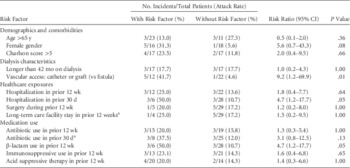
Antibiotics were received by 44.1% of patients in the cohort; 35.1% had been hospitalized within the prior 12 weeks. Hospitalization within the prior 30 days (P=.05) and nonfistula dialysis access (ie, arteriovenous graft or hemodialysis catheter) (P=.01) were significant risk factors for CDI in univariate analysis (Table 1). Prior antibiotic use overall was not a significant risk factor for CDI, but use of β-lactam agents was (P=.05). All CDI patients receiving β-lactam agents had a nonfistula access and had been diagnosed with sepsis within the prior 4 weeks.
Potential Risk Factors for Incident Clostridium difficile Infection (CDI) among Patients of the Hemodialysis Facility

Note. 1 patient who developed CDI before initiation of hemodialysis, and 2 patients with unknown onset dates of CDI were excluded from the hemodialysis cohort.
CI, confidence interval.
a Data not available for 1 non-CDI patient.
Clostridium difficile isolates were recovered from 6 CDI patients: 1 hospital associated, 3 community associated, and 2 with positive screens. In the isolate from the hospital-associated case, the PFGE pattern was indistinguishable from that of a community-associated case that occurred 1 week later (both North American Pulse Field type 4). These 2 patients did not have the same dialysis schedule or station. However, they both received dialysis at the facility throughout the 12 weeks prior to the later case’s illness onset. The PFGE types of the other 4 isolates were unrelated to each other. No isolate from the affected staff member was available for analysis. C. difficile was not recovered from environmental (n=39) or hand (n=10) samples.
In accordance with infection control guidelines for hemodialysis facilities, staff were required to wear gloves during patient contact. 3 , 4 Prior to this outbreak, the facility was using a 1:100 dilution of chlorine bleach for routine environmental surface disinfection after dialysis sessions. Initial response measures included designating 3 dialysis stations as CDI contact isolation stations for all CDI patients. Staff were required to don a dedicated disposable gown and gloves while caring for a patient in contact isolation and to wash hands with soap and water afterward. In addition, all stations were disinfected only after becoming unoccupied. A 1:10 dilution of bleach was used to disinfect environmental surfaces in stations after treatment of CDI patients.
During infection prevention practice audits, hand hygiene was performed during 127 (89%) of 143 opportunities. The wet contact time of bleach was often less than manufacturer’s recommendations. Additionally, patients without CDI were dialyzed at contact isolation stations on some occasions.
The facility instituted additional control measures after these audits, including heightened diligence to ensure adequate wet contact time of bleach on surfaces. Contact isolation stations were dedicated exclusively for CDI patients, and patients were maintained in contact isolation until 2 weeks after completion of CDI antibiotic treatment. As of June 2013, no new CDI cases had occurred.
DISCUSSION
We have described an outbreak of CDI within a hemodialysis facility with high attack rate and recurrence rate. Many affected patients lacked classic risk factors (ie, half had neither prior recent hospitalization nor recent antibiotic use). Available epidemiologic and laboratory data suggest likely intrafacility transmission of C. difficile to at least 1 patient, despite observed hand hygiene adherence of nearly 90%. Transmission to the healthcare worker at the facility also may have occurred given the temporal association. The 2 patients with indistinguishable C. difficile isolates (by PFGE) lacked direct overlap with one another in space and time, suggesting indirect transmission between these 2 patients.
The shared patient environment and lack of physical barriers between stations in outpatient dialysis facilities might facilitate transmission of C. difficile. Infection control recommendations for hemodialysis clinics lack specific recommendations for C. difficile, but contain suggestions that could be relevant for CDI (eg, wear a dedicated gown when caring for patients with uncontrolled diarrhea). 4 The facility’s response to this outbreak extended beyond these recommendations: certain dialysis stations were dedicated for CDI patients and the duration of contact isolation was extended.
We found that the presence of an arteriovenous fistula was protective. Although nonfistula access types could be a marker for underlying patient comorbidity, fistula patients might actually have lower risk of CDI. National efforts to reduce access-related infections in dialysis patients 5 , 6 might have secondary benefits in terms of reduced antibiotic exposure, hospitalizations, and CDI risk.
Unlike a prior study,Reference Sheth, Bernadini and Burr 7 the Charlson index was not associated with CDI in this study, and serum albumin levels were not available for evaluation. Other known CDI risk factors were common: nearly half of the patients had recently used antibiotics, and approximately one-third had recently been hospitalized. Although antibiotic use in general was not a significant risk factor, use of β-lactam agents was.
Limitations with this investigation include the relatively small number of cases, reliability of patient self-reports, and availability of C. difficile isolates. Finally, increased attention to environmental cleaning prior to sample collection may have limited recovery of C. difficile from environmental samples.
In summary, CDI transmission within an outpatient dialysis facility can occur. Outpatient dialysis facilities should routinely adhere to practices that reduce the burden and risk of environmental contamination 3 – 4 , Reference Rutala and Weber 8 and CDI prevention should be considered when developing an infection control plan.
Acknowledgments
The authors would like to thank Jim Collins (Michigan Department of Community Health) for input during discussions of the outbreak and Paula Polso (Portage Health) for assistance with response to the outbreak.
Financial support: This work was supported by the Centers for Disease Control and Prevention.
Potential conflicts of interest: All authors report no conflicts of interest relevant to this article.