Implications
Selection for litter size at weaning has successfully increased the reproductive performance of female rabbits, but the question arises as to whether this has altered resource allocation to other traits. When the environment provides sufficient resources, selection can improve individual traits without penalties in other traits, that is, without changing resource allocation. However, farms are frequently subjected to occasional challenges (feed quality, heat stress, pathogens, etc.), and when resources become limited, a preferential allocation of resources to selected traits (growth, reproduction, etc.) is expected, reducing the ability of animals to respond to other demands (such as coping with disease, stress, etc.). Therefore, a better understanding of the effect of selection to increase litter size at weaning on resource allocation strategies under challenging conditions could help to maintain an adequate productive level of rabbit farms in the long term.
Introduction
Maximum profitability in maternal rabbit lines is achieved when a female rabbit has high reproductive longevity and high litter size. This basic concept of maximum fitness is frequently applied in rabbit selection programmes, which mainly concentrate their efforts on increasing litter size with no special focus on longevity (Estany et al., Reference Estany, Baselga, Blasco and Camacho1989; García and Baselga, Reference García and Baselga2002; Piles et al., Reference Piles, García, Rafel, Ramon and Baselga2006a). Attention to studying longevity is recent (Garreau et al., Reference Garreau, Larzul and Ducrocq2001; Sánchez et al., Reference Sánchez, Baselga and Ducrocq2006; Piles et al., Reference Piles, Garreau, Rafel, Larzul, Ramon and Ducrocq2006b), arising from the high replacement rates observed in commercial farms (Ramon et al., Reference Ramon, Rafel and Piles2004).
Some authors (Sánchez et al., Reference Sánchez, Baselga and Ducrocq2006; Theilgaard et al., Reference Theilgaard, Sánchez, Pascual, Friggens and Baselga2006; Piles et al., Reference Piles, Garreau, Rafel, Larzul, Ramon and Ducrocq2006b) found no evidence of antagonism between selection to increase litter size at weaning and lifespan, in relatively abundant conditions. However, it has been suggested that selection for litter size could increase the reproductive sensitivity when environmental conditions limit the availability of resources (Theilgaard et al., Reference Theilgaard, Sánchez, Pascual, Berg, Friggens and Baselga2007). In fact, reproduction is enhanced during spring and early summer under natural conditions, which means that the rabbits reproduce with high grassland quality and comfortable temperatures, but when the conditions are not suitable reproduction declines. Domestic breeds are also predisposed to express their genetic potential under adequate environmental conditions, reducing their reproductive performance when exposed to high temperature or low-energy diets (Fernández-Carmona et al., Reference Fernández-Carmona, Cervera, Sabater and Blas1995 and Reference Fernández-Carmona, Alqedra, Cervera, Moya and Pascual2003), which could lead to higher culling rates.
However, it may be that different physiological responses are induced, depending on the nature of the environmental constraint. For example, low-energy diets usually lead to a restriction in nutrient supply, whereas high temperatures would mainly bring about a constriction of metabolic rate (and thereby a negative feedback on intake) (Cervera and Fernández-Carmona, Reference Cervera and Fernández-Carmona2010). In addition, the challenge length may also be considered, as during the normal selection process these animals have been faced with short-term challenges (such as the seasonal hot period; Baselga, Reference Baselga2004). There is evidence that when selection to increase a trait is carried out under adequate environmental conditions, the environmental sensitivity could also increase (Falconer, Reference Falconer1990).
The present work aimed to add knowledge on how long-term selection for reproduction could have affected the time-course sensitivity of female rabbits to different environmental challenges. For this task, we compared the reproductive and physiological responses of female rabbits from the same line, but differing by 20 generations of selection to increase litter size at weaning, when subjected to three different environmental conditions (normal, heat and nutritional challenge) during two reproductive cycles.
Material and methods
The experimental procedures were approved by the Universitat Politècnica de València ethic committee on protection and use of animals for experimentation and other scientific purposes, as set forth by Royal Decree 1201/2005 (BOE, 2005).
Animals
Female rabbits belonging to a line constituted from four specialised maternal lines and then selected to increase litter size at weaning (line V; Estany et al., Reference Estany, Baselga, Blasco and Camacho1989) over 16 or 36 generations, hereinafter referred as V16 and V36, were compared simultaneously. Line V has a population size of around 120 female rabbits and 25 bucks and because the selection programme has no control population, a representative sample of each generation (each male contributing with two straws) has been cryopreserved as embryos, from which generation 16 was reconstituted. The parents of V16 female rabbits used in this study, stored as frozen embryos, were thawed and transferred to female rabbits of another line, also selected for litter size at weaning. After one generation without selection, to avoid the environmental maternal effect, 72 adult V16 female rabbits were obtained to be simultaneously compared with 79 female rabbits of generation 36. Detailed information concerning the cryopreservation and embryo transfer techniques used in this study are available in Vicente and García-Ximénez (Reference Vicente and García-Ximénez1993 and Reference Vicente and García-Ximénez1996).
Environments
Three environmental conditions were set up, differing in the room temperature and/or the diet provided. The normal environment (NC) was achieved by combining housing at normal room temperature (N: traditional building equipped only with a cooling system, registering a daily temperature variation from 18°C to 24°C) with a control diet (C) similar to commercial diets formulated to cover the requirements of reproductive rabbit does (11.6 MJ digestible energy (DE)/kg dry matter (DM), 126 g digestible protein (DP)/kg DM and 168 g ADF/kg DM). The heat environment (HC) was created by the combination of a high temperature room (H: climatic chamber set to achieve a daily sinusoidal temperature variation from 25°C to 35°C) with diet C. Detailed information on the design and operating system of climatic chamber can be found in a study by García-Diego et al. (Reference García-Diego, Pascual and Marco-Jiménez2011). Finally, an environmental restriction because of feed quality (NF) was produced by combining N housing with a low-energy fibrous diet (F: 9.1 MJ DE/kg DM, 104 g DP/kg DM and 266 g ADF/kg DM), following recommendations for lactating rabbit does (Nicodemus et al., Reference Nicodemus, Redondo, Pérez-Alba, Carabaño, De Blas and García2010). Ingredients and chemical composition of the experimental diets are available online as a Supplementary Material (Supplementary Table S1) and the apparent digestible coefficients for each generation and environment are given by Savietto et al. (Reference Savietto, Blas, Cervera, Baselga, Friggens, Larsen and Pascual2012), from a sample of animals used in the present study. As a reference, the calculated DE content of diets in N housing was 11.7 MJ DE/kg DM for diet C and 9.1 MJ DE/kg DM for diet F. In H housing, the DE content of diet C was 12.5 MJ DE/kg DM. These values were used to calculate the DE intake of female rabbits.
Experimental procedure
Young female rabbits were reared following the management scheme proposed by Ragab and Baselga (Reference Ragab and Baselga2011) from birth to 63 days of age, and then transferred to the experimental farm. From 63 days to 1st parturition, animals were fed with a commercial diet (CP=15.3 g/kg DM, ether extract=2.5 g/kg DM, and crude fibre=23.1 g/kg DM) supplied ad libitum and daily exposed to 16 h of light. Female rabbits were first artificially inseminated at 125 days of age, reaching the 1st parturition with an average live weight (LW) of 3583±240 g (mean±s.d.). At 1st parturition, female rabbits from both generations (V16 and V36) were randomly assigned to one of the three environments (HC, NC, NF) in a 2×3 factorial design. The number of animals differed owing to the availability of young female rabbits from the selection nucleus (V16HC=31, V16NC=22, V16NF=19, V36HC=29, V36NC=25 and V36NF=25). During the experimental period, which lasted until 3rd parturition, female rabbits followed a programmed reproductive interval of 42 days, with insemination at 11 days post-parturition (dpp). Non-pregnant female rabbits were re-inseminated 21 days later and so on, up to a maximum of three consecutive failures, whereupon they were culled because of infertility. The total number of kits born (TB) and kits born alive (BA) was recorded at each parturition. Litter size was standardised at birth to nine kits in the 1st lactation and 10 in the 2nd. Subsequently, dead kits were not replaced. The number of weaned kits was recorded at 28 dpp.
In both lactations, the female rabbit’s LW was measured at 0, 7, 14, 21 and 28 dpp, and perirenal fat thickness (PFT) at 0, 14 and 28 dpp, using the ultrasound method described by Pascual et al. (Reference Pascual, Blanco, Piquer, Quevedo and Cervera2004). Dry matter intake was monitored weekly during both lactations and during the weaning to parturition intervals. Milk yield was measured 4 days per week during 4 weeks. In the first 3 weeks, female rabbits were weighed before having access to the nest box and just after nursing their kits (i.e. weigh–suckle–weigh method). At week four, the kits were too big to be confined to the nest space. The female rabbits were then placed in new cages, being transferred once per day to nurse their kits. Owing to a limited number of cages in the climatic chamber (HC environment) this practice was not possible; hence, female rabbits and their kits shared a common space, making it impossible to measure milk yield. Thus, no milk yield was available at week 4 at HC, and the DM intake corresponded to the joint female–litter consumption.
Blood plasma parameters
Blood samples were collected from the central artery of the ear using tubes with EDTA after a minimum fasting period of 3 h at 0, 14 and 28 dpp. Samples were immediately centrifuged (3000×g for 10 min at 4°C) and plasma was separated and frozen at −40°C until further analysis. Samples from 12 female rabbits per group (2 generations×3 environments) with complete records were analysed for total T3, leptin, non-esterified fatty acids (NEFA), β OH-butyrate (BHB), glucose and lactate. Total T3 was analysed using the Beckman Coulter ‘Total T3 RIA KIT’ (IM1699-IM3287) (Immunotech AS, Prague, Czech Republic), according to the manufacturer’s guidelines. The intra-assay coefficient of variance (CV) was 7.1% and the inter-assay CV was 7.5%. Leptin was analysed by Multi-species Leptin assays (RIA, XL-85K) (Millipore Corporation, Billerica, MA, USA), following the manufacturer’s guidelines. Intra- and inter-assay CVs were 9.1% and 9.3%, respectively. NEFAs were determined using the NEFA C ACS-ACOD assay method (Wako Chemicals GmbH, Neuss, Germany). BHB was determined as an increase in absorbance at 340 nm owing to the production of NADH, at slightly alkaline pH in the presence of BHB dehydrogenase. Sample blanks were included and the method involved oxamic acid in the media to inhibit lactate dehydrogenase, as proposed by Harano et al. (Reference Harano, Ohtsuki, Ida, Kojima, Harada, Okanishi, Kashiwagi, Ochi, Uno and Shigeta1985). Glucose and lactate were determined according to standard procedures (Siemens Diagnostics® Clinical Methods for ADVIA 1650). Analyses of NEFA, BHB, glucose and lactate were performed using an auto-analyser, ADVIA 1650® Chemistry System (Siemens Medical Solutions, Tarrytown, NY, USA); the intra-assay CV in all instances was below 2%, whereas the inter-assay CV was below 4%.
Statistical analysis
A mixed model (SAS Institute Inc., Cary, NC, USA), with a repeated measure design, was used to analyse performance, hormonal and metabolic data of rabbit does until 3rd parturition. The model considered the variation between animals and the co-variation within them. The covariance structure was estimated using the spatial power function, after objectively comparing among other covariance structures as suggested by Littell et al. (Reference Littell, Henry and Ammerman1998). The spatial power function is a direct generalisation of first-order auto-regressive covariance function for equally time-spaced data, with the advantage of accounting for different lag times between two measurements. The model used to analyse reproductive performance (Table 1) included the generation (16 and 36), environment (NC, HC and NF), parturition (1st, 2nd and 3rd) and their interactions. The model used to analyse other performance traits (Table 2) and blood plasma parameters (Table 3) included the generation, environment, reproductive cycle (two levels: 1st (all measures between 1st and 2nd parturition; only 2nd parturition included) and 2nd (all measures between 2nd and 3rd parturition; only 3rd parturition included) and their interactions. This model also included measurement day (different depending on the variable studied; see experimental procedure) and its interactions with generation and environment as fixed effects. Finally, differences in the evolution of DM and DE intake, milk yield and PFT with time within lactation (Figures 1 to 3) were analysed considering the generation, environment, lactation week and their interactions. All models included the random effect of animal [p~N (0, σ p 2)]. The models for intake and milk yield included the average litter size during lactation as a covariate. Plasma concentrations of total T3, leptin, NEFA, BHB and lactate did not follow a normal distribution; hence, log10 transformation was applied before analysis. Variables were presented as least square means followed by their standard errors, and different contrasts were computed to test the effect of: the environmental challenge [HC−NC: (V16HC+V36HC)/2−(V16NC+V36NC)/2 and NF−NC: (V16NF+V36NF)/2−(V16NC+V36NC)/2], and of the selection for litter size at weaning [V16−V36: [(V16HC+V16NC+V16NF)/3−(V36HC+V36NC+V36NF)/3] in each reproductive cycle.
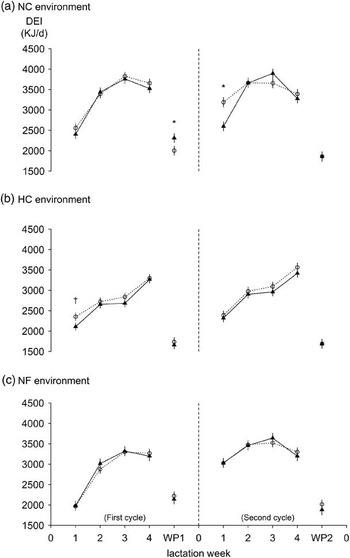
Digestible energy intake (DEI) of V16 (▲) and V36 (○) female rabbits in: (a) normal (NC: normal room temperature (18°C to 24°C) and diet C (11.6 MJ DE/kg DM)), (b) heat (HC: high room temperature (25°C to 35°C) and diet C), and (c) nutritional (NF: normal room temperature and diet F (9.1 MJ DE/kg DM)) challenging conditions. Bars represent the standard errors of least square means. WP is the weaning to parturition interval. *P<0.05 and † P<0.10.

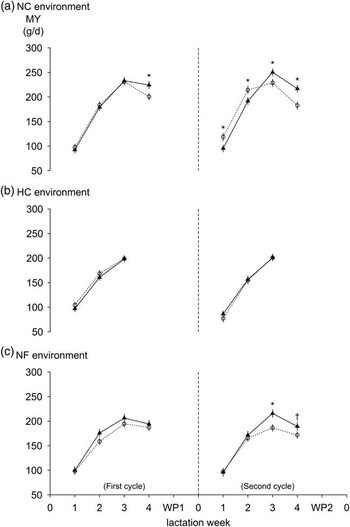
Milk yield (MY) of V16 (▲) and V36 (○) female rabbits in: (a) normal (NC: normal room temperature (18°C to 24°C) and diet C (11.6 MJ DE/kg DM)), (b) heat (HC: high room temperature (25°C to 35°C) and diet C), and (c) nutritional (NF: normal room temperature and diet F (9.1 MJ DE/kg DM)) challenging conditions. Bars represent the standard errors of least square means. WP is the weaning to parturition interval. *P<0.05 and † P<0.10.

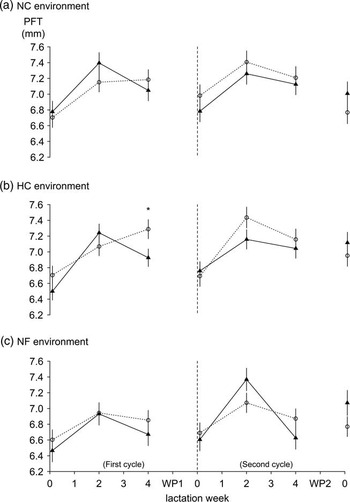
Perirenal fat thickness (PFT) of V16 (▲) and V36 (○) female rabbits in: (a) normal (NC: normal room temperature (18°C to 24°C) and diet C (11.6 MJ DE/kg DM)), (b) heat (HC: high room temperature (25°C to 35°C) and diet C), and (c) nutritional (NF: normal room temperature and diet F (9.1 MJ DE/kg DM)) challenging conditions. Bars represent the standard errors of least square means. WP is the weaning to parturition interval. *P<0.05 and † P<0.10.

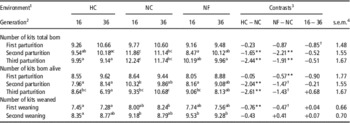
The effect of environment and generation of selection for litter size at weaning on reproductive performance of females rabbit at first, second and third parturition

1 Environment: HC: high room temperature (25°C to 35°C) and diet C (11.6 MJ DE/kg DM), NC: normal room temperature (18°C to 24°C) and diet C, and NF: normal room temperature and diet F (9.1 MJ DE/kg DM).
2 Generations of selection to increase litter size at weaning.
3 Mean differences estimated by contrasts of main effects: **P<0.01 and † P<0.10.
4 s.e.m: pooled standard error of means.
a–cValues within a row with different superscripts differ significantly at P<0.05.
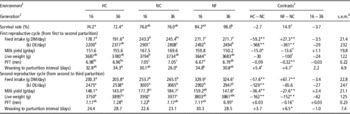
The effect of environment and generation of selection for litter size at weaning on average dry matter (DM) and digestible energy (DE) intake, milk yield, live weight, perirenal fat thickness (PFT), and weaning to parturition interval of rabbit does at first and second reproductive cycles. Survival rate of female rabbits is also presented

1 Environment: HC: high room temperature (25°C to 35°C) and diet C (11.6 MJ DE/kg DM); NC: normal room temperature (18°C to 24°C) and diet C; and NF: normal room temperature and diet F (9.1 MJ DE/kg DM).
2 Generations of selection to increase litter size at weaning.
3 Mean differences estimated by contrasts of main effects: **P<0.01, *P<0.05, and † P<0.10.
4 s.e.m: pooled standard error of means.
a–cValues within a row with different superscripts differ significantly at P<0.05.
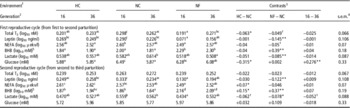
The effect of environment and generation of selection for litter size at weaning on plasma concentrations of total T3, leptin, non-esterified fatty acids (NEFA), β OH-butyrate (BHB), lactate and glucose of rabbit does during first and second reproductive cycle

1 Environment: HC: high room temperature (25°C to 35°C) and diet C (11.6 MJ DE/kg DM), NC: normal room temperature (18°C to 24°C) and diet C, and NF: normal room temperature and diet F (9.1 MJ DE/kg DM).
2 Generations of selection to increase litter size at weaning.
3 Mean differences estimated by contrasts of main effects: **P<0.01, *P<0.05 and † P<0.10.
4 s.e.m: pooled standard error of means.
5 To back transform data of BHB apply ((10 x −5)/1000), where x is the tabulated BHB value.
a−dValues within a row with different superscripts differ significantly at P<0.05.
Results
From the 151 female rabbits with whom the experiment was started, 120 reached the 3rd parturition. In HC, 16 female rabbits (eight from each generation) did not finish, with death around parturition being the main failure reason. Under N room temperature, 11 female rabbits receiving diet C (five from V16 and six from V36) and four in diet F (three from V16 and one from V36) did not reach the 3rd parturition.
Performance traits
The average TB and BA per parturition are shown in Table 1. At 1st parturition, just before random allocation of female rabbits to the different environments, higher numbers of TB (+0.85±0.49 kits; P=0.09) and BA (+0.90±0.60; P=0.13) were observed for V36 litters compared with V16. Subsequently, the HC or NF environment led to an average reduction in TB (−2.03±0.49 and −2.01±0.51, respectively; P<0.05) and BA (−2.31±0.60 and −1.48±0.61, respectively; P<0.05), compared with NC.
Compared with NC, the HC environment caused a greater litter size reduction in V16 (−2.33±0.85 TB and −2.35±1.02 BA; P<0.05) than in V36 (−0.96±0.91 TB and −1.72±1.09 BA) at 2nd parturition. However, V36 litters were more affected (−4.49±1.13 BA; P<0.05) than V16 (−0.72±1.16 BA) at 3rd parturition. Similarly, the NF environment led to a greater litter size reduction in V16 (−3.39±0.94 TB and −2.16±1.12 BA; P<0.05) than in V36 (−1.03±0.89 TB and −0.77±1.04 BA) at 2nd parturition, and V36 litters were more affected (−2.56±1.10 BA; P<0.05) than V16 (−0.29±1.25 BA) at the 3rd. Litter size at weaning is also shown in Table 1, and no differences were observed between generation 16 and 36 in the HC, NC and NF environments, with the exception of first weaning where female rabbits of both generations in HC weaned fewer kits with respect to NC and NF.
The effect of environment and generation on average productive traits of female rabbits during 1st and 2nd lactation is presented in Table 2. Female rabbits in HC had lower intake (on average −18.5% of DM and −14% of DE; P<0.05) than those in NC, leading to lower milk yield (−9 and −20% in 1st and 2nd lactation, respectively; P<0.05) and a lower average LW in 2nd lactation (−4%; P<0.05). During 1st lactation, although female rabbits in NF had slightly higher DM intake (+12%; P<0.01) than those in NC, this did not allow DE intake compensation (−12%; P<0.01), and the average milk yield (−8%; P=0.10) and PFT were also lower (−5%; P<0.01). However, digestible energy intake compensation in NF did (approximately) occur in 2nd lactation, and although milk yield (−15%; P<0.05) and LW (−4%; P<0.05) were even more affected (compared with NC) than in 1st lactation, PFT differences (−2%; P<0.10) were lower than those observed in the 1st lactation.
Selection to increase litter size at weaning during 20 generations did not significantly affect the average productive traits, but the time course of these traits was different for each generation depending on the environment (Figures 1 to 3). In the NC environment, V36 female rabbits had lower DE intake during the 1st weaning to parturition interval (−311.5±155.4 kJ/day; P<0.05) but higher during the 1st week of the 2nd lactation (+591.7±157.4 kJ/day; P<0.05) than V16 (Figure 1). These differences between generations disappeared when they were subjected to the HC and NF environments.
When in NC, V36 female rabbits had higher milk yield in the 1st half of the 2nd lactation (+22.9 g/day; P<0.05) and lower milk yield at the end of both lactations (on average −26.4 g/day in week 4; P<0.05), compared with V16 does. This higher initial milk yield of V36 does was not observed in the HC or NF environments, owing to a higher milk yield reduction for V36 (on average −50.5 and −35.1 g/day at HC and NF, respectively) than for V16 (−22.1 and −10.4 g/day) under these constrained conditions. Milk yield of V16 female rabbits was higher than that observed for V36 during the last 2 weeks of the 2nd lactation in NF (+23.4 g/day; P<0.05).
In general, the evolution of PFT during lactation had an accretion phase until 14 dpp and a mobilisation phase from this point to weaning (Figure 3). In NC, both V16 and V36 female rabbits had increased PFT (on average +0.533±0.139 mm; P<0.05) in the first part of the 1st lactation. In the 2nd part of lactation, V16 mobilised PFT (−0.348±0.160 mm; P<0.05) but V36 did not (−0.032±0.152 mm), resulting in similar PFT between V16 and V36 female rabbits at weaning. No generational differences were observed in 2nd lactation. However, whereas V36 significantly reduced their PFT (−0.444±0.164 mm; P<0.05) from 2nd weaning to 3rd parturition, V16 did not (−0.117±0.166 mm): a result not influenced by the weaning to parturition interval (V16NC=22.6 days and V36NC=23.1 days). During 1st lactation on HC, V36 female rabbits showed a cumulative PFT accretion of +0.584±0.158 mm in late lactation, which resulted in higher PFT values at weaning (+0.363±0.166 mm) compared with V16. Subsequently, V16 and V36 female rabbits had respectively low (−0.167±0.133; P=0.21) and high (−0.596±0.148 mm; P<0.05) PFT mobilisations in the 1st weaning to parturition interval (V16HC=32.8 days and V36HC=34.3 days). When housed in NF, V16 mobilised in late 2nd lactation (−0.742±0.172 mm; P<0.05) the PFT accreted during early lactation (+0.763±0.152 mm; P<0.05), but no significant mobilisation was observed for V36 female rabbits in this period (−0.200±0.150 mm).
Blood plasma parameters
At 1st parturition, before random allocation of female rabbits to treatments, plasma concentrations of leptin (1.74 ng/ml), NEFA (506.4 µ ekv/l), BHB (0.268 mM), glucose (6.76 mM) and lactate (4.70 mM) were similar in both generations, whereas total T3 was slightly lower for V16 than V36 (1.67 and 1.97 nM, respectively; P<0.10). Blood plasma parameters in the 1st and 2nd reproductive cycle are in Table 3. In NC, V16 had a higher plasma concentration of glucose (+11%; P<0.05) during the 1st reproductive cycle and higher BHB (+13%; P<0.05) during the 2nd cycle than V36. However, when housed in NF, V36 had a higher total T3 level (+42%; P<0.05) during the 1st reproductive cycle than V16. During the 1st reproductive cycle, and always compared with NC, V16 female rabbits showed significantly lower total T3 (−33%) and glucose levels (−9%) in HC, and lower total T3 (−36%), leptin (−76%), NEFA (−4%) and higher BHB (+14%) levels in NF. During the 2nd reproductive cycle, V16 female rabbits in NF also had significantly lower leptin (−61%) and NEFA (−3%) levels, but higher BHB (+16%) and lactate (+22%), compared with NC. Housing V36 female rabbits in HC resulted in significantly higher NEFA (+4%) and BHB (+18%) levels during the 2nd reproductive cycle compared with NC, whereas V36 in NF had a reduced lactate (−17%) in the 1st cycle and higher BHB (+27%) level in both reproductive cycles.
Discussion
The main aim of this study was to investigate the effect of long-term selection to increase litter size at weaning (i.e. a reproductive trait) on the female rabbit’s capacity to adapt to environmental challenges. The generational increment owing to selection for litter size at weaning in both TB and BA reported at 1st parturition was +0.045 kits. Despite the differences in the litter size at birth between the present study and that reported by García and Baselga (Reference García and Baselga2002) for the same line (+0.10 kits TB and 0.095 kits BA), both studies reflected the different genetic potentials of V16 and V36 female rabbits.
The environmental challenges were intentionally chosen to affect reproductive performance using different physiological constraints. The high temperature environment was intended to create a constrained environment by limiting the heat loss capacity, whereas the use of a low energy diet limited the energy intake. As a result, overall DE intake reductions of 418 kJ/day and 210 kJ/day were respectively caused by HC and NF environments, compared with NC. Therefore, the planned environmental constraints were sufficient to reduce reproductive performance of rabbit does (Table 1) without noticeably impairing the health status of female rabbits (Table 2).
In general, the results suggest that selection to increase litter size at weaning had changed the way in which the female rabbits interact with environment. To aid interpretation, it should be noted that litter traits at 1st parturition represent differences purely because of genetic selection, as animals were allocated to different environments just after the 1st parturition, whereas differences in the 2nd and 3rd parturition reflect the effect of genotype×environment interaction. Observed performance differences after the 1st parturition were the result of differences in adaptative capacity of V16 and V36 female rabbits to the different environmental constraints, with results in the 1st lactation indicating the effect of the constraint being applied in lactation only, whereas during the 2nd reproductive cycle the effects were the result of the constraint being applied both in that lactation and the preceding gestation. As no differences between V16 and V36 within environments were found in the percentage of female rabbits completing the 1st and 2nd cycle nor in the LW at the end of 1st lactation, results concerning the 2nd lactation and the 3rd parturition can be interpreted as the response of selection to a long-term environmental constraint.
Effect of selection for reproduction (NC)
Twenty generations of selection for litter size at weaning changed the way in which female rabbits manage the available resources. Selection to increase litter size at weaning was achieved by improving the BA, without impairing kit survival during lactation. The higher DE intake and milk yield observed for V36 in the first part of 2nd lactation, a pattern also described by Quevedo et al. (Reference Quevedo, Cervera, Blas, Baselga and Pascual2006) in adult crossbred female rabbits from more advanced generations of selection (for increased litter size at weaning) supports the hypothesis that higher litter size at weaning was also achieved by a reduction in post-natal kit mortality. In this context, Coureaud et al. (Reference Coureaud, Fortun-Lamothe, Langlois and Schaal2007) observed no mortality during the 1st week in kits that ingested at least 7 g of milk on the first 24h. However, there were important differences in lactational performance between the generations. Whereas V16 female rabbits had higher milk yield in late lactation and used their PFT accumulated during the early lactation, it was observed that V36 female rabbits reduced milk yield, without reducing DE intake, to maintain their PFT reserves. Consequently, V36 female rabbits had a lower DE intake after 1st weaning, although they had a greater reproductive performance at 2nd parturition. The greater milk yield of V36 than V16 female rabbits in early lactation may be a response to a change in the relative priorities between the current and future litter, as proposed by Friggens (Reference Friggens2003). Therefore, selection for litter size at weaning induced a change in resource allocation (i.e. reduction of milk yield, preserving PFT with a higher DE intake in late lactation) to properly balance resources between current and future litters, and thereby enhancing the female rabbit’s fitness.
Response to heat stress restriction (HC)
The drop in feed intake at high temperatures (i.e. sows: Quiniou et al., Reference Quiniou, Renaudeau, Dubois and Noblet2000; ruminants: Morand-Fehr and Doreau, Reference Morand-Fehr and Doreau2001; rabbits: Fernández-Carmona et al., Reference Fernández-Carmona, Alqedra, Cervera, Moya and Pascual2003) is a well-known physiological adaptation to prevent an increment in body core temperature above the normal state, and can be considered a metabolic restriction. Female rabbits of generation 16 had a quicker response to heat challenge than V36. They reduced both the DE intake and the plasma concentrations of glucose and total T3 (both positively correlated with energy intake; Dauncey, Reference Dauncey1990; Rommers et al., Reference Rommers, Boiti, Brecchia, Meijerhof, Noordhuizen, Decuypere and Kemp2004; Brecchia et al., Reference Brecchia, Bonanno, Galeati, Federici, Maranesi, Gobbetti, Zerani and Boiti2006), in the 1st reproductive cycle, with respect to NC female rabbits. In contrast, in the 1st reproductive cycle, V36 female rabbits did not reduce glucose and total T3 concentrations, and maintained a higher PFT at weaning. This different adaptation between V16 and V36 female rabbits to the HC environment could be associated with their different reproductive performances at 2nd parturition, where V16 female rabbits had higher reduction in TB and BA than V36 rabbits. These results suggest that female rabbits coming from more recent generations of selection for reproduction conserved, in the short term, their reproductive effort after being exposed to high temperatures.
The negative effect of HC environment on V16 female rabbits in the 2nd lactation was similar to that observed in the previous one. However, symptoms of exhaustion from prolonged heat exposure appeared in the V36 female rabbits; the reduction in DE intake and milk yield in early lactation and the high levels of plasma NEFA and BHB of V36 female rabbits owing to HC were greater in the 2nd reproductive cycle. The low plasma NEFAs (positively correlated to mobilisation of body reserves Brecchia et al., Reference Brecchia, Bonanno, Galeati, Federici, Maranesi, Gobbetti, Zerani and Boiti2006) reflected the absence of body reserve accretion – fuel for reproduction – by V36 female rabbits from 2nd insemination to 3rd parturition. This clearly affected their reproductive performance at 3rd parturition.
Moreover, the high number of stillborn observed for V36 litters at 3rd parity suggests a possible relationship between PFT mobilisation rate in late pregnancy and prenatal survival. Indeed, Martínez-Paredes et al. (Reference Martínez-Paredes, Ródenas, Martínez-Vallespín, Cervera, Blas, Brecchia, Boiti and Pascual2012) described an increment in the number of stillborn at birth (+44.8%) when primiparous female rabbits showed a high PFT mobilisation during late pregnancy. When short-term environmental constraint occurs, V36 female rabbits maintained an adequate balance of resources between the current and the future litters to ensure their higher fitness. However, this strategy could not be maintained when the environmental constraint was prolonged in the long term.
Response to dietary energy restriction (NF)
Savietto et al. (Reference Savietto, Blas, Cervera, Baselga, Friggens, Larsen and Pascual2012) reported similar apparent digestibility of gross energy with diets C and F for V16 and V36 female rabbits. Therefore, the planned DE intake restriction was mainly because of feed quality and its effects on intake capacity. In NF, both V16 and V36 does reduced DE intake (−186.7±67.4 and −222.0±63.2 kJ/day, respectively) compared with NC. Similarly, Quevedo et al. (Reference Quevedo, Cervera, Blas, Baselga and Pascual2006) observed a greater reduction in DE intake (−319.7 kJ/day) when dietary energy was reduced in 1.8 MJ DE/kg DM. Moreover, from both studies it can be deduced that the greater ability of these female rabbits from advanced generations to obtain additional resources is limited by feed quality.
As energy acquisition in NF was similar for both generations, no differences in the evolution of milk yield, LW and PFT were expected. During the 1st reproductive cycle, this expectation was confirmed. However, in the 2nd lactation, V16 female rabbits showed greater PFT accretion in early (+0.76±0.15 mm) and mobilisation in late lactation (−0.74±0.17 mm). They also maintained a higher milk yield in late lactation. In contrast, V36 does reduced milk yield, safeguarding PFT, a pattern also observed during the 1st reproductive cycle, which is compatible with an increased priority for the future litter, relative to V16. In fact, although high plasma BHB levels were found in both generations on NF, indicating PFT mobilisation in late lactation, leptin levels – an indicator of long-term body condition and fitness levels – were only significantly reduced in V16 animals. The physiological response of V16 to a poor quality feed was also reflected in a litter size reduction at 2nd parturition. Brecchia et al. (Reference Brecchia, Bonanno, Galeati, Federici, Maranesi, Gobbetti, Zerani and Boiti2006) reported a similar reduction (−2.1 kits born alive; P=0.27) in female rabbits with lower total T3, leptin and NEFA plasma concentrations. In contrast, in the same period, V36 female rabbits appeared to sustain their reproductive level.
However, prolonged exposition to the NF environment limited the expression of the genetic potential of V36 female rabbits at 3rd parturition, whereas the lower potential of V16 female rabbits was still expressed in this poorer environment. As hypothesised, when the environmental conditions deviate from normal, female rabbits from advanced generations of selection for increased litter size at weaning prioritised the selected trait. However, when the constrained environmental conditions did not improve, their genetic potential was limited (as observed in NF) or even reduced (HC). This response could be related to the environmental conditions in which the V line has been selected (i.e. where occasional and seasonal fluctuations in the environmental conditions normally occur). In fact, the initial studies with this line (Estany et al., Reference Estany, Baselga, Blasco and Camacho1989) also noted the importance of environmental fluctuations on the selection results.
Conclusions
Selection to increase litter size at weaning during 20 generations has changed female rabbits’ capacity to obtain and partition available resources to promote litter size at birth and milk yield in early lactation to ensure the selected trait. In addition, the more selected female rabbits showed higher reproductive robustness at the onset of an environmental constraint, prioritising body condition (HC) or reducing milk yield (NF) to ensure litter size at birth, which could not be sustained in the long term. This response could be related to the environment in which these female rabbits have been selected, reflecting the importance of the selection environment on female robustness.
Acknowledgements
The authors thank Professor Enrique Blas Ferrer for his valuable comments on the initial version of this document, Juan Carlos Moreno for his help in conducting the trial at the experimental farm, and the Ministry of Economy and Competitiveness (Project: AGL2011-30170-C02-01) for economic support.