INTRODUCTION
Receiving a cancer diagnosis represents a major event in a person's life. In different ways, everyone has to cope with a number of issues specific to each phase of the illness: diagnosis, surgery and/or chemotherapy, radiation therapy, visits and follow-ups, progression, terminal phase, and death. The incidence of anxiety and depression is known to be high in those affected by cancer (Newell et al., Reference Newell, Sanson-Fisher and Girgis1999; Ford et al., Reference Ford, Lewis and Fallowfield1995).
Partners (Hagedoorn et al., Reference Hagedoorn, Buunk and Kuijer2000; Nijboer et al., Reference Nijboer, Triemstra and Tempelaar2000) and children of patients (Welch et al., Reference Welch, Wadsworth and Compas1996) are also vulnerable to psychological distress and they often report unmet needs regarding information and psychological support. The need for psychological support is, therefore, very specific in the cancer population. The cancer patient differs markedly from the person who, experiencing psychological distress, consults a psychologist or other mental health professional for non–cancer-related reasons.
Cancer patients not infrequently state that they have never at any time in their lives thought about seeing a psychologist before they received a tumor diagnosis, and/or they are very upset to find themselves experiencing such emotional distress considering it as an obstacle to recovery. Nonetheless, in oncology, emotions and psychological aspects are important in the process of care, and not only from a subjective perspective.
For example, cancer being a chronic illness, patients and relatives build up a strong relationship of confidence in, and dependence upon, the healthcare center in which they are undergoing treatment even when they live far away from the hospital and are referred to it only for visits and follow ups at the end of the active process of care.
Mindful of this, and considering the feeling of abandonment possibly experienced by patients and relatives once discharged from the European Institute of Oncology (IEO), we decided to launch a new service to be placed at the disposal of our patients and their relatives: the Gigi Ghirotti Psychosocial Cancer Phone Center (GGPCPC), a Help Line which, since 1999, has been providing psychosocial support and information to the cancer population nationwide, and which aims to meet some of the documented unmet needs of cancer patients (Iacovino et al., Reference Iacovino and Reesor1997). Evidence from the literature underlines the efficacy of such a means of delivering support and information to oncology patients and their relatives (Downe-Wamboldt et al., Reference Downe-Wamboldt, Butler and Melanson2007; Jefford et al., Reference Jefford, Black and Grogan2005; Walsh & Schmidt, Reference Walsh and Schmidt2003; Aronson et al., Reference Aronson2000; Bucher et al., Reference Bucher, Houts, Glajchen and Holland1998; Gotay & Bottomley, Reference Gotay and Bottomley1998; Marcus et al., Reference Marcus, Garrett and Cella1998; Poe & DeVore., Reference Poe and DeVore1996; Venn et al., Reference Venn, Darling and Dickens1996; Marcus et al., Reference Marcus, Cella and Sedlacek1993; Mermelstein & Holland, Reference Mermelstein and Holland1992; Slevin et al., Reference Slevin, Terry and Hallet1988).
Because at least one third of patients refuse psychological support when offered face-to-face interventions (Bottomley et al., Reference Bottomley, Hunton and Roberts1996; Berglund et al., Reference Berglund, Bolund and Gustafsson1994), many cancer patients may appreciate having at their disposal a different approach, such as that provided by the telephone.
We hypothesized that primarily patients living at some distance from the IEO and Lombardy would be referred to the GGPCPC, this being due to the physical distance from the primary care center, and that this very distance itself could possibly act as an additional source of psychological distress. Therefore we wanted to investigate whether or not a feeling of abandonment was experienced by our patients and their families.
At the same time, we believed that the service would have been more helpful for patients during their follow-up phase, when they had been discharged from the IEO and resumed their daily lives.
MATERIALS AND METHODS
The Gigi Ghirotti Psychosocial Cancer Phone Center
The GGPCPC is a free-of-charge program, established in 1999 by the Gigi Ghirotti National Foundation (www.fondazioneghirotti.it) to provide information and psychological support to cancer patients and their significant others nationwide. The GGPCPC addresses cancer-related issues across the entire illness continuum, from “at risk” and newly diagnosed patients through long-term survival and end-stage cancer. The GGPCPC differs from other cancer help lines worldwide in two main ways: it is staffed by professional psychologists-psychotherapists (Sandgren & McCaul, Reference Sandgren and McCaul2003; Marcus et al., Reference Marcus, Garrett and Kulchak-Rahm2002; Carlsson et al., Reference Carlsson, Strang and Lindblad1996) and gives patients and relatives the possibility of consulting with the GGPCPC over time so that a unique psychological contact may develop into “telephone-support psychotherapy.” This means that, from the very first contact, individuals in greatest need can choose to start long-term telephone support with the same GGPCPC psychologist who becomes a point of reference from a psychological point of view, helping patients and relatives to cope with psychological issues throughout each and every phase of the illness.
The psychologists who staff the GGPCPC use a specific paper-slip on which they record each call. Caller demographic information is entered, as are issues discussed during the call. Identifying information is not requested. Ongoing supervision takes place, involving group meetings monitored by the GGPCPC clinical supervisor.
How IEO Patients and Relatives Can Access the Help Line: IEO Psychologists' Role
IEO patients and relatives can learn about the existence of the GGPCPC through a leaflet specifically created by IEO psychologists and distributed in special displays located throughout the hospital, in every ward.
IEO psychologists have also organized educational meetings, centered on GGPCPC's modus operandi and services offered, with nurses, receptionists, and secretaries considered as key figures in promoting the existence of the help line.
For the first 6 months the IEO psychologists met nurses, secretaries, and receptionists every 3 weeks in order to explore their feedback in being promoters of the GGPCPC.
Each month GGPCPC psychologists sent the paper slips relating to the calls received to the IEO Psycho-oncology Unit. An IEO psychologist was responsible for inputting such dates into an SPSS database for statistical analyses.
IEO psychologists also directly invited patients and relatives to refer to the GGPCPC, especially those living outside Milan and Lombardy, owing to the consequent logistical difficulties of arranging any long-term face-to-face psychological support provided by the IEO Psycho-oncology Unit Staff. This does not mean that IEO psychologists abandon the patient. In fact, it is often the case that IEO psychologists meet patients referred to GGPCPC during follow-up visits in order to assess the patient's psychological situation and their satisfaction with the service offered by the phone center. Furthermore, IEO and GGPCPC psychologists may initially collaborate in order to manage the transition from the end of the relationship with the IEO psychologist to the beginning of the support provided by the GGPCPC psychologist, to prevent any possible feeling of abandonment on the part of the patient.
Because we consider that one of the major features of a unit addressing psychosocial concerns in a major cancer center is to have its services readily accessible to anyone who might need them, integrating a Telephone Center into our daily activity expresses our awareness about the multi-faceted nature of a cancer patient's psychosocial situation.
Data Source
Data for this report are drawn from the SPSS database created specifically for this task. Mandatory data, recorded for each contact, include: contact type (e.g., mail, telephone, other), call date, caller type (e.g., diagnosed cancer patient, immediate family, friends and relatives), how the caller found out about the service, demographics of the caller (e.g., age range, gender, place of residence), topics discussed, presence of a feeling of abandonment by the IEO, critical event at the time of the call, actions taken for the contact, emotions of the caller, and the length of call. In this work only the data relating to the first contact of the caller with the GGPCPC are reported. The contacts originating from callers undergoing long-term psychological support are not considered.
Period of Evaluation
The active collaboration between the Gigi Ghirotti Foundation and the IEO Psycho-oncology Unit started in March 2007. Data for this report refer to the period between March 2007 and March 2009.
Statistical Analyses
Data from callers were included in all analyses. Each individual who contacted the GGPCPC was allocated to one of two groups on the basis of the type of intervention required (simple information vs. psychosocial support). Subject characteristics were reported as categorical variables, summarized as frequencies and percentages and compared by the univariate Pearson's χ2. We also assessed the univariate relation between each subject's characteristic and caller's feeling of being abandoned by IEO. To assess the relation between each potential predictor and outcome (caller's feeling of being abandoned by IEO), a multivariate model was computed using the logistic regression method (Hosmer & Lemeshow, Reference Hosmer and Lemeshow2000). A similar analysis was performed to assess the relation between each potential predictor and the illness phase (on treatment vs. other phases). All multivariate models included: region of residence (Lombardy vs. rest of Italy), primary pathology of the patient (breast vs. others), gender and age of the caller, degree of kindred with the patient (patient her/himself vs. others). P-values derived from the Wald's χ2 test and all tests were two-sided. Statistical analyses were performed using the SAS statistical software (version 8.2 for Windows).
RESULTS
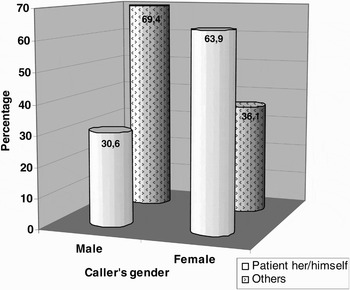
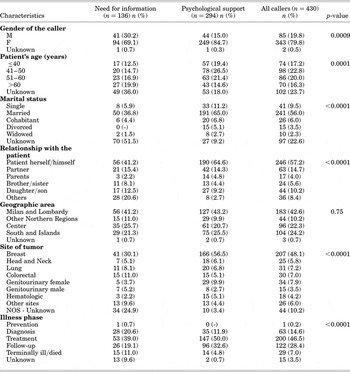
During the period of evaluation, a total of 430 IEO patients and relatives contacted the GGPCPC. Contacts coming from IEO patients and relatives represent almost 30% of the total of the annual help line callers. Fifty-seven percent of the IEO contacts were patients themselves, 43% were relatives and of those: patient's partner (15%), daughter or son (10%), or parents (4%) (Table 1). The majority of the callers were female (80%), 56% of the callers were married, and 43% of the callers were between 41 and 60 years of age. Referring to the sex distribution in the population of relatives and to the request for psychological support or for information and orientation, it emerged that the percentage of male callers increased when the caller was a relative (69%) and when the caller contacted the GGPCPC to request information (Figure 1).
Relationship between caller's gender and the condition of being the patient.

Information and psychological support need in the population as a function of demographic and clinical variables (N = 430 patients)

The most common cancer types among callers were breast cancer (48%), gynecological cancer (8%), lung cancer (7%), colorectal cancer (7%), and head and neck cancer (6%).
Forty-three percent of the callers were resident in Milan and Lombardy, 22% in Central Italy, 24% in Southern Italy and the Islands, and 10% in other Northern Regions (Table 1).
The majority of the contacts (47%) referred to the GGPCPC during the period of oncology treatment, 15% at the moment of first diagnosis and 28% during the follow-up period (Table 1). Sixty-eight percent contacted the GGPCPC in order to receive psychological support; 32% for information about cancer diagnosis, treatment, and management. In Table 1, we note that even though the majority of calls came from patients and relatives of patients during oncology treatment (chemotherapy or radiation therapy), the need for psychological support was at its maximum during the follow-up period: 79% of calls in this phase, in fact, were aimed at obtaining psychological support.
Regarding the length of intervention, the average call duration was 29 minutes (range, 5– 87 minutes). The vast majority (69%) of callers found out about the GGPCPC as a result of the leaflets, which were distributed throughout the institute, 17% learned about it through the nurses and secretaries, and 11% learned about it from the IEO psychologists.
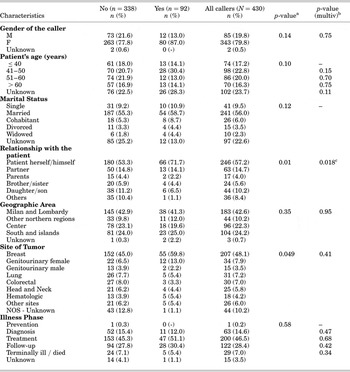
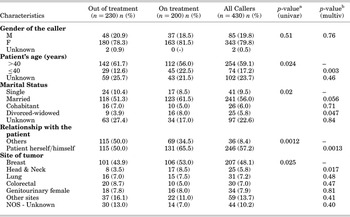
Twenty-one percent of the callers admitted to experiencing a feeling of abandonment by the hospital distress abandoment syndrom (DAS) and it is interesting to note that this psychological construct is not related either to sex, age, the stage of illness, the type of cancer, or to the distance from the hospital but only to the very condition of themselves being a patient (Table 2: p < 0.0001). Because the majority of calls (200/430; 46.5%) came from patients and relatives of patients in their oncological treatment phase, it was important to analyze this population further. Table 3 provides a comparison between those who contacted the GGPCPC during the patient's treatment phase and the other callers. Eighty-two percent of subjects calling during treatment were female, 62% were married, and 23% were <40 years old.
Feeling of being abandoned by IEO (N = 430 patients)

aPearson's χ2.
bLogistic regression including: gender, age (decades), relationship with the patient (herself/himself vs. others), geographic area (Lombardy vs. rest of Italy), site of tumor (breast vs. others), illness phase.
cThe probability of a feeling of being abandoned by IEO is nearly twice if the caller is the patient vs. someone else (OR = 2.0; 95% CI: 1.1–3.5; p = 0.018).
Population on treatment: demographic and clinical characteristics (N = 430 patients)

aPearson's χ2.
bLogistic regression including: gender, age, marital status, relationship with the patient, site of tumor.
By comparing subjects on the basis of the illness phase, it emerged that in 65.5% of the cases (131/200) the treatment phase caller was the patient him/herself, whereas during other illness phases this was the case only for 50% of the calls. By a multivariate analysis this difference was found to be statistically significant (p = 0.0013). Moreover, callers during the treatment phase were younger (≤40 yrs, p = 0.003), more likely to be married (p = 0.056) or divorced/widowed (p = 0.047), and affected by head and neck cancer (p = 0.017). Forty-three percent were resident in Milan and Lombardy. The others, coming from different Italian regions, were staying in Milan only in order to undergo their treatment. In an ideal situation, an evaluation of client satisfaction would be conducted. However, this would be extremely problematic since one of the characteristics and commitments of the GGPCPC is that of ensuring anonymity.
DISCUSSION
As with other help line evaluations in the published literature, we found that the majority of callers to the GGPCPC were women affected by breast cancer in their oncology treatment phase (Jefford et al., Reference Jefford, Black and Grogan2005; Carlsson et al., Reference Carlsson, Strang and Lindblad1996; Venn et al., Reference Venn, Darling and Dickens1996; Slevin et al., Reference Slevin, Terry and Hallet1988). This could be explained by the fact that the majority of the IEO patients are indeed women affected by breast cancer. Nonetheless, the fact that male callers were more numerous throughout the relatives population and also when the caller expressed the need for information and orientation, could be related to the possible tendency of women to ask for psychological support themselves when they are either patients or relatives, whereas men are more likely to express such a need when they are not patients themselves (Galdas et al., Reference Galdas, Cheater and Marshall2005; Angst et al., Reference Angst, Gamma and Gastpar2002; Harrison et al., Reference Harrison, Maguire and Pitceathley1995).
In order to further analyze the male sample contacting the GGPCPC and their need for psychological support, we are currently conducting an analysis of our database to ascertain whether male callers for information and orientation subsequently re-contact the service, expressing the need for psychological support, too. From this perspective, the “need for information” could be a pretext, which allows male patients to express their innermost feelings and emotions arising from their experience of the illness.
Our survey underlines that the majority of users of GGPCPC ask for psychological support (68%). This result differentiates our study from others present in the literature (Sandgren & McCaul, 2003; Marcus et al., Reference Marcus, Garrett and Kulchak-Rahm2002; Bottomley et al., Reference Bottomley, Hunton and Roberts1996; Carlsson et al., Reference Carlsson, Strang and Lindblad1996; Berglund et al., Reference Berglund, Bolund and Gustafsson1994) where it emerges that telephone cancer centers are more often used by the population to receive information and orientation about illness and treatments. This could be explained by the very nature of GGPCPC: unlike other cancer help lines, staffed by nurses (Sandgren & McCaul, Reference Sandgren and McCaul2003; Marcus et al., Reference Marcus, Garrett and Kulchak-Rahm2002; Carlsson et al., Reference Carlsson, Strang and Lindblad1996), it is staffed by clinical psychologists-psychotherapists and, in the leaflet that describes the services offered, psychological support is offered as the main feature of the service.
As shown by Arving et al. (Reference Arving, Sjodén and Bergh2007) and Bottomley et al. (Reference Bottomley, Hunton and Roberts1996), it is not yet known who the most effective telephone counselors are. Arguably, professional psychologists represent the ideal figure to help patients and relatives to express their inner feelings and thoughts in respect to illness, and to represent the psychological meaning of cancer care. Unexpectedly, in our study, the majority of callers are patients in treatment at the IEO, and the geographic origin of the caller was not a significant factor in determining the caller's contacting the GGPCPC.
Initially, when we built up the collaboration with the GGPCPC, we hypothesized that the service would have been more useful for people discharged from IEO and living outside Milan and Lombardy: this, in part, is revealed to be the case, as 79.0% of follow-up phase callers contacted the GGPCPC asking for psychological support. However, it is also the case that 46.5% of the entire set of first-time contacts came from patients in treatment, and therefore in frequent contact with the hospital.
Probably, this is because of the methods we used to distribute the information about the existence of the GGPCPC: the leaflet is more readily available to those who often go to IEO for treatment sessions. A new and more extensive means whereby GGPCPC may be promoted, beyond simply displaying the leaflets, needs investigation. For example, we could ensure that the leaflet is distributed by nurses who discharge patients or by physicians who meet patients during their outpatient visits. It would be useful too, as shown by Broadstock and Hill (Reference Broadstock and Hill1997) to educate IEO physicians and other health professionals, not only nurses, about how the GGPCPC works: if professionals endorse the service, this may increase the number of telephone referrals. This does not mean merely the clinicians' provision of a card promoting the help line but a more intense referral mechanism. Another important reflection related to patients' and relatives' needs for psychological support during the treatment period is that such individuals may benefit from free-of-charge psychological support by also referring to the IEO Psycho-oncology Unit, which guarantees face-to-face psychological interventions of various kinds to IEO patients and their relatives, such as individual psychological support and psychotherapy, couple support, group support, psycho-educational groups, relaxation-based groups, and group psychotherapy. In addition, some oncological patients may prefer a more private and anonymous service such as that offered by telephone consultation. Also, the side effects of treatment may render it difficult to participate in face-to-face psychological programs even when such a need is present. Furthermore, travel to a mental health professional or to a peer support group may become impossible during treatment, and geographical distance from such resources can further intensify the patient's sense of isolation. This is a factor that warrants thorough investigation. Despite the evidence that the telephone can serve medical patients' psychosocial needs, there are few reports of telephone psychotherapy in the cancer population (Mermelstein & Holland, Reference Mermelstein and Holland1992).
To conclude, it could be hypothesized that the presence in each oncologic center of mental health personnel providing psychological support by telephone, is both useful and necessary, representing, as it does, a means of receiving psychological help that cancer patients and their relatives may well consider as a valid alternative to face-to-face interventions throughout the course of their illness.
ACKNOWLEDGMENTS
This study has been supported by grants from the Umberto Veronesi Foundation and the European Institute of Oncology Foundation. The authors thank William Russell-Edu for his assistance in reviewing the English text.