Introduction
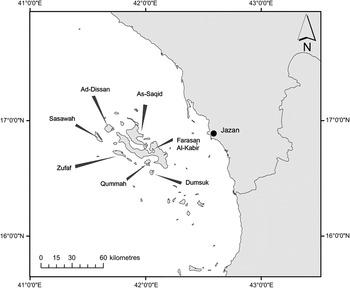
The Farasan Islands are a large archipelago of more than 170 low-lying (0–70 m altitude) coral islands and islets in the southern region of the Red Sea (see Fig. 1). Situated approximately 50 km offshore from the city of Jazan (16°44′15″N, 42°20′18″E), they are one of the most biodiverse sites in Saudi Arabia. Within the archipelago there are seven islands over 10 km2: Farasan Al-Kabir (381 km2), As-Saqid (Sajid) (150 km2), Ad-Dissan (36 km2), Zufaf (33 km2), Sasawah (20 km2), Qummah (15 km2) and Dumsuk (12 km2). Three of these islands, Farasan Al-Kabir, As-Saqid and Qummah, are inhabited. The two main islands, Farasan Al-Kabir and As-Saqid, form the main landmass in the archipelago and are joined together by a 300 m length road bridge.
The Farasan Archipelago (Saudi Arabia) is comprised of 170 coral islands and islets in the southern region of the Red Sea, approximately 50 km from the Saudi Arabian city of Jazan.

The Farasan Archipelago is a site of significant biodiversity and has been managed by the Saudi Wildlife Commission (SWC) as a protected area since 1989. From a number of previous studies (Alwelaie et al., Reference Alwelaie, Chaudary and Alwetaid1993; Hassan & Al-Hemaid, Reference Hassan and Al-Hemaid1996; Collenette, Reference Collenette1999; Atiqur Rahman et al., Reference Atiqur Rahman, Al-Said, Mossa, Al-Yahya and Al-Hemaid2002) and from a series of SWC field visits to the Farasan Islands, 218 plant species have been recorded from the archipelago (see Appendix 1Footnote *). Phytogeographically the flora of the island is predominantly Somalia-Masai. There are no plant species which are endemic to the islands, but the Farasan Archipelago does hold an Arabian endemic, alongside other geographically restricted plant species.
The Farasan Islands are also an important site for faunal diversity. The area holds the largest population of Idmi gazelle in Saudi Arabia (805 counted in 1995). Several species of bat occur, including Patrizi’s trident leaf nose bat Asellia patrizii DeBeaux. Sea mammals recorded in the coastal waters include a small remnant population of dugong Dugong dugon Müller and three species of dolphin, Stenella longirostris Gray, Tursiops truncatus Montagu and Stenella attenuate Gray. Humpback whale Megaptera novaeangliae Borowski and minke whale Balaenoptera acutorostrata Lacépède have also been recorded in the waters of the archipelago. Other prominent animal species include the globally Endangered green turtle Chelonia mydas L. and the Critically Endangered hawksbill turtle Eretmochelys imbricata L. More than 145 bird species have been recorded from the Farasan Archipelago, and the Farasan Islands are listed as an Important Bird Area (Evans, Reference Evans1994). Two of the most significant bird species are the pink-backed pelican Pelicanus rufescens Gmelin and the osprey Pandion haliaetus L. Approximately 40 breeding pairs of pelicans live on the islands, which is likely to be the largest breeding colony of this species in the whole of the Red Sea. With more than 42 breeding pairs of osprey the Farasan population is the largest population of this species in the Middle East.
Geology, Soils and Climate
The Farasan Archipelago is formed from uplifted fossil coral reef. These are continental islands, lying on the Arabian continental shelf. Geologically, the islands are composed primarily of pavements and faulted blocks of uplifted fossil reef limestone. These were formed in Tertiary seas and raised up by a salt dome, the product of intense Miocene evaporation when the Red Sea was cut off from the Indian Ocean. The Pleistocene tectonic shifts which led to the widening of the Red Sea also caused further uplifting of the Farasan Islands (Dabbagh et al., Reference Dabbagh, Hotzl, Schnier, Jado and Zotl1984).
Most of the islands in the archipelago have active fringing reefs, which date from the last rise in sea level 7000 years ago, with patch reefs of sand-covered pavement and shoals in the shallows between them. On some shoals, coral fragments have been cemented into beach rock (farush), which is the base for sandbanks formed by windswept sand. Where not surfaced with coralline limestone, the islands are capped with beach sand.
The soils on the islands can be largely characterised as Udipsamments-Torripsamments: marine flats and dunes, and coral rock outcrops. They are almost entirely derived from the fossil coral bedrock or weathering of the coral reef and beach shells. The fossil coral produces a poor, infertile lithosol of gravelly sand and, over parts of the islands, low soil moistures and a dearth of soil micro-organisms result in a lack of soil altogether. Fine-textured silty clay soils are found in the long narrow ravines resulting from leaching away of the underlying salt stratum, and in cracks, gullies and depressions relatively fertile calcareous silt and clay have accumulated. There are numerous short gullies found in faults in the coral, but only one wadi on the islands, Wadi ‘Abarah south from Al-Muharraq. The shorelines of the larger islands are predominantly sand beaches, although mud flats and coralline limestone rock are also common. In sheltered coastal inlets, silty mud underlies mangrove stands. On the north-facing coasts, seawater intrusion has created a semi-sabkah area of silt sands.
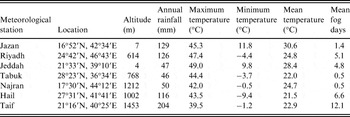
The climate of the Farasan Islands is arid and subtropical, with high humidity, high mean annual temperatures and low rainfall. The nearest meteorological station at Jazan (7 m altitude) indicates a mean annual rainfall of 129 mm per year (Table 1), with rain recorded from both the late winter/spring and summer rainfall systems. Rainfall on the Farasan Islands is probably lower than on the mainland coast with its larger landmass and convection currents. As in other parts of Arabia, condensation of dew is likely to be one of the major contributors to available soil moisture for vegetation. Winds can be constant and relatively strong. The winter sea level is 0.5–1 m higher than in summer because evaporation is less. This causes flooding of low-level coastlines, which become temporary lagoons.
Comparative measurements from seven major meteorological stations in Saudi Arabia. The nearest station to the Farasan Archipelago is Jazan. Data adapted from Ghazanfar & Fisher (Reference Ghazanfar and Fisher1998)

Vegetation
Mangrove
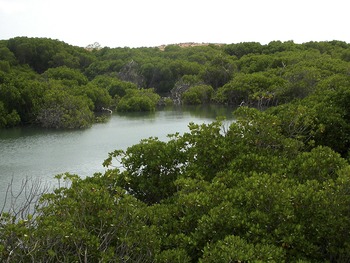
In sheltered coastal areas there are significant stands of mangrove vegetation. There are large stands of Rhizophora mucronata Footnote † in the area of Khawr Kandarah on the NE of Farasan Al-Kabir (see Fig. 2), to the north of Farasan town, North Sulayn Island and about 20 ha of Rhizophora mangrove on Zufaf Island. The total area of Rhizophora mucronata mangrove vegetation is approximately 330 ha. In addition, relatively large areas of black mangrove Avicennia marina line sheltered coastal flats, creeks and channels. Avicennia marina grows on 15 of the northern islands, with the most significant populations around Kharij Haddar, on the NE of Farasan Al-Kabir and NW Zufaf Island. There is also a prominent stand of Avicennia marina in Khawr Farasan (Mandura & Khafajii, Reference Mandura, Khafajii, Leith and Al-Massom1993) which was restored to the area by a successful SWC mangrove restoration programme.
The largest population of Rhizophora mucronata in the Arabian Red Sea region occurs on the Farasan Archipelago.

Rare species
The mangrove Rhizophora mucronata is currently known in the Arabian Red Sea region from the Farasan Archipelago, Baish Al Semirat and Ras Um Rubaise (El-Juhany, Reference El-Juhany2009). Wood (Reference Wood1997) notes that the Bové record of Rhizophora mucronata from Hodeidah (Yemen) is no longer found at this locality.
Acacia woodland
On the eastern side of Farasan Al-Kabir, open Acacia Mill. woodland occurs in depressions and areas of good soils, dominated by Acacia ehrenbergiana with scattered Acacia tortilis subsp. tortilis. Trees and shrubs such as Commiphora gileadensis, Salvadora persica, Indigofera oblongifolia, Grewia tenax and Maytenus parviflora are also prominent. This vegetation is open and supports a well-vegetated ground flora that is dominated by Tetraena simplex. Other herbaceous plants include Blepharis ciliaris, Abutilon fruticosum, Cucumis prophetarum and the tussock-forming grass Desmostachya bipinnata.
Dense Acacia ehrenbergiana woodland occurs in the silty Al-Muharraq area, providing suitable habitat for the Idmi gazelle Gazella gazella Pallas. Trees here include Ziziphus spina-christi, Commiphora gileadensis and Maerua oblongifolia. Bushes of Asparagus flagellaris up to 3 m high are often covered with the climbers Cissus quadrangularis, Pentatropis nivalis, Ipomoea obscura, Ipomoea hochstetteri and Kickxia corallicola. These dense pockets of vegetation are being invaded by Prosopis juliflora. A much more open, less species-rich Acacia woodland also occurs around cultivated areas, along with occasional groves of Hyphaene thebaica and individuals of Ziziphus spina-christi.
Rare species
The Saudi Arabian endemic Kickxia corallicola is an annual herb often found climbing over shrubs within open Acacia woodland on Farasan Al-Kabir. This species also occurs on the mainland Red Sea coast, but as a protected area, Farasan is the most important site for this species. The site of Acacia woodland in Al-Muharraq, Farasan Al-Kabir is the only Arabian locality for the African species Nothosaerva brachiata and Basilicum polystachyon. Farasan is also the only site in Saudi Arabia from which the widespread African and Asian species Ipomoea hochstetteri is recorded.
Open shrubland
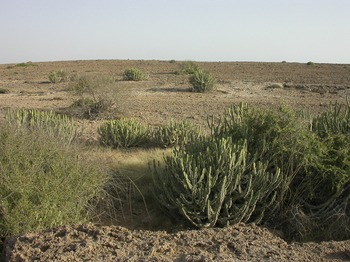
The arid plain of the NW plateau on Farasan Al-Kabir is sparsely vegetated. A largely ancient reef pavement, covered in places with sands, this zone is barren except where cracks and gullies in the limestone collect silt and water. The most common shrubs are Capparis spinosa, Euphorbia collenetteae, Indigofera oblongifolia, with occasional small trees of Salvadora persica and Acacia ehrenbergiana. Abutilon pannosum is dominant on silt and is especially evident in western Farasan and southern As-Saqid islands. In some areas, such as the raised coral platform near Seir, the thickets of Capparis spinosa and Euphorbia collenetteae can become very dense (see Fig. 3). In sandy areas Tetraena simplex, and Aerva javanica, occur, along with Cyperus conglomeratus. After winter rains this area of arid plain is flush with annuals such as Justicia flava.
The succulent shrublands on the raised coral areas of Farasan Al-Kabir and As-Saqid are the only Arabian localities for the Red Sea endemic Euphorbia collenetteae.

Rare species
Khallah Bay on Farasan Al-Kabir is the only Saudi Arabian locality for Cleome noeana subsp. brachystyla, which is also recorded from Yemen in Arabia (Miller & Cope, Reference Miller and Cope1996) and Somalia and Djibouti in NE Africa (Thulin, Reference Thulin1993).
Dumsuk Island is the only locality in the Arabian region for Commiphora erythraea, which is distributed across NE Africa from Tanzania to Eritrea. Surveys on part of the island in February 2009 recorded more than 20 individuals, with an estimated population of 200 trees when extrapolated across Dumsuk. These trees occur in areas of relatively well-developed soils within the raised coral platform and often form a sparse open scrub.
Coastal halophyte vegetation
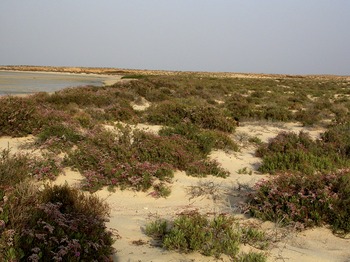
Coastal halophyte vegetation occurs on the silty sands of SE and NE Farasan as well as on large areas of As-Saqid and the coastal areas of Dumsuk. This relatively dense vegetation cover, near the shore (see Fig. 4), is primarily dominated by Limonium axillare, along with Halopeplis perfoliata, Arthrocnemum macrostachyum, Aeluropus lagopoides, Suaeda monoica and Suaeda fruticosa. A Limonium-dominated dwarf shrubland also extends further inland on the sands and rocks of Jabal Kandarah on Farasan Al-Kabir, and in the northern interior of As-Saqid. In areas of sand blown up against the raised coral, Limonium axillare occurs with Cyperus conglomeratus, Tetraena simplex and Polycarpaea spicata. In the Seir district of Farasan Al-Kabir and on the small uninhabited Dawshak Island, Limonium cylindrifolium occurs in the saline sand communities of the sea shore (Alwelaie et al., Reference Alwelaie, Chaudary and Alwetaid1993).
Low coastal shrubland on the north coast of Farasan Al-Kabir, dominated by halophytic species such as Limonium axillare, Halopeplis perfoliata and Arthrocnemum macrostachyum.

Beds of perennial seagrasses grow on sandy or muddy bottoms usually in sheltered waters between 2.5 and 10 m deep. The associated epiphytic algae and nitrogen-fixing ecosystem results in high productivity, and this seagrass ecosystem is very important for a great variety of marine life. Eight species of seagrass have been recorded: Cymodocea rotundata, Cymodocea serrulata, Halodule uninervis, Halophila ovalis, Halophila stipulacea, Syringodium isoetifolium, Thalassia hemprichii and Thalassodendron ciliatum. The most common seagrass species are Thalassia hemprichii and Halophila ovalis in shallower areas on clean sands. The widespread Asian-Australasian seagrass Halodule uninervis is favoured by oyster spat.
Palm groves
Large groves of date palm Phoenix dactylifera occur at As-Saqid and Al-Qisar/Al-Muharraq, and small groves at Qummah and at Khutib beside a group of old Hyphaene thebaica. Among the associated fields Acacia ehrenbergiana is common, some trees being unusually large, with Salvadora persica and occasional Ziziphus spina-christi. At Seir on Farasan Al-Kabir, groves of Hyphaene thebaica form a prominent part of the vegetation in areas of sandy soils. At Al-Faqwah on Khawr al-Ma’adi there is a thicket of date palms along with Ficus populifolia, Acacia tortilis and Acacia ehrenbergiana.
Rare species
The Seir area of Farasan Al-Kabir is the only location in Saudi Arabia from which the widespread afro-tropical fig species Ficus populifolia is recorded. This species is known in Arabia from Yemen, and the most northerly records in Yemen are approximately 200 km south of Farasan (Jabal Melhan) (Wood, Reference Wood1997).
IPA Assessment
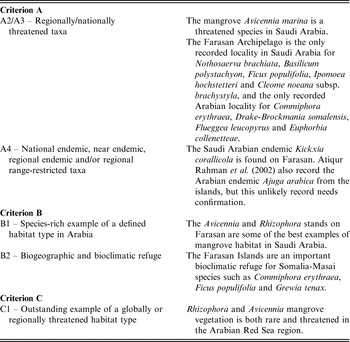
The Farasan Islands are an important site for conservation in Arabia. They are an established protected area in Saudi Arabia, administered by SWC, and are listed as an Important Bird Area (Evans, Reference Evans1994). Scott (Reference Scott1995) considers the archipelago to be a site of international significance as a potential RAMSAR wetland. It is also an important site for wild plant conservation and, using the adapted Arabian criteria (Al-Abbasi et al., Reference Al-Abbasi, Al-Farhan, Al-Khulaidi, Hall, Llewellyn, Miller and Patzelt2010), the Farasan Archipelago qualifies as an Important Plant Area (see Table 2). This paper marks the second in a series of papers on Important Plant Areas in the region (Llewellyn et al., Reference Llewellyn, Hall, Miller, Al-Abbasi, Al-Wetaid, Al-Harbi, Al-Shammari and Al-Farhan2010).
The Farasan Archipelago qualifies as an IPA under criteria A (2–4), B (1 & 2) and C

Socio-economic Issues
The present population of the Farasan Islands is approximately 12,000, the majority of whom live in Farasan town and the neighbouring Al-Masilah village. Until recently, the local population subsisted mainly by artisanal fishing, pearling and small-scale grazing (mainly goats) and subsistence farming (dates and sorghum). The principal occupation is now fishing, both commercial and small scale, along with some clamming and pearling. Government employment and private services provide income for the remainder of the population.
There are no known himas in the Farasan Islands (Llewellyn, Reference Llewellyn, Foltz, Denny and Baharuddin2003), but from SWC consultation with local people it is believed that local people support the establishment of the archipelago as a protected area and the SWC initiatives to restore mangrove habitats on the islands. The Farasan Islands have long been a popular holiday destination for local people from Jazan who come to camp on Farasan Al-Kabir’s long sandy beaches. Whilst there are only a handful of hotels on Farasan Al-Kabir, nature-based tourism is expanding, and it is important to ensure that it remains sustainable. There is great potential for well-managed eco-tourism and wildlife viewing led by SWC rangers and trained local people. This has the potential to provide income for people on the islands, as well as increasing environmental awareness and providing environmental education. Currently, however, there are few visitor services on the islands and there is no interpretation/education centre for visitors to the archipelago.
Threats to Conservation
There are a number of threats to plant conservation on the Farasan Archipelago, including the cutting of mangroves, off-road driving and the expansion of agricultural and mining operations. Development of the islands for tourism is also another potential threat to plant biodiversity conservation. Tourist developments should not be located on important sites for plant and animal biodiversity. It is proposed that these sites (e.g. areas of rare vegetation or the habitat of rare species) should be protected as core biodiversity zones within the SWC protected area. These areas should prohibit development from agriculture, mining and tourism as well as small-scale disturbances such as off-road driving and wood collection.
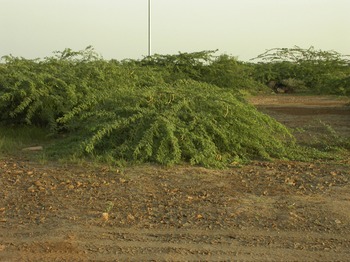
One of the most pressing threats is from the invasive species Prosopis juliflora, a large thicket of which has established on Farasan Al-Kabir near the Al-Muharraq junction (see Fig. 5). This area of Prosopis has established at the expense of the native Acacia woodland and is spreading into the densest areas of Acacia ehrenbergiana woodland in the Al-Muharraq area. Studies in the United Arab Emirates (El-Keblawy & Al-Rawai, Reference El-Keblawy and Al-Rawai2007) have demonstrated that Prosopis juliflora decreases the richness, density and frequency of native plant species. Field observations on Farasan indicate that Prosopis juliflora kills the native Acacia ehrenbergiana woodland. Possible mechanisms for this suppression include the production of allelopathic chemicals (Al-Humaid & Warrag, Reference Al-Humaid and Warrag1998) and the ability of Prosopis to compete aggressively for scarce water resources.
Widely invasive in the Arabian Peninsula, Prosopis juliflora is one of the main threats to plant biodiversity conservation on Farasan.

If no action is taken to halt its spread, Prosopis will likely invade very rapidly (as elsewhere in Arabia) and this will impact the Acacia woodland which is the habitat of Idmi gazelle.
Conservation action must focus on removing the Prosopis which has already begun to invade the Acacia woodland in Al-Muharraq. Unlike in other parts of Arabia, and in East Africa (Mwangi & Swallow, Reference Mwangi and Swallow2008), Prosopis juliflora is not used by the local people and its removal will not cause conflict with the local population. In terms of control methods, biological control using seed-eating Bruchids has been attempted in South Africa with only partial success (Zimmerman, Reference Zimmerman1991; Coetzer & Hoffmann, Reference Coetzer and Hoffmann1997). As there are native species of Prosopis in Arabia, for example Prosopis cineraria (L.) Druce, biological control would be a risky strategy for the Farasan Islands. Instead it is recommended that Prosopis juliflora is controlled by cutting back established trees and by uprooting seedlings before they mature. Following cutting, application of herbicide (either a single herbicide or a combination) is necessary to prevent regrowth. These techniques have been used with success on other weedy Prosopis species in Jordan (Qasem, Reference Qasem2006) and for controlling Prosopis juliflora in Australia (Parsons & Cuthbertson, Reference Parsons and Cuthbertson2001) and on Socotra (A. G. Miller, pers. comm.).
Further Research
Although the flora of Farasan is relatively well known, further floristic work is needed to determine and map the major vegetation types on the islands. The stands of mangrove on the Farasan Archipelago are perhaps the most important plant habitats on the islands, and these require careful monitoring programmes to detect any decline in their quality and extent. Further work is necessary to map the distribution of Rhizophora mucronata in Arabia, particularly in the southern Red Sea and Gulf of Aqaba.
Further research is also needed to determine the biogeographic status of the regionally rare species on the islands, particularly the tree species Commiphora erythraea and Ficus populifolia. Population genetics studies to compare the Farasan populations with those from East Africa (including the Dhalak Islands) would be of great value for ascertaining the genetic divergence of the African and Arabian populations. This would give an indication of the importance of the genetic diversity found in the Farasan populations and would provide evidence on the duration of separation between these populations and also on plant colonisation events in the Red Sea region.
In view of the threat of Prosopis juliflora to the plant biodiversity of the Farasan Islands, a targeted programme to monitor the effects of this species on the local vegetation should be established as a matter of priority. This should coincide with research aimed at determining the most effective method of Prosopis removal from Farasan. Lastly, as there are few individuals capable of identifying plants on the Farasan Islands, a photographic field guide to the plants of Farasan would be a very valuable tool for conducting future surveying and monitoring work (Hall & Miller, in press). It would also be a valuable resource for environmental education and for tourists to use when visiting the islands. Future botanical work should be directed towards photographic documentation of the plants of Farasan and towards compiling a practical field identification guide for the area.
Acknowledgements
We are grateful to an anonymous reviewer for highlighting the new combination necessary for Tetraena boulosii. We also thank a second anonymous reviewer for their helpful comments on earlier drafts of this manuscript.
Appendix 1
Checklist of plant taxa from the Farasan Archipelago. Family delimitation follows APG II (Angiosperm Phylogeny Group, 2003)
This checklist is compiled from survey data, literature sources and herbarium specimens. The principal source for each record is noted in superscript next to each name, listed in order of importance in compiling the list. Taxa known only from herbarium specimens also have the herbarium specimen listed. Synonyms are given where these are still in common usage in the Arabian Peninsula.
1 – IPA survey data
2 – Collenette (Reference Collenette1999)
3 – Collenette & Tsagarakis (Reference Collenette and Tsagarakis2001)
4 – Alwelaie et al. (Reference Alwelaie, Chaudary and Alwetaid1993)
5 – Hassan & Al-Hemaid (Reference Hassan and Al-Hemaid1996)
6 – Atiqur Rahman et al. (Reference Atiqur Rahman, Al-Said, Mossa, Al-Yahya and Al-Hemaid2002)
7 – SWC field records
Acanthaceae
Avicennia marina (Forssk.) Vierh.1
Barleria hochstetteri Nees ex DC.3
Blepharis ciliaris (L.) B.L.Burtt1
Ecbolium viride (Forssk.) Alston2
Justicia flava (Vahl) Vahl3
Aizoaceae
Trianthema portulacastrum L.6
Trianthema sheilae A.G.Mill. & J.A.Nyberg2
Zaleya pentandra (L.) C.Jeffrey [B. Lanza s.n. (BM)]
Amaranthaceae
Aerva javanica (Burm.f.) Juss. ex Schult.1
Amaranthus graecizans L.3
Amaranthus viridis L.6
Arthrocnemum macrostachyum (Moric.) K.Koch1
Atriplex farinosa Forssk.3
Atriplex halimus L.2
Cornulaca ehrenbergii Asch.3
Digera muricata (L.) Mart.3
Halopeplis perfoliata (Forssk.) Bunge ex Asch. & Schweinf.1
Nothosaerva brachiata (L.) Wight2
Suaeda aegyptiaca (Hasselq.) Zohary2
Suaeda fruticosa Forssk. ex J.F.Gmel.1
Suaeda monoica Forssk. ex J.F.Gmel.1
Suaeda vermiculata Forssk. ex J.F.Gmel.6
Amaryllidaceae
Pancratium maximum Forssk. [I.S. Collenette 5827 (RIY)]
Apocynaceae
Calotropis procera (Ait.) Ait.f.5
Caralluma acutangula (Decne.) N.E.Br.1
Caralluma adscendens (Roxb.) Haw.3
Caralluma edulis (Edgew.) Benth. ex Hook.f.2
Glossonema boveanum (Decne.) Decne.2
Leptadenia pyrotechnica (Forssk.) Decne.5
Pentatropis nivalis (J.F.Gmel.) D.V.Field & J.R.I.Wood1
Aristolochiaceae
Aristolochia bracteolata Lam.3
Asparagaceae
Asparagus flagellaris (Kunth) Baker4
Asteraceae (Compositae)
Launaea intybacea (Jacq.) Beauverd3
Launaea procumbens (Roxb.) Ramayya & Rajagopal2
Pluchea dioscoridis (L.) DC.3
Pulicaria jaubertii E.Gamal-Eldin3
Boraginaceae
Heliotropium longiflorum (A.DC.) Jaub. & Spach3
Heliotropium ramosissimum (Lehm.) DC.3
Heliotropium strigosum Willd.2
Heliotropium zeylanicum (Burm.f.) Lam.2
Burseraceae
Commiphora erythraea (Ehrenb.) Engl.1
Commiphora gileadensis (L.) C.Chr.1
Capparaceae
Cadaba farinosa Forssk.3
Cadaba glandulosa Forssk.3
Cadaba longifolia DC.1
Cadaba rotundifolia Forssk.3
Capparis cartilaginea Decne.1
Capparis decidua (Forssk.) Edgew. (syn. Capparis aphylla Hayne ex Roth)1
Capparis spinosa L.6
Cleome brachycarpa Vahl ex DC.1
Cleome gynandra L. (syn. Gynandropsis gynandra (L.) Briq.)3
Cleome noeana Boiss. & Popov. subsp. brachystyla (Deflers) D.F.Chamb. & Lamond2
Cleome tenella L.f. [Unknown 1597 (RIY)]
Dipterygium glaucum Decne. [B. Lanza s.n. (BM)]
Maerua oblongifolia (Forssk.) A.Rich.3
Caryophyllaceae
Polycarpaea repens (Forssk.) Asch. & Schweinf.3
Polycarpaea spicata Arn.1
Celastraceae
Maytenus parviflora (Vahl) Sebsebe1
Commelinaceae
Commelina benghalensis L.3
Commelina forsskalii Vahl3
Convolvulaceae
Convolvulus arvensis L.3
Convolvulus glomeratus Choisy1
Convolvulus pilosellifolius Desr.2
Convolvulus rhyniospermus Hochst. ex Choisy [I.S. Collenette 9269 (E)]
Cressa cretica L.3
Cuscuta planiflora Ten. [V.P. Dickson 759 (K)]
Evolvulus alsinoides (L.) L.3
Ipomoea eriocarpa R.Br. [I.S. Collenette 9267 (E)]
Ipomoea hochstetteri House2
Ipomoea obscura (L.) Ker Gawl.3
Seddera latifolia Hochst. & Steud.3
Seddera virgata Hochst. & Steud. [I.S. Collenette 5844 (K)]
Cucurbitaceae
Citrullus colocynthis (L.) Schrad.6
Cucumis melo L.3 (Collenette & Tsagarakis (Reference Collenette and Tsagarakis2001) list this as Cucumis melo L. subsp. agrestis (Naudin) Pangalo, but de Wilde & Duyfjes (Reference Wilde and Duyfjes2008) reduced this to a forma)
Cucumis prophetarum L.1
Kedrostis gijef (Forssk. ex J.F.Gmel.) C.Jeffrey3
Zehneria anomala C.Jeffrey3
Cymodoceaceae
Cymodocea rotundata Asch. & Schweinf.7
Cymodocea serrulata (R.Br.) Asch. & Magnus7
Halodule uninervis (Forssk.) Boiss.7
Syringodium isoetifolium (Asch.) Dandy7
Thalassodendron ciliatum (Forssk.) Hartog7
Cyperaceae
Cyperus bulbosus Vahl3
Cyperus conglomeratus Rottb.1
Cyperus rubicundus Vahl3
Euphorbiaceae
Acalypha indica L.3
Chrozophora oblongifolia (Delile) A.Juss. ex Spreng.1
Dalechampia scandens L. var. cordofana (Hochst. ex Webb) Müll.Arg.2
Euphorbia collenetteae Al-Zahrani & El-Karemy (syn. Euphorbia sp. aff. fractiflexa S.Carter & J.R.I.Wood)1
Euphorbia granulata Forssk.3
Jatropha glauca Vahl6
Micrococca mercurialis (L.) Benth.2
Hyacinthaceae
Dipcadi Medik. sp.1
Hydrocharitaceae
Enhalus acoroides (L.f.) Royle7
Halophila ovalis (R.Br.) Hook.f.7
Halophila stipulacea (Forssk.) Asch.7
Thalassia hemprichii Ehrenb. ex Solms7
Juncaceae
Juncus rigidus Desf.5
Lamiaceae (Labiatae)
Basilicum polystachyon (L.) Moench2
Leucas urticifolia (Vahl) R.Br. ex Sm.3
Orthosiphon pallidus Royle ex Benth.3
Premna resinosa (Hochst.) Schauer3
Leguminosae
Acacia ehrenbergiana Hayne1
Acacia tortilis Hayne5
Alysicarpus glumaceus (Vahl) DC.1
Argyrolobium sp. aff. arabicum (Decne.) Jaub. & Spach3
Crotalaria microphylla Vahl3
Indigofera caerulea Roxb.3
Indigofera hochstetteri Baker1
Indigofera linifolia (L.f.) Retz.1
Indigofera oblongifolia Forssk.1
Indigofera semitrijuga Forssk.2
Indigofera spinosa Forssk.1
Prosopis juliflora (Sw.) DC.1
Rhynchosia minima (L.) DC.1
Rhynchosia sp. aff. minima (L.) DC.3
Senna alexandrina Mill.3
Senna holosericea (Fresen.) Greuter3
Senna italica Mill.1
Taverniera cuneifolia (Roth) Arn.2
Taverniera lappacea (Forssk.) DC.2
Tephrosia purpurea (L.) Pers.4
Tephrosia subtriflora Hochst. ex Baker1
Tephrosia uniflora Pers. [Collenette 6012 (10065-RIY)]
Lythraceae
Ammannia baccifera L.4
Malvaceae
Abutilon bidentatum Hochst. ex A.Rich.3
Abutilon figarianum Webb2
Abutilon fruticosum Guill. & Perr.1
Abutilon pannosum (G.Forst.) Schltdl.1
Corchorus depressus (L.) Stocks1
Corchorus olitorius L.3
Corchorus trilocularis L.1
Fioria dictyocarpa (Webb) Mattei2
Gossypium hirsutum L.6
Grewia erythraea Schweinf.3
Grewia tenax (Forssk.) Fiori1
Hibiscus micranthus L.f.3
Pavonia arabica Hochst. ex Steud.2
Senra incana Cav.3
Menispermaceae
Cocculus pendulus (J.R.Forst. & G.Forst.) Diels3
Molluginaceae
Mollugo nudicaulis Lam.3
Moraceae
Ficus cordata Thunb. subsp. salicifolia (Vahl) C.C.Berg3
Ficus glumosa Delile2
Ficus populifolia Vahl2
Nyctaginaceae
Boerhavia diffusa L.2
Commicarpus helenae (Roem. & Schult.) Meikle [I.S. Collenette 5862 (E)]
Orobanchaceae
Cistanche tubulosa (Schenk) Hook.f.2
Lindenbergia indica (L.) Vatke3
Striga sp. aff. gesnerioides (Willd.) Vatke3
Palmae
Hyphaene thebaica (L.) Mart.1
Phoenix dactylifera L.1
Phyllanthaceae
Andrachne aspera Spreng. var. glandulosa Hochst. ex A.Rich.3
Flueggea leucopyrus Willd. (syn. Phyllanthus leucopyrus (Willd.) D.Koenig ex Roxb.)2
Flueggea virosa (Roxb. ex Willd.) Royle3
Phyllanthus fraternus G.L.Webster [I.S. Collenette 6001 (RIY)]
Phyllanthus maderaspatensis L.3
Phyllanthus rotundifolius Klein ex. Willd.3
Plantaginaceae
Kickxia corallicola D.A.Sutton1
Nanorrhinum hastatum (R.Br. ex Benth.) Ghebr. (syn. Kickxia hastata (R.Br. ex Benth.) Dandy)3
Schweinfurthia pedicellata Benth. & Hook.f.1
Plumbaginaceae
Limonium axillare (Forssk.) Kuntze1
Limonium cylindrifolium (Forssk.) Verdc. ex Cufod.3
Poaceae (Gramineae)
Aeluropus lagopoides (L.) Trin. ex Thwaites1
Aristida adscensionis L.3
Aristida funiculata Trin. & Rupr.3
Brachiaria ramosa (L.) Stapf3
Cenchrus ciliaris L.3
Chloris barbata (L.) Sw.3
Chrysopogon plumulosus Hochst.3
Cynodon dactylon (L.) Pers.5
Dactyloctenium aegyptium (L.) Willd.3
Dactyloctenium aristatum Link3
Dactyloctenium scindicum Boiss.3
Desmostachya bipinnata (L.) Stapf1
Dichanthium foveolatum (Delile) Roberty4
Digitaria ciliaris (Retz.) Koeler [I.S. Collenette 5872 (K)]
Dinebra retroflexa (Vahl) Panz2
Drake-Brockmania somalensis (Hack.) Stapf2
Elionurus royleanus Nees ex A.Rich. [I.S. Collenette 6010 (K)]
Eragrostis ciliaris (L.) R.Br. [I.S. Collenette 5178 (E)]
Eragrostis lepida (A.Rich.) Hochst. ex Steud.2
Eragrostis minor Host3
Eriochloa fatmensis (Hochst. & Steud.) Clayton3
Halopyrum mucronatum (L.) Stapf3
Hyparrhenia hirta (L.) Stapf4
Panicum coloratum L.3
Panicum turgidum Forssk.3
Paspalidium desertorum (A.Rich.) Stapf2
Pennisetum setigerum (Vahl) Wipff (syn. Cenchrus setigerus Vahl)3
Setaria verticillata (L.) P.Beauv.3
Setaria viridis (L.) P.Beauv.3
Sporobolus helvolus (Trin.) T.Durand & Schinz3
Sporobolus spicatus (Vahl) Kunth3
Tetrapogon tenellus (K.D.Koenig ex Roxb.) Chiov.1
Tricholaena teneriffae (L.f.) Link3
Polygalaceae
Polygala erioptera DC.2
Portulacaceae
Portulaca oleracea L.3
Resedaceae
Ochradenus baccatus Delile1
Rhamnaceae
Ziziphus spina-christi (L.) Desf.1
Rhizophoraceae
Rhizophora mucronata Lam.1
Rubiaceae
Kohautia caespitosa Schnizl.3
Oldenlandia corymbosa L. [T. Abbasi 15105-RIY (RIY)]
Salvadoraceae
Salvadora persica L.1
Scrophulariaceae
Anticharis glandulosa Asch.3
Solanaceae
Solanum forskalii Dunal [Chaudhary 7208 (RIY)]
Solanum thruppii C.H.Wright (syn. Solanum coagulans Forssk.)3
Solanum virginianum L. (syn. Solanum surattense Burm.f.)3
Tamaricaceae
Tamarix L. sp.3
Urticaceae
Forsskaolea viridis Ehrenb. ex Webb2
Vahliaceae
Bistella digyna (Retz.) Bullock (syn. Vahlia digyna (Retz.) Kuntze)3
Verbenaceae
Chascanum marrubiifolium Fenzl ex Walp.3
Priva adhaerens (Forssk.) Chiov.3
Vitaceae
Cissus quadrangularis L.1
Cissus rotundifolia (Forssk.) Vahl1
Xanthorrhoeaceae
Aloe vera (L.) Burm.f.1
Zygophyllaceae
Tetraena alba (L.f.) Beier & Thulin (syn. Zygophyllum album L.f.)6
Tetraena boulosii (A.I.Hosny) M.HallFootnote ‡ (syn. Zygophyllum boulosii A.I.Hosny)1
Tetraena coccinea (L.) Beier & Thulin (syn. Zygophyllum coccineum L.)4
Tetraena simplex (L.) Beier & Thulin (syn. Zygophyllum simplex L.) [R. Basehi 4242 (KSU)]1
Unconfirmed records
Ajuga arabica P.H.Davis6
Astragalus L. sp.6
Cyperus jeminicus Rottb.7
Erica arborea L.6
Indigofera volkensii Taub. [Y. Al-Wutaid 12705-RIY (RIY)]
Ipomoea sinensis (Desr.) Choisy subsp. blepharosepala (A.Rich.) Meeuse6
Maytenus senegalensis (Lam.) Exell6
Maytenus somalensis (Loes.) Cufod.4
Schweinfurthia pterosperma (A.Rich.) A.Braun3
Sporobolus ioclados (Trin.) Nees5