Introduction
The growth potential of the kids is one of the most important traits in a genetic improvement scheme. The profitability of goat production for meat largely depends on kid weight as the growth performance of a kid determines the meat-producing ability of the kid up to a marketable age. Early growth is influenced by the genotype of the animal, and also by the maternal environment. These maternal effects reflect the dam’s milk production and mothering ability. Maternal effects are especially important in early life, and also may have carry-over effects later in life. Body weights used in performance testing are often recorded at a relatively early age, so the influence of maternal effects on these traits needs to be quantified in order to formulate optimal breeding programmes. Studies on traits measured at an early age in farm animals have shown that both direct and maternal influences are important for animal growth (María et al., Reference María, Boldman and Van Vleck1993; Snyman et al., Reference Snyman, Erasmus, Van Wyk and Olivier1995; Näsholm and Danell, Reference Näsholm and Danell1996; Matika et al., Reference Matika, Van Wyk, Erasmus and Baker2003). Further, knowledge of parameters involving the joint influence of genetic and environmental effects on direct growth potential and maternal ability is also required for growth traits (Robison, Reference Robison1981). Exclusion of genetic or environmental factors may lead to overestimates of the remaining (co)variance components fitted in the model. Näsholm and Danell (1994) observed that when maternal genetic effects are important, but not accounted for, heritability estimates are biased upward and the realised efficiency of selection is reduced. The availability of computer software for estimation of variance components has simplified the partitioning of variance into direct and maternal effects, but confounding between direct and maternal effects of the dam in poorly designed studies and difficulty in estimation of the genetic correlation between direct and maternal additive effects (Meyer, Reference Meyer1992; Robinson, Reference Robinson1996) may pose the greatest challenges to fitting maternal effects models (Hanrahan, Reference Hanrahan1976; Willham, Reference Willham1980). Hence, in order to maximise the genetic gain in any selection programme, information on both direct and maternal effects should be taken into account, especially if there is antagonism between them (Meyer, Reference Meyer1992).
Many of the published heritability estimates for growth traits in Indian goat breeds were derived from sire models that did not take account of additive maternal effects. Therefore, the present study was conducted to estimate variance and covariance components due to additive direct and maternal genetic effects and maternal permanent environmental effects for body weights in Jamunapari goat.
Material and methods
Study area and description of the breed
This study was conducted at the Central Institute for Research on Goats, Makhdoom, Mathura, India, 169 m above the mean sea level at 10°N, and 78°02′E and with a semi-arid climate. The annual rainfall in the area averaged 750 mm, while the average annual temperature varied from 6°C (winter) to 44.5°C (summer). The Jamunapari goat is a tall, white and large-sized breed in India and is well known across the country for its milk production. Characteristic features of this breed are a roman nose with the lower jaw longer than the upper jaw, giving a parrot-like appearance. The natural habitat of Jamunapari goats is the Chakarnagar area of Etawah district in the state of Uttar Pradesh, where the breed is commonly known as ‘Pari’. The animal is highly adapted to the ravines of Jamuna, Chambal and Kwari rivers, which have dense vegetation for browsing. The characteristics of the breed, its location and habitat and husbandry practices have been described by Rout et al. (Reference Rout, Saxena, Khan, Roy, Mandal, Singh and Singh2000) and Roy and Pant (Reference Roy and Pant2001). Briefly, animals are generally reared under semi-intensive feeding where they are allowed to graze during the day for 5 to 6 h, except during rains and inclement weather and supplemented with some amount of concentrate or with seasonally available green and dry fodders. Generally, controlled mating is practiced. Females in oestrus are detected twice daily in the morning and evening using teaser bucks and hand-mated to the selected buck in the morning. Does are first exposed to buck at 16 to 18 months of age. Normally one breeding buck is allowed to mate with 20 to 25 does and is used for 3 years. The Jamunapari goat is a seasonal breeder with signs of oestrus exhibited mainly in May and June and in October and November. Subsequently, kidding generally occurs in October and November and in March and April. Does are kept in kidding pens under close observation and proper care for 3 to 4 days prior to the expected date of parturition. At kidding, both kids and dams are weighed and the kidding date, sex and birth status of each kid are recorded. Kids are weighed at 15-day intervals from birth to weaning at 3 months of age and thereafter at monthly intervals up to 12 months of age. Kids are normally weaned at 3 months of age. Animals are vaccinated against peste des petits ruminants (PPR), foot and mouth disease (FMD), enterotoxaemia and haemorrhagic septicaemia (HS).
Data
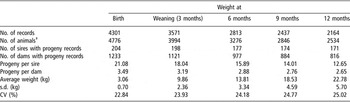
Data available for analysis were collected from the breeding flock of Jamunapari goat maintained at this institute under the All-India Coordinated Research Project on Goat Improvement for a period of 23 years (1982 through 2004). Records on a total of 4301 kids descended from 204 sires and 1233 does were used for this analysis. The traits analysed for this study were birth weight, weaning weight and post-weaning weights at 6, 9 and 12 months of age. Characteristics of the data structure and phenotypic mean and standard deviations for all traits are summarised in Table 1.
Characteristics of data structure for growth traits of Jamunapari goats

†Animals in pedigrees.
Statistical analyses
(Co)variance components were estimated by restricted maximum likelihood (REML) using a derivative-free algorithm fitting an animal model (DFREML, Meyer, 2000). Data were first analysed by least-squares analysis of variance (Harvey, 1990) to identify the fixed effects to be included in the model. The statistical model included the fixed effect of birth year (23 levels), season of birth (2 levels), parity of dam (1, 2, 3, 4, 5, 6, ⩾7), sex (2 levels) and birth status (3 levels) of kids. All these effects were significant (P < 0.05) for all weights and all were included in the models subsequently used to estimate genetic parameters. Convergence of the REML solutions was assumed when the variance of function values (−2 log L) in the Simplex was less than 10−8. To ensure that a global maximum was reached, analyses were restarted for several other rounds of iterations using results from the previous round as starting values. When estimates did not change, convergence was confirmed. Standard errors were calculated for the estimated parameters as a part of the DFREML program (Meyer, 2000).
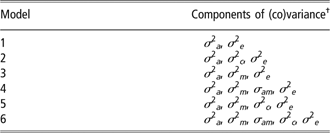
Univariate animal models were fitted to estimate (co)variance components for each trait and are summarised in Table 2. The following six models were used:






where y is the vector of observations for each trait; b, a, m, c and e are vectors of fixed effects (birth year, season of birth, parity of dam, sex and birth status of kid), direct additive genetic effects, maternal additive genetic effects, permanent environmental effects of the dam and residual effects, respectively; X, Za, Zm, Zc are the corresponding incidence matrices relating these effects to y; A is the numerator relationship matrix between animals; and σam is the covariance between additive direct and maternal genetic effects. The analysis used the standard assumptions and definitions for variance (V) and covariance (Cov) matrices involving random effects, i.e.

where I is an identity matrix and σ 2a, σ 2m, σ 2c and σ 2e are additive direct, additive maternal, maternal permanent environmental and residual variances, respectively. Estimates of heritability (h 2), maternal heritability (m 2) and permanent maternal environmental (c 2) effects were calculated as ratios of estimates of σ 2a, σ 2m and σ 2c, respectively, to the phenotypic variance (σ 2p). The direct–maternal correlation (ram) was computed as the ratio of the estimates of direct–maternal covariance (σam) to the product of the square roots of estimates of σ 2a and σ 2m. The total maternal effect,  , was calculated to estimate repeatability of ewe performance. The total genetic contribution was calculated (Willham, Reference Willham1972) as
 , to estimate the expected response to phenotypic selection.
Description of the random effects included in the alternative models
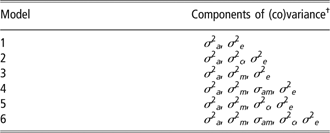
†σ 2a is the additive direct genetic variance; σ 2m is the additive maternal genetic variance; σ 2c is the maternal permanent environmental variance; σ 2e is the residual variance; and σam is the additive direct-maternal genetic covariance.
The most appropriate model for each trait was selected based on likelihood ratio tests (Meyer, Reference Meyer1992). An effect was considered to have a significant influence when its inclusion caused a significant increase in log-likelihood, compared with a model in which it was ignored. Significance was tested at P < 0.05 by comparing differences in log-likelihoods (−2 log L) to values for a chi-square distribution with degrees of freedom equal to the difference in the number of (co)variance components fitted for the two models. Where −2 log L values were not significantly different, the model with fewest random terms was chosen.
Results and discussion
Phenotypic means, standard deviations and coefficients of variation for body weights at birth, weaning and at 6, 9 and 12 months of the age are shown in Table 1. In these data, 48.9% of the kids were male and 51.1% were female. Single-, twin- and triplet-born kids represented 49.3%, 48.7% and 1.9% of the data, respectively. Coefficients of variation for body weights ranged from 22.8% for birth weight to 25.0% for 12-month weight.
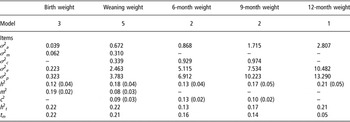
Estimates of (co)variance components and genetic parameters for body weights at different ages for the most appropriate models are summarised in Table 3. The most appropriate model for birth weight included only additive maternal effects (model 3). The appropriate model for weaning weight had both additive genetic and permanent environmental maternal effects but did not include the additive direct–maternal covariance (model 5). For post-weaning weights, the model that included only additive effects and permanent environmental effects of the dam (model 2) was most appropriate for 6- and 9-month body weights, whereas for 12-month body weight, only the direct additive effect (model 1) was significant. Estimates of the correlation between additive direct and maternal effects were generally negative and sometimes large, but were never significant.
Estimated parameters and their standard errors for body weights from the best model for each trait†

†σ 2a is the additive direct genetic variance; σ 2m is the additive maternal genetic variance; σ 2c is the maternal permanent environmental variance; σ 2e is the environmental variance; σ 2p is the phenotypic variance; h 2 is the heritability; m 2 is the maternal heritability; c 2 = σ 2c/σ 2p; h 2t is the total heritability and tm is the repeatability of ewe performance. Figures in parentheses are standard errors of the estimates.
Our estimate of 0.12 for the heritability of birth weight was comparable with estimates of 0.16 for Boer goats (Schoeman et al., Reference Schoeman, Els and Van Niekerk1997) and 0.18 for Emirati goats (Al-Shorepy et al., Reference Al-Shorepy, Alhadrami and Abdulwahab2002). Similar heritability estimates have also been reported for birth weight in sheep (Neser et al., Reference Neser, Erasmus and Van Wyk2001; Ekiz et al., Reference Ekiz, Özcan, Yilmaz and Ceyhan2004). However, higher heritability estimates for birth weight have been reported for some other goat breeds (Mavrogenis et al., Reference Mavrogenis, Constantinou and Louca1984; Malik et al., Reference Malik, Kanaujia and Pander1986). An estimate of heritability for birth weight of 0.29 was reported by Roy et al. (Reference Roy, Singh, Rout, Saxena and Khan2003) in Jamunapari goats using the paternal half-sib method; this estimate is likely inflated by failure to consider maternal effects of the dam, and was similar to the estimate of 0.33 obtained from model 1 of the current study.
The model that included only additive direct and maternal effects was adequate to explain the observed variation in birth weight. Permanent environmental effects were not significant (P < 0.15), although they were subsequently shown to be important for weaning weight. As discussed by Mandal et al. (Reference Mandal, Neser, Rout, Roy and Notter2006a), partitioning of the total maternal effect into additive and permanent environmental components is difficult, even with the substantial numbers of repeated ewe records found in the current data. Model 5 yielded separate estimates of h 2, m 2 and c 2 of 0.13, 0.12 and 0.07, respectively.
Our maternal heritability estimate for birth weight (0.19) was similar to the estimates of 0.18 reported by Al-Shorepy et al. (Reference Al-Shorepy, Alhadrami and Abdulwahab2002) in Emirati goat and 0.14 reported by Schoeman et al. (Reference Schoeman, Els and Van Niekerk1997) in Boer goats. Similar estimates for maternal heritability of birth weight were also observed in sheep (Ligda et al., Reference Ligda, Gabriilidis, Papadopoulos and Georgoudis2000; Yazdi et al., Reference Yazdi, Engström, Näsholm, Johansson, Jorjani and Liljedahl1997; El Fadili et al., Reference El Fadili, Michaux, Detilleux and Leroy2000). Mandal et al. (Reference Mandal, Neser, Rout, Roy and Notter2006a and Reference Mandal, Neser, Rout, Roy and Notter2006b) reported a maternal heritability of 0.17 for birth weight from model 3 in Muzaffarnagari sheep managed at the same location as the goats used for this study. The maternal heritability was larger than the corresponding direct heritability for this trait, in agreement with results obtained in sheep (María et al., Reference María, Boldman and Van Vleck1993; van Wyk et al., Reference Van Wyk, Erasmus and Konstantinov1993; Näsholm and Danell, Reference Näsholm and Danell1996).
The estimates of total heritability (h 2t) and repeatability of ewe effects (tm) for birth weight were substantial and high in magnitude (0.22), indicating that the expected response to phenotypic selection would be high for this trait. The total heritability for birth weight observed in this study was comparable with the estimates of Schoeman et al. (Reference Schoeman, Els and Van Niekerk1997) in Boer goats (0.16) and Neser et al. (Reference Neser, Erasmus and Van Wyk2001) in Dorper sheep (0.21). Our maternal repeatability estimate for birth weight was similar to values reported in sheep (Yazdi et al., Reference Yazdi, Engström, Näsholm, Johansson, Jorjani and Liljedahl1997; Al-Shorepy, Reference Al-Shorepy2001).
The direct heritability estimate of 0.18 from model 5 for weaning weight in this study was in accord with the findings of Schoeman et al. (Reference Schoeman, Els and Van Niekerk1997) in Boer goats (0.18) but lower than the estimate of 0.34 of Al-Shorepy et al. (Reference Al-Shorepy, Alhadrami and Abdulwahab2002) in Emirati goats. The estimates of maternal heritability (m 2 = 0.08) and permanent environmental maternal effects (c 2 = 0.09) for weaning weight were slightly higher than the values reported by Schoeman et al. (Reference Schoeman, Els and Van Niekerk1997) in Boer goats (m 2 = 0.04 and c 2 = 0.07). Using a comparable model, Al-Shorepy et al. (Reference Al-Shorepy, Alhadrami and Abdulwahab2002) obtained estimates of 0.00 for maternal heritability and 0.20 for the permanent environmental maternal effect (c 2) for this trait in Emirati goats. Direct and maternal heritabilities in this study were also within the range of reported values for weaning weight in various sheep breeds (Lewis and Beatson, Reference Lewis and Beatson1999; Neser et al., Reference Neser, Erasmus and Van Wyk2001; Hanford et al., Reference Hanford, Van Vleck and Snowder2002; Safari et al., Reference Safari, Fogarty and Gilmour2005, Mandal et al., Reference Mandal, Neser, Rout, Roy and Notter2006a and Reference Mandal, Neser, Rout, Roy and Notter2006b). Estimates of total heritability (h 2t = 0.22) and maternal repeatability (tm = 0.21) were similar in magnitude in the current study, were comparable with published estimates of h 2t and tm in sheep breeds (Näsholm and Danell, Reference Näsholm and Danell1996; Notter, Reference Notter1998; Hanford et al., Reference Hanford, Van Vleck and Snowder2003), and suggest ample potential for genetic improvement of this trait.
The direct heritability estimates for post-weaning weights increased from 6 to 9 and 6 to 12 months of age (0.13, 0.17 and 0.21, respectively) for Jamunapari goat. These analyses suggest that after weaning, maternal permanent environmental effects were still an important source of variation up to 9 months of age but were no longer important at 12 months. No evidence for an additive maternal effect on post-weaning weight was observed at any age. Similar trends were reported in sheep breeds by María et al. (Reference María, Boldman and Van Vleck1993), Tosh and Kemp (Reference Tosh and Kemp1994) and Mortimer and Atkins (1994). This decrease in maternal permanent environmental effects at later ages presumably reflects an increasing impact on body weight of the animal’s own genotype. A similar increasing trend in the paternal half-sib estimate of direct heritability for post-weaning body weights from 6 to 12 months of age was reported by Roy et al. (Reference Roy, Singh, Rout, Saxena and Khan2003) in this breed. The presence of significant additive and permanent environmental maternal effects on weaning weight but only a permanent environmental maternal effect on post-weaning weights is somewhat surprising and probably resulted from increasing difficulty in partitioning the total maternal effect into its components as this effect decreased in importance at more advanced ages. Estimates of h 2, m 2 and c 2 from the more comprehensive model 5 were 0.13, 0.00 and 0.13, respectively, at 6 months, 0.16, 0.03 and 0.07 at 9 months, and 0.19, 0.01 and 0.01 at 12 months.
Our estimates of direct heritabilities for post-weaning weights were lower than the estimate of 0.29 for body weight at 8 to 9 months of age reported by Snyman and Olivier (Reference Snyman and Olivier1996) in Angora goats. Using a simple animal model (i.e. model 1), Schoeman et al. (Reference Schoeman, Els and Van Niekerk1997) estimated direct heritabilities of 0.60, 0.40 and 0.36 for 6-, 9- and 12-month weights, respectively, in Boer goats, which were much higher than the present findings. However, results of the present study were within the range of estimates obtained in various sheep breeds (Näsholm and Danell, Reference Näsholm and Danell1996; Abegaz et al., Reference Abegaz, Negussie, Duguma and Rege2002; Safari et al., Reference Safari, Fogarty and Gilmour2005). Comparison of current results for maternal permanent environmental effects with those of other studies is difficult because of differences in the models fitted, as Meyer (Reference Meyer1992) postulated that the relative values of h 2, m 2 and c 2 are influenced by the specific model.
Total heritability estimates for post-weaning weights in this breed were moderate, ranging from 0.13 to 0.21 (Table 3) and indicates that selection would be effective for these traits. Estimates of tm for post-weaning weights ranged from 0.05 to 0.16 and agree with most of the published results for sheep (Al-Shorepy and Notter, Reference Al-Shorepy and Notter1996; Lewis and Beatson, Reference Lewis and Beatson1999; Abegaz et al., Reference Abegaz, Negussie, Duguma and Rege2002; Ozcan et al., Reference Ozcan, Ekiz, Yilmaz and Ceyhan2005; Safari et al., Reference Safari, Fogarty and Gilmour2005).
Acknowledgements
The authors thank Dr Karin Meyer, Principal Biometrician, University of New England, Armidale, New South Wales, Australia, for granting permission to use the DFREML program. We wish to acknowledge the contribution of the staff of the Jamunapari unit of the Institute for management and recording of animals. The support extended by Director, CIRG, in providing facilities to carry out this study is also gratefully acknowledged.