INTRODUCTION
A cochlear implant (CI) is a device that transforms sound into electrical impulses, and then transmits these impulses to the inner ear (Loizou, Reference Loizou and Moller2006). In contrast with the human ear, CIs provide the brain with only a part of the acoustic information present in the speech signal (i.e., low spectral and temporal resolution). Despite such limitations, CIs provide huge benefits for language development (Geers, Moog, Biedenstein, Brenner & Hayes, Reference Geers, Moog, Biedenstein, Brenner and Hayes2009; Giezen, Escudero & Baker, Reference Giezen, Escudero and Baker2010; Yoshinaga-Itano, Baca & Sedey, Reference Yoshinaga-Itano, Baca and Sedey2010). In the case of children implanted in the first two years of life, the population analyzed in the present article, the benefits are particularly positive, as confirmed by the large number of children who seem to catch up with their hearing peers after three or four years of implant use (see Geers et al., Reference Geers, Moog, Biedenstein, Brenner and Hayes2009).
However, it remains unclear up to what point the development of productive speech and language is typical in children implanted at an early age. As a group, the long-term outcomes are notably heterogeneous (e.g., Duchesne, Sutton & Bergeron, Reference Duchesne, Sutton and Bergeron2009), which seems to be associated with a combination of individual and environmental factors (e.g., Pisoni & Cleary, Reference Pisoni and Cleary2003; Le Normand, Parisse & Cohen, Reference Le Normand, Parisse and Cohen2008; Geers et al., Reference Geers, Moog, Biedenstein, Brenner and Hayes2009). Furthermore, different researchers have found evidence of either atypical or typical development. Some indications that development might be atypical are: early syllables which do not conform to the presumably universal consonant–vowel structure (Adi-Bensaid & Tubul-Lavy, Reference Adi-Bensaid and Tubul-Lavy2009; see also Ertmer & Mellon, Reference Ertmer and Mellon2001; Gillis, Schauwers & Govaerts, Reference Gillis, Schauwers and Govaerts2002); segmental inaccuracy in the one-word period (Warner-Czyz & Davis, Reference Warner-Czyz and Davis2008; Warner-Czyz, Davis & MacNeilage, Reference Warner-Czyz, Davis and MacNeilage2010; Ertmer & Goffman, Reference Ertmer and Goffman2011); and morphophonological errors early in grammatical development (e.g., Szagun, Reference Szagun2004; Moreno-Torres & Torres, Reference Moreno-Torres and Torres2008). Some indications of typical, though possibly slow, development are: a typical order of phoneme acquisition (Serry & Blamey, Reference Serry and Blamey1999; Barry, Blamey & Fletcher, Reference Barry, Blamey and Fletcher2006; Moreno-Torres & Torres, Reference Moreno-Torres and Torres2008); and typical error patterns in the production of consonant clusters (Kim & Chin, Reference Kim and Chin2008; Adi-Bensaid & Ben-David, Reference Adi-Bensaid and Ben-David2010).
Based on the apparent evidence that perception skills of CI users are generally better than their production skills, some authors have proposed that the deficits in production can be explained in terms of the different sensitive periods for perception and production (e.g., Houston, Pisoni, Kirk, Ying & Miyamoto, Reference Houston, Pisoni, Kirk, Ying and Miyamoto2003; Houston & Miyamoto, Reference Houston and Miyamoto2010). However, such a proposal seems incompatible with the evidence that perception and production networks are closely connected in the brain (Guenther, Reference Guenther1994; Pulvermuller, Reference Pulvermuller2005; Simmonds, Wise & Leech, Reference Simmonds, Wise and Leech2011), which predicts that the two domains should show similar deficits. Given that perception in CI users is far from typical (e.g., Medina & Serniclaes, Reference Medina and Serniclaes2009; Bouton, Serniclaes, Bertoncini & Cole, Reference Bouton, Serniclaes, Bertoncini and Cole2012), it seems necessary to explore the link between perception and production in CI users.
One clue to understanding that link can be found in a recent study by Bouton et al. (Reference Bouton, Serniclaes, Bertoncini and Cole2012). The authors examined two different aspects of perception in CI users and in typically developing (TD) children: ‘categorical perception’ and ‘categorical precision’. Categorical perception is the ability to identify phonologically relevant sound contrasts (e.g., voicing, place of articulation, etc.), and it is the result of top-down effects through which upper-level categories constrain sensory processing. Categorical precision is the degree of accuracy when categorizing the actual sounds. Typical children develop robust categorization skills in the first twelve months of life. In contrast, categorical precision continues to improve up to the end of childhood and even during adolescence. Bouton et al. found that the CI/TD children matched on auditory age (i.e., months of implant use in deaf children=chronological age in TD children) were very similar in terms of categorical perception, but they differed significantly in terms of categorical precision. The authors conclude that the differences in precision may reflect the technical limitations of CIs.
Given such results, we may ask how low precision might disturb the development of productive language skills. One possible link is suggested by the following pieces of evidence: (i) auditory feedback is required to fine-tune motor patterns during development (Guenther, Reference Guenther1994; Guenther, Ghosh & Tourville, Reference Guenther, Ghosh and Tourville2006); thus, limited perceptual precision may reduce the benefits of auditory feedback; (ii) it has been shown that a reduction in auditory feedback effects may result in inconsistent production (Terband & Maassen, Reference Terband and Maassen2010); and (iii) there are some indications that CI users may be inconsistent in the one-word period (Warner-Czyz & Davis, Reference Warner-Czyz and Davis2008; Warner-Czyz et al., Reference Warner-Czyz, Davis and MacNeilage2010). Thus, it is possible that the contrast between typical categorization/atypical precision in perception might result in typical linguistic representations/atypical inconsistency in production. The main aim of the present article is to explore whether such a contrast may explain the characteristics of the emergence of productive speech and language in a group of Spanish-learning CI users. Two important developmental milestones will be explored: the transition from babbling to words, and the one-word period.
Linguistic representations and consistency in typical children
Typical language development can be described as a long gradual process in which the child develops increasingly complex linguistic representations which are used to guide language production. The first evidence of top-down production can be found during the transition from babbling to words (Vihman, Macken, Simmons & Miller, Reference Vihman, Macken, Simmons and Miller1985; McCune & Vihman, Reference McCune and Vihman2001) and in the one-word period (Demuth, Reference Demuth, Morgan and Demuth1996).
Around the age of 0;6–0;10 TD children begin to produce canonical babbling (i.e., rhythmic alternations between consonant- and vowel-like properties, giving a percept of rhythmic speech that simulates adult output without conveying meaning; MacNeilage, Reference MacNeilage1998). Canonical babbling (CB) helps the child to learn vocal motor patterns which are later used to produce words (Vihman et al., Reference Vihman, Macken, Simmons and Miller1985; McCune & Vihman, Reference McCune and Vihman2001). This continuity is the first evidence that children guide their productions by learned (pre)linguistic representations.
One difficulty in examining consistency in early word production is that there are important individual and cross-linguistic differences (Vihman, Reference Vihman1996). However, one aspect that might provide valuable information is syllable structure. Despite cross-linguistic differences, typical children tend to use predominantly CV (consonant–vowel) syllables (MacNeilage, Reference MacNeilage1998). Dominance of other syllable structures (e.g., V syllables) has been observed in atypical children and may indicate deficits in the speech production system (e.g., apraxia: Le Normand & Chevrie-Muller, Reference Le Normand and Chevrie-Muller1991; cri du chant: Kristofferson, Reference Kristofferson2008).
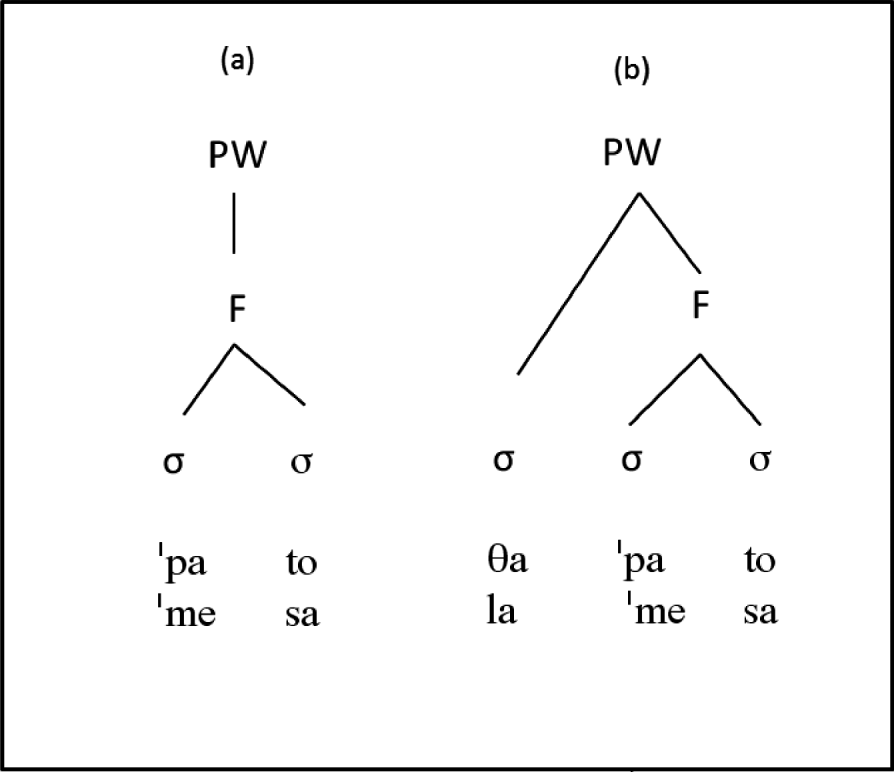
Evidence of top-down effects in production has also been observed during the one-word period (i.e., once they have a lexical store of around 50 word types; Ingram, Reference Ingram1989). In this period TD children produce phonological errors which reflect implicit knowledge of the prosodic and segmental characteristics of the ambient language. At the prosodic level, they adapt their early words to consistent size and rhythmic patterns (Demuth, Reference Demuth, Morgan and Demuth1996; Levelt, Schiller & Levelt, Reference Levelt, Schiller and Levelt1999). In languages such as English and Spanish the adaptation consists typically in omitting pretonic syllables (e.g., banana >nana), in both words and phrases (see Figure 1). Similarly, children show a preference for specific sound types (Vihman & Croft, Reference Vihman and Croft2007; Dinnsen & Gierut, Reference Dinnsen and Gierut2008). While many productions are clearly incorrect in this period, children are notably stable, as evidenced by the fact that their productions can be described in terms of small sets of error patterns or rules (Dodd, Reference Dodd2005). In sum, the examination of the productions of typical children has provided robust evidence that they develop typical representations which are then used to guide production. In addition, despite large individual and cross-linguistic variability, productions tend to be relatively consistent, especially from a prosodic perspective.
Basic (a) and advanced (b) prosodic structures in Spanish-learning children. Examples are the Spanish word zapato (/θa.ˈpa.to/ ‘shoe’) and the noun phrase la mesa (/la.ˈme.sa/ ‘the table’) in their reduced (a) and full (b) forms.

Linguistic representations and consistency in CI users
In the case of CI users, the emergence of CB is one of the first signs of improved perception (Moore & Bass-Ringdahl, Reference Moore and Bass-Ringdahl2002; Schauwers, Gillis, Daemers, De Beukelaer & Govaerts Reference Schauwers, Gillis, Daemers, De Beukelaer and Govaerts2004; Moore, Scott-Prath & Arrieta, Reference Moore, Scott-Prath and Arrieta2007; Schramm, Bohnert & Keilmann, Reference Schramm, Bohnert and Keilmann2009). However, the relationship of CB to later words remains unclear. CI users tend to produce their first words simultaneously or earlier than CB onset, developing relatively large lexicons in the first twelve months of implant use (e.g., Ertmer & Mellon, Reference Ertmer and Mellon2001; Moreno-Torres & Torres, Reference Moreno-Torres and Torres2008). This results in a tendency for babbling and word production to overlap for an extended period (Adi-Bensaid & Tubul-Lavy, Reference Adi-Bensaid and Tubul-Lavy2009; Ertmer & Inniger, Reference Ertmer and Inniger2009). This overlap may indicate that CI users are less successful in storing and/or using motor patterns than TD children. Such results are not incompatible with the continuity between babbling and words. However, this specific issue has not been explored until now.
As regards the type of syllable structure CI users prefer, the data are unclear. One recent study describing the early words of Hebrew-learning CI children found that during the transition between babbling and words almost 40% of the productions were sequences of vowels with no consonants (i.e., consonant-free words, CFWs; Adi-Bensaid & Tubul-Lavy, Reference Adi-Bensaid and Tubul-Lavy2009). CFWs were observable only for a short period: they tended to disappear as children advanced into the one-word period. In contrast, a similar phenomenon has not been observed in other well-studied languages such as English and Dutch. For instance, Gerrit (Reference Gerrit2010) explored a large database of over thirty Dutch-learning CI users. She found only three CFWs. These cross-linguistic differences suggest that CFWs might be favoured by the characteristics of the ambient language. It is possible that the key characteristic is the frequency of syllable types. In Hebrew, CV syllables are dominant. In Dutch and English, more complex syllables types are also relatively frequent (e.g., CVCC, CCVC, etc.). Data from languages similar to Hebrew, such as Spanish, might help to clarify this phenomenon. In sum, more data is needed to determine if during the transition from babbling to words there is a contrast between a tendency to develop typical representations and difficulty in making consistent productions.
As opposed to the babbling-to-words transition, data from the one-word period seem to confirm such a contrast. As noted above, various studies have observed that CI users develop typical prosodic representations (e.g., Chin, Reference Chin2006; Adi-Bensaid & Ben-David, Reference Adi-Bensaid and Ben-David2010). Indirect evidence of inconsistency has been recently observed in English-learning children (Warner-Czyz & Davis, Reference Warner-Czyz and Davis2008; Ertmer & Goffman, Reference Ertmer and Goffman2011; Warner-Czyz et al., 2011). Warner-Czyz and Davis (Reference Warner-Czyz and Davis2008) explored longitudinally consonant accuracy in four CI users (implanted by the age of 20 months) and a control group of TD children. Accuracy was calculated by dividing the number of accurate productions by the number of attempts at a particular CV pattern. Both the CI and TD groups were in the one-word period of language development when the study began. In the next six months accuracy improved by a factor of 3·2 in the control group, and by a factor of 1·3 in the six CI participants (i.e., the gap between the TD and CI children widened). The authors conclude that reduced perception skills disturb segmental development. Ertmer and Goffman (Reference Ertmer and Goffman2011) explored segmental accuracy after twenty-four months of CI use and compared the outcomes with chronologically aged-matched children. They concluded that the children were rapidly approaching the levels of accuracy of their peers, which indicates that inaccuracy may be a transitory phenomenon in CI users.
Altogether, current cross-linguistic data are difficult to interpret. The Hebrew data indicate that children produce atypical syllables types (i.e., CFWs) during the transition from babbling to words. In contrast, the English language data indicate that children may be inconsistent due to the low segmental accuracy in the one-word period. This might lead to the conclusion that the CI is not causing a major disturbance on phonological development, for which atypical features vary cross-linguistically. However, more data are needed to confirm such an interpretation. For instance, as the Hebrew study did not follow the children into the one-word period, we cannot rule out that they were inconsistent later on. Alternatively, given that English syllables are more complex than those of Hebrew, it is possible that inconsistency is observable in English but not in languages with more basic syllable structures such as Hebrew.
Data from Spanish-learning children seem particularly suitable to clarify these issues. As Spanish is similar to Hebrew in terms of the frequency of syllable structures, it might clarify whether the production of CFWs is related with this feature. It may also help to determine if inconsistency is characteristic of the one-word period independently of the characteristics of the ambient language. From a more general perspective, cross-linguistic data may help to clarify up to what point the development of productive language is atypical or not. If the information provided by the CI is clearly insufficient, we might expect children from different language backgrounds to show similar error patterns (e.g., inconsistency in the one-word period). In contrast, if the disturbance is very limited, the linguistic symptoms of atypical development might vary cross-linguistically (e.g., CFWs in Spanish/Hebrew in the transition from babbling to words and inconsistency in English/Dutch in the one-word period).
The present article summarizes two studies describing speech and language development in a group of eight Spanish-learning CI users. The first study examined the transition from babbling to words. The second study examined the one-word period. In both cases, data were obtained to explore up to what point CI users develop typical representations and to determine if their productions were consistent. Based on the evidence from perception studies showing that CI users show limited perception skills, and of the close connection between perception and production, it was hypothesized that the data would provide evidence of inconsistent production.
The Spanish language
Two aspects of the Spanish language are particularly relevant for the present research: the segmental and the prosodic characteristics. At the segmental level, Spanish is characterized by having a limited number of phonemes: 18 consonants and 5 vowels. The 18 consonants include six stops (voiceless: /p/ /t/ /k/; voiced: /b/ /d/ /g/), five fricatives (voiceless: /f/ /s/ /θ/ /x/; voiced /ʝ/), three nasals (/m/ /n/ /ɾ/), one voiceless affricate (/ʧ/), and three liquids (/ɾ/ /r/ /l/). Phonetically, it is relevant that each of the three voiced stops (/b/ /d/ /g/) has two allophones (occlusive/approximant). The approximant allophones are preferred in all contexts except after a pause or a nasal consonant (Martínez-Celdrán, Reference Martínez-Celdrán1991), which explains why they are more frequent than stop allophones.
At the prosodic level, Spanish has been described as a syllable-timed language while English might be better defined as a stress-timed language (Ramus, Nespor & Mehler, Reference Ramus, Nespor and Mehler1999). In Spanish, the most frequent syllable structure is CV (55%) followed by CVC (21%), V (10%), and VC (9%) (Guerra, Reference Guerra1983). As opposed to English, complex codas are not permitted in Spanish. Moreover, in the case of the dialects spoken in southern Spain and the Canary Islands (i.e., the locations of the participants in the present studies), coda consonants undergo lenition (i.e., consonant weakening that may result in the omission or loss of some contrastive features; Kirchner, Reference Kirchner, Hayes, Kirchner and Steriade2003), which has the effect of making CV and V syllables even more frequent.
The relatively high frequency of V syllables in the adult language may explain that Spanish children produce V syllables from very early on. However, CV syllables are clearly more frequent than V syllables (Morales-Font, Reference Morales-Font, Martínez-Gil and Colina2007). In the one-word period, productions are typically restricted to trochaic feet. When they attempt to produce longer words they tend to truncate them by deleting pretonic syllables (see Figure 1). Later on, children begin to produce words and phrases with an increasing number of syllables.
STUDY 1: BABBLING AND EARLY WORDS
The present study aimed to determine up to what point Spanish-learning CI recipients use the motor patterns learned prelinguistically to guide the production of early words. The following questions were addressed:
(1) Do CI children use the same consonants in babbling and in early words? Based on the evidence that CI users show robust categorization perception skills, we expected CI recipients to use the same sounds in babbling and in early words.
(2) Do Spanish-learning CI users produce CFWs? Given the similarity between Hebrew and Spanish in terms of syllable structure (i.e., dominance of CV syllables) and the evidence that CI users tend to be inconsistent, we expected that some children might produce CFWs.
The data for this study were obtained from a set of naturalistic speech samples, which were used to calculate the onset of CB, lexical productivity, and the frequency of CFWs. The productive lexicon was also estimated using the Spanish version of the Words and Gestures MacArthur-Bates parental questionnaire (López-Ornat, Gallego, Gallo, Karousou, Mariscal & Martínez, Reference Guenther, Ghosh and Tourville2005).
METHOD
Participants
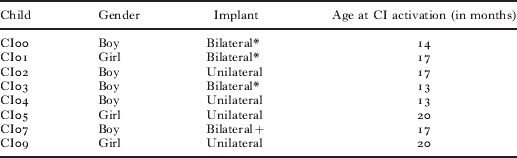
The participants were a group of eight children from monolingual Spanish-speaking families. All the children had profound bilateral deafness confirmed in the first three months of life, and had been implanted in the second year of life (see Table 1). The children were recruited from two Spanish implantation centres: Hospital Universitario Materno–Infantil de Las Palmas (Canary Islands) and Hospital Universitario Virgen de las Nieves (Granada, Spain). The participants had no impairment associated with deafness, and none of them was preterm. Scores in the LittlEars (Coninx et al., Reference Coninx, Weichbold, Tsiakpini, Autrique, Bescond, Tamas and Brachmaier2009) auditory perception questionnaire after twelve months of CI use were close to ceiling in all children (M=34·75; SD=·5; Max=35), which showed that hearing levels were optimal for a CI user.
Demographic data for the CI group
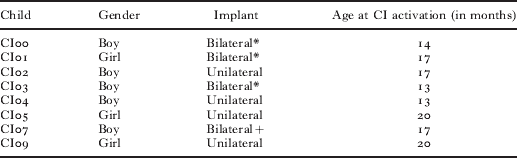
notes: * simultaneous implantation in both ears;+sequential implantation – second implant 18 months after the first implant.
Materials
The data for this study come from a longitudinal database of speech samples of interactions between each child and one adult (mother, father, or speech therapist). Samples of 30 minutes were videotaped on a Sony semi-professional digital video camera recorder DCR-TRV950E Pal. A sampling rate of 48 kHz was used for the recordings. The first session with each child was obtained before CI activation. Then, one speech sample was obtained every 1·5 months for one year, and after 15 and 18 months of CI use. For the present study, we selected speech samples from the first year of CI use (9 sample sessions per child).
All the samples were transcribed according to the CHAT format (MacWhinney, Reference MacWhinney2000) and a broad phonological transcription was produced for vocalizations and words. Transcriptions include all the vocalizations together with the spontaneous and imitative words produced by the children. Transcriptions of vocalizations did not distinguish voicing in stop consonants (e.g., [p] and [b] were treated as a single consonant type; McCune & Vihman, Reference McCune and Vihman2001). Praat acoustic analysis software (Boersma & Weenink, Reference Boersma and Weenink2010) was used to confirm perceptual judgements whenever it was considered necessary.
Corpus annotation and coding
(a) canonical babbling (CB) onset: An utterance is a vocalization or group of vocalizations separated from others by >1 second or ingressive breath (Nathani, Ertmer & Stark, Reference Nathani, Ertmer and Stark2006). Only productions that were adult-like (i.e., including a vowel-like sound or a combination of vowel and consonants) were classified as vocalizations. An utterance was classified as CB if it included the occurrence of at least one consonant–vowel or vowel–consonant syllable, with rapid transition between consonant and vowel (Oller & Lynch, Reference Oller, Lynch, Ferguson, Menn and Stoel-Gammon1992). The onset of babbling was taken to occur when the proportion of babbled utterances on the total number of analyzed utterances exceeded ·2 (Oller & Eilers, Reference Oller and Eilers1988).
(b) ratio ofCFWs. CFWs were defined as (imitative or spontaneous) words: (i) which in adult speech include at least one consonant in onset position; (ii) which were produced by the child as a sequence of vowels (i.e., with no evidence of consonantal features). Examples of CFWs are /'i.a/ for the verb mira (/'mi.ɾa/ ‘look’-imperative) or /'o.e/ for the proper name Jorge (/'xoɾ.xe/). In contrast, one-vowel words such as /e/ for el ‘the’ or en ‘in’ were not classified as CFWs. This association between CFWs and onset omission was motivated by dialectal considerations (i.e., in the dialects of the participants, coda consonants tend to be omitted). CFWs were identified perceptually. Sequences of glottal+vowels were not considered CFWs. The ratio of CFWs was the percentage of word tokens (imitative or spontaneous) which were classified as CFWs.
(c) accumulated word types: The cumulative number of non-imitative words produced in the nine sessions was calculated after three, six, nine, and twelve months of CI use. A word was defined as a production similar to an adult form with correct reproduction in at least one of these three criteria: consonants, vowels, and stress. Further, evidence of the child using the sounds with communicative intention was required. In some cases the transcribers asked for the help of parents and speech therapists to confirm their decision. It is highly probable that the children attempted other words which the transcribers could not recognize. However, it was assumed that the transcriptions included a relevant sample of the actual word productions.
Reliability
Consensual agreement between two investigators (the author and one research assistant) was required for the identification of vocalizations and early words. Vocalizations were encoded as being vowel-like only or consonant+vowel only if independent listener transcriptions agreed. Thus, data for vocalizations represent 100% agreement between transcribers that a minimum level was achieved. In order to determine agreement between coders, 10% of the corpus was re-coded. Cohen's kappa between coders was 74% for CB/non-CB, and 65% for the transcription of consonant types. Given the low level of agreement between the judges for the consonant types, the cases in which disagreement occurred were further examined. Three main sources of disagreement were identified: (i) weak articulation of some sounds types (e.g., dento-alveolar sounds /d/ /t/ /n/ and velar /x/), resulting in approximants which were difficult to interpret by the judges (e.g., /ɾ/ /&deltastroklower;/ /h/). Also, some children produced glottal stops, which are not part of adult language; (ii) Spanish approximants were also difficult to transcribe, possibly due to the fact that these sounds are less clear acoustically than other consonants or vowels; (iii) finally, there was confusion between articulatorily similar sounds such as voiceless stops (e.g., /t/ /k/). The difficulties encountered by the judges in identifying some sound types suggest that the productions of the participants are less clear than those of typical children.
RESULTS
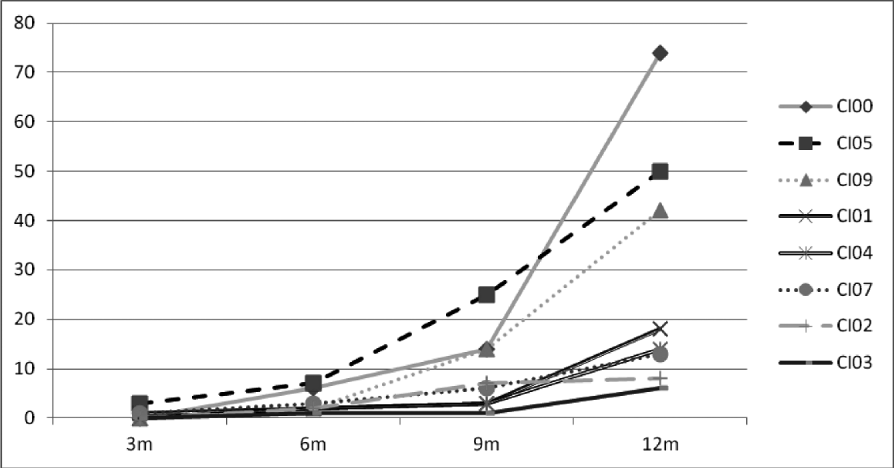
In the seventy-two sessions (i.e., 9 per child), a total of 3,831 vocalizations were annotated (M=478; SD=151). In the pre-implant session the children produced very few adult-like speech sounds (M=4·2, SD=4·8), most of which were non-canonical. The group mean for CB onset was 6·2 months (SD=1·9); see details in Table 2. Examination of word production showed that all children had relatively large lexicons after 12 months of CI use (see Figure 2). The mean number of word types was 28·1 (SD=24·5), and the mean number of words annotated by the parents in the MacArthur questionnaire was 68 (SD=52). A comparison with TD children was made based on the normative data of the Spanish version of the questionnaire. In the TD group the mean scores for the children aged 1;0 is 7·1 (SD=11·49), which is ten times smaller than the mean for deaf children with 12 months of implant use. Thus, the eight participants showed some of the characteristics observed in other studies: early CB onset and rapid lexical development in the first year of CI use.
Accumulated word types in speech samples. The codes of the children in the legend are sorted according to the number of word types in the last session.
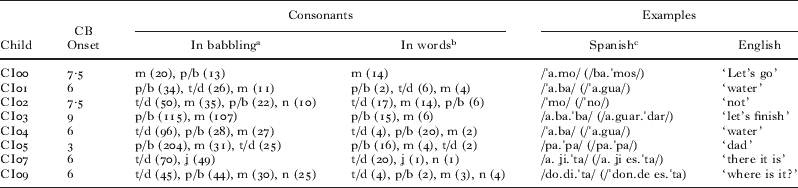
Consonants in babbling and in words
notes: a Sound types produced 10 or more times in babbling until canonical babbling onset session.
b Sound types produced in first 10 words.
c Adult form in parentheses.
In order to determine whether there was continuity between babbling and first words, we examined the consonants produced until CB onset in all canonical syllables and in the first ten words. Results showed that the sound types that children used in these words were always a subset of the sounds which were more frequent in CB. However, children differed in the specific sounds they preferred. For instance, child CI07 had a preference for producing dental sounds and very rarely produced labials, in both babbling and words. The opposite pattern was observed in child CI00.
CFWs were relatively frequent (>20%) in only one child (CI00). For this child, the ratio of CFWs was 35% between 6–9 months, and 20% over the period 9–12 months. Ratios of CFWs close to 10% were observed in CI09 over the period 6–9 months, and in CI05 over the period 9–12 months. Thus, results did not confirm that frequent production of CFWs are common among Spanish CI users. As CFWs might merely be a case of generalized onset omission, we examined the production of all the syllables produced by the children. Onset omission represented a 44% ratio in child CI00 and 19% in child CI09. Child CI07 never omitted onsets. For the remaining children the ratio of onset omission ranged between 4% and 9%. Thus, results are similar for CFWs and onset omission. Considering that in Adi-Bensaid and Tubul-Lavy's (2009) study, CFWs represented over 40% of the productions, our results indicate that other factors apart from the syllable structure might explain the production of CFWs.
In order to understand why CFWs and onset omission were frequent only in some children, we further explored the productions of these children. The three children who produced more CFWs (i.e., CI00, CI05, and CI09) were the ones who had larger lexicons. Interestingly, the words produced as CFWs were not stable. For instance, child CI00 produced the proper name Ale in four different ways in session nine: /'a.e/, /'a.je/, /'a.we/, and /'a.ʝe/. Further examination revealed that inconsistencies were also relatively common in words which were not produced as CFWs. For instance, child CI09 produced the word /a.'θul/ ‘blue’ in four different ways in the last session: /pa.'?u/, /a'bu/, /pa'pu/, /a'pu/. For the remaining five children we did not find clear evidence of token-to-token variability. However, the few examples of inconsistency were observed in the final sessions. For instance, in the ninth session, child CI04 produced four times the word /'a.gua/ ‘water’. On all four occasions he said /'a.ba/. In contrast, in the twelfth session he produced the word /a.'dios/ ‘goodbye’ in three different ways: /a.'do/, /a.'io/, and /a.'ʝo/. In sum, we did not find clear evidence of inconsistency in the transition from babbling to words. However, there was evidence that inconsistency tended to increase as children advanced into the one-word period.
DISCUSSION
This study explored the transition from babbling to words in a group of eight Spanish-learning CI users. Two research questions were addressed: (i) Is there continuity between babbling and early words? (ii) Do they produce CFWs?
As regards the first question, we found that all children used in their early words sound types which were relatively frequent in their babbled utterances. It is important that the reliability measure for the identification of consonants was low, which might raise some doubts regarding the validity of these results. However, the fact that continuity was observable in all the participants indicates that it might be a robust phenomenon. This confirms our prediction that CI users use vocal motor patterns learned during babbling to guide early word production, similarly to typical children and to various atypical populations (Vihman et al., Reference Vihman, Macken, Simmons and Miller1985; McCathren, Yoder & Warren, Reference McCathren, Yoder and Warren1999). Our results provide further support for the proposal that CI users show robust categorization skills (Bouton et al., Reference Bouton, Serniclaes, Bertoncini and Cole2012)
The examination of CFWs revealed that these productions were frequent (>30%) in only one child, and relatively frequent in two more children. It could be argued that there might be other forms of inaccurate production. Indeed, the transcribers' difficulties might be associated with phonetic inaccuracy. Thus, it is possible that a finer comparison of the productions of TD/CI might reveal further differences in consistency. Even if CFWs were not very frequent in these children, it seems that they are notably more frequent in Spanish than in Dutch. Therefore, we may ask why CFWs are more frequent in some languages (e.g., Hebrew/Spanish) than in others (e.g., Dutch/English). One possibility is that it is related to the fact that the child pays attention preferentially to the elements of the input which are more salient. Phonological saliency takes into account the role of each syllable component in carrying and differentiating lexical information (Hua & Dodd, Reference Hua and Dodd2006). In languages with more basic syllables (e.g., Hebrew/Spanish), vowels are more salient and indeed they can provide sufficient information for word recognition. In contrast, in languages with more complex syllables (e.g., Dutch/English), consonants may be more salient than vowels. Thus, the presence of CFWs might be associated with the degree of saliency of consonants in each language. Finally, the fact that CFWs were observable only in children advancing more rapidly might indicate that in these children there is an asynchrony between general cognitive skills and productive language skills (Ertmer & Mellon, Reference Ertmer and Mellon2001). That is, they have the need to communicate but not the tools to do so.
To conclude, the results of this study provide support for the proposal that CI users guide early word production by typical (pre)linguistic representations. We did not find clear evidence that their productions are inconsistent in the transition between babbling and words.
STUDY 2: WORD FORMS DURING THE ONE-WORD PERIOD
The results of Study 1 suggested that inconsistency might become apparent only when children have sufficiently large lexical stores. Such results motivate the need to explore consistency in the one-word period (i.e., independently of the time of implant use). Thus, a second study was conducted to examine if productions in this period are inconsistent and if, despite that, they provide evidence that children develop typical linguistic representations.
In order to determine if CI users' representations are typical, we focused on prosody. It is relevant that in this period prosodic structures tend to be more stable than segments both in typical children (Demuth, Reference Demuth, Morgan and Demuth1996) and in children with inconsistent production (Tubul-Lavy, Reference Tubul-Lavy2012). In addition, the truncation of long words is a robust phenomenon in Spanish-learning children (Gennari & Demuth, Reference Gennari, Demuth, Hughes and Green1997). Thus, the data from truncation in Spanish-learning children seem most appropriate to explore whether CI children develop typical prosodic structures.
Two questions were addressed:
1. Do CI children truncate long words as TD children do? Given the previous evidence that CI users develop typical prosodic structures, we expected truncations to be observable in CI users.
2. Are CI users more inconsistent than TD children? Based on previous evidence and on the results of Study 1 in this article, it was hypothesized that CI users' word forms would be highly variable.
In order to establish if children were inconsistent, we followed Dodd (Reference Dodd2005) in assuming that inconsistency must be determined quantitatively. She proposed that a ratio of over 40% inconsistent production in lists of twenty-five words repeated three times can be taken as evidence of inconsistency. In this study, data were obtained from spontaneous speech samples for which such a measure could not be used. However, it was assumed that if CI children were inconsistent, the ratios of token-to-token variability would be significantly higher than in TD children. For this reason, the results of the CI participants were compared with data from three typical children obtained from the CHILDES database (http://childes.psy.cmu.edu/): the Ornat, Aguirre, and Irene corpora.
METHOD
Participants and materials
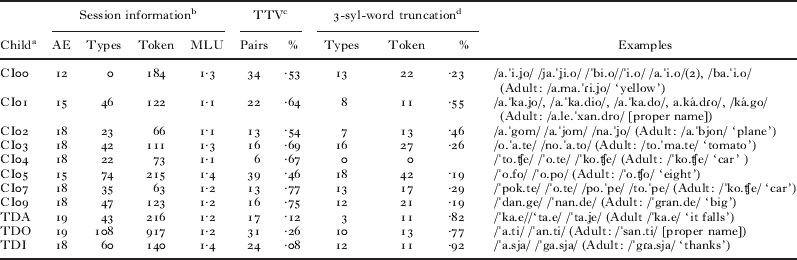
The main participants in this study were the eight deaf children described in Study 1. For each CI participant, we selected one session in which MLU was closest to 1·2 (i.e., at the end of the one-word period), and at which the child produced a minimum of forty word types. In three cases, we had to select sessions with fewer word types because the children were not very talkative (see details in Table 3). The three TD participants' samples were selected because the children were at the end of the one-word period (i.e., 1 <MLU <1·5) and the transcriptions provided sufficient phonetic details. Table 3 indicates the session and the number of types and tokens for each child.
Data analyses
(a) word truncation ratio. We selected all the word tokens produced by the children which in adult form had three or more syllables. A word form was classified as truncated if the child omitted any of its syllables (see example in Figure 1). The ratio of truncated words was the percentage of truncated tokens over the total number of long word tokens.
(b) token-to-token variability. Words produced with different segments for the same syllables were classified as variable. Words which only differed due to syllable omission were considered identical. Accordingly, /a.ˈpa.to/ /ˈpa.to/ were classified as identical, but /ˈpa.to/ /ˈta.to/ /ˈa.to/ were classified as different. In order to avoid the effect of the speech sample size, variability was calculated based on the first two productions of each word type following these steps. First, we selected all the word types that the children produced twice or more. Words with no onset consonant in the adult form were excluded (e.g., the word ahí /a.'i/ ‘there’). Then, following Grunwell (Reference Grunwell and Yavas1991), each pair was categorized as: (i) stable and correct; (ii) variable and correct (i.e., one correct, one incorrect); (iii) stable and incorrect; and (iv) unstable and incorrect (two incorrect).
RESULTS
The total number of types produced by the CI children was 368 (M=43·6; SD=17·6). The TD children produced 211 word types (M=70·3; SD=33·7) (see Table 3). The multisyllabic words selected to explore truncation (i.e., >2 syllables) provided evidence that the CI/TD children had different lexicons. CI children produced 51 words with four or more syllables. Two children produced two-thirds of all those long words: CI00 (N=15) and CI05 (N=16). In contrast, only one instance of a long word was observed in the TD children. Examination of these very long words showed that 71% of these words were truncated to three syllables, and another 20% were truncated to two syllables. The CI children produced a total of 153 3-syllable word tokens, and the percentage of truncated forms was ·31 (range ·19–·55). The TD children produced 25 3-syllable word tokens, and the percentage was ·80 (range: ·72–·92). That is, the CI children produced proportionally longer words and they truncated them less frequently. The difference in the ratio of truncations was statistically significant (Mann–Whitney, two-tailed test U=·000, p=·017) (see Table 3 under 3-syl-word truncation). While the ratio of truncated words is smaller in the CI group than in the TD children, it is relevant that actual truncations were similar in both groups. For instance, CI00 produced the four-syllable word /a.ma.'ɾi.ʝo/ ‘yellow’ seven times (see the examples in Table 3). The child omitted one syllable in five cases and two syllables in two cases. All the omitted syllables were pre-tonic ones, for which all his productions conformed to the typical prosodic structure (see Figure 1). Finally, we did not find examples of truncations which did not conform to the typical prosodic structure (e.g., omission of tonic or post-tonic syllables).
Token-to-token variability and truncation of 3-syllable words
notes: a Codes CI01 to CI09 correspond to the CI children. Codes TDA, TDO, and TDI correspond, respectively, to the child in the Aguirre, Ornat, and Irene corpora from the CHILDES database.
b AE (auditory age in months): for the CI group it is time since implantation. For the TD children it is chronological age. Token, Types, MLU: total number of non imitative word types and tokens, and mean length of utterance in the session.
c TTV (token-to-token variability): is the number of word types with consonant in onset position produced twice or more (the first two productions are selected). % refers to the ratio of pairs which are produced in two different forms.
d Types, Token: number of word types and tokens with three syllables (in the adult form). The % column indicates the percentage of long word tokens which are truncated.
The total number of types produced two or more times was 159 in the CI group, and 72 in the TD group. The percentage of variable types was ·63 in the CI group and ·15 in the TD group. The difference was statistically significant (Mann–Whitney, two-tailed test U=·000, p=·012). Examination of the word pairs in terms of the Grunwell (Reference Grunwell and Yavas1991) classification offered further details. In the CI group most pairs were unstable and incorrect (60%) or stable and incorrect (35%). Only 2% were stable and correct. In the TD children most pairs were stable and incorrect (52%) or stable and correct (35%). Another 16% were unstable and incorrect. This means that variability was higher in the CI children, and that when CI children were stable they did not produce the adult form.
In order to determine whether such results were due to differences in the attempted word forms, we examined how stability was related to word length in syllables. In the TD group, 2-syllable words represented 77% of the selected items, and 3-syllable words another 19%. In the CI group the percentages were 58% and 33%. In the TD group, variability was slightly higher in longer words (25% vs. 16%). In the CI children, variability was almost identical in both cases (70% vs. 69%). This reinforces the idea that variability is very high in the CI group.
Close examination of variable word forms revealed some individual differences. In the most advanced children in terms of lexical development (see Figure 2), variability was observable only with specific consonants. For instance, for child CI00 production of labial (/p/ /b/) and dental (/t/ /d/) stops was highly stable, while velar stops and fricatives were clearly more variable. In less advanced children (e.g., in child CI07), even the consonants which tend to be acquired earlier (e.g., /p/ /b/ /m/) were highly variable. These results suggest that variability might be a temporary phenomenon.
DISCUSSION
Two questions were addressed in the present study, one related to the tendency to truncate long words, and another relative to the stability of word forms. The examination of truncation revealed that, despite being a relatively infrequent phenomenon, whenever CI users truncated long words, they adapted them to typical prosodic structures. Moreover, we did not find examples of truncations which did not conform to typical prosodic structures. Thus, as predicted, the CI users' productions seemed to be constrained by the prosodic structures of the Spanish language. These results provide further evidence that CI recipients tend to develop typical prosodic representations (Titterington, Henry, Kramer, Toner & Stevenson, Reference Titterington, Henry, Kramer, Toner and Stevenson2006; Kim & Chin, Reference Kim and Chin2008).
The examination of token-to-token variability provided a quantitative measure of variability. There are two aspects which are relevant to interpret such measure. First, the ratio of variability was significantly higher in the CI users than in the typical children. Second, Dodd (Reference Dodd2005) proposed that ratios of over 40% of token-to-token variability indicate that a child is inconsistent. Indeed, the ratio of variable word pairs was well below 40% in all the TD children and well above 40% in the CI participants. Thus, results confirmed that all the CI children are inconsistent.
It is relevant that there were clear individual differences in terms of segmental accuracy. In some children, variability involved almost any segment. In other children, it involved only consonants acquired later (e.g., fricatives). Interestingly, the children who showed earlier evidence of variability (i.e., in CFWs; see Study 1) were the same ones who showed less severe forms of variability (i.e., involving fewer consonants). This further confirms that variability might be a transitory phenomenon.
The present results are relevant because they indicate that inaccuracy is not exclusive to English-learning CI children (Warner-Czyz & Davis Reference Warner-Czyz and Davis2008; Warner-Czyz et al., Reference Warner-Czyz, Davis and MacNeilage2010; Ertmer & Goffman, Reference Ertmer and Goffman2011). Instead, it seems that the phenomenon might be characteristic of CI users during the one-word period independently of the ambient language, or at least independently of the syllable structures which are dominant in each language. To conclude, the results of this study have confirmed that while CI users develop typical prosodic representations, their productions are highly unstable in the one-word period.
GENERAL DISCUSSION
Previous research on the development of cochlear implant users has found that, despite the general benefits of CIs, these children are highly heterogeneous in terms of their language outcomes. Partly due to the heterogeneity of this population, one issue which remains unclear is up to what point the process of language development is typical in these children. Some studies have proposed that CI users have mainly production deficits (i.e., no perception deficits) which are caused ultimately by the period of auditory deprivation, rather than by the limitations of the CI (e.g., Houston & Miyamoto, Reference Houston and Miyamoto2010). However, such proposal is in contradiction with the evidence that perception and production are closely connected in the brain (Guenther, Reference Guenther1994; Pulvermuller, Reference Pulvermuller2005; Simmonds et al., Reference Simmonds, Wise and Leech2011). If perception and production are connected, then we should find relatively parallel deficits in both domains.
A recent study by Bouton et al. (Reference Bouton, Serniclaes, Bertoncini and Cole2012) has suggested a potentially relevant hint to explain the language outcomes of CI users. The authors found that CI children showed typical categorization (i.e., top-down) skills together with atypically low perceptual accuracy. Based on previous evidence, we speculated that low accuracy in perception might result in inconsistent production. That is, even if they developed typical linguistic representations, their productions might be inconsistent. In order to answer this question we explored the productions of eight Spanish-learning CI users in the transition from babbling to words, and in the one-word period.
The results of Study 1 could not confirm such a contrast. The children did show evidence of typical categorization skills (i.e., continuity), but the evidence of inaccuracy was very limited and mostly observable as children advanced into the one-word period. In contrast, Study 2 did show a clear contrast between typical prosodic representations and atypically unstable productions. Thus, it seems that the contrast in terms of representations/consistency might be an emerging feature of the development of CI users.
Two issues require further explanation. First, why are CI children inconsistent? And second, why does inconsistency seem to increase in the one-word period? Developmental research has proposed that inconsistency may signal a transitional period as more mature realizations develop (Grunwell, Reference Grunwell1981; Dodd & Bradford, Reference Dodd and Bradford2000; Forrest, Elbert & Dinnsen, Reference Forrest, Elbert and Dinnsen2000). Thus, the fact that CI children are inconsistent may indicate that they are advancing towards more mature word productions, and that this is a cognitively demanding task for them. From a psycholinguistic perspective, it has been proposed that inconsistency may indicate difficulty in assembling a phonological template for the production of an utterance (Dodd, Reference Dodd2005). However, why should the limitations of the implant cause such a deficit? A more precise answer can be proposed in terms of recent models of speech production which emphasize the role of auditory feedback for the development of articulation (e.g., the DIVA model; Guenther, Reference Guenther1994; Guenther et al., Reference Guenther, Ghosh and Tourville2006).
Guenther et al. (Reference Guenther, Ghosh and Tourville2006) propose that articulation is controlled by two types of feedback: direct auditory and oro-sensory. During the babbling stage the child creates links between motor patterns produced arbitrarily and the resulting sounds. Later on, the child uses these links to attempt the production of specific sound types, and auditory and oro-sensory feedback to refine motor patterns. Thus, perception of our own productions becomes crucial to fine-tune the articulation of an increasingly sophisticated set of motor patterns. As the CI mediates auditory feedback, its technical limitations (i.e., low temporal and spectral resolution) may potentially disturb production. But why should their production be inconsistent and not merely consistently incorrect? It has been shown that when the transmission of information in the brain is inefficient (due to neural noise), production may become inconsistent (Terband & Maassen, Reference Terband and Maassen2010). In the case of CI users there is no reason to consider that neural noise causes inconsistency. However, it is possible that a similar effect might occur if the signal sent to the brain is noisy. Note that one of the most commonly cited limitations of today's CIs is perception in noisy environments (Peters, Moore & Baer, Reference Peters, Moore and Baer1998). This may indicate that the signal is not robust enough, because of which it may degrade easily (i.e., it may become noisy). In sum, as the CI mediates auditory feedback, its technical limitations might reduce the capacity to fine-tune speech motor patterns, resulting in a similar effect to the one observed in children with inconsistent production.
The fact that inconsistency is observable more clearly in the one-word period may also be related to the poor feedback provided by the CI. In the transition from babbling to words, children make a limited number of sound types. That means that the information provided by the CI may be sufficient for these basic distinctions. However, as the inventory of segments and syllables increases, the child may require much more acoustic precision than that which the CI may offer. Note, however, that the limited information provided by the CI may disturb aspects of vocal prelinguistic development which have not been explored in Study 1. For instance, the fact that babbling and words co-exist for a relatively long period, as noted by Ertmer and Inniger (Reference Ertmer and Inniger2009), may indicate a difficulty in storing and using the first vocal motor patterns.
The results of these two studies lead to a reflection regarding the causes of the variability in the long-term outcomes of CI users. The fact that the long-term outcomes are variable might be associated either to individual pre-implant conditions, or to the environment (e.g., family, speech therapy, etc.) (e.g., Kirk, Miyamoto, Lento, Ying, O'Neill & Fears, Reference Kirk, Miyamoto, Lento, Ying, O'Neill and Fears2002; Nicholas & Geers, Reference Nicholas and Geers2006; Le Normand, Parisse & Cohen, Reference Le Normand, Parisse and Cohen2008). While we cannot rule out that pre-implant auditory deprivation has negative consequences for development, the present results, together with other perception and production studies, provide evidence that one major source of disturbance for CI children is derived from the limitations of the CI. We may speculate that without a stimulating environment some children might be incapable of overcoming such limitations, which might result in a tendency to increase the gap with those children living in privileged environments.
To conclude, the results of these two studies provide evidence that the CI provides sufficient information to develop typical linguistic representations but not to achieve consistent production rapidly. Future studies should further explore if there are differences in babbling between CI/TD children. Computer simulation models such as DIVA might also provide valuable information to clarify which are the potential consequences of CI hearing on development. Finally, cross-linguistic research should further explore whether children from different language backgrounds show similar developmental patterns, which might help to better identify the consequences of reduced perception for the development of productive language.