Introduction
Insect predators have been grouped as generalists and specialists, with both having variable uses in the biological control of insect pests. Owing to their wide prey range, generalist predators are sometimes considered as less useful in pest management (Harwood et al., Reference Harwood, Sunderland and Symondson2004; Harper et al., Reference Harper, King, Dodd, Harwood, Glen, Bruford and Symondson2005), as they consume both alternative as well as the target prey. However, they may be quite useful in the management of pest complexes of crops. Specialists, on the other hand, consume a single, or closely related species. Despite their differential suitability for biological control, it is essential to determine the prey against which the predator is likely to be more effective. For this purpose, the assessment of prey suitability in terms of development and survival is important.
Ladybirds are one of the important predatory biological control agents. Most predatory ladybirds feed on either aphids or coccids (a few feed on both), while some feed on mites, adelgids, aleyrodids, chrysomelid larvae and psyllids as well (Dixon, Reference Dixon2000). In the absence of natural prey some of these predaceous ladybirds are known to feed on fungal spores, pollen, honeydew and nectar (Lundgren, Reference Lundgren2009). Aphidophagous ladybirds are usually generalists with their prey range categorized into essential, alternative and rejected food (Hodek and Honek, Reference Hodek and Honek1996). Predatory ladybirds rely on essential prey to support their reproduction and on alternative prey for survival (Hodek, Reference Hodek, Strouhal and Beier1962; Mills, Reference Mills1981). Malcolm (Reference Malcolm and Crawley1992) coined the terms included, peripheral and excluded as alternatives to essential, alternative and rejected prey. Rejected prey is avoided every time, even in the face of the consequences of starvation, to death. Michaud (Reference Michaud2005) differentiated prey suitability as optimal, adequate and marginal.
This difference in prey suitability has been attributed to their nutritive value (Phoofolo et al., Reference Phoofolo, Giles and Elliot2007), costs associated with their capture (Rana et al., Reference Rana, Dixon and Jarosik2002) and also their assimilation and utilization of nutrients and energy post prey consumption (Bilde and Toft, Reference Bilde and Toft1999; Vivan et al., Reference Vivan, Torres and Veiga2003). Predators may be satiated either by quantitatively or qualitatively selecting the prey for consumption. A quantitatively high but qualitatively poor prey consumes much energy of the predator, while a quantitatively low, but qualitatively high, food is likely to be beneficial for the predator allowing much gain in nutrition and energy. High-quality prey provide better growth and development with lower mortality, although larvae sometimes do not show a preference for high-quality prey (Ferrer et al., Reference Ferrer, Dixon and Hemptinne2008). Larvae and adults may differ in nutritional requirements, i.e. a prey suitable for larval development may not be suitable for adult reproduction (Michaud, Reference Michaud2000, Reference Michaud2005). Although aphid prey suitability has been studied for many ladybird beetles, viz. Adalia bipunctata L. (Kalushkov, Reference Kalushkov1998), Coccinella septempunctata L. (Omkar and Srivastava, Reference Omkar and Srivastava2003), Coccinella transversalis (Fab.) (Babu, Reference Babu1999; Omkar and James, Reference Omkar and James2004), Propylea dissecta (Mulsant) (Pervez and Omkar, Reference Pervez and Omkar2004; Omkar and Mishra, Reference Omkar and Mishra2005), Micraspis discolor (Fab.) (Omkar, Reference Omkar2006) (all Coleoptera: Coccinellidae) and many more, it is poorly or almost not studied in the ladybird beetle Anegleis cardoni (Weise) (Coleoptera: Coccinellidae).
Anegleis cardoni is a medium-sized ladybird beetle. It is bright yellow with one black median stripe at the joint of both the elytra and two linear markings (one is inwardly and other one is outwardly curved) on each elytron. It occurs in southern and northern parts of India (Puttarudriah and Channabasavanna, Reference Puttarudriah and Channabasavanna1953; Ghorpade, Reference Ghorpade1979). Omkar and Bind (Reference Omkar and Bind1993) reported A. cardoni from Lucknow. It is reported to feed voraciously on whiteflies (Ramani et al., Reference Ramani, Poorani and Bhumannavar2002) and scale insect pests (Sundararaj, Reference Sundararaj2008). Afroze (Reference Afroze2000) studied the feeding of A. cardoni on aphids (viz. Aphis gossypii Glover, Brevicoryne brassicae (L.), Macrosiphum miscanthi Takahashi, and M. pisi Kltb. [all Hemiptera: Aphididae]) and coccids and pseudococcids. Besides this, it is also a predator of Aphis craccivora Koch, A. gossypii and Lipaphis erysimi (Kalt.) (all Hemiptera: Aphididae) (Omkar et al., Reference Omkar, Kumar and Sahu2009) and many other aphid species (Aphids of Karnataka; http://www.aphidweb.com). Therefore, this study was designed to assess prey suitability for A. cardoni in terms of growth, development and survival on ten locally abundant aphid species to answer the following two questions: (a) do the different aphid species provide an equal chance for growth and development of A. cardoni?, and (b) which aphid species ensures faster development and higher survival when A. cardoni is fed on a monotypic diet? Results will help in identifying the aphid(s) that are more suitable for the enhanced production of A. cardoni and also in determining the target prey against which A. cardoni can be used as a biological control agent in the field.
Materials and methods
Laboratory maintenance
Ten locally available, aphid–host plant complexes, viz. Uroleucon compositae (Theobald) (Hemiptera: Aphididae) from safflower [Carthamus tinctorius Linnaeus (Asteraceae)]; Acyrthosiphon pisum (Harris) (Hemiptera: Aphididae) from pea [Pisum sativum Linnaeus (Leguminosae)]; Rhopalosiphum maidis (Fitch) (Hemiptera: Aphididae) from sorghum [Sorghum bicolor (Linnaeus) Moench (Poaceae)]; Rhopalosiphum padi (Linnaeus) (Hemiptera: Aphididae) from wheat [Triticum aestivum Linnaeus (Poaceae)]; Myzus persicae Sulzer (Hemiptera: Aphididae) from black nightshade [Solanum nigrum Linnaeus (Solanaceae)]; Hysteroneura setariae (Thomas) (Hemiptera: Aphididae) from Bermuda grass [Cynodon dactylon (L) Pers. (Poaceae)]; B. brassicae (Linnaeus) from cabbage [Brassica oleracea Linnaeus (Brassicaceae)]; Hyadaphis coriandri (Das) (Hemiptera: Aphididae) from coriander [Coriandrum sativum Linnaeus (Apiaceae)]; Aphis nerii Boyer de Fonsclombe (Hemiptera: Aphididae) from milkweed [Calotropis procera (Aiton) (Asclepiadaceae)] and Ceratovacuna silvestri (Takahashi) (Homoptera: Aphididae) from bamboo [Bambusa arundinacea (Retzius) Willd. (Poaceae)] were chosen for the study.
To establish a stock culture, adults of A. cardoni were collected from False Ashoka (Polyalthia longifolia Sonn. [Annonaceae]) trees located on the University of Lucknow campus, India (26°50′N, 80°54′E). Adults were paired and allowed to mate in Petri dishes (9.0 × 1.5 cm) in an environmental test chamber (ETC) at 27 ± 2°C, 65 ± 5% relative humidity and a 14 h light–10 h dark photoperiod, and supplied with ad libitum monotypic aphid diet (one of the above) together with host plant leaves, collected from the field. After egg laying, the adults were shifted to a fresh Petri dish (size as above). Post hatching, the larvae were reared in glass beakers (9.5 × 6.5 cm) until adult emergence on the same aphid species, as provided to the parental generation. The aphid supply was replenished every 24 h. F1 adults were further mated and eggs laid by the females were used for the experimental study. Monotypic supply of the above listed aphid–host plant complexes was maintained throughout the study.
Experimental design
Immature development and survival
To evaluate the larval performance of the different aphid species, 100 eggs were randomly selected from the stock culture and kept in ETC under controlled abiotic conditions. The incubation period and the number of eggs that were hatched were recorded. The hatched larvae were transferred to glass beakers (size as above). Each beaker consisted of five larvae, which were provided with a sufficient amount of aphids together with host plant leaves. Care was taken to provide the same aphid–host plant complex to the larvae, as was provided to their parental stock. Aphid supply together with host plant leaves was replenished every 24 h. Mean values per beaker were considered as values of a replicate and were used for analysis. The number of larvae surviving to the next stage was recorded until adult emergence. The developmental durations of each instar, pre-pupa and pupa were also recorded. All observations were taken twice a day at 12-hourly intervals. The fresh weight of the adults was recorded within 24 h after emergence.
The percentage of immature survival (number of adults emerged/number of first instars × 100), percentage of pupation (number of pupae/number of first instars × 100), developmental rate (1/total developmental period), growth index (percentage of pupation/mean larval duration), generation survival (number of females that emerged/number of first instars) and sex ratio (number of females/total adult emergence) were recorded. The experiment was conducted on each of the ten aphid species.
Data analysis
The results were subjected to one-way ANOVA and the means were compared using Tukey's highly significant differences (HSD) test with α = 0.05 (MINITAB, 2003). To investigate the relationship of the rate of development with the sex ratio and weight of adults, Pearson's correlation coefficient was used to test for a correlation between sex ratio and development rate, development rate and weight of the female, and log weight male and log weight female.
Life table parameters
Life table analysis is an important tool in ecology to assess the performance of a predator. Life table attributes were calculated following Morris and Miller (Reference Morris and Miller1954) and Southwood (Reference Southwood1978):
(a) Age-specific life table
For the construction of an age-specific life table, the total number of larvae that survived and died were recorded daily and the following parameters were calculated:
x = age in days
lx = age-specific survival, i.e. the number of individuals that survived to enter the xth age interval
dx = the number dying within xth age interval
100qx = apparent mortality, dx as a percentage of lx
Life expectancy
This is the average life expected or average life remaining for the individuals of A. cardoni of a particular stage (x) and was calculated as:

where Lx = the average number alive during any particular stage, calculated as:

Tx = the total number of individuals of stage units beyond the stage x, calculated as:

(b) Stage-specific life table
Stage-specific survival and mortality of eggs, larvae and pupae were recorded for the construction of stage-specific life tables.
x = stage (i.e. eggs, larvae, pupae and adults)
lx = stage-specific survival, i.e. number of individuals surviving at the beginning of stage x
dx = number dying within the age interval x
100qx = apparent mortality, dx as a percentage of l x
100rx = real mortality, dx as a percentage of the original cohort size
k = a dimensionless measure of mortality within the age interval of x
K = total of k values, i.e. κ
Sx = survival rate of a stage.
Mortality:survivor ratio (MSR)
This shows the increase in the population that would have occurred if the mortality in the particular stage (x) had not occurred. This was calculated for a particular stage as:

Indispensable mortality (IM)
The mortality that would not occur in a population, if the factor causing it is not allowed to operate and was calculated as:

Results
Immature development and survival
When the larvae of A. cardoni were fed on A. nerii, predator larvae did not develop to the adult stage. The larvae died in the third instar stage. The developmental durations of the first and second instars on A. nerii were 4.37 ± 0.14 and 4.99 ± 0.08 days, respectively.
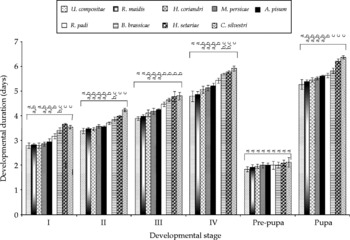
Results revealed an insignificant effect of prey species on incubation period (P = 0.978, F = 0.26, df = 8, 89) and pre-pupal period (P = 0.878, F = 0.46, df = 8, 89). The incubation periods were found to be minimum and equal (4.00 ± 0.21, 4.00 ± 0.15, 4.00 ± 0.15 and 4.00 ± 0.21 days) for U. compositae, R. maidis, M. persicae and H. coriandri, respectively. However, it was found to be maximum (4.20 ± 0.13 days) on C. silvestri. The pre-pupal period was found to be shortest (1.84 ± 0.10 days) when the larvae were fed on U. compositae and longest (2.13 ± 0.20 days) when fed on C. silvestri (Fig. 1).
Developmental durations (days) of different immature stages of Anegleis cardoni, fed on different aphid species. Different letters in a stage mean significant differences at the 5% level (Tukey's test); same letters mean non-significant differences at the 5% level.

Significant effects of prey species were recorded on the durations of the first (P = 0.001, F = 14.09, df = 8, 89), second (P = 0.001, F = 16.01, df = 8, 89), third (P = 0.001, F = 8.39, df = 8, 89), and fourth instars (P = 0.001, F = 11.24, df = 8, 89) and the pupal period (P = 0.001, F = 14.01, df = 8, 89). The developmental duration of the first instar was shortest (2.80 ± 0.11 days) on U. compositae and longest (3.67 ± 0.03 days) on H. setariae. The developmental durations of the second, third and fourth instars and pupa were the shortest (3.39 ± 0.11, 3.90 ± 0.08, 4.79 ± 0.21 and 5.27 ± 0.20 days, respectively) when fed on U. compositae and longest (4.24 ± 0.06, 4.81 ± 0.15, 5.92 ± 0.11 and 6.37 ± 0.07 days, respectively) when fed on C. silvestri. The total development period was also found to be shortest (26.00 ± 0.47 days) when fed on U. compositae and longest (31.21 ± 0.42 days) when fed on C. silvestri.
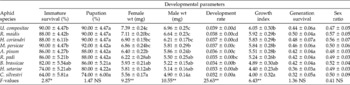
The mean weights of the males and the females, the percentage of immature survival, the development rate and growth index varied significantly, being highest when fed on U. compositae, R. maidis, H. coriandri and M. persicae, while being lowest when fed on C. silvestri and H. setariae (Table 1). The percentage of pupation, generation survival and sex ratio were not found to significantly differ with the aphid species consumed.
Developmental parameters of Anegleis cardoni when fed on different aphid species (df=8, 89)

Values are means ( ± SE). Different letters per column indicate values to be statistically different.
* and ** indicate F-values to be significant at P < 0.01 and P < 0.001, respectively; Tukey's test range = 4.51; df = 8, 89.
NS indicates F-values to be non significant at P>0.05.
Correlation analysis revealed a positive correlation between development rate and weight of female (r = 0.547, P = 0.001) and log weight male and log weight female (r = 0.736, P = 0.001). Development rate, however, showed insignificant correlation with sex ratio (r = 0.127, P = 0.223).
Life table parameters
(a) Age-specific life table
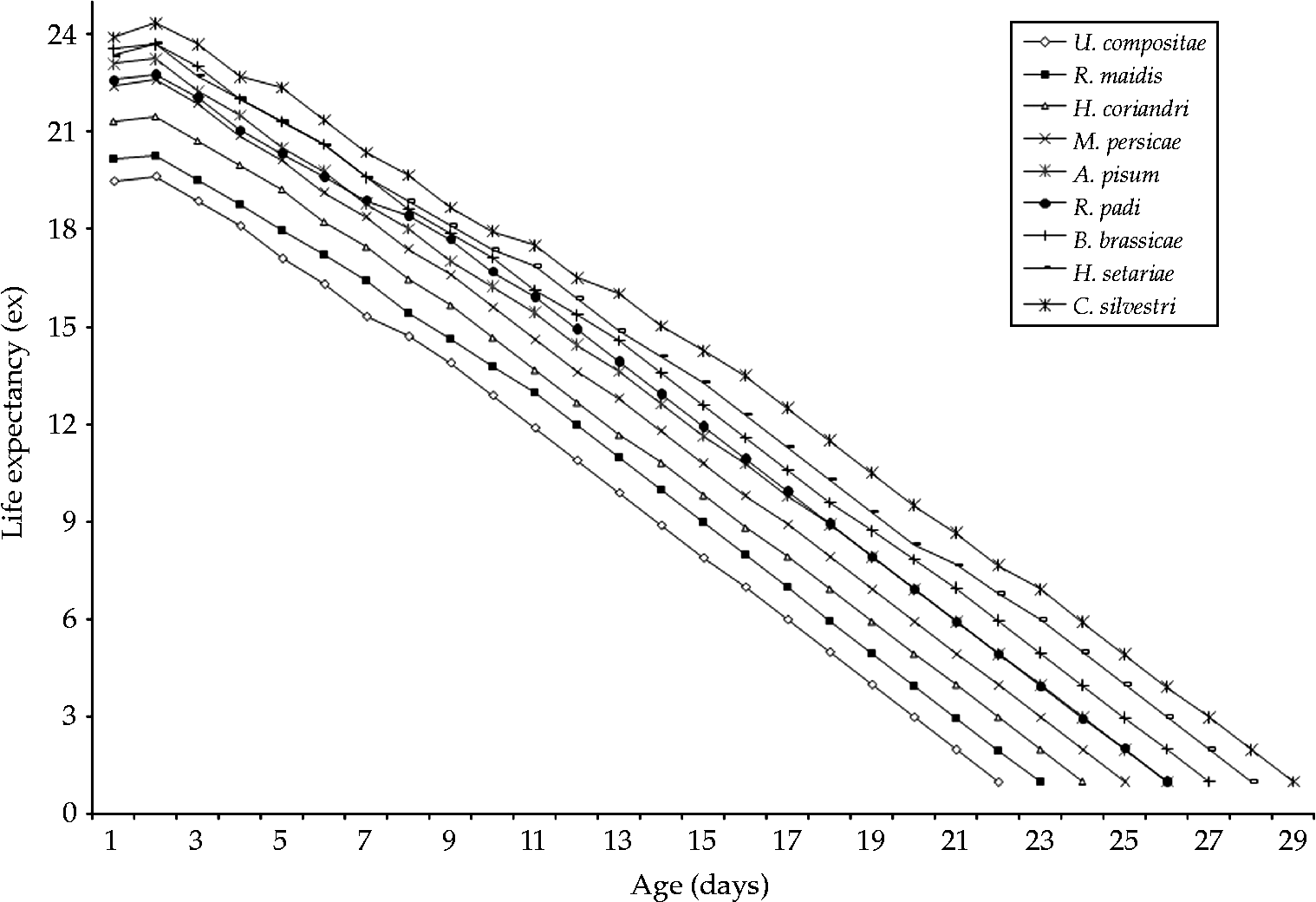
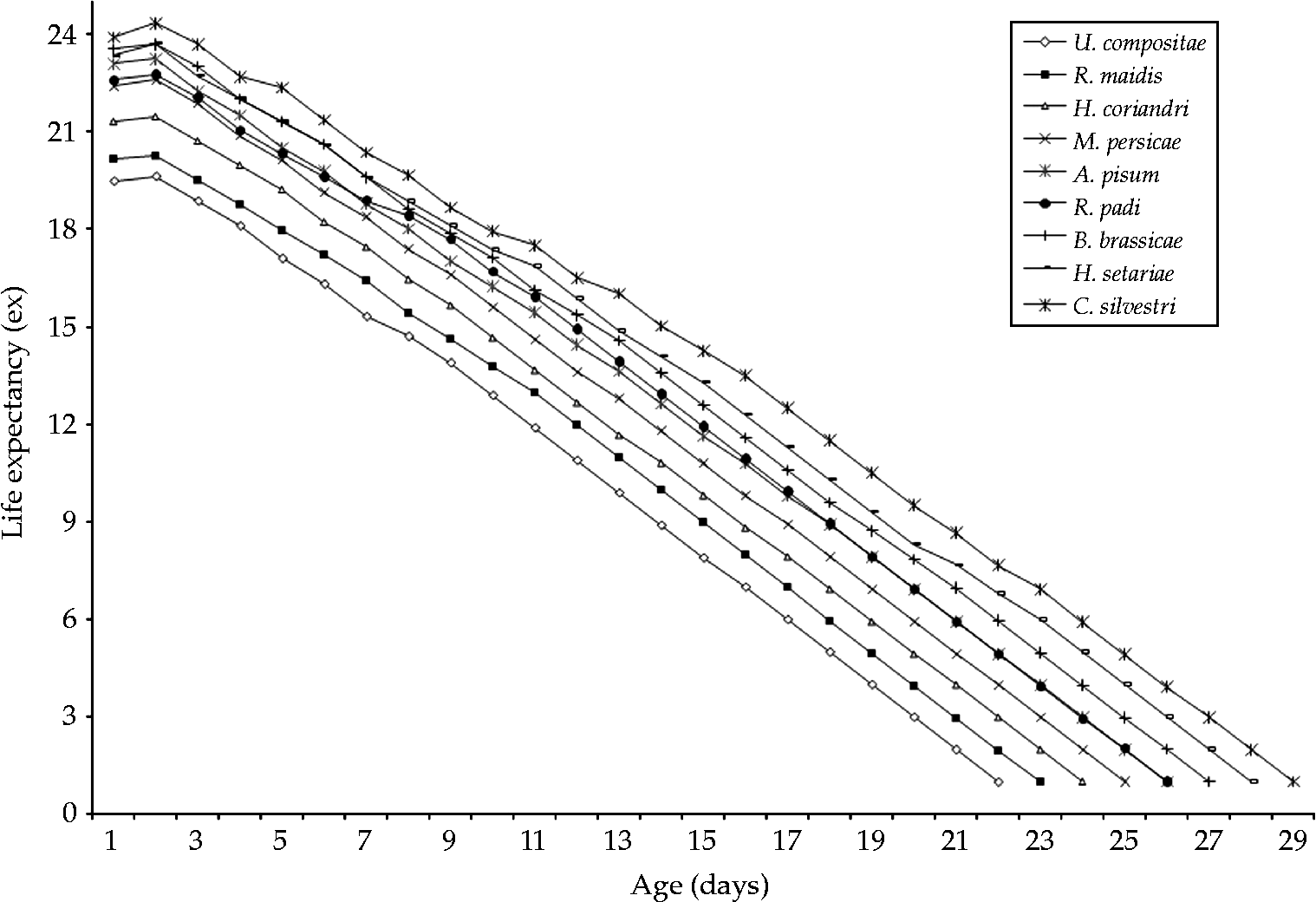
Data revealed that age-specific survival was highest in R. maidis and lowest in C. silvestri (Fig. 2). Apparent mortality was lowest when the larvae of A. cardoni were fed on R. maidis and highest when they were fed on C. silvestri. Results revealed that as the larvae passed on to the next age interval (x), their life expectancy subsequently decreased (Fig. 3). Life expectancy was found to be lowest in U. compositae followed by R. maidis, H. coriandri, M. persicae, A. pisum, R. padi, B. brassicae, H. setariae and C. silvestri. Life expectancy data revealed that the total lifespan of A. cardoni larvae in terms of development was lowest when fed on U. compositae, R. maidis, H. coriandri, and M. persicae, and highest when fed on C. silvestri and H. setariae.
Age-specific survival (lx) of Anegleis cardoni (from egg hatch to adult emergence), fed on different aphid species

Age-specific life expectancy (ex) of Anegleis cardoni (from egg hatch to adult emergence), fed on different aphid species
(b) Stage-specific life table
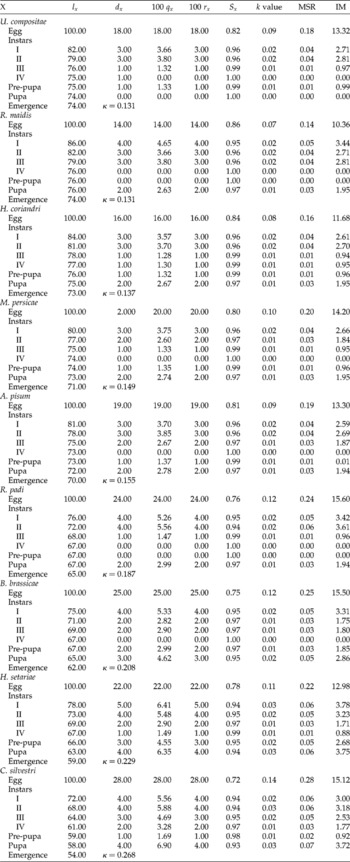
The stage-specific survival was highest on R. maidis and lowest on C. silvestri (Table 2). Apparent mortality and real mortality were lowest on R. maidis and highest on C. silvestri. However, the mortality values for ‘K’ were lowest and equal both for U. compositae and R. maidis. It was highest for C. silvestri.
Stage-specific life table of Anegleis cardoni, fed on different aphid species

MSR, mortality: survivor ratio; IM, indispensable mortality.
The MSR for the egg stage was lowest on R. maidis and highest when the parents were fed on C. silvestri. In the case of larval instars, MSR was found to be zero for the fourth instars on many aphid species (except H. coriandri, H. setariae, and C. silvestri). IM at the egg stage was lowest on R. maidis and highest on R. padi. For larval instars IM was lowest for fourth instar (except H. coriandri).
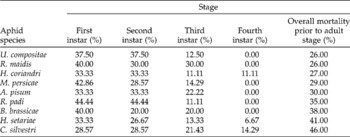
The overall mortality prior to the adult stage of A. cardoni was lowest on U. compositae, R. maidis, H. coriandri and M. persicae, while it was highest when fed on C. silvestri and H. setariae (Table 3). The first instars suffered the highest mortality regardless of the aphid species fed.
Percentage mortality in immature stages of Anegleis cardoni, fed on different aphid species

Discussion
Our results revealed that A. cardoni successfully fed on the different aphid species provided, except A. nerii. Each aphid species significantly influenced the various developmental attributes of A. cardoni, with certain species being more suitable than others. Mortality life table data revealed R. maidis as the most suitable aphid prey. However, the overall percentage of mortality did not differ between U. compositae and R. maidis. The developmental parameters, viz. the percentage of immature survival, adult weight, development rate and growth index was highest in U. compositae. Therefore, on the basis of the different parameters studied, U. compositae may be considered as the most suitable and C. silvestri as the least suitable aphid prey for the mass production of A. cardoni.
The lesser suitability of prey may be because of lower nutrient quality or lower palatability (Hodek, Reference Hodek1993). Variations in lipid and carbohydrate content are known to influence the various life attributes of the predator (Fischer et al., Reference Fischer, O'Brien and Boggs2004; Ziegler and Van Antwerpen, Reference Ziegler and Van Antwerpen2006). This can be a result of nutritional variability in aphids, which may be host plant derived. Phytophagous insects are also known to select plants on the basis of nutritional content (Price, Reference Price1997), causing significant influence on herbivores and in turn their predator's performance in terms of development and survival. The presence of nutritional phagostimulants (such as carbon and nitrogen) as well as defensive metabolites that directly affect the potential and survival rate of the predator may play a role in this (Awmack and Leather, Reference Awmack and Leather2002; Sarfraz et al., Reference Sarfraz, Dosdall and Keddie2006). Such an influence of the different host plants on the suitability of an aphid A. craccivora to the green lacewing Chrysoperla carnea (Stephens) (Neuroptera: Chrysopidae) has been reported (Balasubramani and Swamiappan, Reference Balasubramani and Swamiappan1998). Even for the ladybird Hippodamia variegata Goeze (Coleoptera: Coccinellidae), the suitability of A. gossypii from different host plants has also been reported (Wu et al., Reference Wu, Zhou and Pang2010), indicating that host plants significantly affect the ladybird's life attributes. The poor performance of A. cardoni fed on A. nerii may be attributed to the presence of some host plant-derived toxic substances, such as alkaloids, cardinolides and proteolytic enzymes (Seiber et al., Reference Seiber, Nelson and Lee1982; Morsy et al., Reference Morsy, Rahem and Allam2001). These substances have been reported to have larvicidal properties. Under controlled conditions, fractions from latex of C. procera (R. Br.) (Asclepiadaceae) were responsible for mortality in most of the first instars before reaching second instars in Aedes aegypti (Linnaeus) (Diptera: Culicidae) (Ramos et al., Reference Ramos, Bandeira, Freitas, Nogueira, Alencar, Sousa and Carvalho2006). In another study, chemical extracts from C. procera caused feeding repellence and increased larval and pupal mortality in Henosepilachna elaterii (Rossi) (Coleoptera: Coccinellidae) (Ahmed et al., Reference Ahmed, Zuhua, Bashier, Muafi, Zhongping and Yuling2006). Some predatory ladybird beetles have been found to feed directly on the prey's host plant tissue, which influenced their growth and development (Moser et al., Reference Moser, Harwood and Obrycki2008), although this was not observed in the present study.
Other than nutrition, prey suitability is also influenced by many factors, such as prey quantity (Dixon and Guo, Reference Dixon and Guo1993; Omkar et al., Reference Omkar, Sahu and Kumar2010), sex (Selander, Reference Selander1966), age (Sandlin and Willig, Reference Sandlin and Willig1993), and the size of the prey and the predator (Zerba and Collins, Reference Zerba and Collins1992), spatial location of the prey (Murdoch et al., Reference Murdoch, Avery and Smyth1975) and also the chance encounters between prey and predator (Sherratt and Macdougall, Reference Sherratt and Macdougall1995). However, in the current study, higher immature survival, shorter developmental durations and lower overall mortality of A. cardoni fed on U. compositae may be attributed to the smaller size of this aphid in comparison with other aphid species. Studies have shown that the capture rate decreases with an increase in size of the prey because better defence responses in larger prey promote a better chance to escape (Chau and Mackauer, Reference Chau and Mackauer1997). However, according to the optimal foraging theory, predators maximize their energy returns by consuming large prey (Schoener, Reference Schoener1969). Thus even if the costs associated with consuming small and large prey are different, both could result in a lower net energy gain than with intermediate-sized prey (Roger et al., Reference Roger, Coderre, Vigneault and Boivin2001).
Low overall mortality found in U. compositae, R. maidis, H. coriandri and M. persicae in comparison with other aphid species indicates these aphids to be nutritionally more suitable for A. cardoni. Differences in mortality values may also be attributed to the difference in prey mobility, as a less mobile prey is easier to predate upon and consume. Mobility and vigour increase with size, which enhances the efficiency of defensive strategies of prey against predators (Evans, Reference Evans1976). Differences in tegument characteristics of the prey also influence the predation rate of the predator, because prey with penetrable covers are more likely to be captured and consumed than those with thick covers (Honda and Luck, Reference Honda and Luck1995).
The higher mortality of the lower instars could be due to the difficulty in capturing prey, thereby reducing nutritional access (Dixon, Reference Dixon1959) and also their own thinner cuticles and smaller sizes, which increase their vulnerability to prey. In the current study, the curve drawn for life expectancy of immature stages of A. cardoni up to adult emergence showed low peaks when fed on U. compositae in comparison with the other tested aphid species. This indicates that individuals having lower development durations will show lower life expectancy. As in the case of Scymnus subvillosus (Goeze) (Coleoptera: Coccinellidae), a lower development period with lower life expectancy and higher development period with higher life expectancy was reported (Atlihan and Chi, Reference Atlihan and Chi2008).
Earlier, the development of A. cardoni was investigated on three aphid species, viz. A. gossypii, A. craccivora and L. erysimi. The development of all immature stages of A. cardoni was fastest on A. gossypii than on the other aphid species including those tested in the current study. Therefore, A. gossypii may be considered as the most suitable aphid for this ladybird. Also, the development of the ladybird on A. craccivora was faster than on B. brassicae, H. setariae, C. silvestri and A. nerii and that on L. erysimi was faster than on H. setariae, C. silvestri and A. nerii (Omkar et al., Reference Omkar, Kumar and Sahu2009).
Thus the study concludes that each of the ten tested aphid species has a significant influence on the growth, development and survival of A. cardoni. Aphis nerii may be considered as toxic prey, since no larva of A. cardoni succeeded in developing to the adult stage when fed on it. Developmental durations, percentage of survival, adult weight, growth index and generation survival of immature stages of A. cardoni were highest when fed on U. compositae, R. maidis, H. coriandri and M. persicae in comparison with the other aphid species tested. Hence these aphids may be considered as the most suitable prey, and H. setariae and C. silvestri as the least suitable prey. The suitability of aphid species in decreasing order was: U. compositae>R. maidis>H. coriandri>M. persicae>A. pisum>R. padi>B. brassicae>H. setariae>C. silvestri>A. nerii. Therefore, it can be clearly inferred that rearing of immature stages of A. cardoni on U. compositae, R. maidis, H. coriandri or M. persicae will result in higher production and mass multiplication for better pest management strategies.
Acknowledgements
The authors are thankful to the Department of Higher Education, Government of Uttar Pradesh, Lucknow for providing financial assistance in the form of a Centre of Excellence grant.