INTRODUCTION
Uca tangeri (Eydoux, 1835) is a common crab in marsh land, mud flats, often near river mouths, along the west coast of Africa from Morocco to southern Angola. It is also present on the coast of Portugal, but it does not occur in the Mediterranean (Holthuis, Reference Holthuis, Fischer, Bianchi and Scott1981; Manning & Holthuis, Reference Manning and Holthuis1981; Schneider, Reference Schneider1990).
According to Burggren & McMahon (Reference Burggren and McMahon1988), U. tangeri with a maximum carapace length of 33 millimetres (47 mm carapace width) is the largest species in the genus Uca (Holthuis, Reference Holthuis, Fischer, Bianchi and Scott1981; Lloris & Rucabado, Reference Lloris and Rucabado1998). The most notable feature of this species is the dimorphism of the chelae. Males have one small chela (smaller than observed in females) and the other is enormously enlarged. The small chela is mainly used for feeding while the large one is used for agonistic and mating displays (Christy & Salmon, Reference Christy and Salmon1984; Burggren & McMahon, Reference Burggren and McMahon1988). The waving and vertical movements of the larger chela, together with quick movements of the small one during feeding, have given the genus its popular name of ‘fiddler crabs' (Burggren & McMahon, Reference Burggren and McMahon1988). Fiddler crabs live in burrows and galleries created into the mud and used for protection during high tide, emerging when galleries are exposed at low tide (Altevogt, Reference Altevogt1959; Montague, Reference Montague1980).
There are no reports of the presence of this crab at Madeira and Cabo Verde archipelagos. However, García-Cabrera (Reference García-Cabrera1971), in a paper about similarities of Canary Islands and Antilles marine fauna, reported the presence of U. tangeri in the list of brachyuran species of both areas, but without site specification. Because of this lack of specificity and because there are no previous or later references to that of García-Cabrera in this archipelago González-Pérez (Reference González-Pérez1995) excluded this crab from the species catalogue of crustaceans of the Canary Islands. Also, the citation of U. tangeri for the Antilles is probably due to confusion with other species of the Uca genus.
MATERIALS AND METHODS
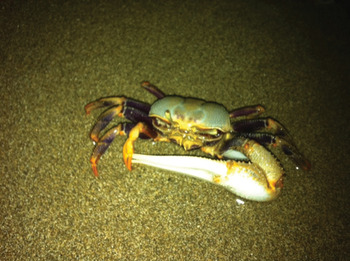
On the night of 3–4 October 2011, a single male specimen of U. tangeri (Figure 1), with carapace length 28.0 mm, carapace width 33.7 mm, and 33.3 g of wet weight, was collected from the Las Canteras Beach (20°08′27.23″N–15°26′09.42″W), north-east of Gran Canaria (Canary Islands, central-east Atlantic). The crab had the left chela (73.2 mm) 4.2 times larger than right one (17.2 mm). The specimen was captured by hand while it was walking on the sand, along the beach strand, in the limit of sea waves during low tide.
Male of Uca tangeri found in Las Canteras Beach (north-east of Gran Canaria, central east Atlantic) (photograph: Desirée Hernández-Hormiga).

During the night of 3–4 October there was low tide (−0.6 m) and the sea surface temperature was 24°C (the minimal low tide recorded in Gran Canaria had been −1.5 m). The moon was in its first quarter. The weather was warmer and winds were light and variable from the north-east at coastal areas, and from the south changing to west at high areas of the island.
RESULTS AND DISCUSSION
This is the first corroborated record for U. tangeri from the Canary Islands. According to García-Cabrera (Reference García-Cabrera1971), in the Canary Islands only 15% of marine species are in common with the neighbouring African coasts. Mainland and island ecosystems are very different. The African waters are colder and less saline than the island ones, with shallow bottoms that extend beyond 120 km without reaching the 500 m depth. These bottoms are rich in marine vegetation and able to accommodate populations of great interest and biomass. However, the islands are of volcanic origin and their shelves are markedly narrow and steep. The coastal areas are quite diverse, with predomination of volcanic and stony shores, and they present a great variety of microclimates and marine biotopes (Bas et al., Reference Bas, Castro, Lorenzo, Hernández-Garcia, Moreno, Pajuelo and Ramos1995; Brito et al., Reference Brito, Lozano, Falcón, Rodríguez, Mena, Llinas, González and Rueda1996, Reference Brito, Falcón, Aguilar, Pascual, Fernández-Palacios and Martín-Esquivel2001). And, probably due to the microclimates and marine biotopes, the absence of river estuaries, adequate muddy areas, and that beaches support a high human pressure (tourism is the main industry in the Canaries), the population of U. tangeri in the island should be very low, and limited to few individuals that live restricted to some small areas.
On the other hand, it is possible that this specimen could be a consequence of occasional larvae drifting transport between the African coast and the Canary Archipelago, as it has been documented for fish larvae (Rodríguez et al., Reference Rodríguez, Hernández-León and Barton1999, Reference Rodríguez, Barton, Hernández-León and Arístegui2004), and the subsequent process of settlement and growing of an isolated individual.
ACKNOWLEDGEMENT
I thank Desirée Hernández-Hormiga for her assistance in the specimen collection, measuring and rearing.