Schoolchildren are the main introducers and an important transmission source of influenza virus in communities.Reference Longini, Koopman, Monto and Fox1, Reference Viboud, Boelle and Cauchemez2 Therefore, school closures have been recommended by the Centers for Disease Control and Prevention as a key nonpharmaceutical measure to slow transmission of influenza during a severe influenza pandemic before vaccine becomes available.3 Although school closures can have the desired effect of slowing influenza transmission,3 they can have unintended social and economic consequences for schools, students, and their families. Perceptions of the appropriateness of school closures, as well as disruption of household routines and lost income among parents or guardians who miss work to care for children during a closure,4-Reference Borse, Behravesh and Dumanovsky6 can cause economic hardship and can undermine willingness to comply with other public health interventions during an influenza pandemic. Additionally, students might congregate when not at school, creating opportunities for ongoing influenza transmission.4, Reference Borse, Behravesh and Dumanovsky6-Reference Gift, Palekar and Sodha8 Understanding these potential consequences will help public health and educational authorities make informed decisions while planning for school closures during an influenza pandemic.
From January 29 through February 5, 2013, a period of elevated influenza activity in Colorado,9 a Colorado school district that served prekindergarten to 12th grade was closed by the district superintendent because of increasing absenteeism among staff and students that was primarily attributed to influenza-like illness (ILI). Student absenteeism peaked at approximately 40% on the morning of the closure start, and similar reported staff absenteeism rendered the school district nonfunctional because of the lack of staff available to conduct essential school operations. To implement the closure, the superintendent enacted the district’s existing protocol for weather-related closures, which uses an incident command-like structure to accomplish the operational aspects of a closure and communicate with parents and guardians. All parents or guardians received an automated telephone call informing them of the closure, and a detailed letter explaining the closure was distributed to all households either by mail or with students when they returned home that day. We evaluated the social and economic consequences of this closure on students and their families.
METHODS
Study Population
The school district is located in an unincorporated town in a county outside the metropolitan core of Denver, Colorado, with an estimated population of 23,000 persons.10 The population of the county is predominantly non-Hispanic white (90.5%). The median household income is $79,367. A limited number of persons (5.8%) have incomes below the poverty level, and the majority of adults (96.8%) have at least a high school education.10
At the time of the closure, the school district enrolled 204 students from 113 households in 1 elementary school and 1 junior and senior high school that are housed in the same complex of buildings. According to the most recent National Center for Education Statistics data,11 during 2010–2011, a total of 230 students were enrolled in the school district, and the majority of the students (90%) were non-Hispanic white; 73 students (32%) were eligible for free or reduced-price school lunches.
Household Survey
During March 2013, we administered a household survey by distributing paper surveys to households to collect data regarding communication of information about the school closure, parent or guardian employment and income interruptions, child care options, interruption of subsidized school meal programs, perceptions of the challenges associated with the closure, and information regarding student re-congregation during the closure. The survey also asked whether household members had ILI symptoms (defined as fever with cough or sore throat) during 2 periods as follows: (1) anytime during the 2 weeks before the closure or (2) during the closure.
We distributed paper surveys to all 113 households, including approximately 20 surveys to parents arriving at a parent-teacher conference event on March 4. Surveys were then mailed to all households along with the school district’s regular newsletter, with instructions that 1 survey be completed per household and returned to the school by students. Completed surveys were collected from the school on April 3. Survey data were entered into an Access (Microsoft Corporation, Redmond, WA) database and were exported to SAS (Version 9.2; SAS Institute, Inc., Cary, NC) for descriptive analysis.
RESULTS
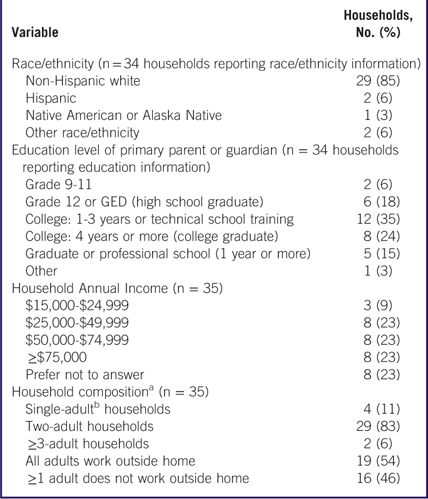
Of 113 households surveyed, 35 households (31%) completed and returned surveys, representing 67 students (33%) of the total student enrollment of 204 reported at the time of the closure. The demographics and composition of the responding households are summarized in Table 1. The majority (29 [85%]) of the 34 responding households with race/ethnicity information reported being non-Hispanic white, similar to the reported background of the overall student enrollment during 2010-201111 and to the overall county population.10 The majority (25 [74%]) of the 34 respondents who reported education information reported that the primary caregiver or guardian in the household had at least some college education, and the majority (16 [59%]) of the 27 households that provided household income data reported annual incomes >$50,000; only 3 of these 27 households (11%) reported income <$25,000. Four of the 35 responding households (11%) were single-adult households (aged ≥18 years), 29 (83%) were households with 2 adults, and 2 (6%) were households with 3 adults. The majority of households (19 [54%]) reported that all adults in the household worked outside the home, including 2 single-adult households. The median number of children per household was 2 (range: 1-3).
Demographic Characteristics and Composition of Households (n=35) Affected by an Unplanned School Closure — Colorado, January 29–February 5, 2013

a Median (range) number of children/household: 2 (1-3).
b Adult was defined as a person aged ≥18 years.
All households reported that they had been notified of the school district closure through an automated telephone call, and the majority [31 (89%)] reported that an automated telephone call is among their preferred methods of notification during future closure events.
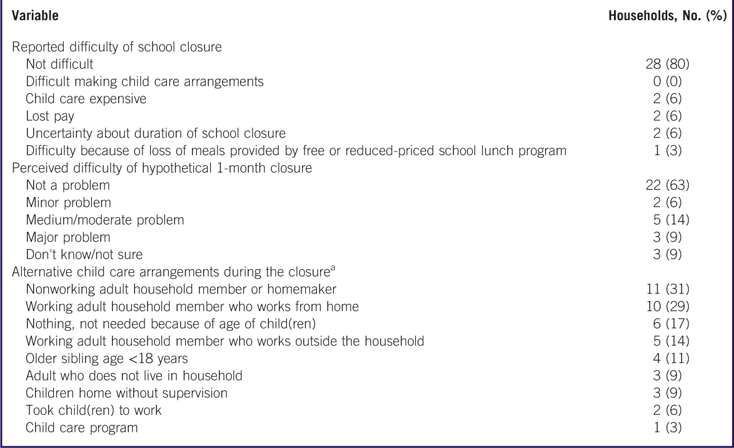
The majority of households (28 [80%]) reported that the closure did not cause challenges (Table 2). For the 7 households (20%) that reported that this school closure did cause challenges, disruption of work from home (1 [3%]), lost income (2 [6%]), child care expenses (2 [6%]), and uncertainty regarding the length of the closure (2 [6%]) were the contributing factors. Five (14%) households reported that an adult missed work during the closure, and 3 of these households reported that an adult lost pay. Two households (6%) reported that additional expenses ($92 and $200, respectively) were incurred for child care, and 1 household (3%) reported challenges caused by loss of meals provided by the free or reduced-priced school lunch program. Although none of the responding households reported that the school district provided alternative options for special education or other related support services, the majority (23 [66%]) of responding households indicated that their children did not receive such services.
Household Perceptions and Alternative Child Care During an Unplanned School Closure — Colorado, January 29–February 5, 2013 (n=35)
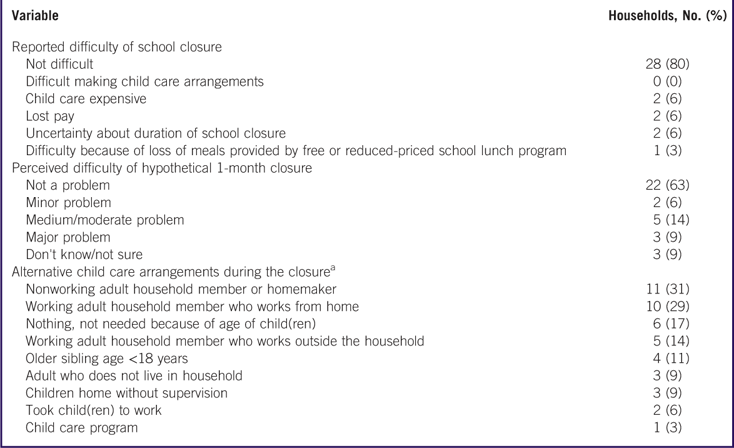
a Categories are not mutually exclusive.
Four of the 7 households (57%) that reported the closure as challenging were households in which all adults worked outside the home. Three of 5 households that reported missed work and 2 of 3 households that reported lost pay were households in which all adults worked outside the home, including 1 of the single-adult households. Eight households (23%) reported that a hypothetical 1-month closure could present either a moderate or a major problem (Table 2); 6 of these 8 households (75%) were households in which all adults were employed outside the home. All children in these households were in pre-kindergarten through grade 8 and would therefore likely require child care during a closure.
Sixteen households (46%) reported that at least 1 adult did not work outside the home, and 8 of the 19 households (40%) with all adults working outside the home reported that at least 1 working adult had an option to work from home. The majority of alternative child care during the closure was provided by adults within the household (Table 2). Eleven households (31%) reported that a nonworking adult household member cared for the children during the closure, 10 (29%) reported that a working adult household member who works from home cared for the children, and 5 (14%) reported that a working adult household member who worked outside the home cared for the children and missed work. None of the responding households reported that the school provided recommendations for alternative child care arrangements during the closure.
Overall, 13 children residing in 9 households (26%) had ILI within the 2 weeks before the closure; 5 children residing in 4 households (11%) had ILI during the closure. The most common activities of all 67 students included in the survey results during the closure were as follows: visits to grocery stores (39 [58%]), restaurants (22 [33%]), sport practices (17 [25%]), religious services (17 [25%]), and friends’ houses (17 [25%]). Students from households in which ILI was reported during the closure did not participate in the majority of these activities, with the exception of visits to grocery stores (students from 3 of 4 households with ILI) and religious services (students from 1 of 4 households with ILI).
DISCUSSION
Overall, this 4.5-day school closure because of ILI-related absenteeism did not pose a problem for the majority of the households that participated in the survey. This might reflect the brief duration of the closure, the relative affluence of the community, or the availability of an adult in the majority of households who could provide alternative child care during the closure without missing work or losing pay, either because a nonworking adult or one who had the ability to work from home was available. Reported agreement with decisions for school closures among parents and guardians has been high in studies of other US school closures,4, 5, Reference Johnson, Moore and Edelson7 even when greater proportions of households reported negative consequences as a result of the closure, such as missed work (20%-29%)4, 5 or children with missed free or reduced-price lunches.5
The majority of respondents (80%) in our study reported that this school closure was not challenging, and the majority (63%) perceived that a hypothetical 1-month closure might not represent a problem for their family. However, among the few households that did report challenges or concerns regarding a hypothetical 1-month closure, the majority were those in which all adults were employed outside the home. All of the children in these households were in pre-kindergarten through grade 8 and would likely require child care; thus, adults might need to either miss work or obtain alternative child care arrangements during a prolonged closure. During school closures in PennsylvaniaReference Gift, Palekar and Sodha8 and New York CityReference Borse, Behravesh and Dumanovsky6 during the 2009 influenza A (H1N1) pandemic, the independent variable “all adults working” was associated with missed workdays. School administrators in Colorado were aware of multiple home child care providers in their community but did not make special arrangements or communications to parents or guardians regarding these options for alternatives during the closure. Our household survey findings indicate that identifying such resources for obtaining alternative child care arrangements that can minimize disruption of work schedules, yet still allow for adequate social distancing to limit influenza transmission among students during a prolonged closure, can be an important component of school closure contingency planning.
In our study, the majority of students visited at least 1 venue outside the home during the school closure. This finding is similar to parental reports in a telephone poll of US parents whose child care centers or schools were closed in response to the 2009 pandemic,5 as well as observations of a Pennsylvania school closure during the same pandemic,Reference Gift, Palekar and Sodha8 and a 2006 outbreak of influenza B in North Carolina.Reference Johnson, Moore and Edelson7 Our observation might reflect the need to bring children while carrying out necessary activities outside of the household, eg, grocery shopping, when no alternative child care exits. Communication to parents and guardians about the rationale and importance of social distancing during school closures might enhance the success of school closures in decreasing influenza transmission.
Limitations
Our ability to generalize our findings is limited by multiple factors. This school closure was conducted in response to student and staff absenteeism and not an influenza pandemic. Influenza activity was elevated in Colorado at the time of the closure, but the severity was not increased, and there was limited apparent social disruption among students during the closure. The sample size was limited, and the response rate was 31%. More vulnerable households that experienced greater difficulties as a result of a school closure, such as those with income loss or difficulty finding alternative child care, might not have prioritized completing the survey over other demands. However, the demographic characteristics of the households in our sample are comparable with those of the school and the community. The school district we studied is limited in size and serves an affluent and well-educated community with a limited number of economically and socially disadvantaged students and families who rely on the school for support services. More data are needed to assess the effects of school closures among different demographic and economic groups.
CONCLUSIONS
This unplanned school closure because of ILI-related absenteeism in a Colorado community for a 4.5-day period provided an opportunity to evaluate the social and economic effects of the closure and to derive lessons to assist public health and educational authorities in making informed decisions when planning for school closures in response to a variety of situations. Although the school closure was not related to a particularly severe influenza season, some lessons from this closure can still be applied in planning for closures that might be recommended during an influenza pandemic. A limited number of households reported adverse consequences of this closure, yet our study indicates that even a relatively affluent community might have needs (eg, alternative child care arrangements for working families) that can be addressed by school and public health authorities. The unique circumstances of each community should be considered when creating school closure contingency plans.
Disclaimer
The findings and conclusions in this report are those of the authors and do not necessarily represent the official position of the Centers for Disease Control and Prevention.