The debate about secularization focuses, inter alia, on changes in the nature of religious belief, the social influence of religion and the influence of, and adherence to, religious institutions.Footnote 1 Most explanations focus on external factors – modernization of thought, urbanization, increasing leisure alternatives and so on – in which churches and other institutions can appear passive and lacking agency.Footnote 2 As Jeremy Morris has noted, relatively neglected are approaches which ‘assume no significant change in religious need, but instead locate the causes of church decline in the various strategies adopted (or refused) by churches themselves’.Footnote 3 Morris referred to these as ‘supply side’ arguments; others, such as Dominic Erdozain, have referred to ‘internal secularisation’.Footnote 4
Churches have long seen the religious socialization of children as a key part of their ministry; and historians likewise have identified this as a crucial factor in church adherence.Footnote 5 Church deficiencies in the religious socializing of children could be seen as a form of ‘internal secularisation’, therefore. The primary focus of historians studying the religious education of nineteenth- and twentieth-century children has been on Sunday schools.Footnote 6 However, in the early twentieth-century Anglican mind, the primary means by which religious education was delivered was church day schools, not Sunday schools: as one rural dean put it, ‘of the agencies engaged in instructing and educating the young, the Day schools are the most important, for there the foundations of the faith are laid’. Consequently, for church people, ‘after the Church, the Day schools should be next in importance’.Footnote 7 Philip Eliot, bishop of Buckingham, saw day schools as a key part of institutional Christianity, with its ‘visible society, ministry, episcopate, sacred books, sacraments, schools etc, all necessary for her existence’.Footnote 8 Hubert Burge, bishop of Oxford, emphasized their importance when addressing his clergy in 1922: ‘If a Parish Priest has a Church school in his parish, I hold that it is as much a matter of obligation upon him to give religious instruction in that school as it is to say his daily offices and to visit his people, and to tend the sick and dying.’Footnote 9
These were not isolated comments. The triennial visitation return questionnaires issued by successive bishops of Oxford during the inter-war years showed the same priorities: a section of five or six questions (out of around twenty-five covering all aspects of the incumbent's ministry) focused on day schools, with an assumption that these would be church schools, whereas typically just half a question related to Sunday schools.Footnote 10
This may have been the contemporary focus, but it is not one reflected in the historiography. Lois Louden's history of the National Society, the Church of England's agency responsible for its schools, is comprehensive but inevitably somewhat partisan.Footnote 11 Simon Green has referred to the ‘abject failure of the various churches’ to deliver satisfactory religious education ‘to many English boys and girls’ in the early twentieth century, due to theological divisions between the established and free churches, but his primary focus was on the 1944 Education Act.Footnote 12 Otherwise, church schools are often mentioned, but rarely seen as worthy of specific focus.Footnote 13
This article argues that the failure to engage with church schools is a significant omission in understanding the trajectory of decline in affiliation and adherence to organized religion. Specifically, it contends that the Church of England's strategies regarding its day schools in the period following the 1902 Education Act had a significant impact on the religious education of millions of children in the twentieth century, including those who did not attend a church school; those strategies weakened the institutional strength not only of church schools but also of the churches themselves, by dissociating religious education (RE) from Christian formation within the body of faith. The focus is on the period between the 1902 and 1944 Education Acts. The challenges faced by church schools in South Buckinghamshire, one of the most rapidly growing areas of the country, and the responses of clerical and lay leaders will be examined.
Church day schools were not only significant as religious institutions, but also socially: in 1902, 3.1 million children, or 57 per cent of England's children, attended one of 14,275 voluntary schools, which comprised 71 per cent of the national total. Of these, 83 per cent were Church of England schools.Footnote 14 These schools were typically older than the council, or board, schools; their buildings were increasingly costly to keep in good repair, let alone to adapt to meet increasing statutory requirements. In addition, central funding for voluntary schools was significantly less, and the corresponding financial squeeze became a national problem: as Louden laments, ‘in effect, elementary schools dragged the whole educational system down because the denominations were incapable of making necessary improvements’.Footnote 15 This situation led to revised funding arrangements under the 1902 Education Act, whereby teachers in voluntary schools would be funded by a local education authority (LEA) but appointed by local managers (that is, the churches); the LEA would also fund ‘fair wear and tear’ and purely educational operating costs. The churches would be responsible for repairs, statutory improvements (monitored by the LEA) and costs for non-school use.Footnote 16
The inter-war period saw a significant shift in the industrial centre of gravity of Britain from the north and Wales towards the south-east. Older heavy industries (coal, iron and steel, shipbuilding and textiles) experienced recession, while newer, growth industries (motor vehicles, aircraft and light engineering) were drawn to the Midlands and south-east, closer to markets rather than to sources of energy and raw materials. Such industries also tended to be located close to, but not in the centre of, the major conurbations, notably London, stimulating ‘urban sprawl’ and suburbanization.Footnote 17
Substantial inter-regional economic migration resulted, with an estimated 1.1 million people moving away from the north and Wales towards the south-east, as well as out-migration from the centres of the major cities.Footnote 18 There was rapid population growth, particularly in the ring of counties around London, including Buckinghamshire, the southern part of which is the focus of this study.Footnote 19 The area classified as South Buckinghamshire by the Registrar General was in Church of England terms the Burnham rural deanery, a group of eighteen parishes with the rapidly growing town of Slough at its heart.
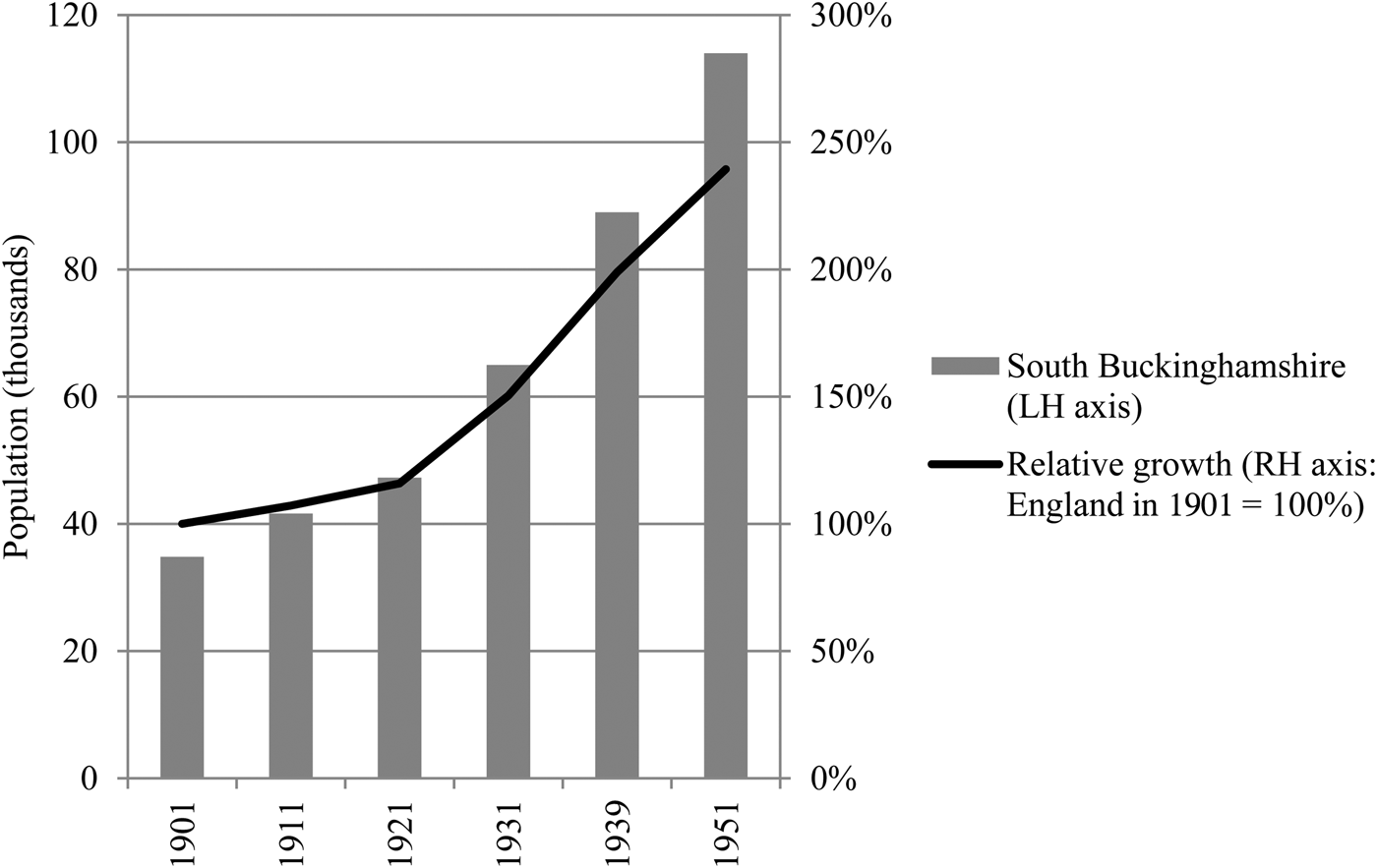
Figure 1 shows the population growth of South Buckinghamshire in the first half of the twentieth century, with a clear acceleration after the Great War due to inward migration. The solid line normalizes the data against general population growth: in this period, the population grew more than twice as fast as the national average, from 47,000 to 114,000. Such demographic changes posed significant challenges for all institutions.Footnote 20 The churches were no exception, and the Church of England, as the national church, was affected most of all. As Archbishop Lang told the Church Assembly in 1935:
This problem of making spiritual provision for the populations of the new districts which were being formed in many parts of the country was the greatest that had been presented to the Church in our generation. It might almost be said to be one of the greatest ever presented to the Church of England in the course of its long history … some dioceses … were almost breaking down under the magnitude of the problem.Footnote 21
Oxford was one of ‘a dozen or more’ such dioceses, although not the most severely affected.Footnote 22
South Buckinghamshire population growth 1901–51. Sources: Census 1921 England and Wales: County of Buckingham (London, 1924), 1, Table 2; Census 1951 England and Wales: County Report, Buckinghamshire (London, 1954), xiv, Table A.

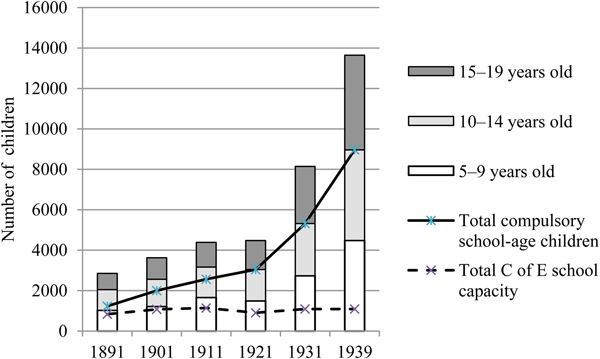
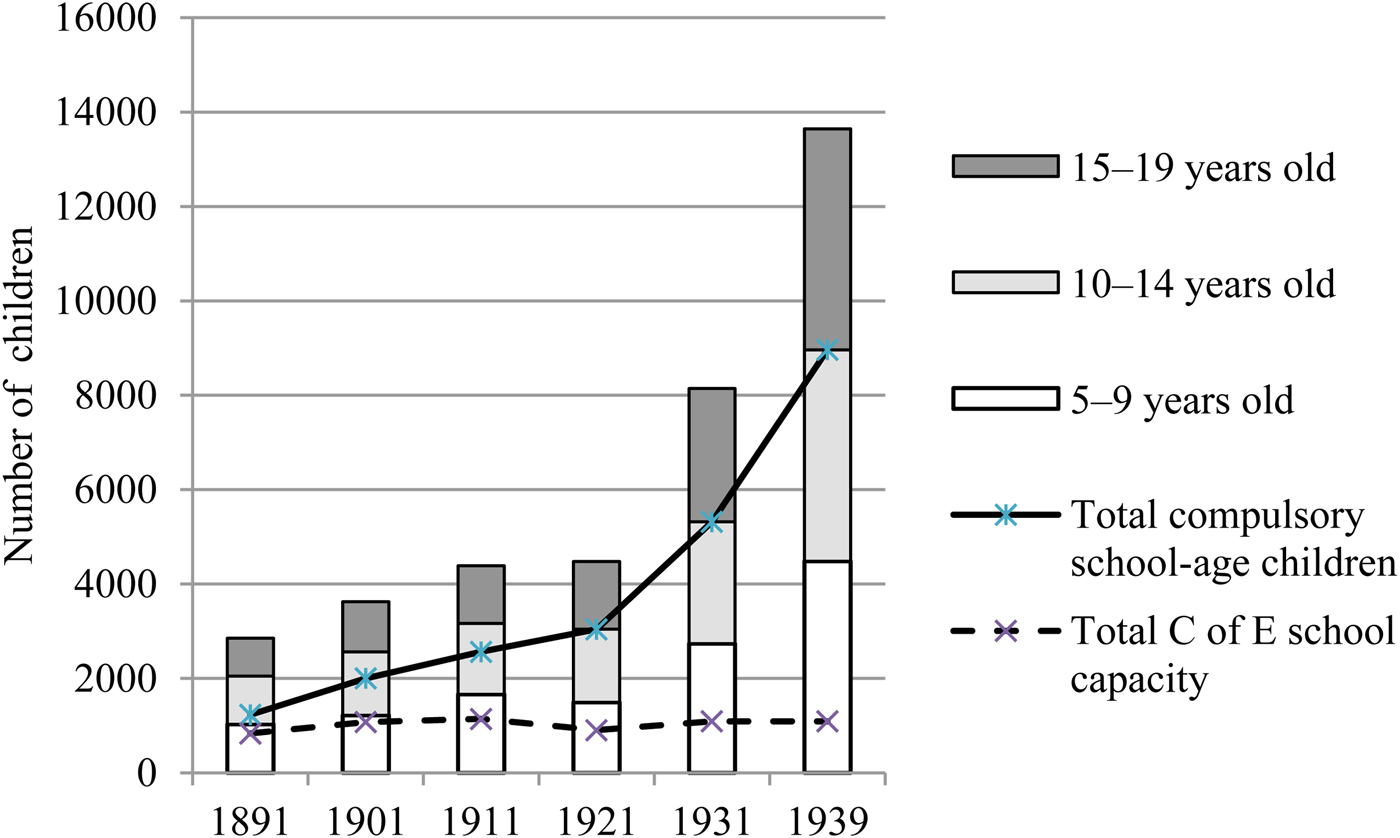
In addition to the challenge of general population growth, the school leaving age was progressively raised from 10 to 15 years of age between 1880 and 1947, with provision for part-time education beyond this age. Figure 2 shows the impact: the number of children of compulsory full-time school age in Slough rose from 1,200 to 9,000 in the fifty years up to the Second World War, again accelerating in the inter-war years.
Church of England school provision in Slough measured against total school-age population, 1891–1939. Sources: Kelly's Directory of Buckinghamshire, 1891, 1899, 1903, 1911, 1915, 1920, 1924, 1928, 1931, 1939; http://www.visionofbritain.org.uk/unit/10032751/cube/AGESEX_85UP>, accessed 4 August 2013.
As noted, the Church of England saw the provision of RE in day schools, and specifically church day schools, as a high priority. Facing the huge increase in schoolchildren in growing areas, there were three general directions open to the church: to maintain and expand existing church schools, to build new schools, or to be actively engaged in providing RE in council schools.
The default position – maintenance of the status quo – was outlined to Slough churchgoers in 1921 by a representative of the National Society. It was churchgoers’ ‘bounden duty’ to preserve the church schools endowed by their forefathers; without them, ‘all continued security for the teaching of Christian faith to the children of the parish disappears’.Footnote 23 While acknowledging that it was ‘often the case [that] fairly good religious teaching [was] given in Council Schools’, he maintained that in some, no religious instruction at all was given; in any case, it was only in church schools that the Catechism was taught. This argument fell on willing ears; so too did the oft-repeated injunction that all true education must be based on a sound religious foundation.Footnote 24 However, events would show this to be an expensive strategy which failed to cater for the vast majority of Slough's children.
At first sight, the position was reasonably healthy. Oxford diocese claimed that 528 out of 730 elementary schools were church schools in 1929, with 49,300 children out of a total of 90,600 on their rolls.Footnote 25 In Buckinghamshire in 1920, there were 152 church schools and 82 council schools.Footnote 26 However, on closer examination, the position was much weaker, and in 1929 was described by Bishop Shaw, the diocese's assistant bishop, as ‘critical’.Footnote 27 There were several challenges: apart from population growth and the rising school leaving age, these included the pattern of urbanization, the financial provisions of the 1902 Education Act, and the question of whether, in parents’ minds, church schools offered something more than the free schooling provided through council schools.
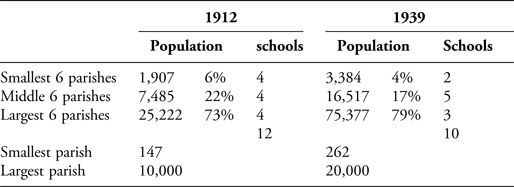
Table 1 shows the distribution of population and church schools across the Burnham rural deanery. The pattern of urbanization meant that the twelve church schools were poorly located in the historic parishes rather than situated according to population. The early growth of Slough had created a significant mismatch between population and parishes even in 1912; by 1939, rapid urbanization had accentuated this still further, and the largest parish in the deanery had eighty times the population of the smallest. In two smaller, rural parishes, pupil numbers fell to unviable levels as couples with children moved away, probably to jobs in Slough, and these parishes’ schools were closed in the 1920s. Elsewhere, some church schools found themselves well away from the new housing estates: in the largest parish the church school was two miles north of the major new developments; but in any case it offered only 195 places for over 2,000 school-age children.Footnote 28 This meant that the church could not provide enough places even for the children of churchgoing Anglican parents: in 1923, before the great population expansion, it was estimated that nationally two-thirds of such children attended council schools, for lack of sufficient church school places.Footnote 29
Burnham Rural Deanery Church Schools

Sources: Crockford's Clerical Directory, 1912, 1939; Kelly's Directory of Buckinghamshire, 1911, 1939.
The 1902 settlement had been intended to protect the future of church schools; in practice, it simply deferred tackling the fundamental underlying problems. Repairing existing church schools involved substantial costs. In addition, the churches were responsible for any alterations and enhancements to church schools to meet rising standards: for example, providing additional floor space per pupil or enabling the serving of school meals. In 1920, it was estimated that £400,000 was needed simply to bring church schools in Buckinghamshire up to the statutory level: a sum that, addressing the Burnham rural deanery, a senior layman described as ‘perfectly impossible … for churchpeople … to find’.Footnote 30 Even this would do nothing to increase capacity to meet the rapidly increasing demand in the larger parishes, illustrated in Table 1.
Ultimately, the church had a choice about how to direct its energies and the financial contributions of its committed supporters. For example, in Datchet, just south of Slough, ‘saving our school’ cost £6,500, raised locally after much effort by the church.Footnote 31 In practice, the school was too large and well attended to have been allowed to close, with a capacity of 320 and attendance of 280 in 1931.Footnote 32 The alternative was to transfer ownership to the LEA, with the corresponding responsibility for maintaining the school fabric, but at the cost of loss of church control over the RE syllabus. However, the £6,500 needed to ‘save’ the school as a church institution could otherwise have funded much-needed church extension – for example, a 250-seat church on a nearby estate cost £1,600 – or additional clergy.Footnote 33
Even where funds for church schools were found, it was usually to upgrade schools to meet minimum standards, and the newer council schools were better equipped, as clergymen recognized.Footnote 34 In Datchet, there was no alternative to the church school; but parents in central Slough could choose between church and council schools. Even church parents were torn: in 1922, Slough's rector complained they ‘failed to realise the far more vital importance of sending their children to Church schools than of securing for them more luxurious surroundings elsewhere’, and that this was resulting in low rolls at the church infant school.Footnote 35
Perhaps parents ‘failed to realise’ because the church could not make a sufficient case for preserving church schools. The line of argument had not changed since the battles over the 1902 act. Firstly, it was argued that these schools offered the best way to guarantee that children would be given a sound religious education; secondly, that this was the essential foundation for a wider education; and thirdly, that RE needed to involve induction into the Church of England, including its denominational practices and teaching.Footnote 36 Winning the argument centrally was one test of whether the case had been made; raising sufficient money locally to upgrade existing church schools, and to build new ones, was another test of public opinion. During the 1920s and 1930s the church struggled both nationally and locally to win the argument.
This was, not least, because it was hard to maintain that religious instruction was not being given in council schools. In Buckinghamshire, the LEA's policy was ‘that definite instruction in the principles and practice of the Christian faith shall be systematically given in every [council] school’.Footnote 37 Fifteen years before the provisions of the 1944 Education Act, this included beginning the day with a hymn, the Lord's Prayer and other prayers, an optional Scripture reading, followed by twenty to thirty minutes of religious instruction.Footnote 38 In 1931, one senior churchman conceded that ‘the religious teaching in some of the [Council] schools was extraordinarily good’.Footnote 39 Despite church concerns that it might be seen as an optional extra, ‘less important than arithmetic or geography’, a local council school headmaster took the opportunity of the annual prize-giving to emphasize the value placed on RE.Footnote 40 ‘The curriculum is comprehensive and the children seem to realise very fully the significance of this part of our work’, he maintained. Parents might therefore ask how this differed from what was being offered in church schools. The headmaster went on to emphasize that the purpose of RE was to give children ‘a thorough training in citizenship’, presumably of a ‘Christian country’.Footnote 41 This was non-denominational RE delivered by teachers, and induction into local churches – of whatever denomination – formed no part of it. In church schools, the clergy's involvement in teaching was often on a daily basis, as witnessed by the visitation returns. But in council schools the clergy's role was limited to being a ‘manager’, or governor, with no day-to-day involvement. Over time, it appears that fewer parents cared: in Colnbrook, after another intensive ‘save our school’ campaign, the vicar remarked of local parents: ‘it is questionable whether if the [church] schools were surrendered [to the LEA] they would be much upset’.Footnote 42
As shown in Figure 2, the number of children of compulsory full-time school age in Slough had risen from around 1,200 in 1891 to around 9,000 in 1939. In 1891, there were 837 Church of England school places in the town, which accounted for 68 per cent of the number of children in school; by 1939, given the funding challenges it faced, the church had been unable to do more than grow capacity to 1,094 places, which now accounted for just 12 per cent of the total number of schoolchildren.Footnote 43 A strategy of protecting existing church schools at all costs had not prevented school closures in two smaller parishes or a massive dilution of provision in the growing parishes. Within forty years, the clergy had moved from being a daily part of the education of the majority of Slough's children to exercising this role for a fairly small minority. In consequence, they lost the link schools created with the parents. Church schools had lost significant traction, and with it, certainly in many Anglican churchmen's minds, one of the main ways in which the church engaged with its parishioners.
This might be seen as an inevitable consequence of ‘the shift from religious to secular control of various of the erstwhile activities and functions of religion’.Footnote 44 However, the church had had opportunities to secure a very different outcome to the teaching of RE, not just for the declining number of children in church schools, but for the millions of children attending council schools (the third option highlighted above).Footnote 45 In many communities, the church owned the only school; in other areas, church schools were a key part of a mixed landscape of voluntary and provided schools. In 1920, the value of church school buildings was put at £40 million and they formed a substantial part of the nation's schools stock.Footnote 46 Recognizing the financial unsustainability of the status quo, as the First World War ended Archbishop Davidson proposed a cooperative approach on RE in all schools, ‘while there were still school buildings to bargain with’.Footnote 47
Over the next few years, general agreement was reached with the government and the free churches, whereby all church schools would come under the control of LEAs, thus relieving churches of the burden of maintenance and improvement; in return, the teaching of RE in all council schools would be strengthened by the provision of properly trained RE teachers, emphasis on setting RE within the context of the church, and cooperation with local clergy of all denominations.Footnote 48 The money saved would be directed towards teacher training colleges, which according to the archbishop were ‘the key to the whole situation’, to provide ‘qualified teachers … thoroughly grounded in … imparting to little children the truths of their Holy Faith’.Footnote 49 The discussion took place at all levels of the Church of England; in 1921, the bishop of Oxford recommended to his clergy that in return for strong cooperation from all denominations in RE teaching, ‘all schools would be provided by the public authority’.Footnote 50 The proposals were recommended to a Burnham deanery conference by a senior layman, who described them as ‘very promising indeed’ and observed that ‘churchpeople would save money’ by accepting the offer. A motion commending the proposals was passed unanimously.Footnote 51
It was not only the financial unsustainability of the status quo that was understood. At the Church Assembly in 1924, two of the dioceses highlighted by Lang ten years later as those most affected by south-eastern urbanization pleaded the case of those unserved by church schools. The bishop of Chelmsford referred to Dagenham, then growing even faster than Slough: ‘it was impossible for the Church to provide religious education in these populous new areas where there were no Church schools. The social upheaval was going to produce these districts everywhere’. In Islington, Revd H. W. Hinde, the rural dean, noting that only 5,020 out of 60,000 school-age children were in church schools, asked for a solution to ‘the whole problem; not making Church schools their first concern, but adequate religious instruction in all schools’.Footnote 52
However, as noted above, some rank and file members of the National Society were against this approach, and they found open ears, particularly in rural communities, ‘where the country parson looked upon the school as his greatest asset in the management of the parish’.Footnote 53 After the Church Assembly approved Davidson's approach, Dean Gamble of Exeter warned against ‘the assumption … that because the Church Assembly may have passed a resolution … therefore the whole Church accepts it. Those who think so will find they have deceived themselves.'Footnote 54 In 1923 the National Society AGM voted against its leadership and against Davidson's proposals, calling on church authorities to abandon any policy of negotiating ‘the surrender of Church schools’.Footnote 55 Vainly did the archbishop of York warn that ‘maintaining Church schools as they are was not a policy that had any future’ and that it risked making ‘the Church, which had done so much for education, seem to be perpetually blocking the way to educational progress’.Footnote 56 A vocal minority maintained that church schools should not only be retained but should be as fully funded by the state as council schools, and that denominational teaching should be allowed in council schools, a throwback to arguments put forward in 1902. The Times observed that any solution must recognize that even within a Christian consensus there was a wide variety of religious life and experience; but some churchmen ‘forget that those outside have convictions and claims no less real than their own’.Footnote 57
Despite five years of debate, continuing resistance meant that the opportunity for a new settlement passed; but educational change continued. During 1924 and 1925, the Board of Education ‘black-listed’ hundreds of church schools that required urgent repairs or faced closure. In 1925 Bishop Shaw proposed to the Oxford Diocesan Conference that church schools be retained, but accepted that ‘some Church schools were quite unfit for their purpose’, with 91 schools on the ‘black lists’.Footnote 58 By 1929, as we have seen, he was reporting a ‘critical situation’ whereby, despite expenditure of £91,000 to resolve problems over the last three years, and the closure of some schools, looking forward it was ‘impossible to state what sum would be required, but it must be large’; no solution was offered for the expanding populations.Footnote 59
These financial pressures ultimately led to more cooperation centrally on the syllabus to be used in council schools within the Oxford diocese, following the example of other dioceses which had proactively sought local solutions in the absence of a national settlement.Footnote 60 As noted above, this meant that council schoolchildren experienced a daily act of worship with a non-denominational focus.
Visiting the rural deanery conference in 1934, Buckinghamshire's education secretary emphasized the considerable level of cooperation with the churches centrally, but noted the predictability of local opposition, including the dislike of change, particularly when involving religion and schools.Footnote 61 Some arguments seemed to reflect less a concern about a reduction in church influence than opposition to any broadening of the provision of education. Thus, commenting on the education secretary's visit, the churchgoing Slough Observer editor condemned ‘the extravagant, needless faddisms of the Hadow Report … a mass of pseudo-psychological twaddle’, maintaining that ‘the sound, simple education of the past, such as the Church of England has invariably provided in its schools, is all that is needed by the average child’.Footnote 62 The education secretary also noted, however, that ‘in the long run, education, like all public services, follows public opinion’ and normally ‘a long way behind’.Footnote 63 Public opinion had left the church and its schools behind on the question of religious education, if nothing else.
In summary, we have seen that the 1902 settlement had changed little in terms of the first two options open to the church in responding to the huge increase in the numbers of schoolchildren in growing areas. Maintaining existing church schools became increasingly difficult, and thoughts of increasing the provision of church schools were generally illusory. Nationally, by 1939 ‘the voluntary schools were again in a parlous state’, according to Louden.Footnote 64 In Slough, any funds raised had been consumed by repairs, and it had been impossible to fund expansion, so that the absolute number of Church of England school places had remained roughly constant. However, population growth had reduced this number from 68 per cent to 12 per cent of Slough's schoolchildren by 1939. We have seen from the contemporary national debate that Slough was but one example of such challenges faced by the Church of England in the rapidly expanding towns of the south-east.
These challenges had led the church's senior leadership to conclude, in the archbishop of York's words, that ‘maintaining Church schools as they are was not a policy that had any future’.Footnote 65 In the years following the Great War, there seemed widespread agreement on an approach which would have traded the church's substantial stock of schools for a much greater role in the religious education of the majority of schoolchildren, the training of teachers and the placing of true religious education firmly in the context of membership of the wider church family.Footnote 66 Apart from funding the training of teachers in RE, the church would also have released substantial funds to be utilized in other parts of its mission, such as building new churches and funding new clergy. However, internal resistance meant the proposals did not proceed, and a different settlement was reached in 1944.
For Simon Green, ‘the abject failure’ of the churches to agree on the content of RE in state schools meant that during the inter-war years, with Sunday school enrolments also declining, many children received little or no religious education; this was a failure to which the 1944 act brought a solution.Footnote 67 This article has argued that the failure had another consequence. In Buckinghamshire at least, comprehensive RE education in state schools was county policy well before the 1944 act, with the danger that RE could be seen as a ‘subject’, to be adequately learned outside the body of faith.
Matthew Arnold's receding tide of faith has proved a popular analogy in the debate on secularization.Footnote 68 However, if there was a clear opportunity for the churches – of all persuasions, but led by the Church of England – to reaffirm that true religious education involved induction into the church, then it is arguable that, by failing to negotiate a new settlement, the churches themselves contributed to secularization in Britain. Perhaps this was not so much a failure to address the receding tide of faith as a lack of attention to the advancing tide of demographic, economic and educational change.