Introduction
Individuals infected with the human immunodeficiency virus (HIV) who have access to combination active antiretroviral therapy (cART) can anticipate life expectancies into their 7th decade (Collaboration, Reference Collaboration2008). Consequently, the number of individuals living with HIV over 50 years of age has increased substantially with some estimating that this group will encompass over half of all HIV/AIDS cases in the US by 2015 (Smith, Reference Smith2005). The number of people living with HIV over 65 years old doubled between 1994 and 2004 (Stoff, Khalsa, Monjan, & Portegies, Reference Stoff, Khalsa, Monjan and Portegies2004). With the emergence of safer antiretroviral medications and broadened access to cART worldwide, these trends are anticipated to continue.
Since the frequency of neurodegenerative disorders is so closely tied to advancing age and since aging itself is associated with changes in cognitive performance, several groups have postulated that HIV will accelerate age-related cognitive changes and predispose infected individuals to neurodegenerative disorders. Before widespread use of cART, several independent epidemiological analyses demonstrated higher rates of HIV encephalopathy associated with older age (Chiesi et al., Reference Chiesi, Vella, Dally, Pedersen, Danner, Johnson and Antunes1996; McArthur et al., Reference McArthur, Hoover, Bacellar, Miller, Cohen, Becker and Jacobson1993) and age remains an important determinant of HIV-associated dementia in the current era (Becker, Lopez, Dew, & Aizenstein, Reference Becker, Lopez, Dew and Aizenstein2004; Valcour et al., Reference Valcour, Shikuma, Shiramizu, Watters, Poff, Selnes and Sacktor2004). Since this diagnostic entity encompasses cognitive, behavioral, and motor abnormalities, the degree to which aging alters neuropsychological testing performance, per se, may not be uniform. Furthermore, coexisting morbidities that are sometimes unrelated to HIV are frequent in this population and may independently impact neuropsychological performance (Valcour & Paul, Reference Valcour and Paul2006). The evaluation of age-HIV interaction effects within a group of subjects well matched for non-HIV characteristics would add to our scientific understanding of this disease.
Several groups have investigated HIV-age interaction effects on neuropsychological performance with mixed results. Both aging and HIV are typically found to impact cognitive performance in most studies; however, only a limited number of studies have identified interactive dynamics on mean scores (Becker et al., Reference Becker, Lopez, Dew and Aizenstein2004; Cherner et al., Reference Cherner, Ellis, Lazzaretto, Young, Mindt, Atkinson and Heaton2004; Hardy et al., Reference Hardy, Hinkin, Satz, Stenquist, van Gorp and Moore1999; van Gorp et al., Reference van Gorp, Miller, Marcotte, Dixon, Paz, Selnes and Mitrushina1994) with notable exceptions (Kissel, Pukay-Martin, & Bornstein, Reference Kissel, Pukay-Martin and Bornstein2005). When identified, these interaction effects appear to be limited in scope and are often most readily demonstrated in patients with more advanced disease, such as those with medical symptoms or those with AIDS (Hardy et al., Reference Hardy, Hinkin, Satz, Stenquist, van Gorp and Moore1999; van Gorp et al., Reference van Gorp, Miller, Marcotte, Dixon, Paz, Selnes and Mitrushina1994). With one exception (van Gorp et al., Reference van Gorp, Miller, Marcotte, Dixon, Paz, Selnes and Mitrushina1994), these studies frequently use controls that are not ideally matched to HIV subjects, consider “old” with variable chronological cut-points, or have few subjects over the age of 50. Based on current published studies, in the era of effective treatment approaches, HIV–aging interaction effects may be especially attenuated with less clear clinical consequences.
The Hawaii Aging with HIV Cohort was specifically designed to prospectively define the fundamental neurological epidemiology of aging with HIV and is a useful cohort to determine if interactions between aging and HIV infection on neuropsychological testing performance exist. Most of the enrolled older HIV individuals were born and raised on the mainland United States and moved to Hawaii in their mature years. Consequently, most are Caucasian and highly educated in a manner similar to national HIV trends, increasing the external validity of these findings (Fast et al., Reference Fast, Poff, Watters, Shiramizu, Shikuma and Valcour2002). In this cohort, HIV-negative control subjects were carefully selected from similar socioeconomic populations in an attempt to isolate HIV-specific effects. In this report, we test the hypothesis that HIV and aging interact to negatively impact neuropsychological testing performance.
Methods
The Hawaii Aging with HIV Cohort (HAHC)
The HAHC is a prospective, longitudinal cohort assessing cognition and neurological outcomes of HIV-infected individuals and matched controls living in Hawaii. HIV subjects were recruited into two groups: older subjects who were primarily over 50 years of age (n = 127) and younger subjects who were less than 40 years (n = 110). The younger and older HIV+ groups are frequency matched by age (± 5 years), educational attainment, ethnicity, and gender to seronegative control individuals meeting similar exclusion criteria.
The methodology for HIV+ recruitment is described in greater detail elsewhere (Valcour et al., Reference Valcour, Shikuma, Shiramizu, Watters, Poff, Selnes and Sacktor2004). Primary referral sources for HIV-negative controls were life-partners or spouses of HIV+ patients, family members, and individuals responding to targeted recruitment advertisements placed in community newspapers and fliers from organizations that our HIV+ subjects frequented. Both HIV+ and HIV-negative participants were excluded if they possessed factors that were likely to impact cognitive testing performance, including head injury with loss of consciousness for more than 1 hr or cognitive sequelae, learning disability, major depression, major neurological or psychiatric illness including stroke, and brain opportunistic infection. Subjects who met Diagnostic and Statistical Manual (DSM)-IV criteria for current substance dependence or had a positive urine drug screening test at the time of their visit were excluded from this analysis. All subjects underwent formal neurological testing to exclude major neurological abnormalities. Furthermore, individuals identified as having major neurological illness during the evaluation were excluded from the analysis. This included three cases found to have had past stroke and one individual with a clear history of transient ischemic attack.
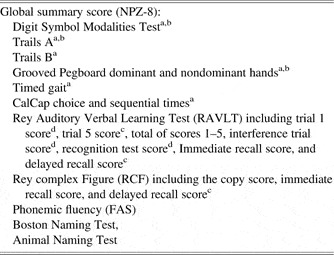
Individuals completed a comprehensive neuropsychological testing battery designed to tests domains impacted by HIV but limited in length to minimize fatigue in older patients (Table 1). A total of 204 HIV-negative control subjects participated in the study.
Neuropsychological testing battery

Superscripts identify tests combined for subscores as follows: a. included in the Global summary score (NPZ-8); b. included in the psychomotor summary score (NPZ-PM); c. included in the Memory summary score (NPZmem); d. included in the working memory, attention, and concentration summary score (NPZwmca).
Trained research assistants captured all clinical data, including medical history, medications, and HIV-related laboratory parameters. Participants reported their CD4 nadir counts, which, based on past analyses strongly correlates with documented nadir counts from medical chart review (r = 0.90) (Valcour et al., Reference Valcour, Yee, Williams, Shiramizu, Watters, Selnes and Sacktor2006). We completed quality assurance on neuropsychological testing every six months and evaluated depressive symptoms using the Beck Depression Inventory (BDI). All participants signed institutional review board-approved consent forms before enrollment, and all human data were obtained in compliance with the regulations of the University of Hawaii.
Statistical Considerations
The statistical analyses compared measurements between groups defined by age and HIV status. Since past studies identified interaction effects primarily in groups with advanced HIV disease (AIDS or symptomatic disease), we stratified our HIV groups into two sets: (1) Low CD4 nadir (CD4 nadir less than 200 cells) and (2) High CD4 nadir (CD4 nadir greater than or equal to 200 cells). In secondary analyses, we also collapsed HIV-positive groups across nadir status into one group. Our initial analyses compared demographic and clinical characteristics between HIV groups among young and old subjects, separately, using χ2 test for categorical variables and Mann-Whitney U-test for continuous variables.
Our primary statistical analyses compared raw neuropsychological testing scores for each individual test in our battery between HIV age groups using linear regression analysis. In particular, we assessed the interaction of age and HIV group on each cognition score at baseline by fitting linear regression models that included terms for age and HIV group, as well as their interaction. The regression models also included estimated intelligence quotient (IQ) using the National Adult Reading Test (NART), gender, and race. The regression model coefficients corresponding to the HIV-age interaction effects measure that magnitude of differences in HIV effects between age groups. Since our primary analyses assessed interactions in 20 neuropsychological outcome scores, we controlled for multiple comparisons using false discovery rate (Benjamini & Hochberg, Reference Benjamini and Hochberg1995). Additional analyses included duration of time since diagnosis to ensure that this variable did not alter our primary outcomes.
In a secondary analysis, we transformed the raw scores to Z-scores using appropriate normative sets as previously published (Valcour et al., Reference Valcour, Shikuma, Shiramizu, Watters, Poff, Selnes and Sacktor2004). We then defined an impaired performance as performance that was greater than one standard deviation below the published mean for HIV positive and HIV negative subjects separately. We used logistic regression analysis to assess whether the frequency of impairment on each test was modulated by HIV status. We fit all linear regression and logistic regression models using PROC GLM in SAS v9.1.3 (SAS Corporation, Cary, NC). We combined some of the tests into summary scores only displaying performance among the six groups of interest; however, no statistical analyses were carried out using summary scores (Table 1).
Results
Baseline Demographics and Medical Characteristics
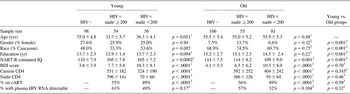
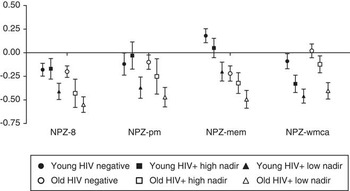
Four hundred fifty subjects met criteria for the analyses. By study design, HIV+ and HIV-negative groups were matched for age, gender, education, and ethnicity within older and younger groups; although small clinically insignificant differences are noted when stratifying the HIV+ groups by CD4 nadir count (Table 2). The groups with lower CD4 nadir also had lower current CD4 counts and were more likely to be on cART. Although most HIV participants were on cART, only approximately half had undetectable HIV RNA levels in plasma at the time of testing. We plotted normative data-adjusted summary Z-scores to display performance by group (Figure 1). In general performance in HIV groups tended to be worse than that for our HIV-negative group, particularly for groups with low CD4 nadir counts.
Demographic constitution of six primary groups

Groups selected to match age, gender, and ethnicity by HIV status within age strata. (Two-sided Student's t test for means, chi square test of equal proportions for frequencies).
1based on Kruskal-Wallis test; 2based on Chi-square test; 3based on Mann-Whitney.
Adjusted summary neuropsychological domain scores and standard error comparing HIV-negative controls and HIV subjects stratified by age group and nadir CD4 count in comparison to published normative data.

Neuropsychological Interaction Effects
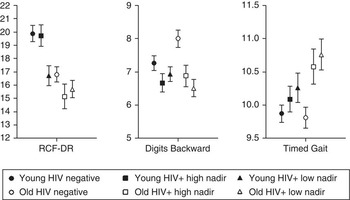
We first evaluated baseline interaction effects for raw neuropsychological testing scores by including the three HIV categories (HIV-negative, HIV + low nadir, HIV + high nadir), age group, gender, estimated IQ, and the interaction variable of HIV group*age group in the models. No interaction effects met statistical significance for interaction effects using a false discovery rate approach to multiple testing. However, the following models showed promise: Rey Complex Figure Delayed Recall [β = −2.2 (−0.38 to 4.8), p = .094 for older group/CD4 nadir <200]; Digit Span Backwards [β = −1.20 (−2.15 to −0.26), p = .012 for older group/CD4 nadir <200]; Timed Gait [β = 0.79 (0.07 to 1.51), p = .031 for older group/CD4 nadir >200] (full list of estimates available on-line as Supplementary Table). Examination of these models suggested that very good performance in the older seronegative group appeared to be a primary factor in these findings for digit span backward and timed gait (Figure 2). When we used neuropsychological data on a continuous scale but did not stratify cohorts by CD4 nadir, the finding with Digit Span Backward (p = .0082) and Timed Gait (p = .019) were similar to our primary model.
Adjusted means (standard error) for six groups for models with marginal evidence of potential interaction effects. All models adjusted for race, gender, and estimated IQ (NART). Note: Higher score is better for Rey Complex Figure (RCF) Delayed Recall (DR) and Digits Backward, whereas higher score is worse for Timed Gait.

In secondary analyses, we repeated the work using an approach that compared frequency of impairment on each test, rather than raw scores. None of the models with marginal statistical significance in the primary approach emerged in this secondary approach (Rey Complex Figure Delayed recall (p = .031); Digit Span Backward (p = .24) and timed gait (p = .27)). In this alternative approach, the phonemic fluency test (FAS) also showed marginal significance (p = .023).
Discussion
The results of this evaluation designed to determine interaction effects between aging and HIV infection indicate that HIV infection and advancing age appear to generally function independently of each other on neuropsychological testing performance, although limited interactions of small magnitude cannot be excluded. Our previous published work in this cohort identified a two-fold increased risk for meeting American Academy of Neurology 1991 Criteria for HIV-associated Dementia in age greater than 50. In our previous work, we used cut-points to define impairment and included neurological and behavioral data to designate diagnoses based on a consensus panel that included neurologists and neuropsychologists. In contrast, here, we a comparing group means and frequency of poor performance on neuropsychological tests only for HIV and age groups in models that include interaction variables. The current work more clearly defines HIV effects on the neuropsychological performance aspect of the neurological syndrome associated with HIV. This work extends the existing literature by demonstrating that age and HIV status appear to largely act independently on neuropsychological performance even when a substantial number of cases are over 50 years of age.
When viewed with an understanding of these methodological differences, these data are congruent with other independent assessments in large multicenter studies where high rates of impaired neuropsychological scores are noted in HIV with general increased risk associated with aging (Heaton et al., Reference Heaton, Franklin, Clifford, Woods, Mindt, Vigil and Grant2009; Robertson et al., Reference Robertson, Smurzynski, Parsons, Wu, Bosch, Wu and Ellis2007). Similarly, these findings do not differ greatly from other studies where interaction effects were either not found, or only modest in magnitude (Becker et al., Reference Becker, Lopez, Dew and Aizenstein2004; Cherner et al., Reference Cherner, Ellis, Lazzaretto, Young, Mindt, Atkinson and Heaton2004; Hardy et al., Reference Hardy, Hinkin, Satz, Stenquist, van Gorp and Moore1999; Kissel et al., Reference Kissel, Pukay-Martin and Bornstein2005; van Gorp et al., Reference van Gorp, Miller, Marcotte, Dixon, Paz, Selnes and Mitrushina1994).
There are several other factors that contribute to our finding. Most importantly, our seronegative controls were carefully selected to match many of the non-HIV socioeconomic factors seen in our HIV population by selecting subjects from similar arenas and, most importantly, their family and social networks. In contrast, our previous publication used published normative data to define impairment rates that informed consensus conference diagnostic categorization. In the current study, we use our internal HIV-negative groups to evaluate HIV effects (Valcour et al., Reference Valcour, Shikuma, Shiramizu, Watters, Poff, Selnes and Sacktor2004). This approach likely minimizes differences by HIV status but may be more informative regarding pure HIV effects on neuropsychological performance. Specifically, the presence of co-existing morbidity in HIV-negative individuals in this study could also impact performance on our tests in a manner that would minimize HIV group findings.
The evaluation of cognitive diagnoses in the setting of HIV requires careful inclusion of behavioral and gross motor findings in addition to neuropsychological performance. It is possible that age modulates the influence of HIV on these behavioral and clinical motor signs and symptoms in a manner that was not detected in this study of neuropsychological outcomes. Indeed, a previous evaluation of motor findings using the United Parkinson Disease Rating Scale (UDPRS) in this cohort revealed higher scores in aged individuals with HIV that was further increased in subjects with dementia (Valcour et al., Reference Valcour, Watters, Williams, Sacktor, McMurtray and Shikuma2008).
As described by Wilkie et al. (Reference Wilkie, Goodkin, Khamis, van Zuilen, Lee, Lecusay and Eisdorfer2003) and a National Institutes of Mental Health workgroup (Butters et al., Reference Butters, Grant, Haxby, Judd, Martin, McClelland and Stover1990), examination of group mean scores may not be sensitive to HIV effects, since it is suspected that only a proportion of these individuals will ultimately develop cognitive dysfunction and relevant findings may be obscured due to inclusion of individuals with less overall risk. Even in the pre-cART era, when HIV infection was largely untreated, only a portion of individuals developed clinically important cognitive dysfunction, suggesting that host or viral factors are critical (McArthur et al., Reference McArthur, Hoover, Bacellar, Miller, Cohen, Becker and Jacobson1993). In the present study we managed this concern by also using cut-points to evaluate proportions of individuals in each group who may be exhibiting neuropsychological impairment. This had little impact in our outcome, but the emergence of interaction effects was noted only on a phonemic fluency test. Another study that used this approach also did not identify interaction effects on cognitive tests, although a significant interaction was noted between age and CSF HIV RNA levels whereby older individuals with detectable CSF HIV RNA had twice the rate of impairment than did their older counterparts who had undetectable CSF HIV RNA. These findings provide some biological evidence that age may modulate HIV effects on the brain in a manner that does not result in overt behavioral decrements on neuropsychological testing (Cherner et al., Reference Cherner, Ellis, Lazzaretto, Young, Mindt, Atkinson and Heaton2004). It should also be noted that the age range of our cohort was limited by HIV demographic characteristics in the United States with only 9% of our HIV cases over the age of sixty. Once older cohorts are enrolled, reconsidering this issue may reveal more significant synergy between age and HIV status. Although our statistical approach adjusted for these variables, a finding that our younger group was less educated, had more non-Caucasian members, and were women may have attenuated our ability to identify interaction effects.
Our work best matches the pre-cART analyses carried out by van Gorp et al., who in 1994 reported a lack of interaction effect between aging and HIV in the Multicenter AIDS Cohort Study (MACS) (van Gorp et al., Reference van Gorp, Miller, Marcotte, Dixon, Paz, Selnes and Mitrushina1994). Although the sample size exceeded 1000 individuals in both the HIV-positive and negative arms, only five subjects were age 55 or greater. In a smaller clinically-based study of symptomatic patients published simultaneously, an interaction effect was identified in the Grooved Pegboard test. Similarly, Hardy et al. identified interaction effects among patients with AIDS, but not in HIV-positive individuals without AIDS (Hardy et al., Reference Hardy, Hinkin, Satz, Stenquist, van Gorp and Moore1999).
Becker et al. examined rates of neuropsychological testing abnormalities among older participants compared to younger individuals in the Allegheny County Neuropsychological Survey, which included 290 HIV-positive and 114 seronegative individuals. They identified 37% of older (n = 22, >50 years of age) compared to 31% of younger individuals (<50 years old) tested in an impaired range, with most of the older patients having greater degrees of impairment (23% defined as dementia compared to 9% in the younger group). In this work, a dementia designation was based on neuropsychological performance rather than clinical diagnostic characterization and 40% of clinically asymptomatic patients were deemed to have dementia.
In summary, this cross-sectional evaluation of HIV-age group interaction effects using HIV-negative controls selected to be similar to HIV-positive groups failed to identify important interactions. Although seemingly in contrast, these findings are in fact congruent with research-based evaluations and epidemiological data demonstrating increased risk for cognitive impairment with advancing age given differences in methodology, differences in normative data selection, and the typical inclusion of behavioral and motor neurological examination findings in studies that use diagnostic approaches. Our work highlights the importance on non–HIV-related and HIV-related coexisting morbidities in the evaluation of cognitive performance and the need for appropriate comparative groups in such work. Future work may be best informed by careful assessment of coexisting morbidities, enrollment of control subjects with similar socio-demographic factors, and the thoughtful inclusion of behavioral and gross motor neurological examination findings in definitions of outcomes.
Acknowledgments and disclosures
The authors thank the participants of the Hawaii Aging with HIV Cohort and community physicians involved in their care. Dr. Valcour has provided consultation to Merck, GlaxoSmithKline, and Abbott. This work is funded by NIH grant U54 NS43049 with analysis supported by NIH grants U54-NS43049, K23-AG032872, P50-AG023501, and UL-1- RR024131. There are no financial or other relationships that could be interpreted as a conflict of interest affecting this manuscript.
Supplementary Material
To review these additional data and analyses, please access the online-only supplementary Table. Please visit journals.cambridge.org/INS, then click on the link “Supplementary Materials” at this article.