Introduction
The chorda tympani nerve is the most common nerve to be affected by disease or iatrogenic trauma in the middle ear. This is because of its unprotected course in the middle ear, where it is suspended between two orifices, making it vulnerable to damage where there is middle-ear pathology. Therefore, the chorda tympani nerve often gets affected by inflammatory diseases of the middle ear, such as chronic otitis media (mucosal and squamous), leading to the functional impairment of taste sensation from the anterior two-thirds of the tongue. It also gets stretched or incised during the flap elevation in different middle-ear surgical procedures, leading to various degrees of taste dysfunction.
The gustatory dysfunction in middle-ear diseases is rarely described in past literature. Only a handful of related full clinical studies have been performed in the past,Reference Krishna, Babu, Azeem Mohiyuddin and Naseeruddin1–Reference Saito, Yamada, Okamoto and Narita5 and the majority of them have focused on chronic mucosal diseases. Additionally, the comparison of taste dysfunction between mucosal and squamous diseases has been rarely addressed in the world literature. In the present study, we have evaluated and compared the gustatory function between chronic mucosal and squamous diseases before and after middle-ear surgery.
Materials and methods
This study was conducted at the Department of Otolaryngology in a tertiary care university hospital from June 2012 to July 2015. A total of 67 consecutive patients with chronic otitis media (both mucosal and squamous types) were included in the study.
Patients were allocated into two groups by simple randomisation, with group A containing 33 patients and group B containing 34 patients. The diagnosis of chronic otitis media was based on routine clinical examination inclusive of otomicroscopy, completed by a high-resolution computed tomography (CT) scan, especially in chronic squamous diseases. All the patients underwent corrective surgical procedures (i.e. type 1 tympanoplasty was performed for mucosal disease and retrograde mastoidectomy was performed for squamous disease).
All patients with unilateral chronic otitis media (both mucosal and squamous), who were aged from 18 to 60 years were included in the study. Patients who underwent revision, had otitis media associated endocrine dysfunction (thyroid gland dysfunction or diabetes mellitus), had chronic systemic diseases (cirrhosis of the liver or chronic renal failure), presence of xerostomia or who were taking drugs that influence taste (phenytoin, biguanides, aspirin and tetracycline chloramphenicol) were excluded.
Each patient underwent gustatory assessment both in the pre-operative and post-operative period, as described by Mueller et al.Reference Mueller, Kallert, Renner, Stiassny, Temmel and Hummel6 Different types of taste strips, made of filter paper 2 × 1 cm in size, were soaked in 4 different concentrations of the desired solution for the assessment of gustatory function. The concentration of the stimulant was such that half of the healthy subjects could identify the lowest concentration of each taste quality, and approximately 100 per cent of the subjects could identify the highest concentration. Depending upon the concentration, a specific score was given for each of the stimulant (Table 1).
Taste scoring based upon the concentration of the stimulant

Before the surgery, written informed consent was obtained from each patient. They were instructed to abstain from the intake of food except for clear water at least one hour before the examination. The gustatory function was first assessed on the diseased ear, followed by function assessment on the normal side. Taste strips were chosen randomly, starting from the lowest concentration. Then these strips were placed on the anterior half of the tongue using a small forceps, and patients were instructed to keep their mouth open and recognise the taste within 20 seconds.
A total of 18 taste strips were presented to the patient on each side, which included four strips, each of five different tastes and two blanks. Patients were asked to rinse their mouths with tap water before the presentation of the next strip, and utmost care was given not to overlap two different types of stimulants.
The final score was given after it was correctly recognised by the patient. Gustatory scoring was assessed based on the identification of the individual taste stimulus as follows: one was given to the identification at the lowest concentration of taste stimulus, and five was given when the patient did not identify the taste even at the highest concentration. The lower the score of the patient, the better the gustatory function. The scores varied between 4 and 20.
Each patient underwent gustatory testing at least four times: before the surgery and then one day, one month and three months after the surgery. The taste scoring was done based upon the number of correctly identified test strips. This procedure was repeated on the opposite half of the tongue, and the final score was evaluated and documented for each side.
Follow up
Patients were discharged 24 hours after surgery. Follow-up visits were scheduled at the end of one month and three months after surgery. During the follow-up visits, patients were evaluated for gustatory function using the same method used during the pre-operative period.
Statistical analysis
Results were presented as number (percentage), mean (range), standard deviation, standard error difference and confidence interval. Pre-operative and post-operative data were compared using the unpaired t-test. Categorical variables between the two groups were analysed using the chi-square test or Fisher's exact test. The difference in various age groups and the duration of the disease was analysed by the analysis of variance test. For the statistical analysis, SPSS® (version 23) statistical software was used, and a p-value ≤ 0.05 was considered significant.
Results
Of the total 67 patients, 9 patients (5 patients in group A and 4 patients in group B) did not come for follow-up visits in the post-operative period and so were excluded from the study. At the end of 3 months, a total of 58 patients (28 patients in group A and 30 patients in group B) were considered for the final statistical analysis (Figure 1).
Flow chart showing the study design.

The mean age of the patients in group A was 33.75 years (range, 28–56), and for group B was 37.13 years (range, 13–45 years). The male-to-female ratio in group A and group B was 12:16 and 22:08, respectively, in mucosal and squamous disease groups. The average follow-up period was 4 months (range, 3–8 months) and 5 months (3–7 months) for group A and group B, respectively. The mean duration of the diseases was 33 months in group A and 30 months in group B (p = 0.56). All patients in group A had undergone type 1 tympanoplasty, and patients of group B had undergone retrograde mastoidectomy with tympanoplasty as a standard surgical procedure.
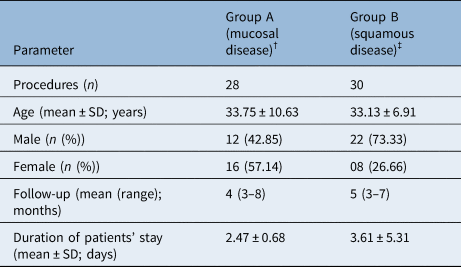
The demographic and intra-operative characteristics of patients are shown in Table 2. The chorda tympani nerve was identified in 25 patients (89.28%) in the mucosal disease group, and 22 patients (73.33%) in the squamous disease group (p = 0.20). Of the total 25 cases where the nerve was identified, it was preserved in 22 cases (88%) and sacrificed in 3 cases (12%). The mean taste score of the contralateral ear (healthy ear) in patients of group A was 5.64, and the respective score in group B was 5.70 (p = 0.75). Again, the mean taste score of patients with mucosal and squamosal disease was 12.63 and 11.86, respectively (p = 0.51).
Demographic data and patient characteristics of the study population*

* Total n = 58; †n = 28; ‡n = 30. SD = standard deviation
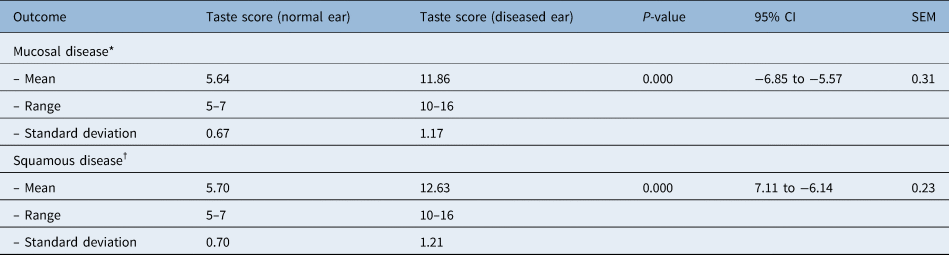
When the mean pre-operative taste scores were compared between the diseased and the healthy ears in both the mucosal and squamous groups, a significant difference was detected (p = 0.000), as demonstrated in Table 3.
Comparison of pre-operative taste scores between the healthy and diseased ear

*n = 28; †n = 30. CI = confidence interval; SEM = standard error of mean
On the first post-operative day, the average taste scores in group A and group B were 11.50 and 11.30, respectively (p = 0.71). Similarly, at the end of 1 month, the taste scores of group A and group B were found to be 10.46 and 11.43, respectively (p = 0.008). In the last follow-up period (i.e. at the end of 3 months) the average taste scores were documented to be 10.21 and 11.60, respectively (p = 0.000), as shown in Table 4.
Comparison of taste scores between mucosal and squamous disease in the follow-up periods

*n = 28; †n = 30. SD = standard deviation; CI = confidence interval; SEM = standard error of mean
The mean improvement of the taste score at the first follow-up visit (day 1) was 0.35 and 1.13 in mucosal and squamous diseases, respectively (p = 0.17) (Figure 2). Similarly, the improvement in the taste scores at 1 month after surgery was 1.39 and 1.20 in mucosal disease, and squamous disease, respectively, (p = 0.71), and the corresponding scores at 3 months of follow-up were 1.64 and 1.03, respectively, (p = 0.21), as demonstrated in Table 5.
The box plot shows a comparison of improvement in taste scores between mucosal and squamous disease groups in the post-operative period.

Comparison of improvement in the taste scores between mucosal and squamous disease

*n = 28; †n = 30. CI = confidence interval; SEM = standard error of mean
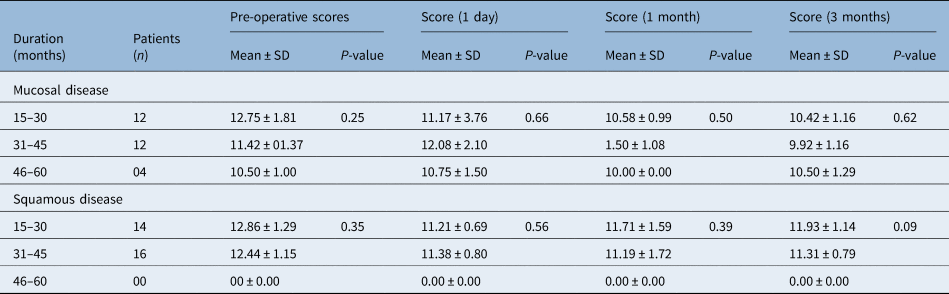
Again, the improvement of the taste scores at day 1 in the mucosal disease (group A) with and without preserving the chorda tympani nerve was found to be 0.27 ± 2.70 and 0.66 ± 3.00, respectively (p = 0.58). Similarly, during the second follow-up period (1 month), the taste scores were 1.4 ± 1.81 and 2.3 ± 2.51, respectively (p = 0.43). The corresponding scores at the 3 month follow up were 1.68 ± 2.23 and 0.33 ± 2.51 (p = 0.34). When the taste scores were evaluated with respect to the duration of disease, we did not find any significant difference in any of the study groups (p > 0.05). Again, there was no significant correlation established between the age of the patients and taste scores in any of the study groups (p > 0.05) (Table 6 and Table 7).
Mean taste score in relation to duration of disease

SD = standard deviation
Mean taste score with respect to the distribution of age

SD = standard deviation
When the qualitative assessment of taste was compared between healthy and diseased ears in the mucosal group, we found a significant difference in each type of taste sensation (p ≤ 0.05). The sweet and bitter taste was the most prominent taste encountered in all the follow-up periods in patients with mucosal disease (p ≤ 0.05). In contrast, patients with squamous disease did not have any significant difference in the follow-up periods (p > 0.05), although a significant difference was noted for the sweet taste in the pre-operative period.
Discussion
Taste is an important sensation for an individual both for daily activities and for professionals such as chefs and wine tasters. Impairment of taste can adversely affect one's feeding habits and later lead to a decrease in quality of life to a great extent. As the chorda tympani nerve remains uncovered in the mesotympanum, it is very much vulnerable to the inflammatory change associated with mucosal and squamous disease. Although the exact aetiology is still unknown, damage to the nerve could be due to the combined effect of infective toxin and the mediators produced in the inflammation.
Past literature has already documented taste dysfunction in patients with middle-ear diseases.Reference Huang, Lin, Wang, Chen, Shiao and Tsai4,Reference Gedikli, Dogru, Aydin, Tuz, Uygur and Sari7,Reference Teker, Gedikli, Altun, Korkut and Ahishali8 Although the chorda tympani nerve is affected in most patients, very few patients complain of taste dysfunction.Reference Landis, Beutner, Frasnelli, Hüttenbrink and Hummel9 As described by Saito et al., only 39 per cent of patients with a damaged nerve complained of taste dysfunction in the post-operative period.Reference Saito, Manabe, Shibamori, Yamagishi, Igawa and Tokuriki10 In the description of the previous literature,Reference Berling, Mannstrom, Ulfendahl, Lilliestrom and Unge11 the neural damage in the inflammatory process is often temporary, and function can be regained after the offending factor is settled (i.e. after the corrective surgery).
In the present study, taste assessment was performed as described by Mueller et al.Reference Mueller, Kallert, Renner, Stiassny, Temmel and Hummel6 in the pre-operative and post-operative periods. On comparing the gustatory function of the diseased ears with that of the normal ears, a significant difference was found both in the mucosal and squamous disease groups (p < 0.05). A similar study was conducted by Landis et al., which described a significant difference in the taste sensation between the healthy and diseased side in patients with chronic otitis media, with the difference in sweet and salty tastes being the most prominent.Reference Landis, Beutner, Frasnelli, Hüttenbrink and Hummel9 As described by Goyal et al., the most noticeable difference in the taste sensation was detected for bitter taste when it was compared with the healthy side in patients with unilateral chronic otitis media without cholesteatoma.Reference Goyal, Singh and Dash12 In the present study also, the most prominent difference in the taste score was noted in the sweet and bitter tastes, which were detected in all the follow-up periods in patients of chronic mucosal disease (p < 0.05). In contrast, in the squamous disease, although a significant difference was noted for sweet taste in the pre-operative period, we did not find any significant difference in the follow-up periods (p > 0.05).
The impairment of taste sensation is often considered a temporary dysfunction related to the degeneration of the chorda tympani nerve, and corrective surgery can enable the nerve to attain its functional integrity. As described in the literature, both improvementsReference Huang, Lin, Wang, Chen, Shiao and Tsai4 and the worsening of taste sensationsReference Ciofalo, Zambetti, Romeo, Vestri, Iannella and Re13 were noted in patients with chronic mucosal disease after the surgery. In the present study, all the patients had a significant improvement in the taste scores in all follow-up periods compared to that of the pre-operative taste score.
As the chorda tympani nerve was sacrificed in all the cases in squamous diseases, it was expected that there would be worsening of symptoms in these patients compared to those with chronic mucosal disease. In contrast, we did not find any significant difference in the taste score between the pre-operative and post-operative periods in the squamous disease cases, and the worsening of the taste score was rare. The insignificant outcome in the taste scores in the squamous disease could be due to poor identification and sacrificing the nerve in the intra-operative period.
In contrast, some authors believe that gustatory dysfunction is minimally affected even after complete resection of the nerve,Reference Saito, Manabe, Shibamori, Yamagishi, Igawa and Tokuriki10,Reference Michael and Raut14 although the data are inconsistent. Different explanations have been proposed for gustatory dysfunction in the past as follows: (1) inhibition of the glossopharyngeal nerve after the injury of chorda tympani nerve;Reference Kveton and Bartoshuk15,Reference Lehman, Bartoshuk, Catalanotto, Kveton and Lowlicht16 (2) cross-innervation from the opposite chorda tympani nerve;Reference Huang, Lin, Wang, Chen, Shiao and Tsai4,Reference Landis, Beutner, Frasnelli, Hüttenbrink and Hummel9 and (3) that because taste perception involves the entire tongue, which is a complex neural pathway including the VIIth, IXth and Xth cranial nerves, the effect of the ipsilateral chorda tympani nerve is relatively unremarkable.Reference Gopalan, Kumar, Gupta and Phillipps17
An animal study conducted by Cain et al. confirmed that there is a temporary shrinking of the fungiform papilla after injury of the chorda tympani nerve, but within two weeks the fungiform papilla recovers.Reference Cain, Frank and Barry18 As described by Nin et al., the recovery of the chorda tympani nerve can be delayed up to one year.Reference Nin, Sakagami, Sone-Okunaka, Muto, Mishiro and Fukazawa19 In the present study, although both mucosal and squamous diseases did have a variable degree of gustatory outcomes, none of the patients in either group had gustatory complaints in the pre-operative period. This could be due to the long duration of disease resulting in gradual loss of the taste function over time, which might bring less attention to subtle changes. Again, for patients with unilateral ear disease, impairment of taste is rarely presented because of the intact contralateral chorda tympani nerve. On considering the confounding factors of duration of disease and the age of the patients, there was no significant correlation between the age of the patients and the duration of the disease with the pre-operative or post-operative taste score in both groups in any of the follow-up periods, as described by Goyal et al.Reference Goyal, Singh and Dash12
In contrast, Felix et al. concluded that the duration of the disease and the pre-operative morbidities adversely affect the gustatory outcome of a patient with otitis media.Reference Felix, Tomita, Pereira, Cordeiro, Carleti and Barros20 As described by Sone et al., the chance of recovery for younger patients is better than for older patients.Reference Sone, Sakagami, Tsuji and Mishiro21 When gustatory scores were compared in patients with and without the preservation of the chorda tympani nerve in mucosal disease, we did not find any significant difference in improvement between the two groups. This could be due to the small sample of patients where the nerve was sacrificed during the surgery.
• Both mucosal and squamous diseases can significantly affect gustatory function compared to healthy ears
• Although improvement in taste sensation was noticed both in chronic mucosal and squamous disease after surgery, the recovery of the taste was better in patients with mucosal disease
• Despite the complete sacrifice of the chorda tympani nerve, taste sensation can be preserved in most of the patients without worsening of taste function
• There was no significant correlation detected between the duration of the surgery or age of the patient and the taste scoring in chronic otitis media
• A large sample size with a long-term follow-up period may be required for a better understanding of the results
Despite the variable gustatory outcomes obtained in the past literature in patients with chronic mucosal and squamous diseases, the improvement of taste in the present study cannot be denied. Although the improvement of taste sensation was not encouraging in squamous disease, we did not find any significant deterioration of taste, as demonstrated in the current study. A large sample size with a long-term follow-up period may be required for a better understanding of the results.
Conclusion
Both mucosal and squamous diseases can significantly affect gustatory function compared to healthy ears. Although the improvement in taste sensation was noticed both in chronic mucosal and squamous disease, the recovery of taste was better in patients with the mucosal disease. Despite the complete sacrifice of the chorda tympani nerve, the integrity of taste sensation can be preserved in the majority of the patients with squamosal disease. There was no significant correlation found between the duration of surgery or age of the patient and the taste score in chronic otitis media. A large sample size with a long-term follow-up period may be required for a better understanding of the results.
Acknowledgements
The authors would like to acknowledge that the study was conducted in the Department of ENT and Head Neck Surgery, Postgraduate Institute of Medical Education and Research, Dr Ram Manohar Lohia Hospital, New Delhi. There are no conflicts of interest among the authors.
Competing interests
None declared