Introduction
Australian health authorities responded promptly to the COVID-19 pandemic, minimizing community transmission of the virus. Reference O’Sullivan, Rahamathulla and Pawar1 However, transmission of SARS-CoV-2, the coronavirus that causes COVID-19, was not completely halted. On March 16, 2021, Australia had recorded 29137 confirmed COVID-19 cases and 909 deaths. 2 In the state of Victoria alone, 3561 Healthcare workers (HCWs) were confirmed COVID-19 positive by January 2021, with 1 death. Reference Ananda-Rajah, Veness, Berkovic, Parker, Kelly and Ayton3,4
A total of 2 distinct spikes in Australian COVID-19 cases were reported during 2020; the first spike occurred between March and April, followed by a reduction in community transmission in May and June. A subsequent second spike ensued in July, waning throughout September. Victoria primarily contributed to this second wave of cases. 2
On the frontline
HCWs are on the frontline when responding to public health emergencies. Throughout the COVID-19 pandemic, medical doctors (MDs), nurses, and paramedics are at increased risk of occupational exposure. Reference Rebmann, Vassallo and Holdsworth5 In addition to the ever-present threat to physical health, COVID-19 has also had an impact on the mental health of HCW’s, including elevated risk of anxiety, Reference Labrague6–Reference Pappa, Ntella, Giannakas, Giannakoulis, Papoutsi and Katsaounou12 insomnia, Reference Lai, Ma and Wang7,Reference Spoorthy, Pratapa and Mahant9,Reference Que, Shi and Deng11–Reference Zhang, Yang and Liu13 depression, Reference Lai, Ma and Wang7,Reference Spoorthy, Pratapa and Mahant9 secondary or vicarious trauma, and severe stress reactions. Reference Vagni, Maiorano, Giostra and Pajardi14,Reference Arpacioglu, Gurler and Cakiroglu15 Diminished job satisfaction, Reference Labrague and de Los Santos10 and increased burnout and demoralization, Reference Allen and Cug16,Reference Cheung, Fong and Bressington17 add to the mental health burden associated with the pandemic.
The long-term physical and mental health consequences for frontline HCWs may not be fully understood for many years. As seen with other disasters such as 9/11 and the Australian Black Saturday bush fires, Reference Duckett, Mackey and Stobart18 frontline workers are susceptible to post-traumatic stress disorder, depression, and substance abuse. Reference DePierro, Lowe and Katz19 A key lesson learned during the Ebola outbreak in West Africa between 2014 and 2016, was the need to enable frontline HCW’s to feel heard. Reference Strachan, Gilbert and Strachen20 The World Health Organization (WHO) advised that engaging with, and supporting HCWs was key to overcoming the outbreak, and believes these insights are crucial in the frontline response to COVID-19. 21,22 During the evolving COVID-19 pandemic, it is critical to explore novel ways to engage with frontline HCW’s and discover, synchronously, what their concerns are.
Key lessons from the COVID-19 pandemic are emerging, including timely access to personal protective equipment (PPE). Reference Shanafelt, Ripp and Trockel8,Reference Nyashanu, Pfende and Ekpenyong23–Reference Halcomb, McInnes and Williams31 There is a need for improved workplace communications, surge planning, and expansion of roles for HCWs. Organizations need to aid HCWs with provision of temporary accommodation and childcare facilities, and explicit policies to protect workers from harm. Reference Minissian, Ballard-Hernandez and Coleman32,Reference Ulrich, Rushton and Grady33
Willingness to work
HCW willingness to work during disasters has been explored in a number of different reviews and studies. Reference Aoyagi, Beck, Dingwall and Nguyen-Van-Tam34–Reference Brice, Gregg, Sawyer and Cyr39 This growing evidence-base has identified a number of key barriers and enablers to frontline HCW’s willingness to work during disasters.
A systematic review regarding willingness to work during influenza pandemics ascertained females were less willing to work than their male counterparts. Reference Aoyagi, Beck, Dingwall and Nguyen-Van-Tam34,Reference Al-Hunaishi, Hoe and Chinna40 Childcare responsibilities increased the probability that a HCW would not want to work. Reference Aoyagi, Beck, Dingwall and Nguyen-Van-Tam34,Reference Brice, Gregg, Sawyer and Cyr39 HCWs based in urban locations or working part-time were less inclined to work. Reference Aoyagi, Beck, Dingwall and Nguyen-Van-Tam34 Several studies identified fear of infection, Reference Smith, Morgans, Qureshi, Burkle and Archer38,Reference Imai41,Reference Anderson, Pooley, Mills, Anderson and Smith42 chemical or radiation exposure, Reference Brice, Gregg, Sawyer and Cyr39,Reference Sultan, Løwe Sørensen, Carlström, Mortelmans and Khorram-Manesh43 and fear of infecting family, Reference Rajbhandari and Maharjan36,Reference Smith, Morgans, Qureshi, Burkle and Archer38,Reference Anderson, Pooley, Mills, Anderson and Smith42,Reference Sultan, Løwe Sørensen, Carlström, Mortelmans and Khorram-Manesh43 as key barriers regarding willingness to work. Feelings of isolation and a desire for compensation if infected were also concerns. Reference Imai41
Feelings of professional obligation to work during a health emergency has been reported in several studies, Reference Rajbhandari and Maharjan36,Reference Smith, Morgans, Qureshi, Burkle and Archer38,Reference Brice, Gregg, Sawyer and Cyr39,Reference Anderson, Pooley, Mills, Anderson and Smith42,Reference Rebmann, Charney, Loux, Turner, Abbyad and Silvestros44 as well as the perception of the importance of the HCWs role during a pandemic, Reference Aoyagi, Beck, Dingwall and Nguyen-Van-Tam34 both of which have positive effects on willingness to work. HCWs professional obligation to work is subtly different from preparedness to work. Willingness to work explores personal motivation to work and is influenced by risk perception. Preparedness to work refers more to their actual ability to work (i.e., enough training, access to PPE etc.). If a workplace was regarded as safe, had plans for surge capacity, and adequate protective measures had been undertaken, HCWs were more prepared to work. Reference Aoyagi, Beck, Dingwall and Nguyen-Van-Tam34,Reference Rebmann, Charney, Loux, Turner, Abbyad and Silvestros44 Trust in the employer and provision of timely information from organizations were linked with willingness to work. Reference Imai41,Reference Anderson, Pooley, Mills, Anderson and Smith42 HCWs who were adequately trained in pandemic awareness, had good knowledge of their role, Reference Aoyagi, Beck, Dingwall and Nguyen-Van-Tam34,Reference Al-Hunaishi, Hoe and Chinna40 and who were good communicators reported increased willingness to work during a pandemic. Reference Aoyagi, Beck, Dingwall and Nguyen-Van-Tam34 Many existing studies explore hypothetical public health emeregiencies, and may not necessarily provide an accurate reflection of willingness to work in the event of an actual emergency.
Often previous research exploring healthcare workers perceptions of willingness to work was based on hypothetical scenarios. Reference Smith, Morgans, Qureshi, Burkle and Archer38–Reference Al-Hunaishi, Hoe and Chinna40,Reference Sultan, Løwe Sørensen, Carlström, Mortelmans and Khorram-Manesh43 Given ongoing reports and concerns regarding HCWs access to PPE and reported negative psychological impacts from responding to this healthcare crisis, this research sought to investigate the extent to which the first wave of COVID-19 impacted on the willingness of frontline HCWs in Australia to work, and if there were any notable differences in willingness to work between MDs, nurses, and paramedics. This research will provide actual unfolding data on the perceptions of frontline HCWs willingness to work during a public health emergency.
Methods
Study design
Participants completed a mixed-methods questionnaire delivered through Qualtrics software (Qualtrics Inc., Provo, Utah) and disseminated via social media (Facebook and Twitter). A multi-modal sampling methodology was utilized, which included initial convenience sampling and subsequent snowball sampling. Snowball sampling was included to increase the number of research participants. Based on the Australian Health Practitioner Regulation Agency (AHPRA) data, there are 125641 medical doctors, 415433 nurses, and midwives, and 19838 paramedics registered in Australia. 45 With a total potential sample pool of 561000 participants, an appropriate sample size would be 384 respondents. 46 Medical practitioners represent 15.7% of all registered healthcare professionals, nurses and midwives represent 56.3% and paramedics, 2.5%. Women account for 75.3% of all registered Australian healthcare professionals. 46 Participants were drawn from all 8 Australian States and Territories. Whilst individual workplaces were not recorded, the sample was widespread throughout Australia and likely drawn from multiple workplaces.
The questionnaire was active between April 16 to 30, 2020 immediately following the first wave of confirmed COVID-19 cases in Australia. Potential participants included any licensed MD, nurse/midwife, or paramedic working within the Australian healthcare system during the research period. Participants read an online information letter then selected an option confirming they consented to participate in the research. The questionnaire was comprised of 2 sections: (1) demographic factors, (2) perceptions of professional obligation, and willingness to work during the COVID-19 pandemic. Participants were asked to what extent the following aspects were impacting their willingness to work during the pandemic:
-
1) Availability of PPE,
-
2) Risk of COVID-19 exposure,
-
3) Inability to socially distance from family,
-
4) Inability to socially distance from other community members,
-
5) Concern expressed from family members, and
-
6) Caring responsibilities.
These questions were posed on a 7-point Likert scale (1 = low impact, 7 = high impact). Questions were either forced response (utilizing Likert scales or dichotomous response options), or optional open-ended questions. The questions utilized in the online survey are included in the supplementary material.
The research was approved by the Edith Cowan University Human Research Ethics Committee (#2020-01397). Appropriate informed consent was obtained from participants via Qualtrics software (Qualtrics Inc., Provo, Utah) survey tool.
Analysis
Quantitative data
Questionnaire data was downloaded into IBM SPSS 24.0 (SPSS Inc., Chicago, Illinois, USA). 1-Way ANOVA and independent samples t-tests compared differences in means of continuous (Likert-scale) variables between groups. Fisher’s Exact and Chi Square tests compared differences in proportions between categorical variables. Significance level was set at α = 0.05.
Qualitative data
A coding protocol was established to identify key themes in the survey’s descriptive open-ended questions. Preliminary manual coding by 2 independent researchers identified relevant themes. Subsequent coding then identified overarching themes within the data.
Results
Demographics
A total of 735 participants commenced the questionnaire, of which 150 did not answer all forced response questions. Out of these 150 participants, there were no differences between age (P = 0.594), gender (P = 0.277), or healthcare discipline (P = 0.155) amongst those who provided demographic data (n = 95), compared to participants who completed all forced response questions. With no noticeable relationships for those not completing all forced response questions, we considered this missing data completely at random and therefore appropriate to exclude from the analysis. The remaining 585 participants answered all forced response questions. Out of these participants, 5 were not licensed MDs, paramedics, or nurses hence were also removed from the analysis, leaving a total of 580 participants.
Participants were comprised of 82 MDs (14.14%), 237 nurses, nurse practitioners, or midwives (subsequently referred to as nurses, 40.86%), and 261 paramedics (45%). The entire sample was 72% female. Females represented 95% of the nursing cohort, 61% of the MD cohort, and 56% of the paramedic cohort. MDs either worked in hospitals (73%), or in General Practice (GP) clinics (27%), while nurses worked in hospitals (68%), GP clinics (17%), aged-care facilities (7%), or in community care positions (8%). All (100%) paramedics worked for an ambulance service. The entire sample’s mean age was 41.2 years (± 10.8 years). Paramedics were significantly younger (μ = 37.2 years) than both MDs (μ = 44.1 years; P < 0.001) and nurses (μ=44.6 years; P < 0.001). The mean years of work experience in participants’ primary profession was 12.7 years (± 9.2 years) for the entire sample. Correspondingly, paramedics had significantly less work experience (μ = 9.8 years) than nurses (μ = 15.3 years; P < 0.001) and MDs (μ = 14.7 years; P < 0.001).
Perceptions of professional obligation and willingness to work during the covid-19 pandemic
Participants were asked ‘Have you received any communication from your workplace concerning obligation to work during the pandemic?’ A quarter of participants (26%) suggested they had. Nurses were more likely to suggest they had compared to paramedics (31% vs. 22%, χ 2 = 6.232, P = 0.044). MDs (27%) were no more likely to suggest they had, compared to nurses or paramedics. Open-ended responses indicated 11% (n = 64) of participants felt there was a lack of information provided, while 9.7% (n = 56) suggested there was information overload. Another 8.4% (n = 49) indicated a lack of clarity in communications from workplaces.
Participants were asked the extent to which they had weighed their professional obligation (‘I should work’) with personal risk (“I could get infected, I could infect my family”). A total of 75% of participants agreed they had considered this. More MDs expressed they had contemplated this statement than paramedics (MDs 81%, paramedics 72%, P = 0.003).
Another question examined the extent to which participants agreed that as a HCW, some level of risk regarding workplace exposure to infectious disease is acceptable. A third of the participants (35%) disagreed with this statement. MDs were less likely to agree with this statement than nurses (MDs 32%, nurses 39%, P = 0.037).
Additionally, participants were asked if their willingness to work had changed during the pandemic compared to pre-pandemic times. A total of 42% of participants suggested they felt their willingness to work during the pandemic was less than pre-pandemic times. MDs were more likely to suggest this compared to both nurses (P = 0.032), and paramedics (P = 0.034) (MDs 54%, nurses 44%, paramedics 44%).
Table 1 below depicts the results of various factors such as the Access to PPE and Risk of exposure to COVID-19, and the impact these factors have had on HCWs willingness to work during the pandemic.
Mean scores for rating of importance placed on factors impacting clinician’s willingness to work during the first wave of the COVID-19 pandemic in Australia (low impact = 1, high impact = 7)

* statistically significant difference between medical doctors and paramedics
# statistically significant difference between nurses and paramedics
Participants suggested that Access to PPE was the factor most heavily impacting on their willingness to work at the present time. Paramedics were less concerned about Access to PPE than MDs and nurses (P < 0.001 respectively). Access to PPE was suggested to impact on willingness to work to a significantly greater extent than all other items with the exceptions of Concern expressed by family members and Risk of Exposure to COVID-19. Access to PPE was more strongly positively correlated to Risk of Exposure to COVID-19 (r = 0.572, P < 0.001) than to Concern expressed by family members (r = 0.356, P < 0.001). Similarly, Concern from family members (P = 0.001) and Exposure to COVID-19 (P = 0.016) was suggested to impact willingness to work significantly greater than all other items with the exception of Access to PPE. While Inability to socially distance from family was not impacting willingness to work to the same extent as Access to PPE, Concern from family members, and Risk of Exposure to COVID-19, it was suggested to impact more than one’s ability to Maintain social distancing from other members of the community, and Caring responsibilities. Being able to maintain social distancing from other members of the community was suggested to impact on willingness to work significantly less than all other items.
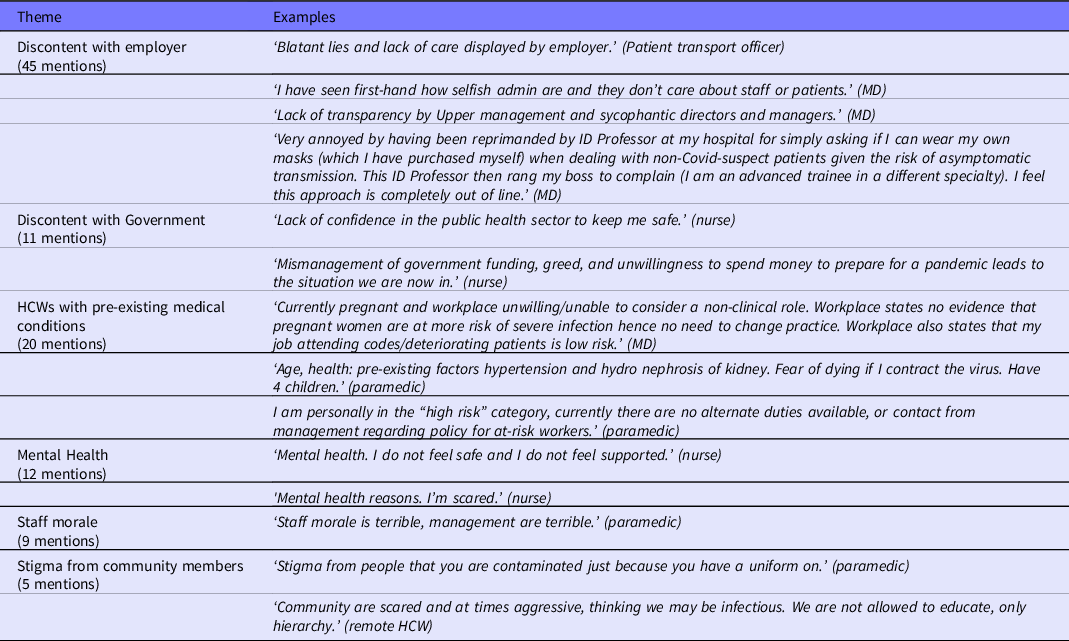
Participants were asked if there were any other aspects currently impacting on their willingness to work at the present time via open-ended text box. From 217 unique responses, 6 themes arose through analysis: (1) discontent with their employer, (2) the government, (3) concerns expressed by HCWs with pre-existing medical conditions, (4) mental health concerns, (5) staff morale, and (6) stigma from the community associated with being an HCW. Table 2 provides some examples of open-text responses under each of the 6 themes.
Themes and examples of open-ended responses from open-ended question asking participants if there were any other aspects currently impacting their willingness to work during the COVID-19 pandemic

Abbreviations: HCW, Healthcare worker; MD, Medical doctor.
Discussion
This research identified that during the first wave of COVID-19 in Australia, frontline HCWs surveyed in April 2020 had several concerns impacting their willingness to work. Compared to pre-pandemic circumstances, over 40% of HCWs were less inclined to work. By April 20, 2020 (the last day the online survey was open for completion) Australia had recorded 6798 cumulative cases, substantially less than the 28000+ recorded by the latter end of January 2021. 2 It is uncertain if more HCWs would be disinclined to work the longer the pandemic lasts. Organizational processes and procedures are likely to be more streamlined now than they were at the start of the pandemic, weighed against factors such as fatigue and burnout.
As the pandemic continues, the risks of ongoing physical, psychological, and emotional toll on frontline workers, and their families is of great concern. Reference Raudenská, Steinerová and Javůrková47 The prevalence of traumatic stress in HCWs during the pandemic has been reported as ranging from 7.4–35% with women, nurses, and frontline workers particularly at risk. Reference Benfante, Di Tella, Romeo and Castelli48 It has been recommended that organizations recognize early symptoms of psychological trauma in order to establish appropriate interventions and protective factors to prevent or help alleviate conditions such as severe depression, post-traumatic stress disorder, and substance abuse from developing. Reference Benfante, Di Tella, Romeo and Castelli48 A 2019 investigation of American nurses concluded burnout was likely to impact on work performance. Reference Dyrbye, Shanafelt, Johnson, Johnson, Satele and West49 A third of participants reported at least 1 symptom of burnout (35%), 30% had symptoms of depression, and 16% disclosed absenteeism. Work performance was self-rated as ‘poor’ in 10% of nurses without burnout, and 27% of nurses with burnout. Reference Dyrbye, Shanafelt, Johnson, Johnson, Satele and West49 Factors such as burnout and depression could potentially impact on the quality of patient care. The investigation was conducted prior to COVID-19 and raises concerns regarding the ability of HCWs to maintain adequate standards of patient care during periods of heightened workplace stress such as the COVID-19 pandemic.
With regard to Social distancing from family, Social distancing from community members, or Caring responsibilities, the extent to which these factors impacted willingness to work were no different between professions (Table 1), although paramedics had a lower mean score for all 3 categories than nurses and MDs. With respect to Concern expressed by family members, this impacted nurses significantly more than paramedics. This survey did not explore family and parental commitments extensively, but occupational exposure to COVID-19 could be a concern to family members of HCWs, particularly if children are part of the family unit. Influenza pandemics have shown childcare obligations can significantly affect frontline HCWs willingness to work, and even young children can be aware of the risks of their HCW parents being exposed to COVID-19 in the workplace. Reference Aoyagi, Beck, Dingwall and Nguyen-Van-Tam34,Reference Skokauskas, Leventhal, Cardeli, Belfer, Kaasbøll and Cohen50
Some HCWs with pre-existing medical conditions reported feeling unsupported by their employers (Table 2). While there is no current evidence that pregnant HCWs are at elevated risk of infection from COVID-19, Reference Hanna, Hanna and Sharma51 the psychological impact from anxiety cannot be ignored. Reference Moyer, Compton, Kaselitz and Muzik52 A recent Austrian study found that the pandemic was having a profoundly negative effect on the psychological health of pregnant women, with nearly 50% of their participants working in essential services or as HCWs. This demonstrates the need for workplaces to consider employees’ physical and mental well-being and scrutinize existing policies concerning employee welfare. Various HCWs expressed a desire to work in a role away from the frontline, as they or their family members were in a ‘high risk’ category. It is possible some organizations are unable to do this, lacking alternative roles and suitable replacements for frontline work. However, there should be appropriate communications and policies in-situ to manage these challenges. Research has underscored the need for suitable pre-pandemic preparedness guidelines from organizations in order to handle such disasters appropriately. Reference Anderson, Pooley, Mills, Anderson and Smith42 Employer discontent was a frequently mentioned factor regarding willingness to work amongst our sample, with 45 open-text box comments. An additional 11 comments expressed discontent with the government’s response to the pandemic. Requests for open and honest communication and timely information were frequently noted.
An important consideration for HCWs was the availability of PPE. MDs and nurses suggested Access to PPE was impacting their willingness to work more so than paramedics; however, paramedics still recorded an elevated level of concern with a mean response of 4.14 out of a possible 7 (with 7 representing ‘high impact’). The reason for paramedics being less concerned than other HCWs is unclear. Many possible reasons exist, including knowledge of pre-existing stock levels within their own organization, a higher risk threshold concerning exposure to COVID-19 or potentially clearer messaging from management about how PPE supplies were going to be managed. PPE shortages have been recorded worldwide, Reference Cohen and Rodgers53,Reference Burki54 and Australian HCWs have also had difficulty with access to sufficient PPE. Reference Halcomb, McInnes and Williams31 It has been reported that during Australia’s second wave of COVID-19 cases, up to 70% of COVID-19 infected HCWs acquired the virus through their occupation. Reference Smith55
Provision of adequate PPE covers multiple aspects of willingness to work: increased occupational exposure and risk of infection, greater risk of transmission to colleagues and family, as well as impacting perceived support from the employer. MDs were significantly more concerned regarding exposure to COVID-19 compared to paramedics, with both MDs and nurses recording higher mean scores (4.87 and 4.67 respectively) compared to paramedics (4.26). In Australia, under the Health and Safety Legislation, the responsibility to appropriately protect employees with PPE falls on organizations. Reference Weekes56
HCWs being less willing to work during COVID-19 when compared with pre-pandemic times must take a toll on the workplace. Staff morale, physical, and mental health could become eroded over time, as the COVID-19 pandemic continues. Staff shortages from illness, quarantining or absence due to caregiver responsibilities reduce the pool of available workers, potentially affecting care quality, and patient outcomes. Reference Propper, Stoye and Zaranko57 HCWs availability and willingness to work is therefore directly related to capacity within the healthcare system, Reference Rajbhandari and Maharjan36,Reference Foley, Kirk, Jepp, Brophy-Williams, Tong and Davis58 and surge planning will need to incorporate contingencies for HCW availability, and adjust resources and maximum capacity ratings accordingly. Reference Tumlinson, Altman, Glaudemans, Gleckman and Grabowski59
Clearly, there is a need for open honest communications from management, and timely information on matters such as PPE supplies. The link between perceived organizational support and job performance is clear. Reference Ahmed and Nawaz60 Policies and guidelines for public health emergencies need to include considerations on ‘just in time’ supply chains and sufficient training in infection control appropriate to the disease outbreak. Reference Shokrani, Loukaides, Elias and Lunt61,Reference Miroudot62 HCWs need to feel valued and supported in their role which is becoming increasingly stressful and complex.
Strengths and Limitations
This study has limitations associated with using convenience and snowball sampling methods, in that self-selection bias may have influenced the representability of the study sample comparative to the general Australian HCW population. Furthermore, validation of participants being HCWs was done in the online survey via self-report only. It is conceivable (albeit unlikely) that some participants may have chosen to provide fictitious data allowing them to be included as participants but not actually meet the inclusion criteria. While the extent to which this may have occurred is unable to be calculated, we deem it highly unlikely that this would have occurred to the extent of impacting on study findings. This is a common limitation of online surveys making use of snowball sampling recruitment methodologies. Lastly, no standard mental health assessment was undertaken in this questionnaire, limiting the ability to consider the relationship between HCWs mental health and their willingness to work. This provides an avenue for future research.
The strength of this research includes the timing of the survey, which immediately followed the first 4-week wave of COVID-19, limiting memory bias. At this point in time healthcare systems were not well organized and ready to respond to the scale of this pandemic. This study provides a window of insight into the perspectives of frontline HCWs working in the early months of the COVID-19 global pandemic in Australia. Given the findings in this research reflect other contemporary studies within Australia, Reference Lord, Loveday, Moxham and Fernandez35 and internationally, Reference Labrague6,Reference Nashwan, Abujaber, Mohamed, Villar and Al-Jabry63 it is probable these findings represent a sizeable portion of the frontline Australian HCWs. This study, therefore, provides accurate data on healthcare workers’ willingness to work during an emergency, providing a unique contribution to what is currently known on this subject. To our knowledge, this is the first research investigation into Australian frontline workers’ willingness to work during COVID-19.
Conclusion
COVID-19 has clearly impacted on a substantial portion of the Australian healthcare workforce’s willingness to work during the pandemic, with MDs agreeing to this sentiment more than paramedics. During a time where communication is essential, only a quarter of HCWs had received correspondence from their employer regarding obligations to work during a pandemic, and many participants remarked on the lack of clarity or information provided. Scarcity of PPE and exposure to the virus were the most cited reasons impacting willingness to work, with MDs being more concerned than other HCWs. Since HCWs are the backbone of any pandemic response, organizations need to take sufficient care of the physical and mental health of their most important resource. The provision of appropriate policies and guidelines to manage resources during healthcare emergencies is also a vital consideration.
Supplementary material
To view supplementary material for this article, please visit https://doi.org/10.1017/dmp.2021.288
Acknowledgements
This research did not receive any specific funding.
Author contributions
Conceived and designed study: BM, ES; Designed and tested the study instruments: BM, ES; Supervised data collection: BM; Data analysis: BM, MH; Prepared manuscript: MH; and Approved manuscript: BM, ES.
Conflict(s) of interest
The authors report no conflict of interest.
Ethical standards
Edith Cowan University Human Research Ethics Committee approval (#2020-01397). Appropriate informed consent was obtained from participants via Qualtrics software (Provo, UT) survey tool.