

Introduction
Degree of income equality has been considered as relatively stable in Japan, in comparison to other industrialized countries (Marmot and Smith, Reference Marmot and Smith1989; Tachibanaki, Reference Tachibanaki2006). Based on data from 2001, the Gini coefficient (an indicator measuring economic disparity in a population) of Japan (0.31) was lower than that of the UK (0.35) or the US (0.37) (Shirahase, Reference Shirahase2001). Despite this, there is increasing public attention to and awareness of working adults living in poverty, or the working poor, including reports in the popular Japanese media (Kadokura, Reference Kadokura2006; NHK Special, 2006).
Because the working poor are less likely to have advanced job skills and to achieve a successful career in their occupational lives, the growing number of the working poor is a potentially serious socioeconomic issue in Japan. However, since Japanese labour statistics lump the working poor together with ‘employed’ adults, the issue of this growing number is usually not included as a public and political strategic priority. According to the Cabinet Office of the Japanese government, there are still no official data on the number of working poor in Japan (Japan Times, 2007).
Since many of the working poor are temporary, part-time, or day labourers, they are less likely to benefit from social security programs such as a private pension plan, premium health insurance, or protected sick leave. Thus, these people may be at risk of poor health and also of inadequate access to healthcare services. A growing number of studies worldwide indicate that low income is associated with higher mortality, poor health status, lower use of health screening, or high-risk behaviours (Berkman and Kawachi, Reference Berkman and Kawachi2000; Marmot and Wilkinson, Reference Marmot and Wilkinson2006). Fukuda et al. also have reported several studies demonstrating the associations between income and health using Japanese population data (Fukuda et al., Reference Fukuda, Nakamura and Takano2005a, Reference Fukuda, Nakamura and Takanob, Reference Fukuda, Nakamura and Takanoc, Reference Fukuda, Nakamura and Takanod, Reference Fukuda, Nakamura and Takanoe). However, there are few studies evaluating health status and healthcare utilization as related to different levels of income among Japanese working adults.
In this study, we aimed to determine the prevalence of working poor in a nationally representative random sample cohort and to explore the relationship of income to health status and healthcare utilization among working adults. Understanding the association between socioeconomic status and health status or healthcare utilization is important for planning rational and integrated economic and public health policies.
Methods
Study design
We designed a prospective cohort study of the Japanese general population based on a health diary strategy for the analysis of healthcare use in communities (Fukui et al., Reference Fukui2005; Tokuda et al., Reference Tokuda2007). We applied this approach to the investigation of health status and healthcare utilization among working adults and their relationships to income. We obtained approval from the Research Ethics Committee of Kyoto University Graduate School of Medicine and informed consent from each participant prior to the study.
There are advantages to using a health diary strategy for evaluating individual health status and health-related behaviors (White et al., Reference White, Williams and Greenberg1961; Green et al., Reference Green, Fryer, Yawn, Lanier and Dovey2001; Gibson, Reference Gibson1995; Bruijnzeels et al., Reference Bruijnzeels, van der Wouden, Foets, Prins and van den Heuvel1998). A health diary provides an accurate and continuous record of daily health events and behaviors of the study participants. In addition, a health diary documents a record of daily events and behaviors without direct observation by the investigators (Gibson, Reference Gibson1995; Bruijnzeels et al., Reference Bruijnzeels, van der Wouden, Foets, Prins and van den Heuvel1998; Anhoj and Moldrup, Reference Anhoj and Moldrup2004).
Study participants
From a nationally representative panel comprising 210,000 households belonging to the Japan Statistics & Research Co. Ltd, we selected a population-weighted random sample of households by controlling for the size of cities, towns, and villages. Since the purpose of this study was to examine health status and healthcare utilization among Japanese adult workers, we performed subgroup analyses using actively working adults aged 20–65 years old. We chose the upper age limit because the official definition of elderly in Japan is 65 years old and these individuals are typically not actively employed. Participants were those with full-time or part-time work. Homemakers, students, retirees, jobless, and those not able to work were excluded from this study.
Data collection
We collected data for demographic, income, and health-related characteristics of all participants. In the health diary, we asked all participants for a daily record of health-related episodes for one month, from 1 to 31 October 2003. The health-related episodes included any symptoms that caused discomfort, healthcare access to physicians, or use of a pharmacy or complementary and alternative medicine (CAM). The health diary specifically sought daily responses to the following:
1 Did you have any pain or other symptoms that caused you discomfort today?
2 If so, in what part of the body did you have pain or discomfort?
3 If the answer to the first question was yes, did you consult a physician? (This includes visits to a primary care physician, a community hospital, or a university hospital.)
4 Did you go to a pharmacy to purchase an over-the-counter medication?
5 Did you use dietary supplements (dietary CAM) such as nutritional drinks, vitamins, calcium, herbs, kampo, or other dietary substances?
6 Did you seek physical manipulation (physical CAM), such as acupressure, acupuncture, massage, Judo-Seifuku, moxibustion, chiropractic, or other physical manipulations?
We collected data on current occupation and annual household income in 2003 (the study year) of the participants during the survey. Occupations were classified into eight categories: administration, office work, sales and service, transport and construction, agriculture and fishery, employer and trustee, professionals, and other. Consistent with the government criterion, we defined the working poor as those with an annual equivalent income of less than 1.48 million Japanese yen; the Japanese welfare system provides financial support based on annual income with a threshold at this level (119 Japanese yen = 1 US dollar in 2003) (Shirahase, Reference Shirahase2001). To obtain annual equivalent income, we divided annual household income by the square root of the number of family members to account for the marginal decrease in living cost for additional persons living in a household (Mackenbach, Reference Mackenbach2005).
We used the SF-8 instrument to assess the health status of the participants. The SF-8 provides a health-related quality of life measurement consisting of eight scales and two summary components: a physical component summary (PCS8) and a mental component summary (MCS8) (Turner-Bowker, Reference Turner-Bowker, Bayliss, Ware and Kosinski2003). The SF-8 is scored and scaled such that 50 represent the mean SF-36 score for the Japanese population to each response category of the SF-8. A score higher than 50 indicates better health status than the mean of the Japanese general population; a score lower than 50 suggests poorer health status (Fukuhara and Suzukama, Reference Fukuhara and Suzukamo2004).
Statistical analysis
We calculated descriptive statistics for demographics and occupational characteristics of the working adults. We compared demographic distribution between study participants and data for Japanese workers of the Ministry of Health, Labour, and Welfare in October, 2003 (http://stat.jil.go.jp). We also calculated the relative proportions of the different job categories, together with weekly hours worked. The cut-off points were 30, 40, 50, and 60 for age, population of 100,000 and 1,000,000 for city residence or rural area (area of residence, mutually exclusive categories), and 15, 35, 43, 49, and 60 for weekly hours worked.
We constructed multiple linear regression analyses for the number of symptomatic episodes (counted as daily episodes), PCS8, MCS8, and healthcare utilizations in relation to income, adjusted for age, gender, and co-morbidity. For each participant, co-morbidity was measured by counting the number of chronic diseases with no weights (de Groot et al., Reference de Groot, Beckerman, Lankhorst and Bouter2003). Further, we determined the ten most frequent symptoms reported by the working adults and compared them between the working poor and other workers. Two-tailed p-values of less than 0.05 were considered as statistically significant. The SPSS software version 15.0J (Tokyo, Japan) was used for all statistical analyses.
Results
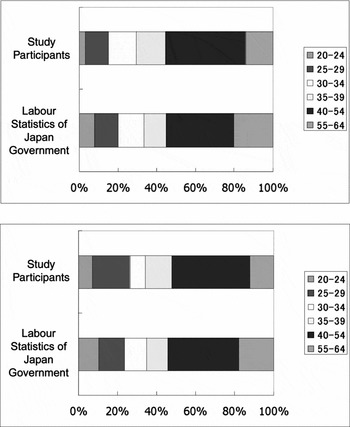
Of 3,568 participants originally enrolled in the study, 3,477 completed the survey (response rate 97%). Of these participants, there were 1,406 working adults who were 20–65 years old and completed the health diary. These working adults were analyzed for the purpose of the study. Figure 1 shows demographic distributions by age and gender to compare the study participants and labour statistics data for all Japanese workers (the Ministry of Health, Labour, and Welfare; October, 2003). Based on these labour statistics data, in a total of 61 million workers in Japan, 25 million (41.4%) were women and 36 million (58.7%) were men. Among the 1,406 study participants, 585 (41.6%) were women and 821 (58.4%) were men. Age-stratified population distributions of the study participants were also similar to those of labour statistics data. There was no significant difference in overall age-stratified distributions between the labour statistics data and the study participants for both genders (p = 0.579 for men and p = 565 for women).
Demographic distribution by age and gender: women (top) and men (bottom) Notes: Data of the Japan Government are based on published data for Japanese workers of Ministry of Health, Labour, and Welfare (October, 2003). The coloured divisions indicate proportions (%) of population with different age class.

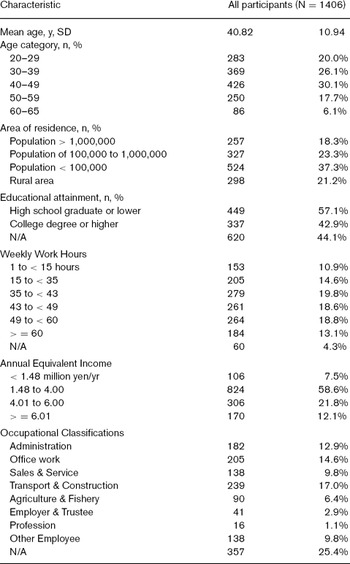
The mean age was 40.8 years old, and 821 (58.4%) were men. Of a total of 1,406 working adults, 1,059 (75.3%) were full-time workers and 347 (24.7%) were part-time workers. Among working men, 789 (96.1%) were full-time workers and 32 (3.9%) were part-time workers. Among working women, 270 (46.2%) were full-time workers and 315 (53.8%) were part-time workers. Table 1 shows the demographic characteristics of the working adults: 20.0% of these 1,406 participants were 20–29 years old and 6.1% were 60–65 years old; 18.3% lived in large cities and 21.2% in rural areas; 42.9% reported receiving a college degree or higher.
Characteristics of the Participants

N/A = data not available.
Table 1 also presents weekly work hours, occupational classifications, and annual equivalent income of the working adults. For work hours, 184 (13.1%) adults reported working 60 hours or more per week, of which 173 (22.0%) were men and 11 (2.0%) were women. Transport and construction was the most popular job among working men, while office work was the most popular job among working women.
Regarding annual income (Table 1), 106 (7.5%) working adults earned an annual income less than 1.48 million yen (the working poor), of which 56 (6.8%) were working men and 50 (8.5%) were working women. Among working poor men, 51 (91.1%) were full-time workers and 5 (8.9%) were part-time workers and among working poor women, 14 (28.0%) were full-time workers and 36 (72.0%) were part-time workers. By age stratification, the working poor comprised 10.8% of working adults aged 20–29, 9.2% of those aged 30–39, 4.3% of those aged 40–49, 6.5% of those aged 50–59, and 9.2% of those aged 60–65.
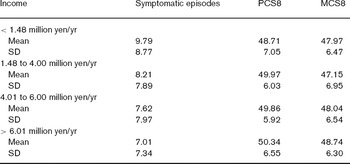
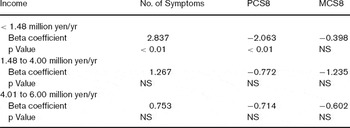
Table 2 presents health status stratified by annual income and Table 3 shows the results of multiple linear regression analyzing the relationships of health status to income adjusted for age, gender, and co-morbidity. The working poor reported a significantly greater number of symptomatic episodes (9.79 ± 8.77) during the one-month study period, compared to the highest income group (7.01 ± 7.34). This difference in symptomatic episodes was significant (p < 0.01) between the working poor and the highest income group. The working poor also reported the slightly lower score in the physical component (PCS8) of HRQOL (48.71 ± 7.05) during the one-month study period, compared to the highest income group (50.34 ± 6.55). This difference of PCS8 was also significant (p < 0.01), but the magnitude of the difference was modest. However, there was no significant difference in the mental component of HRQOL (MCS8) with different levels of annual income.
Health Status in the Participants by Income (N = 1406)

SD = standard deviation; PCS8 = physical component of SF8; MCS8 = mental component of SF8.
Relation of Health Status to Income in the Participants (N = 1406)*

PCS8 = physical component of SF8; MCS8 = mental component of SF8.
*Multiple linear regression for each measure of health status, adjusted for age, gender, and co-morbidity:
Regression models include income as a categorical explanatory variable with the group > 6.01 million yen/yr for reference group.
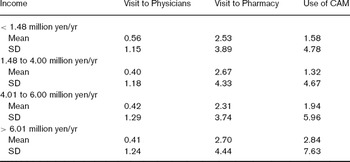
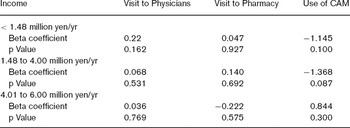
Table 4 presents healthcare utilizations stratified by annual income and Table 5 shows the results of multiple linear regressions, analyzing the relationships of healthcare utilizations to income, adjusted for age, gender, and co-morbidity. Visits to physicians or a pharmacy and use of CAM were not different for different levels of annual income. However, beta coefficients for visits to physicians for different levels of annual income indicated a linear trend, although it was not statistically significant.
Healthcare Utilization in the Participants by Income (N = 1406)

SD = standard deviation; CAM = complementary and alternative medicine.
Relation of Healthcare Utilization to Income in the Participants (N = 1406)*

CAM = complementary and alternative medicine.
*Multiple linear regression for each measure of health status, adjusted for age, gender, and co-morbidity: Regression models include income as a categorical explanatory variable with the group >6.01 million yen/yr for reference group.
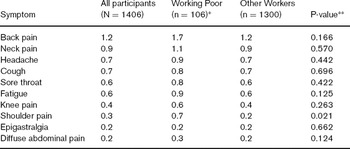
The ten most frequent symptoms reported by the working adults are described in Table 6. There was no overall difference of ranking distributions of common symptoms between the working poor and the non-poor workers. The common symptoms among the working poor included: back pain (the mean number of symptomatic episodes in one month period was 1.7), neck pain (1.1), fatigue (0.9), headache (0.9), and cough (0.8). Similarly, the common symptoms among the non-poor workers were: back pain (1.2), neck pain (0.9), headache (0.7), cough (0.7), and sore throat (0.6). By comparing each symptom between the working poor and other workers, only shoulder pain was reported significantly more among the working poor than among other workers.
The Mean Number of Episodes of Frequent Symptoms between Working Poor and Other Workers

The number of episodes indicates the mean number of symptomatic episodes.
*Working poor is defined as those with income < 1.48 million yen/year.
**P-values are based on t-test comparing mean between the working poor and other workers.
Discussion
Increased public attention is now paid to socioeconomic disparities in Japan, particularly to the growing subpopulation of the working poor. This report documents, for the first time, two characteristics of this group: the prevalence of working poor in a random sample of Japanese working adults (7.5% overall), and the possible health disparities associated with the different levels of income. The working poor report a greater number of symptomatic episodes and a poorer physical component of HRQOL compared to the highest income group, although the magnitudes of these differences seem relatively modest. However, there is no difference in the mental component of HRQOL by income. Healthcare utilization is not affected by income in Japanese working adults. Our study results based on the year 2003 data also confirmed those of Fukuda et al. (Reference Fukuda, Nakamura and Takano2005a) based on the 2001 data. Taken together, there is now strong evidence showing that individual socioeconomic status influences health status in Japan.
This study is the first to determine the prevalence of working poor among Japanese working adults. Segregated by gender, we identified 6.8% of working men and 8.5% of working women as the working poor. Recent data (2006) of the Statistics Bureau of the Ministry of Internal Affairs and Communications show that, in total, there are 38.6 million working men and 26.8 million working women (Communications of Japan Government, 2007). Thus, we may estimate that there are approximately be 2.6 million working poor men and 2.3 million working poor women (a total of 4.9 million) in Japan (out of a total population of 127.7 million in 2005).
The results of the current study indicate that the working poor show a greater number of symptomatic episodes and a poorer score of physical component of HRQOL. Several recent surveys of Japanese adults similarly suggest that low income is associated with poorer HRQOL (Wang et al., Reference Wang2005; Yamazaki et al., Reference Yamazaki, Fukuhara and Suzukamo2005; Honjo et al., Reference Honjo2006). This result is also in line with a recent European study involving seven countries, in which a lower household equivalent income is associated with poorer self-assessed health among men and women throughout these countries (Mackenbach et al., Reference Mackenbach2005). In addition, the results of the current study indicate that poor physical health is noted only among the working poor group compared to the middle−high income groups. This may also support the notion of a greater marginal adverse effect to health per unit decrease in income at the lower income ranges (Mackenbach et al., Reference Mackenbach2005).
Several mechanisms may explain this association between low income and poor physical component of HRQOL. First, low-income people may be more likely to engage in high-risk behaviors, including smoking, alcohol dependence, pathological gambling, drunk or reckless driving, and commercial sexual contacts (Fukuda et al., Reference Fukuda, Nakamura and Takano2005b, Reference Fukuda, Nakamura and Takanod). Second, low-income people may be less likely to participate in regular health check-ups and unlikely to receive health-related educational opportunities (Fukuda et al., Reference Fukuda, Nakamura and Takano2005a). Third, a low-wage job may be associated with poor job control with subsequent poor self-rated health status (Pikhart et al., Reference Pikhart2004; Tsutsumi et al., Reference Tsutsumi, Kayaba, Hirokawa and Ishikawa2006). However, in the current study, there is no difference in mental component of HRQOL with different levels of income. Further research may be needed to investigate the background of differences between physical and mental components of HRQOL as quantifiers of health status among working adults.
In the current study, we prospectively assessed frequencies of visits to physician or pharmacy and use of CAM in the Japanese working adults. Healthcare utilization is not affected by income in Japanese working adults, including working adults. This equity in physician and pharmacy access may be the result of the following characteristics of Japan: universal insurance coverage, ready access to physicians, standardized rates of hospital payment, and availability of numerous clinics and hospitals throughout Japan. In addition, the current Japanese welfare system provides financial support to those with an annual equivalent income of less than 1.48 million Japanese yen on average, which we used as cut-off level for working poor in the current study (Shirahase, Reference Shirahase2001).
However, according to a recent public comment by the Minister of Economic Policy of the Japanese government, many young Japanese people who fail to become full-time workers upon college graduation often continue being unable to secure stable employment (Japan Times, 2007). Indeed, the highest proportion of the working poor was identified among the working adults aged 20–29 (the youngest age class) in our study. These people also have no opportunity to enhance their skills and thus fall into a vicious circle (ibid.). Since the Central Cabinet Office of the Japanese government indicated that there were still no official data on the number of the working poor in Japan (ibid.), the estimate of our study may be useful to adequately fund a safety net and to develop better solutions to the complex set of causes that produce poverty in this country. Potential solutions may include more access to improved job training, vocational education, and apprenticeship programs.
In tandem with the rise in the number of working poor, many young poor workers now stay at Internet cafes overnight because they cannot afford rent on their low salaries, while such people stayed at flophouses or capsule hotels in the past. The Japan Complex Cafe Association estimates that there are about 2,800 Internet cafes nationwide and that some of the facilities provide individual cabins with computers, reclining chairs and cheap meals for 1,000 yen to 2,000 yen per night (Kyodo News, 2007). As so-called ‘net cafe refugees’ or ‘cyber homeless’ are becoming more visible in these 24-hour facilities, the government recently announced preparations to conduct its first survey on net cafe refugees to find ways to address this high-profile social problem (ibid.). Staying overnight in such a facility for a long-term period may adversely influence health status of its heavy users, who are considered as comprised of many young working poor, through poor quality of sleep and poor nutrition in small and uncomfortable cabins with easy access to unhealthy junk foods.
There were several limitations to this study. First, we were unable to determine a causal relationship between income and HRQOL because of the short length of the follow-up study period. Second, this study lacks data related to health risk behaviors including smoking, alcohol, gambling, and others. Third, the health diaries were self-reports and subjective, and information on the severity of symptoms was not requested. Fourth, there may be geographic differences in the cost of living throughout Japan. However, since there was no available poverty threshold adjusting for these differences, the single threshold was used in the current study. Fourth, the baseline panel was a nationally representative random sample of households in Japan, but we conducted a secondary analysis only on the working adults for the purpose of the study and excluded the jobless and those unable to work from the analysis. These selection criteria might have caused a selection bias.
In summary, this study determined the prevalence of working poor and explored the association between income and HRQOL among Japanese working adults. The current study indicates 7.5% of working adults are the working poor. The working poor were more likely to report symptomatic episodes in the one-month study period and showed a slightly lower physical HRQOL in comparison to the highest income group. We found no difference in healthcare utilization as a function of income in Japanese working adults. Since employment and economic policies affecting income disparity may potentially influence health status of the Japanese working poor, there is a need to integrate strategies to rectify social disparities to enhance the country's public health.
Acknowledgement
We thank Kenji Sakurai, MD, FACS, for his support for our research, and we thank Mikio Kumagai, Masato Ichikawa, Yumiko Yotsumoto, Sayoko Yamauchi, Kayo Ichikawa, and Yuko Iwasawa for their excellent secretarial assistance. This study was supported by a research grant from St. Luke's Life Science Institute.