Introduction
The study of Etruscan painted tombs is dominated by visual and text-based perspectives. The absence of surviving Etruscan literary texts has encouraged scholars to approach tomb paintings using Greek and Roman texts, which may not be of direct relevance (Steingräber Reference Steingräber1986; Cristofani Reference Cristofani, Jovino and Treré1987). Conversely, art historical perspectives have led to discourse focused on visual motifs, while epigraphic analyses have concentrated on the reconstruction of tomb ownership and familial relationships (Torelli Reference Torelli1983; Naso Reference Naso1996; Roncalli Reference Roncalli, Gualtier and Briquel1997; Morandi Reference Morandi2004). These different approaches emphasise the presumed meaning and socio-political interpretation of the imagery, but neglect to consider how the Etruscan tomb space was encountered by funerary participants (Renfrew et al. Reference Renfrew, Frith and Malafouris2009). Painted tombs in Etruria were experienced across a wide range of sensory constructs, including their visual, aural, olfactory and haptic properties (Warden & Thomas Reference Warden and M. Thomas1999; Izzet Reference Izzet2007). Apart from the visual, however, researchers often assume most sensory encounters inside these tombs remain out of reach; the experience of sound, for example, is omitted from most studies. I argue that sound is not only accessible, but also uniquely able to shed light on funerary experiences otherwise overlooked by visual analyses. Audition is very different from vision. What is perceived as sound is actually a form of physical touch, hence audition is both cognitively and tactically sensed. Acoustic characteristics such as reverberation, for example, generate bodily vibrations both in individuals with normal hearing and those with hearing impairments, creating a shared human experience (Rogers et al. Reference Rogers, Lister and Febo2006). Audition therefore offers an additional way to understand the burial event from cognitive and corporal perspectives.
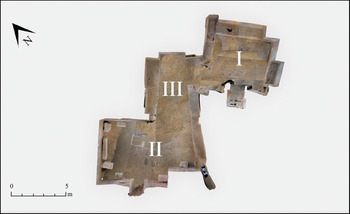
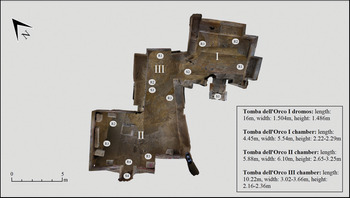
In ancient Etruria environmental sounds, such as thunder, were observed as divine messages. Greek, Roman and early Christian authors including Cicero (Div. 2.38.80; Falconer Reference Falconer1923) and Seneca (QNat. 2.32.2; Corcoran Reference Corocan1971) portray a culture deeply invested in observing natural phenomena, such as divination from birds, or ornithomancy (Pfiffig Reference Pfiffig1975). These traditions extended into the funerary setting, as seen with scenes of ornithomancy depicted on tomb walls. It is therefore curious that sound is so rarely explored by modern scholars when discussing funerary activities (Colonna Reference Colonna2009; Turfa Reference Turfa2012a; de Grummond Reference de Grummond2016). To address this lacuna, this article explores reverberation inside one painted hypogeum in Tarquinia: the Tomba dell'Orco. The structure consists of three burial chambers, dell'Orco I, II and III, and two entrance corridors (dromoi). The oldest chamber and dromos, the Tomba dell'Orco I, dates between 350 and 340 BC, while dell'Orco II and III were subsequently constructed during the later fourth century BC (Figure 1). As part of an ongoing project to measure aural, visual and spatial characteristics across 15 tombs at Tarquinia, Porano (Orvieto) and Cerveteri, acoustic documentation of the Tomba dell'Orco was conducted in 2019. The aim of this article is two-fold. First, an experimental acoustic framework is introduced to supplement more traditional text-based and art historical analyses in Etruscan and pre-Roman archaeology. Second, the article presents the results of a ‘cognitive-acoustic’ analysis, including a partial reconstruction of the aural characteristics of the Etruscan chambered tomb during the burial event. Such an interpretation, when applied alongside more traditional approaches, provides a new understanding of Etruscan tomb spaces, and introduces promising avenues of future research in pre-Roman archaeology.
Tomba dell'Orco floor plan showing dell'Orco I, II and III (figure by J.K. Ortoleva).

Etruscan tomb paintings and the Tomba dell'Orco
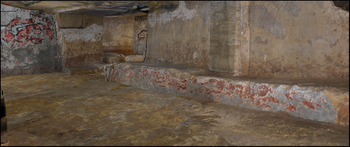
The Tomba dell'Orco was discovered in 1868 (although probably entered during the twelfth century AD or earlier; Helbig Reference Helbig1870; Weber-Lehmann Reference Weber-Lehmann1995). The placement of the dell'Orco III chamber, connecting dell'Orco I and II, originally led to the hypothesis that it was the last of the chambers to be constructed (Figure 2). Recent analyses, however, suggest that dell'Orco II and III are contemporaneous (Weber-Lehmann Reference Weber-Lehmann1995). The identity of the original owners of the hypogeum is debated; the oldest chamber, dell'Orco I, may have belonged to the Spurinna or the Murina families, although the latter is more likely (Torelli Reference Torelli1983; Cristofani Reference Cristofani, Jovino and Treré1987; Morandi Reference Morandi2004). While dell'Orco I includes iconography similar to that in other tombs, including banquet scenes and portraiture, the paintings in dell'Orco II depict figures of the Greek underworld merged with Etruscan beings, such as the daemon Tuchulcha. The imagery indicates that dell'Orco II is not merely reminiscent of an ‘underworld’, but symbolic of Tarquinian eschatological beliefs (Serra Ridgway Reference Serra Ridgway2006; Harari Reference Harari2013). Whether or not the intention of the paintings was to invoke a subterranean underworld, visual analyses of the Tomba dell'Orco have overwhelmingly shaped scholarly presentations of the hypogeum and indeed all painted tombs in Etruria.
Pathway connecting the Tomba dell'Orco I and III (model created in Agisoft Metashape by J.K. Ortoleva).

It is important to emphasise that I am not suggesting thematic interpretations of Etruscan tomb paintings are irrelevant to our wider understanding of painted chambered tombs. On the contrary, they provide invaluable information regarding social class, genealogy, music, and other aspects of the Etruscan funerary record. Yet despite the obvious function of the tomb space as a depository for the dead, details of the Etruscan burial event remain unclear (Warden & Thomas Reference Warden and M. Thomas1999; Warden Reference Warden and Warden2008). Understanding the nature of funerary activities enacted inside the tomb has been further frustrated by the treatment of tombs during the nineteenth century, when burial goods were removed without any effort to maintain proper records. Although at least a few pottery sherds and/or archaeobotanical remains are recorded from the many painted Etruscan tombs investigated during the nineteenth century and several discovered thereafter with an extensive array of burial goods, their excavation histories make reconstruction of the funerary events difficult but not impossible (Helbig Reference Helbig1870; Pallottino Reference Pallottino1955; Steingräber Reference Steingräber1986; Spivey & Stoddart Reference Spivey and Stoddart1992). Ancient perceptions of the aural (and visual) qualities of tombs in the past are permanently lost to us. Our inability to speak (not read) the Etruscan language underscores this reality (Blesser & Salter Reference Blesser and Salter2007; Patel Reference Patel2008). Their extant structures can, however, provide the basis for an analysis of the tomb's original aural properties. This promises to shed light on the spatial and sensory atmosphere of tombs such as dell'Orco, movement within them, and possibly contribute to our understanding of tomb paintings and inscriptions.
Archaeoacoustics: a cognitive approach
The study of acoustics in archaeology, or ‘archaeoacoustics’, has often centred on sites dated to the prehistoric period, for example, rock art panels in Australia, Spain, France and Italy (Reznikoff Reference Reznikoff, Scarre and Lawson2006); other researchers have focused on architecture and exterior settings (Watson & Keating Reference Watson and Keating1999; Till Reference Till2019). Recently, Díaz-Andreu et al. (Reference Díaz-Andreu, Atienzar, Benito and Mattioli2017) and Kolar (Reference Kolar2017) have turned their attention to auditory cognition; the present study builds on this latter development.
‘Sound’ is shaped by pressure waves entering the external acoustic meatus (ear canal) and thereafter transferring electric stimuli to the thalamus (medial geniculate nucleus) and brain stem, and on to the auditory cortex; sound is also conducted via bones in the skull, the skin and other bodily organs (Tchumatchenko & Reichenbach Reference Tchumatchenko and Reichenbach2014). What is perceived as ‘sound’ is therefore essentially a hyperacute form of physical touch. Hence, while sound may seem subjective, it is reliant on physical interactions between the body, brain, and environment (Stevens & Neville Reference Stevens, Neville and Gazzaniga2013).
Early critiques of archaeoacoustics were concerned with a lack of scientifically reproducible protocols and subsequently multiple criteria have been identified as important to consider in archaeoacoustic studies to ensure greater rigour (Scarre & Lawson Reference Scarre and Lawson2006). Several identified criteria are pertinent when considering how sound was encountered inside Etruscan painted tombs. The first relates to intentionality involving sound. Whether or not the Tomba dell'Orco was purposely designed with sound properties in mind is debatable. Specific parts of the tomb, however, were intentionally utilised during the burial process, and different sounds such as religious chant likely played a role in such activities. While painted tombs in Tarquinia were not intact upon discovery, other intact chambered tombs, though lacking paintings, have been properly excavated. The latter demonstrate that the burial event inside the tomb involved the precise placement of objects, including pottery, foodstuffs and other objects, such as mirrors, in specific areas, whether on the tomb floor, or alongside or atop the deceased (Cavagnaro Vanoni Reference Cavagnaro Vanoni1972; Serra Ridgway Reference Serra Ridgway1996; Linington & Serra Ridgway Reference Linington and Ridgway1997; Carpino Reference Carpino2008). Architectural devices, such as loculi (niches for the bodies of the deceased) and benches, indicate where such activities took place.
A second criterion that is especially applicable to the Etruscan tomb involves its acoustic efficacy and general preservation (Scarre & Lawson Reference Scarre and Lawson2006). While some dromoi and burial chambers were adapted with modern materials (such as wall railings), many remain largely intact, allowing for a more precise assessment of sound propagation as originally experienced inside each structure. The acoustic investigation of tombs across different periods provides a way to assess further the evolution of acoustic properties. Although there are problems with the use of Greek and Roman texts to assess Etruria, authors such as Cicero (Div. 2.38.80; Falconer Reference Falconer1923) and Aelianus (NA 12.46; Scholfield Reference Scholfield1958) describe musical performance and the observation of naturally occurring sounds such as thunder in various Etruscan contexts. Such testimonies are further supported in the Etruscan record by extensive imagery of musicians and dancers illustrated in tomb paintings and other funerary media. Futhermore, the material remains of musical instruments suggest that music was an important part of ceremonial contexts (Lawergren Reference Lawergren2007; Martinelli Reference Martinelli2007).
History of material and architectural changes in the Tomba dell'Orco
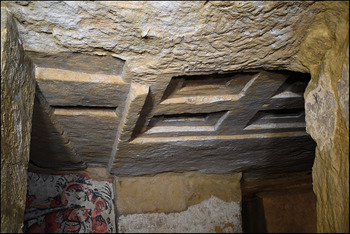
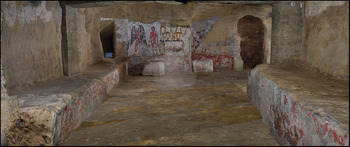
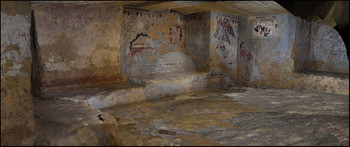
Building material, size and the contextual reality of activities inside the tomb space all influence auditory perception. An acoustic assessment of any space requires a general understanding of its architectural features. The Tomba dell'Orco was carved from subterranean calcareous sandstone (D'Agostino et al. Reference D'Agostino, Gianpiero and Viggiani2010). The chamber walls were then prepared for painting with thick layers of ground clay and a final layer mixed with marble dust, resulting in a less porous surface than that of cut sandstone. Traditionally in Etruscan scholarship painted tombs are considered from the vantage point of the tomb visitor facing the rear area of each burial chamber. The three chambers of the hypogeum range in size (see Figures 1 & 6), and although dell'Orco I has a gabled roof, it is connected to dell'Orco III by a coffered ceiling that terminates at the right-hand wall of dell'Orco III (Figure 3). The left-hand side of dell'Orco III is formed from rock-hewn ‘beams’, which originally continued into dell'Orco II to form a hip roof (Weber-Lehmann Reference Weber-Lehmann1995: 75). Sometime after the initial construction of the tombs, benches were carved into the rear and left walls of dell'Orco I, and right and left walls of dell'Orco III, destroying sections of the wall paintings (Cristofani Reference Cristofani, Jovino and Treré1987; Serra Ridgway Reference Serra Ridgway2006). Rounded niches are placed throughout, with the largest on the rear wall of dell'Orco III, where Cuclu (Cyclops) is depicted (Figure 2). This niche, measuring 2.351m in width, is narrower than the overall width of the chamber, creating a funnel-like effect between the niche and the chamber (see Figure 1). While none of these design choices indicate an intention to engineer or control aural experience, they likely affected how the tomb space was auditorily perceived.
Tomba dell'Orco III displaying the small area of coffered ceiling (photograph by C. Ortoleva).

Many of the architectural features in the Tomba dell'Orco are found in other painted (and non-painted) chambered tombs at Tarquinia. Between the sixth and third centuries BC, the typical design of a chambered tomb included a dromos, a rectangular burial chamber, a gabled roof and benches. The inclusion of small niches emerged as early as the sixth century, with large loculi, as seen in dell'Orco I, becoming more common in the late fifth century (Steingräber Reference Steingräber1986). Roughly ten percent of Tarquinian painted tombs are multi-chambered; however, the unique S-shaped layout of the chambers at Tomba dell'Orco probably reflects continued expansion of the overall hypogeum throughout the fourth century.
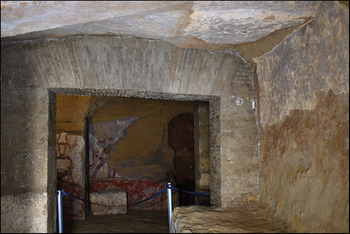
With respect to the acoustic properties of the Tomba dell'Orco, it is important to note the changes made to the tomb in the nineteenth century. After the hypogeum was rediscovered in 1868, the collapse of the ceiling in dell'Orco II and III led to the insertion of five pillars constructed from limestone blocks. One was built on top of a painted Etruscan trapezoidal base in dell'Orco II, while two were affixed to a brick-and-mortar platband, a flat arch that spans the width of dell'Orco III (Figure 4; D'Agostino et al. Reference D'Agostino, Gianpiero and Viggiani2010). A 3D model, which removes the pillars, has been created for this study, allowing an accurate consideration of space and movement (Figures 2 & 5–6). While the visual presence of the pillars is significant, they demonstrate a minimal effect on the analysis presented below because of the present focus on lower-frequency bands (Eda et al. Reference Eda, Yasuda, Sakuma, Burgess, Davey, Don and McMinn2010). Other changes to the tomb include two tunnels carved into the walls of dell'Orco II, probably by tombaroli (tomb robbers), leaving large indentations. These tunnels, and a second dromos, are now backfilled. Multiple unsuccessful past attempts to remove the paintings, as well as decades of visitors, have resulted in the destruction of roughly half of the original painted surfaces (Helbig Reference Helbig1870). The resulting exposed bedrock absorbs higher-frequency sounds, resulting in less reverberation at 4000Hz and above.
Tomba dell'Orco (dell'Orco III) showing nineteenth-century platband and pillars (photograph by C. Ortoleva).

Metashape model of the Tomba dell'Orco III with pillars removed (model by J.K. Ortoleva).

Acoustic site plan of the Tomba dell'Orco I, II and III: S1–4 represent sound sources; R1–4 represent sound receiver points (model by J.K. Ortoleva).

Acoustic protocol in the Tomba dell'Orco
After banqueting scenes the theme most frequently depicted in tomb paintings is the performance of music accompanied by dancers (Martinelli Reference Martinelli2007). With this in mind, the assessment of acoustics inside the Tomba dell'Orco is approached systemically with a digital protocol. While musical performance is not specifically illustrated in the Tomba dell'Orco wall paintings, instruments commonly illustrated in other Tarquinian tombs include the double pipes, concert kithara and lituus. Sound clips of these instruments were therefore included in a digital sample together with a clip of female acapella vocals and a sample of handclaps. This digital recording was projected from each of the sound source placements (S1–4 in Figure 6) using a Bose Soundlink loudspeaker chosen for its portability, clarity and cost effectiveness. The device reproduces a frequency range of 24.000–24.800Hz and delivers especially accurate frequencies below 1000Hz, which is often not a feature of cost-effective speakers.
The digital protocol that is the focus of the present article forms part of a wider study using real-time sounds. Live female speech has been documented in 14 tombs, including the Tomba dell'Orco and a second acoustic protocol has also been completed using a live performer (chelys-lyra musician) in five tombs. Although not detailed in the present article, the addition of live music/speech provided a way to consider human experience further, outside of the digitised protocol while simultaneously referencing the Bose sound source. The integration of the additional protocol will allow a broader examination of sonic and corporal experience inside the hypogeum and is presented in a forthcoming publication (Kolar et al. Reference Kolar2017; Ortoleva Reference Ortoleva and Fortein press).
A Sony PCM-10 sound recorder with two omnidirectional microphones, set at a 48kHz sample rate and a 16-bit depth was placed in three to five different areas of each chamber on a tripod at 1.54m above the tomb floor (see Figure 6). This height replicates the average height of the human ear, based on measurements from male and female osteological evidence from ancient Tarquinia (Becker Reference Becker1990). All data collected inside the hypogeum were analysed across a range of acoustic metrics using the platform EASERA (Electronic Acoustic System Evaluation and Response Analysis).
The number of individuals present inside each chamber during funerary events is unknown; scenes depicting the prothesis or laying out of the dead (presumably not conducted inside the tomb itself), as seen in the Tomba del Morto (520 BC) at Tarquinia, however, depict an average of three to five funerary practitioners surrounding the deceased. Other narratives, such as funerary procession scenes depicted in the Tomba degli Scudi (c. 340 BC) and on cinerary urns from Volterra, Perugia and Chiusi, display four to ten people (P. Gregory Warden pers. comm.). The more individuals inside the Tomba dell'Orco, including the corpse(s), the lower the reverberation of sound at frequencies above 4000Hz. The temperature and humidity of the tomb (also dependent on the number present) would also have affected sound. Another variable involves light and heat. Helbig (Reference Helbig1870) mentions that when the Tomba dell'Orco was discovered, there was evidence on the ceilings of iron rods, probably originally used to hold light sources such as torches. Heat radiating from light sources and other flames, such as those created by burning incense, would have increased the reverberatory qualities of the hypogeum for frequencies above 4000Hz (Gomez-Agustina Reference Gomez-Agustina, Dance and Shield2014; R. De Puma pers. comm.), although high frequencies are not the focus of the present article.
Importance of reverberation as an acoustic signpost
Much like an assessment of colour on a frescoed wall, the measurement of sound metrics creates an acoustic contextualisation of space. Sound is generated by a variety of frequencies supporting a fundamental frequency that corresponds to the perceptual quality of ‘pitch’. Archaeoacoustic studies generally analyse acoustic criteria defined by the International Organization for Standardization (ISO 3382), the most common of which are reverberation, echoes and resonance. Reverberation is the accumulation of sound within a confined or semi-confined space as it reflects across all surfaces until eventually terminating and is arguably the most informative acoustic measurement of space. It also breaks barriers with respect to cognition, as it can be perceived by those with normal hearing and by individuals with hearing impairments (Díaz-Andreu et al. Reference Díaz-Andreu, Atienzar, Benito and Mattioli2017). Other factors that affect how reverberation is perceived include language and musical abilities. Individuals who learn a second language before the age of six perceive reverberation more strongly, while musicians tend to be less sensitive to it (Rogers et al. Reference Rogers, Lister and Febo2006; Bidelman & Krishnan Reference Bidelman and Krishnan2010).
Reverberation time affects how a space is cognised: too long, for example, and reflections may seem like distinct echoes (Amden et al. Reference Amden, De bortoli and Freidkes2018). Generally, as frequency increases, reverberation decreases. Natural sounds with frequencies of 125Hz, such as heavy rain and thunder, are perceived as ‘rumbling’ noises (Cox Reference Cox2014). Musical instruments such as the tuba, drum and lyra can also produce low frequencies (Berglund et al. Reference Berglund, Hassmen and Job1996). The ‘ideal’ reverberation qualities inside a modern space cannot be compared to those of the Etruscan tomb but are nevertheless helpful when considering how reverberation can mould the perception of space. A modern orchestral hall with a reverberation time (RT60, i.e. a time-based measurement of sound decay of 60dB) between 1.5 and 2.4s is ideal. When this falls below 1.5s, such a space may seem acoustically ‘dead’ during a symphony, and levels above 2.4s can create a muddled effect and reduce the ability of the listener to sound localise (Rogers et al. Reference Rogers, Lister and Febo2006). Reverberation times (RT) of 0.9–1.4s are recommended for auditoriums in order to magnify the voice, and 0.4–0.8s is recommended for conference rooms or classroom settings (Till Reference Till2019: 671–72).
Acoustic software packages measure reverberation times across 10, 20 and 30 decibel increments. While RT30 is mentioned in the present study to thus provide an overall picture of each chamber's reverberation times, EDT, or early decay time, is of primary focus across frequencies of 125–2000Hz. All RT measurements are calculated according to decay across 60dB (RT60) intervals. If measuring RT30, or the reverberation time across 30dB, the resulting time is thus multiplied by two to give RT60. The calculation of reverberation in a space (RT30; reverberation time across 30dB) is not fully transposable with the actual human perception of sound. For this reason, EDT (calculated across 0–10dB and per T60) is often of focus in archaeoacoustic studies because it more accurately assesses how sound is perceived in different spatial placements vs the general assessment of sound across space as seen with T30 (Till Reference Till2019). One must note here that EDT is not necessarily a ‘better’ form of measurement for reverberation, but rather a more appropriate tool in terms of further understanding how the tomb space was auditorily perceived.
Reverberation times in the Tomba dell'Orco
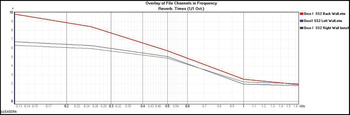
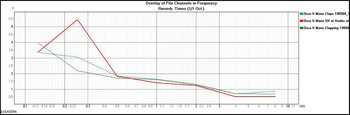
The documentation of sound inside the Tomba dell'Orco results in a range of reverberation times in different parts of the tomb. When projecting the sound source from the lower end of the dromos in dell'Orco I (S1 in Figure 6) and with the sound receiver in the rear of the chamber (R2) the EDT is 1.79s at 500Hz and 1.73s at 1000Hz. The right-hand wall (R1) has a higher EDT of 2.22s at 500Hz and 1.56s at 1000Hz. The left-hand wall of the chamber (R3), on which a procession was originally painted, gives results of 1.99s at 500Hz and 1.56s at 1000Hz. T30 measurements in dell'Orco I are longer, ranging between 4.89 and 5.70s at 500Hz and between 1.94 and 2.52s at 1000Hz (Figure 7). Given the ideal T30 reverberation times in a modern orchestral hall (1.5–2.4s at 1000Hz) and in a conference room (0.4–0.8s), the acoustics in dell'Orco I (EDT of 1.56–1.99s and T30 of 4–5s) are closer to ideal reverberation times in a performance space. The same measurements made in dell'Orco II and dell'Orco III (placing the sound source and receiver at approximately equal distances to those in dell'Orco I) produce varying results. Tomba dell'Orco III, the chamber that connects dell'Orco I and II, also produces mid-level EDT, averaging 1.73s at 500Hz and 1.36s at 1000Hz. In dell'Orco II, the EDT averages 1.76s at 500Hz and 1.46s at 1000Hz. The dell'Orco I chamber exhibits the longest EDT of the three chambers, and this is pronounced for reverberation across frequencies of 125–250Hz.
T30 graph for dell'Orco I, created by J.K. Ortoleva with EASERA (Electronic and Acoustic System Evaluation and Response Analysis).

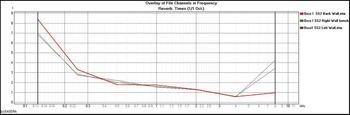
For frequencies between 125 and 250Hz, the rear area of dell'Orco I (which displays a banqueting scene, possibly in honour of the deceased) produces extraordinarily long reverberation times at low frequencies as opposed to the other chambers (8.37s and 3.31s respectively), while the side walls have reverberation times of just under 7s at 125Hz (Figure 8). The rear area of dell'Orco II, which features a painting of Aita (Hades) and Phersipnai (Persephone), has the next longest EDT at 250Hz, and this is much longer than all the other areas of the chamber (Figure 9).
EDT measurements in dell'Orco I, created by J.K. Ortoleva with EASERA (Electronic and Acoustic System Evaluation and Response Analysis).

EDT in dell'Orco II, created by J.K. Ortoleva with EASERA (Electronic and Acoustic System Evaluation and Response Analysis).

Discussion
While additional analysis is necessary across further acoustic metrics and tombs, several observations are of note here. The hypogeum of the Tomba dell'Orco has reverberation times ranging from moderate to quite long, with the longest recorded in dell'Orco I and next to the rear wall of dell'Orco II. For individuals positioned at the rear, left- or right-hand walls of dell'Orco I, where loculi were created for the bodies of the deceased, only a low baritone (male) voice would have been magnified (Figure 10) and strumming a B2 note on a lyra or thumping a drum would have generated a strong rumble. The clarity of general speech and the ability of listeners to localise sound were probably reduced throughout the chamber, and bodily vibrations may have been experienced by many of the individuals present, including those with impaired hearing (Berglund et al. Reference Berglund, Hassmen and Job1996; Cox Reference Cox2014; Till Reference Till2019). On moving into dell'Orco III, these acoustic effects would have gradually diminished.
Tomba dell'Orco I chamber showing a loculus and bench on the rear wall and a loculus on the chamber's right-hand wall (model by J.K. Ortoleva).

In dell'Orco II a strong reverberation would have been stimulated only in the rear of the chamber rather than throughout the space. Although the purpose of the painted trapezoidal base in this chamber is debated, it was positioned at the most reverberant point in the chamber. If the base was used as an altar during funerary rites, the slow chanting accompanying these rites would have been magnified, and the strumming of a B3 note on a lyra would have again stimulated a rumbling sound. Roncalli (Reference Roncalli, Gualtier and Briquel1997: 43–44) has suggested that dell'Orco II was spatially articulated, with the painting to the left-hand side of the entrance and the relief figures flanking the door both representing the living. The Etruscan propensity for boundaries clearly played a role in such an arrangement (Edlund-Berry Reference Edlund-Berry, de Grummond and Simon2006). The present findings suggest that if a funerary participant was located on either side of the dell'Orco II chamber, they would have perceived speech quite easily. Conversely, in the rear of the chamber, vocalisations with frequencies between 125 and 250Hz would have been magnified, while other vocals would have seemed indistinct. As male voices tend to have lower fundamental frequencies, male, rather than female, vocalisations would have been more enhanced. Overall, the highly reverberant qualities of the rear walls of dell'Orco I and II indicate a distinct aural division, both between the chambers and within them, that would have allowed the manipulation of aural effects using specific instruments and speech.
Before death, audition is the last human sense to survive (Blundon et al. Reference Blundon, Gallagher and Ward2020). Sound consequently provides a final perceptual boundary between life and death. Whether or not the Etruscan people understood this, an awareness of sound in Etruscan life and religious ritual is emphasised in secondary texts and illustrated in Etruscan imagery. Colonna (Reference Colonna2009) and de Grummond (Reference de Grummond2016) recently assessed a fourth- to third-century BC temple antefix from Vulci. The antefix, which is one of two terracotta antefixes, depicts the head of a deity that is striking because of the way lightning (possibly thunder according to de Grummond) is represented, placed in the mouth, perhaps connecting thunder to speech (de Grummond Reference de Grummond2016; Ortoleva Reference Ortoleva and Fortein press). Secondary texts illustrate the importance of naturally occurring sounds in Etruria, including animal noises (especially birds; Cicero Div. 2.38.80; Falconer Reference Falconer1923). The most frequently mentioned sonic phenomenon is thunder (Pliny Naturalis Historia 2.51.136; Rackham Reference Rackham1938). The Brontoscopic Calendar, a tool for divination by thunder, is known entirely from a sixth-century AD Greek text by Johannes Lydus that is believed to be a translation from a late Republican Latin copy (De Ostentis 27–38; Turfa Reference Turfa2012a). The calendar includes 360 predictions involving thunder. Depending on the day of the month, thunder is identified as causing anything from plentiful honey to plague (Lydus De Ostentis 29.6–13; Turfa Reference Turfa2012b). Turfa (Reference Turfa2012a) suggests that the Etruscan observer may have equated thunder with a variety of other sounds. Such an observation is apt when considering the range of sounds that thunder can generate, of between 60 and 120dB and with frequencies between 63 and 250Hz (Abegunawardana et al. Reference Abegunawardana, Cooray, Bodhika, Nanayakkara, Sonnadara and Fernando2016). If a drum were thumped inside dell'Orco I, the resulting rumble would easily have resembled thunder. Participants in the burial ritual might even have felt the chamber pulsate. The mention of thunder across other contexts, including those involving death (such as warfare, agriculture, birth and disease), suggests that variants of thunder-like sounds could have been integrated into the funerary event. Connecting an important sound from the natural world to the world of the dead would have been a powerful way to reframe bereavement as an act of divination for the living.
Conclusion
The acoustic analysis of each of the three burial chambers inside the Tomba dell'Orco at Tarquinia demonstrates the acoustic properties of this burial complex. The unique structural design of the hypogeum, which is unlike any other painted tomb in Etruria, contributed to these acoustic results. The findings do not suggest that these acoustic properties were specifically and intentionally considered as part of the design and construction of the Tomba dell'Orco. The absence of such intent, however, does not mean that the nuances of sound experienced during Etruscan burial events were unimportant, especially given the long reverberation times recorded in dell'Orco I and II. The present article has focused on the digital protocol used to assess reverberation within the tomb. The study, however, forms part of an ongoing, comprehensive analysis of acoustics in 15 sixth- to third-century BC tombs at Tarquinia, Orvieto (Porano) and Cerveteri. An important goal of this wider project involves human experience, with observations and documentation of live speech and real-time performance in five tombs. The addition of live performance will provide a more ‘human-centred’ understanding of sound, space and bodily movement, which is often lacking in digital studies. The ultimate goal is to document tombs across multiple regions of Etruria using the digital and live acoustic methods described here.
Musical composition does not survive from Etruria and even if it did it would be impossible to experience music cognitively in the same way as an Etruscan. As presented here, it is possible to gain further understanding of the acoustic and corporeal characteristics of sounds experienced inside the chambered tomb, including those involving natural phenomena, produced by instruments and by the human voice. The clear references to sound in secondary texts and in the Etruscan material record, including those associated with funerary contexts, illustrate a culture that observed and even revered aural phenomena. Perhaps it is now time to listen.
Acknowledgements
Thank you to MiBACT—Soprintendenza Archeologia, Belle Arti e Paesaggio per l'area di Roma, e di Viterbo e l'Etruria Meridionale for providing access to the Tomba dell'Orco, and permission to include images taken in the Tomba dell'Orco for the present study. I would like to express my gratitude to my supervisors, Paul Garwood and Dominik Maschek. Thank you to Gregory Warden, Simon Stoddart and Gretchen Meyers for their encouragement and guidance. Thank you to the anonymous reviewers of this article; your feedback was greatly appreciated. Special thanks to Stefania Peterlini, Daniele F. Maras, Laurel Taylor and Bridget Sandhoff, as well as the following for their insight during my visits to the Tomba dell'Orco: Petronilla Dionisi and Christopher Ortoleva.
Funding statement
This research was supported by a fellowship from the Etruscan Foundation.
Supplementary material
To view supplementary material for this article, please visit https://doi.org/10.15184/aqy.2021.111