Significant outcomes
• Our initial study suggested significant beneficial effects of adjunctive yoga on cognitive impairment among individuals with schizophrenia (SZ).
• The cognitive impairment is difficult to treat at present using medications.
• The design of the present study improves on our preliminary study by including three arms, randomisation of participants to each arm and evaluators who are blind to specific adjunctive treatment.
• This design will enable more conclusive results.
Limitations
• Although a double blind study would be desirable, only single blind studies of supplemental treatments are feasible for behavioural treatments such as yoga.
• Medication dosage could not be standardised because of the wide variation of severity of illness encountered in our clinic population. For clinical and ethical reasons, it was desirable to leave optimisation of doses to the treating psychiatrists in each case.
• Patients staying far away from the treatment facility could not be included in the study.
• Though Independent Living Skills Survey (ILSS) was adopted after translation and retranslation by professionals, it was not validated.
Background
Cognitive impairment is associated with functional impairment in SZ, a lifelong illness that can be severe (Reference Kitchen, Rofail, Heron and Sacco1). The disorder leads to differing degrees of deficits in several domains of cognition (Reference Heinrichs and Zakzanis2) most prominently in memory, attention, working memory, problem solving, processing speed and social cognition (Reference Goldberg and Green3–Reference Keefe and Harvey5). Though medications have generally been unsatisfactory, many cognitive training programmes have shown promising improvement in cognitive functions (Reference Twamley, Jeste and Bellack6–Reference Vinogradov, Fisher and Nagarajan8); benefits include improvement in sustained attention and language processing (Reference Wexler, Hawkins, Rounsaville, Anderson, Sernyak and Green9), executive function (Reference Bell, Bryson, Greig, Corcoran and Wexler10,Reference Wykes, Reeder, Corner, Williams and Everitt11), affect recognition (Reference Wykes, Reeder, Corner, Williams and Everitt11), verbal memory (Reference Hogarty, Flesher and Ulrich12,Reference McGurk and Mueser13), working memory (Reference Bell, Bryson, Greig, Corcoran and Wexler10,Reference Kurtz, Seltzer, Shagan, Thime and Wexler14), processing speed (Reference Hogarty, Flesher and Ulrich12) and social problem solving (Reference Kern, Libkuman, Otani and Holmes15). These innovative training programmes typically involve intensive, repeated training using a variety of guided exercises. Less attention has been paid to other forms of remediation such as meditation or yoga.
Yoga includes a set of spiritual and physical practices that have been evolving for the past 5000 years. Though the precise definitions and the practice of yoga vary, they share a mind–body approach with components of meditation, breathing, activity and postures. Practitioners of this ancient Indian system use breathing exercises, posture, stretches and meditation to balance the body's ‘energy centres’ (16). Yoga – which means ‘union’ in Sanskrit, is viewed by many practitioners as a scientific system designed to purify the body and the mind from toxins accumulated due to poor lifestyle choices and negative thinking patterns (Reference Zang17). The lay press has repeatedly stated that yoga improves diverse domains of human activity, including mental, emotional, physical, behavioural and spiritual functions (18). Several controlled studies now support some of these claims [e.g. review by Ross and Thomas (Reference Ross and Thomas19)]. Its benefits in reducing stress may be related to down regulation of the hypothalamo-pituitary axis and the sympathetic nervous system (Reference Sengupta20,Reference Innes, Bourguignon and Taylor21). Yoga may be as effective or better than physical exercise (PE) alone in managing physiological variables such as heart rate variability [blood glucose and blood lipid levels, (Reference Bowman, Clayton, Murray, Reed, Subhan and Ford22–Reference Yurtkuran, Alp and Dilek25) salivary cortisol (Reference Sterling26) and oxidative stress (Reference Hagins, Moore and Rundle27)]. A review of 10 studies comparing yoga and exercise, yoga interventions suggested positive outcomes in healthy and diseased populations (Reference Ross, Friedmann, Bevans and Thomas28). Other studies of healthy individuals have also reported positive effects of yoga on cognitive functions (Reference Uma, Nagendra, Nagarathna, Vaidehi and Seethalakshmi29–Reference Manjunath and Telles31). Chattha et al. (Reference Chattha, Nagarathna, Padmalatha and Nagendra32) illustrated the superiority of yoga over physical activity in improving the cognitive functions among menopausal women.
Yoga can also be effective as an adjunctive treatment method for neuropsychiatric disorders, including major depression (Reference Sharma, Das and Deshpande33,Reference Uebelacker, Tremont and Epstein-Lubow34); anxiety (Reference Saeed, Antonacci and Bloch35) and obsessive–compulsive disorders (Reference Kirkwood, Rampes, Tuffrey, Richardson and Pilkington36). Improvement in the psychiatric condition, cognitive ability and social behaviour of patients with SZ was reported (Reference Langle, Renner, Gunthner and Buchkremer37).
In a review and meta-analysis it was concluded that yoga could be considered an ancillary treatment for patients with depression (Reference Cramer, Lauche, Langhorst and Dobos38).
Yoga improved social cognition in patients with SZ in India (Reference Gangadhar and Varambally39). Vancampfort (Reference Vancampfort, Vansteelandt and Scheewe40) reviewed published randomised control trials (RCTs) and concluded that yoga – as an add on therapy – reduced psychopathology. In another review, Balasubramaniam (Reference Balasubramaniam, Telles and Doraiswamy41) used the RAND/UCLA appropriateness method to rate prior yoga studies for SZ and concluded that the strength of evidence for SZ as ‘Grade B’, that is more definitive RCT studies were recommended. Another meta-analysis and review comparing the effects of yoga with exercise on symptoms of SZ, quality of life, function and hospitalisation reported only moderate evidence for short-term effects of yoga on quality of life but not on symptoms (Reference Cramer, Lauche, Klose, Langhorst and Dobos42). However, this review reported only one study on cognition.
All but one of the published studies of yoga treatment for SZ have evaluated its impact on cognitive function. As cognitive dysfunction is arguably a more proximal index of pathogenesis than clinical severity (Reference Keefe and Harvey5), it is an appealing target for treatment. In an open trial, we studied the effect of adjunctive yoga on cognitive function among patients with SZ, who received yoga therapy (YT, n = 65) or treatment as usual (TAU, n = 23) (Reference Bhatia, Agarwal and Shah43). Cognition was assessed using the Penn computerised neurocognitive battery (CNB) (Reference Gur, Ragland and Moberg44). All patients also received routine pharmacotherapy. The YT group showed significantly greater improvement in speed estimates compared with the TAU group for sensorimotor function and working memory (p = 0.025 and p = 0.05, respectively). The pattern of changes observed in the YT group differed from those observed among patients with major depressive disorder (MDD), bipolar disorder or patients in a cardiology outpatient clinic (Reference Bhatia, Agarwal and Shah43). Different domains or different index of domains improved in different study groups. Unlike the SZ group, where the improvements were most marked with regard to speed, the cardiac outpatient group showed improvement in accuracy for the following domains: attention (ES = 0.35), face memory (0.615), spatial memory (0.35) and spatial ability (0.28). In the Bipolar I disorder group, speed, accuracy and efficiency improved for abstraction and mental flexibility (ABF), and face memory. Accuracy and efficiency improved in the attention, working memory and spatial memory domains. Speed but not accuracy or efficiency improved significantly in the emotion processing test. There were significant improvements in the MDD group with regard to accuracy indices for attention, face memory and spatial memory. There was also significant improvement in speed indices for the ABF, spatial ability and emotion processing domains (Reference Bhatia, Agarwal and Shah43).
Though this published study provided encouraging evidence for cognitive remediation in SZ, it had several limitations. Participants were not randomised to YT/TAU and raters were not blinded to treatment status. The beneficial effects of yoga could be attributed to PE alone, as comparable benefits of PE have been reported in healthy individuals (Reference Berger and Owen45), as well as persons with SZ (Reference Gorczynski and Faulkner46). Further, the beneficial effects of YT could be mediated indirectly, through beneficial effects on mood or stress reduction. The present study has been designed to address these limitations.
Methodology
Study overview
The study is entitled ‘The impact of yoga supplementation on cognitive function among Indian outpatients with schizophrenia’. It evaluates cognitive enhancement using standardised supervised yoga supplementation, compared with standardised supervised PE or TAU (proposed N = 234 total, N = 78 in each group). The study incorporates standardised patient inclusion criteria, random assignment of patients, blinded assessment of clinical, cognitive and functional outcomes, as well as standardised implementation of yoga and PE protocols. The trial is registered with ClinicalTrials.gov and registration number is NCT01879709.
Our primary hypothesis is that yoga supplementation enhances attention, as well as related cognitive functions among patients with SZ. The secondary hypothesis is that yoga supplementation has beneficial effects on daily functioning. Therefore, the main objective is to evaluate the effectiveness of imparting specific yoga training (YT) in addition to their TAU to patients with SZ and to assess their cognitive function using computerised as well as paper and pencil cognitive tests. A secondary objective is to evaluate changes in daily functioning of the participants as evaluated by caregivers as well as the participants themselves.
Subject recruitment
Participants are being recruited from the Department of Psychiatry, Post-Graduate Institute of Medical Education and Research – Dr. Ram Manohar Lohia Hospital (PGIMER-RMLH), located in central New Delhi. PGIMER-RMLH is funded by the Government of India and accepts patients from all over Delhi for free treatment. Over 250 new/follow-up patients, many with SZ are treated daily. To improve generalisability, we approached all psychiatrists in the department and introduced our research project. Detailed presentations about role of yoga in psychiatric illnesses and our study design were made individually to interested psychiatrists and at introductory meetings where all queries were addressed.
Participant consent process
Patients with a clinical diagnosis of SZ are referred to research staff by their therapists. They are further screened by research personnel who are certified psychologists. The study goals and procedures are explained in detail and any questions are answered. If a patient agrees, the recruiters seek her/his written informed consent. The consent form is also signed by a witness who is usually a family member of the participant. A copy of the signed consent form is provided to the participant.
Diagnostic evaluation
Following informed consent, the Hindi version of Diagnostic Interview for Genetic Studies (DIGS), (Reference Nurnberger, Blehar and Kaufmann47,Reference Deshpande, Mathur, Das, Bhatia, Sharma and Nimgaonkar48) is administered to participants in person by a research psychologist (administration time is 2–4 h). The DIGS is a comprehensive semi-structured interview schedule that seeks extensive clinical as well as demographic information. As medical records are kept by the patient, participants are requested to bring all prior records, including hospital discharge summaries. As needed, collateral information is obtained from relatives following consent by the study participants.
Consensus diagnosis
The research associate interviewing the participant synthesises data from the DIGS, as well as collateral information obtained from relatives and available medical records. Following discussions with local board certified psychiatrists, a consensus diagnosis is established using DSM IV criteria. In case of disagreement between the diagnosticians, further information is obtained from the participant, and if necessary from additional sources with the patient's consent. The US collaborators are consulted if needed. If consensus cannot still be attained, the participant is not included in the study.
Randomisation
If a consenting patient fulfills all inclusion criteria, she/he is randomised using block randomised stratified lists generated by an online randomisation programme (http://www.randomization.com). The randomisation is stratified by age; younger (18–30 years) and older (above 30 years). Two block randomised lists have been generated: one for those between 18 and 30 years and the other for those above 30 years of age. Each block comprises of 12 participants. The randomisation lists are stored with study investigator in a password protected computer. If a new patient is randomised she/he is assigned group according to the age category in the list and the patient and the instructor are made aware about the group but rater is blind to this allocation. A new block randomised list has been generated for 30+ age category as earlier list was exhausted.
Intervention
There are three groups in the study with two interventions – yoga or PE. Participants in both intervention groups continue to receive TAU, which consists of psychiatrist, directed pharmacotherapy and counseling. The treating psychiatrists are blind to the study intervention. Therapists are encouraged to maintain stable treatment during the study. If prescribed medications are altered, the changes are recorded in the research records (Table 1).
Inclusion and exclusion criteria
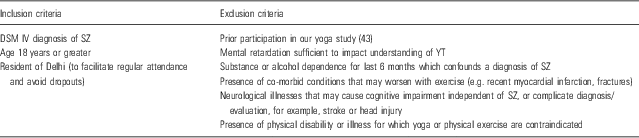
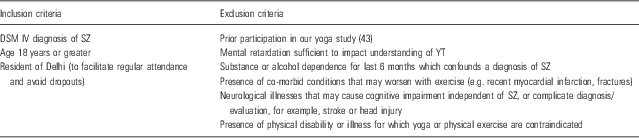
SZ: schizophrenia; YT: yoga therapy.
Yoga Training (YT)
Participants are imparted YT for 21 days, daily for 1 h using a manualised protocol (Reference Bhatia, Agarwal and Shah43). This includes postures or asanas (exercises) and Pranayama (breathing protocols). The training begins with deep breathing with prayer (chanting ‘Om’), followed by warm up exercises and breathing exercises. Special yogic breathing exercises (Pranayama) are practiced before physical postures or asanas. Pranayama (breath control) corrects movements and synchronises movement with breathing. The asanas comprise of different postures; standing: Kati chakrasan (waist rotating pose), Tadasan (mountain pose), Trikonasan (extended triangle pose); supine lying postures: Savasana (corpse pose), Uttanpadasan (leg raised yoga pose), Naukasan (boat pose), Pawanmuktasan: Ardha and Poorna (wind releasing pose); prone position postures: Makarasan (crocodile pose), Bhujangasan (cobra pose), Shalabhasan (locust pose), Dhanurasan (bow pose); and sitting postures: Pashimottanasan (seated forward bend), Ushtrasan (camel pose), Gomukhasan (cow face pose), Ardha Matsyendrasan (half lord of fishes pose), Vajrasana (adamantine, diamond, kneeling or pelvic pose). Water inhalation through the nostrils (Kriyas, Jalnethi – yogic cleansing) is practiced every Saturday. On this day no other asanas are practiced.
This programme was developed by a yoga expert and has been approved by the Central Council of Research and Naturopathy, Indian Ministry of Health and Family Welfare. The YT is administered by a yoga instructor who holds a diploma in YT from an institute recognised by the Government of India and is further trained for the study specific training module by a consultant. Identical yoga training is imparted to all participants. The YT is held in the morning, but in exceptional circumstances it is provided in the afternoon.
Physical Exercise (PE)
The training incorporates simple PEs for 1 h daily, including Saturdays. The schedule includes 15 min of brisk walking followed by light exercises adapted from the National Fitness Corps – Handbook for Middle High and Higher Secondary Schools (Reference Duraiswamy, Thirthalli, Nagendra and Gangadhar49). The PE instructor is a diplomate in PE from an institution approved by the Government of India.
Treatment As Usual (TAU)
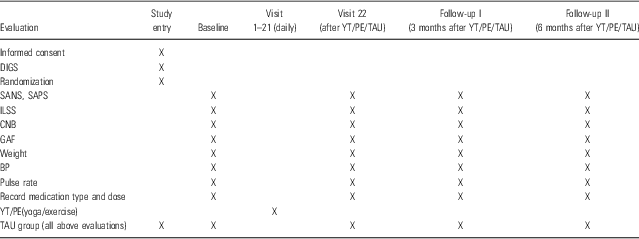
The participants receive standard TAU and complete evaluations listed in Table 2.
Schedule of evaluations
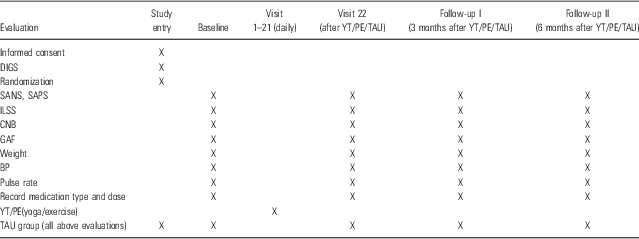
DIGS,- Diagnostic Interview for Genetic Studies; SANS: Schedule for Assessment of Negative Symptoms; SAPS: Schedule for Assessment of Positive Symptoms; ILSS: Independent Living Skills Survey; GAF: Global Assessment of Functioning; CNB: Computerised Neurocognitive battery; BP: blood pressure; YT: yoga therapy; PE: physical exercise; TAU: treatment as usual.
Continuation of treatment following the study
All YT and PE participants are asked to continue unsupervised YT or PE, respectively, after they complete the study. They are provided a compliance sheet that records the dates of yoga or exercise with duration, and whether practice was supervised by a caregiver.
Outcome assessments
All raters are blind to the intervention status. The treating psychiatrists are also blinded to the type of intervention. The Penn CNB, along with the Trail Making Test (TMT) provides the key variables to test the primary hypothesis. Additional measures of clinical severity and daily function are also listed below. In addition, blood pressure, weight and pulse rate are recorded at each assessment point.
Trail Making Test (TMT)
This is a paper and pencil test used to estimate attention, working memory and executive function. The time taken to complete the test is recorded. If the participant makes an error she/he is asked to correct it but the stopwatch is not stopped. The time to complete part A and B of the test is taken as final score. (Administration time is ∼20 to 30 min) (Reference Horton and Roberts50,Reference Bhatia, Shriharsh, Adlakha, Bisht, Garg and Deshpande51).
Information scale of PGI battery
This is a subscale of Post-Graduate Institute Battery of Brain Dysfunction (Reference Pershad and Verma52). The battery is based on the Wechsler Adult Intelligence Scale and has been adapted to Indian conditions. All verbal tests are in Hindi. The information subtest consists of 33 items of general knowledge. This is used as proxy for measuring intelligence.
University of Pennsylvania Computerised Neurocognitive battery
Penn CNB is a validated battery that measures quantitatively cognitive domains in healthy subjects as well as in SZ patients (Reference Gur, Ragland and Moberg44,Reference Gur, Ragland and Moberg53–Reference Gur, Richard and Calkins55). The following domains are assessed: (1) abstraction and mental flexibility; (2) attention; (3) face memory; (4) spatial memory; (5) spatial processing; (6) working memory; (7) sensorimotor dexterity; (8) emotion processing. The Penn CNB has been adapted for use by Hindi speaking individuals (Reference Thomas, Chandra and Bhatia56). Verbal memory and language domains are not used, as these need proficiency in English language. For each domain, three summary functions are calculated: (1) accuracy, which reflects the number of correct responses; (2) speed, which reflects the median reaction time for correct responses; and (3) efficiency, which reflects both accuracy and speed accuracy/log (speed). Participants can be differentially sensitive to these indices (Reference Gur, Nimgaonkar and Almasy57). We intend to use accuracy and speed indices as the key outcome measures. The accuracy index of all eight domains of CNB are the primary outcome measures. However, adjustment for α accumulation will be performed using Hochberg procedure (Reference Hochberg58).
Independent Living Skills Survey (ILSS)
The ILSS is a comprehensive, objective, performance-focused, measure of the basic functional living skills (Activities of Daily Living) for individuals with severe and persistent mental illness. The informant and the patient versions are used. The English version was translated to Hindi by two psychologists and the Hindi version was back translated by two other research personnel. The original and the back-translated versions were then compared and discrepancies were resolved by consensus. There are 103 items to assess performance in 12 areas of basic community living skills. The informants indicate how frequently an individual has performed each skill within the past month on a five-point scale (never, sometimes, often, usually and always). The answers are scored from 0 (never) to 4 (always), then summed and averaged per functional area (Reference Wallace, Liberman, Tauber and Wallace59).
Global assessment of function (GAF)
The GAF is a numeric scale (0–100) used to rate the social, occupational and psychological functioning of adults (Reference Endicott, Spitzer, Fleiss and Cohen60).
Schedule for Assessment of Negative Symptoms (SANS)
The SANS rates negative symptoms of SZ on a five-point scale (Reference Andreasen61).
Schedule for Assessment of Positive Symptoms (SAPS)
The SAPS assesses hallucinations, delusions, bizarre behaviour and positive formal thought disorder. It is a 34 item five-point instrument (Reference Andreasen62).
The period of reference for GAF, SANS and SAPS is for the past 15 days. As the first follow-up assessment occurs after 21 days, the usual assessment schedule of these tests (30 days) cannot be maintained.
Quality control
Training on DIGS, CNB and all other scales is provided to all research associates and co-investigators to maintain quality control. Inter-rater reliability is checked periodically. κ-values over 0.8 for diagnoses are required for inter-rater reliability tests among research associates. Cross-cultural issues are addressed routinely through intensive discussions and consultations about individual cases.
Data Safety Management Board (DSMB)
A DSMB has been constituted to check the quality, completeness and timeliness of data, protocol adherence, factors affecting confidentiality in the study and adequacy of compliance to goals.
Data entry and data safety monitoring
A custom password protected Microsoft Access-based program has been designed for data entry and analysis. The software has inbuilt logic for checking routine errors. Penn CNB data are acquired directly on laptop computers and are uploaded to a secure website at the University of Pennsylvania. Other data are entered manually and are routinely double checked for data entry errors.
Data analysis
Initially, the dataset will be scrutinised to identify outliers and extreme values. Such values will be examined for possible data entry errors. The modified Thompson τ test will be used to identify outliers. We will identify outlier by mean ± 3SD. We will test for the differential dropout rates statistically by Kaplan–Meir method using log rank test, if no obvious errors are detected, analyses will be conducted with and without such values. Next, the demographic and clinical features (such as indices of clinical severity) of the three groups will be compared. Any available demographic data regarding individuals who were excluded or dropped out of the study will also be examined. We are including all the patients who are randomised that is the intent-to-treat (ITT) analysis. Distributions of the measures will be examined for approximate normality and transformed if necessary. We will analyze 16 measures from eight Penn CNB domains (accuracy and speed indices). We will also identify the correlation structure of the cognitive domains and try to reduce the dimension of data by selecting a subset of measures (e.g. principal components).
With four time points, baseline (pre-treatment), after 21 days (post-treatment), month 3 and month 6, we will use repeated measures mixed-effects analytical methods to test our primary hypotheses. Group status (YT/PE/TAU) will be considered as the first factor (between) and time (baseline, visit at 21 days, 3 months and 6 months) will be used as the second factor (within). We will also use time by group interaction in the model and other covariates (described below). The primary hypotheses will be tested using contrasts. The measurement at 3 months would help to capture an intermediate benefit that may recede at 6 months.
We will include as covariates socio-demographic variables (gender, age, socio-economic status and living situation), information score using information scale of PGI battery, and clinical variables (duration of illness, other concurrent treatment including type and dosage of medications). The impact of co-existing medical conditions, as well as past co-morbid alcohol/substance abuse that may impact on the dependent variables will also be considered. Thus, longitudinal neurocognitive and daily functioning data will be analyzed in relation to clinical and demographic variables in an attempt to deduce the relative influence of these additional factors on particular outcomes. Inclusion of any covariates in a model will require careful consideration of its relationship with the outcome variable. Efforts will be made to keep the number of covariates to a minimum. We will use an ITT model that requires all randomised patients be included in our final analysis. Though we will make every effort to retain patients in our protocol, we expect some patients will miss follow-up assessments, or dropout. To handle missing data, we will first investigate the missingness process. We will consider intermittently missing data as ‘missing at random’ (MAR) and investigate the reasons for dropout to assess the validity of MAR assumption for the dropouts. If the MAR is confirmed, we will use standard SAS PROC MIXED (for continuous) or PROC GLIMMIX (for categorical) variables. However, if it is found to be non-ignorable, then we will consider other techniques (e.g. selection models with a logistic dropout process, pattern-mixture models or shared-parameter models) followed by a sensitivity analysis to judge the robustness of the results (Reference Mazumdar, Tang and Houck63).
We will start with univariate repeated measure models for our outcomes and adjust our p-values for multiple comparisons using standard procedures (Reference Blakesley, Mazumdar and Dew64). However, we will also use multivariate repeated measures mixed-effects model if we can identify two or three outcome variables that may require further in-depth analysis due to their correlated nature. A multivariate repeated measures model (also known as doubly multivariate models) takes account of correlations among repeated measures of different outcomes at the same point in addition to the correlation among measurements taken at different occasions. We have some experience in fitting such models (Reference Dang, Mazumdar, Anderson, Houck and Reynolds65). An advantage of using this modelling approach is to increase power.
The repeated measures data will allow us to use latent growth curve modelling to investigate whether there are subgroups of patients exhibiting or not cognitive improvement in each treatment group, which can be followed by logit models to identify and compare predictors of group membership.
Secondary analysis
To evaluate whether biometric evaluation of physical exertion and/or fitness, which might of themselves play a role above that of YT, we will measure weight, pulse rate and blood pressure of all participants at all assessment points. The impacts of YT and PE on these measures will be evaluated in the short term (i.e. pre- and post session) and over longer periods. These measures will be compared between the YT and PE groups. We will also evaluate the correlations between these measures and indices of cognitive improvement, including relevant covariates. If indicated by these analyses, we may consider including key biometric indices as covariates in the main analyses described above.
Sample size considerations
Our power calculations are based on preliminary analysis of our initial study (Reference Vancampfort, Vansteelandt and Scheewe40). We propose three treatment groups and four time repeated factor levels. The correlation between repeated measures in our initial study was 0.3–0.5. Assuming the lower correlation value and an estimated effect size of 0.15 for between group differences, the required sample for a replicative study was calculated using G*Power software (Reference Faul, Erdfelder, Lang and Buchner66). Assuming analysis of variance/repeated measures between factors analysis, we estimate that a total sample of 234 should have 85% power with medium effect size (0.15) at 0.05 α levels. Assuming a 20% attrition rate, we will enroll 98 in each treatment group (total N = 294).
Evaluating study progress
During weekly meetings, enrollment is discussed and dropout rates are checked. Potential reasons for dropping out are discussed and ethical strategies to reduce these as much as possible are emphasised. Computerised data are reviewed routinely to check for quality and missingness. If some fields are incomplete or difficult to interpret, participants are re-contacted to complete the data. The research personnel are asked to encourage the participation by re-contacting referring clinicians and regularly reporting progress of the study. The participants’ clinical status is monitored for data safety and potential protocol deviations that the study investigators review at staff meetings as appropriate and strict actions are recommended to stick to protocol.
Results
Recruitment
A total of 309 participants were randomised, but 98 participants dropped out at various stages after recruitment (details in Fig. 1). There are 219 participants enrolled in the study as of 31 August 2013; of whom 148 have completed all study procedures and follow-up. Some of the common reasons for dropout are tabulated in Fig. 1.
Flow Chart of Enrollment till August 31, 2013.

Acceptability of YT and PE
No side effects or injuries have been reported in the YT or the PE groups. Only 15% participants dropped out after starting yoga while 25% dropped out after starting PE.
There have been no adverse events to date. Final details will be provided in main outcome paper.
Discussion
Yoga is increasingly finding a place in the therapeutic armamentarium for chronic disorders. In India, the government has established yoga centres in most publicly funded hospitals and has made yoga available in schools. It has established a separate department in the Ministry of Health for Yoga and other traditional forms of indigenous medicine (Ayurveda, Yoga and Naturopathy, Unani, Siddha and Homeopathy, AYUSH; http://indianmedicine.nic.in). Separate councils for research in indigenous systems of medicine have also been established. Thus, the present study is timely as it is among the first RCTs to examine the impact of yoga supplementation on cognitive functions and living skills among SZ patients.
A recent review suggested encouraging benefits of yoga for neuropsychiatric disorders, but pointed key limitations of published studies, such as the inability to conduct double blind studies, multiplicity of comparisons within small studies and lack of replicate studies (Reference Balasubramaniam, Telles and Doraiswamy41). While double blind studies cannot be conducted for certain behavioural interventions, the present replicative study seeks to address most of the other limitations. By using multivariate analyses, we propose to reduce the penalty incurred by multiple comparisons. The PE group provides a suitable comparison for the YT group and could help resolve whether the beneficial effects of YT, if present, are attributable merely to regular physical exertion. Including a TAU group, with careful monitoring of changes in drug doses will enable control over variables related to routine clinical treatment.
Our YT protocol was simplified for the convenience of SZ patients, as it was felt that ongoing psychopathology or co-morbid medical disorders might limit physical flexibility required with more complex postures or ‘asanas’. The YT and the PE protocols have been generally well accepted and recruitment has progressed as planned. No participants reported that the YT was cumbersome or complex. No injuries have been reported, suggesting that YT is a relatively safe adjunct for treatment in SZ. Overall, ∼30% of the participants dropped out at different stages in the study. Some PE participants dropped out as they preferred YT and decided to suspend participation when they found out that they were not randomised to the YT group. In the YT group, dropouts typically occurred because participants could not travel to the hospital on a daily basis as required. Participation improved when travel expenses were reimbursed per trip. If YT is found to be superior to PE following data analysis, it will be important to evaluate the efficacy of a YT protocol that entails less frequent attendance or a protocol that can be completed at home. The randomisation process has generally worked well, but we initially observed a gender imbalance, with an excess of male patients. Such an imbalance is noted typically in clinic-based SZ studies. As older patients were more frequently recruited, the randomisation process was modified to include two age blocks. Following this adaptation, the age disproportion has improved.
Conclusion
An RCT to evaluate the effects of adjunctive YT on cognitive functions in SZ is being conducted. It was motivated by a prior open trial that showed significant improvement in specific cognitive functions following YT. If the results are replicable, yoga may provide a novel adjunctive intervention for cognitive remediation among SZ patients. Its strengths include relatively few ‘side effects’ and it is generally acceptable to SZ patients who elect to try it. Yoga is cost-effective and it is also easy to incorporate it in the treatment regimen of SZ patients if the study finds positive effects on cognition (Reference Chuang, Soares and Tilbrook67).
Acknowledgements
We are thankful to our consultants Dr. Rajesh Nagpal, Dr. S.N. Pande for their support. We are debited to all psychiatrists at Department of Psychiatry, PGIMER-RMLH for referring patients and all our research personnel for their dedicated effort to complete the study. Author contributions are as follows: Triptish Bhatia: concept, methodology and writing of manuscript; Sati Mazumdar: statistical analysis, power analysis and review of manuscript; N.N. Mishra: data retrieval, data collection and review; Raquel E. Gur: review and editing the manuscript; Ruben C. Gur: review and editing the manuscript, designing CNB; V.L. Nimgaonkar: concept, design and editing the manuscript; Smita N. Deshpande: concept design and editing the manuscript.
Financial Support
This project is funded by grants from Fogarty International Center, National Institutes of Health (NIH) (The impact of yoga supplementation on cognitive function among Indian outpatients with schizophrenia, TW008289 to T.B.; Tri National Training Programme in Psychiatric Genetics, TW008302 to V.L.N.). The content is solely the responsibility of the authors and does not necessarily represent the official views of the NIH or other funding agencies.
Conflicts of Interest
The authors declare no conflicts of interest.
Ethical Standards
The authors assert that all procedures contributing to this work comply with all ethical standards of Institutional Ethics Committee, PGIMER-RMLH, Indian Council of Medical Research guidelines for research on human research and with Helsinki declaration of 1975, as revised in 2008.