Introduction
Ambiguous loss when loved ones go missing
When someone is lost without verification, the family members are left in a state of uncertainty, vacillating between hope and despair and they do not come to an acceptance of death even after many years (Boss, Reference Boss2002). Continued disbelief of the death of a loved one prevents initiation of the normal grief process resulting in high psychological morbidity (Kersting et al., Reference Kersting, Brähler, Glaesmer and Wagner2011). Besides the ambiguity of the fate of their loved one, family members have to contend with financial, social and legal ramifications arising from the disappearance of the loved one (Crettol and La Rosa, Reference Crettol and La Rosa2006). The family members often embark on a desperate pursuit of evidence to establish whether their relatives are alive or dead.
There are but a handful of studies which have studied this phenomenon of ambiguous loss resulting from persons going missing. Civil wars, terrorism and natural disasters across the globe render many families bereft of their loved ones classified as ‘missing’ (Barakovic et al., Reference Baraković, Avdibegović and Sinanović2014). A study compared the prevalence of post-traumatic stress disorder (PTSD) in wives of missing individuals with unconfirmed death and confirmed death in Bosnia and Herzegovina. This study showed greater PTSD among wives who did not have an opportunity to see the mortal remains of their husbands (Powell et al., Reference Powell, Butollo and Hagl2010).
Ambiguous loss in Sri Lanka
Sri Lanka has suffered three decades of ethnic conflict, the late 1980s youth insurrection, and the tsunami disaster in 2004 which left a large number of individuals unaccounted for. The Presidential Commission on missing persons in Sri Lanka has received more than 20 000 complaints about missing individuals including more than 5000 missing from government forces (ICRC,. 2016). The Sri Lankan parliament in response to this issue has passed a law on a statutory office of Missing Persons in August 2016 which has become operational in 2018. People in southern Sri Lanka have experienced the above described three calamities which have resulted in thousands of missing persons. It is important to understand the extent of psychological morbidity the family members of these missing persons endure. It is known that persons who experience grief can progress to prolonged grief disorder (PGD), major depressive disorder (MDD) and PTSD) (Boelen et al., Reference Boelen, van de Schoot, van den Hout, de Keijser and van den Bout2010; Boelen, Reference Boelen2013). Although the literature on normal grief and abnormal grief reactions following the death of a loved one is extensively described, the grief following a loved one going missing is not adequately described or documented.
Aims of the study
The objective of this study was to compare the rates of PGD, MDD and PTSD among family members of those classified as missing and ascertain whether those who did not receive confirmation of their death subsequently had higher psychological morbidity. We also looked at their belief as to whether the missing individual was still alive or dead and its effect on the outcome.
Methods
Participant recruitment and assessment
This is a cross sectional study involving family members of individuals in Sri Lanka who went missing in the tsunami disaster in 2004, the late 1980s youth insurrection and while serving in the military during the civil conflict.
The missing, as referred to in this research paper are individuals unaccounted for as a result of the 2004 tsunami, the armed conflict in late 1980s and the separatist war in the north of Sri Lanka. The study however was conducted in the south of Sri Lanka and those who went missing in the south in relation to the war in the north were mainly military personnel and not civilians. Purposive sampling was done due to the sensitive nature of the research. We approached two groups of respondents, 223 family members of missing individuals and 168 family members who had lost family members due to the above situations but had confirmation of the death of their loved one. The study was conducted in Galle, Matara and Hambantota districts in the southern province of Sri Lanka. The families were identified through the district secretariat office and the village civil service official known as the Grama Niladhari. Some families did not volunteer to divulge information due to understandable reasons such as security issues and stigma. Hence, a snow balling sampling method was used. The family members were visited by the researchers and interviewed after informed consent. In each family, the first family member who volunteered to participate was interviewed. If the interviewee had lost more than one family member, they were asked to specify whose death was most difficult to cope with and to base their answers with reference to that person. Interviews were carried out by a doctor trained in psychiatry. The interview included a questionnaire on the socio-demographic background and the circumstances involving the missing or dead individual. All the interviewees were screened using culturally adapted and validated versions of the General Health Questionnaire, Beck Depression Scale and Post-Traumatic Stress Symptom Scale self-report version (PSS-SR). Those who screened positive on the above scales were assessed clinically on Diagnostic and Statistical Manual of Mental Disorders (DSM)-5 criteria by a psychiatrist blind to interviewee status, to diagnose MDD, PGD and PTSD. Thus each of these three diagnoses was mutually exclusive.
Psychometric instruments
General health questionnaire-30 (GHQ-30)
GHQ-30 displays adequate validity for screening psychiatric disorders (Jackson, Reference Jackson2007). It has been validated and widely used in the Sri Lankan Sinhala speaking population with a sensitivity of 67.5% and specificity of 80% at the score of 5/6 (Abeysena et al., Reference Abeysena, Jayawardana and Peiris2012). Individuals who scored six or more were further evaluated for MDD, PGD and PTSD. When rating the GHQ-30, we used the scoring system of allocating marks: 0, 1, 2 and 3 for the four responses in each item. Therefore, the possible scores for the GHQ-30 raged from 0 to 90.
Beck depression inventory-II (BDI-II)
BDI has been the most commonly used self-rating depression screening tool and rating scale with 21 items which has good psychometric properties and has shown discriminant validity in many cultures (Steer et al., Reference Steer, Ball, Ranieri and Beck1999). BDI-II has been validated to use among Sinhalese speaking Sri Lankan individuals and found to have both sensitivity and specificity of 94 at a cut off score of 16 (Rodrigo et al., Reference Rodrigo, Kuruppuarachchi and Pathmeswaran2015).
Post-traumatic stress symptom scale-self-report version (PSS-SR)
PTSD was screened by a self-administered PSS-SR (Foa et al., Reference Foa, Riggs, Dancu and Rothbaum1993). PSS-SR has been previously used in Sinhalese speaking populations (Hollifield et al., Reference Hollifield, Hewage, Gunawardena, Kodituwakku, Bopagoda and Weerarathnege2008; Wijesinghe et al., Reference Wijesinghe, Williams, Kasturiratne, Dolawaththa, Wimalaratne, Wijewickrema, Jayamanne, Isbister, Dawson, Lalloo and de Silva2015). The self-administered version of the PSS-SR has satisfactory internal consistency, high test–retest reliability and good concurrent validity (Foa et al., Reference Foa, Riggs, Dancu and Rothbaum1993).
DSM-5 criteria
DSM-5 criteria were used to make a psychiatric diagnosis. MDD included all categories under DSM-5 category 296. PGD is diagnosed when severe persistent grief reaction occurs following a loss of a loved one (Prigerson, Reference Prigerson2004). It corresponds to the diagnostic criteria of persistent complex bereavement disorder in DSM-5 which gives three comprehensive diagnostic categories; separation distress, reactive distress to the death and social identity disruption with clinically significant distress or impairment in functional level. PTSD was diagnosed on criteria on 309.81 (American Psychiatric Association; American Psychiatric Association, DSM-5 Task Force, 2013).
Statistical analysis
Descriptive statistics for variables that were of the nominal data type were calculated and shown as frequencies and percentages. Variables related to age were considered as continuous data and described using mean and standard deviation. Calculations related to GHQ scores were also done considering it to approximate continuous data, as the range of the scale was relatively high. In the process of identifying the independent predictors of depression and PGD multiple logistic regression analysis was performed. This included an initial calculation of unadjusted odds ratios (ORs) for all potential predictor variables followed by arriving at the final model with significant independent predictors. Adequacy of the final fitted model was assessed with Hosmer and Lemeshow goodness of fit test. Type-I error of 0.05 was considered in all significance calculations and all analyses were performed using the IBM SPSS statistical package.
Ethical considerations
Ethical approval for the study was granted by the Ethical Review Committee of the Faculty of Medicine, University of Kelaniya, Sri Lanka. Written informed consent was obtained from all participants. The psychological status of the persons interviewed could be fragile. When these incidents are probed into, these individuals may be re-traumatised. Nevertheless, skilful and sensitive interviews can sometimes be helpful (Nelson et al., Reference Nelson, Onwuegbuzie, Wines and Frels2013). Subjects may benefit from talking openly about their experiences. Emotional distress was monitored during the interview and the interviewer stopped conversation immediately if participants did not want to continue to talk about their experiences. It was made clear that at any point the interviewee could terminate the interview without any negative consequences.
Interviewees found to have any psychological morbidity were referred to local mental health teams for assessment and treatment.
Results
Demographic characteristics of participants
The study included 391 cases of disappearances with an immediate family member of each missing person being the responder for the interview. Of the interviewees, 275 (70.3%) were females and 164 (41.9%) were mothers of the disappeared person. They had a mean age of 57.6 (s.d. = 14.8) years, with the youngest and oldest being 18 and 89 years, respectively. At the time of their family member's disappearance, the interviewees ranged from being just 2 years to 72 years in age (mean = 38.2, s.d. = 13.8).
Characteristics of the missing person
Of the 391 cases of disappearances, 248 (63.4%) were related to civil conflicts in Sri Lanka, while the remainder were due to the 2004 Indian Ocean Tsunami. According to the year of disappearance, 2004 (the year of the tsunami) had the highest number of disappearances. This was followed by the period around 1989, when Sri Lanka faced a violent youth insurrection. Overall, 75.2% of the disappeared individuals in the sample were male. Those that had gone missing in the tsunami however were mostly females (64.3%) while those who had gone missing during the civil conflict were almost all male (98.0%). The average age of the persons that had gone missing (at the time of disappearance) in this sample was 28.54 (s.d. = 15.67) years. When performing sub-analysis of age of the disappeared, based on the circumstance of the disappearance, it was seen that those related to civil conflict were mostly restricted to the young adult age group while those related to the tsunami were much more widely spread.
The death of 168 (43.0%) of the cases had been later confirmed by the remains being found and identified as the missing person. Families of the remaining 223 (57.0%) in the study are yet to receive any confirmation related to the status of their loved one. While 50.3% (72) of those who had disappeared following the tsunami were confirmed to have died, this was the case for only 38.7% (96) of the disappearances related to civil conflicts.
Among those that have not obtained confirmation of death; when inquired about their general belief about the present status of the loved one that had gone missing, about 44% of the interviewees were unsure if he or she had died or was still alive. Almost a similar proportion was confident that the person had died, while a small number was living with the strong belief that their family member was still alive somewhere (Table 1).
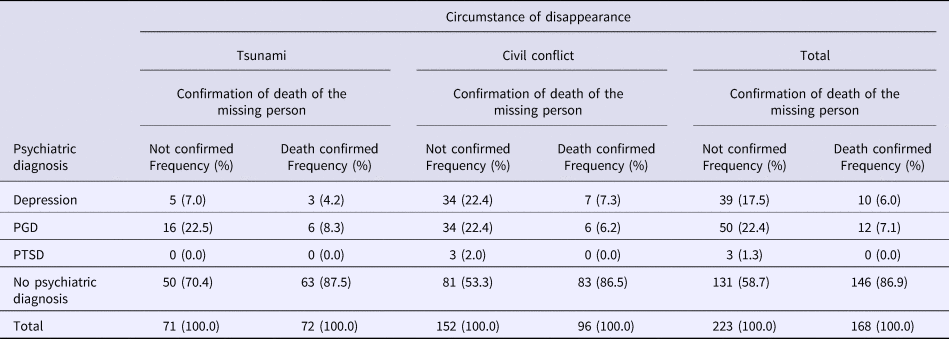
Interviewee's psychiatric diagnosis according to circumstance of disappearance of family member and status of death confirmation

Psychiatric morbidity in the family members of the missing
The assessment of mental health status of the interviewees showed that 49 (12.5%) had MDD, 62 (15.9%) had PGD and three (0.8%) had PTSD. A total of 114 (29.3%) had psychiatric morbidity as each diagnosis was mutually exclusive and confirmed clinically.
While the overall mean GHQ-30 score for the sample was 15.41, there were significant differences in the mean scores between those without psychiatric morbidity [6.47; 95% confidence interval (CI) 5.82–7.11], those with PGD (25.52; 95% CI 23.94–27.10) and those with MDD (51.65; 95% CI 44.71–58.60). Even though the GHQ-30 score for responders with PTSD was relatively high (40.00), as there were only three individuals with the diagnosis, it was not significantly different from the other diagnostic categories (95% CI 3.92–76.08). Due to the low number of cases with PTSD, those three responders were excluded from further analyses in the study. Table 2 provides details of GHQ-30 scores in the study sample.
General Health Questionnaire-30 score according to psychiatric diagnosis

Major depressive disorder (MDD) and its predictors
In the analysis of factors associated with depression, cases with depression (n = 49) and those without any diagnosed psychiatric illness (n = 277) were taken into consideration, while excluding the responders with PGD or PTSD. The potential predictors for depression in the sample were initially screened using simple logistic regression. The significance of the obtained coefficient (and thus the unadjusted OR) was used in assessing the relationship of the predictor variable with the presence or absence of depression. Variables under consideration included those related to the interviewee, the person that had gone missing and the disappearance itself. Except for the age-related variables and duration since disappearance, all other variables were categorical in nature.
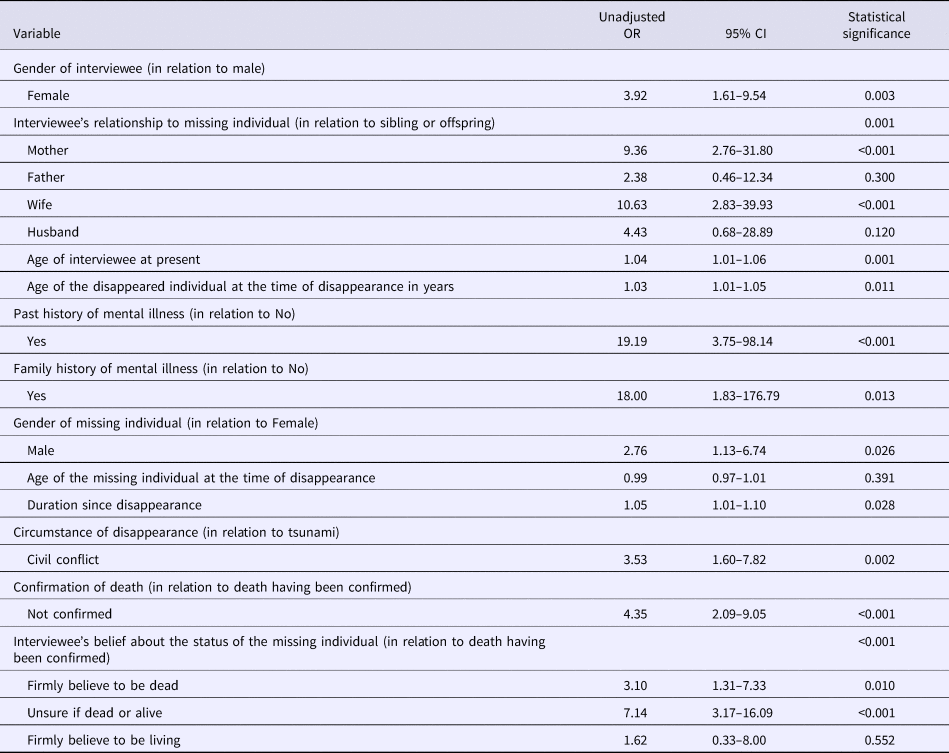
All the factors except for age of the person that had gone missing were found to be significantly related to the interviewed family member having depression (Table 3). Some of the more salient points include the 19 times higher odds of having depression in those with a past history of mental illness and 18 times higher odds for those with a family history of mental illness. But, it must be stressed that these are values obtained without controlling for the other variables. When the circumstance of the disappearance was related to a civil conflict, the interviewees had 3.5 times the odds of suffering from depression than when it was related to the tsunami.
Unadjusted ORs for the variables predicting depression among family members of the disappeared

The unadjusted odds also showed that when the missing person is a male, the responding family member was at a higher risk of depression than when the missing person was female. On the other hand, female responders were more likely to have depression than males. This is also depicted by the finding that mothers and wives of the disappeared were affected significantly more than the other family members of the disappeared. As interviewees’ relationship to the missing individual contained within itself the gender of the interviewee, the variable; gender of the interviewee, was omitted from subsequent multiple logistic regression analyses. Similarly, the variable that specified whether the death of the missing person was confirmed or not was excluded since it was contained within the variable interviewee's belief about the status of the missing individual. Yet, the finding that when a disappeared person's death is not confirmed, it is associated with a higher depression rate among their immediate family members should be highlighted.
To identify the independent variables associated with depression, among family members of those who had gone missing, binary logistic regression analysis was performed. We used the predictor variables mentioned above and the backward elimination method to arrive at the final model. Only three variables turned out to be significant, and the final model with these variables (and the constant term) showed a good fit using the Hosmer and Lemeshow test (χ2 = 10.51, p = 0.162).
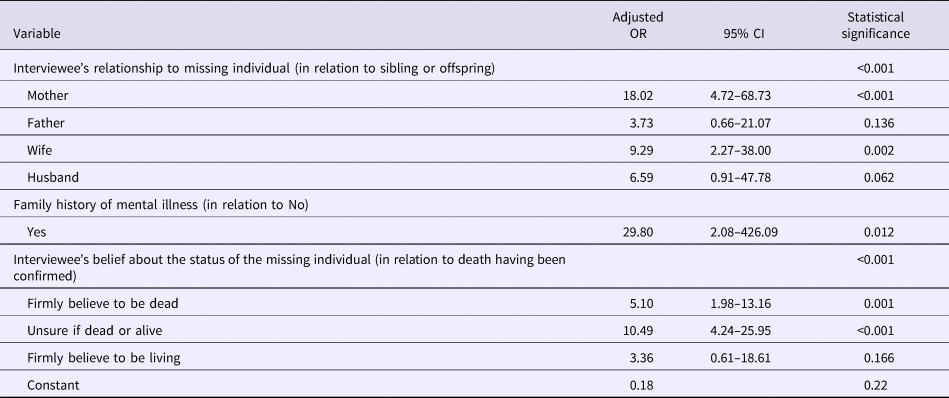
The three variables that independently predicted depression in the responders of the study were: interviewee's relationship to missing individual, family history of mental illness and interviewee's belief about the status of the missing individual. Mothers and wives had significantly higher odds of depression relative to siblings and offspring of the disappeared persons. Fathers and husbands were not at a significantly higher risk. Having a family history of mental illness placed the responders at almost 30 times the odds of having depression compared with those that did not report such a family history. Relative to those who had their loved one's death confirmed following the disappearance, the family members that were unsure if the individual is living or not, had 10.49 (95% CI 4.24–25.95) times greater odds of being diagnosed with depression. If they were of the belief that the individual had died following the disappearance, the OR comes down to 5.10 (95% CI 1.98–13.16). Interestingly, if the belief is that the person is still alive, the adjusted odds for depression are not significantly different from those that had confirmation of death (Table 4).
Adjusted ORs for the variables in the final model for depression

Prolonged grief disorder (PGD) and its predictors
The factors associated with PGD were assessed using those with PGD (n = 62) and those without a psychiatric diagnosis (n = 277), while excluding individuals with MDD and PTSD. The same sets of variables used above for MDD were applied.
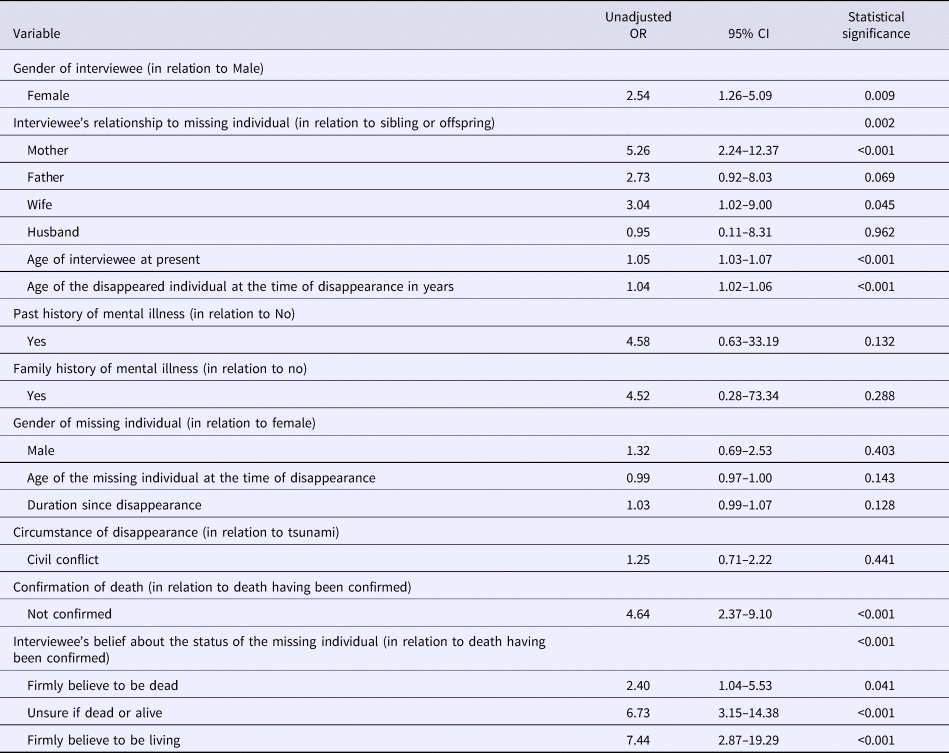
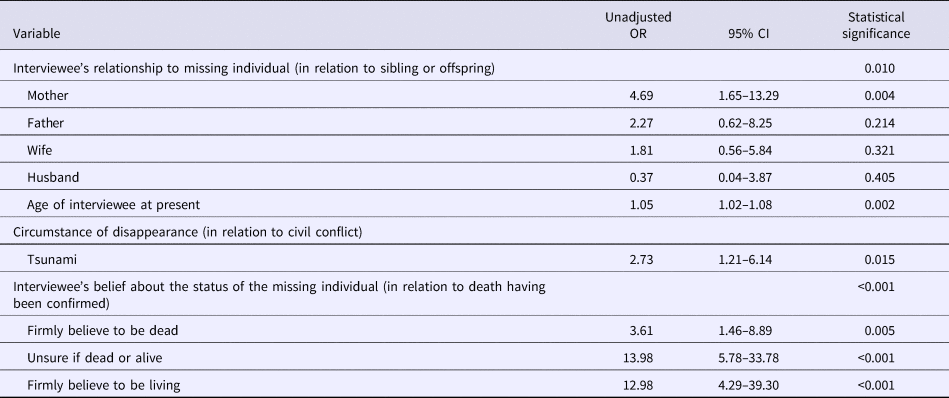
When considering unadjusted ORs, interviewee-related variables of past history and family history of mental illness did not become statistically significant. Two variables related to the missing person, gender and age at disappearance, were also non-significant along with the variable: circumstance of disappearance. As in the case of MDD, family members of individuals that had gone missing show a significantly higher rate of PGD when there has not been confirmation of death (Table 5).
Unadjusted ORs for the variables predicting PGD among family members of the disappeared

When calculating independent predictors of PGD, binary logistic regression analysis with stepwise method was used. The final model had four variables (Table 6), showing an adequate model fit with the Hosmer and Lemeshow test (χ2 = 8.63, p = 0.374). The variables identified as independent predictors of prolonged grief are: interviewee's relationship to the missing individual, circumstance of disappearance, present age of interviewee and interviewee's belief about the status of the missing family member. Mothers had significantly higher odds of having PGD relative to siblings and offspring. Fathers, wives, and husbands did not show a significant OR relative to siblings and offspring. Further, older individuals were at higher odds of showing PGD compared with younger ones. For each year in increase of age, the odds of PGD increased by 5% (95% CI 2% to 8%) with the other variables kept constant.
Adjusted ORs for the variables in the final model for PGD

When the disappearance was related to the tsunami, the family members had 2.73 (95% CI 1.21–6.14) times higher odds of showing PGD compared with when the disappearance was linked to civil conflict. It is interesting to note that odds of PGD were higher when related to civil conflict when unadjusted for other variables, even though being statistically non-significant. Yet, in the final model, not only has this variable become significant, but also, the order of impact had reversed.
When considering the belief about the missing person being dead or not; compared with family members that have found the remains, those who were ambivalent about the status had almost 14 times greater odds of having PGD. If they were strong believers that the person was still alive, the odds of PGD are about 13 times higher. But, if the belief is that the missing loved one is dead, the OR dropped to 3.6. In contrast to MDD, all three types of beliefs would put the person at a higher risk of PGD. However, it was considerably less when they believed that the person was dead.
Discussion
Main findings
This study is one of few empirical studies that illustrate the greater psychological morbidity in terms of MDD and PGD in the next of kin who had not received the mortal remains of their loved one in comparison with those who subsequently found the body following their disappearance in tragic circumstances. The study also highlights for the first time, the nature of the loved one's belief as to whether the missing person was dead or alive and the higher psychological morbidity in relation to the ambivalent or still living belief. The belief that the missing person was dead enabled better outcomes and confirms the role of closure for families of missing persons.
Mothers and wives seem particularly vulnerable as are those with a history of mental disorder or a family history of mental disorder. This finding is consistent with the study done by Steve et al., where the severity of depression and PTSD symptoms was significantly higher in wives of missing husbands in Bosnia and Herzegovina (Powell et al., Reference Powell, Butollo and Hagl2010). South Asian women especially have greater psychological morbidity as shown in a study from Pakistan (Basharat et al., Reference Basharat, Zubair and Mujeeb2014). Living without a verification of the death of a loved one can be considered a mental health risk factor. First, families of missing individual have to endure different profiles of stressors compared with those with confirmed death. Second, they do not have an opportunity to grieve in a funeral ritual with family and friends. Third, with the disappearance of the loved one, numerous complex emotional and psychosocial issues arise and there is no social, religious or political structure in place to deliver the support the families of missing individuals’ need (Powell et al., Reference Powell, Butollo and Hagl2010).
Our findings in relation to whether the civil conflict or the tsunami was more of a risk for morbidity, was inconclusive. More MDD is experienced by family members of those who went missing during the civil conflict in comparison with those who went missing in the tsunami. As always, man-made trauma is more difficult to come to terms with unlike natural disasters which are often conceived as ‘acts of god’. Also the tsunami involved shared grief among communities and mass rituals to grieve the loss were conducted. These factors may have mitigated the impact of the loss (Beder, Reference Beder2002). In contrast, loss during the civil conflict is more personal and isolated and the victim is often made to seem guilty in the socio-political context.
However, the risk of PGD was higher in contrast to MDD in the families who had lost their loved ones in the tsunami compared with those who had gone missing during the civil conflict. It is noteworthy that we looked at the risks of PGD after having excluded the persons with MDD. This shows that although the risk of MDD was less in those affected by the tsunami, they were still at risk of PGD.
We are not sure whether the duration since the loss too had an impact on MDD or PGD. The tsunami was in 2004 – around 12 years prior to the interview while the civil conflict ranged from 1989 to 2009 and a large proportion had gone missing during the early period, nearly 25 years before. Statistically we only found a marginal significance with a longer duration being associated with MDD.
MDD and PGD can be differentiated in terms of mood, course of the illness, response to treatment and the degree of preoccupation about the deceased (Tsai et al., Reference Tsai, Kuo, Wen, Prigerson and Tang2018). The clinical interviews conducted in our study established the three mutually exclusive categories of MDD, PGD and PTSD. However there are researchers who raise concern about the overlapping symptoms in these three disorders (Bryant, Reference Bryant2014).
It is noteworthy that even after 20 years of their loved one gone missing only a little more than two-fifths of the interviewees believed that their loved one was dead. The majority of the rest were ambivalent and nearly one-sixth firmly believed they were living. Thus the majority were living in limbo, constantly searching for the missing person and unable to achieve closure and move on.
Strengths and limitations
This is the first study to compare the prevalence of MDD and PGD between family members of missing individuals and those who have confirmed the death by seeing the mortal remains of their loved one. We also highlight the importance of the belief as to whether the missing person was dead or alive and the greater risk of MDD and PGD in those who were unsure. Another strength is that the psychiatric diagnoses were confirmed by a psychiatrist in each of the participants using DSM-5 criteria.
Purposive sampling due to the complicated and sensitive nature of the study may be considered a weakness. Families were often reluctant to reveal information due to safety issues and the re-traumatisation involved in recalling suppressed painful memories.
It should be noted that there may have been other losses and stressful events which may have cumulatively affected the psychological morbidity. These factors could be potential confounders and this study does not identify causation.
There is also a possibility that the researcher could have been perceived as someone who could deliver assistance or compensation to the interviewees. This could lead to exaggeration of the impact of the disappearance. Some families were involved in socio-political activities to determine the truth or seek justice with regard to the missing individual.
Implications
In the context of wars, terrorism and natural disasters globally, many families have to contend with the sad phenomena of their family members going ‘missing’ without confirmation of their death. The disappearance of the person leads to uncertainty and inhibits the normal grieving process that occurs following the death of a person. The families need to be supported by psychological services to prevent, identify early and treat the associated psychological morbidity. The governments and greater civil society need to enable mechanisms that facilitate closure for these families.
Acknowledgements
The authors are grateful to Tanya McLaven, Deputy Librarian, University Hospital Leicester, UK for the comprehensive literature review.
Author contribution
All four authors were involved in conception and design, or analysis and interpretation of data drafting the article or revising it critically for important intellectual content and final approval of the version to be published.
Conflict of interest
None.
Ethical standards
The authors assert that all procedures contributing to this work comply with the ethical standards of the relevant national and institutional committees on human experimentation and with the Helsinki Declaration of 1975, as revised in 2008.
Author ORCIDs
Amila Isuru 0000-0003-3113-1209; S.N. Hewage, 0000-0002-8459-4840; S.S.Williams, 0000-0001-7764-5550