INTRODUCTION
Commercial poultry farming in Pakistan is expanding day by day. However, this sector is still confronted with many problems like coccidiosis which are hindering its progress (Saima et al. Reference Saima, Jabbar, Mehmud, Abbas and Mahmood2010). Avian coccidiosis is caused by obligate intestinal protozoan parasites belonging to the genus Eimeria. In general, coccidiosis results in intestinal lesions, enteritis, and diarrhoea (Finlay et al. Reference Finlay, Roberts and Hayday1993), and extensive damage to the digestive tract may lead to death (Cook, Reference Cook1988). There are 7 species of avian coccidian (Shirley, Reference Shirley, McDougald, Long and Joyner1986) each has a particular predilection site in the chicken digestive tract. However, the most common and pathogenic species that affects the poultry industry in Pakistan is Eimeria tenella (Ayaz et al. Reference Ayaz, Akhtar, Hayat, Hafeez and Haq2003), which results in high mortality.
Eimeria tenella primarily invades and resides in the lining of the caecum of exposed chickens (Laurent et al. Reference Laurent, Mancassola, Lacroix, Menezes and Naciri2001). Infective sporozoites enter the caecal mucosa by penetrating villus epithelial cells, resulting in extensive destruction of the caecal epithelium, haemorrhagic feces, reduction in body weight gain, and decrease in feed efficiency and eventually mortality which lead to serious economic consequences with an estimated worldwide annual loss of more than $3 billion (Dalloul and Lillehoj, Reference Dalloul and Lillehoj2006). So far, chemoprophylaxis and anticoccidial feed additives have controlled the disease but have been complicated by the emergence of drug resistance (Abbas et al. Reference Abbas, Iqbal, Sindhu, Khan and Arshad2008, Reference Abbas, Iqbal, Blake, Khan and Saleemi2011a) and their toxic effects on animal health (Nogueira et al. Reference Nogueira, Franca and Peixoto2009). Moreover, drug residues in the poultry products are a potential constraint to the consumer. Therefore, alternative strategies are being sought for more effective and safer control of coccidiosis in chickens both in the developed (Christaki et al. Reference Christaki, Florou-Paneri, Giannenea, Papzahariadou, Botsoglou and Spais2004; Duffy et al. Reference Duffy, Mathis and Power2005) and underdeveloped countries like Pakistan (Abbas et al. Reference Abbas, Iqbal, Akhtar, Khan, Jabbar and Sandhu2006, Reference Abbas, Iqbal, Khan, Zafar and Zia2010, Reference Abbas, Munawar, Manzoor, Iqbal, Khan, Saleemi, Zia and Yousaf2011b, Reference Abbas, Manzoor, Munawar, Iqbal, Khan, Saleemi, Zia and Yousafc). Among alternative approaches, the botanicals are the potential candidates for the control of avian coccidiosis. In Pakistan, poultry farmers claim a number of botanicals having anticoccidial effect, some of them have been validated (Abbas et al. Reference Abbas, Iqbal, Akhtar, Khan, Jabbar and Sandhu2006, Reference Abbas, Iqbal, Khan, Zafar and Zia2010; Awais et al. Reference Awais, Akhtar, Muhammad, Haq and Anwar2011) and a number of botanicals still need a scientific validation by using standardized parasitological procedures.
This study was, therefore, executed to evaluate the anticoccidial effect of a herbal formulation based on 4 plants. The plants used in the herbal formulation included leaves of Azadirachta indica and Nicotiana tabacum, flowers of Calotropis procera and seeds of Trachyspermum ammi. These plants have previously been reported on account of their antiparasitic activity both from the Department of Veterinary Parasitology, University of Agriculture, Faisalabad-Pakistan (Iqbal et al. Reference Iqbal, Jabbar, Akhtar, Muhammad and Lateef2005, Reference Iqbal, Lateef, Jabbar, Ghayur and Gilani2006, Reference Iqbal, Lateef, Jabbar and Gilani2010; Abbas et al. Reference Abbas, Iqbal, Akhtar, Khan, Jabbar and Sandhu2006; Lateef et al. Reference Lateef, Iqbal, Akhtar, Jabbar, Khan and Gilani2006), and from elsewhere (e.g., Adjanohoun et al. Reference Adjanohoun, Cusset, Waechter, Le, Keita, Le and Lejoly1989; Ak´e Assi, Reference Ak´e Assi1992; Sundaram and Sloane, Reference Sundaram and Sloane1995; Kilonzo et al. Reference Kilonzo, Ngomuo, Sabuni and Mgode2001; Al-Rajhy et al. Reference Al-Rajhy, Alahmed, Hussein and Kheir2003; Costa et al. Reference Costa, Bevilaqua, Camurça-Vasconcelos, Maciel, Morais, Castro, Braga and Oliveira2008; Rosell et al. Reference Rosell, Quero, Coll and Guerrero2008; Pandey et al. Reference Pandey, Chandrakar, Garg and Patel2009; Worku et al. Reference Worku, Franco and Miller2009) as individual plants.
MATERIALS AND METHODS
Herbal extract preparation
Four plants i.e. leaves of Azadirachta indica A. Juss and Nicotiana tabacum L., flowers of Calotropis procera Ait. F. and seeds of Trachyspermum ammi L. were obtained from the field and from the local market (Faisalabad). These were identified and authenticated by a botanist in the Department of Botany, University of Agriculture Faisalabad, Pakistan. Leaves of A. indica and N. tabacum, and flowers of C. procera were dried under shade. Five kilograms of each plant material were soaked together in 50 liters of distilled deionized water at room temperature in large-sized buckets covered with a lid. The suspension was shaken vigorously every 72 h. After 30 days, the suspension was heated (not exceeding 50°C) until an extract in the form of a paste weighing 10 kg was achieved. The extract was stored at 4°C, and used for different biological assays after dilution with distilled deionized water.
Experimental birds, feed and management
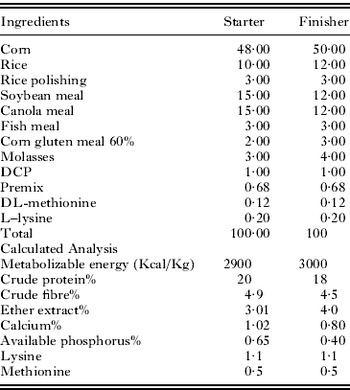
In total, 360 one-day-old, Hubbard broiler chicks (Hubbard Al-Noor Chicks, Pvt-Pakistan) were purchased from a local hatchery. Chicks were reared on floor pens under standard management practices. All pens had concrete floors with new wood-shavings litter. All the chicks were kept on broiler starter rations for up to 2 weeks of age and then fed a broiler finisher. These commercial-type starter and finisher diets (Table 1) without any anticoccidials were given ad libitum. Water was also available on an ad libitum basis. Heating was supplied by electric heater bulbs and temperature was maintained at 29·5–32·5°C during the first week of age and was reduced by 3 °C on a weekly basis. Artificial lighting and ventilation were provided continuously throughout the experimental period.
Composition and calculated nutrient contents of starter and finisher diets

All the birds were vaccinated with the Lasota strain against Newcastle disease by the eye-drop method on the 5th day of age, and when they were 28 days old, Lasota strain vaccine against Newcastle disease was added to the drinking water. Gumboro vaccine, against infectious bursal disease, was administered as eye drops on the 14th day of age. Oil emulsion vaccine, against hydropericardium syndrome, was injected at a dose rate of 0·5 ml subcutaneously on the 18th day of age.
Parasite
The oocysts of Eimeria tenella were obtained from the caeca of infected chickens and were propagated in broiler chickens by giving oral infection. After obtaining a sufficient amount of oocysts, they were sporulated by placing in 2·5% K2Cr2O7 in the presence of suitable humidity and temperature. Sporulated oocysts were cleaned and counted by the McMaster technique (MAFF, 1986). The required concentration of sporulated oocysts (75 000/ ml) was maintained in phosphate-buffered saline.
Study design
The chicks (n=360) were divided into 6 groups and placed 20 per pen with 3 pens (replicates) per treatment. Treatments were randomized within blocks. Treatments were as follows: 2 g herbal complex medicated group; 4 g herbal complex medicated group; 6 g herbal complex medicated group; Amprolium medicated group – amprolium was used at the recommended dose rate of 125 ppm; infected non-medicated control; non-infected, non-medicated control. All the groups were inoculated orally with 75 000 sporulated oocysts on the 14th day of age, except for the non-infected, non-medicated control. Amprolium (at the dose rate of 125 ppm) was given in the drinking water and different concentrations of herbal complex were given orally once per day from the 14th to the 21st days of age. The trial was pursued for 35 days.
Evaluation of anticoccidial effects
Ten chicks from each pen were weighed on day of inoculation (14th day of age) and then reweighed on the 21st, 28th and 35th day of age. The weight of treated chicks was compared with control groups. The weight on day 14 was, therefore, considered as the initial weight. Feed conversion ratio (FCR) was calculated as the grammes of feed consumed to produce 1 gramme of live weight. FCR was determined from the 3rd to the 5th week of age (1st to 3rd week post-inoculation of sporulated oocysts).
Seven chicks from each pen were examined for bloody diarrhoea from the 4th to 6th day post-inoculation. The extent of bloody diarrhoeal score was assigned one of the 5 degrees, from 0 to 4. Zero is the normal status, whereas 1, 2, 3 and 4 correspond to 25%, 26–50%, 51–75%, and over 75% blood in total feces, respectively (Youn et al. Reference Youn, Kang and Jang1993).
Seven chicks from each pen were sacrificed for post-mortem examination at day 7 post-inoculation (21st day of age). Caecal lesions were scored by the lesion scoring technique described by Johnson and Reid (Reference Johnson and Reid1970). An oocyst index (0 to 5) was determined by microscopical examination of scrapings from the caeca of chicks sacrificed for lesion scoring on day 7 post-inoculation (Hilbrich, Reference Hilbrich1978) as follows: (0) <1 oocyst; (1) 1–10 oocysts per microscope field; (2) 11–20 oocysts per microscope field; (3) 21–50 oocysts per microscope field; (4) 51–100 oocysts per microscope field; (5) >100 oocysts per microscope field.
Fecal samples of 3 chicks for each pen were investigated for oocyst excretion from 6 to 10 days after infection with E. tenella. The counting of oocysts was done by McMaster technique (MAFF, 1986). Three g of the fecal sample were taken and thoroughly mixed with 42 ml of tap water in a beaker. The chambers of the McMaster slide were filled with the sample and allowed to stand undisturbed for 2–3 min so that the oocysts came into the same focus level. The McMaster slide was then examined microscopically. The number of oocysts per g of fecal sample was calculated by the following formula.

where X=average count in 1 chamber; 0·15=volume under ruled area; 45=total volume of suspension; 10=1/10 dilution factor; 1/3=correction factor for 1 g of feces
The survival percentage of birds was calculated by the following formula:
Survival percentage=(Total number of chicks – Dead chicks/Total number of chicks)×100.
Statistical analysis
Data obtained on various parameters were analysed by analysis of variance, and the mean values were compared by the Tukey test. The differences between group means were considered significant at P<0·05.
RESULTS
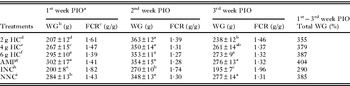
The results of weight gain (Table 2) showed that the body weight gains in all the medicated groups were significantly (P<0·05) higher than the infected non-medicated control. Among herbal complex (HC) medicated groups, the maximum weight gain was shown by the group medicated with 6 g HC followed by the groups medicated with 4 g and 2 g HC. There was no significant (P<0·05) difference between the weight gains of groups medicated with 6 g HC and amprolium. The FCR values (Table 2) of HC medicated groups were numerically lower compared with the infected, non-medicated group, although a statistical comparison could not be made due to group feeding. Among HC medicated groups, the lowest FCR was observed in the group medicated with 6 g HC followed by the groups medicated with 4 g HC and 2 g HC.
Comparative values of the mean (and s.d.) weight gain, total weight gain percentage and mean feed conversion ratio from first to third week after challenge with Eimeria tenella

a–e Means sharing similar superscripts within a column do not differ (P<0·05).
a Post-inoculation of Eimeria tenella oocysts.
b Weight gain.
c Feed conversion ratio.
d 2 g herbal complex medicated group.
e 4 g herbal complex medicated group.
f 6 g herbal complex medicated group.
g Amprolium medicated group.
h Infected, non-medicated control.
i Non-infected, non-medicated control.
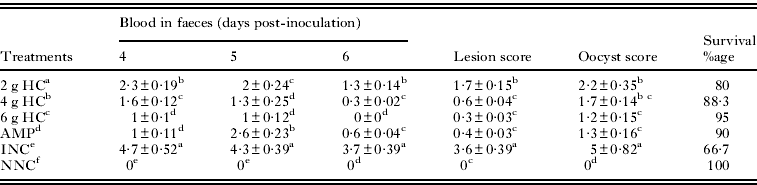
Bloody diarrhoea (Table 3) was observed from the 4th to the 6th day after challenge with E. tenella. In the group treated with 6 g HC, the extent of bloody diarrhoea was milder than that observed in other groups. The results of the lesion scores are indicated in Table 3. All the groups medicated with HC and amprolium showed significantly (P<0·05) lower lesion scores than the infected, non-medicated group. Among all medicated groups, the lowest lesion scores were shown by the group medicated with 3 g HC. The results of the oocyst scores (Table 3) revealed a pattern relatively similar to that of lesion scores among the different groups. The oocyst scores were lower (P<0·05) in medicated groups compared with the infected, non-medicated group. Among medicated groups the maximum reduction in oocyst scores were seen in the 3 g HC medicated group followed by amprolium, 4 g HC and 2 g HC medicated groups respectively. The results revealed that the herbal complex has anticoccidial activity in terms of reducing oocyst score. Survival percentage (Table 3) was higher in the medicated groups compared with the infected, non-medicated control group. Among medicated groups, the survival percentage was numerically higher in the amprolium medicated group followed by groups medicated with 6 g, 4 g and 2 g HC respectively.
Comparative values of the mean (and s.d.) bloody diarrhoea, lesion score, oocyst score and survival percentage of chicken treated with herbal complex and challenged with Eimeria tenella
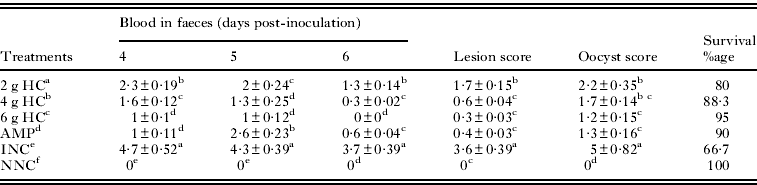
a–e Means sharing similar superscripts within a column do not differ (P<0·05).
a 2 g herbal complex medicated group.
b 4 g herbal complex medicated group.
c 6 g herbal complex medicated group.
d Amprolium medicated group.
e Infected, non-medicated control.
f Non-infected, non-medicated control.
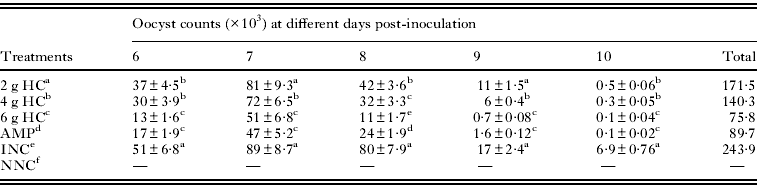
The mean counts of excreted oocysts (Table 4) in the groups treated with amprolium and HC were significantly lower than that of the infected control group. Maximum reduction was recorded in the 6 g HC medicated group followed by the amprolium, 4 g and 2 g HC medicated groups respectively. A similar pattern was also observed from the 6th to the 10th day after challenge with E. tenella.
Effect of herbal complex on oocyst excretion (mean±s.d) in chicks artificially infected with Eimeria tenella
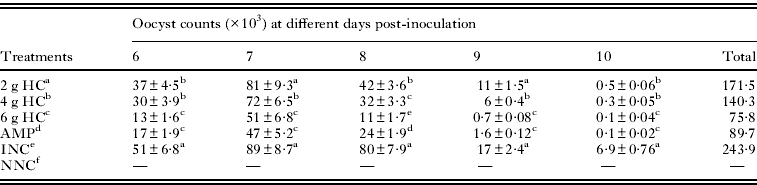
a–e Means sharing similar superscripts within a column do not differ (P<0·05).
a 2 g herbal complex medicated group;
b 4 g herbal complex medicated group;
c 6 g herbal complex medicated group;
d Amprolium medicated group;
e Infected, non-medicated control;
f Non-infected, non-medicated control.
DISCUSSION
To prevent and control avain coccidiosis, the poultry industry has been mostly dependent upon anticoccidial drugs resulting in the development of resistant strains of Eimeria to all introduced anticoccidial drugs (Abbas et al. Reference Abbas, Iqbal, Blake, Khan and Saleemi2011a). Therefore, recent research has focused on alternative strategies for the control of avian coccidiosis such as using botanicals as anticoccidial agents (Abbas et al. Reference Abbas, Iqbal, Khan, Zafar and Zia2010, Awais et al. Reference Awais, Akhtar, Muhammad, Haq and Anwar2011).
In the present study, HC has demonstrated anticoccidial effect against Eimeria tenella in terms of improved weight gains, better FCR, mild bloody diarrhoea, lower oocyst and lesion scores, and higher survival rates. Interestingly, values of some parameters were either comparable or even better than those of amprolium treated and/or uninfected unmedicated chicks, pointing to some growth-promoting factors in the HC.
The botanicals of the studied formulation are cheap, commonly available, and easy to use as a decoction. Azadirachta indica is well known for its anticoccidial activity against avian coccidisos (Tipu et al. Reference Tipu, Pasha and Ali2002; Abbas et al. Reference Abbas, Iqbal, Akhtar, Khan, Jabbar and Sandhu2006; Biu et al. Reference Biu, Yusuf and Rabo2006; Toulah et al. Reference Toulah, Ismeel and Khan2010). So far, the exact mechanism of action of A. indica against coccidian parasites is unknown, but the report by the National Research Council (1992) suggested that an aqueous leaf extract of A. indica when taken orally produced an increase in red blood cell, white blood cell and lymphocyte counts thus enhancing the cellular immune response, increasing antibody production. Thus most pathogens can be eliminated before they cause the ill effects associated with disease.
Calotropis procera is rich in alkaloids, carbohydrates, glycosides, phenolic compounds/tannins, proteins and amino acids, proteolytic enzymes, flavonoids, saponins, sterols and/or triterpenes, acidic compounds and resins (Singh and Rastogi, Reference Singh and Rastogi1972; Dhar and Singh, Reference Dhar and Singh1973; Seiber et al. Reference Seiber, Nelson and Lee1982; Mossa et al. Reference Mossa, Tariq, Mohsin, Ageel, Al-Yahya, Al-Said and Rafatullah1991; Sen et al. Reference Sen, Sahu and Mahato1992; Sharma and Sharma, Reference Sharma and Sharma1999).
Nicotiana tabacum contains alkaloids, mainly nicotine, which was isolated for the first time in 1828 from the leaves of the plant and it accounts for over 90% of the total alkaloidal content (Bowman and Rand, Reference Bowman and Rand1980). So far, the anticoccidial mode of action of nicotine is unknown but anthelmintic properties of nicotine may be through the activation of the neuromuscular junctions which ultimately cause paralysis (spastic) in the worms, eventually leading to death and expulsion of the worm from the body of the host. Nicotine is a ganglion stimulant (Bowman and Rand, Reference Bowman and Rand1980), which is possibly responsible for the antiparasitic activity of the plant extract.
Thymol and carvacrol are the active ingredients present in Trachyspermum ammi (Nagalakshmi et al. Reference Nagalakshmi, Shankaracharya, Naik and Rao2000; Khajeh et al. Reference Khajeh, Yamini, Fatemeh and Bahramifar2004). Thymol has been reported as an antimicrobial (Ogaard et al. Reference Ogaard, Larsson, Glans, Henriksson and Birkhed1997) and antifungal agent (Montes-Belmont and Carvajal, Reference Montes-Belmont and Carvajal1988). Both thymol and carvacrol hinder the peroxidation of liposome phospholipids in a concentration-dependent way (Aeschbach et al. Reference Aeschbach, Loliger, Scott, Murica, Butler, Halliwell and Aruoma1994).
Phytochemicals of 4 plants discussed above can be broadly divided into phenols flavonoids, tannins, terpenoids and essential oils, alkaloids, and saponins. These components are known to have antitumour, anti-inflammatory, antioxidant, antiproliferative, antibacterial, antiviral, and anti-parasitic properties (Crespy and Williamson, Reference Crespy and Williamson2004; Fujiki, Reference Fujiki2005; Isogai et al. Reference Isogai, Isogai, Hirose, Hayashi and Oguma2001; Molan et al. Reference Molan, Meagher, Spencer and Sivakumaran2003, Reference Molan, Sivakumaran, Spencer and Meagher2004; Weber et al. Reference Weber, Ruzindana-Umunyana, Imbeault and Sircar2003). Simple phenols and phenolic acids cause enzyme inhibition by the oxidized compounds, possibly through reaction with sulfhydryl groups or through more non-specific interactions with the proteins (Mason and Wasserman, Reference Mason and Wasserman1987). The antimicrobial activity of flavones, flavonoids, and flavonols is probably due to their ability to complex with extracellular and soluble proteins and to complex with bacterial cell walls, more lipophilic flavonoids may also disrupt microbial membranes (Tsuchiya et al. Reference Tsuchiya, Sato, Miyazaki, Fujiwara, Tanigaki, Ohyama, Tanaka and Iinuma1996). Tannins have been reported to complex with polysaccharide (Ya et al. Reference Ya, Gaffney, Lilley, Haslam, Hemingway and Karchesy1988). Condensed tannins have been shown to bind cell walls of bacteria, preventing growth and protease activity (Jones et al. Reference Jones, McAllister, Muir and Cheng1994). One of the molecular actions of tannins is to complex with proteins through so-called non-specific forces such as hydrogen bonding and hydrophobic effects, as well as by covalent bond formation (Haslam, Reference Haslam1996; Stern et al. Reference Stern, Hagerman, Steinberg and Mason1996). They also have the ability to inactivate microbial adhesins, enzymes, cell envelope transport proteins etc. Their anticoccidial mechanism of action is due to the induction of oxidative stress against Eimeria species (Wang et al. Reference Wang, McAllister, Newbold, Rode, Cheeke and Cheng1998). In the present study, the reduction in the pathogenic effects (bloody diarrhoea, lesion score and oocys counts) of Eimeria tenella demonstrated by the HC medicated groups might be because of the tannin content of plants in the herbal complex.
The mechanism of action of the antimicrobial activity of terpenoids and essential oils (Barre et al. Reference Barre, Bowden, Coll, Jesus, Fuente, Janairo and Ragasa1997; Amaral et al. Reference Amaral, Ekins, Richards and Knowles1998) is not fully understood but is speculated to involve membrane disruption by the lipophilic compounds. The antimicrobial effects of alkaloids (Omulokoli et al. Reference Omulokoli, Khan and Chhabra1997) such as berberine and harmane (Hopp et al. Reference Hopp, Cunningham, Bromel, Schermeister and Wahba Khalil1976) are attributed to their ability to intercalate with DNA (Phillipson and O'Neill, Reference Phillipson and O'Neill1987).
Saponins are steroidal glycosides with strong surfactant activity, reducing the superficial tension of fluids and allowing better absorption of nutrients by the intestinal epithelium (McAllister et al. Reference McAllister, Wang, Hristov, Olson and Cheeke1998), thus resulting in better weight gains. Saponins cause the inhibition of protozoon development by interacting with the cholesterol present on the parasite cell membrane, thus resulting in parasite death (Wang et al. Reference Wang, McAllister, Newbold, Rode, Cheeke and Cheng1998). In the present study, improved weight gains in the HC medicated groups may be due to the growth-promoting effects of the saponin contents of the Calotropis procera plant.
Avain coccidiosis leads to huge economic losses in the poultry industry, because of pathogenic effects of Eimeria species in the intestinal tract, resulting in malabsorption of nutrients and subsequent adverse effects on the growth parameters (weight gain and FCR). The performance improvements observed whilst using herbal complex (particularly 6 g) could overcome these losses.
CONCLUSIONS
The studied herbal complex may be used as a potential anticoccidial agent. The contents of the formulation are cheap, commonly available, and easy to use as a decoction particularly for the resource-poor farmers. Moreover, it is not a new animal husbandry input as farmers are already using these plants individually in animal health and production. Incorporation of this herbal complex in integrated coccidiosis management practices will add to the sustainability and thus, income of the farmers. Large-scale controlled studies are, however, recommended for standardization of the doses and applications of the product. Studies on fraction-based activity of formulation will be useful in identifying the active principles leading to development of a refined product with better anticoccidial efficacy.