Introduction
Dementia currently has a major impact on every health and social care system in the world (Wimo and Prince, Reference Wimo and Prince2010). A significant issue is the direct costs associated with care provision by health professionals. This economic burden is expected to worsen as the estimated number of people living with dementia is predicted to treble by 2050 to 115.4 million worldwide (Wimo and Prince, Reference Wimo and Prince2010). To avert a healthcare crisis, most developed countries have devised national dementia action plans or frameworks (Benbow and Kingston, Reference Benbow and Kingston2010). Without exception, each nation declares that it needs to find ways to support and bolster their dementia care workforce to adequately withstand and confidently surmount the challenges posed by dementia in the 21st century (e.g. Australia's National Framework for Action on Dementia (AHMC, 2006); Norway's Dementia Plan 2015 (NMHCS, 2007); USA's A National Alzheimer's Strategic Plan (ASG, 2009); England's Living Well With Dementia (DH, 2009); Canada's Rising Tide (AS, 2010)). At a political and public policy level, preparation is underway to best find ways to deal with the dementia epidemic. Whether this translates to current research evidence in capacity-building for dementia care is yet to be determined.
This review aims to assess the current level of evidence on how dementia care worker training initiatives affect organizational capacity, through factors such as retention and service delivery. A comprehensive approach is taken to the examination of training interventions for workers in the dementia care setting. There is a bi-directional relationship between worker variables (i.e. well-being, job satisfaction and functioning) and organizational climate or health variables (i.e. performance, productivity, capacity, or resilience, at the level of the organization or workplace; Rafferty and Griffin, Reference Rafferty and Griffin2004). Therefore this review focuses on studies that can inform knowledge about the processes that are essential in this interaction. Dementia training interventions set in both primary care and community health arenas are included in the current review. Practical elements of training interventions for dementia are detailed by focusing on information about the format of training and qualifications of facilitators along with the type of work setting and healthcare workers targeted by the training. Differing intervention components are reviewed paying attention to whether an organizational support component forms part of the training as well as how the impact of these components are assessed. An aim of the study was to evaluate the applicability of training as part of capacity-building in preparation for organizational change in the face of the aging population trend.
The dementia care setting is made up of health and community services that are delivered within primary care, in-patient hospital care, and residential nursing home, as well as community care. Barriers to high quality dementia care are linked to workforce issues and include workers’ limited knowledge of the disease itself, with low numbers of staff receiving dementia care training, even among those working in specialist dementia services (APPG, 2009). Although training alone is insufficient to improve the care provided to people with dementia, the very low level of training in dementia is a significant barrier.
Currently this workforce is under siege. Demand is growing for caregivers, especially in community-based settings as care workers are one of the occupational groups with the largest projected job growth this decade (Hecker, Reference Hecker2005). In Australia, the majority (83%) of care workers are based in the community, are female, and about 50 years of age (Martin and King, Reference Martin and King2008). Very low numbers of care workers enjoy permanency at their workplace, and it is most likely that they are employed on permanent part-time contracts (Richardson and Martin, Reference Richardson and Martin2004). Other nations, such as England and the USA, share similar care workforce characteristics including low levels of education, qualifications, and remuneration (Figueriredo, Reference Figueriredo2011; Hussein and Manthorpe, Reference Hussein and Manthorpe2011). Financial constraints will limit access to training, a fate unconducive to developing capacity in the workforce.
A lack of clear regulation status linked to heterogeneity of qualifications and training among the care workforce results in poor employment terms and conditions and lack of career opportunities. This contributes to high staff turnover due to poor recruitment and retention of dementia care workers (APPG, 2009). This workforce also faces problems of multi-disciplinary dementia competency in rural and remote areas worldwide (Morgan et al., Reference Morgan, Innes and Kosteniuk2011).
Health services research has focused extensively on topics related to attrition and staff turnover. Aged care, especially the dementia care labor sector is no exception to these investigations. There is a need for an aged care workforce strategy to recruit and retain workers with dementia knowledge and experience. A systematic literature review found that the main reason for quitting the dementia care labor market was lack of job satisfaction, largely relating to negative worker appraisals of the quality of care provision (Vernooij-Dassen et al., Reference Vernooij-Dassen2009). Workers commonly reported feeling dissatisfied with the quality of care they were able to provide. Worker dissatisfaction may play a role in inhibiting capacity-building given the negative effects of staff turnover. The lack of specific knowledge of dementia and ways to manage behavioral aspects of the disease may also contribute to job dissatisfaction in the care worker population. Care workers’ frustrations may arise from unresolved problems they feel underprepared to handle.
Review studies often report training interventions that take place in residential and or long-term care facilities (Kaasalainen, Reference Kaasalainen2002; Kuske et al., Reference Kuske, Hanns, Luck, Angermeyer, Behrens and Riedel-Heller2007), leaving a knowledge gap about studies taking place in the community setting. Only one published review of staff training in dementia interventions was dementia specific. The review focused exclusively on nursing professionals working in nursing homes caring for dementia patients and included non-controlled trials, as well as randomized interventions (Kuske et al., Reference Kuske, Hanns, Luck, Angermeyer, Behrens and Riedel-Heller2007). The authors did not examine whether organizational variables were assessed as outcome measures.
In comparison to patient and informal caregiver outcomes, worker and organizational outcomes are often overlooked and, until recently, organizational support and training evaluation literature received relatively little attention. In particular, the impact of training and education on levels of job satisfaction, psychological well-being, and work stress are rarely assessed. According to the perceived organizational support theory, workers’ productivity is influenced by the extent that workers believe their organization values their work contributions and well-being. The current review aims to examine training interventions that also include organizational components of support for workers. To date, no evaluation on the strength of the effects of the rigorously tested studies has been conducted, in particular focusing on both worker and organizational outcomes.
Job satisfaction has a well-established negative correlation with high job demands and stress. A meta-analysis of 31 studies of nurses found job dissatisfaction was most strongly correlated with job stress (Zangaro and Soeken, Reference Zangaro and Soeken2007). Further, job stress is considered a major factor for work-related injuries, workplace turnovers, absenteeism, and worker compensation claims at an international level (Richardson and Martin, Reference Richardson and Martin2004). The risk of developing a psychological disorder, such as depression, is higher for workers with high work demands, reduced autonomy (i.e. low decisional power and the lack of control over work), strain, overload, and pressure (Darr and Johns, Reference Darr and Johns2008).
At the basic level, capacity refers to the amount that something or someone can produce as well as receive or hold (Moore, Reference Moore2004). In terms of organizational systems, capacity therefore relates to an organization's ability to provide or hold and maintain services, workers’ skill and aptitude to absorb knowledge, fulfill roles, meet demands and standards, all resulting in a desired consumer outcome, such as quality care or satisfaction. Capacity in health and community care will need to grow to maintain and adapt service provision in light of future demands. A systematic review of the efficacy of training interventions for dementia care workers will help provide some direction for services in the future wishing to improve the capacity of their workforce. In turn, a focus on outcomes for workers and organizations will show which interventions produce the best effects in different stakeholders.
A focus on studies that provide information for multiple domains will allow the analysis to adopt a holistic approach, whereby multiple factors proven to build the capacity of dementia care service providers can be examined. Including studies that evaluate worker mood and well-being will also allow some potential barriers to learning and translation to be explored. Further, to gain some sense of whether the intervention is impacting more broadly on workforce capacity, there have to be markers of worker capacity such as job stress, retention, and absenteeism.
This study reviews systematically all studies published in the past 21 years testing the effectiveness of dementia training interventions for healthcare workers. The review details the reasons for study selection based on inclusion and exclusion criteria, which are detailed in the “Methods” section. Results are presented by displaying the training format, setting, and outcomes of the interventions. Methodological concerns related to the included studies are also presented. Finally, implications and recommendations are made for capacity-building in dementia care.
Methods
The literature search sought to capture all studies from 1990 to 2011 that evaluated training for paid health workers who care for people with dementia. This period was selected to capture developments over the last 21 years of research, with particular interest in randomized controlled study designs in the field. Relevant publications were identified searching computerized databases Web of Science, PsycINFO, Scopus, ProQuest, and PubMED for terms such as “dementia training,” “dementia care training,” “dementia training intervention,” “dementia staff training,” and “dementia education.” Multiple search strategies were used to maximize the probability of locating as many relevant articles as possible. Finally, the references from papers located through these database searches were also examined for additional relevant papers. Thus, two recent review papers proved useful for identifying dementia-specific studies that met the selection criteria: one critiqued interventions to train staff to manage the mental well-being of elderly residential care patients (Moyle et al., Reference Moyle, Hsu, Lieff and Vernooij-Dassen2010); the second examined professional development for medical and other health professionals working in generic health settings (Rampatige et al., Reference Rampatige, Dunt, Doyle, Day and van Dort2009).
To inform knowledge about interactive processes between worker and organizational functioning, this review focuses only on interventions that involved dual outcome domains. That is, the included studies must have assessed both worker (e.g. dementia knowledge, job satisfaction, and well-being) and organizational outcomes (such as retention and service delivery). Studies that do not assess both outcome domains are limited in their potential to inform practice and policy for enhancing the dementia workforce in a sustained way. For example, though a worker training intervention might have positive effects on worker outcomes in the relative short term, in the absence of knowledge about organizational outcomes, the impact of worker training on organizational health and core business (Jensen, Reference Jensen2011) is unknown. Conversely, if an organizational intervention does not assess worker outcomes, the results cannot inform whether any organizational change has translated to, or affected, worker capacity or well-being.
Thus, only the studies meeting the following inclusion criteria were chosen for further analysis, i.e. the study must:
• involve an intervention that targets workers who provided support or care to people with dementia and or their informal carers (this could include workers employed in residential facilities or community-based services);
• assess some aspect of worker capacity or well-being (e.g. job stress, knowledge, mood) as well as organizational factors (e.g. service delivery or retention);
• adopt a randomized controlled design and evaluate the effects of the intervention using empirical data;
• be published in English; and
• be published between 1990 and 2011.
Studies were excluded from the review if no worker or organizational assessment was undertaken by the authors, and if the study predominantly focused on outcomes for the person with dementia or their informal carer. Studies that focused primarily on behavior change in people with dementia via staff training in skills aimed at changing specific behaviors were excluded if they did not include worker-related outcomes (Allen-Burge et al., Reference Allen-Burge, Stevens and Burgio1999; McCabe et al., Reference McCabe, Davison and George2007). While these may provide workers with confidence in a specific domain of dementia care, the focus of these interventions is not on workers’ well-being per se. Papers were also excluded if they were not dementia specific (i.e. a study testing a training intervention of a generalized educational resource for nurses in elderly care). Studies that only assessed change in one domain were also excluded. Two of the authors reviewed the identified papers for consistency of selection; if discrepancy occurred this was discussed in light of the eligibility criteria until consensus was reached. The papers were summarized and categorized as a means of identifying the applicability of training to the workplace, and reviewing best effects for service providers considering organizational training and evaluation in dementia.
Where possible, effect sizes (Cohen's d) were calculated to determine the strength of effect of the interventions on measured outcomes and to produce comparison across domains. The format, duration, and content of the interventions, and therapist variables, such as the qualifications and training of the intervention facilitators, are also reported in the review. These variables inform researchers about the potential to replicate, disseminate, and sustain successful interventions in other organizational settings or workforces, or can help explain null effects. In addition, the methodological quality of each study was calculated based on a rating scale developed from criteria based on the Consolidated Standards of Reporting Trials (CONSORT; Moher et al., Reference Moher, Schulz and Altman2001) and by Brodaty et al. (Reference Brodaty, Green and Koschera2003), which was in part also adopted by a previous systematic review of nursing home staff training in dementia care (Kuske et al., Reference Kuske, Hanns, Luck, Angermeyer, Behrens and Riedel-Heller2007). Methodological comments are discussed in reference to the size of effects across outcome domains.
Results
The search strategy identified 74 studies after review of initial abstracts for dementia training programs. Of these, 68 studies did not meet inclusion criteria (with 46 of these excluded as they were not randomized controlled trial (RCT) designs). In total, 22 RCT studies were excluded from the current review. Nine RCT studies were excluded as they did not assess worker outcomes (Rovner et al., Reference Rovner, Steele, Shmuely and Folstein1996; Proctor et al., Reference Proctor1999; Teri et al., Reference Teri, McCurry, Logsdon and Gibbons2005b; Callahan et al., Reference Callahan2006; Downs et al., Reference Downs2006; Fossey et al., Reference Fossey2006; Vickrey et al., Reference Vickrey2006; Moniz-Cook et al., Reference Moniz-Cook2008; Testad et al., Reference Testad, Ballard, Bronnick and Aarsland2010). Seven RCT studies were excluded as they did not assess organizational outcomes (Wells et al., Reference Wells, Dawson, Sidani, Craig and Pringle2000; Burgio et al., Reference Burgio2001; Reference Burgio, Stevens, Burgio, Roth, Paul and Gerstle2002; Teri et al., Reference Teri, Huda, Gibbons, Young and Van Leynseele2005a; Chodosh et al., Reference Chodosh2007; Davison et al., Reference Davison, McCabe, Visser, Hudgson, Buchanan and George2007; Visser et al., Reference Visser, McCabe, Hudgson, Buchanan, Davison and George2008). Chodosh et al. (Reference Chodosh2007) did assess quality of care delivered; however, this was measured from the primary care physician's perspective and therefore was not a true organizational outcome. One intervention tested by Smyer et al. (Reference Smyer, Brannon and Cohn1992) was not focused on dementia, but instead on general training in nursing home care, and was therefore excluded despite assessing changes in job roles. Three RCT studies did not report any results and only described the intervention under examination (Vollmar et al., Reference Vollmar, Butzlaff, Lefering and Rieger2007; Perry et al., Reference Perry2008; Holle et al., Reference Holle2009). A further two RCT studies were excluded as they only offered simulated results (i.e. neurologists reviewing dementia case scenarios in a lab-based study replicating dementia symptoms in actors; Holloway et al., Reference Holloway, Gifford, Frankel and Vickrey1999; Schindel-Martin et al., Reference Schindel-Martin, Morden, Cetinski, Lasky, McDowell and Roberts2003).
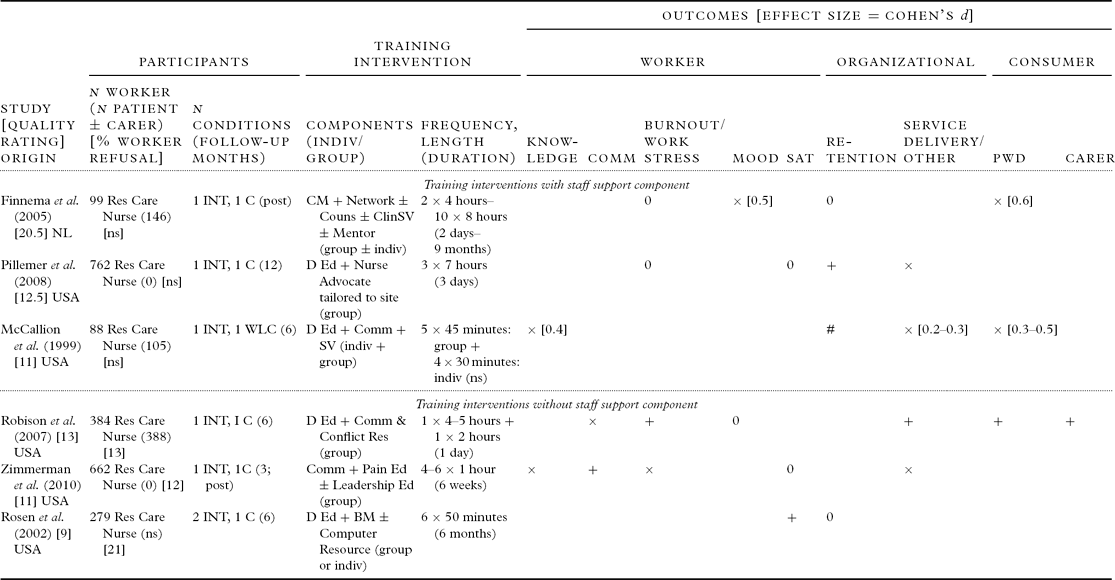
A total of six RCT studies were included in the review (see Table 1 for studies presented in rank order based on methodological rigor determined by concerns raised in Table 2). Five studies took place in the USA and one in the Netherlands. Training interventions that targeted change for healthcare workers, the organization, and or consumers fell into two categories: (i) interventions with a staff support component, and (ii) interventions without a staff support component. All studies included in the review took place in the residential care setting. Despite the eligibility criteria of the review including the community setting, no studies were found for the community setting that assessed both worker and organizational outcomes.
Summary of RCT studies testing training interventions in dementia care
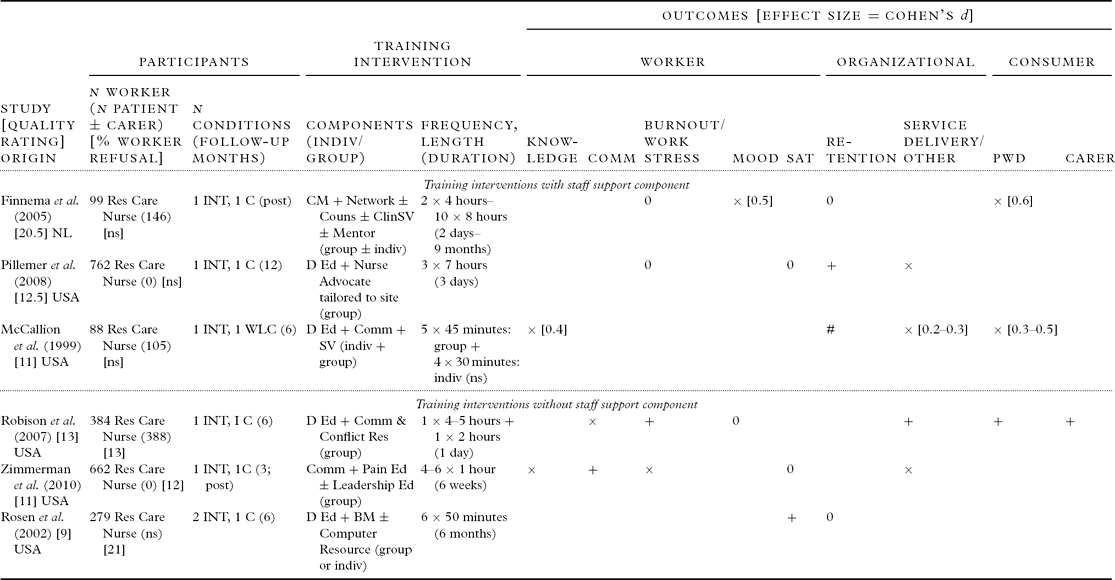
PWD = people with dementia; NL = Netherlands.
Setting: Res Care = residential care; Design: C = control; INT = intervention; WLC = wait list control. Format: group/indiv = intervention delivered in a group or one-on-one. Intervention components: BM = behavioral management; CM = case management; ClinSV = clinical supervision; Comm = communication; Conflict Res = conflict resolution; Couns = counseling; D = dementia; Ed = educational/instructional; Network = network meetings; Nurse Advocate = a nurse who advocates for workers needs; Mentor = a peer mentor or staff member who guides/monitors workers; Pain = pain management; SV = supervision for workers to practice skills and have feedback. Outcomes: Comm = communication; Sat = satisfaction; + = significant improvement monitored to follow-up; × = significant improvement, but not to follow-up; # = no improvement at time one, significant improvement found at follow-up; 0 = no effect.
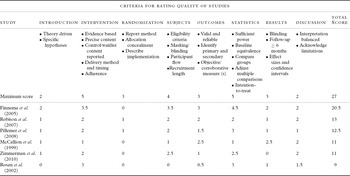
Rating of RCT studies in descending order of research quality

Some studies could attract 0.5 of a mark if there was reference to a given criteria, but incomplete information; examples of this include: Criteria = Intervention Adherence – intervention and control groups were supervised by different nursing advisors, but no details were reported on whether the intended topics were delivered; Criteria = Statistics Sufficient Power – reports that power was sufficient, but calculations not provided.
The review describes training outcomes for 2,274 workers in dementia care. Workers range from nursing assistants and personal carers with practice certificates in formal caregiving to registered nurses with bachelor degrees. Organizational settings include residential care facilities and specific dementia units and hospital wards. Of those studies evaluating effects for consumers, 639 people with dementia and their family or carers were involved. Half the training interventions provided an additional staff support component. Results of the current review show that, over the past 21 years, ways to improve the capacity of healthcare workers in the dementia setting has focused on improving knowledge in dementia via education, skills, and education training in behavior management, and in some cases organizational support in the form of supervision.
Training format and setting
The majority of training interventions for health workers in dementia care included in the review followed a group format, with three interventions also adopting the use of individual format. There was only one study selected in the review where workers were randomly allocated to receive training individually. Training interventions aimed to improve capacity in dementia healthcare by adopting the use of multiple component programs. In total 14 types of components were used in the six interventions, displayed in Table 1. The most commonly adopted training component was dementia education or instructional training. Information about dementia was generally delivered through mixed methods adopting the use of lectures, video, role-play, group exercises, and case discussions. The average length of training interventions was a total of approximately 22 hours. All training lasted under 21 hours, except for one, lasting a total of 88 hours. Training facilitators had health professional qualifications such as nurse, social worker, or physician backgrounds. All studies reported expert knowledge in dementia held by facilitators, in the form of advanced degrees, or specialist training.
Outcomes for interventions with staff support
Interventions that adopt a staff support component involve some type of interaction between staff in both nurse assistant and more senior roles. Staff support was delivered in the form of supervision, both of a general and clinical nature and a mentor or nurse advocate.
Worker outcomes are varied. Two out of three interventions produced positive, but not lasting outcomes for workers. Nurse assistants who reported using more counseling (emotion-oriented) skills showed improvements in general stress levels (Finnema et al., Reference Finnema2005). However, this medium-level effect was not sustained over time. No effects were found for work stress or burnout (despite some improvements in general stress) or competence and job satisfaction. Knowledge of treatment care and behavioral management improved for nurse assistants after participating in an intervention with instructional training on dementia and communication (McCallion et al., Reference McCallion, Toseland, Lacey and Banks1999). This effect was medium in size and it did not last over time. The intervention tested by McCallion et al. (Reference McCallion, Toseland, Lacey and Banks1999) did not produce improvements in dementia knowledge, despite one of the core components targeting this area.
Mixed results were found for organizational outcomes. Lasting effects were found for retention and retention efforts within the organization when nurses undertook instructional training in dementia and a nurse advocate was positioned in the workplace (Pillemer et al., Reference Pillemer2008); however, no calculations of effect size could be made. Delayed improvements were found for retention when nurse assistants attended instructional training on dementia communication and received supervision (McCallion et al., Reference McCallion, Toseland, Lacey and Banks1999). Again, the effect size could not be calculated. Despite two studies reporting positive results for retention, Finnema et al. (Reference Finnema2005) found no improvements in staff absenteeism at a nursing home. Non-lasting effects were found for service delivery in the form of care quality, staff education quality (no effect sizes), and the use of physical and chemical restraints (small effects sizes).
Some non-lasting effects were found for consumers, with the largest effect for self-care (Cohen's d = 0.6) of people with dementia in a nursing home. The same intervention tested by Finnema et al. (Reference Finnema2005) found a non-lasting medium effect for emotional balance of residents with dementia, but this was only for residents who were in less need of assistance, with mild-moderate levels of dementia. Depression and aggressive behaviors (Cohen's d = 0.2) improved in people with dementia after staff training in dementia education communication and supervision (McCallion et al., Reference McCallion, Toseland, Lacey and Banks1999). Despite these small to medium effects, none was found for behavioral problems for people with dementia. No outcomes were reported for carers of people with dementia in the studies that tested interventions with a staff support component.
Outcomes for interventions without staff support
Two interventions without staff support found lasting effects (Rosen et al., Reference Rosen, Mulsant, Kollar, Kastango, Mazumdar and Fox2002; Robison et al., Reference Robison, Curry, Gruman, Porter, Henderson and Pillemer2007). All interventions adopted a group educational component to deliver dementia education, in association with other components such as communication or behavioral management strategies. No effect sizes could be calculated for the intervention outcomes for any study in this category.
Worker outcomes showed improvements for knowledge in general (lasting over time; Rosen et al., Reference Rosen, Mulsant, Kollar, Kastango, Mazumdar and Fox2002) and also specific knowledge about pain (not maintained to follow-up; Zimmerman et al., 2010). Satisfaction with training and compliance to attend training were found to be higher for nurses who completed training in using a computer resource about dementia and behavioral management than nurses who attended traditional group training in lecture format (Rosen et al., Reference Rosen, Mulsant, Kollar, Kastango, Mazumdar and Fox2002). Lasting effects were found for general communication when care workers and their supervisors undertook instructional education on communication, pain, and leadership (Zimmerman et al., Reference Zimmerman2010). When instructional education focused on dementia, communication, and conflict resolution, non-lasting effects for nurse communication with family members and carers of people with dementia were found (Robison et al., Reference Robison, Curry, Gruman, Porter, Henderson and Pillemer2007). Improvements were lasting for worker ratings of burnout (Robison et al., Reference Robison, Curry, Gruman, Porter, Henderson and Pillemer2007), but work stress worsened, though it was not lasting (Zimmerman et al., Reference Zimmerman2010). No effects were found for mood (Robison et al., Reference Robison, Curry, Gruman, Porter, Henderson and Pillemer2007) or satisfaction of care workers and supervisors with care provision for people with dementia (Zimmerman et al., Reference Zimmerman2010).
The number of programs offered to families increased after nurses attended training in dementia, communication, and conflict resolution and remained to follow-up (Robison, et al., 2007). Care workers and supervisors reported improvements in supervisor support and work with other staff after group education in communication, pain, and leadership (Zimmerman et al., Reference Zimmerman2010); however, these were not lasting effects. No effects were found on retention (Rosen et al., Reference Rosen, Mulsant, Kollar, Kastango, Mazumdar and Fox2002). Consumer outcomes were found by Robison et al. (Reference Robison, Curry, Gruman, Porter, Henderson and Pillemer2007) with people with dementia improving behaviorally and family members and/or carers improving on communication with staff and their level of involvement at the nursing home.
Methodological concerns
All studies had some level of methodological problem (see Table 2) and were ranked in order of highest to lowest quality rating.
The study by Finnema et al. (Reference Finnema2005) scored the highest quality rating of the six RCTs in the review, but methodological problems were evident. Concerns were found in the lack of reporting about randomization methods, such as allocation concealment and implementation. Only partial training adherence steps were taken. Intervention and control groups were supervised by different nursing advisors. In addition, nurse participants were assessed by family members on their interaction with people with dementia; however, this attempt to monitor compliance related more to an outcome of the training than to whether trainers delivered the appropriate material consistently. No reports were made regarding blinding to treatment group for researchers during analyses of results. Despite scoring the highest quality rating of the six studies, Finnema et al. (Reference Finnema2005) found no lasting effects of the dementia training intervention on worker, organizational, or consumer outcomes.
The study by Robison et al. (Reference Robison, Curry, Gruman, Porter, Henderson and Pillemer2007) had the second highest quality rating, scoring 13 out of 26 points. In spite of ranking second, the rationale of the study was not theory driven and no content was reported for the control condition even though precise content existed for the intervention via the form of a training manual. While there was a training manual, no information about adherence to the training manual was reported. Stratification was reported as the method for randomization, but no details were provided for allocation concealment and implementation methods, such as who generated the allocation sequence and enrolled participants. Length of recruitment and subject masking was unclear, so too were primary and secondary outcomes. Baseline differences were found for people with dementia and the length of their stay at the residential facility and for workers on interpersonal conflict, affecting the ability to say that the effects were due solely to the intervention and were not pre-existing. No adjustments were made for multiple analyses, no effect sizes were reported, and although research staff completed most of the data collection, no reports were made of blinding researchers to treatment.
The third highest rating study in the review scored 12.5 and tested the effects of dementia education and nurse advocacy tailored to each nursing home site. Pillemer et al. (Reference Pillemer2008) had eight similar reasons for methodological concern as Robison et al. (Reference Robison, Curry, Gruman, Porter, Henderson and Pillemer2007). These included no mention of a specific theory in the introduction of the study, no details of the content of the control group, allocation concealment or implementation methods, no mention of blinding of those delivering the intervention or outcome assessors, unclear recruitment length, and no calculation of effect sizes. Pillemer et al. (Reference Pillemer2008) did not consider power analysis and failed to acknowledge the limitation in intervention design, as there was variation in nurse advocate roles across facility, potentially reducing the validity of comparison.
The study by McCallion et al. (Reference McCallion, Toseland, Lacey and Banks1999) was given a quality rating of 11 out of 26. The study was developed to resolve existing problems in communication with people with dementia in nursing homes, but the rationale was not theory driven and the intervention was not evidence based. A waitlist control was adopted; this was a cause for concern because the content of the control remained unreported. Another confounding influence was that the waitlist control continued to receive usual in-service training (no details on type of training were provided). Concerns were evident for randomization methods as no reports were made about allocation, implementation, or masking of participants. The flow of participants was difficult to understand as dropouts and refusals were not reported. Despite the sound psychometrics of the overall measures, the main outcome finding was reliant upon the subscale of a measure, a process that increases the likelihood of type one errors. Statistical adjustments were not made for multiple comparisons and no intention-to-treat analysis was completed.
The total quality rating for the study by Zimmerman et al. (Reference Zimmerman2010) was 11. The rationale for testing the intervention was theory based, but only general hypotheses were considered in the introduction of the study. Poor description of the processes of randomization was evident with outcome measures being experimenter derived or modified. Qualitative assessment failed to consider inter-rater agreement on coding methods, providing subjective analysis open to individual coder bias. Low power was reported and methodological problems were evident in the results with no blinding of researchers. Only one outcome was assessed at three time points, while others were only assessed at pre-post time points, with the follow-up time less than six months.
The study by Rosen et al. (Reference Rosen, Mulsant, Kollar, Kastango, Mazumdar and Fox2002) was rated nine for quality. A novel computer-based approach was adopted by Rosen et al. (Reference Rosen, Mulsant, Kollar, Kastango, Mazumdar and Fox2002) to deliver training to nursing home staff in mental health and dementia, but the rationale for the study was not based in theory and no specific hypotheses were described. The intervention content derived from focus groups of facility educators identifying topics for training. Similar to other low-rated studies, poor randomization and treatment of subject methods were evident. Concerns were apparent about the reliability and validity of the outcomes, as all measures were experimenter derived. Again, baseline differences were a problem, requiring caution when interpreting results.
Discussion
Implications
Over the past 21 years only six RCT interventions have been conducted that target capacity-building in dementia care, including outcomes for both the worker and organization, as identified by the selection criteria in the current review. No studies were identified in the review for the community setting. Of the six interventions tested, all were multi-component, most frequently containing dementia education instructional modules. Outcomes were varied across workers, the organization, and consumers. All studies included in the review had underlying methodological problems.
Limitations of the current review should be acknowledged as these can influence the interpretation of the results. There was a bias towards published studies. Unpublished papers tend to report null results. Significant and positive results are published more often leading to a subsequent over-representation of positive results, not uncommon in systematic reviews (Higgins and Green, Reference Higgins and Green2011). The review focused exclusively on studies that assessed both worker and organizational variables. It was determined that these studies have the greatest potential to inform how these two domains might operate in concert to improve workforce capacity and preparedness. Excluding studies that focused only on worker outcomes may have limited findings about interventions that are efficacious for improving a specific set of worker skills or knowledge in a given workplace. However, these studies do not inform knowledge about the organizational variables that might be essential for broader dissemination of interventions, beyond specific workplaces and settings. Similarly, while studies that only assess organizational outcomes might inform aspects of organizational change per se, the findings do not shed light on workers’ responses and satisfaction with these interventions; hence, the feasibility and viability of these interventions for building workforce capacity is unknown.
Mixed results were found across interventions, with no consistent finding for outcome domains. No patterns were evident for interventions with or without staff support. However, organizational psychology theory can offer a rationale for inclusion of staff support in such interventions. The job demands-resources model purports that burnout is the product of job demands exceeding job resources (Demerouti et al., Reference Demerouti, Bakker, Nachreiner and Schaufeli2001). Therefore, when job resources (such as ongoing supervision, a staff mentor, or educational resources) are present in a service, these resources can act to protect worker health and uphold work performance in the face of high demands. Providing conjunctive organizational support to workers may assist in capacity building.
There have been numerous studies, particularly in the field of nursing, that target training to help staff manage a given patient outcome. Few have focused on the workers’ well-being or ways to enhance role functioning and resilience or measured these capacity-building outcomes. In the current review, only three studies conducted some form of assessment on worker well-being (mood, stress, or burnout). Three studies found non-lasting effects (Finnema et al., Reference Finnema2005; Robison et al., Reference Robison, Curry, Gruman, Porter, Henderson and Pillemer2007; Zimmerman, et al., 2010), and one found lasting effects on rates of burnout (Robison et al., Reference Robison, Curry, Gruman, Porter, Henderson and Pillemer2007). Of all these findings, only one outcome reported an effect size (Finnema et al., Reference Finnema2005; medium non-lasting improvements in general stress). This mix and inconsistency of results may have occurred as the interventions in the review did not directly target worker well-being.
Care workers and nurses in dementia care perform instrumental tasks, such as bathing and dressing. Wellin (Reference Wellin and Hilton2008) recognized the interpersonal and emotional relations in which such tasks are embedded. No interventions in the review targeted aspects of the emotional regulation of workers and how they manage the intimacies of caring, particularly concerns of privacy and dignity. Other than communication, the relationship aspects of the care role, such as closeness and personal boundary issues, are ignored in training modules of rigorously tested interventions. Training of care workers is usually provided by their employing organization and often focuses on basic nutrition, infection control, and manual handling techniques, not on topics of residents’ rights, ethical concerns, dementia care, family stress issues, communication, and spirituality (Wellin, Reference Wellin and Hilton2008).
Commitment to the consumer is one of the highest motivating factors of care worker participation in the workforce (Howes et al., Reference Howes2008). Job dissatisfaction at not being able to deliver quality care is one of the main reasons why workers quit the dementia care industry (Vernooij-Dassen et al., Reference Vernooij-Dassen2009). Barriers to improving capacity of the dementia care workforce may relate to factors that interfere with workers’ commitment to clients and workers’ appraisals of providing quality care. Challenges for care workers is lack of time to complete their job effectively (Booth et al., Reference Booth, Roy, Jenkins, Clayton and Sutcliffe2005) and attend training when arranging coverage of shifts is affected by both an attachment to clients and concerns for other workers’ unfamiliarity with clients’ needs (Elliott et al., in press). Determining how care workers can remain feeling committed to clients by providing quality care, while undergoing training or job development, is paramount to engaging workers in capacity-building activities.
It appears that emotional regulation, stress management, and psychological well-being of dementia workers is not incorporated into the capacity picture, which is peculiar considering the well-established links between work performance and mental health. Job stress and burnout have implication for retaining workers in employment, as well as affecting their ability to participate in work roles. Several meta-analytic reviews conducted over five decades have established the relationship between general health, psychological well-being, work stress, and dissatisfaction (Standsfeld and Candy, Reference Standsfeld and Candy2006; Bonde, Reference Bonde2008; Darr and Johns, Reference Darr and Johns2008). Future studies addressing capacity-building in the dementia care workforce need to take into account workers’ health and well-being and how job tasks and delivering services to people with high care needs impacts on their ability to receive intervention and deliver quality care.
The studies in the review provided little information about the skill level of workers and their stage of career, which may account for differences in intervention outcomes. Some studies tried to correct such problems by adopting the use of a training manual; however, little attempt was made to review adherence to the intervention and training guidelines. There was little detail about intervention design and implementation in studies included in the review, a finding supported by Nielsen et al. (Reference Nielsen, Taris and Cox2010) who recommend that future studies should provide in-depth information in these areas. Multiple concerns were raised in the current review regarding the methodological quality of the studies, with five of the studies rating low on study quality. The current review confirms previous findings of methodological weakness (Kuske et al., Reference Kuske, Hanns, Luck, Angermeyer, Behrens and Riedel-Heller2007) in studies testing the effects of training interventions in dementia care.
Evidence-based science has exposed a significant gap in community dementia care. The current review reports that no capacity-building intervention for training in dementia care has been rigorously tested following an RCT design. This finding is a call for action to politicians and umbrella groups worldwide to fund and set up more rigorous research into the community arena of dementia care. Internationally, community aged care is already experiencing considerable strain and is one of the fastest growing occupational sectors. Without significant activity at both the coal face and research end, the existing problems of turnover, recruitment, retention, regulation, and training issues, to mention a few, will become much worse.
From this review we recommend that future studies focus on two related agendas. The first focus is on intervention effectiveness, with RCT designs recognized as the gold standard. Clustered RCTs may be useful to overcome some barriers associated with randomization in workforce studies such as masking, as well as fidelity concerns. However, an important second agenda is to understand more about intervention mechanisms and or mediators of intervention response to refine future development. In this regard, problems with defining and testing intervention components and the best areas to target for enhancing adjustment could be overcome by using a mixed methods design. Such studies have the potential to increase our knowledge on the best ways to build capacity and resilience in the dementia care workforce. Future research that addresses these concerns will improve our ability to support the dementia workforce. The findings from this review guide an agenda to overcome methodological obstacles in dementia care training.
Conflict of interest
None.
Description of authors' roles
K. J. Elliott and J. L. Scott led the formulation of the research questions, which were reviewed and refined by all authors. K. J. Elliott analyzed the data and led the preparation of the paper, to which all authors contributed.
Acknowledgments
This research was supported in part by a PhD scholarship granted to K. J. Elliott, jointly provided by TIME for Dementia (Tasmania and Victoria Dementia Training Study Centre, Australia) and the Wicking Dementia Research and Education Centre, University of Tasmania, Australia.