Introduction
The tablet K.2549 + K.3117 + K.3287 + K.3519 + K.9012 + K.12920 + Sm.828 + Sm.1326 and its duplicate Rm.246 (+) K.19607 + Rm.0306 + 79-7-8, 136, both from Neo-Assyrian Nineveh, contain a royal penitential ritual. The text includes four cultic cycles, to Marduk (lines 1–28), Anu (lines 29–43), Enlil (lines 44–64), and Ea (lines 65–82), respectively. Each ritual cycle contains various ritual acts that take place for a period of three days (most acts are repeated in the four cycles), including the recitation of two kinds of prayers for appeasing the angry gods: Šigû rituals and prayers for absolving the king's individual sin and restoring kingship, and Emesal rituals and prayers for appeasing the gods concerning communal issues.
The present article first discusses the two types of prayers mentioned above, and then discusses the specific ritual acts found in the Marduk cycle, which differ in some cases from the ritual acts in the Anu, Enlil, and Ea cycles. This is followed by a philological edition of the text.
The Šigû Prayers
The original usage of Šigû is as an exclamation (Mayer Reference Mayer1976: 112; van der Toorn Reference van der Toorn1985: 117), implying a plea for the remission of sin and reconciliation (van der Toorn Reference van der Toorn1985: 117–119; Matini and Ambos Reference Matini, Ambos, Scafa and Viaggio2009: 253f.; Mayer 1997: 173; Seux Reference Seux, Caquot and Delcor1981: 419–438). According to the suggestion of lexical texts: ér = ši-gu-ú (MSL 14, 205 lines 133, 143) and nam-tag = še-gu-ú (5 R 16, obv. 2 c d), the Šigû prayers are penitential (see also van der Toorn Reference van der Toorn1985: 119, and Seux Reference Seux, Caquot and Delcor1981: 420f.). In the hemerologies of Assyrian and Babylonian scholars (the offering bread hemerology and the royal hemerology “Fruit, lord of the month”), the utterance of Šigû brings remission of sin or release of evil (e.g., Livingstone Reference Livingstone2013: 132 lines 36–39). In some Šigû prayers (e.g., Mayer Reference Mayer1976: 466ff. Marduk 28, and KUB 4, 47 rev. 20–27), the main content is the confession of sin and the request for the remission of sin (cf. Fadhil and Hilgert Reference Fadhil, Hilgert, Barjamovic, Dahl, Koch, Sommerfeld and Westenholz2011: 96f.).
In our text, Šigû refers to a specific type of prayer (as a particular type of penitential prayer, see van der Toorn Reference van der Toorn1985: 119f.). The text probably includes incipits of Šigû prayers (cf. incipits of some Šigû prayers, e.g., KUB 4, 47, rev. 20–22, and Mayer Reference Mayer1976: 466 Marduk 28 Vs. 1–2). However, though less likely, the recitations to the various gods in our text might be other utterances rather than part of the Šigû prayers. The recitation to Madānu is the same as an incipit in a Lipšur litany (see Notes below, ad line 9); nonetheless, it is also possible that the Šigû prayers share the same incipits as other kinds of prayers. Additionally, a catchline in a penitential prayer (Rm.2, 481 9’) is probably identical to the Gula recitation (lines 11, 54) in our text (see Notes below, ad line 11).
In the Marduk cycle, the Šigû prayers are employed to release and recover the king from the anger of the gods or a bad omen (lines 1–2). The phrase dingir-šà-dab-ba gur-ru-da-kam (line 3) is probably not a rubric for the Dingiršadabba incantations but a description of the function of the Šigû prayers (cf. Lambert Reference Lambert1974: 267f.), namely averting the angry gods. In line 28, šà-dab-ba damar-utu u dzar-pa-ni-tum búr-šú also demonstrates this function. In a Šigû ritual from Boghazköy, the function of the Šigû prayers is to pacify the angry gods (KUB 4, 47 obv. 7). The text on Si.116 introduced by a šigû exclamation is also similar to the Dingiršadabba incantations and Lipšur litanies, admitting sinful behaviors for releasing from his sins and reconciliation (see Matini and Ambos Reference Matini, Ambos, Scafa and Viaggio2009: 254, 256f.; cf. Jaques Reference Jaques2015: 1; Reiner Reference Reiner1956: 131; Jiménez Reference Jiménez2014: 111f.).
The usage of dingir-šà-dab-ba gur-ru-da-kam to express the function of prayer might also appear in Šuila prayers. For example, Nisaba 1 line 12 (see Frechette Reference Frechette2001: 92):
ka-inim-ma šu-íl-lá dnisaba-ke4 dingir-šà-dab-ba gur-ru-da-kám
It is the wording of Šuila prayers to Nisaba to appease the angry god.
Although J.-M. Seux classified Nisaba 1 as a mixture of the Šuila prayers with the Dingiršadabba incantations (Seux Reference Seux1976: 399), it is possibly just a Šuila prayer with a description of its function (cf. Frechette Reference Frechette2001: 70f., 83).
Another Šuila prayer to Ištar also mentions the pacification of divine anger in its subscript (SpTU 3, 77 lines 24, 28; Zgoll Reference Zgoll2003: 151 lines 3: 24, 28):
24 ka-inim-ma šu-íl-lá dinana-kam (…)
28 u4 3-kam gur-gur-ma dingir-dab-ba gur-gur-ru-da-kam
24 It is the wording of Šuila prayers to Inanna. (…)
28 You keep repeating (it) for three days, in order that the angry deity turns back.
The performance of Šigû prayers usually appears accompanying some purification ritual acts, such as washing with water, cleansing the body, and wearing a white garment (e.g., KUB 4, 47; KAR 117; KAR 178 rev. VI 34–52; KUB 4, 46 + KUB 43, 1, see Fincke Reference Fincke2009: 121ff.). The purification acts in our text, after which lugal, “king”, appears again (i.e., lines 26, 62), are probably used to manifest the restoration of kingship. After the purification acts, the king is restored to his status and is able to perform the Emesal prayers.
The change of clothes mentioned in our text can be compared to the change of clothes and sprinkling of the king with water in the bīt salā’ mê ritual that demonstrate the restoration of kingship, allowing the king to take part in the events of the Akītu festival (Ambos Reference Ambos, Sax, Quack and Weinhold2010: 25–28). The gallābu barber's cleansing of the body in our text (i.e., lines 23, 39) probably includes the shaving of hair (cf. KUB 4, 47 obv. 12–14), which may be employed to avert the status.Footnote 1 In an incantation text against the enemy (PBS 1/2 106; see Ebeling Reference Ebeling1949: 178ff.), the gallābu barber's shaving hair (Rs. 29) is used to avert the risk of defeat (see Ebeling Reference Ebeling1949: 173f.). In a royal ritual against enemy threats (BM 98583; see Mayer Reference Mayer1988: 147f.), the king and his people should organize a cleansing ritual (rev. 1) between a Šigû prayer and an Eršaḫunga (see Mayer Reference Mayer1988: 147).Footnote 2
To sum up, the Šigû prayers in our text are performed to appease the angry gods so that the king's sin can be released, and his kingship will be restored.
The Emesal Prayers
Our text prescribes the performance of Emesal texts (lines 25, 41, 62, 79–80). In the first millennium BCE, Emesal prayers consist of the Balag̃, Eršema, Eršaḫug̃a, and Šuila genres (see Gabbay Reference Gabbay2014: 5–9). First-millennium BCE ritual texts usually use the term Takribtu to refer to Balag̃, and sometimes to a Balag̃ paired with an Eršema (Gabbay Reference Gabbay2014: 6). The ritual acts of the Emesal prayers include: sweeping the ground and sprinkling water for purification, preparing (rakāsu) ritual arrangements (riksu) and offering tables (paṭīru / gi-du8), offering a Niqû (udusískur), and so forth (see Gabbay Reference Gabbay2014: 168f.; Maul Reference Maul1988: 30ff.).
The purpose of the Emesal prayers is to appease the heart of the gods (Gabbay Reference Gabbay2014: 15). The Emesal prayers in our text are probably employed to appease the angry gods for communal issues in contrast to the Šigû prayers for the king's individual sin. The king regains his kingship through the Šigû prayers, and then he is able to perform the Emesal prayers (i.e., Eršaḫug̃as) for his people or city. Eršaḫug̃as are specifically associated with the king and are performed by the king or his representative (see Gabbay Reference Gabbay2014: 9, 173f.). In a royal inscription of Ashurbanipal, he appeased the angry gods and goddesses of his enemies through a Takribtu and an Eršaḫunga (RINAP 5/1 Ashurbanipal 11 IV 88–89).
IV 88–89. dingir-meš-šú-nu ze-nu-u-ti d15-meš-šú-nu šab-sa-a-te
ú-ni-iḫ ina tak-rib-ti u ér-šà-ḫun-gá
IV 88–89. I appeased their angry gods (and) their furious goddesses through a
Takribtu and an Eršaḫunga.
Features of the Marduk Cycle
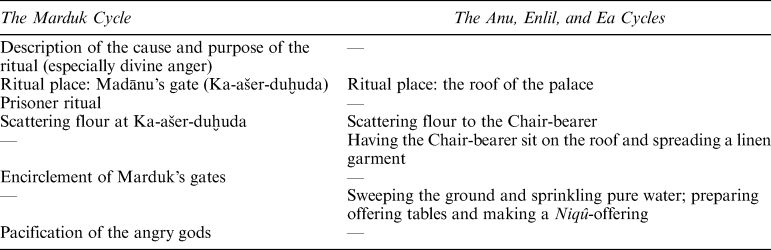
The text includes a sequence of repeated cultic actions, each dedicated to a different deity (referred to as “cycle” in this article), viz. the Marduk, Anu, Enlil, and Ea cycles. The Anu, Enlil, and Ea cycles are almost identical, while several distinct differences (see Table 1) appear in the Marduk cycle.

Firstly, the ritual of Marduk, whose temple is in Babylon, takes place at the actual temple, while the rituals of the other primary gods, whose main temples are not situated in Babylon, take place on the roof of the palace. Therefore, some ritual acts, such as the encirclement of the gates, could only be performed in the Marduk cycle, and other acts, such as preparing (temporary) offering tables, are unnecessary.
More crucially, as the most important Babylonian god, the king of the gods, the grantor of kingship, and the city god of Babylon who protects the city and its people, Marduk must play a particular role compared with other great gods; therefore, some contents, such as the mention of divine anger (Dingiršadabba) and the prisoner ritual (including the tying of a cord on the king's head), only appear in the Marduk cycle.
1) Divine Anger.
Although usually connected with personal gods (van der Toorn Reference van der Toorn1985: 122; Jaques Reference Jaques2015: 1, 3f.), Dingiršadabba prayers (or ritual) are not restricted to personal gods (Lambert Reference Lambert1974: 268; cf. Jaques Reference Jaques2015: 231f.). However, as part of the syncretistic tendency to see Marduk as including all the gods, he might function as the king's personal god.Footnote 3 On the other hand, as the god of the king's city (Babylon), Marduk may function as the (royal) personal god who protects the city and its people.
2) The Prisoner Ritual
During the night before the morning Šigû prayers, the king should lie on a bed with a reed fence (line 5). CAD translated the sentence ki-ná zi-ib-ni i-na-al (mayyāl zibni inâl) as “he lies down on a reed mat for a bed” (CAD Z 104b), but it could also be “he shall lie on a bed with a reed fence,” because zibnu is associated with a fence (see CAD Z 104).
In an incantation text, Schwemer translated zib-na mu4-mu4-su-nu-ti as “Du bekleidst sie mit Schilfmatte(n),” “You clothe them (the figurines) with reed mat(s)” (VAT 13609 // LKA 154 Vs. 20; Schwemer Reference Schwemer2007: 62 Vs. 21). Being clothed with zibnu is a comparable idea to erecting a fence around the figurines. Besides, due to the singular form of zibna, it seems possible that all the figurines were surrounded by a reed mat as a fence, rather than plural for reed mats. Interestingly, the previous line in this incantation text [á-m]eš-šú-nu ana egir-šú-nu ta-kas-˹si˺ “You shall bind their [ar]ms to their backside” (VAT 13609 // LKA 154 Vs. 19; Schwemer Reference Schwemer2007: 62 Vs. 20) parallels line 7 in our text (see Notes, ad line 7). Probably, these figurines and the king in our text both refer to prisoners.
During the night in the Akītu festival in autumn (the bīt salā’ mê ritual at the night of the 8th Tašrītu), the king should stay in a reed prison in the steppe, surrounded by a reed fence. In our text, sleeping in a reed fence, similar to the king's stay in prison in the bīt salā’ mê ritual, is probably an indication of his temporary loss of kingship (Ambos Reference Ambos2013: 73; Ambos Reference Ambos, Sax, Quack and Weinhold2010: 25–28).
The tying of a cord or string (pitiltu, written šu-sar) on the king's head (line 5) is a distinctive feature of the Marduk cycle. After the Šigû prayers, it is plausible that the pitiltu cord should be untied (for the restoration of šu-sar búr “he shall untie the pitiltu cord,” see Notes below, ad line 24). The untying of the pitiltu cord sometimes manifests the untying of sin. For example (Reiner Reference Reiner1956: 136f.):
77 ar-nu-šú lip-taš-ši-ru ḫi-ṭa-tu-šá(sic!) lip-ta-si-sa
78 gíl-la-tu-šú lim-ma-sa-a ma-ma-tu-šu lip-taš-ši-ra
79 gig-meš-šú lit-tak-ki-šú gim sum-sar liq-qal-pu
80 gim zú-lum-ma liš-šá-aḫ-ṭu gim šu-sar lip-pa-áš-r[u]
77 may his sins be absolved, his(!) offences wiped out,
78 his crimes washed off, his curses absolved,
79 his pains driven out – may they be peeled off like an onion,
80 stripped off like dates, unraveled like a cord.
This concept can also be found in the Šigû prayers, for example, a Šigû prayer to Marduk (Mayer Reference Mayer1976: 466ff. Marduk 28; see also Oshima Reference Oshima2011: 298ff.):
7 a[n-n]u-ú-a ḫi-ṭa-tu-ú-a gíl-la-tu-ú-a (…)
11 ki-ma šu-sar lip-pa-áš-ra-am
7 My s[i]ns, my crimes, my transgressions (…)
11 May they be stripped from me like a cord.
The untying of the pitiltu cord manifests the untying of sin (corresponding to the restoration of kingship); accordingly, the tying of the pitiltu cord in our text (line 5) probably manifests the tying of sin (corresponding to the loss of kingship).
The entire prisoner ritual, with all its details, as a status of the temporary loss of kingship, only exists in the Marduk cycle, probably because Marduk is the grantor of kingship.
Edition
Texts
-
A = K.2549 + K.3117 + K.3287 + K.3519 + K.9012 + K.12920 + Sm.828 + Sm.1326
-
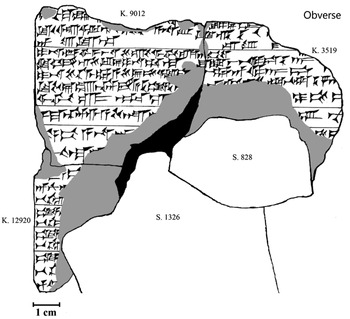
Copy: 4 R2 54/2 and add. 54 (without K.3519, K.9012, and K.12920), Geers J64 (K.3519, unpublished), Geers A37 (K.9012, unpublished), and Fig. 2 (K.3519, K.9012 and K.12920). Edition: Jensen Reference Jensen1915, 56–57 (without K.3519, K.9012, and K.12920).
-
Provenance: Nineveh (mod. Kuyunjik).
-
Period: Neo-Assyrian period.
-
B = Rm.246 (+) K.19607 + Rm.306 + 79-7-8, 136
-
Copy: A. R. George, J. Taniguchi, and W. G. Lambert Reference George, Taniguchi and Lambert2019, No. 232 (Rm.246), and 4 R2 54/2 (Rm.306 and 79-7-8, 136), Fig. 1 (K.19607).
-
Edition: Jensen Reference Jensen1915, 56–57 (Rm.306 and 79-7-8, 136).
-
Provenance: Nineveh (mod. Kuyunjik).
-
Period: Neo-Assyrian period.
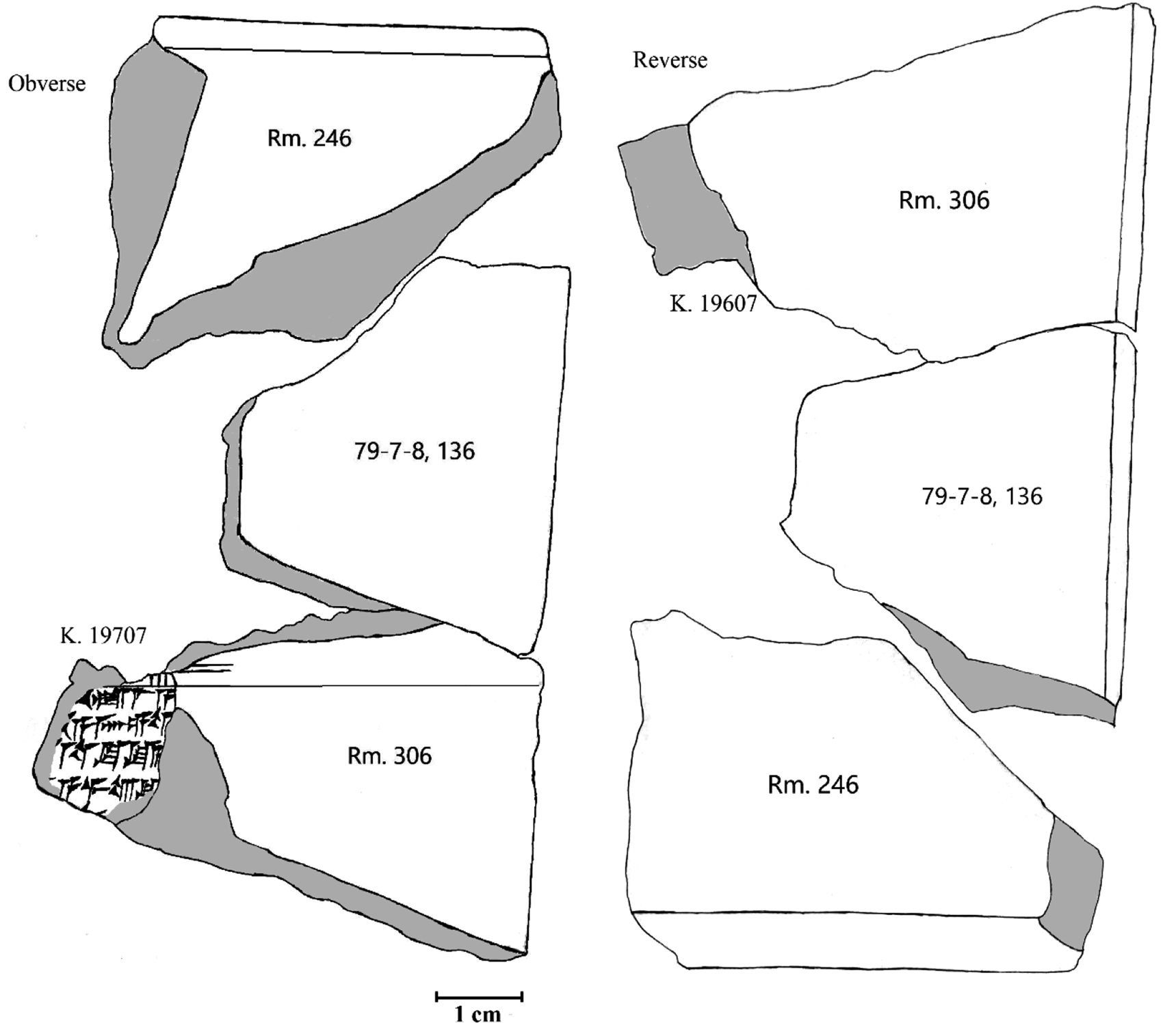
Jensen's edition (Jensen Reference Jensen1915: 56–67) was not made according to photos (but rather according to Pinches’ copy, 4 R2 54/2, see Jensen Reference Jensen1915: 57 footnote 4) and does not conform to the philological standards accepted today. The present article collates the text from the CDLI images (P394505, P404408, P424659) and some photos taken in the British Museum,Footnote 4 resulting in new readings, the new duplicate, and the indirect join of text B, all of which contribute to our better understanding of the text and thus require a new treatment. After the first publication of Text A, W. G. Lambert joined K.3519 and K.9012 in 1959, then later W. Mayer joined them to K.2549 + in 1988. By comparing the shape (see Fig. 1) and the corresponding lines of Rm.246 and 79-7-8, 136 (text B), it seems probable that Rm.246 is part of the same tablet as K.19607 + Rm.306 + 79-7-8, 136.
K.19607 + the outlines of Rm.246, Rm.306 and 79-7-8, 136 (the drawing is based on the CDLI images: P404408 and P424659)

K.3519 + K.9012 + K.12920 (the drawing is based on the CDLI image: P394505, and photos taken by Mark Weeden in the British Museum)

Transliteration (restorations are indicated in Text A)

Translation
1 Wh[e]n the king, [the] a[nger] of Marduk [and] Zarpanītu is upon him,
2 or there is a bad omen, for releasing him and recovering [him],
3 in order to div[ert] divine anger:
—————————————————————————————————
4 In a favorable month, in an appropriate day, he shall reci[te] a Šigû prayer to Marduk.
5 He shall lie down on a bed with a reed fence. You shall ti[e] a pitiltu cord on his head.
6 In the morning, he shall stan[d] at the Ka-ašer-duḫuda = at the gate of Madānu.
7 You shall scatter flour. You shall b[in]d his arms to his backside, he shall kneel down, and you shall put your … on him.
8 He shall recit[e] a Šigû prayer. [He shall kneel down to Madānu and] speak [thus]:
—————————————————————————————————
9 “His-Word-Is-Favorable, [the Chair-bearer], the pronouncer of good things,” he shall recite.
—————————————————————————————————
10 [There]after, [he shall kneel down] to [Gula] and speak thus:
11 “[G]ula, the mot[her, who bea]rs mankind,” he shall recite.
—————————————————————————————————
12 Thereafte[r], he shall kneel down [to Zarpanī]tu and speak thus:
13 “Pap-n[un-anki], the [m]erciful [mother](?), the bestower of life,
14 the [great](?) lad[y], the goddess of the goddesses,” he shall recite.
—————————————————————————————————
15 Thereafter, he shall kneel down [to N]abû and speak thus:
16 “The ex[a]lted lor[d], who is outstanding among the gods,” he shall recite.
—————————————————————————————————
17 Thereaf[t]er, he shall kneel down to Tašmētu and speak thus:
18 “The noble la[d]y, whose power is outstanding,” he shall recite.
—————————————————————————————————
19 There[a]fter, he shall kneel down to Marduk and speak thus:
20 “The lo[rd], the shepherd of everything,
21 Mar[duk], the merciful go[d],” he shall recite.
—————————————————————————————————
22 [For three da]ys, in the morning and evening, he shall recite the Šigû prayers. He shall circle the gates of Marduk.
23 [At the first watch of the] night, he shall wash with water from a purification vessel. He shall carry out the (cleansing) barber-rites.
24 [he shall untie the pitiltu cord.](?) He shall clothe himself with a white [garm]ent. In the morning, at the gate of Madānu and Gula,
25 yo[u shall perform a Takribtu]. (26)You shall make the king recite(26) Eršaḫungas to Marduk, Zarpanītu, Na[bû, Tašmēt]u,
26 [Madānu], Gula. Thereafter, “Gula, [Madānu],” he shall [r]ecite.
27 He shall give a gift to Madānu and prostrate himself. He shall go straight to his palace. On the th[ird day],
28 it should be placed at the g[ate](?) of Marduk and Zarpanītu. The anger of [Marduk and Zarpanīt]u will be appeased towards him.
—————————————————————————————————
29 When the king [recit]es a Šigû prayer to Anu:
—————————————————————————————————
30 In a [fav]orable mon[th], in an appropriate day, he shall recite a Šigû prayer to Anu. On the roof of the palace, you shall [have the Chair-bearer sit dow]n.
31 You shall spread a white linen garment [o]n (it). In the morning and evening, you shall scatter flour to the Chair-bearer.
32 He shall kneel down to the Chair-[be]arer and speak thus:
—————————————————————————————————
33 “The Chair-b[earer, the p]ronouncer of good things,” he shall recite.
—————————————————————————————————
34 Thereafter, he shall kneel down to [Išta]r and speak thus:
35 “Išta[r, the que]en of the gods, the l[a]dy of the Igigi gods,” he shall recite.
—————————————————————————————————
36 Thereafter, he shall kneel down to [A]nu and spea[k th]us:
37 “Anu, the gre[a]t one, the lord of [the gods](?),” he shall recite.
—————————————————————————————————
38 For three days in the morni[ng and evening, he shall recite the Šigû prayers. At the first watch] of the [ni]ght, he shall was[h] with water.
39 He shall carry out the (cleansing) barber-rites. [He shall clothe himself with a wh]ite garment. [In the morning, on the roof of the palace, you shall sw]eep [the ground]. You shall sprink[le] pure water.
40 [You shall prepare] three offering tables for Anu, [Ištar, the Chair-bearer]. You shall make a [Niq]û-offering.
41 You shall perform a Takribtu. [You shall make the king recite] their Eršaḫungas. [Thereafter, “Gula, Madānu,” he shall recite].
42 He shall giv[e] a gift to the Chair-bearer and [prostrate himself. He shall take off his garment and go straight to his palace].
43 On the third day, [it should be placed] at the gate of E-ann[a].
—————————————————————————————————
44 When the king [recites] a Šigû prayer to Enlil:
—————————————————————————————————
45 In a favorable month, in an appropriate day, he shall reci[te] a Šigû prayer to Enli[l]. [On the roof of the pala]ce, [you shall have] the Cha[ir-bearer sit down].
46 You shall spr[e]ad a white linen garment on (it). In the morning and evening, (47)you shall sc[att]er(47) flour
47 [to] the Chair-bearer. He shall kneel down and speak thus:
—————————————————————————————————
48 “The Chair-bearer, the pronouncer of good things,” he shall recite.
—————————————————————————————————
49 Thereafter, he shall kneel down to Nusku [a]nd speak thus:
50 “Nusku, the great one, the [a]dvisor of the great gods,” he shall recite.
—————————————————————————————————
51 Thereafter, he shall kneel down to Ninurta and speak thus:
52 “Ninurta, the great lord of powerful strength,” he shall recite.
—————————————————————————————————
53 Thereafter, he shall kneel down to Gula and speak thus:
54 “Gula, the mother, who bears mankind,” he shall recite.
—————————————————————————————————
55 Thereafter, he shall kneel down to Ninlil and speak thus:
56 “Ninlil, the great goddess, the wife of Nunamnir,” he shall recite.
—————————————————————————————————
57 Thereafter, he shall kneel down to Enlil and speak thus:
58 “The exalted lord, who makes instructions firm,” he shall recite.
—————————————————————————————————
59 For three days, in the morning and evening, he shall recite the Šigû prayers. At the first watch of the night,
60 he shall wash with water. He shall clothe himself with a white garment. In the morning, on the roof of the palace, you shall sweep the ground. You shall sprinkle pure water.
61 You shall prepare five offering tables for Enlil, Ninlil, Ninurta, Gula, Nusku.
62 You shall make a Niqû-offering. You shall perform a Takribtu. You shall make the king recite their Eršaḫungas.
63 Thereafter, “Gula, Madānu”, he shall recite. He shall give a gift to the Chair-bearer and prostrate himself.
64 He shall take off his garment and go straight to his palace. On the third d[a]y, it should be placed at the gate of E-kur.
—————————————————————————————————
65 When the king recites a Šigû prayer to Ea:
—————————————————————————————————
66 In a favorable month, in an appropriate day, he shall recite a Šigû prayer to Ea. On the roof of the palace,
67 you shall have the Chair-bearer sit. You shall spread a pure linen garment on (it).
68 In the morning and the evening, you shall scatter flour to the Chair-bearer.
69 He shall kneel down to the Chair-bearer and speak thus:
—————————————————————————————————
70 “The Chair-bearer, the pronouncer of good things,” he shall recite.
—————————————————————————————————
71 Thereafter, he shall kneel down to Usumu and speak th[us]:
72 “The Chair-bearer, the pronouncer of good th[ings],” he shall recite.
—————————————————————————————————
73 Thereafter, he shall kneel down to Damkina and speak [thu]s:
74 “Ninmah, the mother, the creator of mank[in]d,” he shall recite.
—————————————————————————————————
75 Thereafter, he shall kneel down to Ea a[nd] speak th[u]s:
76 “The capable lord with powe[r] …,” he shall recite.
—————————————————————————————————
77 For three days, in the morning and e[vening, he shall recite the Šigû prayers. At the fir]st watch of the night,
78 he shall wash with water. [He shall clothe himself] with a wh[ite] garment. [In the morning, on the roof of the palace, you shall sweep the ground. You shall sprinkle pure water. (79)[You shall prepare](79) three offering tables for] E[a],
79 Damkina, Usu[mu. You shall make a Niqû-offering]. You shall perfor[m] a [Takribtu].
80 [You shall make the king recite their E]ršaḫungas. [Thereafter, “Gula, M]adān[u,” he shall recite].
81 [He shall give] a gift [to the Chair-bearer and prostrate himself. He shall take off his garment and] go [straight to] his [palace].
82 [On the third day, it should be placed at the gate of E-abzu]. [……]
Notes
1. For the restoration ˹šà?˺-[dab-ba], cf. line 28, and e-nu-ma šà-˹dab-ba˺ d˹x˺ … (K.9746 obv. 1; cf. Maul Reference Maul1988: 42 Vs. 1). Šà-dab-ba here probably stands for kimiltu (cf. diš na dab-ti dingir u diš8-tár ugu-šú gál-ši, BAM 316 II 26’).
gál-šú ?: according to Rm.246 (B), the broken sign at the end of line 1 is more likely ši; however, the verb should be in subjunctive in enūma clauses (cf. also gál-šú in line 2).
2. The function of the ritual is to release the king (šupṭurišu), from the anger of Marduk and Zarpanītu (line 1), or a bad omen. Similar phrases concerning releasing either divine anger or bad omens are found in the following two texts:
A ritual against sickness (Rm. 2, 160 rev. 9-10; see Mullo-Weir Reference Mullo-Weir1929: 282):
9 dingir zi-na-a dištar zi-ni-tu4 šul-li-mì-im-[ma]
10 ki-mil-ti dingir u dištar šup-ṭí-ri ia-[a-ši]
9 Make the angry god and the angry goddess be at peace with me.
10 Release the wrath of god and goddess for me.
An incantation against the enemy (PBS 1/2 106 rev. 15-16; see Ebeling Reference Ebeling1949: 179):
15 a-na šup-ṭu-ur giskim-meš šá an-e u ki-ti
16 at-tu-nu-ma ta-az-zi-za
15 In order to release the omens of heaven and earth,
16 you stood.
3. According to Rm.246 (B), the signs at the end of line 2 are ba-lá-ṭi-šú, and the beginning of line 3 in K.2549+ (A) is dingir-šà-dab-ba. George and Taniguchi restored this line (in Rm.246) as [ka-inim-ma dingir-šà-dab-ba] gur-ru-da-[kam] (George et al. Reference George, Taniguchi and Lambert2019: 13); however, there seems no space for ka-inim-ma.
5. The sign sag in Rm.246 (B) (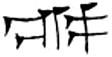 , more usual in NA script) and K.3519 (A) ((
 ) was written differently.
6. ina ká-a-še-er-duḫ-ù-˹da˺ [: i]na ká ddi-kud: this is a gloss. Ka-ašer-duḫa is a gate of Madānu's cella (George Reference George1992: 93, 97).
7. For the restoration t[a-kàs]-˹si-ma˺ (or perhaps su rather than si), see the following texts. VAT 13609 // LKA 154 Vs. 19-20 (cf. Schwemer Reference Schwemer2007: 62 Vs. 20-21):
19 [á-m]eš-šú-nu ana egir-šú-nu ta-kàs-˹si˺ ina ˹igi dutu˺ ina ugu é-gar8
20 [x] x gá gar-an zib-na mu4-mu4-su-nu-ti …
19 You shall bind their arms to their backside. In front of Šamaš,
20 you shall place … (19)on a wall(19). You shall clothe them with a reed mat.
The figurines were represented as evildoers, and treated as prisoners. See also a Namburbi ritual against calamities (Maul Reference Maul1994: 485 line 15):
15 A (LKA 120) Rs. 1 á-šú ana egir-šú ta-kàs-su … B (K.2777 +) Vs. 5’f áii!-šú ana egir-šú lá-su … You shall bind his hands to his backside. …
The man's hands should be bound as a prisoner in order to undo calamities. The restoration [gur]-˹ma˺ also seems possible. Cf. K.2273 + K.2901 + K.8910 obv. 33 (Namburbi rituals against witchcraft, see Abusch and Schwemer Reference Abusch and Schwemer2016: 411):
33 … áii-šú-nu a-na egir-šú-nu gur-ár
33 … You shall turn their (figurines’) arms to their backside.
The figurines here were also represented as evildoers.
8. The main problem here is to which god the king should kneel. Jensen restored it as dgu-za-la “the Chair-bearer” (Jensen Reference Jensen1915: 58) because the Šigû prayers in the Anu, Enlil, and Ea cycles begin with the Chair-bearer. However, the god here is probably ddi-kud (Madānu), who is the Chair-bearer of Marduk, because (1) Magrat-Amassu in line 9, as the Chair-bearer of Marduk, is identified with the justice god Madānu (An=Anum II: 253–255). (2) Since Gula is mentioned in line 10, it is likely that Madānu is mentioned in obv. 8, as evidenced by the pairing of the two gods in other lines (i.e., lines 24, 63). (3) In the other cycles, the king should give a gift to the Chair-bearer (i.e., lines 42, 63), but in the Marduk cycle, he should give a gift to Madānu (line 27).
9. [gu-za-lá]: Madānu is the Chair-bearer of Marduk, and all the Chair-bearers have the same epithet qa-ab sig5-meš “the pronouncer of good things” (i.e., lines 33, 48). The recitation to Madānu here is probably identical to the incipit of a prayer to Madānu in a Lipšur litany (K.2096 rev. 26–30 and parallels, see Fadhil and Jiménez Reference Fadhil and Jiménez2020: 243–244 lines 60’-64’; cf. Martin Reference Martin1903: 206 and Reiner Reference Reiner1956: 131, 146–147):
26 dma-ag-rat-a-mat-su gu-za-lá qá-ab dam-qa-a-[ti]
27 mu-paṭ-ṭir en-ni-it-ti mu-dam-me-eq e-gir-re-e mu-šim ši-ma-a-[ti]
28 [d]ingir šá ina é-sag̃-íl ma-la šà-šú ma-ṣu-˹ú˺
29 ˹a˺-mat-su še-ma-a-tu ˹qí˺-bi-is-su ma-ag-ra-tu 4 li-paṭ-rak-ku pi-šìr-t[i]
30 [q]ú-ul lìb-bi líp-ṭúr-ku ki-iṣ-ri ta-a-a-ar-t[i]
26 His-Word-Is-Favorable, the Chair-bearer, the pronouncer of good thing[s],
27 the absolver of sin, who makes ominous utterances good, who decrees the fate[s],
28 the [g]od who in the Esag̃il does as much as his heart's desire,
29 whose word is acceded, whose command is favored: May the piširtu-offering of the silence of the heart be absolved before you!
30 May mercy absolve the anger before you!
11. ˹um˺-[mu a-li-da]-˹at˺ is restored according to the epithet of Gula in line 54. This recitation is probably found in Rm.2, 481 9’ (catchline):
9’ dgu-la um-mu a-l[i- …]
9’ Gula, the mother, who be[ars …]
13. For the restoration [um ?-mu ?] ˹re˺-mé-ni-tum, cf. Mayer Reference Mayer1976: 517 Zarpanītu 3, line 6’. It could also be dingir-tum re-mé-ni-tum because her consort Marduk has a similar epithet: [din]gir re-me-nu-ú (line 21).
14. For the restoration [gal?-tu]m, cf. be-lum gal-˹ú˺ in line 52.
16. For ˹ša˺-[q]u-ú, cf. line 58.
20. ˹ka-la˺-a-am: the usual form kalama would have been expected.
23. For the phrase gallābūta epēšu, see Mayer Reference Mayer1988: 151 n. 8.
24. Though broken off, the line might begin with šu-sar búr “he shall untie the pitiltu cord.” As mentioned above, the tying and untying of the pitiltu cord manifest the tying and untying of sin; after the Šigû prayers, it is plausible that the pitiltu cord should be untied, corresponding to the tying of the pitiltu cord in line 5.
25. The restoration [ér gar-a]n is based on lines 41, 62.
26. [ddi-kud]: according to the gods appearing in the Šigû prayer series in the Marduk cycle, it is probably the Chair-bearer ddi-kud (Madānu) here rather than dnin-urta in Maul's restoration (cf. Maul Reference Maul1988: 166). Maul's restoration is probably based on the fact that Gula is Ninurta's spouse, and they also appear together in the Enlil cycle (lines 51–54); however, in Esagila, Gula and Madānu share the same cella (George Reference George1992: 97).
a-na lugal: the preposition ana is used as nota accusativi to mark the second accusative (see GAG §114e, §144c, §145g; Jiménez Reference Jiménez2017: 184).
d[di-kud šid-nu]: cf. line 63.
28. d[amar-utu u dzar-pa-ni-tu]m: after the sign dingir, a tiny triangle trace shows the next sign might be amar referring to Marduk (amar-utu). Following Pinches’ copy, Jensen restored the sign before búr as áš, but the sign could also be tum. There is enough space for amar-utu u dzar-pa-ni-tum, and Marduk and Zarpanītu often appear together (e.g., lines 1, 28) in our text.
30. For the restoration ˹d˺[gu-za-lá tu-še-šeb], cf. line 67.
37. ˹be-el dingir?˺-[meš?]: cf. the epithet of Ištar: šar-rat dingir-meš (line 35). It could also be be-el šamê u erṣeti (Tallqvist Reference Tallqvist1974: 54) or be-el Igigi or Anunnaki corresponding to another epithet of Ištar: e-tel-let Igigi (line 35).
40. ˹d˺[iš-tar dgu-za-lá]: the priest should prepare three offering tables; except Anu, the other two gods should be Ištar and the Chair-bearer who appear in the Šigû prayer series; however, in the Enlil cycle, the nameless Chair-bearer is excluded (lines 61–62).
42. For the restoration of this line, cf. lines 27, 63–64.
74. [ṣal-mat sag-du]: The signs are probably ṣal-mat sag-du “mankind” according to Text B, and the creator (ba-na-at) of mankind also accords with Ninmaḫ's mother figure (cf. also an epithet of Ninmaḫ: ama ba-ni-ti-ya, LIH 97 II 43; see Tallqvist Reference Tallqvist1974: 21).
77–82. Cf. lines 38–43, 59–64.
78. There are four gods in the Šigû prayer series of the Ea cycle; therefore, the priest possibly prepares four offering tables, including the nameless Chair-bearer as in the Anu cycle (line 40) and then in line 79, there should be dgu-za-lá after dša. However, in the Enlil cycle, the Chair-bearer is excluded (line 61); therefore, it is also possible that there are just three offering tables.
Acknowledgements
I wish to express gratitude to my supervisor Prof. Uri Gabbay, who provided advice, insights, and comments, and Prof. Enrique Jiménez, who offered valuable comments.