Acute rheumatic fever is a well-known non-suppurative complication of the group A β-haemolytic streptococcal pharyngitis.Reference El Said 1 – Reference Tani 4 Some rhythm problems – first- and second-degree heart block, junctional tachycardia, etc. – are seen frequently in acute rheumatic fever patients. Accelerated junctional rhythm had been detected in about 9.4–20% of electrocardiograms from children with acute rheumatic fever.Reference Clark and Keith 5 , Reference Cristal, Stern and Gueron 6 However, it is not known whether or not accelerated junctional rhythm is specific to acute rheumatic fever. In the present study, we aimed to answer this question.
Materials and methods
All families gave an informed consent for participation in the study, and approval for the study was obtained from the local ethics committee.
Patient groups
Group 1: patients with acute rheumatic fever
These were the children with acute rheumatic fever who were evaluated previously for the frequency of asymptomatic rhythm and conduction abnormalities.Reference Karacan, Isıkay, Olgun and Ceviz 7 Patients and evaluation methods in this group were explained in detail in our previous study.Reference Karacan, Isıkay, Olgun and Ceviz 7
Group 2: healthy children with a history of group A β-haemolytic streptococcal tonsillopharyngitis
In order to determine the frequency of accelerated junctional rhythm in healthy children, normal healthy children with a history of group A β-haemolytic streptococcal pharyngitis but who did not develop acute rheumatic fever were included into the first control group. Throat cultures were obtained from children – in the age group of 5–15 years – with clinical signs of tonsillopharyngitis. Patients with a positive throat culture and without a history of previous cardiac problems were reevaluated after a 2–4-week period in order to mimic the latent period in patients with acute rheumatic fever. If the patient did not have any symptom or sign consistent with acute rheumatic fever, surface electrocardiography and 24-hour electrocardiography recordings were obtained.
Group 3: patients with systemic diseases that can cause articular and/or cardiac involvement
Children with other systemic diseases that cause clinical pictures similar to acute rheumatic fever formed the second control group. All patients were evaluated clinically and surface electrocardiography and 24-hour electrocardiography recordings were obtained. Echocardiography was performed in order to detect possible cardiac involvement due to the original disease.
Analysis of rhythm
A standard surface electrocardiography was obtained on admission from all cases. Following the diagnosis, the 24-hour electrocardiography recording was started (DMS 300-7 Holter recorder, DMS Inc., New York, United States of America), and the recordings were evaluated the following day (DMS Cardioscan 11 Holter analysis program, DMS Inc., New York, United States of America). The 24-hour electrocardiography recordings were evaluated by 1-minute strips. Accelerated junctional rhythm was defined as a narrow QRS rhythm when the ventricular rate was the same or exceeded the atrial rate. Atrioventricular dissociation was considered to be present when the atria and the ventricles operated independently for more than three beats.Reference Cristal, Stern and Gueron 6
Exclusion criteria
The patients who did not fulfill the Jones criteria, those in whom 24-hour electrocardiography monitoring could not be performed for technical reasons, and those whose surface electrocardiography or 24-hour electrocardiography recordings were not sufficient for evaluation – poor electrocardiography records, 24-hour electrocardiography recordings with a short duration, and/or many artefacts – were excluded from the study.
Statistical analysis
The data were transferred to the statistical package for the social sciences programme. For comparison of groups in terms of rhythm and conduction abnormalities, Pearson's χ 2 analysis was used for comparison of frequencies of electrocardiography findings and students t-test (Mann–Whitney U-test) for comparison of mean values. A p-value <0.05 was considered significant.
Results
Patient characteristics
Group 1
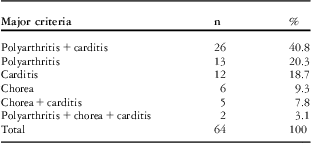
Group 1 included the patients who formed the study group of our previous studyReference Karacan, Isıkay, Olgun and Ceviz 7 , and the clinical characteristics of the patients and evaluation methods in this group were explained in detail in the original study.Reference Karacan, Isıkay, Olgun and Ceviz 7 The frequencies of the major Jones criteria are given in Table 1.
The major Jones criteria diagnosed on admission in Group 1.

Carditis was diagnosed in 45 (70.3%) patients, either isolated or together with the other findings. Carditis was mild in 42 (93.4%), moderate in one (2.2%), and severe in two (4.4%). Of the 64 patients, 41 had active polyarthritis, either isolated (13/41) or together with the other findings.
Group 2
In all, 60 children with a history of group A β-haemolytic streptococcal pharyngitis tonsillopharyngitis were evaluated. Of these, 10 were excluded because of absence of surface electrocardiography (n = 4), the long period between infection and echocardiography (n = 4), and insufficient Holter recordings (n = 2). Results of the remaining 50 patients were evaluated.
The mean duration between tonsillopharyngitis and electrocardiography recording was 22.3 ± 4.7 days. None of these children had any symptom or sign related to acute rheumatic fever during the days of rhythm analysis.
Group 3
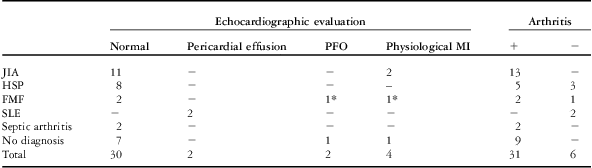
Of 37 children who were included in Groups 3, 13 (35.1%) had juvenile idiopathic arthritis, eight (21.7%) had Henoch–Schönlein purpura, three (8.1%) had familial Mediterranean fever, and two (5.4%) had systemic lupus erythematosus. There were nine (24.3%) patients who did not have a specific diagnosis during the study.
In 31 (83.3%) patients, active arthritis was present during the days of rhythm analysis. Echocardiographic evaluation revealed physiological mitral regurgitation in four (10.8%), pericardial effusion in two (5.4%), and patent foramen ovale in two (5.4%) patients. In the remaining patients, echocardiography was normal (Table 2).
Echocardiographic findings and presence of arthritis in Group 2 patients.

FMF = familial Mediterranean fever; HSP = Henoch–Schönlein purpura; JIA = juvenile idiopathic arthritis; MI = mitral insufficiency; PFO = patent foramen ovale; SLE = systemic lupus erythematosus
*Foramen ovale and physiological MI in the same patient
Comparison of groups in terms of demographic features
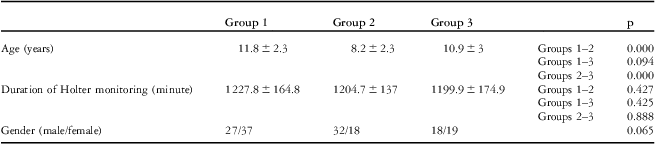
Demographic features of the groups are given in Table 3. The mean age of Group 2 (8.2 ± 2.3 years, range 5–14 years) patients was lower than that of Group 1 (p = 0.000) and Group 3 (p = 0.000). There was no difference between the groups in terms of gender distribution and mean Holter monitoring duration.
Demographic features of the groups.

Values are given as mean ± standard deviation
Comparison of groups in terms of frequency of accelerated junctional rhythm
In surface electrocardiography, accelerated junctional rhythm was detected in three (4.7%) patients from Group 1. However, it was detected in nine patients (14%) in Holter recordings. Accelerated junctional rhythm was present in the surface electrocardiography in only two of these nine patients. In one patient with accelerated junctional rhythm in surface electrocardiography, Holter monitoring was normal. Therefore, accelerated junctional rhythm frequency in surface electrocardiography and/or Holter recording was 15.6% (10/64) in Group 1. Among patients with polyarthritis as the single major criterion, it was 30.8% (4/13), and among patients with polyarthritis either isolated or together with other major criteria it was 21.9% (9/41). All 10 patients in whom accelerated junctional rhythm was detected were in the acute phase of the illness during the evaluation. Accelerated junctional rhythm was not detected in the surface electrocardiography and/or Holter recording in any of the patients from Groups 2 or 3. The frequency of accelerated junctional rhythm was significantly higher in Group 1 (χ 2 = 14.558, p = 0.001) than Groups 2 and 3.
We investigated the sensitivity and specificity of accelerated junctional rhythm in the diagnosis of acute rheumatic fever (Group 3 was taken into account as the control group); sensitivity was 15.6% (10/64), specificity 100% (37/37), positive predictive value 100% (10/10), and negative predictive value 40.6% (37/91). When the patients with active arthritis from Groups 1 and 3 were taken into account, the same values were 21.9% (9/41), 100% (31/31), 100% (9/9), and 49.2% (31/63), respectively.
Discussion
To date, there exists no specific clinical or laboratory test for diagnosis of acute rheumatic fever yet. Diagnosis is based on the modified Jones criteria. 2 Polyarthritis, carditis, chorea, subcutaneous nodules, and erythema marginatum are the major criteria, and fever, arthralgia, increased acute phase reactants, and PR prolongation in surface echocardiography are the minor criteria. In case of evidence of recent group A β-hemolytic streptococcal infection, the presence of two major or one major and two minor criteria indicates a high probability of acute rheumatic fever. 2
Since 1920, it is known that the PR interval is prolonged in many patients.Reference Clark and Keith 5 , Reference Sokolow 8 Over time, some other rhythm and conduction abnormalities like second-degree atrioventricular block,Reference Stocker, Czoniczer, Massell and Nadas 9 , Reference Zalzstein, Maor, Zucker and Katz 10 complete heart block,Reference Stocker, Czoniczer, Massell and Nadas 9 , Reference Malik, Hassan and Khan 11 junctional rhythm,Reference Cristal, Stern and Gueron 6 ventricular tachycardia,Reference Freed, Sacks and Ellman 12 , Reference Olgun and Ceviz 13 right-left bundle branch block,Reference Lenox, Zuberbuhler, Park, Neches, Mathews and Zoltun 14 , Reference Yahalom, Jerushalmi and Roguin 15 brady-tachyarrhythmia, and ventricular premature contractionsReference Lenox, Zuberbuhler, Park, Neches, Mathews and Zoltun 14 , Reference Woo 16 have been reported. Those are mostly reported as case reports or small case series dealing with a specific arrhythmia in surface electrocardiography.Reference Clark and Keith 5 , Reference Cristal, Stern and Gueron 6 , Reference Zalzstein, Maor, Zucker and Katz 10 Karacan et alReference Karacan, Isıkay, Olgun and Ceviz 7 performed the first study investigating the frequencies of different types of arrhythmias in Holter recordings of children with acute rheumatic fever, and they reported the frequency of accelerated junctional rhythm in surface electrocardiography and/or Holter recordings as 15.6%. However, it is not known whether or not accelerated junctional rhythm is specific to acute rheumatic fever. The present study is the first to investigate the frequency of accelerated junctional rhythm in healthy children and in children with other systemic disorders that can involve the joints and/or heart. As such, it provides important information about the specificity of accelerated junctional rhythm to acute rheumatic fever.
Junctional acceleration is an original arrhythmia reported in patients with acute rheumatic fever. In that study, atrioventricular dissociation was detected in surface electrocardiographies of 14 out of 70 (20%) patients. Although they could not explain the mechanism, they postulated that it would be a result of enhanced atrioventricular node activity. In patients without carditis, atrioventricular dissociation was seen more frequently, and PR prolongation was present in only a minority of these patients.Reference Cristal, Stern and Gueron 6 Clarke and KeithReference Clark and Keith 5 determined atrioventricular junctional rhythm in only 9.4% (48 patients) on standard electrocardiography of 508 patients with acute rheumatic fever. It was not related to the presence of carditis, and atrioventricular dissociation was present in 35 of 48 electrocardiographies.
Karacan et alReference Karacan, Isıkay, Olgun and Ceviz 7 detected accelerated junctional rhythm in 15.6% of patients with acute rheumatic fever (Group 1). No relation between presence of accelerated junctional rhythm and prolonged PR interval was detected. In addition, this was the first study confirming the statistical relationship between the presence of accelerated junctional rhythm and the absence of carditis. Frequency of accelerated junctional rhythm was higher among patients with polyarthritis, either isolated (30.8%) or with other major criteria (21%).Reference Karacan, Isıkay, Olgun and Ceviz 7 In the present study, accelerated junctional rhythm was not detected in any of the patients from Group 2 or 3 in surface electrocardiography and/or Holter recording. Frequency of accelerated junctional rhythm was significantly higher in Group 1 (χ 2 = 14.558, p = 0.001). In addition, the specificity and positive predictive value of the presence of accelerated junctional rhythm to acute rheumatic fever was 100%. These findings suggest that presence of accelerated junctional rhythm may be used in the differential diagnosis of arthritis.
Study limitation
Our control group (Group 3) with arthritis was an inhomogeneous patient group, which may have affected our results.
In conclusion
Our results indicate that although its frequency is low the presence of accelerated junctional rhythm in surface electrocardiography and/or Holter monitoring is specific to acute rheumatic fever. This finding may be used in confirmation of acute rheumatic fever, especially in patients with polyarthritis, even in the absence of carditis. Owing to the fact that the frequency of accelerated junctional rhythm is low, new studies with larger patient groups and a relatively homogeneous control group are needed to confirm our suggestion.
Conflicts of Interest
None.