Introduction
Doctors and other clinical staff make routine judgments about patients' capacity to consent to treatment, investigations or follow-up arrangements on a daily basis. The complexity of some cases requires a more careful assessment. Most research on capacity has been conducted in general psychiatry inpatient settings, where incapacity (generally regarding clinical care) is mainly associated with serious mental illness (Palmer et al., Reference Palmer, Dunn, Appelbaum and Jeste2004; Cairns et al., Reference Cairns2005a; Palmer et al., Reference Palmer, Dunn, Depp, Eyler and Jeste2007; Owen et al., Reference Owen, Richardson, David, Szmukler, Hayward and Hotopf2008). Few studies have investigated mental capacity in general hospital settings. A cross-sectional study in the U.K. suggested that the lack of mental capacity regarding treatment decisions in a heterogeneous group of acutely ill medical patients (aged 18 years and over) was common (31.4%), rarely recognized by the treating doctors (Raymont et al., Reference Raymont2004), and strongly and independently associated with older age and cognitive impairment, rather than with functional psychiatric disorders. Given the demographic trend in high income countries, the number of older people with dementia and other mental health problems admitted to general hospitals is likely to grow, thus making mental capacity assessments increasingly relevant. Very few studies have focused on older people. A study in Canada among an older group of patients (mean age 74 years, range 57–84 years) admitted to general internal medicine units for major medical treatments reported that 37% lacked capacity for treatment decisions (Etchells et al., Reference Etchells1999).
In the study described in this paper, we review assessments of mental capacity in older medical and surgical inpatients through the work of a recently established specialist liaison psychiatry service for older people in a large London teaching hospital. In a previous audit of the same service, capacity assessments were carried out on 20% of all referrals (Mujic et al., Reference Mujic, Hanlon, Sullivan, Waters and Prince2004). In this study we aimed to establish the frequency of mental incapacity among those undergoing capacity assessments, to compare the demographic and clinical characteristics of patients lacking mental capacity and those deemed to have mental capacity, and to investigate the consequences of the outcome of the capacity assessment.
Methods
We performed a retrospective review of routinely collected data on the activity of a Liaison Psychiatry Service for Older People, comprising 1267 consecutive referrals over a period of four years (2003–2006). The setting was a London teaching hospital with 950 beds covering a large inner city area. The Liaison Psychiatry Service for Older People was restructured in December 2000 introducing a true liaison model of service delivery as described elsewhere (Mujic et al., Reference Mujic, Hanlon, Sullivan, Waters and Prince2004).
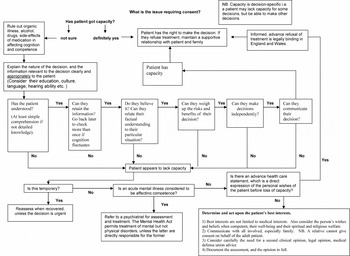
Decision-making capacity of patients referred to the service was assessed routinely by all members of the liaison psychiatry team using an agreed protocol (see Figure 1) with a functional approach (Grisso et al., Reference Grisso, Appelbaum, Mulvey and Fletcher1995; Wong et al., Reference Wong, Clare, Gunn and Holland1999), later adopted as best practice in the U.K. Mental Capacity Act 2005 (Department for Constitutional Affairs, 2005). This Act came into force in October 2007, after the end of the period covered by this paper. The only substantive change from the protocol that we had routinely adopted was that under the new Act there is no requirement that a capacitous patient must believe the information that has been conveyed to them.
Capacity Assessment Chart.

The decision was deferred in acutely confused or unconscious patients to allow for further treatment and regaining of mental capacity, unless an urgent and life-saving intervention was required. Medical and surgical teams were encouraged to attempt assessment of mental capacity initially, and to refer more complex or important assessments to our service. Assessment of capacity did not prove to be necessary in every case where a referral was received. There were also instances where we carried out assessment of capacity, although this had not formed part of the referral request.
Sample and data collection
The study included all patients aged 65 and over seen by our liaison psychiatry service between January 2003 and December 2006. A two-page referral form was filled in routinely for each patient in order to record patients' details on the electronic register and to monitor the activity of the service. This form included demographic characteristics, referral details, and outcomes of the initial psychiatric assessment including the primary diagnosis and intervention plan. We recorded whether a capacity assessment was carried out, which domains of capacity were assessed (treatment decisions, placement, financial capacity and other), and, for each domain assessed whether or not the patient was capacitous.
A separate form included data on discharge destination at the end of the admission – i.e. returned home, placed in a care home, placed into care home for Elderly Mentally Infirm (EMI), died or other outcome. EMI care homes in the U.K. are specialized care homes for older people suffering from mental illness, in particular dementia, who need 24-hour supervised care. EMI nursing homes are staffed by a full complement of mental health nurses, whereas EMI residential care homes have a more limited provision of qualified nursing staff.
Mini-mental State Examination (MMSE) scores (Folstein et al., Reference Folstein, Folstein and McHugh1975) were recorded where administration was feasible. Scores of 20–24 indicate mild, 11–19 moderate and 0–10 severe cognitive impairment; these scores are used as part of the criteria for diagnosing mild, moderate and severe dementia. For the purposes of descriptive analysis, the sample was divided into a group of patients not assessed and a group assessed for mental capacity, with the latter divided further into those found to lack mental capacity and those found to have mental capacity.
Statistical analysis
Data were analyzed using the Statistical Package for the Social Sciences (SPSS) version 12.0 and Stata Version 9.2. We compared the age, gender, ethnicity, clinical characteristics and cognitive status (MMSE score) of those assessed and not assessed for capacity, using χ2 test, two samples T test (age), or Mann-Whitney U test (MMSE score) as appropriate. We report the overall proportions of those assessed for capacity with respect to decisions regarding placement, treatment, finances and other, and assessed for each capacity domain the association between capacity and primary psychiatric diagnosis and cognitive status (MMSE score). We also investigated, among those who were admitted from home, the association between the capacity decision and placement for the first time in a residential care setting. Specifically, in those assessed for capacity for placement decisions, we used Poisson regression to estimate the independent effect of a decision that the patient lacked capacity upon placement in residential care (among those admitted from home) and upon placement in an EMI care home (among those admitted from home and discharged to a residential care facility) controlling for age, gender, ethnicity, dementia diagnosis and MMSE score.
Results
Caseload
The service reviewed 1267 patients referred by medical and surgical teams during the study period. In this group, 343 patients (27%) had been referred to the service for assessment of mental capacity. Of these, 15 did not undergo mental capacity assessment as the psychiatrist considered it not to be relevant at the time. Mental capacity issues were identified by psychiatrists in a further 51 patients which brought the total number of patients assessed for mental capacity to 379, representing 30% of the overall service activity.
Patients' characteristics
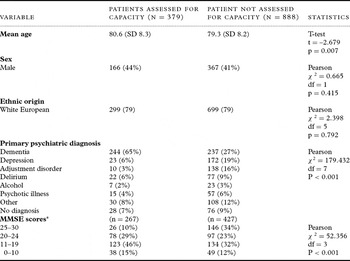
Table 1 presents the main demographic and clinical characteristics of the patients assessed and patients not assessed for mental capacity. Patients assessed for mental capacity were older but there was no statistically significant association with sex or ethnicity. Diagnoses on admission to general hospital included a wide range of medical and surgical diagnoses that were evenly distributed in these two groups. The only significant difference was that people assessed for mental capacity were more likely to have been admitted after a fall (29% vs 18%). MMSE scores were recorded for 267 patients assessed for mental capacity. The remaining 112 patients were either not able to engage in testing or refused. Similarly, MMSE scores were recorded in 427 patients not assessed for mental capacity. Patients assessed for mental capacity were more likely to have moderate to severe cognitive impairment, and to have a primary diagnosis of dementia (Table 1).
Comparison of patients assessed and not assessed for mental capacity

* Patients with recorded MMSE scores.
Assessment of mental capacity and main issues
Those patients who underwent a capacity assessment tended to be assessed regarding one issue only (77%). Decisions regarding placement accounted for the majority of assessments (n = 303/379, 80% of all those assessed), followed by treatment (n = 86, 23%), finance (n = 70, 19%) and other (n = 59, 16%). Mental capacity regarding two or more capacity issues was assessed in 87 patients (23%), most often placement in combination with other issues.
Lack of mental capacity – the main associations
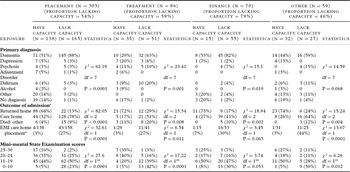
A high proportion of those assessed for financial capacity (79%) were found to lack capacity (Table 2). Around half of those assessed for decisions regarding placement, treatment or other issues were found to lack capacity. There was no statistically significant association between lack of capacity and age, sex or ethnicity in any of the capacity domains studied. There was a strong association between dementia diagnosis and lack of capacity regarding placement, treatment and finance but not “other” issues. Indeed, dementia was overwhelmingly the most common primary psychiatric diagnosis in those lacking capacity in all domains – affecting 88% of those lacking capacity for decisions regarding placement, 63% for treatment, 82% for finance and 59% for “other.” People lacking capacity regarding placement (p = 0.0001), treatment (p = 0.0001) and “other” issues (p = 0.009) were also more likely to have moderate and severe cognitive impairment as assessed by MMSE scores. However, not all patients with dementia assessed for capacity lacked capacity. Thus, patients with dementia were found to have capacity in 33% of cases regarding placement, 24% regarding treatment, 15% regarding finances and 47% regarding “other” issues. Only patients lacking capacity regarding treatment were significantly more likely to have a diagnosis of delirium, accounting for 20% of those lacking capacity in this respect.
The prevalence of mental incapacity among those assessed for capacity and the characteristics of those with and without capacity

* EMI = elderly mentally infirm; patients admitted from care homes were excluded from these analyses.
** Test for trend, on one degree of freedom.
Among those admitted from home, being assessed as lacking mental capacity was strongly associated with placement in a care home upon discharge (Table 2). In the event of placement, this was more likely to be in an EMI home. Adjusting for age, gender and ethnicity, those found to lack capacity for decisions regarding placement were 2.6 times (95% confidence intervals (CI) 1.8–3.7) more likely to be placed in a care home, and 3.8 times (95% CI 1.3–10.6) more likely to be placed in an EMI home. The corresponding relative risks, after controlling additionally for dementia and cognitive impairment (MMSE score) were 2.0 (1.3–3.0) and 4.3 (1.2–15.4).
Discussion
The main findings from this analysis of routinely collected clinical data from a specialist old age psychiatry liaison service in a U.K. general hospital setting are that:
1. 30% of referrals to the service involved an assessment for capacity. Those assessed for capacity were more likely to be older, to be cognitively impaired and to have a diagnosis of dementia
2. Among those assessed for this, capacity was found to be impaired to a significant degree in around half of the cases. Among our patients, all of whom were aged 65 years or older, lack of capacity was very strongly associated with a diagnosis of dementia; other psychiatric and neuropsychiatric disorders, including delirium, were much less commonly implicated.
3. Assessments for capacity to make decisions regarding placement upon discharge accounted for the majority of capacity assessments. Being found to lack capacity was strongly associated with residential placement, particularly to an EMI care home. These associations persisted after controlling for dementia diagnosis and degree of cognitive impairment.
The proportion of our assessments that included assessment of mental capacity had increased from 20% to 30% since an earlier survey for the same service, covering the period 1998–2001 (Mujic et al., Reference Mujic, Hanlon, Sullivan, Waters and Prince2004). This proportion is higher than that reported for general adult liaison services in the U.S.A. (Jourdan and Glickman, Reference Jourdan and Glickman1991; Knowles et al., Reference Knowles, Liberto, Baker, Ruskin and Raskin1994). Comparable data within the U.K. system is hard to come by, but there seems to be considerable variation in practice. Two U.K. reports suggested that referrals for mental capacity assessment were either uncommon (Benbow and Dawson, Reference Benbow, Dawson, Guthrie and Creed1996) or were not made at all (Rao, Reference Rao2001). However, in 2003, at another London teaching hospital with a similar dedicated old age liaison psychiatry service, 23% of referrals were for assessment of mental capacity (Whelan et al., Reference Whelan, Lawson and Burton2007). Interestingly, this proportion dropped sharply to 6% in 2004 following introduction of a referral form that included guidelines on capacity assessment, and the requirement to state explicit grounds for referral. There are no reports to date on the effect of the introduction of the new Mental Capacity Act in late 2007 on referrals for assessment of mental capacity. Preliminary data from our service suggest no marked change, but this is relatively soon after the introduction of the Act, and we plan to monitor this over a longer period.
There has been debate among liaison psychiatrists for older adults as to whether their services should be involved in such assessments at all (Ball and MacDonald, Reference Ball and MacDonald2002; Stewart, Reference Stewart2004). Furthermore, these services are rare in the U.K. (Holmes et al., Reference Holmes, Bentley and Cameron2003). Dedicated liaison psychiatry services for older people in general hospitals can make prompt assessments in complex cases. They can also educate and train general hospital staff regarding good practice. However, the case has been made for liaison psychiatrists not to abdicate responsibility, given that they can provide a greater degree of independence than would be the case when medical and surgical care teams carry out capacity assessments of patients under their care (Stewart, Reference Stewart2004).
A relatively high proportion of all those that we assessed for capacity, at the request of general healthcare teams, were found to be capacitous. We may speculate that the high frequency of dementia in this group may have provided the main indication for referral. The much criticized “status approach” continues to be applied – it is assumed that an entire class (e.g. those with dementia) lacks capacity regardless of the decision to be made, the individual patient's circumstances and the context. The combination of a frail patient and a risk-averse and medically paternalistic clinical team probably accounts for the 14%–20% of those assessed as having capacity with no psychiatric diagnosis – dissent with a management plan may sometimes be enough to initiate referral. Old age liaison teams therefore have an important role to play in protecting the rights of vulnerable older people as autonomous decision-makers. General adult liaison psychiatrists will not have as much experience as their old age psychiatry colleagues in assessing people with dementia and complex physical comorbidities. This may be an important limitation – in our study of older inpatients, the only consistent predictors of lack of capacity were dementia diagnosis and cognitive impairment. The association with older age found in previous studies with wider age ranges (Christensen et al., Reference Christensen, Haroun, Schneiderman and Jeste1995; Raymont et al., Reference Raymont2004) could be a reflection, mainly, of the higher prevalence of dementia among older patients.
All medical and surgical inpatients will face decisions about treatment, and their consent should be sought for all investigations, drug treatments and operative procedures. In clinical practice, formal assessment of capacity is confined to those for whom there are some grounds for concern that this may be impaired. However, it makes sense, at least for the purposes of research, to assess the prevalence of incapacity across a representative sample of inpatients. Raymont et al. (Reference Raymont2004), using a structured assessment tool in a research survey of an unselected sample of medical inpatients, found that 31% lacked capacity for decisions regarding treatment, and estimated, under different assumptions, that the true prevalence could be as high as 40% or even 48%. Age-specific prevalence of incapacity was not reported; however, given that all patients aged 18 and over were included, and that there was a very strong association between older age and incapacity, the prevalence among older adults would presumably have been much higher (Raymont et al., Reference Raymont2004). In this context, the estimate in our study of 59% of patients lacking capacity seems relatively modest, particularly given that the older medical and surgical inpatients had all been referred to our service for assessment of their treatment capacity. Our finding that incapacity was mainly associated with dementia, which typically affects around one quarter of older medical inpatients (Cairns et al., Reference Cairns, Evans and Prince2004) would also appear to place a much lower upper limit on the prevalence of incapacity. On the other hand, it may well be that those who “agree” to treatment, or at least do not actively resist, are not referred for assessment of capacity, despite lacking capacity to consent. We may also have underestimated incapacity because clear-cut cases (for example, patients in coma), and other less complex decisions would not have been referred by general healthcare teams.
The lack of a standardized mental capacity assessment tool in our study could be perceived as a weakness, or a strength. The reliability of expert judgment tends to be low (Kim et al., Reference Kim, Caine, Swan and Appelbaum2006). However, merely testing interrater reliability through multiple ratings of a video or audiotaped interview does not allow assessors to frame their own questions or clarify ambiguous responses (Kim et al., Reference Kim, Caine, Swan and Appelbaum2006). The assessment of mental capacity in our study was performed by eight junior clinicians, each spending six months working for the service, and two permanent senior clinicians (MP and FM). All staff were carefully trained by MP or FM at the beginning of their posting in the correct application of the assessment methods described, and supervised throughout. Nevertheless, we cannot exclude the possibility of misclassification error arising from lack of experience, variation in assessment procedure, and differing views regarding the threshold in borderline cases.
Structured assessments have advantages, particularly with respect to reliability (Grisso et al., Reference Grisso, Applebaum and Hill-Fatouhi1997; Raymont et al., Reference Raymont, Buchanan, David, Hayward, Wessely and Hotopf2007; Cairns et al., Reference Cairns2005b; Applebaum, Reference Applebaum2007). However, there have been remarkably few attempts to assess their criteria, as opposed to concurrent validity, and this, together with their ecological validity, remain open to question (Dunn et al., Reference Dunn, Nowrangi, Palmer, Jeste and Saks2006). Clinical evaluation has been suggested to be the gold standard for determination of capacity (Moye et al., Reference Moye, Gurrera, Karel, Edelstein and O'Connel2006; Moye and Marson, Reference Moye and Marson2007). We believe that our assessment procedures reflect current recommended good practice, were specific to the particular decision salient to the patient's care at that time, and were carried out taking into account all relevant individual circumstances. Given the suggestion from earlier research that treatment incapacity is much more prevalent among older inpatients (Raymont et al., Reference Raymont2004) there is a clear need for a more definitive study of the extent of this problem, and its management, in a large representative sample of older inpatients. Such a study could usefully include a more comprehensive assessment than has previously been undertaken of the utility and validity of structured assessments of capacity in older people.
The most common mental capacity issues for older people referred to our liaison psychiatry service were related to discharge planning, namely placement and finances rather than inpatient treatment decisions. Despite their importance, particularly for older people, the literature on these aspects of capacity assessment is much smaller than that on treatment capacity. Unlike treatment-related issues, capacity for placement decisions is only a relevant consideration to that subgroup of inpatients for whom placement is being considered.
For people with dementia, admission to a general hospital can be a determining event, precipitating the transition from home to residential care (Brindle and Holmes, Reference Brindle and Holmes2005). The large number of referrals to our service linked to placement suggests that discharge planning for older people with dementia can present difficult practical and ethical dilemmas for clinical teams, particularly with respect to the assessment of mental capacity and establishing patients' best interests (Brindle and Holmes, Reference Brindle and Holmes2005).
Our finding of a high prevalence of incapacity among those assessed for financial capacity (79%) is consistent with a survey of community-dwelling patients with dementia, suggesting that financial capacity is already impaired in mild dementia and declines rapidly thereafter (Martin et al., Reference Martin2008). Our estimate that 54% of those assessed lacked capacity to make decisions regarding placement is consistent with another recent U.K. study of older medical inpatients reporting that 18 of 38 (47%) older inpatients referred to social workers for care home placement lacked capacity (Ripley et al., Reference Ripley, Jones and MacDonald2008). The importance of this assessment is underlined by our finding that being adjudged to lack capacity was strongly associated with subsequent placement, particularly to a more care- and cost-intensive EMI care home. The persistence of this association, even after controlling for dementia diagnosis and cognitive impairment, is, at first sight, surprising. However, it may be that impairment in executive function (reasoning, judgment, planning), which is not well captured by the MMSE score, contributes both to being judged incapacitous regarding the decision about placement, and to the perceived need for 24-hour institutional support and care.
Our finding that 36% of those assessed for placement capacity (all of whom, by definition were being considered for placement) and 13% of those found to lack capacity returned to their own homes attests to the value of a specialist liaison psychiatry service for older people in preventing needless and costly institutionalization. In the U.K., placement from hospital is generally initiated by the clinical team, and then managed by local authority social workers. If government funding is sought, then a multidisciplinary panel must approve the level of care requested. There has been no statutory requirement to involve psychiatrists in this process, nor in the assessment of capacity should that be relevant. However, in 2008, Deprivation of Liberty Safeguards were introduced in the U.K. under an amendment to the 2005 Mental Capacity Act (Ministry of Justice, 2008). From April 2009, separate assessments of mental health status (by an approved clinician), mental capacity (by an approved assessor) and best interests need to be made before a statutory approval of effective deprivation of liberty can be made. This legislation will apply to those who lack capacity to consent to institutionalization, regardless of whether they appear to be accepting of their care, if the intent is to restrict their liberty should they attempt to leave. Institutionalization can be avoided both by asserting the rights of older people with capacity to make their own decisions, and by helping to plan a comprehensive social care package and multidisciplinary follow-up in the community, facilitating a successful return of incapacitous patients to their own home when it is in their best interests to do so.
In summary, our data suggest that old age mental health professionals have an important role to play in assessing mental health capacity, in supporting the rights to self-determination of those with mental illness who have capacity, and in assuring that appropriate services are provided to secure the best interests of those who lack capacity. The extent and importance of these tasks justify the creation of specialist old age liaison psychiatry services based in general hospitals. However, these roles cannot be the preserve of old age psychiatry, and regular training of frontline medical and surgical teams will be required to raise awareness and improve practice among all staff who are routinely confronted with these dilemmas. Finally, more research is needed focusing on older inpatients, both to refine and validate capacity assessments and to cast a light upon the prevalence, current management and consequences of incapacity.
Conflict of interests
None.
Description of authors' roles
FM and MJP initiated and designed the study. FM is in charge of ongoing audit and continuous data collection on activity of the service which is used for further service development. FM and MJP analyzed the data for this study. FM wrote the first draft of the paper and all authors contributed to the final version.