Introduction
Cutworms and armyworms (Lepidoptera: Noctuidae) form a complex of pest species that produce erratic and cyclic economic losses in a variety of crops across the Canadian Prairie Provinces. Several studies have examined life histories, seasonal flight patterns, and the relative abundance of cutworm species using various monitoring approaches (Ayre et al. Reference Ayre, Turnock and Struble1982; Byers and Struble Reference Byers and Struble1987; Ayre and Lamb Reference Ayre and Lamb1990). Crop losses can approach 100% during outbreaks and be devastating for individual farmers. An estimated 1.2 million ha of crop were infested with Agrotis orthogonia Morrison (pale western cutworm) during an outbreak cycle in Saskatchewan, Canada from 1929 to 1932 (McMillan Reference McMillan1935). Outbreaks of Mamestra configurata Walker (bertha armyworm) in 1971, 1994, and 1995 caused estimated losses in canola (Brassica napus Linnaeus; Brassicaceae) totalling more than 130 million CAD in 2015 dollars (Mason et al. Reference Mason, Arthur, Olfert and Erlandson1998). In 1990, over 10 000 ha of crop in southern Alberta, Canada were infested with Euxoa auxiliaris (Grote) (army cutworm); about 6000 ha were sprayed with insecticide and the remainder was reseeded without spraying (Byers et al. Reference Byers, Yu and Jones1993). In fescue (Festuca Linnaeus; Poaceae) seed fields and pastures in northern Alberta, outbreaks of Apamea devastator (Brace) (glassy cutworm) in 2000 caused estimated losses of about a million CAD in 2015 dollars (Dosdall Reference Dosdall2000). In 2011, cutworms were identified as the number one canola pest in Alberta and Saskatchewan, particularly Euxoa ochrogaster (Guenée) (redbacked cutworm), Feltia jaculifera (Guenée) (dingy cutworm), and A. orthogonia (Meers Reference Meers2011).
Accurate and timely identification of larvae to ensure appropriate management strategies can be problematic. Agrotis orthogonia, Lacinipolia renigera (Stephens) (bristly cutworm), and E. ochragaster overwinter as eggs, whereas E. auxiliaris, F. jaculifera, and A. devastator overwinter as larvae (Strickland Reference Strickland1923; Walkden Reference Walkden1950; Ayre and Lamb Reference Ayre and Lamb1990). Agrotis orthogonia and A. devastator feed almost entirely underground, severing and killing young plants. In contrast, E. auxiliaris, L. renigera, F. jaculifera, and E. ochragaster feed on the soil surface, cutting off young plants and feeding on the foliage of older plants (Strickland Reference Strickland1923; Walkden Reference Walkden1950; Beirne Reference Beirne1971). Mixtures of pest and non-pest species may co-occur in the same field and species determinations can be challenging. Larval identification is confounded by colour-variation within species, whereas identification of adults often relies upon dissection of male genitalia (Lafontaine and Schmidt Reference Lafontaine and Schmidt2010).
Molecular markers, including cytochrome c oxidase 1 (CO1) barcode sequencing, can be used to identify species of Noctuidae with a high degree of accuracy (Zahiri et al. Reference Zahiri, Lafontaine, Schmidt, DeWaard, Zakharov and Hebert2014) and could expedite agronomic studies of the cutworm pest complex affecting various crops on the Canadian prairies. Use of standard DNA barcoding requires molecular markers to be sequenced, which adds further time and cost to the identification process. Multiplex polymerase chain reaction (PCR) systems, however, allow for use of molecular markers without the need for sequencing. These systems use a mixture of primers to produce uniquely sized PCR products (amplicons) that can be compared against a known standard to obtain a species identification. We have previously developed and used these systems to good effect in ecological studies of insect species that are difficult to identify using morphological characters (Gariepy et al. Reference Gariepy, Kuhlmann, Haye, Gillott and Erlandson2005, Reference Gariepy, Kuhlmann, Gillott and Erlandson2008).
In the current study, we developed a multiplex PCR assay to distinguish among five key pest species of cutworms affecting canola. The targeted species were A. orthogonia, E. auxiliaris, E. ochrogaster, F. jaculifera, and L. renigera, all of which have been associated with outbreaks in canola fields in recent years (Canola Council of Canada 2011). We also included the non-pest species Euxoa divergens (Walker) (divergent dart), which occasionally is common in canola fields. Based on our previous experience, our approach was to use a universal forward primer and at least five species-specific reverse primers targeting the internal transcribed spacer (ITS) regions of the nuclear rRNA transcriptional unit. In principle, this tool can be used as a single-step PCR assay to identify the aforementioned six cutworm species with use of either the larval, pupal, or adult stages.
Materials and methods
Insect specimen sources
Voucher specimen samples for E. ochrogaster, E. auxiliaris, A. orthogonia, F. jaculifera, and L. renigera were provided by Dr. Bob Byers (retired, Lethbridge Research and Development Centre, Lethbridge, Alberta, Canada) as adults caught by light trap during the 2012 field season near Lethbridge. These voucher specimens were identified to species based on morphology by Dr. Byers, an expert in cutworm natural history. Feltia jaculifera has different pheromone phenotypes that differ in adult phenology and potentially in their molecular barcodes (Byers and Struble Reference Byers and Struble1990; Byers et al. Reference Byers, Struble, Herle, Kozub and Lafontaine1990; Sperling et al. Reference Sperling, Byers and Hickey1996). For this reason, we included adult F. jaculifera captured in early summer (mid-July 2012 – pheromotype B) and later in the season (September 2012 – pheromotype A). Additional cutworm specimens from various collaborators were obtained as moths (light traps) or larvae (soil sampling) recovered from various locations across Alberta and Saskatchewan during the 2012–2015 field seasons. All voucher samples are currently housed in the Agriculture and Agri-Food Canada, Saskatoon Research and Development Centre (Saskatoon, Saskatchewan, Canada) insect collection as frozen samples (−80 °C).
DNA extraction
DNA was extracted using a DNAeasy blood and tissue DNA extraction kit (Qiagen, Mississauga, Ontario, Canada). The manufacturer’s suggested protocol for insect tissue was used with either a metathoracic leg for moth samples or with small portions of larval tissue (up to 50 mg) being suspended in 180 µL of sample buffer (ATL buffer) and the tissues homogenised in 1.5 mL centrifuge tubes using a nylon pestle. Samples were incubated with proteinase K and RNase A followed by the addition of 200 µL each of extraction buffer (AL) and ethanol. The samples were transferred to a DNAeasy mini-spin column and spun at 6000×g for one minute. The columns were washed twice with 500 µL of wash buffers (AW1 and AW2) and DNA eluted from the mini-spin column with 50 µL of elution buffer (AE). The DNA concentrations were estimated using a Nanodrop spectrophometer (Fisher Thermo, Waltham, Massachusetts, United States of America).
Polymerase chain reaction and amplicon sequencing
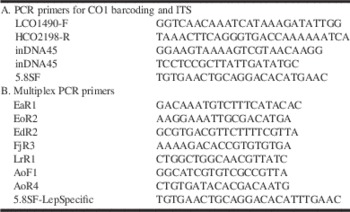
Where required, species identifications were verified using CO1 barcoding primers LCO1490-F+HCO2198-R (Folmer et al. Reference Folmer, Black, Hoeh, Lutz and Vrijenhoek1994) (Table 1) using the following thermal cycler conditions: an initial denaturation step at 94 °C for one minute; followed by five cycles at 94 °C for 40 seconds, 45 °C for 40 seconds, and 72 °C for one minute; 35 cycles at 94 °C for 40 seconds, 51 °C for 40 seconds, 72 °C for one minute; and 72 °C for five minutes. Resulting CO1 amplicons were gel purified using a Qiaquick gel extraction kit and directly Sanger sequenced using the same barcode primers as sequencing primers. Resulting sequences were compared with the BOLD barcode database for species identification (http://www.boldsystems.org/index.php/Public_BINSearch?searchtype=records). We previously have developed multiplex PCR protocols for insect species identification by targeting the ITS regions of nuclear rRNA elements (Gariepy et al. Reference Gariepy, Kuhlmann, Haye, Gillott and Erlandson2005, Reference Gariepy, Kuhlmann, Gillott and Erlandson2008). Thus, the full ITS and ITS2 regions were amplified for two to five voucher specimens for each target species using primers inDNA44+inDNA45 or 5.8SF optimised for Lepidoptera+inDNA44, respectively (Table 1) using the following thermal cycler conditions: an initial denaturation step at 94 °C for three minutes; followed by 30 cycles at 94 °C for 60 seconds, 55 °C for 60 seconds, 72 °C for 90 seconds, and finally at 72 °C for five minutes. Amplicons were cloned into pGEM T-EASY and five plasmid clones from each specimen were Sanger sequenced using the forward and reverse universal vector specific primers. The sequences were aligned and a consensus sequence was generated for each species using SeqmanPRO software (DNASTAR-Lasergene, Madison, Wisconsin, United States of America).
Polymerase chain reaction (PCR) primers.

ITS, internal transcribed spacer.
Multiplex polymerase chain reaction primer design and protocol optimisation
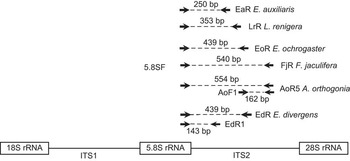
The consensus sequences for the ITS2 region of the target species were aligned and species-specific reverse primers designed using the primer design tool in CLC Genomics Workbench software (CLC Bio, Boston, Massachusetts, United States of America). Reverse primers were selected in regions of DNA sequence differences between the five species such that the multiplex PCR system yielded different sized amplicons for each species (Fig. 1). The reverse primers were designed with annealing temperatures within a similar range so that the multiplex PCR system including all primers was feasible (Table 1).
Diagrammatic representation of the internal transcribed spacer (ITS) region of six cutworm species showing the location of the universal forward 5.8SF primer and the locations of species-specific reverse primers (EoR, EaR, LrR, FjR, AoR5, AoF1, EdR, and EdR1) and the predicted size of the respective polymerase chain reaction amplicons. bp, base pairs.

Each multiplex PCR reverse primer was optimised by testing a range of annealing temperatures with DNA samples from each individual species and an optimal temperature selected for minimal cross reactivity. DNA samples from a range of additional Lepidoptera species, identified by CO1 amplicon sequencing, were tested in the multiplex PCR to investigate possible cross reactivity of the multiplex PCR primers. The final optimised multiplex PCR conditions were as follows: each 25 μL reaction contained 2.5 μL of 10×PCR reaction buffer, 4 mM MgCl2, 0.4 mM dNTPs, 0.04 mg/mL BSA, 2.0 μM of the 5.8SF Lep forward primer, 0.4 μM of each species-specific reverse primer and the AO forward primer, 1 U Taq DNA polymerase, and ~0.4 ng of DNA template. The PCR reactions were carried out in an MJMini Personal ThermoCycler (Bio-Rad Laboratories, Mississauga, Ontario, Canada) with an initial denaturation step at 94 °C for two minutes, followed by 25 cycles at 94 °C for 30 seconds, 58.5 °C for 30 seconds, and 72 °C for 45 seconds. A final extension period at 72 °C for 10 mintues followed the 25 cycles. PCR products were electrophoresed on 0.9% agarose gels, containing Gel-Red (Biotium – Cedarlane, Burlington, Ontario, Canada), at 90 V for 45–60 minutes and DNA products were visualised by ultraviolet transillumination. For each multiplex PCR assay of field-collected specimens, DNA templates from E. auxiliaris, E. ochrogaster, E. divergens, F. jaculifera, L. renigera, and A. orthogonia were included as positive controls along with a no template negative control.
Results and discussion
In all cases, identifications of the moth voucher specimens, based on morphological characters, for each of the five key cutworm species were also confirmed by matching the CO1 amplicon barcode sequence from each individual moth to sequences in the BOLD barcode database. Without exception, morphological and CO1 barcode sequence determinations were in complete agreement for the five common species. This was not universally the case for all voucher specimens of other cutworm species tested by barcode sequencing, which attests to the difficulty of identifying moths to species based solely on external morphology and colouration. For example, the CO1 barcode amplicons derived from voucher specimens morphologically identified as Euxoa declarata (Walker) gave ambiguous results or matched the closely related species Euxoa campestris (Grote). Interestingly, the CO1 barcode amplicon sequence was identical for all F. jaculifera voucher specimens including individuals from both the early and late season collections (data not shown). This supports previous conclusions that mitochondrial sequence linages (including CO1) within different F. jaculifera populations do not reliably distinguish between F. jaculifera pheromone phenotype designations (Sperling et al. Reference Sperling, Byers and Hickey1996).
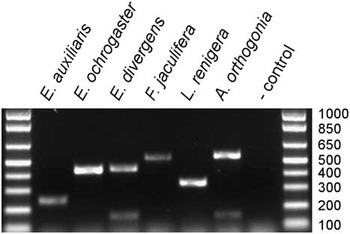
The ITS2 consensus sequence based on the aligned DNA sequences from five clones for each of two to five individuals was submitted to GenBank for the following species; E. ochrogaster (KX461928), E. auxiliaris (KX461927), E. divergens (KX499517), A. orthogonia (KX461926), F. jaculifera (KX461929), and L. renigera (KX461925). The F. jaculifera ITS2 sequence consensus was derived from cloned amplicons from two individuals from each of the early and late season voucher specimen samples, which produced essentially identical sequences. The ITS2 sequences were aligned in CLC Genomics Workbench and the alignments identified limited regions of DNA sequence differences between species that were sufficient for species-specific primer design. We were able to design a Lepidoptera-tailored universal forward primer targeting the 5.8 S region of the rRNA transcription unit and species-specific reverse primers that generated sufficiently different sized PCR amplicons for E. ochrogaster (439 base pairs), E. auxiliaris (250 base pairs), F. jaculifera (353 base pairs), and L. renigera (540 base pairs) (Figs. 1–2). The multiplex PCR assay produced similar sized (353 base pairs) amplicons for both early and late season voucher specimens of F. jaculifera (data not shown). To accommodate A. orthogonia in the multiplex PCR and still readily distinguish it from L. renigera, we designed an additional forward primer (AoF1) that was compatible within the multiplex PCR and generated a second PCR amplicon (162 base pairs) in addition to the 554 base pairs amplicon produced by the universal 5.8SF primer and the species-specific reverse primer (AoR1) (Fig. 1). During the 2012 field season, light trap collections from canola fields at some Saskatchewan locations yielded high numbers of Euxoa divergens moths, species identification was by morphology and CO1 barcode sequencing. The E. divergens DNA samples yield a similar sized PCR amplicon (~440 base pairs) to that of E. ochrogaster DNA samples when analysed by the multiplex PCR assay. We therefore added an E. divergens specific reverse primer that yielded a 143 base pairs amplicon such that E. divergens DNA samples yielded two bands to distinguish it from E. ochrogaster (Figs. 1–2). The multiplex PCR system was optimised through a series of thermal gradient and PCR primer concentration experiments outlined in the Material and methods section.
Multiplex polymerase chain reaction of DNA templates from Euxoa auxiliaris, Euxoa ochrogaster, Euxoa divergens, Feltia jaculifera, Lacinipolia renigera, Agrotis orthogonia, and a negative template control.

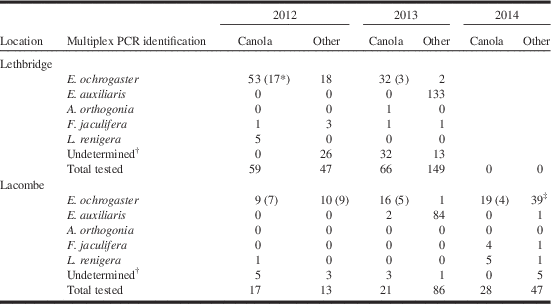
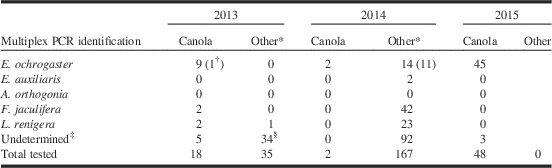
The multiplex PCR assay was used to identify DNA extracted from field-collected samples from the Lethbridge (larval collections reared to moths) and Lacombe (moths) regions of Alberta in the 2012 through 2014 field seasons. These moths had been tentatively identified to species by external morphology and wing pattern colouration. The species identification of these moths by multiplex PCR is summarised in Table 2. It was clear that E. auxiliaris was the predominant species in southern and central Alberta in 2013, particularly in crops other than canola, but was not collected in 2012. Euxoa ochrogaster, as identified by the multiplex PCR, was prevalent in both 2012 and 2013 Lethbridge field samples, both in canola and other crops, and in all three sampling years in Lacombe. The other three key cutworm species were rarely collected in either the Lethbridge or Lacombe regions. In most cases the multiplex PCR species identification matched that determined by moth morphology and wing pattern colouration and by confirmation by CO1 barcode sequencing of a subset of samples. However, E. ochrogaster multiplex PCR identifications proved somewhat problematic as false positive identifications of E. ochrogaster for individuals of other Euxoa Hübner species resulted for some locations and for both canola and other crop type samples (Table 2). For example, all 17 false positive E. ochrogaster individuals from the 2012 Lethbridge canola collection were from a single field site and CO1 barcode sequencing identified them as E. tessellata specimens. To identify the extent of the false positive problem, individuals for a number of closely related Euxoa species were tested with the multiplex PCR assay. The universal 5.8SF primer, in combination with the E. ochrogaster reverse primer, amplified products of approximately 430–450 base pairs from DNA samples from E. albipennis, E. cicatricosa, E. flavicollis, E. infausta, E. manitobana, E. messoria, and E. tessellata (data not shown). This made positive identifications of these species difficult on the basis of DNA band migration in agarose gel electrophoretic analysis using the multiplex PCR assay. As well, DNA extracted from some field-collected specimens, larvae or adults reared from field-collected larvae, produced no amplicon or only weak DNA bands of a size not matching any of those predicted for the six target species. These specimens were classified as “non-target” species of unknown identity for the purpose of this study (Tables 2–3).
Summary of multiplex polymerase chain reaction (PCR) identifications for field-collected specimens from south Alberta (Lethbridge) and central Alberta (Lacombe).

* Numbers in brackets are the number of false positive multiplex PCR identifications as confirmed by CO1 barcode sequencing.
† No amplicon or ambiguous.
‡ Not tested by COI barcode PCR.
Summary of multiplex polymerase chain reaction (PCR) identifications for field-collected specimens from northern Alberta.

* Majority of specimens in the “other” category were collected from red clover (Trifolium pratense Linnaeus; Fabaceae) field with a few specimens coming from timothy (Phleum pratense Linnaeus; Poaceae) or alfalfa (Medicago sativa Linnaeus; Fabaceae) fields.
† Numbers in brackets are the number of false positive multiplex PCR identifications as confirmed by CO1 barcode sequencing.
‡ No amplicon or ambiguous.
§ Majority identified as Actebia fennica (Tauscher) by COI barcode sequencing.
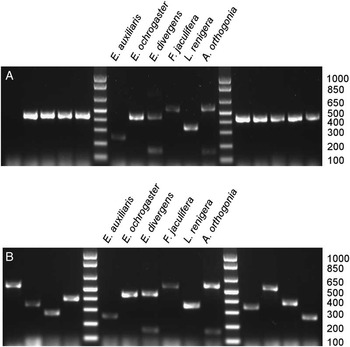
Although the sample sizes were somewhat smaller for the cutworm populations sampled from the Peace River region of northern Alberta in 2013 through the 2015 season, cutworm species identified from canola sites were predominantly E. ochrogaster (Fig. 3, Table 3). In contrast, the cutworm species composition associated with collections from other crops, predominantly red clover fields, were much more diverse with similar numbers of F. jaculifera, L. renigera, and putative E. ochrogaster specimens being identified by the multiplex PCR (Fig. 3, Table 3). Because of the possibility of false positives for E. ochrogaster identification in the multiplex PCR, all the specimen DNA samples summarised in Table 3 were CO1 barcode sequenced to confirm species identification. Almost all multiplex PCR identifications from the canola sample sites were correctly identified including the E. ochrogaster specimens based on CO1 barcode sequencing. While it is recognised that CO1 barcode sequence analysis has its limits for species identification among Euxoa species, E. ochrogaster is not among those species listed as either sharing CO1 sequence identity with other species or possessing low sequence divergence,<2% (Supplementary Tables 2–3, Zahiri et al. Reference Zahiri, Lafontaine, Schmidt, DeWaard, Zakharov and Hebert2014). However, those specimens from the red clover sites that were identified as E. ochrogaster by multiplex PCR were found to be a variety of related Euxoa and Lacinipolia species by CO1 barcode sequencing (data not shown). Thus, the Peace River specimen data suggest that crop plant may have an impact on cutworm species distribution. These data further suggest that the potential problem with false positive E. ochrogaster identification by the multiplex PCR assay may not be a significant problem in terms of its use in cutworm identifications in the canola cropping system in northern Alberta. We also note that larvae for the Euxoa species that produced false positives for E. ochrogaster are either known or thought to feed on the soil surface (Beirne Reference Beirne1971; Ayre and Lamb Reference Ayre and Lamb1990). Thus, an incorrect identification of an Euxoa species causing economic damage in a crop would still result in the correct management strategy; i.e., a pesticide application targeting a surface-feeding species.
Multiplex polymerase chain reaction (PCR) of DNA templates from field-collected moth and larval cutworm specimens from northern Alberta representing collections from canola (A) and red clover (B) crops. DNA templates from Euxoa auxiliaris, Euxoa ochrogaster, Euxoa divergens, Feltia jaculifera, Lacinipolia renigera, and Agrotis orthogonia were included in every multiplex PCR as positive control along with a no template negative control.

In summary we have developed a single-step multiplex PCR assay that will allow for identification of specimens of five key cutworm species within field collections of cutworms whether at the larval, pupal or adult stage. The assay will be a valuable tool in agronomic and ecological studies of cutworm infestations in the canola cropping system across western Canada.
Acknowledgements
This project was supported by Canola Agronomic Research Program (CARP) grant 2012.1 from the Canola Council. We wish to thank Bob Byers, Jim Broatch, and Patti Reid for providing field-collected samples for analysis.
Supplementary materials
To view supplementary material for this article, please visit https://doi.org/10.1017/tce.2017.5