On March 11, 2011, the Great East Japan Earthquake, an earthquake of moment magnitude 9.0, caused massive damage to Japan’s Tohoku region. This was a compound disaster including a tsunami caused by the megathrust earthquake and a nuclear power plant accident triggered by the tsunami. The number of dead and missing totaled approximately 18,000, 1 , 2 and as of September 2012, approximately 300,000 were still living as evacuees. Of these, 65,000 were out-of-prefecture (ie, area of local government in Japan) evacuees, originally from Miyagi, Iwate, and Fukushima Prefectures, who had evacuated to multiple locations across Japan. 3
The most distinctive feature of the period following the earthquake disaster was the distance of the evacuations, because of the nuclear power plant accident. As of September 2012, approximately 1000 people who were either evacuated to avoid radiation damage or had lost their homes because of the tsunami were living in Kyoto Prefecture, approximately 550 km to the west of the area affected by the Fukushima Dai-ichi Nuclear Power Plant accident. 3 A questionnaire survey administered to evacuees by the Kyoto prefectural government (44% response rate, administered between June and July 2012) showed that 73% of the evacuees in Kyoto Prefecture had moved there because of concerns about health issues stemming from radiation. The majority of these evacuees were mothers in their 30s and 40s and their children. 4
Evacuees experience an interruption in their access to everyday health care and health services (eg, medical consultations, health checkups, and vaccinations for infants). They must therefore obtain access to these services in their evacuation destination—a new place and community—before any new health problems develop or existing ones worsen. Providing health care for evacuees with chronic diseases was a particularly critical problem in evacuation destinations after the disaster.Reference Waring 5 - Reference Uscher-Pines 12 It was reported that support for information technology systems at community health centers improved the medical care for evacuees of Hurricane Katrina.Reference Arrieta, Foreman and Crook 13 After the earthquake disaster, information obtained, for example, from health insurance claims, was useful for providing suitable care for evacuees.Reference Tanihara, Tomio and Kobayashi 14
Health care information (HCI) played a significant role in the process of health care management.Reference Milewski and Chen 15 Therefore, it is likely that being able to obtain HCI after evacuation will be critical to evacuees’ health care management. However, very few studies have been conducted on how evacuees obtain HCI, and particularly whether this varies for particular groups. The purpose of this study was to explore how evacuees obtained HCI at their evacuation destination following the earthquake disaster; whether it varied for different types of evacuees, for example, mothers with children, families, or individuals; and what factors influenced choices about where to obtain information.
METHODS
Participants
Participants were individuals who had moved to City A in Kyoto Prefecture after the earthquake disaster. The inclusion criteria were being at least 20 years old, being able to communicate orally in Japanese, and providing written consent to participate in the study. In Japan, those over 20 years old are considered to be adults. We therefore judged this a reasonable starting age. Because we planned to study evacuees who had moved somewhere unfamiliar, those who had moved to the homes of relatives were excluded. Those who moved to an unfamiliar area had to find out about health care for themselves. In Japan, the social and medical support system differ by prefecture; therefore, moving to a difference prefecture can change entitlement to services as well as where services are provided. 16
We tried to use snowball sampling but were unable to obtain evacuee information from the municipal office of City A because of administrative personal information protection. The evacuees were therefore considered a hard-to-reach population. Hard-to-reach populations are minority groups with sensitive characteristics; a variety of unique approaches depending on circumstances have been used to reach them in previous studies.Reference Faugier and Sargeant 17 , Reference Marpsata 18 We repeatedly negotiated with the social welfare council of City A and asked them how we could contact evacuees. We were introduced to an evacuees’ support group, and a leader there knew some of the evacuees in City A. We therefore asked the group for help in recruiting participants.
Data Collection
We used a qualitative methodology, including interviews. Qualitative research is “concerned with the meanings people attach to their experiences of the social world and how they make sense of that world.”Reference Pope and Mays 19 Our purpose was to explore how evacuees obtained HCI at their evacuation destinations. An interview study focusing on evacuees’ narrative experience was therefore considered appropriate. The first author (HO), who had been trained in interview methods, conducted interviews with 1 or 2 participants at a time, at the participants’ preferred meeting place (for example, the office of the support group) in City A. No payment was provided.
Each participant underwent a single semi-structured interview based on an interview guide. The interview guide covered how the participant had obtained HCI since arriving in Kyoto Prefecture; reasons for obtaining HCI; problems encountered in obtaining information; age, gender, and birthplace (basic attributes); when the participant moved to Kyoto Prefecture; and residency registration status (registered as a resident of City A or not). The interviews were recorded with an IC recorder. The study was conducted between September 7 and November 21, 2012.
Data Analysis
We used the constant comparative method for analysis. This method is grounded in qualitative data and modified grounded theory approach. It is appropriate for conceptualizing processes of social phenomena and generating theories.Reference Glaser and Strauss 20 - Reference Kinoshita 22 Transcripts (data) were produced from the interview recordings and examined with the main study theme in mind (how the evacuee had obtained HCI and why they had chosen to use this method). Definitions were formulated from the data, and questions or considerations that emerged during the interpretation process were recorded in memos. Concept names were produced from the definitions, and higher-level, more abstract categories were generated by considering the relationships between concepts. Data, concepts, and categories were continually compared and examined to identify and explore relationships between data and concepts, among concepts, and between concepts and categories. The progress was recorded in detail in the notes on emergent themes, and relations between the categories were summarized.
Data coding was conducted by one of the authors and was supervised and checked by the other 2 authors. Any differences were resolved by discussions between the researchers. To avoid arbitrary bias among the investigators and to ensure the work’s reliability, the results were presented at meetings of a specific qualitative study group at Kyoto University. The study was approved by the Kyoto University Graduate School and Faculty of Medicine Ethics Committee (approval no. 998; September 5, 2012). Written informed consent was obtained from the participants after they had been given a document explaining the aims of the study and the measures that would be taken to protect their privacy and manage the interview recordings. Care was taken to minimize the mental burden on participants. Our main focus was to avoid reminding participants about the disaster itself during the interview. If any of the participants had become distressed, we were also prepared to contact with a psychiatrist so that we could take suitable measures should any adverse events occur. This research followed the checklist for reporting qualitative research (RATS). 23
RESULTS
Participant Characteristics
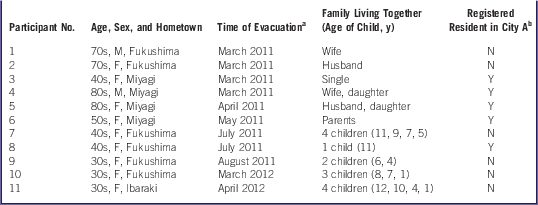
In total, 11 participants were interviewed (2 men and 9 women; age range, 30–82 years; median, 49 years). The time of evacuation to Kyoto ranged from March 2011 to April 2012. Six of the participants were family or single evacuees, and 5 were mother-children evacuees. The ages of the children who moved with their mothers ranged from 1 to 12 years. Six of the participants were not registered as residents in their evacuation destination. The average interview time was 80 minutes (Table 1).
Participant Characteristics

a Time of evacuation is the time at which the individual moved to Kyoto Prefecture after the great earthquake disaster on March 11, 2011.
b Registered resident in City A: N (no), people who did not register as a resident in City A; Y (yes), people who registered as a resident in City A.
Analysis
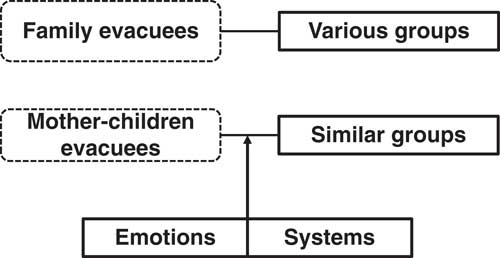
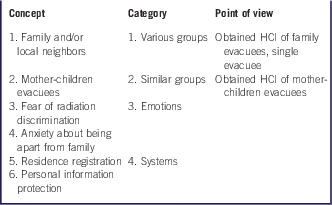
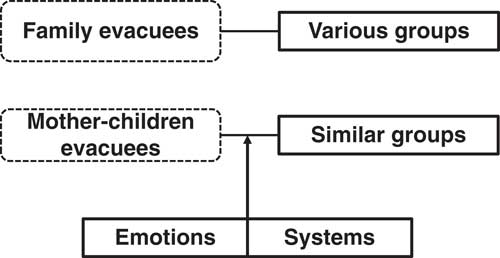
Four categories emerged from 6 concepts (Table 2). Narrative portions are presented in the text in italics. HCI was obtained differently by family/single evacuees and mother-children evacuees (Figure 1). Family or single evacuees are those whose family composition remained unchanged from before the earthquake disaster, and mother-children evacuees are those whose family composition changed from before the disaster, in which only the mother and children had moved and were therefore separated from the rest of the family. All evacuees obtained HCI by word of mouth.
How Evacuees Obtained Health Care Information and Factors Influencing the Obtained Health Care Information.
Six Concepts and 4 Categories Emerging From the InterviewsFootnote a

a Abbreviation: HCI, health care information.
Various Groups (Category 1)
Individuals who had moved with their family or by themselves relied on HCI obtained from family or local neighbors, with “neighbors” being other residents of City A who had lived there since before the disaster. In other words, they obtained HCI from various groups and did not hesitate to communicate with local neighbors.
When we arrived here, we became acquainted with the people in the town, and they brought us a map. “You’ll find the hospital here,” they said. My daughter also did a lot of research on the internet about the hospital, and they took us there. (No. 4: family evacuee)
One female evacuee, who came by herself from Miyagi (No. 3) obtained HCI from her neighbors about the hospital or medical checkups. She also did not hesitate to communicate with local neighbors.
I evacuated to Kyoto alone. Initially, when I first got here, there was nobody I talked to or who I could ask. Now I sometimes obtain health care information from neighbors who live in the same apartment. (No. 3: single evacuee)
Similar Groups (Category 2)
Mothers who had moved with their children, leaving behind other family members, tended to obtain HCI from other mother-children evacuees. In other words, they obtained HCI from similar groups and were sometimes reluctant to communicate with local neighbors. This was a key difference from family/single evacuees.
After coming here, I became acquainted with a person who had arrived earlier at Kyoto as an evacuee. I asked if there was a good place that would examine children who had come as evacuees, and was referred to a children’s hospital. She taught me about children’s vaccinations and health checkups at the municipal office of City A. (No. 10: mother-children evacuee)
Emotions (Category 3)
There were various emotional factors that influenced why mother-children evacuees obtained HCI from similar groups. The evacuee mothers often felt anxiety being apart from the rest of the family because they did not have anyone nearby to consult and tended to consult other evacuee mothers without partners when concerned about their children’s health.
Coming to a place I don’t know, I’m anxious. So I was concerned whether there were children of similar ages. (No. 7: mother-children evacuee)
Mother-children evacuees felt fear of radiation discrimination for their children, although they carried on as much as possible. They felt disconnected from the local residents, and were eager to connect with other mother-children evacuees.
I worry about radiation discrimination. I can’t stay long if in the end, the environment isn’t good for the kids. I need to assimilate into the environment. And because I haven’t transferred my residence card, I can exchange information with peace of mind if there is someone in a similar situation. (No. 7: mother-children evacuee)
Of the people who had arrived early, there were some who returned to their hometown because they had been bullied and become isolated. A middle school student was verbally abused about radiation. Like, “you’ll infect me so stay away.” Within a period of 5 months, 2 households returned. Apparently, the lack of a connection still counted for a lot. (No. 9: mother-children evacuee)
Systems (Category 4)
Four of the 5 groups of mother-children evacuees were not registered as residents in their evacuation destination. They therefore obtained HCI from other mother-children evacuees in the same situation.
Ideally, it would help if health checkups and uterine cancer tests were available. But I was told they couldn’t see me because I wasn’t registered as a resident….An evacuee mother in the same residence told me about a doctor who could treat infantile allergies. (No. 11: mother-children evacuee)
At the time of the disaster, knowing who was an original resident and who was an evacuee was impossible because of the Personal Information Protection Law. This made the mutual exchange of information among evacuees difficult. We observed barriers to obtaining HCI from mother-children evacuees because of personal information protection.
Apparently the “Shakyo” (social welfare council) couldn’t get the evacuee list from the municipal office either, due to the protection of personal information. They did a lot of negotiating for us, and finally there was a meeting of evacuees in City A. I was asked where we came from, and I told them that I left my husband in Fukushima and brought my children. That surprised them. (No. 9: mother-children evacuee)
DISCUSSION
In this study, 2 ways of obtaining HCI were observed in evacuee narratives after the earthquake disaster. All evacuees obtained HCI by word of mouth. Family/single evacuees tended to obtain HCI from their family or local residents of City A. Mother-children evacuees, who had moved and left behind other family members out of concern for their children, obtained HCI from fellow mother-children evacuees and hesitated to communicate with local neighbors at the time of evacuation. We found 2 factors influencing how mother-children evacuees obtained HCI.
Emotions
Mothers who had left other family members and moved with their children were worried that their children would experience discrimination. They also felt anxiety being apart from the rest of the family because they did not have anyone nearby to consult. Mother-children evacuees suffered from discrimination and prejudice specific to radiation. 24 Because of the sense of distance they felt between them and the local residents of City A, mother-children evacuees wanted to form communities with fellow mother-children evacuees (participant no. 7).
It has been reported that people who were evacuated to surrounding areas after the Chernobyl Nuclear Power Plant accident in 1986 became isolated and ill as a result of the social stigma and discrimination because of radiation contamination.Reference Bromet and Havenaar 25 Our study also found anecdotal evidence that a mother and her middle school student, who had been verbally abused (“you’ll infect me with radiation so stay away”), were unable to adjust to life in the evacuation destination and returned to the disaster site (participant no. 9). This state of affairs, in which evacuees were subjected to discrimination and prejudice, may have arisen because the host municipality initially did not understand what support the evacuees needed. Future measures are required to prevent discrimination and prejudice because of fears about radiation contamination.
Systems
Mother-children evacuees obtained HCI from fellow mother-children evacuees. In Japan, each municipality provides health services (health checkups, vaccinations, and health screening for cancer) to their residents. 26 Following the earthquake disaster, disaster victims voluntarily moved to various locations in Japan, often far from Fukushima Prefecture, because of concerns that young children would be harmed by radiation. In our study, the ages of children who moved with their mothers ranged from 1 to 12 years, with mothers’ ages ranging from 30s to 40s. Most mother-children evacuees did not register as residents at their evacuation destinations (Table 1).
Fukushima Prefecture has a unique program, the 18-and-under child health care assistance program, which allows for free checkups, and an individual must be registered as a resident of Fukushima Prefecture to benefit. 4 This was the main reason that the evacuees did not transfer their residency registration to Kyoto Prefecture. Health care services for residents in Kyoto Prefecture (the evacuation destination) were more restricted. This shows that the response to evacuees during the disaster was inflexible because the resident registration system is very well established in Japan. Mother-children evacuees who were not registered as residents at the evacuation destination were therefore a special case among evacuees, which is probably why they wanted to exchange information about health care services with fellow mother-children evacuees.
At the time of their evacuation, mother-children evacuees were isolated from their surroundings (No. 9). Fellow evacuees could not communicate with one another because of personal information protection. The evacuees were anxious and initially had no settings in which to exchange information, because they did not know who was an evacuee and who was an original resident, even within the same collective housing compound. The mental and economic burdens of leading a double life were also considerable. 4 We surmise that evacuees wanted to meet others in the same situation, and exchange information including about health care management. In Japan, the Personal Information Protection Law was established in 2003, and as a general rule, personal information cannot be transmitted to a third person without the consent of the individual concerned. 27
In 2006, the Japan Cabinet Office developed the Evacuation Support Guidelines on Information for Persons Needing Support during a Disaster. 28 However, personal information protection during an emergency was not appropriately interpreted, and after the earthquake disaster, evacuees had difficulty contacting one another. The proper interpretation of the Personal Information Protection Law during a disaster and its establishment as common knowledge are challenges for the future.
Although support for housing and everyday needs is given the highest priority after a disaster, we suggest that support for community formation among evacuees should also be considered a priority from an early stage. Exchanging information is critical to establishing a new life, including finding suitable health care at the evacuation destination. At the time of the disaster, the response to evacuees’ needs was inflexible, because of the legal framework on protection of personal information and the resident registration system. We suggest these findings have implications for policy-makers. We also suggest that they will be useful in planning for future disaster management, particularly evacuation after disasters.
Study Limitations
This study had some limitations. First, the sample was limited to 11 participants who attended the meetings conducted by the support group and were interested in the subject of obtaining HCI, which could have caused selection bias. Second, there were only 2 men among the 11 participants, although the results would probably be affected by gender differences. There were many more female than male participants because of the issue of mother-children evacuees, which is specific to this disaster. Third, the interviews were often conducted in pairs, although participants would probably provide different answers in a group setting compared with one-on-one. Fourth, qualitative studies may not reach saturation level. Further studies with larger samples will be necessary in the future to verify our results. The study was, however, significant in that we performed a detailed analysis of interview data obtained from evacuees of the earthquake disaster, a hard-to-reach population, and revealed how evacuees obtained HCI.
CONCLUSIONS
We observed 2 different ways that mother-children evacuees and family evacuees obtained HCI after the earthquake disaster. Mother-children evacuees obtained HCI from fellow mother-children evacuees. At the time of the evacuation, we found 2 factors influencing how this group obtained HCI: emotions and systems. It was crucial for officials to provide support to help mother-children evacuees to form a community and thereby obtain HCI.
Acknowledgments
We are very grateful to the study participants for their time. We also thank the staff of the evacuee support group, the social welfare council in City A in Kyoto Prefecture, and the Kyoto University qualitative study group.
Author Contributions
HO designed the study, collected and analyzed data, and drafted the manuscript. TN and KM helped to design the study and supervised the qualitative data. All authors contributed to data interpretation and critically reviewed the manuscript. All authors read and approved the final manuscript.