Introduction
Cognitive domains are highly flexible and adaptive, especially if subjected to continuous demanding conditions. This is clearly shown by expertise studies. For example, visual selective attention is enhanced in habitual videogame players (Green & Bavelier, Reference Green and Bavelier2003), whereas problem-solving and motor error detection mechanisms are boosted in chess masters (Bilalić, McLeod & Gobet, Reference Bilalić, McLeod and Gobet2008) and professional tango dancers (Amoruso, Ibáñez, Fonseca, Gadea, Sedeno, Sigman, García, Fraiman & Fraiman, Reference Amoruso, Ibáñez, Fonseca, Gadea, Sedeno, Sigman, García, Fraiman and Fraiman2016; Amoruso, Sedeno, Huepe, Tomio, Kamienkowski, Hurtado, Cardona, Alvarez Gonzalez, Rieznik, Sigman, Manes & Ibáñez, Reference Amoruso, Sedeno, Huepe, Tomio, Kamienkowski, Hurtado, Cardona, Alvarez Gonzalez, Rieznik, Sigman, Manes and Ibáñez2014), respectively. However, little is known about the impact of sustained extreme demands on another well-characterized cognitive domain: bilingual memory – namely, the lexico-semantic system of individuals who speak both a native and a non-native language (L1 and L2, respectively). A key model to examine this issue is afforded by experts in simultaneous interpretation, a most exacting form of bilingual activity characterized by cumulative, dynamic, and concurrent processing of oral input and output under strict time constraints (Chernov, Reference Chernov2004). Building on these premises, we assessed the susceptibility of bilingual memory to expertise-related changes by comparing the lexical skills of professional simultaneous interpreters (PSIs) and non-interpreter bilinguals (NIBs).
Bilingual memory is cross-theoretically conceived as a complex of interfacing components (Dijkstra & van Heuven, Reference Dijkstra and van Heuven2002; Dong, Gui & Macwhinney, Reference Dong, Gui and Macwhinney2005; French & Jacquet, Reference French and Jacquet2004; Kroll & Stewart, Reference Kroll and Stewart1994; Kroll, van Hell, Tokowicz & Green, Reference Kroll, van Hell, Tokowicz and Green2010; Paradis, Reference Paradis2004; Van Hell & De Groot, Reference Van Hell and De Groot1998; van Heuven, Dijkstra & Grainger, Reference van Heuven, Dijkstra and Grainger1998). Macroanatomically, lexical processes for both L1 and L2 in high-proficiency bilinguals are subserved by overlapping regions (Perani, Paulesu, Galles, Dupoux, Dehaene, Bettinardi, Cappa, Fazio & Mehler, Reference Perani, Paulesu, Galles, Dupoux, Dehaene, Bettinardi, Cappa, Fazio and Mehler1998), irrespective of the age of L2 acquisition (Abutalebi, Cappa & Perani, Reference Abutalebi, Cappa, Perani, Kroll and Groot2005; Perani et al., Reference Perani, Paulesu, Galles, Dupoux, Dehaene, Bettinardi, Cappa, Fazio and Mehler1998). However, different components of this overall system possess specific, partly dissociable functions. For example, although the L1 and the L2 lexico-semantic systems continuously coactivate and exchange information (for a review, see Kroll, Dussias, Bice & Perrotti, Reference Kroll, Dussias, Bice and Perrotti2015), they are subserved by relatively independent neural substrates (Chee, Soon & Lee, Reference Chee, Soon and Lee2003; Klein, Zatorre, Chen, Milner, Crane, Belin & Bouffard, Reference Klein, Zatorre, Chen, Milner, Crane, Belin and Bouffard2006; Lucas, McKhann & Ojemann, Reference Lucas, McKhann and Ojemann2004; Ojemann & Whitaker, Reference Ojemann and Whitaker1978; Rapport, Tan & Whitaker, Reference Rapport, Tan and Whitaker1983). Similarly, subdomains within these systems (e.g., semantics, phonology) interact during verbal processing, but they rely on partially autonomous networks (Marian, Spivey & Hirsch, Reference Marian, Spivey and Hirsch2003; Pillai, Araque, Allison, Sethuraman, Loring, Thiruvaiyaru, Ison, Balan & Lavin Reference Pillai, Araque, Allison, Sethuraman, Loring, Thiruvaiyaru, Ison, Balan and Lavin2003; Sasanuma, Sakuma & Kitano, Reference Sasanuma, Sakuma and Kitano1992; Teichmann, Turc, Nogues, Ferrieux & Dubois, Reference Teichmann, Turc, Nogues, Ferrieux and Dubois2012). Moreover, at least some of the neural circuits engaged during interlingual processes (e.g., word translation) are different from those involved in single-language processes (e.g., word reading) (Borius, Giussani, Draper & Roux, Reference Borius, Giussani, Draper and Roux2012; García, Reference García2015b).
Beyond strictly linguistic mechanisms, speech production and comprehension in L1 and L2 also rely on cognitive control processes, which are activated depending on the interactional context and the bilingual status of the interlocutor (Green & Weib, Reference Green and Weib2014). As proposed by several models, control mechanisms regulate lexical competition processes in bilingual memory. In single- or dual-language contexts, bilinguals must select a specific language schema and suppress non-target language items (Green & Abutalebi, Reference Green and Abutalebi2013), a requisite that renders lexical processing more costly but seems to enhance executive functioning at large (Bialystok, Reference Bialystok2009; Bialystok, Craik, Grady, Chau, Ishii, Gunji & Pantev, Reference Bialystok, Craik, Grady, Chau, Ishii, Gunji and Pantev2005; Bialystok, Craik, Klein & Viswanathan, Reference Bialystok, Craik, Klein and Viswanathan2004; Calvo, Ibáñez & García, Reference Calvo, Ibáñez and García2016). Indeed, executive functions play a key role in the inhibition of words in the non-target language, be it L1 or L2 (Rodriguez-Fornells, De Diego Balaguer & Munte, Reference Rodriguez-Fornells, De Diego Balaguer and Munte2006), but control demands are not always equivalent for both languages. In low- or mid-proficiency NIBs, switching from the dominant language (typically, L1) to the less dominant one (typically, L2) proves more effortful than doing so in the opposite direction (Costa & Santesteban, Reference Costa and Santesteban2004). However, this asymmetrical switching cost is sensitive to the level and type of bilingual proficiency, as it can be neutralized in highly proficient NIBs (Costa & Santesteban, Reference Costa and Santesteban2004) and even reversed in PSIs (Proverbio, Leoni & Zani, Reference Proverbio, Leoni and Zani2004).
Despite its integrity as a functional system, then, bilingual memory is an amalgam of specialized mechanisms that can be subjected to differential use-related demands, adaptations, and enhancements. Many of the connections holding these subsystems together are extremely taxed in PSIs, who must continually reformulate diverse forms of oral discourse from one language into another, sometimes for several hours. Typically, in professional settings, simultaneous interpreting occurs at a speed which largely exceeds the ideal rate of 95–120 words per minute (Chernov, Reference Chernov2004; Gerver, Reference Gerver1975), with a delay between input and output of 2 to 4 seconds (Anderson, Reference Anderson, Lambert and Moser-Mercer1994; Gerver, Reference Gerver and Briskin1976). Yet, PSIs typically achieve remarkable propositional correspondence, significantly outperforming NIBs (Barik, Reference Barik1975; Dillinger, Reference Dillinger1994; Gerver, Reference Gerver1975). This suggests that mechanisms implicated in finding and translating task-constrained words can become enhanced due to the recurrence and intensity of their activation. Indeed, word-level processing is more efficient in bilinguals who attained high levels of L2 proficiency (Ferré, Sánchez-Casas & Guasch, Reference Ferré, Sánchez-Casas and Guasch2006; Guasch, Sánchez-Casas, Ferré & García-Albea, Reference Guasch, Sánchez-Casas, Ferré and García-Albea2008; Sunderman & Kroll, Reference Sunderman and Kroll2006; Talamas, Kroll & Dufour, Reference Talamas, Kroll and Dufour1999) or who acquired their L2 at an early age (Montrul & Foote, Reference Montrul and Foote2014; Silverberg & Samuel, Reference Silverberg and Samuel2004), with both languages remaining susceptible to dynamic adaptations across the lifespan (Malt, Li, Pavelnko, Zh & Ameel, Reference Malt, Li, Pavelnko, Zh and Ameel2015). By the same token, interpreting expertise could represent another critical subject variable to investigate the susceptibility of bilingual memory to fine-tuned processing skills forged throughout time.
Previous studies focused on executive functions have shown that PSIs exhibit behavioral enhancements (Babcock & Vallesi, Reference Babcock and Vallesi2015; for a review, see García, Reference García2014) and relevant neuroplastic adaptations (Elmer & Kuhnis, Reference Elmer and Kuhnis2016; Hervais-Adelman, Moser-Mercer, Michel & Golestani, Reference Hervais-Adelman, Moser-Mercer, Michel and Golestani2014). More particularly, other studies indicate that, relative to NIBs, PSIs are faster to perform lexical decisions on non-words (Bajo, Padilla & Padilla, Reference Bajo, Padilla, Padilla, Chesterman, Gallardo San Salvador and Gambier2000), categorize non-typical exemplars (Bajo et al., Reference Bajo, Padilla, Padilla, Chesterman, Gallardo San Salvador and Gambier2000), and translate words in both directions (Christoffels, de Groot & Kroll, Reference Christoffels, Degroot and Kroll2006). Moreover, in semantic decision tasks, they exhibit distinct neurophysiological modulations only for word pairs presented in the professionally trained direction (Elmer, Meyer & Jancke, Reference Elmer, Meyer and Jancke2010). It seems, therefore, that interpreting expertise may entail changes only in those bilingual skills specifically taxed by expert performance (i.e., vocabulary search, interlingual reformulation).
This conjecture, however, requires direct testing, as its supporting data are scant, heterogeneous, and clouded by various confounds. Crucially, only Elmer et al. (Reference Elmer, Meyer and Jancke2010) matched PSIs and NIBs for L2 proficiency, age of L2 acquisition, and amount of L2 exposure, and none of the available studies did so in terms of extralinguistic skills associated with L2 processing and translation performance, such as working memory (Kroll, Michael, Tokowicz & Dufour, Reference Kroll, Michael, Tokowicz and Dufour2002; Linck, Osthus, Koeth & Bunting, Reference Linck, Osthus, Koeth and Bunting2014). Moreover, no single study has systematically assessed how different mechanisms within bilingual memory are affected by the extreme processing demands characterizing the activity of PSIs.
Against this background, we conducted the first comprehensive examination of expertise-related differences in bilingual memory by comparing carefully matched PSIs and NIBs on phonological and semantic fluency, picture-naming, word-translation, and word-reading tasks, all in both L1 and L2. Guided by extant findings, we hypothesized that only those mechanisms implicated in time-constrained vocabulary search and word translation would become more efficient in subjects who underwent systematic interpreting practice. Thus, we predicted that, relative to NIBs, PSIs would produce more words in verbal fluency tasks and exhibit lower response latencies in word translation tasks, but not in picture naming or a shallow-processing task like word reading. Evidence for such selective enhancements could shed light on the organization and adaptability of the bilingual lexico-semantic system.
Materials and methods
Participants
The study comprised 36 participants, but two of them (both PSIs) were excluded because of technical problems during data acquisition. The final sample thus consisted of 34 native Spanish speakers from Argentina (32 female) who learned English through formal instruction. They all had normal or corrected-to-normal vision and no history of neurological or psychiatric disease. Half of them comprised NIBs (n = 17), that is, advanced students at an English teacher training program (n = 14) or English teachers (n = 3) with no experience in interpreting. The other half comprised PSIs (n = 17), mostly specialized in conference interpreting, with a mean of 14.65 years of experience (SD = 12.09).Footnote 1 Some of the participants (9 NIBs and 14 PSIs) reported possessing varying levels of competence in an additional language (mainly French, Italian or Portuguese, but also German, Argentine Sign Language, and Flemish in three individual cases). However, in professional settings, all PSIs interpreted only between Spanish and English.
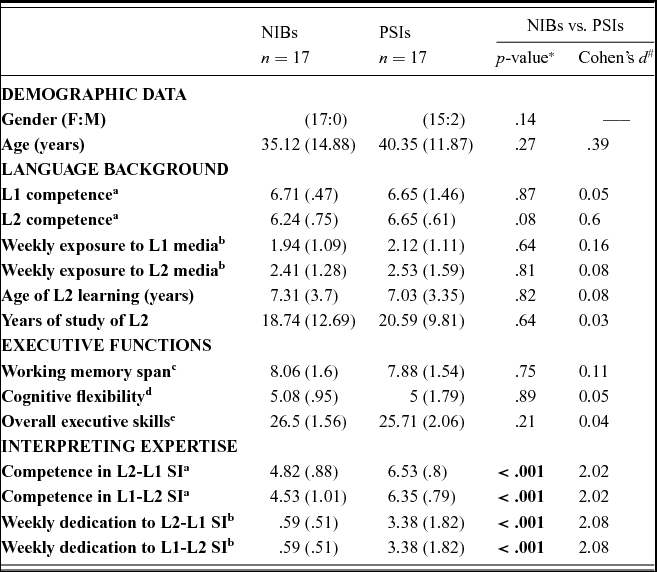
All participants completed a self-report questionnaire providing demographic and language-related information, including interpreting expertise. They first reported their gender, age, age of L2 learning, and years of L2 study. They were also asked to indicate their level of competence in both languages as well as competence in L1-L2 and L2-L1 interpreting directions in a scale ranging from 1 (null) to 7 (optimal). It was indicated that those extremes of the scale denoted complete inability to perform even basic relevant tasks and high capacity to routinely deploy those skills at ease, respectively. Participants were also asked to estimate how many hours they spent each week watching, reading, or listening to media (e.g., TV, written texts, radio) in both languages and practicing SI in each direction. As shown in Table 1, PSIs were significantly more competent in L2-L1 and L1-L2 interpreting and they spent more hours interpreting in both directions each week. Crucially, however, the two samples were matched for gender, age, and critical variables known to modulate lexical performance, namely: L1 and L2 competence, hours of weekly exposure to media in L1 and L2, age of L2 learning, and years of study of L2. Moreover, they were similar in terms of relevant non-linguistic skills, such as working memory span, cognitive flexibility, and overall executive functioning (the measures used to tap into these domains are described in section “Materials and procedures”). Note, in this sense, that the NIBs were not specifically selected so that they would match the PSIs in the above measures. This was an empirical pattern emerging from our initial between-group comparisons – despite contradictory findings (García, Reference García2014), similar results have been reported by Köpke and Nespoulous (Reference Köpke and Nespoulous2006) and Signorelli, Haarmann and Obler (Reference Signorelli, Haarmann and Obler2011).
Participants’ demographic, linguistic, executive, and interpreting profile.

Data presented as mean (SD) with the exception of gender. NIBs: non-interpreter bilinguals; PSIs: professional simultaneous interpreters; L1: native language; L2: foreign language; SI: simultaneous interpreting.
a Data from a self-rating scale ranging from 1 (null) to 7 (optimal).
b Data from a self-rating scale with the following ranks: 0 = null, 1 = little (from 1 to 5 hs), 2 = considerable (from 5 to 10 hs), 3 = intense (from 10 to 15 hs), 4 = very intense (from 15 to 20 hs), 5 = extremely intense (from 20 to 25 hs), 6 = excessive (more than 25 hs).
c Based on the working memory index of the INECO Frontal Screening battery (Torralva et al., Reference Torralva, Roca, Gleichgerrcht, Lopez and Manes2009). This executive subdomain was subjected to individual analysis given its relevance for research on PSIs interpreters (I. K. Christoffels et al., Reference Christoffels, Degroot and Kroll2006; Carolina Yudes et al., Reference Yudes, Macizo, Morales and Bajo2013).
d Based on the Wisconsin Card Sorting Test (Nelson, Reference Nelson1976).
e Based on the global score of the INECO Frontal Screening battery (Torralva et al., Reference Torralva, Roca, Gleichgerrcht, Lopez and Manes2009).
*p-values calculated with t-tests for independent samples (except for gender results, which were analyzed via a chi-square test.
Materials and procedures
All participants began the evaluation by answering the questionnaire described above. Then they performed two of the verbal fluency tests, followed by the executive function tasks. Then the picture-naming, reading, and translation tasks were assigned in randomized order across subjects. These were all performed on a personal computer in a dimly illuminated room, while an examiner monitored the participants’ performance. The picture-naming task was designed and run on e-Prime software, whereas the reading and translations tasks were developed on Python programming language (www.python.org) with the Pygame development library (www.pygame.org). The protocol finished with the remaining verbal fluency tests. Note that the protocol's counterbalancing scheme, which was separately and identically applied for each group, ensured that no particular task, language or condition was at an inherent disadvantage due to previous-task exposure or fatigue effects – for a detailed account of the sequencing of instruments/tasks, see Tables S1 through S4 in the Supplementary Material (Supplementary Material). Details on the materials and procedures of each task are offered below.
Executive functions
First, overall executive skills were assessed through the INECO Frontal Screening (IFS) battery (Torralva, Roca, Gleichgerrcht, Lopez & Manes, Reference Torralva, Roca, Gleichgerrcht, Lopez and Manes2009), a sensitive tool tapping on eight relevant domains, namely: (1) motor programming: subjects perform the Luria series (“fist, edge, palm”), first by copying the administrator and then on their own; (2) conflicting instructions: subjects are required to tap the table once when the administrator taps it twice, or twice when the administrator taps it once; (3) motor inhibitory control: subjects are told to tap the table only once when the administrator taps it once, but to do nothing when the examiner taps it twice; (4) numerical working memory: subjects are asked to repeat a progressively longer string of digits in the reverse order; (5) verbal working memory: subjects are asked to list the months of the year backwards, starting with December; (6) spatial working memory: the examiner presents four cubes and points at them in a given sequence; the subject is asked to repeat the sequence in reverse order; (7) abstraction capacity: subjects are read proverbs and asked to explain their meaning; (8) verbal inhibitory control: this task, based on the Hayling test, measures the ability to inhibit an expected response; in the first part, subjects are read three sentences and asked to complete them correctly, as quickly as possible; in the second part, they are asked to complete another three sentences with a syntactically correct but semantically incongruous word. The maximum global score on the IFS is 30 points.
Second, working memory skills were calculated by reference to the corresponding index from the IFS. Specifically, performance was measured as the sum of the results from two of the above-mentioned subtests: numerical working memory and spatial working memory. For the former, the total score over a maximum of 6 is calculated as the number of digits remembered in the exact order. For the latter, the participant can obtain up to 4 points depending on the number of correctly performed sequences. Thus, the maximum score in the WM index is 10 points.
Finally, cognitive flexibility was assessed with the Wisconsin Card Sorting Test (Nelson, Reference Nelson1976). In this stimulus categorization task, four guide cards are presented and, in each trial, the participant must place a new card below one of them. The cards vary according to three parameters: color (red, blue, green or yellow), shape (triangle, circle, star or cross) and number of figures (one, two, three or four). In each trial, the examiner sets a tacit categorization parameter (e.g., based on color) and subjects have to infer the underlying rule being used to find the correct position for the cards. The examiner only states whether the selected position is correct or not, so that the participant must infer the rule being used. At a certain point the examiner changes the rule (e.g., the categorization parameter switches to shape) without informing the participant, and the subject has to adapt his operative mental schema to infer the new rule and respond accordingly. In the present study, statistical analyses were based on the number of categories correctly inferred and completed.
Verbal fluency
Vocabulary search skills and word retrieval efficiency under time pressure were assessed via two phonological and two semantic fluency tasks, one in each language. Whereas the former focuses on form-level search skills (using phonemes as cues), the latter taps into conceptually mediated search mechanisms (within a predefined semantic field). Before the picture-naming, reading, and translation tasks, participants were randomly assigned the phonological condition in one language and the semantic one in the other. The remaining conditions were performed after the three above-mentioned tasks – for a detailed account of these tasks’ counterbalancing scheme, see Table S2 in the Supplementary Material (Supplementary Material).
Phonological fluency was assessed through the Controlled Oral Word Association Test COWAT (Benton & Hamsher, Reference Benton and Hamsher1989). Participants were allotted 60 seconds to utter as many words as they could say starting with a specific phoneme (/f/, /a/, and /s/).Footnote 2 Importantly, the cumulative numbers of candidate items, considering all parts of speech (4,067 for Spanish and 4,663 for English) and only nouns (2,136 for Spanish and 2,284 for English), were similar between languages [all parts of speech: t(4) = −0.378905), p = .72; nouns: t(4) = −0.163470), p = .88], which indicates that task difficulty, in terms of potential responses, was similar between languages – these analyses were based on the 20,000 more frequent words in Spanish (Davies, Reference Davies2008a) and English (Davies, Reference Davies2008b). The order of cue phonemes was alternated between languages and participants. For analysis, the performance on each of the three cue phonemes was averaged for each subject. As regards the semantic fluency tests, participants were given 60 seconds to produce all the words they could think of belonging to the category animals. All responses were audio-recorded in .mp3 files, which were then transcribed by one examiner and checked by another one.
In line with standard analysis procedures for both tasks (Spreen & Strauss, Reference Spreen and Strauss1991), repeated words, proper names, and words corresponding to the same lemma were not taken into consideration. Indeed, if repeated words were factored in the analyses, performance could be biased by constant reliance on one item (e.g., sock, soup, sock, sock, steel, sock), and the same could happen if valid responses included derivates of the same noun (e.g., perro, perra, perros, perras, perrito, perrita) or proper names (e.g., Mariano, Mariana, Marianito, Marianita). Under these parameters, individual scores for each condition were computed as the total number of valid responses given, with higher scores indicating better vocabulary retrieval and search skills.
Picture naming
The participants’ lexicalization skills (i.e., going from concepts to words) were assessed with a picture-naming task. Unlike semantic fluency tasks, which tap into the ability to activate numerous concepts within a broad semantic field, this paradigm examines the capacity to produce specific words guided by image-evoked semantic constraints. The stimuli consisted of 64 black-and-white images from Cycowicz et al. (Cycowicz, Friedman, Rothstein & Snodgrass, Reference Cycowicz, Friedman, Rothstein and Snodgrass1997), all corresponding to concrete nouns. They were presented in two 32-item pseudorandomized blocks, each including 16 cognate and 16 non-cognate targets. The blocks were counterbalanced across participants, so that half responded to the first one in L1 and to the second one in L2, while the other half did so in the reverse order – for a detailed account of these tasks’ counterbalancing scheme, see Table S3 in the Supplementary Material (Supplementary Material). The images in each set were similar in terms of name agreement (t(62) = −1,17, p = .25), familiarity (t(62) = .42, p = .67), image agreement (t(62) = 1.87, p = .07), and visual complexity (t(62) = .69, p = .49), based on normative data for the adult Argentine population (Manoiloff, Artstein, Canavoso, Fernandez & Segui, Reference Manoiloff, Artstein, Canavoso, Fernandez and Segui2010). Similarly, the target words in each set were matched for length of the L1 target (t(62) = .00, p = 1), length of the L2 target (t(62) = .00, p = 1), frequency of the L1 target (t(62) = .07, p = .94), and frequency of the L2 target (t(62) = .66, p = .51). Moreover, there were no significant differences in length (t(126) = .73, p = .47) or frequency ranking (t(126) = .44, p = .66) between the full sets of L1 and L2 targets.
Each trial began with a fixation cross, shown for 300 ms. A picture was then displayed for 800 ms against a white background. The following trial was launched 1 second after a response was made, or after 2500 ms if no response was given. Participants were instructed to name each image aloud as fast and accurately as possible, in the language indicated by the instructions. An examiner kept track of response accuracy for each trial, while reaction times were recorded by the computer. The task lasted approximately 10 minutes.
Word translation
Word translation was assessed with a previously reported task (for full details, see García, Ibáñez, Huepe, Houck, Michon, Lezama, Chadha & Rivera-Rei, Reference García, Ibáñez, Huepe, Houck, Michon, Lezama, Chadha and Rivera-Rei2014). This paradigm offers an objective measure of the participants’ ability to activate cross-linguistic equivalents of specific source-language items (i.e., words with considerable or maximal semantic overlap between languages). Two blocks of 64 English nouns (EN1, EN2) were used for backward translation (BT, from L2 to L1), and another two blocks of 64 equivalent Spanish nouns (SP1, SP2) were used for forward translation (FT, from L1 to L2) – for a detailed account of these tasks’ counterbalancing scheme, see Table S4 in the Supplementary Material (Supplementary Material). To prevent translation priming effects, each participant was assigned only one English block and only one Spanish block (i.e., EN1 and SP2, or EN2 and SP1). All blocks had the same number (n = 16) of concrete cognates (e.g., paper, papel), abstract cognates (e.g., comedy, comedia), concrete non-cognates (e.g., table, mesa), and abstract non-cognates (e.g., punishment, castigo). Stimuli in each language were matched for frequency ranking (p = 0.97) and syllabic length (p = 0.99), and blocks for each language were additionally matched for frequency (Spanish: p = 0.95; English: p = 0.98) – data for these variables were extracted from (Davies, Reference Davies2008a, b). The blocks were counterbalanced across participants, and stimuli within them were pseudorandomly distributed.
Each trial started with a fixation cross 300 ms prior to the stimulus, which was displayed in white letters against a black background for 200 ms. Participants were instructed to translate each word aloud, as fast and accurately as possible, into the language indicated at the beginning of each block. An examiner kept track of response accuracy for each trial, while reaction times were recorded by the computer. The examiner judged the responses with a control grid that included the specific word that was considered as valid in each case. The following five rejection criteria were considered: (i) no response (e.g., subject remains silent); (ii) hesitation or false start (e.g., fury → fueg. . . furia!); (iii) task confusion (e.g., subject reads when asked to translate, or vice versa); (iv) wrong translation (e.g., fury → fuera); and (v) non-predefined translation (e.g., fury → ira). In all cases, one examiner first went over each participant's responses to identify invalid trials, and then a second examiner checked the procedure to spot inaccuracies. In the few cases in which these emerged, they were settled by a third member of the team. The task lasted approximately 20 minutes. For full methodological details, see García et al. (Reference García, Ibáñez, Huepe, Houck, Michon, Lezama, Chadha and Rivera-Rei2014).
Word reading
The word reading task was also taken from García et al. (Reference García, Ibáñez, Huepe, Houck, Michon, Lezama, Chadha and Rivera-Rei2014). This paradigm taps into the participants’ skills to articulate words prompted by their written representation, so that shallow (i.e., form-level) mechanisms suffice for task completion (Sasanuma et al., Reference Sasanuma, Sakuma and Kitano1992; Teichmann et al., Reference Teichmann, Turc, Nogues, Ferrieux and Dubois2012). Stimuli consisted of two blocks of 64 nouns, one in each language. The two blocks were matched for number (n = 16) of concrete cognates, abstract cognates, concrete non-cognates, and abstract non-cognates, as well as frequency ranking (p = .99) and syllabic length (p = .99) – data for the latter two variables were extracted from Davies (Reference Davies2008a, b). The blocks were counterbalanced across participants, and stimuli within them were pseudorandomly distributed – for a detailed account of these tasks’ counterbalancing scheme, see Table S4 in the Supplementary Material (Supplementary Material). Participants were instructed to read each word out loud, as fast and accurately as possible, in the same language of presentation. The stimulus presentation, data recording, and trial rejection procedures were exactly the same as the ones applied in the word translation tasks. The task lasted approximately 10 minutes. For full methodological details, including set-up features, statistical details, and trial rejection criteria, see García et al. (Reference García, Ibáñez, Huepe, Houck, Michon, Lezama, Chadha and Rivera-Rei2014).
Statistical analysis
As in multiple previous studies in the field (Babcock & Vallesi, Reference Babcock and Vallesi2015; Bialystok, Craik & Luk, Reference Bialystok, Craik and Luk2008; Christoffels et al., Reference Christoffels, Degroot and Kroll2006; Friesen, Luo, Luk & Bialystok, Reference Friesen, Luo, Luk and Bialystok2015; Heikoop, Declerck, Los & Koch, Reference Heikoop, DeClerck, Los and Koch2016; Hernández, Costa, Fuentes, Vivas & Sebastián-Gallés, Reference Hernández, Costa, Fuentes, Vivas and Sebastián-Gallés2010; Hernández, Martin, Barceló & Costa, Reference Hernández, Martin, Barceló and Costa2013; Ibáñez, Macizo & Bajo, Reference Ibáñez, Macizo and Bajo2010; Kousaie, Sheppard, Lemieux, Monetta & Taler, Reference Kousaie, Sheppard, Lemieux, Monetta and Taler2014; Padilla, Bajo & Macizo, Reference Padilla, Bajo and Macizo2005; Poarch & van Hell, Reference Poarch and van Hell2012; Prior & Macwhinney, Reference Prior and Macwhinney2009; Stavrakaki, Megari, Kosmidis, Apostolidou & Takou, Reference Stavrakaki, Megari, Kosmidis, Apostolidou and Takou2012; Yudes, Macizo & Bajo, Reference Yudes, Macizo and Bajo2011), experimental data for each task were separately analyzed using mixed-effects ANOVA and Tukey's HSD tests (to address necessary corrections in post-hoc contrasts). Effect sizes were calculated with partial eta squared (η2). Also, to assess whether observed differences were directly related to interpreting skills, we reanalyzed results from all tasks yielding significant main effects of group or interactions through ANCOVAs using “competence in L2-L1 interpreting” and “competence in L1-L2 interpreting” (Table 1) as covariates. In addition, for all linguistic tasks yielding group differences, we performed correlation analyses between the outcome in each language/direction and the PSIs’ years of interpreting experience. Finally, to assess the role of the participants’ domain general skills on their lexical abilities, we ran multiple linear regressions between outcomes in the executive tasks (digit span, WCST, IFS) and their performance in each word-processing task. Standard benchmarks were used to discriminate among small (η2 = 0.01), medium (η2 = 0.06), and large (η2 = 0.14) effects (Cohen, Reference Cohen1988). Alpha values were set at p < .05. All statistical analyses were performed on Statistica 10 (http://www.statsoft.com/).
Results
In each task, and in line with previous lexical processing studies (e.g., Ferré et al., Reference Ferré, Sánchez-Casas and Guasch2006; García & Ibáñez, Reference García and Ibáñez2016; Guasch et al., Reference Guasch, Sánchez-Casas, Ferré and García-Albea2008), participants whose mean scores were 2 standard deviations away from the group's mean in each task and condition were considered outliers and removed only from the corresponding analyses – no other scores were interpolated in their stead. Additional subject-level data points were removed due to incorrect logging by the software or inaccurate audio recordings. See Table S5 (Supplementary Material) for details about the percentage of participants excluded in each task.
Verbal fluency
To examine between-group differences in form-based lexical search, on the one hand, and semantically-driven lexical search, on the other, data from the phonological and the semantic fluency tasks were analyzed via two separate 2 x 2 mixed-effects ANOVAs, with group (NIBs and PSIs) as a between-subjects factor and language (L1 and L2) as a within-subject factor. The rates of rejected responses for each task were similar between groups and languages. Specifically, for NIBs, rejected responses in the phonological condition amounted to 14.8% in L1 and 13.8% in L2, and in the semantic condition they amounted to 3.1% in L1 and 1.7% in L2. For PSIs, rejected responses in the phonological condition amounted to 17.5% in L1 and 15.6% in L2, and in the semantic condition they amounted to 7.4% in L1 and 3.7% in L2. Neither condition yielded significant between-group differences (phonological fluency in L1: χ2 = 0.037, p = 0.85; phonological fluency in L2: χ2 = 0.039, p = 0.84; semantic fluency in L1: χ2 = 0.947, p = 0.33; semantic fluency in L2: χ2 = 0.172, p = 0.68).
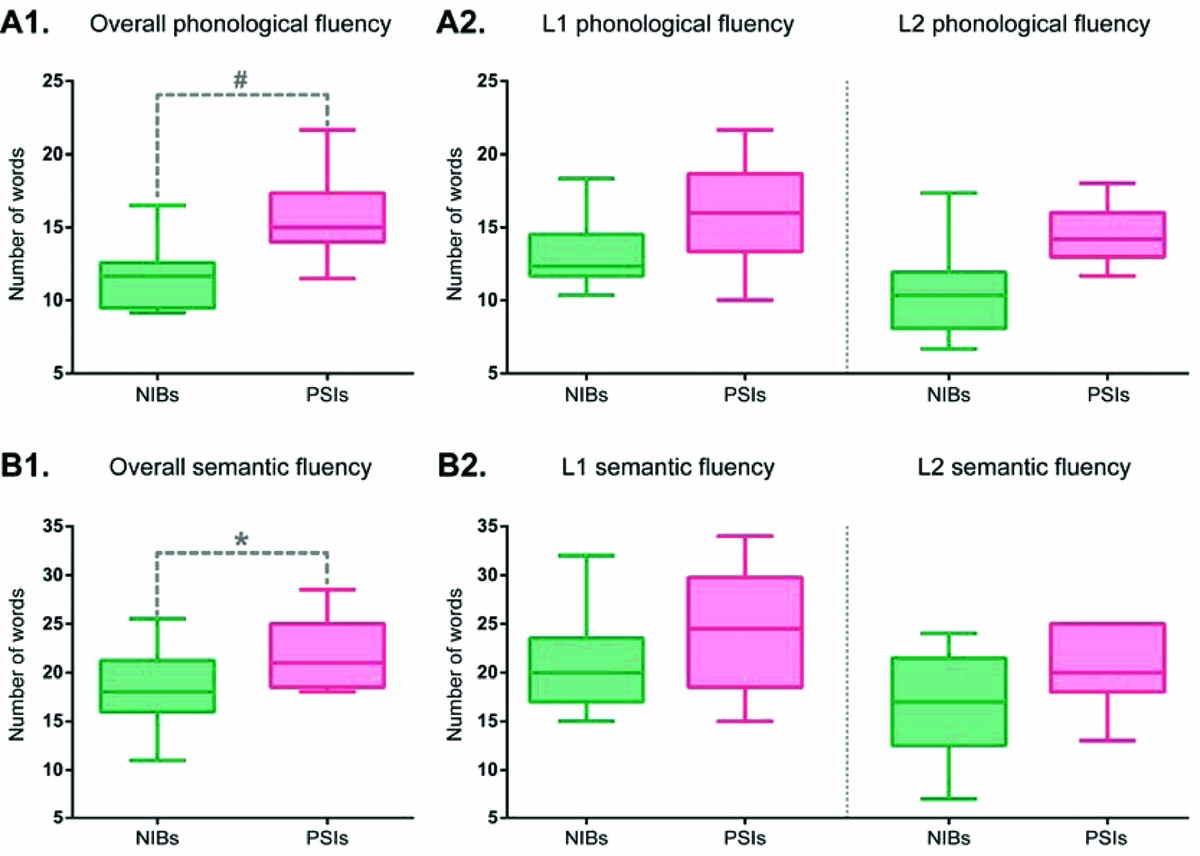
Results from the phonological fluency task revealed significantly better performance for PSIs over NIBs [F(1, 28) = 16.75, p < .001, partial η2= .37]. We also observed a main effect of language [F(1, 28) = 15.27, p < .001, partial η2 = .35], with more words produced in L1 than in L2. The interaction between the two factors was not significant [F(1, 28) = 2.12, p = .16, partial η2 = .07]. These results remained the same after the ANCOVA analysis for the main effects of group [F(1, 26) = 9.65, p < .005, partial η2 = .27] and for the interaction effect [F(1, 26) = 1.02, p = .32, partial η2 = .04]. However, the main effect of language did not survive the covariance analysis [F(1, 26) = 0.12, p = .71, partial η2 = .005]. These results are captured in Figure 1A. Also, a complementary analysis showed that, for PSIs, there was no association between the years of interpreting experience and phonological fluency performance in either language (see Table S6 in the Supplementary Material (Supplementary Material)). Neither was their performance predicted by any of the executive function measures (see Table S7a in the Supplementary Material (Supplementary Material)).
Phonological and semantic fluency results. A1. Overall phonological fluency: PSIs produced more words than NIBs when considering their performance in both languages. However, covariance results indicated that this pattern was not dependent on interpreting expertise. A2. Groups’ performance in each language: no statistical differences were found in the language-by-group interaction. B1. Overall semantic fluency: PSIs outperformed NIBs. This difference disappeared after covariance analysis, suggesting that it depended on interpreting expertise. B2. Groups’ performance in each language: as for phonological fluency, the language-by-group interaction was not significant. PSIs: professional simultaneous interpreters; NIBs: non-interpreter bilinguals. The asterisk (*) indicates significant differences at p < .05 for mixed ANOVA analysis only. The hash (#) identifies significant differences at p < .05 for both the mixed ANOVA and the ANCOVA analyses.

A similar pattern emerged in the semantic condition. PSIs produced significantly more words than NIBs [F(1, 27) = 6.18, p = .019, partial η2 = .19], and production was larger in L1 than in L2 [F(1, 27) = 11.43, p = .002, partial η2 = .3]. The group-by-language interaction did not reach significance [F(1, 27) = 1.63, p = .75, partial η2 = .004]. However, the main effect of language [F(1, 25) = .21, p = .65, partial η2 = .008], the effect of group [F(1, 25) =0.63, p = .435, partial η2 = .025], and the interaction effect [F(1, 25) = 0.28, p = .6, partial η2 = .01] were not significant after covariation with interpreting competence. These results are graphically shown in Figure 1B. Moreover, no significant correlations emerged between the PSIs’ years of experience and their semantic fluency performance in either language (see Table S6 in the Supplementary Material (Supplementary Material)). Finally, the PSIs' performance was not predicted by any of the executive function measures (see Table S7b in the Supplementary Material (Supplementary Material)).
In sum, these results indicate that vocabulary search skills were better for PSIs than NIBs (when guided by either phonological or semantic cues) and that both groups performed better in their L1 than in their L2. However, only differences in the semantic condition seemed to depend directly on interpreting competence. Furthermore, for PSIs, performance in none of the conditions was associated with the years of experience.
Picture naming
Accuracy and reaction time (RT) data were analyzed via two separate mixed-effects two-way ANOVAs. Both analyses included group (NIBs and PSIs) as a between-subject factor and language (L1 and L2) as a within-subject factor.
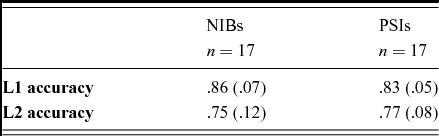
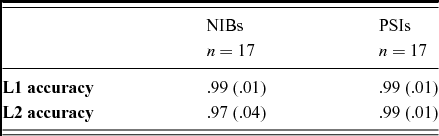
Accuracy analyses revealed that both groups were similarly accurate [F(1, 29) = .047, p = .83, partial η2 = .002]. They also showed an effect of language, with higher accuracy in L1 than in L2 [F(1, 29) = 23.79, p < .001, partial η2 = .45]. The interaction between the two factors was not significant [F(1, 29) = 2.65, p = .11, partial η2 = .08]. Mean scores and standard deviations are shown in Table 2.
Picture naming accuracy.

Data presented as mean (SD). NIBs: non-interpreter bilinguals; PSIs: professional simultaneous interpreters; L1: native language; L2: foreign language.
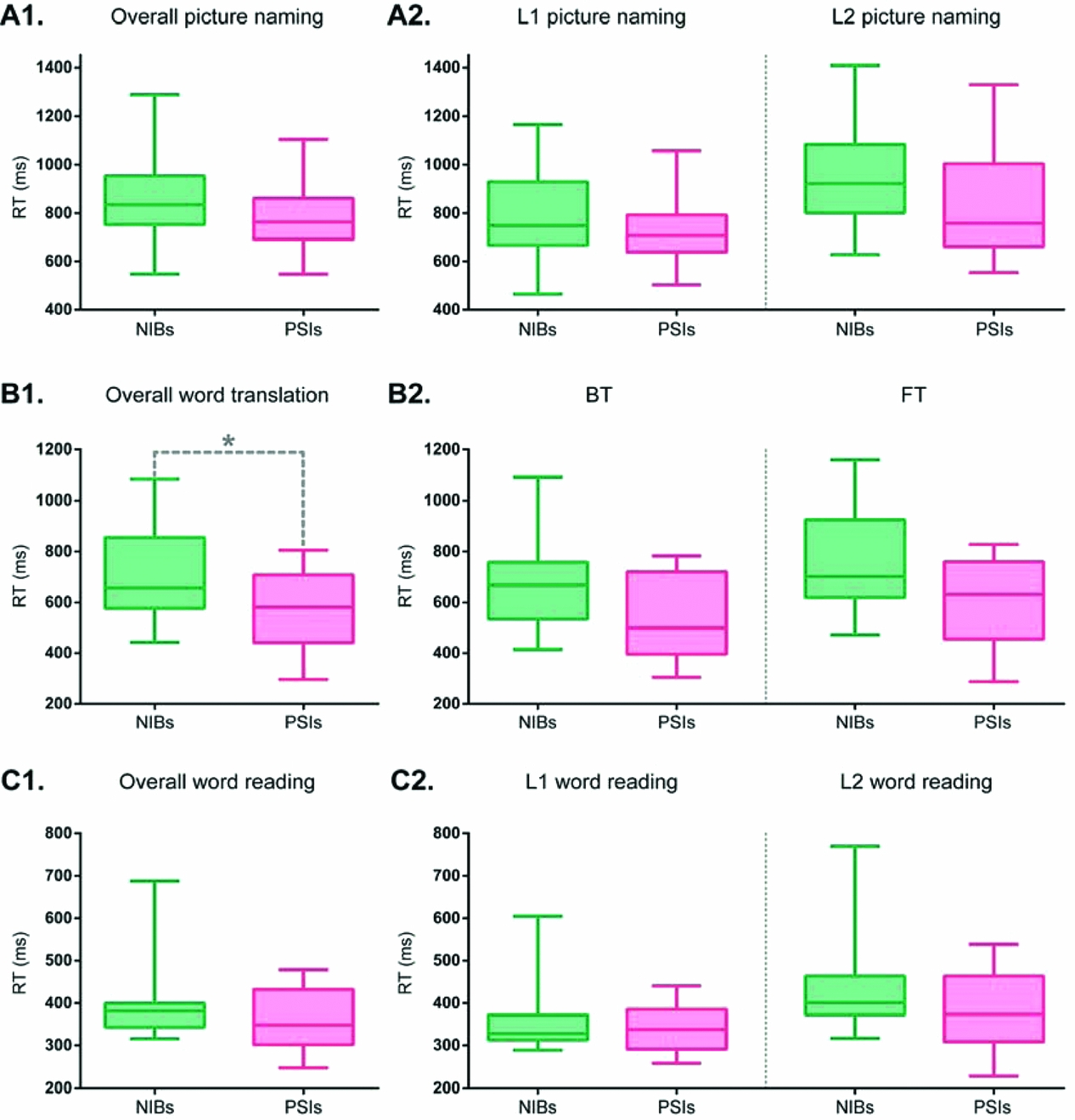
Results showed that PSIs did not significantly differ from NIBs in their RTs [F(1, 30) = 2.68, p = .11, partial η2 = .08]. Besides, naming was faster in L1 than in L2 [F(1, 30) = 23.92, p < .001, partial η2 = .44]. The interaction between both factors was not significant [F(1, 30) = 1.34, p = .26, partial η2 = .04]. After the covariance analysis, whereas the language effect remained significant [F(1, 28) = 7.57, p = .010, partial η2 = .21], no significant differences were observed in the effect of group [F(1, 28) = 0.02, p = .88, partial η2 = .001] and the interaction effect [F(1, 28) = 0.39, p = .535, partial η2 = 0.01]. These results are captured in Figure 2A. Also, the PSIs’ picture-naming performance was not predicted by any of the executive function measures (see Table S7c in the Supplementary Material (Supplementary Material)).
Reaction time results for the picture naming, word translation, and word reading tasks. A1. Overall picture naming: PSIs and NIBs presented similar reaction times. A2. Groups’ performance in each language: the interaction effect between language and group was not significant. B1. Overall word translation: PSIs were significantly faster than NIBs. This difference disappeared after covariance analysis, suggesting an influence of interpreting expertise. B2. Groups’ performance in each language: no statistical differences were found in the language-by-group interaction. C1. Overall word reading: The two groups showed similar reaction times. C2: Groups’ performance in each language: the language-by-group interaction was not significant. PSIs: professional simultaneous interpreters; NIBs: non-interpreter bilinguals. The asterisk (*) indicates significant differences at p < .05 for mixed ANOVA analyses only.

Overall, both groups evinced a similar performance in retrieving semantically constrained words. Also, both groups were characterized by greater efficacy and efficiency to perform the task in L1 than in L2, even after covariation analysis.
Word translation
Translation performance was analyzed through a 2 x 2 mixed-effects ANOVA, with group (NIBs and PSIs) as a between-subjects factor and directionality (BT and FT) as a within-subject factor.
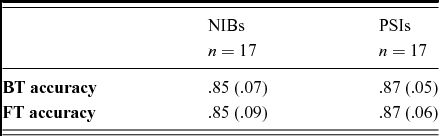
Accuracy was similar between groups [F(1, 30) = 0.68, p = .42, partial η2 = .02] and conditions [F(1, 30) = .000, p = .99, partial η2 < 001]. The interaction between both factors was not significant [F(1, 30) = .03, p = .87, partial η2 < .001]. Mean scores and standard deviations are shown in Table 3.
Word translation accuracy.

Data presented as mean (SD). NIBs: non-interpreter bilinguals; PSIs: professional simultaneous interpreters; BT: backward translation; FT: forward translation.
Instead, translation performance was significantly faster for PSIs than NIBs [F(1, 32) = 6.006, p = .02, partial η2 = .16], and BT involved lower RTs than FT [F(1, 32) = 12.49, p = .001, partial η2 = .28] . However, no significant RT differences emerged in the interaction between group and directionality [F(1, 32) = 1.3, p = .26, partial η2 = .04]. Also, the effect of group did not survive covariation with interpreting competence [F(1, 30) = 0.02, p = .89, partial η2 = .001.], which also yielded null effects of translation direction [F(1, 30) = 0.25, p = .62, partial η2 = .01.] and interaction [F(1, 30) = 2.45, p = .13, partial η2 = .075]. These results are graphically presented in Figure 2B. Furthermore, the amount of experience in PSIs was negatively correlated with translation speed in each direction (see Table S6 in the Supplementary Material (Supplementary Material)). Note, in addition, that the PSIs' performance was not predicted by any of the executive function measures (see Table S7d in the Supplementary Material (Supplementary Material)). Finally, regression analyses on data from both groups collapsed showed that only translation speed – as opposed to translation accuracy – could be predicted for both BT and FT in terms of the subjects’ self-reported competence in the corresponding direction (Table S8a). However, separate regression analyses for each group (Table S8b and S8c) revealed that, only in PSIs, RTs for FT could be predicted by self-reported competence in that direction.
In short, both groups were similarly accurate in BT and FT. However, PSIs were characterized by faster performance in both directions, and they exhibited similar latencies for BT and FT. Once again, ANCOVA results indicated that these differences depended on the participants’ level of interpreting competence, even though the PSIs’ translation performance was not associated with their years of experience.
Word reading
The analysis of word-reading results followed the same statistical approach used for picture naming.
Accuracy results showed no significant differences between groups [F(1, 32) = 1.37, p = .25, partial η2 = .04] or languages [F(1, 32) = 1.97, p = .17, partial η2 = .06]. The interaction between those variables was not significant either [F(1, 32) = 2.27, p = .14, partial η2 = .07]. Mean scores and standard deviations are shown in Table 4.
Word reading accuracy.

Data presented as mean (SD). NIBs: non-interpreter bilinguals; PSIs: professional simultaneous interpreters; L1: native language; L2: foreign language.
RT results also showed similar performance for both groups [F(1, 32) = 1.055, p = .31, partial η2 = .03], although processing was faster for L1 than L2 collapsing both groups [F(1, 32) = 29.8, p < .001, partial η2 = .48]. However, the interaction between group and language was not significant [F(1, 32) = 2.19, p = .15, partial η2 = .06]. These results are shown in Figure 2C. Finally, word reading efficiency in PSIs was not predicted by any of the executive function measures (see Table S7e in the Supplementary Material (Supplementary Material)).
In sum, word-reading performance was similar for both groups, which also coincided in showing more efficient reading skills for L1 than L2 words.
Discussion
This study examined whether various operations within bilingual memory are sensitive to the sustained extreme demands characterizing the activity of PSIs. We found a two-fold pattern. On the one hand, PSIs exhibited better vocabulary search skills and they were faster to translate words in both directions. On the other hand, they showed no advantages for picture naming or word reading in either language. Such findings shed light on the cognitive particularities of PSIs and, more generally, on the adaptability of bilingual memory mechanisms to extreme processing conditions.
The selective impact of interpreting expertise on bilingual memory mechanisms
Verbal fluency tests revealed better lexical retrieval skills in L1 than in L2 for both groups. This replicates well-established patterns of asymmetrical performance in bilinguals with various levels of L2 and translation competence during single-language tasks (French & Jacquet, Reference French and Jacquet2004; García et al., Reference García, Ibáñez, Huepe, Houck, Michon, Lezama, Chadha and Rivera-Rei2014; Kroll & Stewart, Reference Kroll and Stewart1994). Yet, the most relevant finding was that, in both languages, PSIs showed greater efficiency than NIBs. This pattern emerged for both the phonological and the semantic fluency conditions, suggesting that sustained interpreting demands can enhance the ability to quickly find words satisfying task-specific constraints.
In line with these findings, PSIs have been observed to outperform NIBs in tasks which tax sublexical search mechanisms – e.g., lexical decisions on non-words (Bajo et al., Reference Bajo, Padilla, Padilla, Chesterman, Gallardo San Salvador and Gambier2000) – and meaning-based vocabulary search – e.g., categorization of non-typical exemplars (Bajo et al., Reference Bajo, Padilla, Padilla, Chesterman, Gallardo San Salvador and Gambier2000) and detection of semantic errors (Fabbro, Gran & Gran, Reference Fabbro, Gran and Gran1991; Yudes, Macizo, Morales & Bajo, Reference Yudes, Macizo, Morales and Bajo2013). In this sense, note that lexical retrieval processes in professional interpreting can engage either form-level or conceptual routes at different times (De Groot & Christoffels, Reference De Groot and Christoffels2006; Paradis, Reference Paradis1994). The advantage we found on both fluency tasks may thus follow from the continual demands that PSIs place on both levels of processing during task-constrained lexical retrieval.
However, results from the picture-naming task indicate that no such advantage emerges when words must be accessed within the constraints of restrictive picture-evoked conceptual schemas. Indeed, the same result was also observed in the only previous assessment of picture-naming skills in PSIs (Christoffels et al., Reference Christoffels, Degroot and Kroll2006). Thus, the semantic retrieval advantages exhibited by PSIs in the fluency task disappeared when words had to be activated based on schemas that satisfy highly specific semantic constraints.
The emerging pattern is that extreme demands placed by PSIs on bilingual memory affect mechanisms that are differentially taxed in professional settings. This is consistent with the results from the translation tasks. Although NIBs were as accurate as PSIs, the latter were significantly faster and, once again, this effect was not driven by their performance in either BT or FT. Prima facie, the latter result might seem at odds with Elmer et al.’s (Reference Elmer, Meyer and Jancke2010) finding that PSIs exhibit specifically distinct electrophysiological markers of semantic processing in the L2-L1 direction – for PSIs, this was the only language combination failing to evince enhanced N400 modulations during semantic decision. However, note that the PSIs in that study had been trained specifically in L2-L1 interpreting, suggesting that each interpreting direction can manifest specific adjustments depending on the particular forms of expertise developed by the PSIs. This implication actually aligns with our new findings: given that professionals in the present investigation reported possessing higher skills to interpret into each of their languages and doing so much more frequently than NIBs (see Table 1), it seems that cross-language connections for each direction can also become more efficient when repeatedly subjected to extreme demands. Note, in this sense, that regression analyses (Table S8b and S8c) showed that only in PSIs were translation RTs predictable from self-reported competence in the corresponding direction – although results for BT were only marginally significant.
A previous comparison between PSIs with NIBs yielded similar outcomes for both BT and FT (Christoffels et al., Reference Christoffels, Degroot and Kroll2006). Those results, as well as our own, are consistent with the ‘activation threshold hypothesis’, which posits that the more a connection is engaged during bilingual processing, the lesser the amount of stimulation needed to activate it (Paradis, Reference Paradis1993, Reference Paradis1994). It seems plausible that crosslinguistic links in PSIs developed lower thresholds due to their systematic recruitment in working settings. In fact, reaction times for BT and FT were the only two variables showing significant (negative) correlations with the PSIs’ years of interpreting experience (see Table S6), suggesting that translation speed increased in proportion to time spent in the profession. Interestingly, though, Christoffels et al. (Reference Christoffels, Degroot and Kroll2006) found no differences in translation performance when comparing PSIs with L2 teachers. However, this finding does not contradict the above interpretation.Footnote 3 In fact, L2 teachers can consistently rely on translation in their classes (Pekkanli, Reference Pekkanli2012) and develop greater (informal) translation competence than bilinguals who are not language professionals (García et al., Reference García, Ibáñez, Huepe, Houck, Michon, Lezama, Chadha and Rivera-Rei2014), Exp. 1). It is thus likely that translation-relevant routes become strengthened by any regular activity that continually taxes them.
On the other hand, PSIs showed no word-naming advantage in either language. Crucially, visual word recognition and phonological production subsystems (de Groot, Borgwaldt, Bos & van den Eijnden, Reference de Groot, Borgwaldt, Bos and van den Eijnden2002) are not taxed during simultaneous interpretation – reading skills have no critical bearing in this activity and the rate of production is not higher than that characterizing single-language communication (Chernov, Reference Chernov2004; Gerver, Reference Gerver1975). More particularly, word reading is a shallow task, which can be accomplished without semantic information or other mechanisms involved in vocabulary search (Sasanuma et al., Reference Sasanuma, Sakuma and Kitano1992; Teichmann et al., Reference Teichmann, Turc, Nogues, Ferrieux and Dubois2012). In fact, while electrophysiological evidence indicates that PSIs, as opposed to NIBs, would be characterized by “a training-induced altered sensitivity to semantic processing within and across L1 and L2” (Elmer et al., Reference Elmer, Meyer and Jancke2010, p. 152), semantic manipulations fail to modulate word naming performance regardless of the subjects’ experience in interlinguistic reformulation (García et al., Reference García, Ibáñez, Huepe, Houck, Michon, Lezama, Chadha and Rivera-Rei2014). Taken together, then, our findings indicate that the enhancements linked to interpreting expertise are confined to those skills that are specifically taxed during professional performance.
Finally, note that the enhancements of PSIs were not driven by any particular target language. Previous studies on executive skills have offered mixed results concerning this point, showing superior performance of PSIs in both languages for certain tasks (Christoffels et al., Reference Christoffels, Degroot and Kroll2006), but not others (Chincotta & Underwood, Reference Chincotta and Underwood1998; Tzou, Eslami, Chen & Vaid, Reference Tzou, Eslami, Chen and Vaid2011). One of the possible factors underlying those discrepancies is whether both the L1 and the L2 are regularly used as source and target languages. Our present findings, stemming from lexical tasks, likely reflect the interpreters’ greater expertise at working into their two languages. Indeed, relative to NIBs, PSIs perceived themselves as more competent in BT and FT and they spent significantly more hours a week interpreting in each direction. Thus, the interpreters’ language-non-selective advantages may reflect the high semantic and cross-linguistic demands posed on both languages and directions.
Notably, between-group differences in interpreting competence emerged robustly, and with large effect sizes, even though NIBs judged their interpreting skills as roughly “intermediate” (with scores of 4.82 for L2-L1 and 4.53 for L1-L2, over a maximum of 7). This possible overestimation may have been driven by the caveats inherent to self-report measures. However, even if excessive, these values were significantly lower (< .001) than those of PSIs, who, in agreement with their sustained experience in the field, actually estimated their skills as near-optimal (6.53 for L2-L1 and 6.35 for L1-L2). Although this pattern aligns with the overall rationale of the study, it would be important to acknowledge the potential caveats of subjective competence assessments and complement them with objective measures (see “Limitations and avenues for further research” section).
In sum, PSIs were characterized by increased lexical efficiency, but only in tasks requiring quick vocabulary search or interlinguistic processing. These two operations, as opposed to word reading, are differentially taxed in the particular linguistic scenarios they recurrently face. Thus, extreme demands placed on bilingual memory do not lead to holistic reconfigurations of the system. On the contrary, processing enhancements seem confined to those subfunctions that become specifically recruited for expert performance.
Insights into the organization and flexibility of bilingual memory
Our results show that, despite their constant interplay and tight coactivation, specific mechanisms within bilingual memory can selectively adapt to meet elevated processing demands. This overall finding underscores the functional independence of distinct mechanisms within the system, thus shedding light on its architecture.
First, the enhancement of translation performance in the absence of increased reading efficiency attests to the autonomy of interlinguistic (as opposed to intralinguistic) connections within bilingual memory. Our claim is supported by two separate strands of evidence. Crucially, behavioral evidence has repeatedly shown differential performance between both tasks in subjects with and without formal training in interlingual reformulation (García et al., Reference García, Ibáñez, Huepe, Houck, Michon, Lezama, Chadha and Rivera-Rei2014; Kroll & Stewart, Reference Kroll and Stewart1994; Kroll et al., Reference Kroll, van Hell, Tokowicz and Green2010). Also, neurological evidence indicates that reading and translation skills involve differential activity patterns (García, Reference García2013; Price, Green & von Studnitz, Reference Price, Green and von Studnitz1999) and can become doubly dissociated following brain lesions (García, Reference García2015b) or selectively inhibited with direct cortical stimulation of circumscribed cortical sites (Borius et al., Reference Borius, Giussani, Draper and Roux2012).
Second, the differential pattern between semantic- and form-level operations (e.g., semantic fluency vs. word reading) supports hierarchical models of bilingual memory – namely, models that recognize partially distinct processing mechanisms at the levels of meaning and form. This observation, indeed, is consistent with studies in various bilingual groups showing dissociations between conceptual and sublexical manipulations via translation, masked interlinguistic priming, equivalent recognition, and word association paradigms (for reviews, see Brysbaert & Duyck, Reference Brysbaert and Duyck2010; García, Reference García2015a; Kroll et al., Reference Kroll, van Hell, Tokowicz and Green2010). Moreover, it aligns with clinical evidence of bilingual aphasics capable of establishing interlinguistic correspondences despite semantic access impairments (De Vreese, Motta & Toschi, Reference De Vreese, Motta and Toschi1988; Paradis, Goldblum & Abidi, Reference Paradis, Goldblum and Abidi1982) – for a review, see García (Reference García2015b).
From a theoretical perspective, the evidence exposes the limitations of models which fail to introduce explicit distinctions between routes specialized for reading and translation, or between semantic and form-level systems (van Heuven et al., Reference van Heuven, Dijkstra and Grainger1998). Conversely, it supports models which relate those oppositions with specific connections and strata, respectively (Dijkstra & van Heuven, Reference Dijkstra and van Heuven2002; Dong et al., Reference Dong, Gui and Macwhinney2005; Kroll & Stewart, Reference Kroll and Stewart1994; Kroll et al., Reference Kroll, van Hell, Tokowicz and Green2010; Van Hell & De Groot, Reference Van Hell and De Groot1998). Our findings contribute to the literature by showing that these functionally independent subsystems or operations within bilingual memory can selectively adapt to meet recurrent high demands placed on them.
Furthermore, present results suggest that the intensity and recurrence with which the above mechanisms are used can enhance relevant connections beyond the well-established effects of L2 proficiency, age of acquisition, or degree of exposure. In particular, PSIs in our study were matched with NIBs in terms of L2 competence, age of L2 learning, years of L2 study, and weekly hours of exposure to L2 media, which suggests that the observed effects were probably not driven by such factors. In the same vein, bilingualism per se has no beneficial effects on semantic fluency in adults (Bialystok et al., Reference Bialystok, Craik and Luk2008; Friesen et al., Reference Friesen, Luo, Luk and Bialystok2015; Sandoval, Gollan, Ferreira & Salmon, Reference Sandoval, Gollan, Ferreira and Salmon2010), and increased translation competence entails lexical processing enhancements even when samples are matched for L2 competence (García et al., Reference García, Ibáñez, Huepe, Houck, Michon, Lezama, Chadha and Rivera-Rei2014). Although objective assessments would be required to better assess the issue, self-report measures of L1 and L2 skills have been found to closely replicate reaction-time results (Langdon, Wiig & Nielsen, Reference Langdon, Wiig and Nielsen2005), successfully predict language ability (Marian, Blumenfeld & Kaushanskaya, Reference Marian, Blumenfeld and Kaushanskaya2007), and reproduce statistical results of multilingual naming tests for classifying bilinguals into language-dominance groups (Gollan, Weissberger, Runnqvist, Montoya & Cera, Reference Gollan, Weissberger, Runnqvist, Montoya and Cera2012). Therefore, the differences observed between groups seem to be specifically associated to interpreting expertise, as opposed to field-unspecific variables modulating bilingual performance – for compatible claims about executive skills, see Babcock and Vallesi (Reference Babcock and Vallesi2015).
Indeed, ANCOVA results showed that between-group differences in semantic fluency and word translation disappeared after covariation with interpreting competence, suggesting a critical influence of this variable on such effects. The only exception to this pattern concerned phonological fluency differences, which did survive covariation with interpreting competence. Given that the groups were matched for bilingualism-related factors (e.g., L2 competence, age of L2 learning, years of L2 study), we surmise that phonological fluency may be more critically dependent on other factors non-linearly related to interpreting competence, such as phonological awareness. Also, the pattern may be more simply reflecting a ceiling effect in task performance. However, since our study did not include tests aimed to assess these factors, these claims remain conjectural and should be further addressed in future studies.
Finally, it has not escaped our attention that lexical processing also recruits executive functions (Christoffels et al., Reference Christoffels, Degroot and Kroll2006; Christoffels, De Groot & Waldorp, Reference Christoffels, De Groot and Waldorp2003; Martin, Wiggs, Lalonde & Mack, Reference Martin, Wiggs, Lalonde and Mack1994; McDowd, Hoffman, Rozek, Lyons, Pahwa, Burns & Kemper, Reference McDowd, Hoffman, Rozek, Lyons, Pahwa, Burns and Kemper2011), which would in principle weaken the proposed association between interpreting expertise and adaptations of bilingual memory proper. However, reported semantic processing advantages in PSIs are independent of working memory (Yudes et al., Reference Yudes, Macizo, Morales and Bajo2013), and enhancements of the latter domain do not necessarily correlate with superior lexical retrieval (Christoffels et al., Reference Christoffels, Degroot and Kroll2006). Similarly, although working memory capacity correlates with word translation performance in NIBs (Kroll et al., Reference Kroll, Michael, Tokowicz and Dufour2002), previous research indicates that PSIs’ remarkable ability to engage in concurrent source-language comprehension and target-language production depends on lexical skills rather than on executive enhancements (Padilla et al., Reference Padilla, Bajo and Macizo2005). Also, results from graphical modeling show that translation and working memory skills are independent components which contribute separately to interpreting performance (Christoffels et al., Reference Christoffels, De Groot and Waldorp2003). More crucially, increased efficiency in the present study cannot be attributed to PSIs’ executive skills, as both samples were matched for working memory, cognitive flexibility, and overall executive performance. In fact, multiple linear regressions in the present study showed that the PSIs’ performance in each lexical task was not predicted by executive skills (see Tables S7a–S7e). Also, although some studies have found enhanced performance for PSIs than NIBs on certain executive domains (García, Reference García2014), this pattern is not entirely systematic – for instance, non-significant differences have been reported by Köpke and Nespoulous (Reference Köpke and Nespoulous2006) and Signorelli et al. (Reference Signorelli, Haarmann and Obler2011). Consequently, we propose, sustained extreme demands during bilingual processing can hone specific lexical mechanisms in a sui generis fashion, irrespective of the contributions of domain-general functions.
In sum, despite their joint and tight cooperation, different subcomponents within bilingual memory seem characterized by independent usage-driven flexibility. This complex system is susceptible to sustained extreme demands beyond the effects of L2 mastery, age of acquisition, and degree of exposure. Moreover, the selective adaptation of its inner mechanisms is not epiphenomenal to extralinguistic factors. These findings, derived from PSIs as a model of expert bilingual processing, can fruitfully extend the field's current research agenda.
Limitations and avenues for further research
Our work features a number of limitations that pave the way for further research. First, we were unable to include additional tasks tapping other bilingual memory mechanisms, such as lexical and semantic decision, equivalent recognition, or associated word production. These paradigms could be incorporated in replications or extensions of our study as an additional testing ground of its conclusions. Second, the present findings are blind to the impact of interpreting expertise on other verbal units (e.g., sentences or supra-sentential texts), which could further illuminate the issue. Third, data on language and interpreting competence in our study were obtained exclusively through self-report measures. While these are widely and profitably used in the field (Hulstijn, Reference Hulstijn2012), they may be biased by self-image (e.g., social desirability) factors. Hence, future assessments should also include relevant objective measures, as suggested in the specialized literature (Hulstijn, Reference Hulstijn2012), and they should also consider the impact of the amount of training received in each interpreting direction. Fourth, our study is blind to several phenomena constraining bilingual lexical processing, such as cross-language (e.g., interference) effects (Roelofs, Piai, Garrido Rodriguez & Chwilla, Reference Roelofs, Piai, Garrido Rodriguez and Chwilla2016). In principle, our strict counterbalancing of tasks, conditions, languages (and even phonemes in the phonological fluency tasks) suggests that the present results cannot be attributed to disproportionate interferences between languages for each group due to aspects of the study's design. However, it may be the case that asymmetrical patterns of interactions between the L1 and L2 (Heikoop et al., Reference Heikoop, DeClerck, Los and Koch2016; Slevca, Daveya & Linck, Reference Slevca, Daveya and Linck2016) influenced the observed language effects (which consistently yielded better performance in L1). Further research would be needed to ascertain the specific role of potential cross-linguistic (including interference) effects during lexical processing in PSIs. Also, given that our research design precludes causal interpretations, it would be useful to replicate the study with a longitudinal approach and thus establish which of the observed differences are directly triggered by interpreting expertise. Finally, our behavioral approximation could be refined by adding neuroscientific measurements, as done in research tapping other aspects of interpreting expertise (Elmer, Hänggi & Jäncke, Reference Elmer, Hänggi and Jäncke2014; Elmer & Kuhnis, Reference Elmer and Kuhnis2016; Elmer et al., Reference Elmer, Meyer and Jancke2010). More generally, the notion that extreme demands on lexical systems may selectively modulate a subset of their mechanisms could be extrapolated as a working hypothesis for other models of expert language use, including stenographers, choppers (fast-paced rappers), and verse improvisers (e.g., Basque bertsolari or Argentine payadores). Efforts in these directions could open new avenues of development for bilingual memory research and related fields.
Conclusion
This work extends available evidence on the organization and flexibility of bilingual memory by showing its susceptibility to sustained extreme demands. By comparing the lexical skills of PSIs and NIBs, we found that vocabulary search and translation (as opposed to reading) mechanisms within the system can selectively adapt to meet the exacting conditions characterizing the former group. Our results support hierarchical models that incorporate functionally autonomous routes for interlinguistic processes as well as distinct processing levels for semantic and sublexical information. Further research on lexical processing in PSIs could offer additional valuable insights into the architecture of bilingual memory and its capacity for usage-driven reconfiguration.
Supplementary material
To view supplementary material for this article, please visit https://doi.org/10.1017/S1366728918000378