This completes my fourth year as editor of the APSR. The main theme
of last year's annual report was continuity from the previous year in the
flow, processing, and variety of the papers that we received and the
articles that we published. That theme dominates this year's report as well,
for only a glance at the tabular data reported below will be needed to
establish the incremental character of the year-to-year changes that we
experienced in the number and diversity of the papers that we received, the
time it took to process them, and the outcomes of our review process. Having
said that, I hasten to add that this year we have devoted extensive time and
energy to an exciting new project, which I will discuss at the end of this
report.
Before proceeding any further, I must extend a warm thanks to those who
contributed to the operation of the APSR during the past year,
including: Assistant Editor Elizabeth Cook; Editorial Assistants Jennifer
Deets, Beth Franker, Lee Michael, and Jennie Schulze; the members of the
APSR Editorial Board, bolstered during 2004–2005 by the
additions of James Adams and Daniel Treisman; staff members too numerous to
list at the APSA office, the George Washington University, and Cambridge
University Press; the authors who submitted their papers; and the reviewers
who donated their time, expertise, and good will to assessing these
submissions (and who will be acknowledged by name in our November
issue).
Submissions and Processing
The Number of Papers Submitted
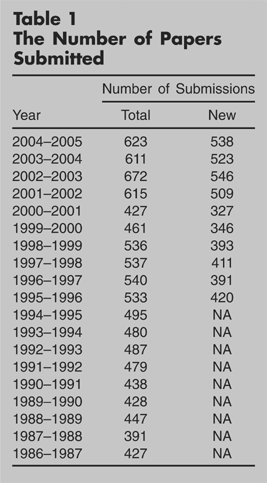
During my first year as editor, 2001–2002, submissions skyrocketed,
rising by 44% overall and by 56% for new manuscripts, compared to
the preceding year.1
As in previous
reports, for “total submissions” successive resubmissions of
the “same” paper are counted separately. For example, a
paper that was submitted, revised and resubmitted, and then
finally resubmitted following its conditional acceptance
pending final changes would count as three submissions, not
one. In terms of assessing the workflow for our office, this
counting rule is reasonable, for in the example just given,
several separate review processes would have been conducted.
For “new” or “original” submissions, by contrast, that
sequence would be counted as a single submission, not
three.
The next year, they spurted by another 9%
and 7%, respectively. Since then, they have reverted, more or less,
to their first-year levels. To judge from the numbers shown in
Table 1, the norm for the
APSR
appears to have settled in at 500 to 550 “new” submissions per year
and more than 600 in all. Thus, the 2004–2005 numbers bear out my
conclusion in last year's report that we had reached a new
equilibrium in terms of submissions and that submissions would
probably continue to hover around their current level.
The Number of Papers Submitted
Turnaround Times
One of my initial goals as editor was to speed up the review process.
During my first two years as editor, even as the flow of submissions
was rising dramatically, we compiled faster processing times than
had been achieved in the past by the APSR or, for that
matter, by other major political science journals. As explained in
last year's report, during 2003–2004 we deliberately slowed down the
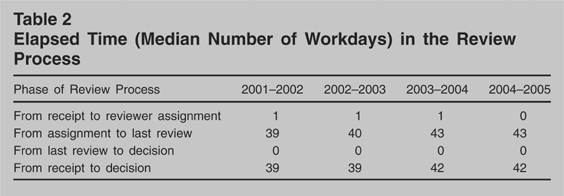
review process in some instances, and our median turnaround time
(the elapsed time between the day a paper arrive in our offices and
the day I sign the decision letter) rose from 39 to 43 working days.
During 2004–2005, our review process continued at the same pace as
in 2003–2004 (See Table 2). We
could go a little faster, but the effort that would be
required to do so would strain our capacity and the steps that would
be required (e.g., rejecting more papers without sending them out
for review) would engender a loss of good will among authors. Some
other journals are now touting turnaround times that are a bit
faster than ours, but such claims warrant close scrutiny2
For example, I reject very few papers
without review, and putting papers through a full-scale
review process obviously takes longer than rejecting them
out of hand. Moreover, many journals—but not the
APSR—cease operations and “stop the clock” for
a month during the summer. That is, they do not count days
spent at the beach as “working days” for purposes of
calculating turnaround times; thus, 43 working days at the
APSR may well pass more quickly, in real time,
than, say, 38 working days at another journal.
and,
in any event, the pace of our review process continues to be highly
acceptable.
Elapsed Time (Median Number of Workdays) in the Review
Process
The Mix of Submitted Papers
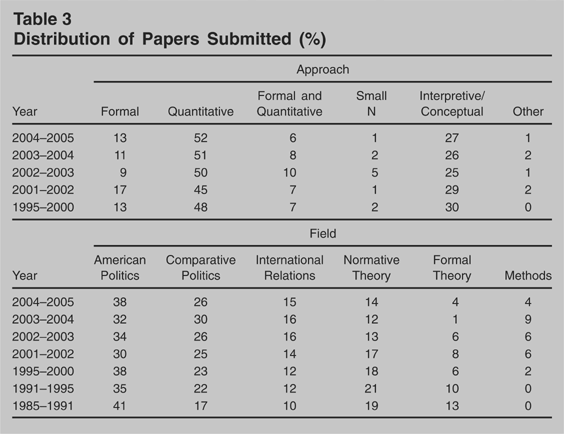
Categorized according to primary analytical approach and disciplinary
subfield, the distribution of submitted papers remained virtually
identical in 2004–2005 to the pattern that has become familiar in
recent years (See Table 3). Again in
2004–2005, most APSR submissions were quantitative and/or
formal, and about one in four (predominantly but by no means
exclusively normative theory) was classified broadly as
“interpretive/conceptual.” We continued to receive very few
“small-N” papers. American politics-focused submissions continued to
outpace submissions in other subfields, followed by comparative
politics and, more distantly, international relations and normative
theory. I am reluctant to attribute much meaning to year-to-year
fluctuations in these figures, and longer-term comparisons indicate
changes of quite limited degree.
Distribution of Papers Submitted (%)
Outcomes
From the perspective of outcomes as well as submissions and processing,
2004–2005 amounted to more of the same, i.e., a continuation of trends
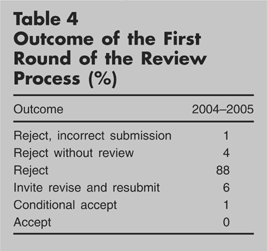
documented in my prior annual reports. Once again, 88 of every 100 of my
first-round decisions were rejections based on the recommendations of
reviewers. Another 1% (“incorrect” submissions) occurred because the
authorship of a paper had not been rendered sufficiently anonymous, the
paper far exceeded our length limit, or its formatting was wildly at
variance with our guidelines; in each such case, the author was invited
to fix the problem and submit a corrected version of the paper. Another
4% of my decisions were to reject a paper without review because in my
judgment it was so inappropriate for the APSR that no purpose
would be served by sending it out for review; this was a higher
proportion than in past years, reflecting encouragement from the
editorial board to make selectively greater use of this expedient. Only
7% of my first-round decisions were “positive,” in the sense of inviting
an author to revise a paper for further consideration or accepting it
subject to some final conditions; one paper was unconditionally accepted
in the first round. (See Table 4.)
Outcome of the First Round of the Review Process (%)
I also continued to make very sparing use of “revise and resubmit”
invitations and to resist the temptation to pile one such invitation on
top of another. The great majority—75–80%—of revised-and-resubmitted
papers were ultimately accepted.
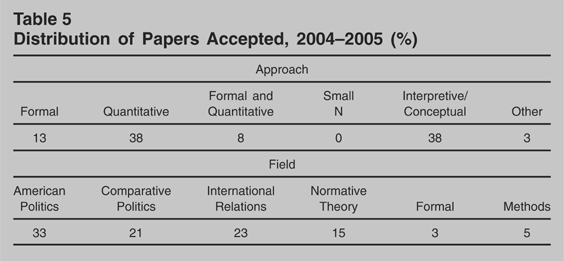
Of the papers that were accepted during 2004–2005 for publication in the
APSR, 59% were classified as formal and/or quantitative,
less than the proportion of such papers that we received during the year
(71%). On the other hand, 38% of the acceptances were for
interpretive/conceptual papers, which accounted for 27% of our
submissions. Across fields, acceptances roughly mirrored submissions. As
in past reports, I want to caution against overinterpreting differences
implied by comparing the figures in Tables 2
and 5; Table 5 is
based on a small number of acceptances, and the categorizations on which
both tables are based are rough-and-ready at best.
Distribution of Papers Accepted, 2004–2005 (%)
The articles that appeared in the APSR during 2004–2005
represented a wide variety of theoretical, analytical, and
methodological approaches and a rich array of subject matters; and
although only time will tell whether it will emerge among the most
important articles the APSR has ever published, one article in
particular—Alford, Funk, and Hibbing's “Are Political Orientations
Genetically Transmitted?”—has set a new standard for political science
in terms of the media attention and public discussion that its
publication has provoked.
Special Centennial Issue
In November 2006, we will publish a special issue on “The Evolution of
Political Science.” The November 2006, issue will launch the 100th
annual volume of the APSR, and a special centennial issue
devoted to analyses of the evolution of the discipline over the years
seems highly appropriate as a means of commemoration. I am co-editing
the special issue with M. Elizabeth Sanders, a member of the
APSR editorial board.
During the past year, we put out a call for submissions for the special
issue. In doing so, we emphasized, among other things, that (1) papers
must be brief (no more than 15–17 pages) so that we can accommodate as
large and diverse an array of perspectives on the discipline as
possible; (2) prospective authors should begin by submitting a brief
prospectus; (3) all submitted papers will undergo a full peer-review
process and we can offer no a priori assurance that a paper,
once submitted, will be accepted for publication; and (4) the deadline
for receipt of papers is January 2, 2006.
We undertook this project with a mixture of enthusiasm and trepidation.
We had no idea of whether it would spark much interest. Nor did our
normal procedures seem entirely appropriate in this instance; for
example, in receiving paper proposals and providing authors with
detailed feedback on them, we are functioning more in the mode of
Perspectives on Politics than of the APSR.
Happily, the call for submissions has produced an outpouring of proposals
far exceeding our most optimistic expectations. Building on preliminary
contacts from more than 120 prospective authors, we have received
roughly 75 full-blown proposals along with another 15 or so indications
that proposals may be forthcoming. For each such contact, we have tried
to provide constructive criticism and advice. Based on our feedback,
some authors have decided not to proceed, but the great majority have
expressed their intention to follow through by submitting a paper. I am
not exactly certain how we will manage this paper flow in
addition to our “regular” review process, but we will manage
it. (A nightmare scenario is that a large van will back up to our
building one day in early January and dump 75 centennial submissions on
our doorstep.) Many procedural details remain to be worked out. In any
event, the proposals that we have received promise to bring an
extraordinary diversity of perspectives to bear, and based on what I
have seen so far the publication of the centennial issue should greatly
enhance our understanding of the history and evolution of our discipline
and may even heighten our sense of intellectual community.