Introduction
Psychotic experiences (PEs) are hallucinations and delusions that do not reach the clinical threshold for a psychosis diagnosis (DeVylder et al., Reference DeVylder, Cogburn, Oh, Anglin, Smith, Sharpe, Jun, Schiffman, Lukens and Link2017). The annual incidence and prevalence of PEs have been reported to be 2.5% and 7.2%, respectively (Linscott and van Os, Reference Linscott and van Os2013). PEs are associated with an increased risk for psychotic disorders (Kaymaz et al., Reference Kaymaz, Drukker, Lieb, Wittchen, Werbeloff, Weiser, Lataster and van Os2012), as well as several physical conditions (e.g. angina, asthma, and arthritis) (Moreno et al., Reference Moreno, Nuevo, Chatterji, Verdes, Arango and Ayuso-Mateos2013), disability (Oh et al., Reference Oh, Koyanagi, Kelleher and DeVylder2018), and all-cause mortality (Sharifi et al., Reference Sharifi, Eaton, Wu, Roth, Burchett and Mojtabai2015). Therefore, identifying risk factors for PEs is a public health priority.
One potential risk factor that has been little studied to date is sexual orientation. Individuals with a non-heterosexual identity are known to be at high risk for a variety of factors that have been associated with the emergence of PEs [e.g. common mental disorders (CMDs) (Pakula and Shoveller, Reference Pakula and Shoveller2013), substance use (Hagger-Johnson et al., Reference Hagger-Johnson, Taibjee, Semlyen, Fitchie, Fish, Meads and Varney2013), and stress (Krueger et al., Reference Krueger, Meyer and Upchurch2018)]. However, to the best of our knowledge, there is only one previous study that has investigated the association between sexual orientation and PEs (Gevonden et al., Reference Gevonden, Selten, Myin-Germeys, de Graaf, ten Have, van Dorsselaer, van Os and Veling2014). This Dutch study including more than 11 200 participants found that lesbian, gay, and bisexual individuals were more likely to report at least one psychotic symptom compared to heterosexuals [odds ratios (OR) 2.30–2.56], and this association was partially mediated by factors such as experiencing discrimination in the past year or living arrangement (i.e. living or not with a partner). Although the findings from this study are of interest, it has several limitations that should be acknowledged. First, the sample only included sexually active persons, and it may thus be difficult to extrapolate the results to the general population. Second, sexual orientation (i.e. preceding year) and PEs (i.e. lifetime) were not assessed during the concurrent period. Thus, temporality is difficult to establish. Third, although the mediation analysis included factors such as past-year discrimination and lifetime cannabis use, it failed to include important factors that might potentially play a major role in the association between sexual orientation and PEs. These factors include marital status, education, employment, income, nicotine dependence, alcohol dependence, loneliness, social support, lifetime bullying victimization, perceived stress, stressful life events, CMDs, borderline personality disorder (BPD) traits, posttraumatic stress disorder (PTSD), and sleep problems.
Investigating the role of these factors is important as, for example, non-heterosexual orientation is positively associated with tobacco smoking (Lindström et al., Reference Lindström, Axelsson, Modén and Rosvall2014) and alcohol use (Hagger-Johnson et al., Reference Hagger-Johnson, Taibjee, Semlyen, Fitchie, Fish, Meads and Varney2013) possibly via minority stress and peer norms, while cigarettes (Gage et al., Reference Gage, Hickman, Heron, Munafò, Lewis, Macleod and Zammit2014) and alcohol (Tien and Anthony, Reference Tien and Anthony1990) have strong psychoactive effects that can increase the risk for PEs. In addition, loneliness and a lack of social support are common in sexual minorities (Doyle and Molix, Reference Doyle and Molix2016), both of which may in turn lead to PEs via mental disorders (Smyth et al., Reference Smyth, Siriwardhana, Hotopf and Hatch2015; Jaya et al., Reference Jaya, Hillmann, Reininger, Gollwitzer and Lincoln2017). Moreover, non-heterosexual orientation is a risk factor for bullying victimization (Berlan et al., Reference Berlan, Corliss, Field, Goodman and Austin2010), perceived stress (Krueger et al., Reference Krueger, Meyer and Upchurch2018), and stressful life events (Austin et al., Reference Austin, Rosario, McLaughlin, Roberts, Gordon, Sarda, Missmer, Anatale-Tardiff and Scherer2016), and these factors may increase the risk for PEs via elevated baseline activity and responsivity of the hypothalamic-pituitary-adrenal (HPA) axis (Beards et al., Reference Beards, Gayer-Anderson, Borges, Dewey, Fisher and Morgan2013; Catone et al., Reference Catone, Marwaha, Kuipers, Lennox, Freeman, Bebbington and Broome2015; DeVylder et al., Reference DeVylder, Koyanagi, Unick, Oh, Nam and Stickley2016). Sexual minorities are also known to be at a particularly high risk for CMDs (Pakula and Shoveller, Reference Pakula and Shoveller2013), BPD traits (Reuter et al., Reference Reuter, Sharp, Kalpakci, Choi and Temple2016), and PTSD (Roberts et al., Reference Roberts, Austin, Corliss, Vandermorris and Koenen2010), and these associations may be explained by exposure to discrimination, social isolation, and limited mental health service utilization. On the other hand, these mental health conditions are well-known risk factors for subclinical psychotic symptoms (Varghese et al., Reference Varghese, Scott, Welham, Bor, Najman, O'Callaghan, Williams and McGrath2011; Alsawy et al., Reference Alsawy, Wood, Taylor and Morrison2015; Niemantsverdriet et al., Reference Niemantsverdriet, Slotema, Blom, Franken, Hoek, Sommer and van der Gaag2017). Finally, the prevalence of sleep problems is high in sexual minorities, and this may be explained by a lack of social resources, high levels of distress, and unhealthy behaviors (Chen and Shiu, Reference Chen and Shiu2017). Sleep problems may in turn favor the occurrence of PEs via anxiety, depression, and stress (Reeve et al., Reference Reeve, Emsley, Sheaves and Freeman2018).
Therefore, the goal of the present nationally representative study using community-based data from the 2007 Adult Psychiatric Morbidity Survey (APMS) conducted in England was to analyze the association between sexual orientation and past 12-month PEs, and to identify the potential mediators involved in this relationship. Given that ~1.1 million people identify themselves as lesbian, gay or bisexual in Britain (Geary et al., Reference Geary, Tanton, Erens, Clifton, Prah, Wellings, Mitchell, Datta, Gravningen, Fuller, Johnson, Sonnenberg and Mercer2018), and that access to healthcare is often difficult for sexual minorities (McNamara and Ng, Reference McNamara and Ng2016), investigating this association using community-based data is important to obtain a better understanding of the epidemiology of PEs in this setting.
Methods
Study participants
This study used data from 7403 people who participated in the 2007 APMS. Full details of the survey have been published elsewhere (Jenkins et al., Reference Jenkins, Meltzer, Bebbington, Brugha, Farrell, McManus and Singleton2009; McManus et al., Reference McManus, Meltzer, Brugha, Bebbington and Jenkins2009). Briefly, this was a nationally representative survey of the English adult population (aged ⩾16 years) living in private households. The National Center for Social Research and Leicester University undertook the survey fieldwork in October 2006 to December 2007 using a multistage stratified probability sampling design where the sampling frame consisted of the small user postcode address file, while the primary sampling units were postcode sectors. Participant information was obtained through face-to-face interviews where some of the questionnaire items were self-completed (with the use of a computer). Sampling weights were constructed to account for non-response and the probability of being selected so that the sample was representative of the English adult household population. The survey response rate was 57%. Ethical permission for the study was obtained from the Royal Free Hospital and Medical School Research Ethics Committee. All participants provided informed consent before their inclusion.
Measures
Sexual orientation (independent variable)
Two items, adapted from the Kinsey scale, were used to measure sexual orientation: (a) ‘Which statement best describes your sexual orientation? This means sexual feelings, whether or not you have had any sexual partners.’ with answer options ‘entirely heterosexual,’ ‘mostly heterosexual,’ ‘bisexual,’ ‘mostly homosexual,’ ‘entirely homosexual,’ and ‘other’; and (b) ‘Please choose the answer below that best describes how you currently think of yourself…’ with answer options ‘completely heterosexual,’ ‘mainly heterosexual,’ ‘bisexual,’ ‘mainly homosexual,’ ‘completely homosexual,’ and ‘other.’ Participants were randomly allocated to item (a) and item (b) in order to analyze the impact of question wording and format on the prevalence of non-heterosexual orientation in the sample. As in a previous APMS publication, the two items were combined, and heterosexual orientation was operationalized as replying ‘entirely heterosexual’ to the first item or ‘completely heterosexual’ to the second item (Chakraborty et al., Reference Chakraborty, McManus, Brugha, Bebbington and King2011). All other individuals were considered to be non-heterosexual.
Psychotic experiences (dependent variable)
The Psychosis Screening Questionnaire (PSQ), which consists of sections on hypomania/mania, thought control, paranoia, strange experiences, and auditory hallucinations, was used to assess PEs in the past 12 months. As in a previous publication using the same dataset, the strictest criteria were used to define the presence or absence of psychotic symptoms in an attempt to capture truly anomalous experiences (Jacob et al., Reference Jacob, Haro and Koyanagi2018b). The questions used in the PSQ can be found in online Supplementary Appendix S1. Any PE referred to the endorsement of at least one of the five types of PE.
Mediating variables
These variables were selected based on previous literature (Tien and Anthony, Reference Tien and Anthony1990; Berlan et al., Reference Berlan, Corliss, Field, Goodman and Austin2010; Roberts et al., Reference Roberts, Austin, Corliss, Vandermorris and Koenen2010; Varghese et al., Reference Varghese, Scott, Welham, Bor, Najman, O'Callaghan, Williams and McGrath2011; Beards et al., Reference Beards, Gayer-Anderson, Borges, Dewey, Fisher and Morgan2013; Hagger-Johnson et al., Reference Hagger-Johnson, Taibjee, Semlyen, Fitchie, Fish, Meads and Varney2013; Pakula and Shoveller, Reference Pakula and Shoveller2013; Bauermeister et al., Reference Bauermeister, Meanley, Hickok, Pingel, VanHemert and Loveluck2014; Gage et al., Reference Gage, Hickman, Heron, Munafò, Lewis, Macleod and Zammit2014; Gevonden et al., Reference Gevonden, Selten, Myin-Germeys, de Graaf, ten Have, van Dorsselaer, van Os and Veling2014; Lindström et al., Reference Lindström, Axelsson, Modén and Rosvall2014; Alsawy et al., Reference Alsawy, Wood, Taylor and Morrison2015; Catone et al., Reference Catone, Marwaha, Kuipers, Lennox, Freeman, Bebbington and Broome2015; McGrath et al., Reference McGrath, Saha, Al-Hamzawi, Alonso, Bromet, Bruffaerts, Caldas-de-Almeida, Chiu, de Jonge, Fayyad, Florescu, Gureje, Haro, Hu, Kovess-Masfety, Lepine, Lim, Mora, Navarro-Mateu, Ochoa, Sampson, Scott, Viana and Kessler2015; Mollborn and Everett, Reference Mollborn and Everett2015; Smyth et al., Reference Smyth, Siriwardhana, Hotopf and Hatch2015; Austin et al., Reference Austin, Rosario, McLaughlin, Roberts, Gordon, Sarda, Missmer, Anatale-Tardiff and Scherer2016; DeVylder et al., Reference DeVylder, Koyanagi, Unick, Oh, Nam and Stickley2016; Doyle and Molix, Reference Doyle and Molix2016; Reuter et al., Reference Reuter, Sharp, Kalpakci, Choi and Temple2016; Chen and Shiu, Reference Chen and Shiu2017; Jaya et al., Reference Jaya, Hillmann, Reininger, Gollwitzer and Lincoln2017; Lunn et al., Reference Lunn, Cui, Zack, Thompson, Blank and Yehia2017; Niemantsverdriet et al., Reference Niemantsverdriet, Slotema, Blom, Franken, Hoek, Sommer and van der Gaag2017; Charlton et al., Reference Charlton, Gordon, Reisner, Sarda, Samnaliev and Austin2018; Davies et al., Reference Davies, Sullivan and Zammit2018; Krueger et al., Reference Krueger, Meyer and Upchurch2018; Reeve et al., Reference Reeve, Emsley, Sheaves and Freeman2018). Specifically, factors that have been reported to be associated with sexual orientation, and can precede or cause PEs were selected. These factors were marital status, qualification, employment, income, nicotine dependence, alcohol dependence, cannabis use, loneliness, social support, bullying victimization, perceived stress, number of stressful life events, discrimination due to sexual orientation, CMDs, BPD traits, PTSD, and sleep problems. Loneliness and lack of social support were both considered as separate mediators as they are distinct concepts which do not necessarily correlate. Specifically, loneliness refers to a subjective feeling of being alone, whereas the lack of social support refers to objective social exclusion (Tomaka et al., Reference Tomaka, Thompson and Palacios2006). Perceived stress and stressful life events were also included as separate mediators as perceived stress refers to a global and dynamic multidimensional subjective concept that is influenced by numerous factors (e.g. sociodemographics, personality, and lifestyle factors), whereas stressful life events refer to specific events that are known to be objectively associated with stress (Feizi et al., Reference Feizi, Aliyari and Roohafza2012).
Sociodemographic factors. These included marital status (married/cohabiting or single/widowed/divorced/separated), qualification (having a qualification i.e. degree, non-degree, A-level, GCSE, and other: yes or no), employment status, and income (highest ⩾£ 29 826, middle £ 14 057–<£ 29 826 or lowest <£ 14 057; equivalized income tertiles).
Nicotine dependence. Nicotine dependence was assessed using the Fagerström test, a six-item questionnaire (Chabrol et al., Reference Chabrol, Niezborala, Chastan and de Leon2005). The score of the test ranges from 0 to 10, and a score of ⩾6 indicates dependence to nicotine. A dichotomized variable was created (score ⩾6 or else).
Alcohol dependence. Excessive alcohol consumption was screened using the Alcohol Use Disorders Identification Test (AUDIT). Alcohol dependence was assessed with the Severity of Alcohol Dependence Questionnaire in participants with an AUDIT score of 10 or above. Scores of four or above indicated alcohol dependence in the past six months (Jacob et al., Reference Jacob, Haro and Koyanagi2019).
Cannabis use. Cannabis use referred to answering affirmatively to the question ‘In the last 12 months, have you taken cannabis?’ Data on the frequency of lifetime cannabis use were also available and this variable was dichotomized as <10 or ⩾10 times.
Loneliness. Loneliness was assessed with an item from the Social Functioning Questionnaire. Respondents were asked to assess to what extent they had felt ‘lonely and isolated from other people’ in the past 2 weeks with response options, ‘very much,’ ‘sometimes,’ ‘not often,’ and ‘not at all.’ In the analyses that follow, these response options were dichotomized with those who responded ‘sometimes’ and ‘very much’ being categorized as lonely (Jacob et al., Reference Jacob, Haro and Koyanagi2019).
Social support. This was assessed with a 7-item measure. Using answer options ‘not true’ (score = 0), ‘partly true’ (score = 1), and ‘certainly true’ (score = 2), participants responded to statements which inquired if family and friends did things to make them happy, made them feel loved, could be relied on no matter what, would see that they were taken care of no matter what, accepted them just the way they are, made them feel an important part of their lives, and gave them support and encouragement. Responses were added to create a scale score that could range from 0 to 14. The internal consistency of the scale was good: Cronbach's α = 0.89.
Bullying victimization. Those who claimed to have been bullied at any time in life were considered to have experienced bullying (Jacob et al., Reference Jacob, Haro and Koyanagi2018a).
Perceived stress. Participants were asked if their tasks at home and at work were stressful. Answers ranged from 0 ‘not at all’ to 3 ‘most of the time.’ Stress was then dichotomized into ‘not at all’ v. ‘occasionally,’ ‘usually,’ and ‘most of the time’ (Jacob et al., Reference Jacob, Haro and Koyanagi2019).
Stressful life events. Eighteen items were used to assess different stressful life events (e.g. serious illness, death of an immediate family member, major financial crises) (Jacob et al., Reference Jacob, Haro and Koyanagi2019). The total number of stressful life events was further calculated for each participant and ranged from 0 to 18.
Discrimination due to sexual orientation. Participants were asked if they had been unfairly treated in the past 12 months because of their sexual orientation.
Common mental disorders. These were assessed using the Clinical Interview Schedule Revised and referred to depressive episode and/or anxiety disorders (i.e. generalized anxiety disorder, panic disorder, phobia, and obsessive-compulsive disorder) in the past week (Jacob et al., Reference Jacob, Haro and Koyanagi2019).
Borderline personality disorder traits. The presence of the nine diagnostic criteria for BPD was assessed by the Structured Clinical Interview for DSM-IV Axis II disorders. The scores from each of the criteria (yes = 1 and no = 0) were added to create a scale ranging from 0–9 (Cronbach's α = 0.74). Following the lead of a previous publication using the same dataset (Kelleher et al., Reference Kelleher, Ramsay and DeVylder2017), the cutoff to represent high-BPD traits was based on a figure that corresponds to a prevalence which is approximately 10 times higher than that of BPD (0.4% in this dataset). Specifically, a score of ⩾6 was used as the cutoff to construct the dichotomous variable subsequently used in the analyses, with a score of ⩾6 coded as 1 and a score of <6 coded as 0. Owing to the fact that there were only 16 individuals with BPD in our dataset, we were unable to conduct meaningful analyses with BPD. Thus, rather, we focused on high-BPD traits.
Posttraumatic stress disorder. The Trauma Screening Questionnaire was used to examine PTSD symptoms. ‘Reliving' of the traumatic event was assessed with five items, while experiencing ‘arousal’ subsequent to the trauma was assessed with five other items. Each item with an affirmative answer was given one point, and a total score of ⩾6 points out of the possible 10 indicated a positive screen for PTSD, or probable PTSD (Alsawy et al., Reference Alsawy, Wood, Taylor and Morrison2015).
Sleep problems. Two questions were used to assess sleep problems: ‘In the past month, have you been having problems with trying to get to sleep or with getting back to sleep if you woke up or were woken up?’ (sleeping less than usual) and ‘Has sleeping more than you usually been a problem for you in the past month?’ (sleeping more than usual). Participants were considered as having sleep problems if they reported sleeping less or more than usual.
Control variables
The present study controlled for sex, age, and ethnicity (British White: yes or no).
Statistical analyses
Individuals with definitive or probable psychosis were omitted from the analysis as the focus of the study was on PEs not reaching the clinical threshold for a psychosis diagnosis (definition provided in online Supplementary Appendix S2). Differences in the sample characteristics by sexual orientation (heterosexual v. non-heterosexual) were tested with χ2 tests for categorical variables and Student's t tests for continuous variables.
We conducted multivariable logistic regression analyses to assess the association between sexual orientation (independent variable) and the individual types of PE and any PE (dependent variables). Sensitivity analysis by the two groups that were administered different questions on sexual orientation was subsequently performed. We further conducted mediation analysis to quantify the degree to which the association between sexual orientation and PEs may be explained by factors which can theoretically be mediators in this association. The khb (Karlson–Holm–Breen) command in Stata was used for this analysis (Breen et al., Reference Breen, Karlson and Holm2013). This method can be applied in logistic regression models and decomposes the total effect (i.e. unadjusted for the mediator) of a variable into direct (i.e. the effect of sexual orientation on any PE adjusted for the mediator) and indirect effects (i.e. the mediational effect). Using this method, the percentage of the main association explained by the mediator can also be calculated (mediated percentage). Each of the 17 mediating factors was included individually in the model.
The regression analyses including the mediation analysis were adjusted for sex, age, and ethnicity. Furthermore, since previous research has found that the association between sexual orientation and mental health disorders differs by sex (Bolton and Sareen, Reference Bolton and Sareen2011), an interaction analysis was conducted by including the product term of sexual orientation × sex in the models. All variables used in the analyses were categorical variables with the exception of age, social support, and the number of stressful life events. The sample weighting and the complex study design (i.e. strata and primary sampling units) were taken into account in all analyses with the use of the svy command in Stata, which relies on the Taylor linearization method. Under 2.0% of the values were missing for all the variables used in our study with the exception of income (20.0%). Complete case analysis was done. The level of statistical significance was set at p < 0.05. All analyses were performed with Stata version 13.1 (Stata Corp LP, College Station, Texas, USA).
Results
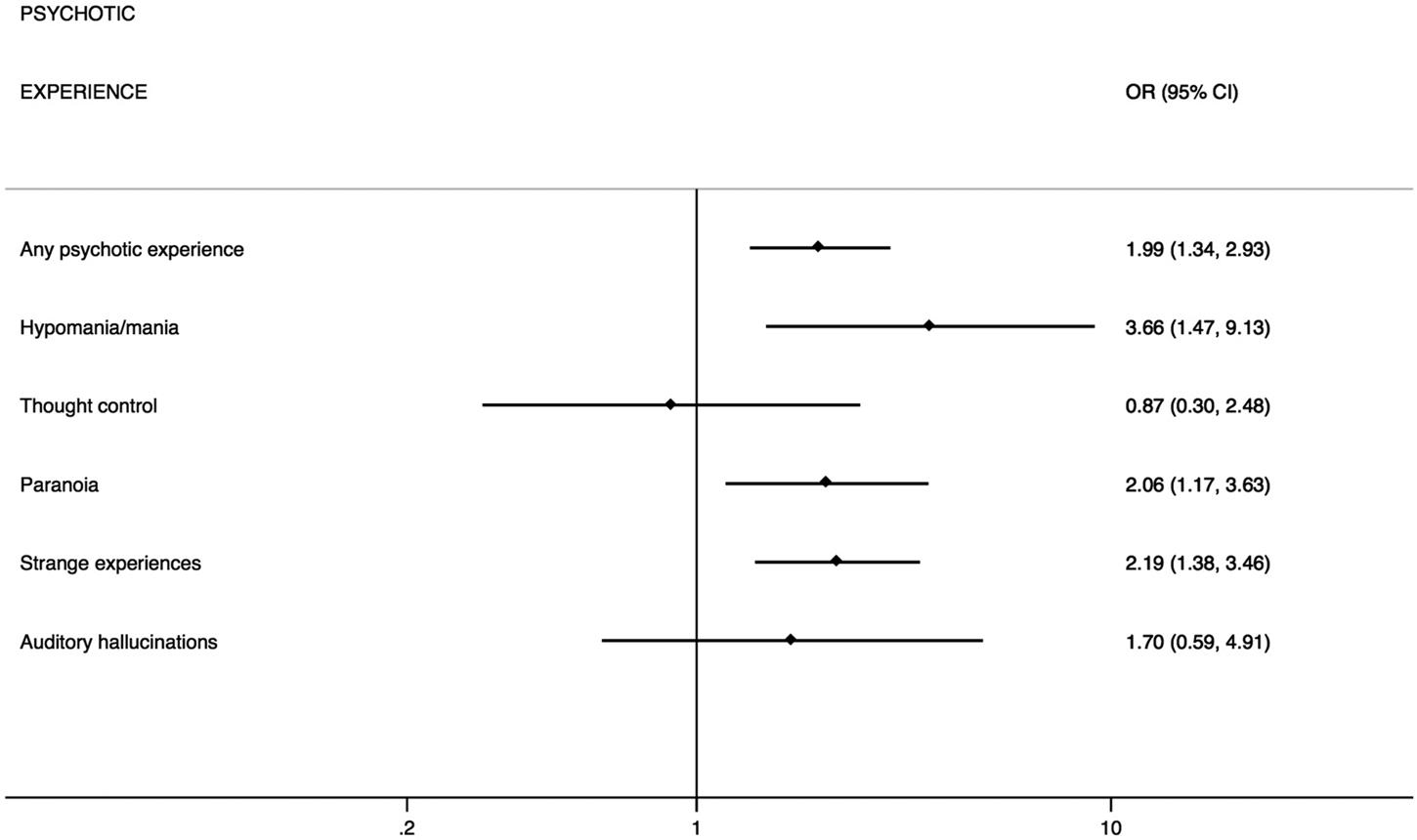
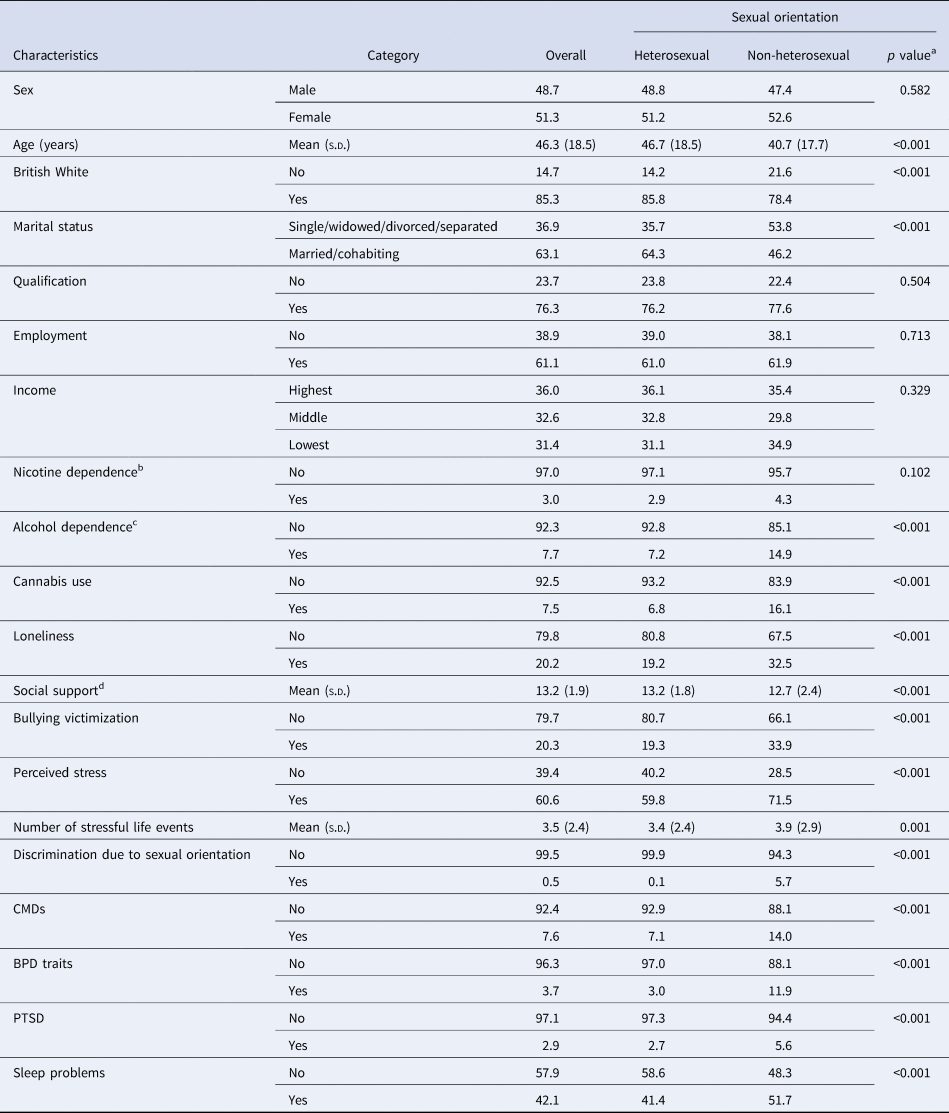
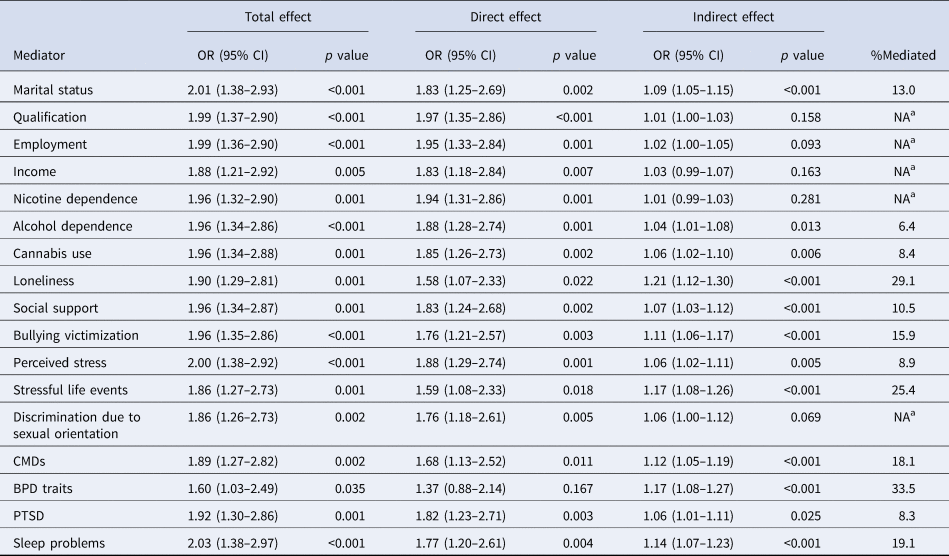
There were 7403 people aged ⩾16 years who participated in the 2007 APMS. We excluded 40 people who had probable psychosis from the study. Of the remaining 7363 individuals, a further 88 were excluded due to the lack of information on definitive/probable psychosis and/or sexual orientation. The prevalence of non-heterosexual orientation and any PE was 7.1% and 5.5%, respectively. The sample characteristics are displayed in Table 1. Ethnicity other than British White, single/widowed/divorced/separated, alcohol dependence, cannabis use, loneliness, bullying victimization, perceived stress, discrimination due to sexual orientation, CMDs, BPD traits, PTSD, and sleep problems were more common, and age and social support lower, while the number of stressful life events higher in non-heterosexual than in heterosexual individuals. The prevalence of any PE was 10.6% and 5.1% in non-heterosexual and heterosexual participants, respectively. After adjusting for sociodemographic factors (i.e. sex, age, ethnicity), non-heterosexual orientation was positively associated with any PE [OR 1.99, 95% confidence interval (CI) 1.34–2.93], hypomania/mania (OR 3.66, 95% CI 1.47–9.13), paranoia (OR 2.06, 95% CI 1.17–3.63), and strange experiences (OR 2.19, 95% CI 1.38–3.46; Fig. 1). Interaction analysis further revealed that sex was not a significant effect modifier in the sexual orientation-PE relationship (data not shown). The results of the sensitivity analysis by the two groups that were administered different questions on sexual orientation were similar, and this suggests that the phrasing of the question had little impact on the results. Finally, the results of the mediation analyses are shown in Table 2. The association between sexual orientation and any PE was significantly mediated by BPD traits (mediated percentage = 33.5%), loneliness (29.1%), stressful life events (25.4%), sleep problems (19.1%), CMDs (18.1%), bullying victimization (15.9%), marital status (13.0%), social support (10.5%), perceived stress (8.9%), cannabis use (8.4%), PTSD (8.3%), and alcohol dependence (6.4%). The mediated percentage for cannabis use was 5.9% when frequency (i.e. ⩾ or <10 times in life) was taken into account (data shown only in text). The level of pair-wise correlation between the mediators is shown in online Supplementary Appendix S3. A high level of correlation was not observed for any of the pairs.
Association between non-heterosexual orientation (exposure) and different types of PEs or any PEs (outcomes) estimated by multivariable logistic regression. OR, odds ratio; CI, confidence interval. Participants were asked about their sexual orientation, and sexual orientation was dichotomized into heterosexual and non-heterosexual (i.e. mostly/mainly heterosexual, bisexual, mostly/mainly homosexual, entirely/completely homosexual, other). Models were adjusted for sex, age, and ethnicity.

Sample characteristics (overall and by sexual orientation)

CMDs, Common Mental Disorders; BPD, Borderline Personality Disorder; PTSD, Posttraumatic Stress Disorder; s.d. Standard Deviation.
Participants were asked about their sexual orientation, and sexual orientation was dichotomized into heterosexual and non-heterosexual (i.e. mostly/mainly heterosexual, bisexual, mostly/mainly homosexual, entirely/completely homosexual, other)
a p values were based on χ2 tests except for age, social support, and the number of stressful life events (t-tests).
b Individuals who do not smoke were included in the category ‘no nicotine dependence’.
c Individuals who do not consume alcohol were included in the category ‘no alcohol dependence’.
d The variable on social support ranged from 0 to 14, with higher scores representing higher levels of social support.
Mediating factors in the association between non-heterosexual orientation (independent variable) and any psychotic experience (dependent variable)

OR, odds ratio; CI, confidence interval; CMDs, Common Mental Disorders; BPD, Borderline Personality Disorder; PTSD, Posttraumatic Stress Disorder.
Participants were asked about their sexual orientation, and sexual orientation was dichotomized into heterosexual and non-heterosexual (i.e. mostly/mainly heterosexual, bisexual, mostly/mainly homosexual, entirely/completely homosexual, other).
Any PE referred to the presence of at least one of: hypomania/mania, thought control, paranoia, strange experiences, and auditory hallucinations.
Models are adjusted for sex, age, and ethnicity.
a Mediated percentage was only calculated when the indirect effect was significant (p value < 0.05)
Discussion
Main findings
To the best of our knowledge, this is one of the first studies to examine the association between sexual orientation and PEs, while it is the first to investigate the potential mediating role played by a wide range of factors in this association. In this nationally representative study of English adults, the prevalence of any PE was around 11% in the non-heterosexual group and 5% in the heterosexual group. The regression analysis adjusted for sociodemographic factors (i.e. sex, age, and ethnicity) further revealed that non-heterosexual orientation was associated with a 2.0-fold increase in the risk for any PE compared to heterosexual orientation. We also found that the association of sexual orientation with hypomania/mania, paranoia, and strange experiences was particularly strong and this suggests that sexual orientation may not impact all types of PEs similarly. Finally, BPD traits, loneliness, and stressful life events explained around 25% to 34% of the sexual orientation-any PE relationship. Substance use had very little influence in the association.
Interpretation of the findings
The fact that non-heterosexual individuals were at higher risk for PE in our study is in line with the earlier Dutch study which found that non-heterosexual orientation was associated with 2.30–2.56 times higher odds for PE (Gevonden et al., Reference Gevonden, Selten, Myin-Germeys, de Graaf, ten Have, van Dorsselaer, van Os and Veling2014). The results also accord with those of previous studies that have investigated the association between sexual orientation and more severe forms of psychosis. For example, a nationally representative study using data from around 34 700 US participants showed that sexual minorities (e.g. gay and bisexual) were at an increased risk for psychosis, with ORs ranging from 1.99 to 2.70 (Bolton and Sareen, Reference Bolton and Sareen2011). Another UK study found in more than 7400 adults that there was more than a three-fold increase in the risk for probable psychosis in non-heterosexual individuals compared to heterosexual individuals (Chakraborty et al., Reference Chakraborty, McManus, Brugha, Bebbington and King2011).
In terms of the mediators, we found that BPD traits, loneliness, and stressful life events explained more than 25% of the association between sexual orientation and PE, while other factors such as sleep disorders, CMDs, bullying victimization, marital status, and social support explained 10–20% of the association. In contrast, the most important mediator identified in the Dutch study was past-year discrimination due to sexual orientation (34%) (Gevonden et al., Reference Gevonden, Selten, Myin-Germeys, de Graaf, ten Have, van Dorsselaer, van Os and Veling2014). Although we used a similar variable, discrimination due to sexual orientation was not a significant mediator in our study. This discrepancy in the findings highlights the fact that psychosocial factors involved in the sexual orientation-PE relationship may be population or context specific. Regarding substance use, the results of the two studies concur and show that it only plays a minor mediating role.
In our study, stressful life events explained around 25% of the sexual orientation-PE relationship. A longitudinal study conducted in the US and including young adults followed for several years showed that stressful life events (e.g. a life-threatening event, death of a loved one, divorce) were more frequent in bisexual or lesbian and in mostly heterosexual women than in their completely heterosexual counterparts (Austin et al., Reference Austin, Rosario, McLaughlin, Roberts, Gordon, Sarda, Missmer, Anatale-Tardiff and Scherer2016). On the other hand, a meta-analysis of 16 studies further reported that stressful life events increased the risk for psychotic disorder or subclinical psychosis (OR 3.19) (Beards et al., Reference Beards, Gayer-Anderson, Borges, Dewey, Fisher and Morgan2013). The association between stressful life events and PEs likely involves several mechanisms such as negative distortions of perception of the external world and dysregulations of the HPA axis (Beards et al., Reference Beards, Gayer-Anderson, Borges, Dewey, Fisher and Morgan2013). Bullying victimization may also be implicated in the sexual orientation-PE association in a similar way. Although some stressful life events and bullying victimization could have occurred for a variety of reasons during childhood and adolescent developmental stages, youths who will later identify as being non-heterosexual may display certain levels of gender non-conformity, and this could make them more susceptible to parental maltreatment at home or peer bullying at school during this formative period (Gevonden et al., Reference Gevonden, Selten, Myin-Germeys, de Graaf, ten Have, van Dorsselaer, van Os and Veling2014).
Loneliness also explained an important proportion of the association between sexual orientation and PEs. A previous study showed that sexual minorities (i.e. mostly heterosexual, bisexual, mostly gay/lesbian, and gay/lesbian) are more likely to be lonely possibly due to marginalization (Doyle and Molix, Reference Doyle and Molix2016). In turn, loneliness may lead to PE via depression and other mental disorders (Jaya et al., Reference Jaya, Hillmann, Reininger, Gollwitzer and Lincoln2017). Interestingly, despite this finding on loneliness, social support explained the sexual orientation-PE association to a much lesser extent in our study. This may mean that the self-perception of social relationships is more important than actual social ties.
Next, a variety of psychopathology including BPD traits, CMDs, and PTSD has been reported to be more common in non-heterosexual individuals, and this may be due to factors such as chronic environmental invalidation (e.g. negation of emotions, dismissal of cognitive experiences) and disruptions in identity formation (Reuter et al., Reference Reuter, Sharp, Kalpakci, Choi and Temple2016). On the other hand, PEs are known to be highly prevalent among those with BPD and other psychiatric conditions (Niemantsverdriet et al., Reference Niemantsverdriet, Slotema, Blom, Franken, Hoek, Sommer and van der Gaag2017). Moreover, an important proportion of non-heterosexual individuals is affected by sleep disorders (Chen and Shiu, Reference Chen and Shiu2017), and sleep problems have been reported to induce PEs (Koyanagi and Stickley, Reference Koyanagi and Stickley2015). Furthermore, perceived stress is highly frequent in sexual minorities (Krueger et al., Reference Krueger, Meyer and Upchurch2018), and the association between perceived stress and PEs may involve chronic hyperactivity of the HPA axis (DeVylder et al., Reference DeVylder, Koyanagi, Unick, Oh, Nam and Stickley2016). However, it is also important to note that the mediators identified in our study may be operating at multiple levels of the causal pathway. For example, non-heterosexual orientation may lead to increased levels of perceived stress (Krueger et al., Reference Krueger, Meyer and Upchurch2018), while this in turn, may increase risk for sleep problems (Charles et al., Reference Charles, Slaven, Mnatsakanova, Ma, Violanti, Fekedulegn, Andrew, Vila and Burchfiel2011) and a variety of mental disorders (Bergdahl and Bergdahl, Reference Bergdahl and Bergdahl2002), which could lead to the emergence of PEs (Varghese et al., Reference Varghese, Scott, Welham, Bor, Najman, O'Callaghan, Williams and McGrath2011; Reeve et al., Reference Reeve, Emsley, Sheaves and Freeman2018). Finally, it is possible that other factors which were not measured in our study may be implicated in the sexual orientation-PE relationship, and these may include factors such as cortisol levels (Collip et al., Reference Collip, Nicolson, Lardinois, Lataster, van Os and Myin-Germeys2011) and sexually transmitted diseases (Alciati et al., Reference Alciati, Fusi, D'Arminio Monforte, Coen, Ferri and Mellado2001; Fenton et al., Reference Fenton, Mercer, Johnson, Byron, McManus, Erens, Copas, Nanchahal, Macdowall and Wellings2005).
Clinical implications and directions for future research
The results of our study showed that PEs in non-heterosexual individuals are likely to be explained, at least in part, by psychosocial factors (e.g. loneliness, stressful life events, bullying victimization) and mental health conditions (e.g. BPD traits, CMDs, PTSD). Clinicians should be aware that these conditions are more common among non-heterosexuals and that these may be underlying factors for PEs. Taken together, our findings highlight the importance of the social context in the sexual orientation-PE relationship. These findings also underline the need for new programs aiming at the improvement of the health, safety, and well-being of sexual minorities. In addition, the lack of acceptance of non-heterosexual individuals may have considerable effects on their health and well-being, and this should be the focus of collective efforts in the future. Finally, further studies that investigate the underlying mechanisms that lead to stronger associations between sexual orientation and certain types of PE are warranted.
Limitations
First, in order to achieve a sample of individuals without clinical psychosis, we used a conservative approach of excluding not only individuals with a definitive psychosis diagnosis but also people with probable psychosis. However, it is possible that some individuals with probable psychosis did not have clinical psychosis, and thus, some individuals without clinical psychosis could have been excluded. Second, the design of this study was cross-sectional, and it was thus not possible to determine causality or temporality in the sexual orientation-PE relationship. Relatedly, mediation and confounding have been found to be statistically identical and distinguished only on conceptual grounds in the context of ordinary least squares regression (MacKinnon et al., Reference MacKinnon, Krull and Lockwood2000). While many of the mediating variables assessed in this study can be conceptualized as mediators, it is not possible to determine whether the attenuation in the ORs after the inclusion of the mediating variable is due to mediation or confounding in our cross-sectional study. Nonetheless, given that the influential factors in the association between sexual orientation and PE are largely unknown, we believe that our study provides an important platform for future longitudinal studies to provide more concrete evidence for the establishment of causality.
Conclusion
Our findings suggest that there is a positive relationship between non-heterosexual orientation and PEs in the general population in England, and that underlying mechanisms may involve other mental health conditions as well as psychosocial factors. Further studies with a longitudinal design are warranted to understand in more detail, how these factors are implicated in the association between sexual orientation and PEs.
Supplementary material
The supplementary material for this article can be found at https://doi.org/10.1017/S003329171900309X.
Data
The dataset on which the present study was based is publicly available to all interested researchers but they must make a formal request to the UK data service data repository (https://www.ukdataservice.ac.uk/) where the dataset is stored.
Acknowledgements
We would like to thank the National Center for Social Research and the University of Leicester who were the Principal Investigators of this survey. In addition, we would also like to thank the UK Data Archive, the National Center for Social Research, and other relevant bodies for making these data publicly available. They bear no responsibility for this analysis or interpretation of this publicly available dataset.
Author contributions
Louis Jacob and Ai Koyanagi designed the study, managed the literature search, undertook the statistical analysis, and wrote the first draft of the manuscript. Lee Smith, Daragh McDermott, Josep Maria Haro, and Andrew Stickley contributed to the design of the study and the intellectual content. All authors contributed to and have approved the final manuscript.
Financial support
This research received no specific grant from any funding agency, commercial or not-for-profit sectors.
Conflict of interest
None.