Introduction
Standardization of operating guidelines for veterinary care in evacuation and emergency animal shelters is a key component of an organized professional response during a disaster. The National Alliance of State Animal and Agricultural Emergency Programs (NASAAEP; Albany, New York USA) has convened a number of working groups, which have provided a series of white papers establishing the basis for best practices on various aspects of emergency response for animals.1,2 Currently, these working groups, as well as the PETS Act of 2006, do not include specific guidelines for sheltering and veterinary care of large animals and solely focus on household pets, service, and assistance animals. Veterinary care of livestock, equines, wildlife, and research species is not standardized and consequently dictated by the authority in charge of the response effort. Therefore, a memorandum of understanding for both animal care and veterinary needs during a disaster should be integrated into county planning to ensure an effective and appropriate response.
The operational guidelines described here are intended to improve efficacy, establish best practices, preserve consistency of care, and safeguard animal welfare for livestock and equine species. In contrast to standard operating protocols, which have a higher level of stringency and immutability, these standardized guidelines provide a framework for the operational model for veterinary medical providers. Guidelines allow for clinical judgement in nonconforming circumstances for the abovementioned animal species.
For this paper, multi-casualty emergencies will be referred to as disasters. Disasters can lead to widespread catastrophic physical and psychological effects on animals.Reference Madigan and Dacre3 Emergency responder agencies, including animal responders and veterinary organizations, need to prospectively plan and utilize best practices guidelines in order to mitigate the numerous adverse effects and to ensure the safety and welfare of animals affected by disasters. The University of California Davis (UCD; Davis, California USA) Veterinary Emergency Response Team (VERT) is a trained veterinary volunteer organization that provides field veterinary medical care during a declared emergency or disaster. The UCD VERT is deployable as a Medical Reserve Corps (MRC; Washington, DC USA) unit by the California Office of Emergency Services (OES; Sacramento, California USA) as well as under the Yolo County OES (Woodland, California USA). Through both of these channels, the UCD VERT can be activated by an affected county or a partner agency. The objective of this paper is to describe the UCD VERT operational model for veterinary care in large animal shelters.
Components of Disaster Response by UCD VERT
Field disaster response provided by UCD VERT has two primary elements: animal search and rescue (ASAR) and veterinary care in evacuation and emergency shelters for livestock and equine animals, including hoofed farm animals, avian, and exotic species. Animal search and rescue operations are guided by the unique circumstances of the disaster, and animals might be evacuated or rescued prior, during, or after the disaster hits. A number of agencies are involved in ASAR, and these aspects of disaster response are not discussed in this paper.
The veterinary care for livestock and equine species in emergency shelters is the next critical element of disaster response provided by UDC VERT. Evacuation or emergency shelters house animals that are directly affected by disasters and animals evacuated prior to suffering any direct deleterious impacts from the natural or manmade event. For livestock and equine species, often fairgrounds, racetracks, or sale barns can provide temporary housing.4 An evacuation or emergency shelter is a safe place away from the direct effects of a disaster, but can also pose its own risks due to interactions of animals from different species and backgrounds. These risks can be mitigated with proper husbandry, veterinary care, and appropriate biosecurity measures. The shelter population often encompasses animals with injuries and illnesses sustained during the disaster, animals with medical conditions or behavioral abnormalities related to stabling in this new environment, as well as animals with pre-existing and chronic conditions that require management.
Systematic Organization
Field disaster response provided by UCD VERT utilizes the incident command system (ICS), a planning and operational tool to facilitate an effective and coordinated response to a disaster. The ICS provides flexibility through guidelines for unity of command and span of control. The UCD VERT utilizes this structure to integrate with first responder agencies and shelter management. Additionally, the ICS leads to proper assignment of responsibilities and flexible scene management.1,Reference Wenzel5 Regardless of one’s role, the individual’s responsibilities should not exceed a person’s span of control, meaning that an individual should manage between three and seven individuals for maximum efficacy.6 Because of the UCD VERT commitment to training veterinary students, their protocol is to have teams with a veterinarian’s supervision limited to two to five individuals.
Under the ICS umbrella, veterinary medical response is in the operations division. The structure of the UCD VERT is guided by the principles outlined by other veterinary response organizations.Reference Bissett, Zoran, Clendenin, Espitia, Moyer and Rogers7 The UCD VERT leadership structure for smaller scale disasters is depicted in Figure 1 and larger scale disasters in Figure 2. The descriptions of the positions are outlined below:
-
Veterinary Operations Section Chief: Responsibilities include supervising deployed teams, communicating with the incident commander and other relevant personnel, relying information to the veterinary public information officer, and ensuring the safety and well-being of volunteer teams. The chief is responsible for all activities until specific functions are delegated.Reference Wenzel5 This position has the capacity to appoint additional leadership levels, as seen in Figure 2, as well as creating a separate safety officer and liaison depending on the magnitude of response.
-
Veterinary Public Information Officer: Responsibilities include interfacing with the veterinary medical operations section chief to organize and disseminate information including photos, statistics, and current UCD VERT activities. The presence of media is inevitable, and a single entity is required for correct, appropriate, and prompt communications.Reference Irvine8
-
Veterinary Logistics and Planning Manager: Responsibilities include coordinating daily teams of volunteers (students, veterinary technicians, and veterinarians), ensuring adequate equipment and supplies, organizing supplies, and establishing treatment boards including photographically documentation of the boards twice daily. The logistics coordinator is also responsible for making electronic copies of the medical records and ensuring that information is entered into the veterinary medical database. The veterinary logistics and planning manager may assist in ensuring medical record completion. This position directly supervises the lead veterinary student.
-
Lead Veterinary Student: Responsibilities include coordinating student volunteers, disseminating information to students about the deployment, ensuring student liability forms are completed prior to deployment, and soliciting feedback after deployment.
-
Veterinary Medical Operations Coordinator: Responsibilities include serving as a readiness specialist, confirming completion of the medical records, double checking the treatment boards, and coordinating referral of animals requiring advanced or intensive care. In smaller disasters, the veterinary medical operations coordinator oversees the triage of animals and assigns patients to veterinary teams. In a larger scale veterinary medical response involving multiple species, the veterinary medical operations coordinator oversees the medical species leads.
-
Veterinary Medical Species Lead: Responsibilities include triaging animals of specific species and assigning patients to veterinary teams, ensuring medical record completion, and establishing treatment boards. This position is assigned when the response exceeds two animal species requiring veterinary medical care.
-
Veterinary Medical Teams: Include a field veterinarian, veterinary technician, and veterinary students. The field veterinarian responsibilities include providing veterinary care for patients and supervising student volunteers, as well as reporting directly to the veterinary medical species lead or veterinary medical operations coordinator (depending on the magnitude of response). A single veterinarian should be directly responsible for two to five veterinary students.
UCD VERT Organizational Structure for Small-Scale Disaster Shelters.

UCD VERT Organizational Structure for Large-Scale Disaster Shelters.

Veterinary Medical Providers
The UCD VERT members are an essential part of the preparedness and active response of the organization. Disaster response training, as well as specialist training, is factored into the selection of veterinarians for deployment. Depending on the shelter population, specialty training with certain species can be a significant asset. Personnel requests are communicated with the appointed contact for each section chief within the larger UCD Veterinary Medical Teaching Hospital (Davis, California USA).
Veterinary student deployment is one of the foundations of the UCD VERT organization and represents a critical component of the staffing and educational experiences provided at the disaster shelter facilities. Veterinary students are organized in teams of two to three students with a supervising veterinarian. These teams can be adjusted based on the need at the shelter location, but the volunteer request is arranged prior to deployment. The student volunteers are required to have a current Yolo County disaster service worker status, which requires completion of FEMA IS-100 and IS-700 courses, and Yolo County OES training. Students are also sorted based on their status in the UCD Emergency Response Special Studies Program (ER-SSP) curriculum, and preference is given to student volunteers that have completed or are enrolled on ER-SSP Level 2. The lead student sends a survey to all UCD VERT students at the beginning of the deployment, inquiring about daily availability and species-specific handling experience (ie, equine, ruminant, or avian). Students with extensive experience with the species present in the shelter should receive preference, to result in each team having at least one experienced handler. Depending on the shelter environment, species-specific handling experience may be prioritized over other qualifications to ensure the safety of personnel.
Veterinary Medical Provider Training
Members of the UCD VERT include volunteer veterinarians, veterinary technicians, veterinary students, and non-veterinary personnel. Training is a central component of disaster response and allows for effective integration of veterinary providers into the overall response system.Reference Decker, Lord, Walker and Wittum9 The veterinary student members are enrolled in the ER-SSP training, which includes didactic and hands-on training in topics pertinent to emergency response, including ICS, biosecurity, humane euthanasia, species-specific training in behavior, capture, restraint, triage, and sheltering. Additionally, UCD VERT student members participate in case discussions delving further into aspects of veterinary medicine commonly seen in disasters, and mandatory field exercises focusing on applying this knowledge to mock emergency scenarios and working alongside the UCD Fire Department. The training program for UCD VERT students focuses on the basic components of disaster management, including preparedness, response, and recovery.
Shelter Management Communication and Policies
The UCD VERT team works in collaboration with the large animal shelter/staging area management group. Therefore, it is necessary to establish a point person on both sides for reliable communication and to ensure that all animal needs are being met by both parties.Reference Travers, Degeling and Rock10 It is also the responsibility of UCD VERT to relay any animal welfare concerns regarding husbandry to shelter management, to prevent any future medical conditions.
At the onset of the relationship with the shelter management organization, it is vital to collaboratively establish shelter policies related to veterinary care, including vaccination of shelter animals, guidelines for client communication, dissemination of laboratory results, and any rules related to administering pharmaceuticals.
Animal Identification
A major difficulty in any disaster is the accurate identification of animals. This is critical for providing proper husbandry, veterinary care, disposition, and reunification with owners. Simply using the location of an animal is not sufficient, because animals can be moved to different locations, or more than one animal may be placed in the same housing location, as is often the case of herd species such as sheep and goats. Therefore, a medical identification (ID) code should be given to all animals under veterinary care. This medical ID should be temporarily affixed to the animal for the duration of sheltering by means of a neck collar in an appropriate material for the species, similar to human patients receiving wrist bands while hospitalized. This medical ID will allow for easy tracking of individual medical records. Additionally, the neck band will alert volunteers and owners that the animal is under veterinary care and reduce redundant requests for veterinary services. Teams triaging animals will be responsible for placing a neck band with a sequential medical ID code and starting the corresponding medical record with the appropriate medical ID.
An electronic system would improve efficiency and efficacy regarding animal identification and medical records. Teams might use a portable electronic device, such as a smartphone or tablet, to input animal identification information, assign a medical ID, and then add to the medical record as needed over the duration of veterinary care.
Triage
Animals should be triaged either at arrival at the sheltering facility or after the veterinary staff is alerted to a medical issue by the owner or shelter volunteer. Triaging through verbal description of events is preferred prior to examination by a veterinarian, and through this, patients are placed in an order of priority to receive veterinary care. Assigning patients to veterinarians should be done based on availability, specialty training, and species-specific preferences.
Patients in critical conditions who cannot be managed in the shelter environment should be immediately referred to specialty centers for advanced care. This decision should be made promptly and in the best interest of the patient. The VERT members will communicate directly with referral centers to ensure proper continuity of care.
There are cases in disaster situations when humane euthanasia is clearly medically indicated. In these situations, the protocols require that two or more VERT personnel agree that euthanasia is warranted. This decision must be well-documented in the medical record. If the owner is not present, then authorization and information should be conveyed to county animal services. If there is any uncertainty, then referral to a specialty center will be prioritized.
It is important to determine if the reported health issues identified in the shelter are acute, acute on chronic, or chronic medical conditions. The stress of evacuation, rescue, and sheltering is likely to exacerbate existing medical conditions. If an owner would like an evaluation of a chronic medical issue, expectations should be set that the patient will be assessed to determine if the shelter environment is exacerbating the condition, but resolution or full diagnostic work up of a chronic condition may not be performed.
Veterinary Medical Treatments
It is pertinent to emphasize that all medical treatments should be completed only after a physical assessment of the patient. Given the changing circumstances of a shelter environment, every medication needs to be justified at each treatment time.
Patients who are receiving regular veterinary care or medications should be written on a treatment board (eg, white board) for easy visualization of the required treatments. The date should be prominently placed on the white board. The white board should be organized in columns including medical ID, location, problem, treatment (ie, medication, vital signs, and colic watch), and frequency (Figure 3). An empty box should be drawn in the frequency column denoting the appropriate timing of treatment, and this box should be checked off when the treatment has been completed. It is ideal to schedule treatments during the three outlined intervals (AM, noon, or PM) to allow for personnel scheduling. Medications administered at long intervals (eg, every 48 hours) must be written with the date clearly indicated.
Organization of Treatment White Board.

If an animal has an on-going prescription from a primary veterinarian and the owner does not have an adequate quantity for proper administration, then two options exist as part of California state law. The UCD VERT may serve in the absence of the primary veterinarian to maintain the patient for 72 hours until the primary veterinarian can be contacted; or if the primary veterinarian can be contacted, then the patient’s medical record must be discussed and the VERT designated as the veterinarian in the absence of the primary veterinarian (16 CCR 2032.25).
Medical Records
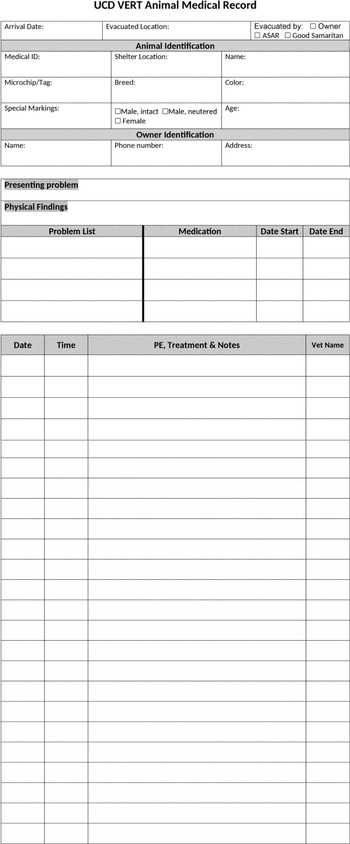
All animals receiving veterinary medical care should have an individualized medical record. This medical record should be linked to their medical ID and remain in the sheltering facility for review by veterinary staff working at the shelter. An outline of the sections of the UCD VERT Animal Medical Record (Figure 4) is below:
-
Arrival Information: The date that the animal arrived at the sheltering facility should be noted, the location where the animal was evacuated from, and the person/agency that brought the animal to the shelter (eg, owner, ASAR team, or good Samaritan).
-
Animal Identification: The animal should receive a medical ID number, ideally with a neck band displaying this. The current shelter location of the animal should be recorded. Other identifiers such as the name and microchip or tag number should be recorded, as well as the breed, color, marking, sex, and age of the animal, if possible. Situations may result in the inability to fill in all of these fields, but appropriate efforts should be taken to make sure the animal is identified with the most specific details.
-
○ An electronic version of the medical records to allow for storing of photographs of the animal at the time of presentation is essential. Standardized photos must be taken, including a front-facing head shot and the entire animal from each side.
-
-
Owner Identification: Whenever possible, the owner’s name, phone number, and address should be recorded in the animal medical record. If this information is not available at the time of triage, then the medical record should be flagged as incomplete to alert veterinary staff. Animal identification information should be shared with the shelter management organization to help facilitate reunification with owners.
-
Presenting Problem: During triage, the presenting problem should be logged. This should represent the main cause for requesting medical care.
-
Physical Findings: Temperature, heart rate and rhythm, and respiratory rate and character; body condition score; and estimated body weight should be registered at intake. All pertinent physical findings and any diagnostics at the time of triage should be listed.
-
Problems: The animal’s problems should be listed at the highest level of understanding, meaning that physical exam abnormalities may be grouped as needed. Additionally, it should be included whether the problem is historic/chronic or acute.
-
Medications: Any medication used for the treatment of medical issues should be listed, including dosage, volume, route, and frequency. Care must be taken to comply with food animal residue avoidance database (FARAD) recommendations, and withdrawal times must be included whenever applicable. The medication start date and end date must be written.
-
Physical Exam, Treatments, and Notes: This section represents any physical exams, treatments, and notes while the patient is receiving veterinary care. All client and primary veterinarian communications should be written here. Date and time are imperative to note. The supervising veterinarian should be listed for each time point.
Animal Medical Record Templates.

Disaster Database
The use of a disaster database to collect aggregate data will define the epidemiology of the event as well as allow for retrospective assessment and improvement.Reference Dieckmann, Costa, Martínez-López and Madigan11 This data collection should be in parallel with individual medical records but not replace them.
Veterinary Supplies
A pre-determined cache of supplies should be immediately mobilized for disaster situations. Items should be organized by species-specific veterinary needs for common illnesses and injuries. Previous work has identified conditions affecting various animal species and serves as guidelines for supply planning for equines, livestock, and exotic animals.Reference Dieckmann, Costa, Martínez-López and Madigan11 These supplies can remain on site as needed. Donation of supplies should be coordinated and organized through the logistics and planning manager.
Biosecurity and Personal Protective Equipment (PPE)
In a shelter environment, it is imperative that safety and biosecurity measures be considered when treating animal patients. It is the responsibility of the shelter manager, with input from veterinary staff, to decide on a quarantine location for patients that show clinical signs of potentially contagious disease. Successful quarantine is dependent on abiding by protocols that will be decided on by the incident commander of the shelter. The UCD VERT is responsible for making sure all deployed members are aware of the quarantine protocols and location.
For general treatment of animal patients, the UCD VERT team should be conscientious of wearing the appropriate PPE. Gloves should be worn and changed between patients and hands sanitized/washed between patients is considered ideal. Medical equipment should be appropriately cleaned or disinfected between patients.
The safety of the UCD VERT members is crucial. In the case of air quality concerns, such as fires, all UCD VERT members should wear properly fitted N-95 masks and people with respiratory conditions will not be selected for deployment.
Client Communication
Direct communication with owners reduces unnecessary communication channels that could lead to misinformation and ensures an appropriate veterinarian-client-patient relationship. If an owner is available, the supervising veterinarian should disclose all medical information and ask for consent prior to treating the animal. A designated representative of the owner can also approve treatment.
It is important to recognize that these owners are undergoing a personal crisis and communication should emphasize support and empathy. Additionally, VERT is responsible for setting expectations of patient care. The VERT provides free veterinary care for all animals affected by a disaster, including emergent conditions and exacerbation of chronic injuries. This does not include providing veterinary services such as a diagnostic work up of chronic conditions or preventative health care not pertinent during disasters and emergencies.
Often in the disaster situation, the owner is unidentified or cannot be reached. If this is the case, then a physical exam is warranted to determine the extent of any medical conditions. If the condition requires immediate action, especially if it is a life-threatening emergency, treatment is merited. Any treatment must comply with the FARAD stipulations.
Discharge Instructions
Discharge instructions are written for all animals receiving medical evaluation and care from UCD VERT. Information in the discharge instructions should include the date, patient’s medical problem(s), procedures performed, medications including route, dosage and withdrawal time, and name of the veterinarian with contact information (Figure 5).
Discharge Instructions Template.

Conclusion
Disaster situations have the potential to displace, injure, and stress animals in close proximity. Preparing for, mitigating, and responding to animal needs in a disaster situation can help address and reduce medical and welfare concerns. Therefore, veterinary professionals should be included as disaster responders to render emergency medical care. Operational guidelines for appropriate roles, responsibilities, documentation, and professional conduct will improve personnel organization, enhance medical care, ensure proper documentation, and minimize stress on providers.
Acknowledgements
Thank you to the UCD VERT volunteers who put these guidelines into practice. The authors appreciate the contributions of Drs. Claudia Sonder and Eric Davis.
Conflicts of interest
none