


For the past half-century, a small British party—first the Liberals, now the Liberal Democrats—has occupied a policy position in between the two major British parties: Labour and the Conservatives. During much of the same period, the Free Democrats in Germany have held a similar position between the Social Democrats and the Christian Democrats. In addition, recent American presidential elections have featured the candidates John Anderson (in 1980) and Ross Perot (in 1992 and 1996), who had no realistic chance of winning and who were arguably located between the Democratic and Republican nominees.1
The 2000 and 2004 U.S. presidential elections featured minor-party candidate Ralph Nader, who was viewed as being more liberal than either major-party candidate. Our paper is not intended to apply to this scenario, although we briefly touch on this case in the Discussion.
What are the policy consequences of the existence of such small, centrist parties or candidates? On what political institutions do these consequences depend? Do these consequences benefit the policy aspirations of the centrist party or do they undermine these goals?
Under proportional representation, it is well known that a small centrist party such as the Free Democrats in Germany may hold the balance of power, bargaining with each of the major players as they attempt to form governing coalitions. But in a plurality-based system as in Britain or the United States, the consequences are far less clear. If a small centrist party or candidate has no chance to win control of parliament or the presidency, its immediate influence, if any, must lie in affecting the electoral fortunes of the major parties or in altering the policies that the major parties propose. Presumably, in a plurality-based system, a centrist party with no realistic chance of winning itself could hope that its participation would motivate the major parties to moderate their policies. Alternatively, if the centrist party's policy inclinations shade slightly to the left or to the right, its leaders might hope that—as a consequence of their party's participation in the election—the policies of the major parties might shift in a direction favorable to the small party.
We develop a spatial analysis of an election context that may occur in plurality-based systems: namely, elections involving two major, noncentrist parties or candidates along with a small, centrist third-party candidate with no serious chance of winning. We present theoretical and empirical arguments that in a policy-motivated model, not only are both of the intuitions broached here mistaken, but also the actual consequences of a small centrist party's electoral participation are the opposite of these expected effects. Simply put, our results suggest that when such parties contest elections they actually bring about results that undermine their policy objectives.
POLICY SEEKING IN TWO- VERSUS THREE-PARTY ELECTIONS: ILLUSTRATIVE EXAMPLES
The Basic Model
Perhaps the most widely cited motivation for the observed policy divergence between parties or candidates in two-party elections is that the competing candidates or party leaders have policy motivations—that is, that politicians seek office to implement desired policies, rather than propose policies to win office. As Donald Wittman (1990; 66) has argued, to the extent that voters' decisions are moved by policy concerns (a key spatial modeling assumption), it is reasonable to posit that politicians similarly care about policy outputs. In the years since Wittman's (1973, 1977, 1983) seminal articles, spatial modelers have elaborated many approaches to theorizing about policy-motivated politicians' strategic choices in plurality-based, single-winner elections (see, e.g., Cox 1984; Hinich and Munger 1997). However—with important exceptions to be noted later—these models focus exclusively on two-party elections. We specify a model in which parties and voters locate along a one-dimensional policy continuum, and each voter supports the party whose announced policy is closest to his or her own position. The assumption driving policy-seeking spatial models is that each party faces a tradeoff between promising the policies its leaders sincerely prefer and proposing alternative policy positions that may render the party more electable and, furthermore, that the parties' preelection policy proposals constrain their abilities to implement policy if they win office (see Groseclose 2001; Wittman 1983). Hence, we make a distinction between a party's sincere policy preference, on the one hand and its announced or strategic position in light of this tradeoff on the other. In particular, policy-seeking parties evaluate election outcomes not according to which party controls the government, but according to their evaluations of the winning party's policy proposals. In the terminology of spatial modeling we posit that the parties are entirely policy seeking; that is, they derive no utility from holding office per se apart from the fact that this allows the party to implement its preelection policy promises.2
As indicated in the Discussion, we find that the central substantive conclusions we report extend to more general models in which the major parties have mixtures of policy- and office-seeking motivations.
Throughout, party names are in bold; the policy locations of these parties are denoted by the corresponding italic characters.
We denote the preferred positions of parties L, C, and R by RL, RC, and RR, respectively. Primarily, we will assume linear loss utilities for the parties, for example, L's utility for the policy proposal L if L is elected declines with distance between L's announced position L and its preferred position RL and is given by
; L's utility for the policy proposal C if C is elected is given by
, and so forth.
Although policy-seeking models represent a fundamental departure from Downs's office-seeking perspective, policy-seeking motivations alone do not necessarily motivate party divergence. In particular, in the basic two-party spatial modeling scenario in which parties are fully informed about the voters' policy preferences, policy-seeking candidates will converge to identical policies—the same result predicted for office-seeking parties (see Calvert 1985).
Incorporating uncertainty about the distribution of voters' policy preferences offers a possible solution to the puzzle that arises because, empirically, candidates and parties do not converge (Burden 2004; Adams, Merrill, and Grofman 2005). Uncertainty about voters' policy preferences occurs not only because of sampling error in polling and uncertainty about which citizens will turn out but also because of fluidity in voter opinion between the time when parties announce their policies and election day.
Following Groseclose (2001) and Roemer (2001, chapter 3), we represent this uncertainty by specifying the voter distribution by a continuous, probability distribution that is known except for the location of its center, that is, its median. Uncertainty about the location of this median is represented by a second probability distribution. Thus the distribution of voter ideal points has a fixed shape (e.g., the normal curve), but this distribution may shift to the left or right depending on the value of the median. Substantively, this implies that the parties know the shape of the voter distribution but are uncertain about where it is centered; that is, they are uncertain about the location of the median voter. Parties' uncertainty over the voter distribution in turn translates into uncertainty over the election outcome. As a result policy-seeking parties in two-party elections can be expected to diverge in the policy space, as they balance their desires to propose policies that reflect their sincere preferences against the need to propose centrist positions (relative to their expectations about the voter distribution) that increases their chances of winning (Fowler and Smirnov n.d.; Groseclose 2001; Wittman 1983).
We define party L's expected utility as the sum of its utilities for the policies of each party weighted by the probability that that party wins. Thus, in a two-party election involving parties L and R, if we denote the probabilities that L and R win the election by
and
, respectively, given policy strategies L and R, then party L's expected utility is given by

where
and
represent party L's utilities for the policies L and R, respectively. Party R has a comparable utility function. Similarly, in the three-party election involving parties L, C, and R, party L's expected utility is given by

with comparable utility functions for parties C and R.
Competition Between Policy-Seeking Parties: Two-Party Versus Three-Party Elections
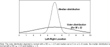
We now present a simple illustrative example designed to convey the intuition about why the presence of a small, centrist party motivates the major policy-seeking parties to diverge in the policy space, compared to the positions they would present in pure two-party competition. For this example, we assume that the voter distribution is shaped like the one pictured in Figure 1, that is, a distribution that is single-peaked and widely dispersed over the policy interval [0, 10]. Further we assume that its exact location is uncertain, specifically that the median of the voter distribution is itself a normally distributed random variable whose mean is 5 and whose standard deviation is
, which we label the degree of policy-related uncertainty (see Figure 1). We further assume that the preferred positions of parties L and R are located significantly to the left and to the right of 5, respectively. (For these illustrative examples, all that is required is that L's preferred position lies anywhere to the left of 3.25, and that R's preferred position is to the right of 6.75.)

Voter and Median Distributions
Party Strategies in Two-Party Elections
If parties L and R have linear policy loss utilities, then the degree of dispersion at equilibrium is a policy distance equal to
times the degree of policy-related uncertainty
(Brams and Merrill 1991). At equilibrium party L locates at
and party R locates at
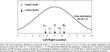
(see Figure 2).

Policy Divergence in the Two- and Three-Party Models
Three-Party Competition: The Symmetrical Case
We now add a third competitor, party C, whose preferred policy is located at 5. As discussed earlier, this scenario is relevant to postwar British politics, where the Liberal Democrats have been viewed as preferring moderate policies. Furthermore assume that the parties believe that the plurality party will win a parliamentary majority (again a reasonable assumption for Britain where this condition has been fulfilled in 15 of 17 postwar elections). We might intuitively expect that party C—fixed in a centrist position that gives it no chance to win the election—will have no impact on the degree of separation between the larger parties at equilibrium. In fact, however, this intuition is mistaken: provided that an equilibrium exists for the three-party election, the degree of policy dispersion is generally much greater than that for a comparable two-party election. Specifically, under a wide range of assumptions (see Theorem 1 later), the degree of dispersion is twice as great as that for the two-party model.
Figure 2 also illustrates the equilibrium positions for parties L and R that obtain when C is fixed at C=5: the parties locate at
and
, positions that are twice as dispersed as are these parties' equilibrium strategies in the two-party scenario. Note also that despite the increased dispersion of the peripheral parties, the centrist party C is still supported only by the relatively narrow band of voters located in the policy interval [4.375, 5.625], so that C has no chance of winning.
Why, in this example, does the introduction of a minor, centrist, third party—one with no chance of winning—motivate the major parties to diverge further away in the policy space, compared to their positioning for two-party elections? The central intuition is that when a small, centrist third party is introduced into the model, then the peripheral parties' likelihoods of winning are less responsive to their policy positions than is the case in the two-party model. Specifically, in a three-party model, each peripheral party's policy shift has only one-half the impact on its expected vote margin versus the rival peripheral party, compared with the corresponding two-party case. This is because in the three-party scenario, a peripheral party's shift toward the center increases its expected vote at the expense of the centrist party, whereas in the two-party case the expected vote increase comes at the expense of the rival peripheral party. Because the peripheral parties' likelihoods of winning are less sensitive to their positioning than in a two-party model, policy-seeking parties in the three-party model have the leeway to shift further away from the center, in the direction of their preferred policy positions. We label this finding—which we support theoretically below—the policy divergence result.
We return to the three-party example and consider party C's policy-seeking logic. Although we fixed C at its sincere policy preference C=5 in the previous analysis, one might suspect that C would have policy-seeking motivations to shift away from this position. However, this is not the case. To see this, note first that with parties L and R located at
and
, it is simple to check that C cannot win by shifting to any other position between parties L and C. Second, party C is indifferent between the peripheral parties' policy positions (because these positions are equidistant from C's preferred position of 5), so that C has no incentive to alter its strategy in an effort to enhance one of these peripheral parties' election prospects. Finally, party C's only other strategic option is to propose a sharply noncentrist position that outflanks one of its rivals. Although such a strategy gives C a (small) positive probability of winning the election, note that this strategy also commits the party to implement a highly distasteful policy in the event that it is victorious—a policy outcome that would actually be less desirable, from C's perspective, than the policy outcome ensuing from a victory by either party L or party R. Together, these facts establish that party C has no policy-seeking incentive to shift away from the strategy C=5, and it follows that the configuration L=3.75, C=5, R=6.25 is an equilibrium in policy-seeking strategies. We present theoretical analyses later suggesting the conditions for existence of a three-party equilibrium are likely to be satisfied, a finding which we label the policy stability result.
Three-Party Competition: The Asymmetrical Case
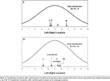
Finally, we shift the position of party C leftward from C=5 to C=4.5, to ascertain the effects on the peripheral parties' strategies. We note that this scenario is relevant to British postwar politics, in which the small Liberal Democratic Party is viewed as presenting center–left positions. We might intuitively expect that party C's leftward shift would motivate corresponding left-shifts by the two peripheral parties. However, in this scenario parties L and R in fact have policy-seeking motivations to shift to the right, in the opposite direction from C's policy shift. Figure 3A illustrates the equilibrium positions for parties L and R that obtain when C is fixed at C=4.5: the parties locate at
and
; that is, the peripheral parties shift to the right by 0.5 policy units when C shifts 0.5 policy units to the left. Note also that, in toto, the parties' policy shifts leave voters' party preferences unchanged: as was the case for the equilibrium configuration L=3.75, C = 5, R = 6.25 given earlier, the configuration L = 4.25, C = 4.5, R = 6.75 motivates the band of voters located in the policy interval [4.375, 5.625] to support party C.

Policy Strategies in the Three-Party Model with a Small, Centrist Party
The logic that motivates the peripheral parties to shift in an opposite direction to the centrist party is as follows. Note first that when party C shifts unilaterally to the left this enhances party R's election prospects in two ways: by siphoning away support from party L among center–left voters and by augmenting party R's support among center–right voters. In response, party R trades off some of its increased probability of election by shifting further to the right, in the direction of its preferred position; similarly, party L compensates for its depressed election prospects by shifting to a more moderate position. In terms of the peripheral parties' policy strategies, we note that the strategic considerations relating to a small, centrist, third-party mirror the logic that Wittman (1990, Theorem 4) has developed for pure two-party elections with biased voters, namely, that the introduction of an exogenous factor that enhances one party's election prospects typically motivates both parties to shift in the direction of the advantaged party's preferred position (see chapter two in Smirnov and Fowler n.d., for related analyses on the effects of changes in parties' beliefs about the voter distribution). We label this effect, which we support theoretically later, the reverse shift effect.
POLICY-SEEKING EQUILIBRIUM FOR THREE-PARTY ELECTIONS: THEORETICAL RESULTS
We now demonstrate that the strategic logic suggested by the previous examples generalizes to a wide class of three-party elections. For these analyses we assume that the voter distribution V is continuous, unimodal, and symmetric about its median M, where M is itself a random variable with a continuous distribution with median μ, standard deviation
, and cumulative distribution function
, and density function
. Let
denote the cumulative distribution function of the voter distribution V when M = m. We assume that the voter ideal points follow a compound distribution, which has the same shape for every value m of the median M, but that this distribution may shift to the left or right depending on the value of m.4
To be specific, for each x and
; that is, for each m, the distribution is a shift of the distribution for m = μ.
.
Equilibrium Strategies for the Major Parties
The following theorem provides conditions that a Nash equilibrium exists for the two peripheral parties, given that the small centrist party has a fixed position, and specifies the locations of these equilibrium strategies for each of the two major parties. (A Nash equilibrium is a configuration of strategies, i.e., policy positions, such that no party can increase its expected utility by unilaterally deviating from its strategy.) The theorem and its proof are patterned on a related result for final-office arbitration in Brams and Merrill 1983. See also Brams and Merrill 1991 for the correspondence between final-offer arbitration and spatial models of electoral competition.
Theorem 1
Suppose that a three-party plurality election involves two peripheral parties L and R with positions L and R and a small, centrist party C with location C. Parties are assumed to be policy seeking, and party utility is based on linear loss. Uncertainty about the location of the median voter is represented by a compound distribution as specified previously. Assume that
exists and
. Then

are local equilibrium strategies if the following conditions are satisfied:

the preferred positions of L,
, and of R,
, satisfy
and
,

and

Proof
See the Appendix, in which we also derive necessary and sufficient conditions that the local equilibrium
given by equation 1 be a global (Nash) equilibrium. Very roughly, these conditions require that the density function for the voter median not be too heavy near its center nor too heavy in the tails. Such conditions appear plausible for the parties' subjective representation of uncertainty.
Remark
Were there only two parties, the equilibrium strategies specified in Theorem 1 would be replaced by

and the conditions for a Nash equilibrium are that the preferred positions of L and R satisfy
and
, and that inequality 2 in Theorem 1 is satisfied (Brams and Merrill 1983, 1991).
In words, equation 1 in Theorem 1 (in combination with the Brams–Merrill result given in equation 5) implies that the introduction of a small, centrist third party doubles the separation between the major parties at equilibrium.5
Specifically, equation 1 implies that at equilibrium the degree of separation between the peripheral parties in three-party elections is equal to
(note that this degree of separation does not depend on the location of the centrist third party), whereas equation 5 implies that in two-party elections this degree of separation equals
.
Note that, in the three-party model, if a portion of the voters who are nearer party C than either Party L or R nevertheless vote for one of the major parties (due, e.g., to long-term party allegiance or to strategic voting), we can expect optimal strategies for L or R located intermediate between those specified by equations 1 and 5. Insofar as such voters desert party C, constraint 4 can be relaxed so that L and R may assume somewhat more extreme positions without risking a win by Party C. Note also that Theorem 1 remains valid if the condition that the voter distribution be unimodal is removed, except that constraint 4 becomes more complicated (see the proof of the theorem in the Appendix for details).
Finally, note that Theorem 1, in combination with the Brams–Merrill result summarized previously under Remark establishes that the conditions for an equilibrium in three-party elections with a minor, centrist, party are more stringent than are the corresponding conditions for the pure two-party case—specifically, that whenever an equilibrium in the major parties' strategies exists in the three-party case then an equilibrium exists in the pure two-party case, but not vice-versa. However, in the Appendix we show that the conditions for a Nash equilibrium in the major parties' strategies in three-party elections are satisfied by the normal distribution—as well as many other common distributions for the voter median—as long as constraints given by equations 3 and 4 hold. We show, furthermore, that the separation between the optimal (equilibrium) strategies of the peripheral parties—assuming the voter median follows a normal distribution—is approximately 5 standard deviations (SDs) of that distribution.
With respect to the existence conditions delineated in Theorem 1, note that inequality 2 is satisfied whenever the probability distribution associated with the median voter position is symmetric, something that is highly plausible with respect to the parties' beliefs about the likely location of the median voter. Inequality 3 stipulates that the position of party C must lie sufficiently close to the peripheral parties' best estimate about the location of the median voter. Intuitively, this condition is required because if party C, for instance, locates sharply to the left of the median voter's (expected) position, this severely damages party L's chances of being elected on a left-wing platform (because leftist voters will then split their support between parties C and L), so that L's optimal policy-seeking strategy is to leapfrog party C which in turn destabilizes the contest between parties L and R.
Inequality 4 stipulates that the voter distribution is sufficiently dispersed that when the peripheral parties present their equilibrium positions the center party C's vote share falls below 1/3, so that C has no chance of winning.7
The proof of the equilibrium theorem assumes that party C has no chance to win the election; clearly, if Party C's support exceeds 1/3 then C has some chance to win, which would affect its strategy as well as the strategies of the peripheral parties.
Equilibrium for the Center Party: Expressive Versus Instrumental Motivations
Equation 1 in Theorem 1 delineates the major parties' equilibrium positions with the center party C's position fixed. Here we consider the question: when the conditions given in Theorem 1 are satisfied, what conditions must be satisfied for party C's position to be in equilibrium? In other words, when will the positions given by equation 1 constitute a three-party Nash equilibrium in policy-seeking strategies? We consider this question for two possible motivations of the small, centrist party. Either it exhibits expressive motivations in which case it presents its sincere policy position without concern for strategic implications, or it exhibits instrumental motivations, in which case—having no chance of achieving victory—it chooses its strategy to maximize the likelihood that the major party it prefers will win the election. We shall see that both types of motivations can support three-party Nash equilibrium, but that the locations of the parties' equilibrium positions differ for these types of motivations.
Under expressive motivations, the sincere and declared strategy positions of the centrist party are the same. Theorem 1 applies directly, with the centrist party fixed at its preferred position (refer to Figure 3A presented earlier). Hence under expressive motivations, a three-party Nash equilibrium exists when the conditions in Theorem 1 are satisfied and party C presents its sincere policy preference.
Under instrumental motivations, the situation is more complex. At equilibrium, the two peripheral parties must be at equal distance from the preferred position,
, of the centrist party. Otherwise, Party C will prefer the closer of these parties and can increase its instrumental utility by moving to benefit the closer party. This point is important: instrumental considerations typically motivate the third party to shift away from its sincere policy preference, to aid the election prospects of the major party whose position it prefers. But by equation 1 in Theorem 1, only by placing itself at position
, with the peripheral parties at
can an equilibrium occur, where, without loss of generality, we have set μ = 0 for convenience.8
In terms of
.
is negative (i.e., the centrist party's sincere policy preference is slightly leftist), then to achieve an equilibrium C must declare a slightly rightist policy position and both peripheral parties must shift to the left, symmetrically placed about the negative of C's declared position, that is, symmetric about C's preferred position (see Figure 3B). In summary, under instrumental motivations, a three-party Nash equilibrium exists when the conditions in Theorem 1 are satisfied and party C presents a position that is symmetric to its sincere policy preference, with respect to μ.
Existence and Location of Parties' Equilibrium Positions: Illustrative Examples
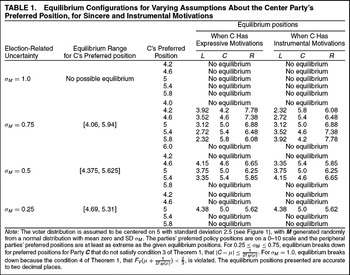
Table 1 reports three-party equilibrium configurations for alternative sets of assumptions about party C's preferred position, party C's motivations (expressive vs. instrumental), and the degree of election-related uncertainty parties experience. These results illustrate how both the existence of a three-party equilibrium and the configurations of the parties' positions when an equilibrium exists vary with the election context. For these examples we assume a normal voter distribution centered on 5 with SD 2.5 (refer to Figure 1 presented earlier), with the voter median M generated randomly from a normal distribution with mean zero and SD
, and the peripheral parties' preferred positions at least as extreme as the equilibrium locations reported. We note that for every election scenario that we investigate an equilibrium would exist in pure two-party competition between parties L and R; that is, an equilibrium would exist if the center party C did not contest the election.

When the probability distribution for M is normal with mean 5 and SD
, then equation 1 of Theorem 1 specifies that at equilibrium the three parties locate at

that is, the peripheral parties are separated by a distance equal to
times the SD
. As the table shows, when the degree of policy-related uncertainty is set at the low value
, a three-party equilibrium—for both instrumental and expressive motivations—exists when party C's preferred position is
, with the main parties separated by a distance of
. However, equilibrium breaks down—again for both instrumental and expressive motivations—when C's preferred position lies outside the narrow policy interval [4.69, 5.31], because this violates the condition
(inequality 3 of Theorem 1) that C's position must lie sufficiently close to the peripheral parties' best estimate of the median voter's position to avoid leapfrogging. This illustrates the fact that when parties experience minimal uncertainty about the median voter's location, then the conditions for existence of a three-party equilibrium are demanding.
When
is increased to
or
—values that plausibly approximate the degree of policy-related uncertainty that parties experience in real-world elections9
Analyses of the variations in the median voter position in Britain during the postwar period, as calculated using the method developed by Kim and Fording (2001) for estimating the position of the median voter, suggests that the degree of uncertainty that parties experience with respect to the location of the median voter corresponds roughly to
for Britain; that is, this is the standard deviation of the locations of the British median voter over the postwar period when calibrated to a 0–10 scale (standard deviations computed from the data on the CD-ROM that accompanies Budge et al. 2001).
, and furthermore three-party equilibria exist for a wider range of preferred positions for party C. Note that C's equilibrium position matches its sincere policy preference under expressive motivations, but that for instrumental motivations C's equilibrium position shifts to the right as its preferred position shifts left; this latter result illustrates the logic explained in the earlier examples that instrumental motivations typically give the center party incentives to shift away from its sincere preferences. Note also that, consistent with the policy strategy result, C's equilibrium positions shift in the opposite direction from the peripheral parties' equilibrium positions.
Finally, no equilibrium exists when policy-related uncertainty is set at the unrealistically high value
, because inequality 4 of Theorem 1—namely,
, which becomes
or σM<0.344σV (where Φ denotes the standard normal cumulative distribution function)—is violated. In fact, for
, inequality 4 is violated for
greater than
. Such extreme uncertainty motivates the peripheral parties to diverge so sharply in the policy space that the center party has a chance to win the election, which in turn destabilizes the peripheral parties' strategies.
PARTY STRATEGIES IN POSTWAR BRITAIN
We have seen that the conditions that support three-party Nash equilibrium in policy-seeking strategies and our policy divergence and reverse shift effects are more stringent than are the corresponding equilibrium conditions for pure two-party elections. However, the results reported in Table 1 suggest that three-party equilibrium is likely when parties experience moderate degrees of uncertainty about the median voter's location, and when furthermore the center party's preferred position lies near the (expected position of) this voter median. Both of these conditions appear to have been met in postwar Britain, where the variation in the median voter's estimated position during the postwar period plausibly generated moderate uncertainty about this voter's location (see note 9). The centrist Liberal Democratic Party, moreover, is viewed as being located close to the median voter's position, albeit slightly to the left (see Huber and Inglehart 1995; Powell 2000, chapter 8). Here we discuss the relevance of our findings for postwar British politics, offering insights into the evolution of the British Labour and Conservative parties' policies during the postwar period, which in turn illuminates two strategic dilemmas that the Liberal Democrats confront.
The Evolution of Party Politics in Postwar Britain: Major-Party Polarization
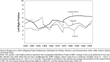
Our theoretical results offer a possible explanation for the strategic logic that motivated the Labour and Conservative parties to propose similar policy positions during the time period running roughly from the mid 1950s to the early 1970s—a period which scholars have labeled the “Social Democratic Consensus” (SDC)—but to present sharply divergent strategies in the periods preceding and following the SDC (see Figure 4).10
Figure 4 displays the evolution of the British parties' Left–Right positions over the 15 General Elections held between 1945 and 1997, based on the codings of the parties' election programs reported by the Comparative Manifesto Project (CMP). The CMP's coding procedures involve sorting “quasi-sentences” in the party's election program into varying categories (law and order, defense, welfare, etc.) and then taking the percentages in each category as a measure of the party's overall Left–Right orientation (Budge et al. 2001). In Figure 4 and all subsequent figures we have recalibrated the CMP's Left–Right codings, which range from −100 to +100, to the more familiar 0–10 scale.
The Liberal Democratic Party represents the merger of the Liberal Party and the Social Democratic Party in 1990. The latter two parties campaigned under an electoral pact in the 1983 and 1987 elections. Elections prior to 1983 were contested by the Liberal party (the Social Democratic Party was not formed until 1982). In this section we refer to the Liberal Democrats when discussing current British politics, and to the Liberals when discussing British politics prior to the 1980s.
For the 1945–50 period the Liberals presented candidates in 62% of the constituencies; from 1951 to 1970 the Liberals' participation rate dropped to an average of 38%; from 1974 to 1997 the Liberals (and in later periods the Liberal Democrats) contested 94% of the constituencies. We note also that although the proportion of constituencies contested by Liberal candidates varied dramatically during these three periods, these candidates' vote shares were fairly stable, averaging 16.5% per contested constituency for 1945–50, 16.3% from 1951 to 1970, and 20.9% from 1974 to 1997; that is, the variation in the Liberal Party's national vote share between elections was primarily due to variations in the proportion of constituencies contested, rather than variations in constituency-level support for Liberal candidates (statistics taken from Table 1 in Nagel 2001).

Spatial Mapping of British Parties' Ideological Positions, as Coded by the Comparative Manifesto Project
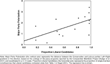
It seems plausible that during the era when the Liberals were contesting a minority of the constituencies—a time period that corresponds almost perfectly with the Social Democratic Consensus—the Labour and Conservative parties viewed the election context as resembling a pure two-party contest, and therefore moderated their policy strategies as our theoretical results would predict. Further evidence on this point is presented in Figure 5, which plots the Left–Right distance between Labour and the Conservatives in each election (the vertical axis) against the proportion of constituencies contested by the Liberals (and in later periods the Liberal Democrats) in that election (the horizontal axis). This figure shows that Labour–Conservative polarization increased sharply when the Liberals contested more constituencies and the major parties reacted to changes in the proportion of three-cornered constituency-level elections. The strength of this statistical association (a one-tailed test is significant at the .01 level) is striking given the small number of observations (N=15) and also that the major parties' positions are surely influenced by numerous additional unobserved factors that change over time, including voters' and party elites' sincere policy preferences, the need to raise money from interest groups, the need to avoid the perception that the party has flip-flopped, and so on (see Adams et al. 2004; Baron 1994; Budge 1994). These results support the policy divergence hypothesis.

Major Party Polarization Versus the Proportion of Constituencies Contested by the Liberals, 1945–97
Three-Party Competition and the Liberal Democrats' Strategic Dilemmas
Our empirical and theoretical findings also highlight two strategic dilemmas that the Liberal Democrats confront. The first is that their presence in the party system—particularly in elections where they contest a large proportion of the single-member constituencies, as they have done since the mid 1970s—motivates the major parties to polarize, thereby bringing about a more distasteful policy outcome, from the Liberal Democrats' perspective, than would occur if they did not contest the election. This dilemma has previously been noted by Nagel (2001, 13), in his analysis of postwar British politics:
The initial results suggest an excruciating dilemma for the Liberal Democrats, one that has often been noted in commentary and debate on British politics. Unless they can overcome the distortion of the FPP [First-Past-the-Post] electoral system to win a share of government power, the more Liberal Democrats succeed electorally, the more they fail in policy terms by encouraging or enabling the major parties to adopt relatively extreme policies, which one or the other will have the power to enact.
The value of our spatial analysis is that our policy divergence result illuminates the causal mechanism that permits the major parties to diverge in the policy space: namely, that when the Liberal Democrats contest the election then policy extremism is less damaging to the major parties' election prospects than it is in the pure two-party case, because in the three-party context the major parties' vote losses redound to the benefit of the Liberal Democrats, whereas in the two-party case the beneficiary is the major party's chief rival.
The second, related, dilemma that the Liberal Democrats have confronted relates to the reverse shift effect. The Liberal Democrats are viewed as presenting center–left policies, and furthermore there is widespread agreement that these policies reflect Liberal Democratic politicians' sincere beliefs, that is, that these politicians are behaving expressively rather than strategically (see Cook 1998). The reverse shift effect implies that the Liberal Democrats' center–left positioning should motivate both major parties to present more right-wing positions than they would if the Liberal Democrats had presented centrist or center–right policies—that is, that the Liberal Democrats' sincere center–left positioning enables the Conservatives to diverge to sharply right-wing positions, while motivating more moderate leftist positions from Labour. In fact, this is precisely the empirical pattern that is observed beginning with Margaret Thatcher's ascension to Conservative party leadership in 1975: one in which the Conservatives present their most extreme right-wing policy programs of the postwar period, whereas Labour and the Liberal Democrats present similar, center–left policies (refer to Figure 4 presented earlier). Note that in situations where the Conservative party is elected—which was the case in the four general elections held between 1979 and 1992—the reverse shift effect thereby suggests that the Liberal Democrats' sincere positioning brings about the worst possible outcome: namely, that in which their least-preferred rival is elected, and in which this rival presents more extreme positions than it would have presented in the event the Liberal Democrats had acted strategically by presenting center–right policies designed to harm the Conservatives' prospects. Nagel (2001, 16) has also noted this strategic dilemma, writing that “Liberal Democrats face a moral quandary. By acting straightforwardly to support a third party in which they believe, they may help bring about the policies they find most distasteful.” The value of our reverse shift effect is that its logic sharpens the horns of the Liberal Democrats' dilemma by providing an explanation for the likely consequences of their sincere behavior.
DISCUSSION
We have sought answers to two questions about elections conducted under the plurality rule: how does the presence of a minor, centrist, third party affect the major parties' policy-seeking strategies?, and, Does our spatial modeling approach illuminate the dynamics of real-world politicians' strategic choices? Our study produces four findings, three theoretical and one empirical.
First, we derive necessary and sufficient conditions for existence of a three-party Nash equilibrium in a deterministic spatial model, specify the location of equilibrium strategies, and show that these existence conditions—although more stringent than the corresponding conditions for two-party elections—are likely to be satisfied, given realistic assumptions about parties and voters. This finding on policy-seeking parties stands in contrast to the well-known fact that a multiparty equilibrium in vote-seeking strategies rarely exists, even in competition over a single-policy dimension (Eaton and Lipsey 1975).13
When voting is probabilistic, then multiparty equilibria are likely to exist (see Lin, Enelow, and Dorussen 1999; Merrill and Adams 2002; Schofield and Sened 2005).
Second, for a considerable range of assumptions, we show that the presence of a minor, centrist party motivates the major parties to propose policies that are much more divergent (to be precise, twice as divergent) than without the third party. Therefore the addition of a minor third party—even though it has no chance of winning—dramatically affects the major parties' strategies, and in ways that are harmful to the minor party: namely, it causes the major parties' policies to be more extreme—and hence more distasteful to the centrist minor party—than would have been the case had the minor party not contested the election. (On the other hand, in a plurality-based parliamentary system, widening of the gap between the major parties typically leads to an enhanced vote share for the centrist party and a greater—although typically still small—likelihood of holding the balance of power.) We also show that this dilemma—which is related to earlier arguments presented by Nagel (2001)—exists whether or not the small third party behaves expressively by proposing a policy that its leadership sincerely prefers, or instrumentally by taking a position designed to aid the election prospects of its more-preferred rival.
Third, we establish a reverse shift effect, that in three-party elections with a minor centrist party, the major parties can be expected to shift their positions in the opposite direction relative to the centrist third party, again thwarting the policy aspirations of the third party.
Fourth, on the empirical side, we discuss how the policy divergence and reverse shift results may illuminate the evolution of political parties' election strategies in postwar Britain. We have presented empirical evidence that our three-party model provides insights into postwar British politics, illuminating two strategic dilemmas facing the center–left Liberal Democrats: first, that by contesting elections they motivate the major parties to present more extreme policies; second, that by presenting its sincere center–left beliefs, the Liberal Democrats enable the Conservatives to present more extreme positions than they would present if the Liberal Democrats positioned themselves strategically.
Our findings have important implications for spatial modeling, for party strategies, and for political representation. With respect to spatial modeling, our equilibrium results suggest that models of policy-seeking parties are useful for analyzing three-party elections with minor, centrist third parties—a result that was not previously known and one that considerably expands the scope of policy-seeking spatial models. With respect to party strategies, our policy divergence and reverse shift effects highlight a dilemma that potential third parties and candidates face when they make strategic decisions about whether to contest elections: namely, that contesting the election can motivate the major parties to present more extreme policies and to shift in a direction opposite to that of the minor party, thereby causing a less desirable policy outcome from the latter's perspective than if the centrist party had not participated in the election.
Finally, and related to the previous point, the policy divergence result may illuminate the findings on political representation reported by Powell (2000) and McDonald and Budge (2006), that governing parties in plurality-based systems are on average more extreme than are the governing parties in PR systems.
Our three-party model can be extended to encompass other scenarios and additional factors that influence party strategies. Perhaps most obvious is the situation in which one or more small parties takes a policy position more extreme than one of the major parties, such as the candidacy of Ralph Nader in the 2000 and 2004 American elections. Analysis of this scenario is less tractable mathematically than that of a small centrist party, but simple simulations suggest that the effect of a minor, peripheral party contesting the election is typically to shift the optimal strategies of both major parties in the direction opposite to that of the small party—a “reverse shift” effect analogous to the one we identified in this paper, and one that is detrimental to the minor party's immediate policy objectives.
A second variable whose effects can be explored is the strength of the minor party—a factor that can be investigated by the introduction of “valence” dimensions of competition, following an approach that has been pursued for two-party elections (see, e.g., Groseclose 2001). Simple simulations using this approach suggest that the divergent effects on major party strategies reported here extend to this valence model, so long as the minor party is not so weak on valence grounds that it attracts no popular support.
Third, if we incorporate an office-seeking component so that the major parties have mixtures of policy-seeking and office-seeking incentives, computer simulation suggests that introducing a minor, centrist third party motivates the major parties to propose more extreme policies than they would without the third party, as well as to shift their policy positions in a direction opposite to that of the centrist party. Relative to a purely policy-seeking model, introducing an office-seeking component tends to draw in the major parties toward the center, but leads to the same qualitative conclusions as does the purely policy-seeking model.14
If the minor, centrist party is also motivated in part by office-seeking motivations, then equilibrium typically breaks down, because the minor party is then motivated to leapfrog the major parties in pursuit of office. Details of the computer simulations described in this section are available on the Web site http://course. wilkes.edu/merrill/.
Finally, the implications of strategic voting by voters or the threat of abstention by alienated citizens could be explored when determining party strategies in three-party elections.
We emphasize that although we have presented reasons why minor, centrist parties may actually undermine their policy objectives when they contest elections, it is possible that such parties may nevertheless further their objectives in ways that lie outside the scope of our model. First, by emphasizing new or emerging issues (such as education and environmental policy in the case of the British Liberal Democrats) third parties have opportunities to shape the “terms of the political debate,” thereby influencing the major parties' policy agendas (see Meguid 2005). Second, minor parties may endogenize public opinion by articulating arguments that persuade voters to shift their positions along longstanding dimensions of policy debate (see Gerber and Jackson, 1993); in this regard, recent empirical work showing that major parties systematically adjust their policy programs in response to public opinion shifts implies that policy persuasion can further minor parties' policy objectives (see, e.g., Erikson, Mackuen, and Stimson 2002; Adams et al. 2004). Finally, in certain situations minor parties may realistically aspire to the status of major parties (as seemed possible for the Liberal Democrats during the 1980s, when Labour was viewed as extremely weak).
The previously cited caveats notwithstanding, our arguments suggest that by contesting elections, small, centrist third parties may inadvertently bring about perverse policy outcomes, because the introduction of such parties alters the strategic calculations of the two major policy-seeking parties in plurality elections. We find that such three-party contests create dramatically different strategic incentives than do pure two-party elections.
APPENDIX
Theorem 1
Suppose that a three-party plurality election involves two peripheral parties L and R with positions L and R and a small centrist party C with location C. Parties are assumed to be policy seeking, and party utility is based on linear loss. Uncertainty about the location of the median voter is represented by a compound distribution as specified in the text. Assume that
exists and
. Then

are local equilibrium strategies if

the preferred positions of L,
, and of R,
, satisfy
and
,

and

Furthermore, the local equilibrium
given by equation (A1) is a global (Nash) equilibrium if and only if


and the same inequalities hold for
in place of
.
Remark
Condition (A2) holds whenever
exists and
is symmetric, because in that case
.
Proof
Because the scale is arbitrary, without loss of generality, we can take
to be 0. Suppose that the Left Party L declares position
, the Right Party R declares
, and the Center Party C declares C. Then recalling that for any specific value for the median voter m, the voter distribution is given by
(see footnote 4), so that Party L wins if and only if
, that is,
, which by the symmetry of
about 0 occurs if and only if
is closer than
to 0; that is, when
is closer than
to m. But the latter occurs when
; that is, when
.
Assume that the position of the centrist party is fixed at C. Then utility for Party R is given by15
Next, in expressing the utility of, say, party R for the location R, we have replaced
with
(where
is the preferred location of party R), as this simplification does not alter the location of maxima.

so that at a local equilibrium,

and similarly for party L,
and

Adding and subtracting equations A7 and A8 yields

and

From equation A10, we conclude that

and from equation A9 that

It follows that

Note that in general,
and
.
The argument above assumes that
. For this to be the case requires that
, which in turn implies that
, or in general that
, which establishes A3.
To determine when the solution in equation A1 is a local equilibrium, note that

Evaluated at
,

so that a maximum occurs for
if and only if
. Similar analysis shows that
and a maximum occurs for
if
. Thus
is a local equilibrium if
. This establishes A2.
To establish inequality A4, note that for Party C to have a vote share less than 1/3 (so that it cannot win), we must have
for all values of the median, m (here we use
instead of 0 for clarity). But, because the voter distribution is assumed symmetric and unimodal, for any value m of M,
, so that it is sufficient to assume that
, or equivalently that
, because the voter distribution is symmetric.
Next we determine conditions for the local equilibrium specified by A1 to be a global (Nash) equilibrium. We note that a local (global) equilibrium occurs for
at
if and only if a local (global) equilibrium occurs for
at
. Thus, without loss of generality, we may assume that
and
. It suffices to show that
for all real b. Note that
if
, because then both peripheral candidates offer negative strategies. So we may assume that
. Then

if and only if

Subtracting 1/2 from both sides, this is true if and only if

Setting
, so that
, this inequality is equivalent to

for
, that is, for
, which is equivalent to the first formula in A6. The other formula in inequality A6 is equivalent to the statement that
for
If, on the other hand,
, that is,
and equation A11 may be replaced by

Setting
, for

which establishes the second formula in A5; the other formula in A5 is equivalent to the statement that
for
This completes the proof of Theorem 1.
Because the necessary and sufficient conditions of Theorem 1 may be difficult to verify directly, we provide more convenient sufficient conditions in the following corollary. As before, we assume, without loss of generality, that
Corollary
Under the conditions of Theorem 1, the following are sufficient conditions for a local equilibrium
to be a global equilibrium:

and there exist
and
with
, such that


Proof
As before, we assume, without loss of generality, that
. We show that A13 implies A5 and that A14 and A15 imply A6. If A13 holds, then for

where the last inequality can be checked by cross multiplication. This implies A5.
For
, A14 implies that

because
, as can be seen by taking derivatives.
Finally, if A15 holds, for
,

which implies that

so that A6 holds. Arguments for
are similar. This completes the proof of the Corollary.
We now show that if the median M follows a normal distribution, then the conditions of the Corollary hold so that a global equilibrium exists. By Theorem 1, this global equilibrium occurs at
, so that the distance between the positions of the two peripheral parties at equilibrium is approximately five times the standard deviation of the distribution of the voter median.
To see that the conditions of the Corollary hold when the voter median follows a normal distribution, we assume without loss of generality that
. Because the normal density peaks at 0, A13 is trivial. Next note that

if and only if
, so that A15 is satisfied for
. If
, the reverse inequality holds, so A14 holds.
It is simple to show that many distributions in addition to the normal, such as the uniform, (symmetric) triangular, logistic, and double exponential, satisfy the conditions of the Corollary and hence admit Nash equilibrium configurations (see Brams and Merrill, 1983). The separation between the major party positions at equilibrium varies from 2.8 SDs for the highly peaked double exponential to 6.9 SDs for the flat uniform distribution, but in each case this separation is twice what would occur for the corresponding two-party model.
An earlier version of this paper was presented at the annual meeting of the Public Choice Society, New Orleans, LA, March 10–13, 2005. We thank James Fowler, Oleg Smirnov, and three anonymous reviewers for valuable comments on earlier drafts of this paper. Any remaining errors are the authors' responsibility.



Comments
No Comments have been published for this article.