INTRODUCTION
The Strait of Gibraltar is a biogeographical zone in which faunas of the Mediterranean and the Atlantic, along one axis, and of Europe and Africa along the other, overlap. It is a very important geographical–geological region formed in the final phases of the Pliocene period, being the boundary for the Mediterranean region (to the east), the Lusitanian region (to the north-west) and the Mauretanian region (to the south-west). Thus, the Strait has attracted the attention of marine taxonomists in latter years and several biogeographical studies have been published (e.g. bryozoans: López de la Cuadra & García-Gómez, Reference López de la Cuadra and García-Gómez1994; sponges: Carballo et al., Reference Carballo, Naranjo and García-Gómez1997; ascidians: Naranjo et al., Reference Naranjo, Carballo and García-Gómez1998; molluscs: Gofás, Reference Gofás1998; amphipods: Conradi & López-González, Reference Conradi and López-González1999; Guerra-García & Takeuchi, Reference Guerra-García and Takeuchi2002). However, most of these studies have considered the Strait of Gibraltar as a whole and have compared it with other biogeographical areas, especially from the Atlantic coasts. Consequently, patterns of biodiversity variation at small scales along the Mediterranean–Atlantic axis and between the north and south coastlines of the Strait of Gibraltar have been scarcely explored.
The knowledge of peracarid fauna in the Strait of Gibraltar is also scarce, especially along the coasts of Morocco. Conradi et al. (Reference Conradi, López-González, Cervera and García-Gómez2000) and Conradi & López-González (Reference Conradi and López-González2001) studied the seasonality and spatial distribution of peracarids, mainly amphipods, associated with the bryozoan Bugula neritina in Algeciras Bay (southern Spain). Sanz et al. (Reference Sanz, Estacio, Sánchez-Moyano and Carballo1994) studied the tanaids from Algeciras Bay and Castelló & Carballo (Reference Castelló and Carballo2001) studied the isopod fauna from the southern Iberian Peninsula; all these studies focused on the north side of the Strait of Gibraltar.
Understanding the causes for driving species distribution is a major challenge of modern biogeography (Pereira et al., Reference Pereira, Lima, Queiroz, Ribeiro and Santos2006). Among epifaunal organisms, peracarids in general and amphipods in particular have been often used in studies of zoogeography (see Lopes et al., Reference Lopes, Marques and Bellan-Santini1993; Thiel, Reference Thiel2002) because all of them have direct development (e.g. Thiel & Vásquez, Reference Thiel and Vásquez2000), lacking a pelagic larval stage that could be considered important for transport over large oceanic distances (Scheltema, Reference Scheltema1988). On the other hand, marine algae are known to provide habitats for a wide range of animal species (Williams & Seed, Reference Williams, Seed, John and Price1992; Pereira et al., Reference Pereira, Lima, Queiroz, Ribeiro and Santos2006). For the present study we have selected Corallina elongata which is distributed along the Mediterranean and Atlantic, and constitutes one of the dominant algae in the intertidal ecosystems of the Strait of Gibraltar (Guerra-García et al., Reference Guerra-García, Maestre, González and García-Gómez2006).
The main objective of this study is to explore, using the algae-associated peracarid crustaceans, possible biodiversity and biogeographical patterns of variation along the north–south and Atlantic–Mediterranean axes across the Strait of Gibraltar.
MATERIALS AND METHODS
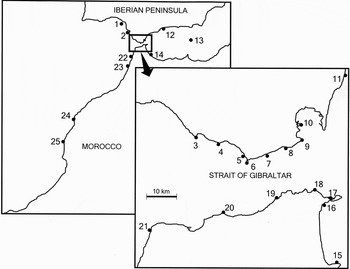
The study encompassed the whole Strait of Gibraltar and nearby areas. Twenty-five stations were selected along the north and south coasts of the Strait (Figure 1) to cover the broadest possible range of environmental conditions, including both natural rocky shores and artificial breakwaters.
Study area showing the sampling localities.

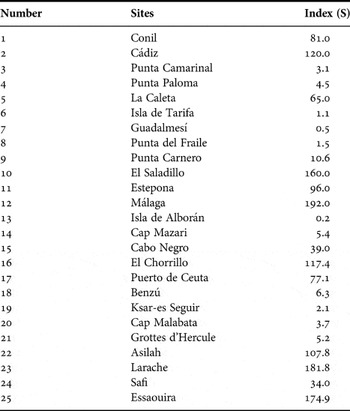
The degree of human pressures at the stations was estimated with the index of general anthropogenic stress (Fa, Reference Fa1998) (Table 1). The index was calculated by the equation S = (∑Pa/Dt) × A, where S is the general anthropogenic stress, Pa is the total area of each of the main population centres in a 5 km radius from the site, Dt is the distance of the focus of each population centre to the site, and A is a measure of disturbance based on a subjective assessment of both ease of access and levels of human activity, ranked in the following way (see Fa, Reference Fa1998; Guerra-García et al., Reference Guerra-García, Corzo, Espinosa and García-Gómez2004):
1. Very difficult access—little or no direct influence
2. Difficult access—little human activity
3. Moderate ease of access—moderate human activity
4. Moderate access—high activity or easy access—moderate activity
5. Extremely easy access together with high levels of human activity. Observations by Fa (Reference Fa1998) indicated that sites under high levels of human pressure were characterized by index values > 20.
Localities sampled and value of the index of anthropogenic stress (S). See also Figure 1.

To estimate the coastline complexity between the north and south coasts of the Strait of Gibraltar, the value of the fractal dimension (δ) was obtained for both coasts (see Fa, Reference Fa1996), being 1.23 for the north coastline and 1.42 for the south one. This indicates that the south coast of the Strait has a slightly more rugged structure than the north.
Sampling was conducted in summer 2006 (from 19 June to 3 August). To avoid problems caused by pooling data from diverse substrate types, sampling efforts were limited to a well-defined habitat (intertidal Corallina elongata J. Ellis & Solander) (see Thiel, Reference Thiel2002). Algal samples were taken in the low intertidal zone during low tide. At each station, C. elongata was scraped from different rocks to avoid effect of patchiness and to adequately sample peracarid diversity, until a volume of 200 ml was collected (modified from Thiel et al., Reference Thiel, Guerra-García, Lancellotti and Vásquez2003). Samples were preserved in 70% ethanol. In the laboratory, the samples were washed over a sieve with 0.5 mm mesh size, and all peracarids were sorted from the algae and identified to species level in most cases. Density of animals was expressed as number of individuals per volume of algae, which was estimated as the difference between the initial and final volume when placed into a graduated cylinder with a fixed amount of water (see Pereira et al., Reference Pereira, Lima, Queiroz, Ribeiro and Santos2006).
Species were classified in geographical distribution groups, following Arístegui & Cruz (Reference Arístegui and Cruz1986), later modified by Marques & Bellan-Santini (Reference Marques and Bellan-Santini1990), López de la Cuadra & García-Gómez (Reference López de la Cuadra and García-Gómez1994) and Conradi & López-González (Reference Conradi and López-González1999). The groups considered are the following (see Conradi & López-González, Reference Conradi and López-González1999):
I: Endemic Mediterranean
II: North-eastern Atlantic present in the Mediterranean
a. Boreotemperate
b. Subtropical or warm-temperate
c. Wide latitudinal distribution (a+b)
III: North-eastern Atlantic, absent in the Mediterranean
a. Boreotemperate
b. Subtropical or warm-temperate
c. Wide latitudinal distribution (a+b)
IV: North-eastern Atlantic, present in the Mediterranean and Indo-Pacific Ocean
V: Amphiatlantic
VI: Circumtropical
VII: Cosmopolitan.
The total number of species, the Shannon–Weiner diversity index (Shannon & Weaver, Reference Shannon and Weaver1963), and Pielou's evenness index (Pielou, Reference Pielou1966) were calculated for each station. Possible differences of these indices between north side (Stations 1–12) versus south side (Stations 14–25), and Mediterranean (Stations 7–19) versus Atlantic (Stations 1–6 and 20–25) sites were tested with one-way ANOVA, after verifying normality using the Kolmogorov–Smirnov test, and the homogeneity of variances using the Levene test. The influence of the type of substrate (artificial versus natural) and the anthropogenic stress (high versus low) on the species richness, abundance, diversity and evenness were tested using two-way ANOVA. The affinities among stations based on the peracarid species were established by cluster analysis using UPGMA (unweighted pair group method using arithmetic averages); the abundance data of peracarids were transformed by the square root and the Bray–Curtis similarity index was used (see Guerra-García & García-Gómez, Reference Guerra-García and García-Gómez2004).
RESULTS
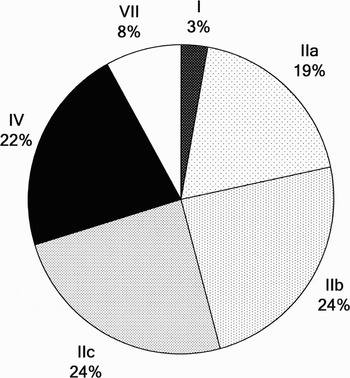
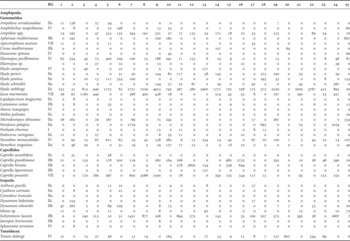
Forty peracarid species were collected (25 gammarids, 5 caprellids, 9 isopods and 1 tanaid) (Table 2). The classification of species in geographical distribution groups (Figure 2) shows that most species have an Atlantic–Mediterranean distribution (67%) with only one species, the gammarid Parhyale eburnea, being an endemic Mediterranean species. Groups IIb and IIc were the best represented and there was also an important percentage of north-eastern Atlantic taxa, present in the Mediterranean and Indo-Pacific Ocean. However, no species were found belonging to groups III, V and VI.
Percentage of species in the zoogeographical groups considered (see text).

Abundance of the peracaridean species associated to intertidal Corallina elongata from the Strait of Gibraltar (ind/1000 Ml seaweed). BG, biogeographical region (see text).

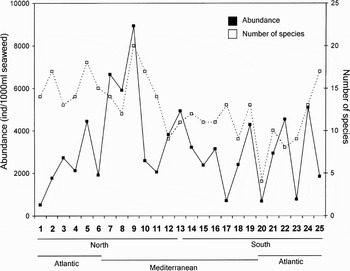
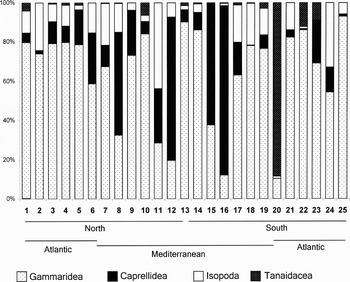
The most common species collected during the present study were the gammarids Hyale stebbingi, Jassa marmorata, Stenothoe monoculoides and Ampithoe spp., the caprellids Caprella grandimana and C. penantis, the isopod Ischyromene lacazei and the tanaid Tanais dulongi. The highest number of species (20 species/site) and the highest abundances (>8000 ind/1000 ml seaweed) were measured in Station 9 (Punta Carnero) with an intermediate value of the anthropogenic stress index (see Table 1). The lowest number of species (4 species/site) was registered in Station 20 (Cap Malabata) with a low index value of anthropogenic stress. Stations 1, 17, 20 and 23 were characterized by the lowest peracarid abundances (Figure 3). Gammarids dominated in abundance in most of the stations, although caprellids were dominant in some of the Mediterranean stations (8, 12, 15 and 16). Isopods were dominant only in Station 11, due to the high densities of I. lacazei, and the tanaid Tanais dulongi was the dominant taxon in Station 20 (Figure 4).
Total abundance (ind/1000 ml seaweed) and total number of species in each station.

Contribution of each group of peracaridean crustaceans to the total abundance per station.

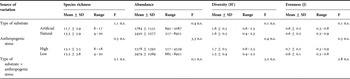
The number of species per station and the diversity index were significantly higher in the stations located in the north side of the Strait of Gibraltar (Table 3). The differences found in the north–south axis were not found in the Atlantic–Mediterranean axis (Table 4). There were no differences in species richness, abundance, diversity and evenness between artificial and natural substrates and between sites with high anthropogenic stress versus low stress sites, according to the two-way ANOVA (Table 5).
Mean values, standard deviations (SD), and range of the number of species (S), abundance (ind/1000 ml seaweed), diversity (H′), and evenness (J) in north (N = 12) versus south (N = 12) stations in the Strait of Gibraltar (*P < 0.05, **P < 0.01, n.s., not significant).

Mean values, standard deviations (SD), and range of the number of species (S), abundance (ind/1000 ml seaweed), diversity (H′), and evenness (J) in the Atlantic Ocean (N = 12) versus Mediterranean Sea (N = 13) stations in the Strait of Gibraltar; n.s., not significant.

Two-way ANOVA results for the influence of the type of substrate and the anthropogenic stress on the species richness (S), abundance (ind/1000 ml seaweed), diversity (H′), and evenness (J); n.s., not significant.

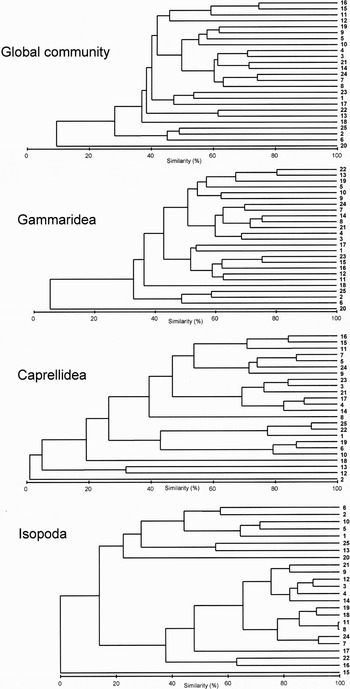
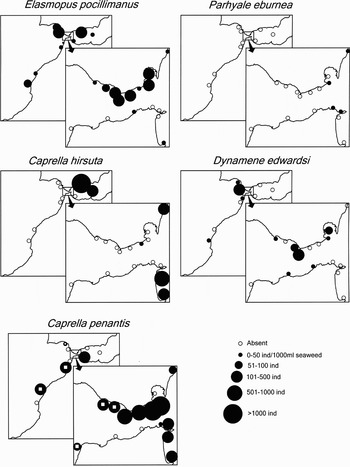
Although the classification analyses based on species composition did not show clear differences among stations through the north–south and Atlantic–Mediterranean axes (Figure 5), some species had distinct patterns of distribution. Caprella hirsuta was very abundant in Mediterranean stations, but absent in the Atlantic sites (Figure 6). Parhyale eburnea was also found exclusively in the Mediterranean, while the isopod Dynamene edwardsi showed highest abundances in the Atlantic stations. The amphipods Elasmopus pocillimanus and Caprella penantis were more abundant in the north side of the Strait. In the case of C. penantis, although the species was widely distributed in both Atlantic and Mediterranean stations, we found two different varieties clearly segregated. The forms with a tooth in the median palm of male gnathopod 2 (cf form lusitanica or testudo) were only found in the Atlantic, whereas all the specimens found in the Mediterranean belonged to form simulatrix (Figure 6).
Cluster analyses for the epifaunal peracarid assemblages from the red algae Corallina elongata at the 25 sampling sites along the Strait of Gibraltar based on abundance data for total community, Gammaridea, Caprellidea and Isopoda.

Abundance patterns of selected species found during the study. For Caprella penantis, white squares inside the black circles indicate forms with a tooth in the median palm of male gnathopod 2.

DISCUSSION
Biogeographical considerations
The results of the present study revealed that most of the peracaridean crustaceans associated to intertidal Corallina elongata from the Strait of Gibraltar were widely distributed along the Atlantic and Mediterranean, and the percentages of Mediterranean endemics were very low (3%) in comparison with other studies (see Bellan-Santini & Ruffo, Reference Bellan-Santini, Ruffo and Ruffo1998; Conradi & López-González, Reference Conradi and López-González1999; Guerra-García & Takeuchi, Reference Guerra-García and Takeuchi2002). However, we should also take into account that the Mediterranean stations of the present study are all located in the Alboran Sea, which is the westernmost basin of the Mediterranean and still have a very strong Atlantic influence (Parrilla & Kinder, Reference Parilla and Kinder1992). A recent cladistic analysis by Bellan-Santini & Ruffo (Reference Bellan-Santini, Ruffo and Ruffo1998) indicated that the Mediterranean and Atlantic fauna of amphipods are very close and that, in the light of the palaeogeographical history of the Mediterranean, leads us to presume that to a large extent the Mediterranean fauna is of Atlantic origin and relatively recent (post-Messinian). The low number of Mediterranean endemics found in the present study contrast with the 37% of endemic amphipods reported by Bellan-Santini & Ruffo (Reference Bellan-Santini, Ruffo and Ruffo1998), even higher than the 26.6% calculated by Fredj et al. (Reference Fredj, Bellan-Santini and Meinardi1992) for all the Mediterranean fauna as a whole. Conradi & López-González (Reference Conradi and López-González1999) also reported a high endemic benthic Gammaridea fauna (18.3% endemics) from Algeciras Bay (Iberian side of the Strait of Gibraltar). However, as indicated by Bellan-Santini & Ruffo (Reference Bellan-Santini, Ruffo and Ruffo1998), further researches along the Atlantic coast of North Africa and the Iberian Peninsula would likely reduce the number of amphipods that are considered endemic to the Mediterranean. For example, Caprella hirsuta and Caprella grandimana, considered as Mediterranean endemics in Krapp-Schickel (Reference Krapp-Schickel and Ruffo1993), have been recently reported on the Atlantic African coast from Cape Spartel to Cape Blanc (Bellan-Santini & Ruffo, Reference Bellan-Santini, Ruffo and Ruffo1998). Anyway, the marked differences between the low number of Mediterranean endemic species found in Corallina elongata during the present study and the high number found in previous studies using benthic amphipods associated to a variety of substrates, could be due to the wide distribution of the alga used in the present study, Corallina elongata, which is an unspecific substrate widely distributed along the Atlantic and Mediterranean intertidal ecosystems. The peracaridean fauna associated to this alga seems to have a low endemic component but a high percentage of lessepsian species (group IV) which represents the colonization in progress by Indo-Pacific elements via the Suez Canal and which is certainly destined to increase in the immediate future in comparisons with other studies (see Conradi & López-González, Reference Conradi and López-González1999).
All peracarids have direct development (e.g. Thiel & Vásquez, Reference Thiel and Vásquez2000) and lack a pelagic larval stage that could be considered important for transport over large oceanic distances. However, most of the species found in the present study are widely distributed; it has been suggested that rafting of juveniles and adults may be an important transport mechanism for organisms with direct development, and rafting could be particularly important for plant-associated fauna such as the peracarids examined in the present study (see also Thiel, Reference Thiel2002; Thiel et al., Reference Thiel, Guerra-García, Lancellotti and Vásquez2003).
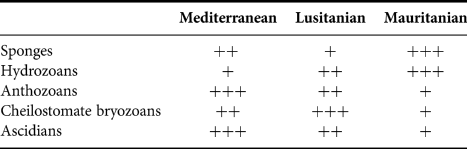
In general, most of other marine invertebrates in the Strait of Gibraltar have biogeographical similarities with the surrounding regions, although there is no clear pattern for all the fauna due to differences in dispersal abilities, historical reasons, influence of marine currents and human impact (Table 6). Hydrozoans and sponges have great affinity with the Mauritanian regions (Carballo et al., Reference Carballo, Naranjo and García-Gómez1997; Medel & López-González, Reference Medel and López-González1998), probably due to the entrance of tropical and subtropical species into the Mediterranean through the Strait of Gibraltar during the Pliocene. The groups which present more biogeographical affinities with the Mediterranean region, in a similar manner to peracaridean crustaceans, are the Ascidians and Anthozoans (López-González, Reference López-González1993; Naranjo, Reference Naranjo1995; Naranjo et al., Reference Naranjo, Carballo and García-Gómez1998). This trend has been also observed for opisthobranch molluscs (Cervera et al., Reference Cervera, Calado, Gavaia, Malaquias, Templado, Ballesteros, García-Gómez and Megina2004), which are characterized by planctotrophic–lecitotrophic larvae, a lack of Mediterranean endemisms and scarce number of amphiatlantic species (García-Gómez, Reference García-Gómez2002). In connection with the bryozoan fauna, the Cheilostomatida (mainly lecithotrophic larvae) from the Strait are more typical of cold waters than of warm waters, and the fauna is more similar to the fauna from the Boreal Province (López de la Cuadra & García-Gómez, Reference López de la Cuadra and García-Gómez1994). The Canary Stream, a branch of the Gulf Stream directed southwards along the European and African coasts, aids species to disperse to the south and results in the waters along the Canary Islands and northern African coasts being cooler than would be expected from their latitude. Ascidian larvae spend a short time in the plankton (around three days) and, consequently, the dispersal capacity of this group is very low. This could explain why the number of endemic species is clearly higher in ascidians than in other groups (Table 7) (Rodríguez, Reference Rodríguez1982). The peracaridean community of the present study shows a higher proportion (67%) of Atlantic–Mediterranean species; this trend is also observed for most groups except for hydrozoans, which are characterized by a high proportion of species from warm temperate waters around the world. Taking into account that hydroids have a great dispersal capacity and life cycle plasticity, we could think that species distributions should be related to the life history. However, most of the widely distributed hydroids lack a medusa phase, and many endemic species have free-swimming medusae (Medel & López-González, Reference Medel and López-González1998). For these reasons, life cycles cannot be related to specific distribution patterns.
Faunistic affinities between the Strait of Gibraltar and the three surrounding regions. Data taken from López-González, Reference López-González1993; López de la Cuadra & García-Gómez, Reference López de la Cuadra and García-Gómez1994; Carballo et al., Reference Carballo, Naranjo and García-Gómez1997; Medel & López-González, Reference Medel and López-González1998; Naranjo et al., Reference Naranjo, Carballo and García-Gómez1998.

Proportions of species belonging to the groups of geographical distribution in the Strait of Gibraltar. Data taken from López-González, Reference López-González1993; López de la Cuadra & García-Gómez, Reference López de la Cuadra and García-Gómez1994; Naranjo, Reference Naranjo1995; Carballo et al., Reference Carballo, Naranjo and García-Gómez1997; Medel & López-González, Reference Medel and López-González1998.

Recently, Pereira et al. (Reference Pereira, Lima, Queiroz, Ribeiro and Santos2006) studied the biogeographical patterns of intertidal peracarids and their association with macroalgal distributions along the Portuguese coast. They found a clear gradient of species substitution from north to south, but, geographical patterns in epifaunal abundance and diversity were not related with geographical changes in the identity of the dominant algal species. The species gradient supported the idea that the Portuguese coast acts as a region of contact between warm-water (from North Africa and the Mediterranean Sea) and cold-water species (from the North Sea and the Arctic). In the case of the Strait of Gibraltar, the present study reveals that, at least for peracaridean crustaceans, this biogeographical area behaves as a whole region, with a very similar fauna composition in all stations and there is no clear gradient of species substitution from the Mediterranean to the Atlantic stations.
Biodiversity patterns
Multivariate analyses conducted in the present study using the whole peracaridean community, and each group separately, did not show clear changes in species composition along the Mediterranean–Atlantic and north–south axes within the Strait of Gibraltar. However, although the species composition is quite homogeneous throughout the entire Straits, surprisingly, species richness per station and Shannon diversity were significantly higher in stations located in the north side. Taking into account that we selected the same substrate (Corallina elongata) at all stations, and that the two-way ANOVA revealed that differences between north and south were not due to environmental factors such as anthropogenic stress or type of substrate, we should think in terms of historical contingency to explain the higher diversity in the north side of the Strait of Gibraltar.
Ajbilou et al. (Reference Ajbilou, Marañón and Arroyo2006) and Rodríguez-Sánchez et al. (Reference Rodríguez-Sánchez, Pérez-Barrales, Ojeda, Vargas and Arroyo2008) reported a higher tree species diversity in forest sites in southern Spain than in equivalent sites in northern Morocco, and they suggested several non-exclusive hypotheses to explain these differences: (1) the lower landscape heterogeneity on the southern side of the Strait; (2) the forest resources are more heavily exploited in Moroccan side of the Strait; (3) general diversity loss by human impact on the southern side of the Strait; and (4) the Strait of Gibraltar has been a long-term barrier to dispersal. The first hypothesis refers to the relationship between diversity and heterogeneity. This is a valid premise and to test this, we have used the value of the fractal dimension (δ), which indicated that the north coast is less heterogeneous than the south. Consequently, we can discard this factor to explain the higher number of species per station on the north coast of the Strait due to a higher heterogeneity. The hypotheses 2 and 3 are closely related and an attempt has been made in this paper to address this issue using the index of general anthropogenic stress. Although we could not find differences based on this index, values could require some form of weighting or modification for a normalized comparison due to socio-economic differences across the north–south axis. The index does implicitly assume generally consistent human behaviours to make the results obtained comparable. The fourth hypothesis is far more relevant to trees than marine organisms, but future studies of dispersal capabilities of the species in question linked to the dynamic oceanography of the Strait with regard to possible changes during glacial/interglacial cycles, should help to establish how permeable (or not) the Strait might have been to dispersal. The Messinian salinity crisis represented the desiccation of the Mediterranean Sea between 5.96 and 5.33 million years ago (Myr) and was one of the most dramatic events on Earth during the Cenozoic era (Hsü et al., Reference Hsü, Ryan and Cita1973). It resulted from the closure of marine gateways between the Atlantic Ocean and the Mediterranean Sea. Consequently, the peracaridean biodiversity patterns which can be measured today along the north–south axis across the Strait of Gibraltar should be found after this period. When the sea level grew again, many species came into the Mediterranean basin through the Strait of Gibraltar, such as the ‘Senegalese fauna’ from equatorial African origin in the middle–late Pleistocene. In this respect, during the Sicilian period (1 Myr–200,000 yrs) many Palaeomediterranean species (fauna of the Tertiary when Mediterranean was not a discrete water body, rather a part of the Tethys Sea, connected with the Indo-Pacific) disappeared, and some of those that survived may have evolved into the endemic Mediterranean fauna (Pérès, Reference Pérès and Margalef1985). However, it is very difficult to determine whether a species survived and evolved in situ or whether it was extinguished in the Mediterranean and then reintroduced during one of the Quaternary transgressions. Also, the sea level changes are an important aspect of the glacial–interglacial cycles through the Pleistocene–Holocene in the western Mediterranean; it could have produced fluctuations in size populations and, therefore, bottleneck events (Espinosa & Ozawa, Reference Espinosa and Ozawa2006). Furthermore, the transitional states between the glacial and interglacial periods, the so called ‘windows of opportunity’, are characterized by a negligible surface flow, where conditions are most favourable for a crossing of the Strait (Fa et al., in press). On the other hand, variations in the Earth's orbit with periods of 10–100 thousand years have led to recurrent and rapid climatic shifts throughout Earth's history (Jansson & Dynesius, Reference Jansson and Dynesius2002). These cause changes in the geographical distribution of clades, which we term orbitally forced range dynamics (ORD) and the magnitude of ORD varies geographically. Thus, ORD could potentially explain a wide array of biodiversity patterns, suggesting ORD as a fundamental factor in evolution, and the vulnerability of biotas to many human activities should vary with the magnitude of ORD (Jansson & Dynesius, Reference Jansson and Dynesius2002).
Summarizing, most environmental factors affecting the terrestrial vegetation (Ajbilou et al., Reference Ajbilou, Marañón and Arroyo2006; Rodríguez-Sánchez et al., Reference Rodríguez-Sánchez, Pérez-Barrales, Ojeda, Vargas and Arroyo2008) are hardly suitable to explain the patterns obtained for the peracaridean community associated to Corallina elongata in the present study. We selected the same algae in all the stations and human impact was similar in stations of both sides. Provided that the species composition is similar in the north and south sites, potential barriers could be also discarded. Consequently, the higher richness per station at the southern Iberian Peninsula seems to have an important historical biogeographical component rather than a short-term environmental basis. The ultimate factors controlling these interesting differences along the north–south axis in the Strait of Gibraltar should be further investigated in future studies.
ACKNOWLEDGEMENTS
Financial support of this work was provided by the Ministerio de Educación y Ciencia (Project CGL2007-60044/BOS) co-financed by FEDER funds, and by the Consejería de Innovación, Ciencia y Empresa, Junta de Andalucía (Project P07-RNM-02524). Two anonymous referees provided helpful comments to improve the manuscript.