Extensive research suggests that people with poor social ties are at risk for morbidity and mortality from cardiovascular disease (CVD; Barth, Schneider, & Von Kanel, Reference Barth, Schneider and von Kanel2010). A number of different constructs have been studied in this literature, including isolation, network diversity, social support, and marital status and quality. In general, individuals who are isolated and have limited access to and/or low quality of social support and who have smaller or less diverse networks are at increased risk of CVD morbidity and mortality, independent of traditional cardiovascular risk factors (e.g., Berkman, Leo-Summers, & Horwitz, Reference Berkman, Leo-Summers and Horwitz1992; Eng, Rimm, Fitzmaurice, & Kawachi, Reference Eng, Rimm, Fitzmaurice and Kawachi2002; Frasure-Smith et al., Reference Frasure-Smith, Lesperance, Gravel, Masson, Juneau and Talajic2000; Gorkin et al., Reference Gorkin, Schron, Brooks, Wiklund, Kellen and Verter1993; Kawachi et al., Reference Kawachi, Colditz, Ascherio, Rimm, Giovannucci and Stampfer1996; Knox, & Uvnas-Moberg, Reference Knox and Uvnas-Moberg1998; Kuper, Marmot, & Hemingway, Reference Kuper, Marmot and Hemingway2002; Lett et al., Reference Lett, Blumenthal, Babyak, Strauman, Robins and Sherwood2005; Seeman, & Syme, Reference Seeman and Syme1987; Vogt, Mullooly, Ernst, Pope, & Hollis, Reference Vogt, Mullooly, Ernst, Pope and Hollis1992). There is also mounting evidence that social factors are associated with risk for the metabolic syndrome, a collection of symptoms that includes central adiposity, hypertension, insulin resistance, and dyslipidaemia, and which is known to be a precursor of and contributor to the pathogenesis of CVD (Grundy et al., Reference Grundy, Cleeman, Daniels, Donato, Eckel and Franklin2005). The strongest evidence of this phenomenon comes from long-term prospective studies that have shown that social constructs, that is, childhood social isolation, poor marital quality, and the loss of a spouse through death or divorce, are associated with increased risk of metabolic syndrome onset or clustering of the symptoms that comprise it (e.g, Caspi, Harrington, Moffitt, Milne, & Poulton, Reference Caspi, Harrington, Moffitt, Milne and Poulton2006; Troxel, Matthews, Gallo, & Kuller, Reference Troxel, Matthews, Gallo and Kuller2005; for an exception, see Ikeda, Kawachi, Iso, Inoue, & Tsugane, Reference Ikeda, Kawachi, Iso, Inoue and Tsugane2011).
To understand the mechanisms through which social factors contribute to CVD outcome, researchers have begun studying the biological consequences of social interactions. Research in this domain has focused on how both supportive and conflictual interactions influence biological processes involved in CVD pathogenesis. Much of this work has been done in laboratory settings. For example, studies have shown that support from others can ameliorate people's cardiac and vascular responses to brief lab stress (e.g., Kamarck, Manuck, & Jennings, Reference Kamarck, Manuck and Jennings1990; Lepore, Mata Allen, & Evans, Reference Lepore, Mata Allen and Evans1993; see review by Uchino, Carlisle, Birmingham, & Vaughn, Reference Uchino, Carlisle, Birmingham and Vaughn2010), which may be important because stress reactivity itself is a CVD risk factor in both healthy and clinical populations (e.g., Alderman, Ooi, Madhavan, & Cohen, Reference Alderman, Ooi, Madhavan and Cohen1990; Keys et al., Reference Keys, Taylor, Blackburn, Brozek, Anderson and Simonson1971; Krantz et al., Reference Krantz, Santiago, Kop, Merz, Rozanski and Gottdiener1999; Manuck, Olsson, Hjemdahl, & Rehnqvist, Reference Manuck, Olsson, Hjemdahl and Rehnqvist1992; Sheps et al., Reference Sheps, McMahon, Becker, Carney, Freedland and Cohen2002; see review by Treiber et al., Reference Treiber, Kamarck, Schneiderman, Sheffield, Kapuku and Taylor2003). Lab studies have also evaluated the biological sequelae of social conflicts; particularly in married couples (see review by Kiecolt-Glaser, & Newton, Reference Kiecolt-Glaser and Newton2001). These studies indicate that conflictual interactions raise blood pressure (BP), trigger activity of the sympathetic nervous system and hypothalamic–pituitary–adrenal axis, and increase the production of inflammatory mediators (Baker et al., Reference Baker, Paquette, Szalai, Driver, Perger and Helmers2000; Graham, Christian, & Kiecolt-Glaser, Reference Graham, Christian, Kiecolt-Glaser and Ader2007; Heffner, Kiecolt-Glaser, Loving, Glaser, & Malarkey, Reference Heffner, Kiecolt-Glaser, Loving, Glaser and Malarkey2004; Kiecolt-Glaser et al., Reference Kiecolt-Glaser, Malarkey, Chee, Newton, Cacioppo and Mao1993, Reference Kiecolt-Glaser, Newton, Cacioppo, MacCallum, Glaser and Malarkey1996, Reference Kiecolt-Glaser, Glaser, Cacioppo, MacCallum, Snydersmith and Kim1997, Reference Kiecolt-Glaser, Loving, Stowell, Malarkey, Lemeshow and Dickinson2005; Smith et al., Reference Smith, Uchino, Berg, Florsheim, Pearce and Hawkins2009). Each of these processes has been implicated in various stages of the development and manifestation of CVD (Kop, Reference Kop1999)
More recent studies have explored the biological consequences of social interactions that occur in real-world settings. Kamarck and colleagues (Reference Kamarck, Janicki, Shiffman, Polk, Muldoon and Liebenauer2002) followed 340 older adults over a 3-day period using electronic daily diaries and ambulatory BP (ABP) monitors. They observed that episodes of social conflict were associated with greater systolic BP (SBP) and diastolic BP (DBP) activity, above and beyond potential confounds like posture and activity at the time of measurement. A similar pattern has been observed in adolescents: one study that used electronic diaries and ABP monitoring found that anxious- and avoidant-attachment boys had augmented ambulatory heart rate and BP during social interactions (Gallo & Matthews, Reference Gallo and Matthews2006). Another found that among adolescents who have a tendency to read threat into ambiguous situations, ABP was higher during social interactions than it was when they were alone. This pattern was reversed in adolescents who tend not to read threat into ambiguous situations (Chen, Matthews, & Zhou, Reference Chen, Matthews and Zhou2007). Day to day social interactions have also been related to indicators of atherosclerosis, the pathogenic condition that underlies much CVD. In particular, to the extent that men reported frequent interactions with their spouses, they showed less progression of atherosclerosis in the carotid artery over 3 years, provided they also had high marital quality (Janicki, Kamarck, Shiffman, Sutton-Tyrell, & Gwaltney, Reference Janicki, Kamarck, Shiffman, Sutton-Tyrell and Gwaltney2005). These associations were not observed among women.
Collectively, these findings suggest that social interactions have biological consequences of potential relevance to understanding CVD pathogenesis. However, a number of important questions in this literature have not yet been answered. The first has to do with the nature of the association between social interactions and disease processes. Do positive and negative encounters have separable and independent associations with the relevant outcomes? Or do they represent different ends of the same continuum? To what extent do they have synergistic influences on disease processes, such that people who have more negative and fewer positive encounters are worst off? Can positive interactions serve as a buffer, offsetting any health effects of negative ones?
Another unanswered question in this literature has to do with what role broader personality characteristics play in driving these associations. Personality traits like extraversion, neuroticism/emotional stability, and agreeableness have strong influences on the quantity and quality of a person's social encounters (Doeven-Eggens, De Fruyt, Hendriks, Bosker, & van der Werf, Reference Doeven-Eggens, De Fruyt, Hendriks, Bosker and van der Werf2008; Scarr, & McCartney, Reference Scarr and McCartney1983; Swickert, Hittner, & Foster, Reference Swickert, Hittner and Foster2010). These traits are also associated with risk for CVD morbidity and mortality (e.g., Shipley, Weiss, Der, Taylor, & Deary, Reference Shipley, Weiss, Der, Taylor and Deary2007; Smith & MacKenzie, Reference Smith and MacKenzie2006; Terracciano, Lockenhoff, Zonderman, Ferrucci, & Costa, Reference Terracciano, Lockenhoff, Zonderman, Ferrucci and Costa2008). Thus, it is important to determine the extent to which they are contributing to associations between social interactions and disease processes.
Finally, little is known about the role of social interactions and disease processes in a developmental context (Matthews, Reference Matthews2005). Researchers are increasingly emphasizing the importance of viewing pathogenesis of CVD from a life-course perspective. Autopsy studies indicate that atherosclerosis begins in the early decades of life (Kavey et al., Reference Kavey, Daniels, Lauer, Atkins, Haymann and Taubert2003; McGill et al., Reference McGill, McMahan, Herderick, Malcom, Tracy and Strong2000; Strong, Malcom, & McMahan, Reference Strong, Malcom, McMahan, Tracy, Newman and Herdrick1999) and CVD risk factors established in childhood and adolescence are generally stable across time (Morrison, Friedman, & Gray-McGuire, Reference Morrison, Friedman and Gray-McGuire2007). Adolescence is also of special interest psychologically, given the major socioemotional changes it often entails. It is a time when many youth struggle for independence from their parents, have their first romances, assemble their own friendship networks, and navigate the interpersonal complexities of their school environments. These struggles seem to have important consequences for mental health; the risk of depression increases markedly in the teenage years, particularly in females (Nolen-Hoeksema & Girgus, Reference Nolen-Hoeksema and Girgus1999). Mood problems are often exacerbated by young women's social difficulties (Allen et al., Reference Allen, Porter, Land, Insabella, Smith and Phillips2006; Lee, Hankin, & Mermelstein, Reference Lee, Hankin and Mermelstein2010; Schrepferman, Eby, Snyder, & Stropes, Reference Schrepferman, Eby, Snyder and Stropes2006), creating a downward spiral that might also have implications for CVD. These considerations make adolescence a rich time of life to observe everyday social interactions and their biological consequences.
The goal of this study was to build on previous research by addressing these limitations. A sample of female adolescents recorded impressions of their day to day social encounters using electronic diaries. Symptoms of the metabolic syndrome were assessed at the same time and annually thereafter for 2 years. We predicted that, to the extent that they had abrasive social interactions in day to day life, participants would display increased metabolic risk over the follow-up. We also expected positive interactions to be associated with better metabolic outcomes, and to attenuate any adverse health effects arising from negative ones. Finally, we expected these associations to be independent of personality characteristics, like neuroticism, agreeableness, and extraversion, which are associated with both social behavior and CVD outcomes.
Methods
Participants
Data were collected as part of a larger project on depression and atherosclerosis in young women at risk for affective disorders. The participants were recruited from the Vancouver, BC, community through advertisements. Eligibility criteria included being (a) female, 15–19 years old, and fluent in English; (b) free of acute illness in the past 2 weeks; and (c) without a history of chronic medical or psychiatric disorders. A total of 157 young women were enrolled in the study; our analyses included only the 147 participants who were recruited to be at high risk for developing an initial episode of depression. High risk was defined as having a first-degree relative with a history of affective disorder, and/or scoring in the top quartile of the population on cognitive vulnerability to depression. (The other 10 participants, who were excluded from these analyses, were enrolled as low-risk controls.) Over the course of the 2-year follow-up, 25 of the 147 admissible participants were lost to attrition (17.0%): 6 of them moved away, we lost contact with 4, and 15 withdrew. Thus, the final sample consisted of 122 young, healthy female participants. All procedures and methods were approved by the University of British Columbia Research Ethics Board. Written consent was obtained from all participants prior to participation. For participants younger than 18 years of age, a parent or guardian consent was also obtained.
Procedure
Participants visited the research center on six occasions over a 2.5-year period. The analyses in this article focus on the data gathered at study entry and 12 and 24 months later (referred to hereafter as Visits 1, 2, and 3, respectively). These were the only study visits in which daily social interactions and metabolic symptoms were assessed. At each visit, participants arrived between 8 and 11 a.m., following an overnight fasting period. After obtaining informed consent, participants completed a battery of interviews and questionnaires, described in more detail below, which were used to evaluate alternative explanations such as mood, personality characteristics, and health practices. BP values, waist circumference, and a blood sample for assessment of high-density lipoproteins (HDL), triglycerides, and glucose were obtained (see below for details). Following the testing sessions at Visits 1 and 2, participants were given a Palm Pilot, which prompted them to rate the quality of social encounters in daily life. The diary was completed twice daily over a 2-day period using a format similar to the Rochester Interaction Record (see below). In addition, participants were also asked questions about daily physical activity practices.
Measures
Perception of social encounters
On each day of monitoring, participants were queried twice about their social interactions (4 and 14 hr after waking). The first item asked if they had interacted with their closest friend, romantic partner, parent/guardian, and other friends since the last diary entry. For each category of interaction answered “yes,” the Palm Pilot prompted them to rate the encounter(s) on eight negative (conflict, criticism, disappointment, exclusion, sense of inferiority, anger, shame or embarrassment, prying) and seven positive (pleasantness, intimacy, helpful advice, helpful assistance, care, sense of confidence, value or respect) dimensions. These items were drawn from the Rochester Interaction Record (Reis, & Wheeler, Reference Reis, Wheeler and Zanna1991) and the Diary of Ambulatory Behavioral States (Kamarck et al., Reference Kamarck, Shiffman, Smithline, Goodie, Paty and Gnys1998). Ratings were made on a 0 (not at all) to 4 (very much/a lot) scale. For each encounter, composite positive and negative scales were calculated by averaging ratings across the appropriate dimensions. Both of the scales were internally consistent, with Cronbach α = 0.75 for negative perception of social encounters and α = 0.82 for positive. Scores on the negative scale could range from 0 to 32, whereas those on the positive scale could range from 0 to 28. Scores on the two scales were inversely correlated in a modest fashion (r = −.17, p = .05). Participants’ ratings of their interactions were fairly stable over time: over the year that elapsed between diary ratings at Visits 1 and 2, the stability of scores on the negative scale was r = .36 (p < .001) and on the positive scale was r = .60 (p < .001). Thus, ratings were collapsed across these periods to form more traitlike indicators of positive and negative interaction tendencies. Each of these indicators comprised eight separate diary entries (two entries per day, for 2 days, at both Visits 1 and 2), which could have included ratings of up to four separate social encounters each.
Metabolic risk
Following recommendations as issued in a joint statement by the American Heart Association and National Heart, Lung and Blood Institute, metabolic risk was assessed by considering levels of HDL and triglycerides, as well as fasting glucose, SBP and DBP, and waist circumference (Grundy et al., Reference Grundy, Cleeman, Daniels, Donato, Eckel and Franklin2005). To measure resting SBP and DBP, participants were seated in a chair with an occluding cuff on one arm. Following a 5-min rest period, four BP readings, spaced 2 min apart, were collected using an automatic, calibrated, oscillometric BP monitor (BPM-100, VSM MedTech, Coquitlam, BC). Appropriately sized BP cuffs were selected according to the diameter of the participant's arm. Average SBP and DBP were calculated by averaging the last three measures (the first reading is excluded as it tends to be elevated due to the novelty of the procedure). This device and protocol has been validated in pediatric populations and yield BP readings that meet the standards of the British Hypertension Society for accuracy and reliability (Mattu, Heran, & Wright, Reference Mattu, Heran and Wright2004).
Waist circumference was measured from the side at the midpoint between the upper iliac crest and lower costal margin at the midaxillary line using a standard measuring tape. Measurements were taken at least twice, and repeated until a consistent reading was obtained.
Overnight fasting blood samples were collected at each visit to quantify other metabolic parameters. A 10-ml sample of blood was collected into a serum separator Vacutainer tube (Becton-Dickinson, Oakville, ON) through antecubital venipuncture. The sample was spun for 12 min at 1200 × g. After the serum had been aspirated, it was frozen at −30°C until assayed in batch. The analyses were performed in the Clinical Chemistry laboratory of St. Paul's Hospital in Vancouver. Triglycerides were determined enzymatically on a Hitachi 747 (Kyowa Medex, Japan) after hydrolysis to glycerol. This method has an interassay coefficient of variation of 1.1%. HDL was measured using standard enzymatic techniques with cholesterol esterase and cholesterol oxidase, after low-density, intermediate density, and very-low density lipoproteins had been precipitated through centrifugation, on a Hitachi 911 instrument (Kyowa Medex, Japan). This method has an interassay coefficient of variation of 5.1%. Glucose was measured with an enzymatics technique that uses hexokinase and glucose-6-phosphate dehydrogenase enzymes on an ADVIA 1650 Chemistry System (Bayer Diagnostics, Tarrytown, NY) with an interassay coefficient of variation of 1.2%.
Because our sample was recruited to be young and healthy, none of the participants met criteria for diagnosis with the metabolic syndrome either at study entry or during the follow-up period. Therefore, in order to model the evolution of metabolic risk during follow-up, and based on previous research that has focused on these processes in healthy youth (e.g., Eisenmann, Reference Eisenmann2008; Ekelund et al., Reference Ekelund, Brage, Franks, Hennings, Emms and Wareham2005), we computed a composite score comprised of values on the six components of the metabolic syndrome: HDL, triglycerides, fasting blood glucose, waist circumference, SBP, and DBP. Scores on each component were converted to a z score; HDL was reverse coded to match risk direction of the others. Composite metabolic risk was then calculated for each visit by averaging the z scores across components. Scores were fairly stable across time, with correlations of 0.47 (p < .001) and 0.44 (p < .001) across 1 and 2 years of follow-up, respectively.
Alternative explanations
Several other variables were assessed as potential alternative explanations for any association observed between social interaction tendencies and metabolic risk trajectories. These included demographic characteristics (age, ethnicity, socioeconomic status [SES]), oral contraceptive (OC) use, depressed mood (as measured by the Beck Depression Inventory [BDI], see below), daily physical activity, and neuroticism, agreeableness and extraversion (as measured by the Big Five Inventory), see below). SES was indexed by the highest years of education completed by either the participant's mother or father.
Depressed mood
Depression has profound influences on the quantity and quality of people's social interactions, and is also independently associated with increased risk for the metabolic syndrome and CVD more generally (Kinder, Carnethon, Palaniappan, King, & Fortmann, Reference Kinder, Carnethon, Palaniappan, King and Fortmann2004; Rugulies, Reference Rugulies2002). Coupled with the fact that this sample was recruited specifically to be at risk for affective disorders, these considerations led us to consider whether depression was underlying any observed associations between social interactions and metabolic outcomes. Thus, we had participants complete the BDI (Beck, Ward, Mendelson, Mock, & Erbaugh, Reference Beck, Ward, Mendelson, Mock and Erbaugh1961) at Visits 1, 2, and 3. The BDI is a widely used measure of the intensity of depressive symptoms. It consists of 21 items assessing symptoms and attitudes of depression experienced during the past week, with possible scores for each question ranging from 0 to 3. The BDI was internally consistent in our sample, with an average Cronbach alpha of 0.93 across visits.
Neuroticism, agreeableness, extraversion
Personality was assessed at Visit 1 using the Big Five Inventory (1991), a 44-item inventory that provides assessment of the Big Five dimensions of personality (John, Donahue, & Kentle, Reference John, Donahue and Kentle1991). Participants are asked to rate the degree to which they agree with a characteristic presented in a statement, with responses ranging from 1 (strongly disagree) to 5 (strongly agree). For the purposes of this article, we considered three dimensions closely linked to social interactions and health outcomes in past research: neuroticism, which is characterized by traits like tenseness, moodiness, and anxiety (8 items; Cronbach α = 0.76); extraversion, which encompasses traits like talkative, energetic, and assertive (8 items; Cronbach α = 0.84); and agreeableness, which includes traits like sympathetic, kind, and affectionate (9 items; Cronbach α = 0.75).
Physical activity
Low levels of physical activity have been associated with general negative mood (e.g., Dunn, Trivedi, & O'Neal, Reference Dunn, Trivedi and O'Neal2001; Janisse, Nedd, Escamilla, & Nies, Reference Janisse, Nedd, Escamilla and Nies2004; Penedo & Dahn, Reference Penedo and Dahn2005; Scully, Kremer, Meade, Graham, & Dudgeon, Reference Scully, Kremer, Meade, Graham and Dudgeon1998) and increased risk of the metabolic syndrome (e.g., Ekelund et al., Reference Ekelund, Brage, Franks, Hennings, Emms and Wareham2005; Laaksonen et al., Reference Laaksonen, Lakka, Salonen, Niskanen, Rauramaa and Lakka2002; Lakka et al., Reference Lakka, Laaksonen, Lakka, Mannikko, Niskanen and Rauramaa2003). To rule out physical activity as a possible confound, we chose to include it as a control variable in analyses. At the end of each day of monitoring participants were asked about physical activity using an item from the Paffenbarger Activity Scale (Paffenbarger, Blair, Lee, & Hyde, Reference Paffenbarger, Blair, Lee and Hyde1993). They were asked “Did you engage in any activity today akin to brisk walking, jogging, bicycling, etc., long enough to work up a sweat?” If they responded affirmatively, they were asked for how long. The average per-day minutes of exercise was then averaged over the monitoring periods following Visits 1 and 2. This approach to assessing physical fitness has been validated in previous research, which shows that self-reported brisk activity is related to VO2 max scores during treadmill tests (Paffenbarger et al., Reference Paffenbarger, Blair, Lee and Hyde1993).
Results
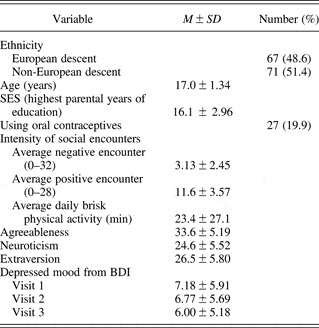
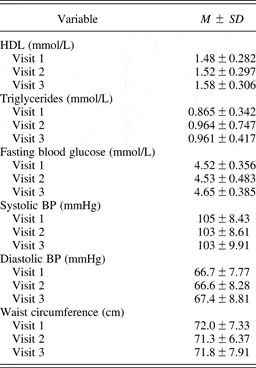
The sample consisted of healthy adolescent females, as can be seen from the information presented in Table 1. Participants were primarily of Asian and European descent, and whose parents had, on average, a university education. Table 2 contains descriptive statistics for individual components of the metabolic index. Over the 2-year follow-up period the sample as a whole displayed increases in HDL, F (1.8, 169) = 8.384, p = .001, and glucose, F (2, 184) = 4.951, p = .008. There was also a trend toward increasing SBP over follow-up, F (2, 184) = 2.452, p = .081. The sample as a whole did not show changes in triglycerides, F (1.5, 134) = 1.19, p = .296, DBP, F (2, 184) = 0.346, p = .708 or waist circumference, F (1.8, 167) = 0.682, p = .494, over time. The sample as a whole did not show changes in the metabolic composite over the follow-up period, p = .75. However, further analyses revealed that there was marked within- and between-person variability in metabolic trajectories. The intraclass correlation for the metabolic composite was 0.54, indicating that about half of the total variance in this construct over time was between participants. The other half was due to within-person changes and person by time interactions. These figures suggest that there is sufficient variability in metabolic trajectories in the sample to justify exploring the potential influence of participants’ social encounters.
Characteristics of the sample (N = 122)

Note: SES, socioeconomic status; BDI, Beck Depression Inventory.
Descriptive statistics for metabolic parameters over the course of study

Note: HDL, high density lipoprotein; BP, blood pressure.
Statistical approach
To determine whether perceived quality of social encounters predicted changes in metabolic risk over time, we estimated a series of multilevel models with HLM 6.08 (Raudenbush, Bryk, & Congdon, Reference Raudenbush, Bryk and Congdon2006). The within-person (Level 1) models included a variable reflecting time since study entry (in months). The between-person (Level 2) models included the relevant indices reflecting social interactions, as well as five standard control variables: age, ethnicity (European descent vs. non-European descent), OC use, parental education, and average minutes of physical activity. In later models we added depressive symptoms and personality characteristics as covariates, to evaluate their role in shaping the observed associations. In all cases we estimated random slope models, in which Level 2 error terms were allowed to vary freely. Models were estimated with robust standard errors.
Preliminary results
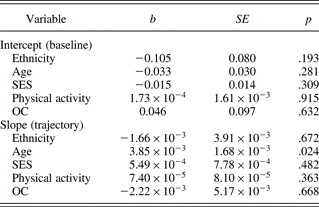
To estimate how much the control variables explained metabolic change over time, we ran an initial model that included time from study entry at Level 1, and age, ethnicity, oral contraceptive use, and parental education at Level 2. The results are presented in Table 3. Age was associated with change in metabolic composite over time, b = 3.85 × 10⁻³, SE = 1.68 × 10⁻³, p = .024, such that participants who were older at study entry had larger increases in metabolic composite scores over the follow-up. None of the other standard control variables was associated with the metabolic composite, either at study entry or over time.
Results of hierarchical linear modeling model predicting metabolic profiles over time from control variables

Note: SES, socioeconomic status; OC, oral contraceptive.
Positive and negative social encounters
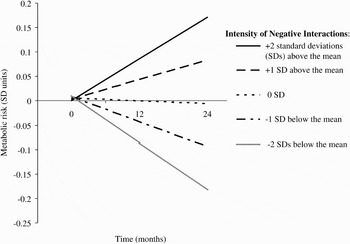
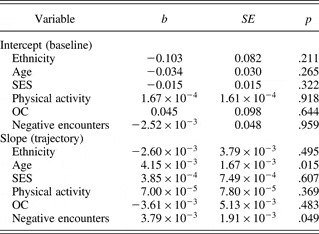
Next we evaluated our principal hypotheses by including variables reflecting the quality of social interactions in the Level 2 models. As Table 4 shows, older subjects, b = 4.15 × 10⁻³, SE = 1.67 × 10⁻³, p = .015, continued to show larger increases in metabolic symptoms over the follow-up. Over and above the contribution of the control variables, negative social interactions were associated with metabolic composite trajectories. As Figure 1 shows this was a positive association, such that participants who had more intense negative social encounters in day to day life showed increasing scores on the metabolic composite over the 2-year follow-up, b = 3.79 × 10⁻³, SE = 1.91 × 10⁻³, p = .049. Conversely, participants with less intense negative encounters showed a decline in metabolic composite scores over time.
Negative social encounters and metabolic composite scores over 2 years. Participants who had more negative social encounters in day to day life showed increasing scores on the metabolic composite over follow-up (b = 3.79 × 10⁻³, SE = 1.91 × 10⁻³, p = .049). Conversely, participants with less negative social encounters showed a decline in metabolic composite scores over the same time frame.

Results of hierarchical linear modeling model predicting metabolic profiles over time from control variables and negative social interactions

Note: SES, socioeconomic status; OC, oral contraceptive.
Further analyses revealed that there was no association between the intensity of positive encounters and the metabolic composite at baseline, b = −0.10, SE = 6.2 × 10⁻², p = .10, or over follow-up, b = 3.34 × 10⁻³, SE = 1.9 × 10⁻³, p = .083. There also was no evidence of a statistical interaction between the two dimensions of social encounters, b = 3.5 × 10⁻⁴, SE = 2.0 × 10⁻³, p = .86. Thus, positive encounters did not offset the apparent metabolic consequences of negative ones.
Alternative explanations
The final models evaluated alternative explanations. We began by testing whether symptoms of depression might be driving the observed associations. BDI scores from Visits 1, 2, and 3 were added to the Level 1 models. However, the intensity of negative social encounters continued to predict changes in the metabolic composite under these conditions, b = 5.4 × 10⁻³, SE = 2.1 × 10⁻³, p = .013, suggesting this association was not being driven by underlying depressive symptoms.
We next evaluated the contribution of the personality traits extraversion, neuroticism, and agreeableness. Variables reflecting these traits were added to the Level 2 equations in separate models. None of the variables were associated with scores on the metabolic composite at study entry. Only extraversion was associated with changes in the metabolic composite, b = 5.8 × 10⁻⁴, SE = 2.9 × 10⁻⁴, p = .05. Moreover, the intensity of negative encounters continued to predict increases in metabolic composite scores over time when extraversion, b = 4.0 × 10⁻³, SE = 1.9 × 10⁻³, p = .037, neuroticism, b = 3.9 × 10⁻³, SE = 1.9 × 10⁻³, p = .045, and agreeableness, b = 4.3 × 10⁻³, SE = 1.9 × 10⁻³, p = .027, were in the model, suggesting these traits were not driving the observed associations.
Discussion
With mounting evidence that poor social ties increase the risk of morbidity and mortality from CVD, greater focus has been placed on exploring the biological consequences of everyday social interactions. The goal of this study was to determine whether the quality of these interactions presaged changes in symptoms of the metabolic syndrome in healthy young women at risk for depression. We found evidence that the intensity of negative, but not positive, social encounters was associated with trajectories of metabolic risk over a 2-year period. To the extent that they had more intense negative encounters in day to day life, participants showed increasing scores on the metabolic composite over follow-up. Conversely, participants with less intense negative interactions showed a decline in metabolic composite scores over the same time frame. This observation persisted after adjustment for age, ethnicity, SES, OC use, daily physical activity, depressed mood, and personality traits (agreeableness, neuroticism, and extraversion). Positive encounters were not associated with metabolic trajectories, and did not offset the apparent influence of negative ones. These results further our understanding of how everyday social interactions affect the development of metabolic processes involved in CVD. In doing so they may help to explain why broader constructs, like perceived social support or social network diversity, relate to CVD outcomes in such a robust fashion.
We predicted that negative social interactions would be associated with worsening metabolic trajectories. The results were consistent with this hypothesis. To the degree that they experienced more intense negative encounters, participants showed increasing scores on the metabolic composite over time. This association was fairly small in its magnitude, with each standard deviation increment in negative interactions associated with a 3.8 × 10⁻³SD increase in metabolic composite trajectories. Differences of this size are unlikely to have any immediate clinical significance, especially in this population of healthy adolescents. However, if this dynamic was sustained through adolescence and adulthood it would presumably contribute to the development of frank metabolic syndrome. Apart from their potential clinical implications, these findings are noteworthy in two more theoretical respects: first, they suggest the presence of a graded association between social interactions and metabolic symptoms, whereby even small variations in people's tendencies to have negative exchanges seem to have biological repercussions. Second, they suggest that this dynamic begins early in life, when people are still in good overall metabolic health. The implication is that aversive social encounters, often viewed as a normative development experience for adolescents, may set off biological trajectories that, if sustained, ultimately contribute to the development of CVD.
We also expected that positive social interactions would relate to better metabolic outcomes, or at least offset the consequences of negative encounters. However, neither of these hypotheses was borne out. These findings indicate that, at least in our sample, there are no metabolic benefits associated with having regular positive social interactions. When considered alongside the roughly linear effects that emerged for negative encounters, these results suggest that young women are likely to accrue more metabolic benefits by reducing the intensity of negative social interactions than increasing the intensity of positive ones. In general, this pattern of findings is consistent with literature on well-being, which suggests that negative events tend to be more impactful than positive ones (Baumeister, Bratslavsky, Finkenauer, & Vohs, Reference Baumeister, Bratslavsky, Finkenauer and Vohs2001; Finch, Okun, Barrera, Zautra, & Reich, Reference Finch, Okun, Barrera, Zautra and Reich1989; Finch, Okun, Pool, & Ruehlman, Reference Finch, Okun, Pool and Ruehlman1999; Newsom, Rook, Nishishiba, Sorkin, & Mahan, Reference Newsom, Rook, Nishishiba, Sorkin and Mahan2005; Rook, Reference Rook2001; Schuster, Kessler, & Aseltine, Reference Schuster, Kessler and Aseltine1990). It is also consistent with an early study of BP responses to marital conflict, which concluded that “not being nasty matters more than being nice” (Ewart, Taylor, Kraemer, & Agras, Reference Ewart, Taylor, Kraemer and Agras1991, p. 155). Of course, it is also possible that the null findings herein stem from problems with the study's research design. The diary sampling period was fairly brief. If influential positive encounters occur infrequently, our sampling period could have missed them altogether. This also could have posed a problem for testing the offset hypothesis, particularly if positive encounters act as buffers against very intense (but infrequent) negative exchanges. It is also possible that our diary did not tap the dimensions of positive social interactions that are most important for health.
Although these data suggest that negative interactions worsen metabolic symptoms over time, the underlying mechanism through which this process occurs is not yet understood. Our analyses help to eliminate some of the most plausible explanations, such as confounding by age, ethnicity, SES, physical activity, and depressed mood. The observed patterns also do not seem to be a reflection of the influence of personality characteristics like neuroticism, agreeableness, and extraversion, which shape the quality of people's social encounters and also have been related to CVD outcomes. Of course, it is possible that more narrow facets of personality not captured in the Big 5's major dimensions could play a role in the observed associations.
Assuming the observed associations reflect a process that is causal in nature they could be driven by the direct biological consequences of the social encounters themselves. As we noted earlier in the paper, acute episodes of social conflict raise BP (Gallo, & Matthews, Reference Gallo and Matthews2006; Kamarck et al., Reference Kamarck, Janicki, Shiffman, Polk, Muldoon and Liebenauer2002), which is a component of the metabolic syndrome. Conflictual interactions also trigger activity of the sympathetic nervous system and the hypothalamic–pituitary–adrenal axis (Graham et al., Reference Graham, Christian, Kiecolt-Glaser and Ader2007; Heffner et al., Reference Heffner, Kiecolt-Glaser, Loving, Glaser and Malarkey2004; Kiecolt-Glaser et al., Reference Kiecolt-Glaser, Newton, Cacioppo, MacCallum, Glaser and Malarkey1996, Reference Kiecolt-Glaser, Glaser, Cacioppo, MacCallum, Snydersmith and Kim1997, Reference Kiecolt-Glaser, Loving, Stowell, Malarkey, Lemeshow and Dickinson2005), whose hormonal products are thought to increase fat accumulation and impair glucose control, among other things (Bjorntorp & Rosmond, Reference Bjorntorp and Rosmond1999; Brunner et al., Reference Brunner, Hemingway, Walker, Page, Clarke and Juneja2002). In young women, more chronic exposure to negative social encounters has been prospectively linked to upregulation of inflammatory processes (Miller, Rohleder, & Cole, Reference Miller, Rohleder and Cole2009), which are known to play a key role in the pathogenesis of most components of the metabolic syndrome (Hotamisligil, Reference Hotamisligil2006). It will be important for the next wave of studies in this area to evaluate the role these proposed mechanisms play in the link between social encounters and metabolic trajectories. Meanwhile, there could be value in targeting social processes as a way to intervene and slow early disease processes. If our findings do reflect a causal process, interventions that reduce the frequency and/or severity of negative interactions could have consequences for metabolic trajectories. There is evidence that family systems therapy, which aims to improve parent–child relationships, can improve blood glucose control in teenagers with diabetes (Wysocki et al., Reference Wysocki, Harris, Buckloh, Mertlich, Lochrie and Mauras2007). Such interventions might also have benefits for psychopathology and comorbidity of mental and physical illnesses.
Future research is also needed to explain the temporal dimension of our findings. The metabolic disparities associated with abrasive encounters were not apparent at baseline, but seemed to gradually accumulate as the study's follow-up period progressed. The reasons for this pattern are unclear. During adolescence there are profound changes in body size and shape, as well as BP, insulin resistance, and other metabolic processes related to CVD (e.g., see Moran et al., Reference Moran, Jacobs, Steinberger, Steffen, Pankow and Hong2008). At this stage of life there are also considerable within-person symptom fluctuations, with nearly 50% of youth classified as having metabolic syndrome losing their diagnosis within 3 years (Goodman, Daniels, Meigs, & Dolan, Reference Goodman, Daniels, Meigs and Dolan2007). It may be that the influence of social encounters only becomes apparent in the later stages of adolescence, when the frequency of these fluctuations has subsided and more stable risk trajectories becomes established.
This study has several limitations that should be considered. First, because it focused on young women who were at risk for affective disorders, it is unclear how broadly the results can be generalized to other populations. The women studied herein may be especially sensitive to negative social encounters, and some may have attributional tendencies that would exaggerate responsibility for, and consequences of, abrasive interactions that occurred with friends, family, or even strangers. Thus, replication of these findings in other populations is necessary before they can be safely generalized. Second, our daily diary sampling was limited to two 48-hr periods. Although this duration was adequate to capture the individual differences in negative interactions associated with metabolic trajectories, it may have been too short to tap positive encounters that are infrequent but highly impactful. In future research, more extended periods of sampling would help to alleviate this concern, and allow for a more robust test of the hypotheses we considered. Third, as is the case with any study that has an observational design, there are potential alternative explanations for our findings that involve unmeasured confounds. Particularly worrisome in this regard are genetic liabilities that predispose individuals to both abrasive social encounters and symptoms of metabolic syndrome. One especially rigorous way to evaluate whether our findings are causal in nature would be to assess metabolic endpoints in people who received (or did not receive) an intervention to improve the quality of their social interactions (e.g., couples therapy).
In summary, this study's findings suggest that, in adolescent females, there is a graded association between the negativity of social encounters and trajectories of metabolic symptoms over time. Positive interactions do not seem to have an influence on metabolic profiles. They also do not appear to function as a buffer against the metabolic consequences of negative interactions. Collectively, these findings shed light on some of the mechanisms that might underlie the broader epidemiologic linkage between social relationships and CVD morbidity and mortality (e.g., Barth et al., Reference Barth, Schneider and von Kanel2010; Berkman et al., Reference Berkman, Leo-Summers and Horwitz1992; Eng et al., Reference Eng, Rimm, Fitzmaurice and Kawachi2002; Frasure-Smith et al., Reference Frasure-Smith, Lesperance, Gravel, Masson, Juneau and Talajic2000; Gorkin et al., Reference Gorkin, Schron, Brooks, Wiklund, Kellen and Verter1993; Kawachi et al., Reference Kawachi, Colditz, Ascherio, Rimm, Giovannucci and Stampfer1996; Knox, & Uvnas-Moberg, Reference Knox and Uvnas-Moberg1998; Kuper et al., Reference Kuper, Marmot and Hemingway2002; Lett et al., Reference Lett, Blumenthal, Babyak, Strauman, Robins and Sherwood2005; Seeman, & Syme, Reference Seeman and Syme1987; Vogt et al., Reference Vogt, Mullooly, Ernst, Pope and Hollis1992). They also highlight the important role that adolescence experiences may play in early stages of the disease process.