Introduction
Rice (Oryza sativa L.) is a staple food for 2 billion people in Asia and other regions of the world (Fang et al. Reference Fang, Li, Li, Li, Ren, Zheng, Zeng, Shen and Lin2015; Kueh et al. Reference Kueh, Yusup, Osman and Ramli2019). Barnyardgrass [Echinochloa crus-galli (L.) P. Beauv.] is the most dominant and harmful weed in paddy fields (Gao et al. Reference Gao, Li, Pan, Liu, Napier and Dong2018; Zhang et al. Reference Zhang, Gu, Zhao, Yang, Peng, Li and Bai2017). Echinochloa crus-galli can germinate under anaerobic conditions and demonstrates rapid germination, rapid ripening, and abundant production of seeds in rice fields (Mennan et al. Reference Mennan, Ngouajio, Sahin, Isık and Altop2012). Therefore, E. crus-galli easily outcompetes rice in terms of nutrition, light, water, and other resources (Xie et al. Reference Xie, Chu, Zhao, Liu and Liu2019a). Due to their strong competitive ability, E. crus-galli plants cause high levels of yield loss in rice crops (Panozzo et al. Reference Panozzo, Scarabel, Tranel and Sattin2013). Research has shown that rice yields can be reduced by more than 50% when the density of E. crus-galli reaches 9 plants m−2 (Maun and Barrett Reference Maun and Barrett1986).
Herbicides are effective at controlling harmful agricultural weeds and are useful in inhibiting the growth of E. crus-galli (Gao et al. Reference Gao, Li, Pan, Liu, Napier and Dong2018; Xie et al. Reference Xie, Tang, Zhao, Li, Liu and Liu2019b); however, herbicide-resistant populations have recently been identified around the world (Yan et al. Reference Yan, Zhang, Li, Fang, Liu and Dong2019). Integrated weed management projects, including cultivation control and non-chemosynthetic herbicides, can reduce dependence on herbicides and maintain adequate rice yields (Chauhan Reference Chauhan2013; Mennan et al. Reference Mennan, Ngouajio, Sahin, Isık and Altop2012). As an important aspect of traditional weed management, flooding inhibited the growth of many kinds of weeds (Chauhan and Johnson Reference Chauhan and Johnson2010). Still, E. crus-galli is difficult to control by flooding, as it is well adapted to anaerobic environments (Smith and Fox Reference Smith and Fox1973), although its germination rate and early growth rate are somewhat inhibited (Fukao et al. Reference Fukao, Kennedy, Yamasue and Rumpho2003). Once E. crus-galli shoots have emerged from the water, the influence of flooding on their growth becomes minimal (Chauhan and Johnson Reference Chauhan and Johnson2011). Therefore, to control E. crus-galli, improved weed control methods based on flooding need to be developed and applied.
The biostimulant fulvic acid (FA) has been widely used on horticultural plants and crops (Canellas et al. Reference Canellas, Olivares, Aguia, Jones, Nebbios, Mazzei and Piccolo2015). As a fertilizer, FA benefits plants by increasing nutrient absorption and stabilizing soil pH (Wang et al. Reference Wang, Yang, Zheng, Shen and Xu2019), reducing the toxic effects of heavy metals on plants (Ali et al. Reference Ali, Bharwana, Rizwan, Farid, Kanwal, Ali, Ibrahim, Gill and Khan2015; Tang et al. Reference Tang, Zeng, Gong, Liang, Xu and Zhang2014), and strengthening plant tolerance to abiotic stresses such as drought and flooding (Anjum et al. Reference Anjum, Wang, Farooq, Xue and Ali2011; Yamazaki et al. Reference Yamazaki, Ohashi, Hashimoto, Negishi, Kumagai, Kubo, Oikawa, Maruta and Kamimura2003). As a humic substance, FA is a natural compound produced from organic substances by microorganism-based decomposition and forms a major component of soil organic matter (Wu et al. Reference Wu, Evans and Dillon2002; Yi et al. Reference Yi, Yang, Yuan, Chen, Duan and Zhu2019). Extracted FA (EFA) from soil or coal is a mixture and is composed of a large number of small molecules. EFA contains unknown substances, making it difficult to explore the effects of FA on plant growth. Small amounts of pure FA had been identified, isolated, and synthesized artificially as early as 1935 (Oxford et al. Reference Oxford, Raistrick and Simonart1935). The chemical structure for the FA (C14H12O8) purchased and used in this paper is shown in Figure 1; the synthetic routes were reported by Kurobane et al. (Reference Kurobane, Hutchinson and Vining1981) and Yamauchi et al. (Reference Yamauchi, Katayama, Todoroki and Watanabe1985). With a relatively low molecular weight and many oxygen-rich and carbon-poor functional groups (Weng et al. Reference Weng, Van Riemsdijk, Koopal and Hiemstra2006), FA affects plant germination, growth, and hormone activity due to its active biological properties (Canellas et al. Reference Canellas, Olivares, Okorokova-Façanha and Facçanha2002). FA improves the ability of plants to synthesize antioxidases, including superoxide dismutase (SOD), peroxidase (POD), and catalase (CAT) (Anjum et al. Reference Anjum, Wang, Farooq, Xue and Ali2011), and eliminates reactive oxygen species (ROS), so as to alleviate the inhibition of plant growth and resist environmental stress (Canellas et al. Reference Canellas, Olivares, Aguia, Jones, Nebbios, Mazzei and Piccolo2015). Studies have shown that low concentrations of FA promote plant growth, while high concentrations inhibit growth (Rauthan and Schnitzer Reference Rauthan and Schnitzer1981; Senesi and Loffredo Reference Senesi and Loffredo1994). For example, a concentration of FA exceeding 4,000 ppm was poisonous to pea (Pisum sativum L.) plants (Poapst et al. Reference Poapst, Genier and Schnitzer1970). The phenomena of low concentrations of FA promoting plant growth and high concentrations inhibiting growth suggest FA is similar in effect to auxin growth promoters (Nardi et al. Reference Nardi, Pizzeghello, Muscolo and Vianello2002; Zancani et al. Reference Zancani, Bertolini, Petrussa, Krajňáková, Piccolo, Spaccin and Vianello2011; Zandonadi et al. Reference Zandonadi, Canellas and Façanha2007). However, those studies focused on the effect of FA on vegetables and crops, and no research on weed control has been reported.
The structure of fulvic acid (FA).

This study aimed to (1) determine the effects of different concentrations of FA on the growth of E. crus-galli under flood conditions, (2) evaluate the feasibility of preventing and controlling E. crus-galli with FA after rice transplanting through laboratory tests, and (3) explore the mechanism underlying the regulation of E. crus-galli seedling growth by FA using antioxidant enzyme assays and metabolomic and transcriptomic analyses.
Materials and Methods
Plant Materials and Treatments
Echinochloa crus-galli seeds were collected from rice fields in Changsha (28.18°N, 113.17°W), Hunan Province in China during October 2017. The rice variety used was ‘Huanghuazhan’, a conventional indica rice commonly used in southern China. All plump E. crus-galli seeds were screened before planting, and the germination rate was found to reach more than 90% in 2 d. EFA was extracted from weathered coal (Morgan et al. Reference Morgan, Herod, Brain, Chambers and Kandiyoti2005), and its purity was 90%. For an in-depth exploration of its mechanism, FA (C14H12O8, CAS number 479-66-3) was investigated using antioxidant enzyme assays and metabolomic and transcriptomic analyses. FA with a purity of 98% was purchased from Shanghai Ryon Biological Technology (Shanghai, China). The chemical structure is given in Figure 1.
Echinochloa crus-galli or rice seeds were planted in transparent plastic cups with a height of 15.5 cm, an upper diameter of 9.0 cm, and a lower diameter of 5.3 cm. A volume of 300 ml of agar solution (0.25%) was added into each cup before seeds were sown. The E. crus-galli and rice seeds were pretreated with 0.02% gibberellin for 48 h, and the sprouted seeds were evenly sprinkled on the agar substrate before it completely solidified. Therefore, the seeds were fixed to the agar surface and would not float when water was added. Each plastic cup contained 20 E. crus-galli seeds or 10 rice seeds. After planting, the different concentrations of FA or EFA solution (250 ml) were added to the plastic cups, and the seeds were flooded under 5.0 cm of FA solution. All groups of E. crus-galli and rice seeds were cultivated in a climate chamber under light conditions consisting of 14 h at 30 C with a light intensity of 100 μmol m−2 s−1 and dark conditions consisting of 10 h at 30 C. The shoot length, root length, and fresh weight of the plants were measured after 7 d of growth. The influence on rice seedling growth was measured by bioassay to determine the safety of FA on transplanted rice, and the bioassays were conducted 15 d after rice planting. The mean values and standard errors for each experimental treatment were calculated based on the mean values of all measurements for each cup.
Enzyme activity determination and omics analysis require a sufficient sample size and appropriate treatment time. The sprouted E. crus-galli seeds were grown under flooding conditions for 4 d, and the stems and leaves of the blank control group with water-only treatment (CK, 0 g L−1), the low concentration group (LF, 0.02 g L−1), and the high concentration group (HF, 0.80 g L−1) were collected after 2 d of treatment with FA. The variation of gene expression and metabolite occurred earlier than the phenotypic changes, and the samples used in enzyme activity determination and omics analysis were treated with FA for 2 d. To ensure enough sample biomass to explore the mechanism of FA affecting E. crus-galli growth, E. crus-galli was grown for 4 d before FA treatment.
Determination of GST and Antioxidant Enzyme Activity
Echinochloa crus-galli samples were ground and homogenized with liquid nitrogen before being diluted 10 or 100 times with normal saline. Total proteins were quantified using the Bradford assay, and GST activity was detected using the colorimetric method based on the principle that oxidation of glutathione (GSH) and hydrogen peroxide (H2O2) can be catalyzed by GSH-Px to produce oxidized glutathione and H2O. The total SOD (T-SOD) content was assayed using the xanthine oxidase method based on the production of O2− anions. The activity of POD was measured based on the change of absorbance at 420 nm by catalyzing H2O2, and the activity of CAT was measured based on the hydrolysis reaction of H2O2 with CAT (Li et al. Reference Li, Xiao, Cao, Yan, Li, Shi, Wang and Ye2013). The experiments were completed using commercial assay kits purchased from Nanjing Jiancheng Bioengineering Institute (Nanjing, China).
Metabolite Identification and Quantification
Biological samples were vacuum freeze-dried and crushed using a mixer mill (MM 400, Retsch, Arzberg, Germany) with zirconia beads for 1.5 min at 30 Hz. The powder (100 mg) was weighed and extracted overnight at 4 C with 1.0 ml of 70% (w/w) aqueous methanol. Following centrifugation at 10,000 × g for 10 min, the extracts were absorbed (CNWBOND Carbon-GCB SPE Cartridge, 250 mg, 3 ml, Anpel, Shanghai, China) and filtered (SCAA-104, 0.22-μm pore size, Anpel) before liquid chromatography–mass spectrometry (LC-MS) analysis. The sample extracts were analyzed using an LC–electron-spray ionization–tandem MS (LC-ESI-MS/MS) system with high-performance liquid chromatography (HPLC, Shim-pack UFLC SHIMADZU CBM30A system, Shimadzu, Kyoto, Japan; tandem MS, Applied Biosystems 6500 Q TRAP, Thermo Fisher Scientific, Waltham, MA, USA). The effluent was alternatively connected to an ESI triple-quadrupole linear ion trap (Q TRAP)-MS. The conditions for the HPLC and MS were described by Chen et al. (Reference Chen, Gong, Guo, Wang, Zhang, Liu, Yu, Xiong and Luo2013).
Based on the self-built MetWare database (MWDB; https://www.metware.cn) and the public database of metabolite information, namely MassBank (http://www.massbank.jp), the substance was qualitatively determined according to the secondary spectral information. Metabolite quantification was completed by multiple reaction monitoring using a triple four-step MS. After the metabolite spectrum analysis data for different samples were obtained, the integral peak area was measured for all MS peaks, and the peak areas for the same metabolite in different samples were integrally corrected (Fraga et al. Reference Fraga, Clowers, Moore and Zink2010). Partial least-squares discriminant analysis was performed on the identified metabolites. The metabolites with significant differences in content were chosen using thresholds of variable importance in projection (VIP) ≥1 and fold changes of ≥2 or ≤0.5.
RNA-Seq and Annotation
The total RNA of the E. crus-galli samples was extracted from frozen stems and leaves. The purity of RNA was determined using a spectrophotometer (OD260/280 and OD260/230, NanoPhotometer, Implen, Munich, Germany). The quantity and quality of RNA were accurately measured using a Qubit 2.0 fluorometer and Agilent Bioanalyzer 2100 system (Agilent Technologies, Palo Alto, CA, USA), respectively. The integrity of RNA and the presence of DNA contamination were determined by 1% agarose gel electrophoresis, and the RNA concentration was adjusted for uniformity (Wang et al. Reference Wang, Cui, Vainstein, Chen and Ma2017). The mRNA was isolated from the total RNA using oligo (dT) magnetic beads. The cDNA was synthesized using a cDNA Synthesis Kit (TaKaRa Beijing, China), and the sequencing adapter was connected to both ends of the cDNA for sequencing (Chai et al. Reference Chai, Li, Chen, Perl, Zhao and Ma2014). The library preparations with the effective concentration over 2 nmol L−1 were sequenced on an Illumina HiSeq platform (Illumina, Santiago, CA, USA). For this project, the E. crus-galli genome was used as the reference sequence for the alignment analysis using the ENA (European Nucleotide Archive) under assembly accession GCA_900205405 (Guo et al. Reference Guo, Qiu, Ye, Jin, Mao, Zhang, Yang, Peng, Wang, Jia, Lin, Li, Fu, Liu and Chen2017), and HISAT2 was used as the alignment software (Kim et al. Reference Kim, Langmead and Salzberg2015).
Analysis of Differentially Expressed Genes
The values of FPKM (fragments per kilobase of transcript per million mapped reads) were used for gene- and transcript-level quantification (Wang et al. Reference Wang, Cui, Vainstein, Chen and Ma2017). Differentially expressed genes (DEGs) were collected with log2 (fold change) ≥1 and corrected P ≤ 0.005. All DEGs were reinforcement analyzed by gene ontology (GO) enrichment using GOseq v. 1.10.0 (Götz et al. Reference Götz, García-Gómez, Terol, Williams, Nagaraj, Nueda, Robles, Talón, Dopazo and Conesa2008) and Kyoto Encyclopedia of Genes and Genomes (KEGG) enrichment using KOBAS software (Mortazavi et al. Reference Mortazavi, Williams, McCue, Schaeffer and Wold2008).
Real-Time Quantitative PCR Validation
Reverse transcription of total RNA was performed using a reverse transcription kit (A2791, Promega, Madison, WI, USA). A total of 16 correlated genes were selected for quantitative real-time PCR (qRT-PCR) with specific primers (Supplementary Table S1). The qRT-PCR was performed with a fluorescence quantitative PCR instrument (Qubit 2.0, Bio-Rad, Berkeley, CA, USA) using a Real-Time Master Mix (SYBR Green) kit (Vazyme, Nanjing, China). Relative quantitative data were analyzed using the 2−ΔΔCT method (Wang et al. Reference Wang, Cui, Vainstein, Chen and Ma2017), and the UBQ gene was used as a reference gene.
Data Analysis
Three biological replicates were collected from every treatment group. Data from independent experiments were presented as means ± standard errors (SEs) from three independent experiments; three replications were carried out for each sample to maintain reproducibility and reliability. ANOVA was calculated using SPSS v. 22.0 (IBM SPSS Statistics, Chicago, IL, USA). Significance was set at P < 0.05. The figures for transcript profiling were prepared using Microsoft PowerPoint, and the core heat maps were generated by GraphPad Prism 7.0 (GraphPad Software, Santiago, CA, USA).
Results and Discussion
Effects of FA on Echinochloa crus-galli and Rice
In this research, the effects of FA on the growth of E. crus-galli and rice seedlings were studied. The results showed that low concentrations of FA promoted the growth of E. crus-galli and rice seedlings, whereas high concentrations of FA inhibited their growth under flooding conditions.
Under 5.0-cm flooding conditions, the growth of the E. crus-galli seedlings was promoted by low concentrations of FA; however, growth was strongly inhibited by high concentrations of FA (Figure 2A and B). After 7 d of growth under flooding conditions, the 0.02 g L−1 FA treatment showed the strongest promotional effect on the growth of E. crus-galli seedlings; shoot length significantly increased by 23% (P < 0.05) compared with the blank control (CK, 0 g L−1), but root length and fresh weight did not significantly increase. FA at concentrations of 0.10 g L−1 and above significantly inhibited the growth of E. crus-galli roots, and when the concentration of FA was above 0.80 g L−1, the growth of the seedlings was significantly repressed. Compared with the CK, the values for shoot length, root length, and fresh weight of the seedlings were significantly reduced by 32%, 92%, and 42% (P < 0.05), respectively, at 0.80 g L−1 FA. When the concentration of FA in the flooding water exceeded 0.80 g L−1, the seedlings became yellow and showed signs of decay.
Effect of fulvic acid (FA) on Echinochloa crus-galli seedling growth. CK, blank control group (0 g L−1 FA).

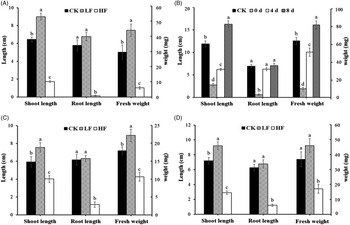
FA had a stronger effect on the growth of rice seedlings than on E. crus-galli seedlings (Figure 3A). Compared with the CK, shoot length and fresh weight of rice seedlings were significantly increased by 39% and 49% (P < 0.05), respectively, at 0.02 g L−1 FA; however, root length did not significantly increase. The values of shoot length, root length, and fresh weight of rice seedlings were significantly reduced by 73%, 98%, and 79% (P < 0.05), respectively, at 0.80 g L−1 FA. Compared with the CK (0 g L−1 FA), shoot length and fresh weight of seedlings after 15 d of growth were significantly reduced by 48% and 20% (P < 0.05), respectively, under the addition of 0.80 g L−1 FA at 4 d after rice planting. Shoot length and fresh weight of seedlings were significantly enhanced by 28% and 37% (P < 0.05), respectively, under the addition of 0.80 g L−1 FA at 8 d after rice planting (Figure 3B).
Effect of fulvic acid (FA) on rice seedling growth and extracted FA (EFA) on Echinochloa crus-galli and rice seedling growth. (A) Effect of FA on rice seedling growth. (B) Effect of FA on rice seedling growth at different times after planting. (C) Effect of EFA on Echinochloa crus-galli seedling growth. (D) Effect of EFA on rice seedling growth. CK, blank control group (0 g L−1 FA); LF, low concentration group (0.02 g L−1 FA); HF, high concentration group (0.80 g L−1 FA). The error bars are standard errors. Columns with the same letter are not significantly different at P < 0.05, one-way ANOVA, followed by Tukey’s honestly significantly different tests.

The effect of EFA on the growth of E. crus-galli and rice seedlings was slightly weaker than that of FA (Figure 3C and D). Under the 0.02 g L−1 EFA treatment, shoot length and fresh weight of rice seedlings were significantly increased by 25% and 28%, respectively; shoot length and fresh weight of E. crus-galli seedlings were significantly increased by 24% and 27% (P < 0.05), respectively, compared with the blank control (CK, 0 g L−1), but root length did not increase significantly in rice and E. crus-galli. Under the 0.80 g L−1 EFA treatment, the values for shoot length, root length, and fresh weight of rice and E. crus-galli seedlings were reduced by 54%, 60%, and 81% and 40%, 32%, 81%, respectively, compared with the CK.
At high concentrations (0.80 g L−1), the inhibitory effects of FA on the roots of E. crus-galli seedlings were pronounced (92%). The decrease in root length ensured that the E. crus-galli plants were not fixed in the soil and instead floated away with the current, thus reducing the number of E. crus-galli weeds in paddy fields. This also affected the subsequent growth of E. crus-galli, leading to its weakened competitiveness with rice. Under flooding conditions, E. crus-galli will sacrifice root length and promote shoot growth to break through the water surface quickly (Chauhan and Johnson Reference Chauhan and Johnson2011). We hypothesized that the stress of flooding on E. crus-galli might be aggravated by high concentrations of FA. Compared with the blank control, more nutrients of E. crus-galli were transferred to the stems and leaves to increase their height in the high-concentration FA treatment. Therefore, the inhibitory effect of high concentrations of FA on the root length of E. crus-galli was stronger than on the shoot length and fresh weight. However, this hypothesis needs to be further verified.
The growth of transplanted rice was promoted by high concentrations of FA, because it had been growing for some time and was established, whereas the growth of E. crus-galli was restrained, as it was at the germination stage when the rice was transplanted. The addition of FA might provide a new method for controlling E. crus-galli in transplanted paddy fields without using chemical pesticides. Compared with FA, the EFA from coal presented similar growth-regulating functions in E. crus-galli and rice seedlings. The characteristics of easy access and a low price might allow EFA to be applied for practical integrated weed management.
Compared with chemical pesticides, FA displayed little herbicidal effect. However, FA can also be used as fertilizer in paddy fields while controlling E. crus-galli (Wang et al. Reference Wang, Yang, Zheng, Shen and Xu2019). As a humus, FA increases organic matter and microorganisms without any chemical pollution in the soil. Through proper application of FA and water retention in transplanting fields, the damage caused by E. crus-galli might be significantly reduced, and the rice yield might be improved due to the increase in available fertilizer.
GSTs and Antioxidant Enzyme Activity
To obtain enough samples to determine the biological enzyme activities and undertake the omics analyses, FA was added after 4 d of E. crus-galli growth under water, at which point the grass exhibited sufficient biomass. After 2 d of growth under FA-positive conditions, the effects of the compound on E. crus-galli seedling growth were significant. Sampling during this period was conducive to undertake the metabolomic and transcriptomic analyses. The shoot lengths for seedlings in the CK, LF, and HF groups were 3.23 ± 0.14, 3.62 ± 0.09, and 2.87 ± 0.11 cm, respectively; the root lengths were 4.43 ± 0.10, 4.77 ± 0.16, and 1.36 ± 0.05 cm, respectively. Both the growth-promoting and growth-inhibiting effects of FA on E. crus-galli seedlings had occurred by the time of sampling.
Compared with the CK, the activities of GSTs, T-SOD, POD, and CAT were significantly increased by 140%, 21%, 20%, and 50%, respectively, under the LF treatment. Compared with the CK, the POD activity of the HF-treated seedlings decreased by 24.59%, whereas the activities of GSTs, T-SOD, and CAT were not significantly different (Figure 4).
Effect of different concentrations of fulvic acid (FA) on the activities of glutathione S-transferases (GSTs), (B) total superoxide dismutase (T-SOD), (C) peroxidase (POD), and (D) catalase (CAT) in stems and leaves of Echinochloa crus-galli. The error bars are standard errors. Columns with the same letter are not significantly different at P < 0.05, one-way ANOVA, followed by Tukey’s honestly significantly different tests. CK, blank control group (0 g L−1 FA); LF, low concentration group (0.02 g L−1 FA); HF, high concentration group (0.80 g L−1 FA).

The high concentrations of FA showed apparent toxicity to the growth of E. crus-galli seedlings. GSTs catalyze the conjugation of glutathione to various substrates, which increases non–target site resistance by enhancing metabolic detoxification (Cummins et al. Reference Cummins, Cole and Edwards1999). Under different concentrations of FA, GST activities in E. crus-galli stems and leaves were increased to provide resistance to FA. In contrast, the GST activity of E. crus-galli was further improved in the LF group compared with the HF treatment. Therefore, under LF conditions, E. crus-galli showed stronger resistance to FA toxicity, and seedling growth was not inhibited by FA. Under HF conditions, although the synthesis of E. crus-galli GSTs increased, the improved activity was not significant enough to provide resistance to FA, and seedling growth was significantly inhibited.
Flooding inhibits plant growth, but E. crus-galli can resist this stress. ROS, including superoxide anions (O2-), H2O2, and hydroxyl radicals (·OH), are inevitable by-products of aerobic respiration under normal conditions, and they are strictly controlled at acceptable levels in cells (Valavanidis et al. Reference Valavanidis, Vlahogianni, Dassenakis and Scoullos2006). Environmental pressures generally promote the accumulation of plant ROS and cause an imbalance between ROS generation and elimination (Song et al. Reference Song, Yin, Chen and Hong2007; Zhou et al. Reference Zhou, Huang, Guo, Mehta, Zhang and Yang2007). Plants prevent ROS-induced oxidative damage through the synthesis of antioxidases, including SOD, POD, and CAT, as ROS accumulation can lead to severe damage such as premature leaf senescence (Abogadallah et al. Reference Abogadallah, Serag and Quick2010). Appropriate amounts of FA effectively could improve the antioxidase activity of plants and enhance their ability to withstand environmental stresses such as salinity, water, and heavy metals (Wang et al. Reference Wang, Yang, Zheng, Shen and Xu2019). The activities of T-SOD, POD, and CAT were significantly improved under flooding stress by a low concentration of FA, which enhanced E. crus-galli ROS elimination and resistance to flooding. The T-SOD and POD activities in E. crus-galli were both decreased under a high concentration of FA. Hence, the ability of E. crus-galli to resist flooding was reduced, and the growth of E. crus-galli was inhibited.
Widely Targeted Secondary Metabolite Assay
A total of 927 secondary metabolites were identified from all E. crus-galli samples (Additional File 1 in the Supplementary Material). The contents of 45 and 354 metabolites were significantly different in the comparison of CK:LF and CK:HF, respectively. A Venn diagram analysis demonstrated 11 significantly differentially expressed metabolites that were common to all comparison groups (Figure 5B).
Different metabolites in stems and leaves of Echinochloa crus-galli for comparison groups of CK:LF, CK:HF, and LF:HF. (A) Different accumulated flavone compounds. (B) Venn diagram for the overlap of different metabolites. CK, blank control group (0 g L−1 FA), LF, low concentration group (0.02 g L−1 FA), HF, high concentration group (0.80 g L−1 FA).

A total of 10 indole derivatives were identified in all E. crus-galli samples, and 6 indole derivatives were significantly different in the CK:HF comparison. Under the HF treatment, the concentrations of 5-methoxyindole-3-carbaldehyde, methoxyindoleacetic acid, indole, and 3-indoleacetonitrile were 11.82-, 5.16-, 4.49-, and 4.14-fold higher than in the CK, respectively, while the concentration of 5-hydroxyindole-3-acetic acid was reduced by 0.47-fold. However, these substances were downregulated 0.62- to 0.94-fold when compared with LF:CK. No 5-hydroxytryptophol was detected in the CK and LF samples, but it was present in the HF group (Table 1).
Differentially accumulated indole derivatives in the stems and leaves of Echinochloa crus-galli seedlings under CK, LF, and HF treatments.a

a Abbreviations: FA, fulvic acid; CK, blank control group (0 g L−1 FA); LF, low concentration group (0.02 g L−1 FA); HF, high concentration group (0.80 g L−1 FA); VIP, variable importance in projection.
b “Not detected” means the metabolite content was too low to be detected.
c Metabolite fold changes: value > 1.0 represents increase; value < 1.0 represents decrease. Differentially accumulated indole derivatives were identified by threshold VIP (variable importance in projection) ≥ 1, and fold change ≥ 2 (upregulation) or ≤ 0.5 (downregulation) in HF:CK.
A bubble chart for the KEGG pathway enrichment of differentially identified metabolites showed that a high concentration of FA drastically affected flavonoid synthesis in E. crus-galli (Supplementary Figure S1). In the comparison between the HF and CK groups, 110 differentially accumulated flavone compounds were identified in stems and leaves. The numbers of species of flavone, flavonoid, flavonol, flavanone, and isoflavone found were 54, 20, 14, 11, and 11, respectively, but only 13 flavone compounds were found among the differentially accumulated metabolites in the CK:LF comparison (Figure 5A).
Transcriptome Analysis
In this study, RNA-Seq produced 55,009,494.67, 55,992,401.33, and 54,856,558.67 clean reads from the CK, LF, and HF libraries, respectively (Supplementary Table S2). Through sequence alignment with the reference genome of E. crus-galli, 78,445 genes were identified and annotated. There were 1,877, 15,835, and 15,048 DEGs in the comparison groups of CK:LF, CK:HF, and LF:HF, respectively. Compared with the CK, 1,129 genes were upregulated, and 648 genes were downregulated in the LF group, whereas, 7,721 genes were upregulated, and 8,114 genes were downregulated in the HF group (Figure 6A). The Venn diagram analysis showed that 362 DEGs were common to all three comparison groups (Figure 6B).
Functional annotation and classification of differentially expressed genes in stems and leaves of Echinochloa crus-galli for comparison groups of CK:LF, CK:HF, and LF:HF. (A) Numbers of differentially expressed genes. (B) Venn diagram for the overlap of differentially expressed genes. CK, blank control group (0 g L−1 FA); LF, low concentration group (0.02 g L−1 FA); HF, high concentration group (0.80 g L−1 FA).

In this study, KEGG pathway enrichment revealed ribosome, glycolysis/gluconeogenesis, DNA replication, carbon metabolism, carbon fixation in photosynthetic organisms, and biosynthesis of secondary metabolites to be the significantly changed pathways in the CK:HF comparison (Table 2; Supplementary Figure S2). The analysis of GO classification assigned 34,287, 33,719, and 32,142 unigenes to the classes of cellular components, molecular function, and biological processes, respectively (Supplementary Figure S3). The clusters of orthologous groups (COG) functional classification for proteins database allocated 880 genes to 24 COG categories in the CK:LF comparison and 7,480 genes to 25 COG categories in the CK:HF comparison (Supplementary Figure S4). The categories of general function prediction only and posttranslational modification, protein turnover, and chaperones were the two largest groups in the COG functional classification (respectively: 135 genes [15.34%] and 94 genes [10.68%] for CK:LF comparison; 1,130 genes [15.11%] and 808 genes [10.80%] for the CK:HF comparison).
Significantly enriched KEGG pathway in stems and leaves of Echinochloa crus-galli for comparison groups of CK:HF.a

a Abbreviations: KEGG, Kyoto Encyclopedia of Genes and Genomes; FA, fulvic acid; CK, blank control group (0 g L−1 FA); LF, low concentration group (0.02 g L−1 FA); HF, high concentration group (0.80 g L−1 FA); DEGs, differentially expressed genes.
Indole Derivatives Biosynthetic Pathways
Compared with the CK group, the significantly different metabolites of indole derivatives in E. crus-galli were almost all downregulated (Table 1), and DEGs were all upregulated under the LF treatment (Figure 7). The significantly differentially expressed metabolites of the aforementioned indole derivatives were upregulated (except 5-hydroxyindole-3-acetic acid) in the HF treatment, while DEGs were mostly downregulated, including aldehyde dehydrogenase (ALDH) (seven DEGs, EC_v6.g089449, −2.96 for log2FoldChange), l-tryptophan decarboxylase (TDC) (three DEGs, EC_v6.g032146, −3.81, and EC_v6.g033915, −4.73, for log2FoldChange), indole-3-acetaldehyde oxidase (IAO) (one DEG, EC_v6.g045995, −1.59 for log2FoldChange), l-tryptophan-pyruvate aminotransferase (TPAT) (two of three DEGs, EC_v6.g055806, −2.42 for log2FoldChange), and indole-3-pyruvate monooxygenase (IPMO) (two of seven DEGs, EC_v6.g039482, −2.39 for log2FoldChange). However, two DEGs of amidase (AME) were upregulated (Figure 7).
Transcript profiling of genes in the indole derivatives biosynthetic pathways in stems and leaves of Echinochloa crus-galli for comparison groups of LF:CK and HF:CK. CK, blank control group (0 g L−1 FA); LF, low concentration group (0.02 g L−1 FA); HF, high concentration group (0.80 g L−1 FA). ALDH, aldehyde dehydrogenase; TDC, l-tryptophan decarboxylase; TPAT, l-tryptophan-pyruvate aminotransferase; IAO, indole-3-acetaldehyde oxidase; AME, amidase; IPMO, indole-3-pyruvate monooxygenase; IADH, 3-indoleacetaldoxime dehydratase; INAH, 3-indoleacetonitrile aminohydrolase; INAD, 3-indoleacetonitrile hydratase; IPDC, indolepyruvate decarboxylase; TIL, l-tryptophan indole-lyase; TM2O, tryptophan 2-monooxygenase; TM5O, tryptophan 5-monooxygenase; MAO, monoamine oxidase; DAO, diamine oxidase; ASMT, acetylserotonin O-methyltransferase; TOR, tryptamine oxidoreductase; HTOR, N-hydroxyl-tryptamine oxidoreductase.

Regulating the synthesis of plant hormones, especially auxin, is an effective way of impacting plant growth. Indoleacetic acid (IAA) is a ubiquitous endogenous auxin in plants, but high concentrations of IAA inhibit the growth of plants (Chapman and Estelle Reference Chapman and Estelle2009). As a biostimulant, the mechanism of FA on plant growth is like that of auxin (Canellas et al. Reference Canellas, Olivares, Aguia, Jones, Nebbios, Mazzei and Piccolo2015). In this study, FA affected biosynthetic pathways for indole derivatives of E. crus-galli and regulated the growth of E. crus-galli seedlings (Zandonadi et al. Reference Zandonadi, Canellas and Façanha2007). Although the content of IAA was too sparse to be detected by widely targeted LC-MS, l-tryptophan, an IAA precursor, was upregulated by 4-fold in the HF:CK comparison. Most indole derivatives, including 5-methoxyindole-3-carbaldehyde, methoxyindoleacetic acid, indole, 3-indoleacetonitrile, and 5-hydroxytryptophol, which have structures analogous to that of IAA and are easily converted to IAA (Mortazavi et al. Reference Mortazavi, Williams, McCue, Schaeffer and Wold2008), were upregulated under HF conditions. The accumulation of these indole derivatives could cause excessive accumulation of IAA and inhibit the growth of E. crus-galli (Wang et al. Reference Wang, Yang, Zheng, Shen and Xu2019). In addition, we speculated that the large accumulation of indole derivatives might cause the downregulation of DEGs within their biosynthetic pathways due to negative feedback under the HF treatment (Chapman and Estelle Reference Chapman and Estelle2009). In the LF:CK comparison, the expression of DEGs for indole derivative biosynthetic pathways was rare, while the content of indole derivatives showed a slight decrease. The lower concentration of auxin was most likely more suitable for the growth of the E. crus-galli seedlings, and hence the growth of plant shoots was enhanced. Under HF conditions, the transcription of auxin-responsive genes, including AUX/IAA, GH3, and SAUR, was regulated (eight DEGs of AUX/IAA, four DEGs of GH3, and four DEGs of SAUR, were upregulated; 11 DEGs of AUX/IAA and eight DEGs of SAUR were downregulated) and cell enlargement and plant growth were inhibited (Supplementary Table S3) (Jain and Khurana 2019). In future studies, auxin concentrations should be determined by using more accurate methods to confirm the inhibitory and promotional effects of different concentrations on the growth of E. crus-galli, as well as the specific effects of FA on auxin synthesis and gene regulation.
Flavonoid Biosynthesis Pathway
Partial flavonoid biosynthetic pathways were shown in the ko00941 KEGG pathway (Figure 8). Compared with the CK group, most significantly differentially expressed flavonoid metabolites were downregulated, but only two DEGs in the flavonoid basic biosynthesis pathway were downregulated under the LF treatment. In the HF:CK comparison, most of the DEGs in the flavonoid biosynthesis pathway were downregulated, including chalcone synthase (CHS) (six of seven DEGs, EC_v6.g071938, −2.32, and EC_v6.g083936, −2.29 for log2FoldChange), chalcone isomerase (CHI) (two of three DEGs, EC_v6.g071938, −2.32, and EC_v6.g083936, −2.29 for log2FoldChange), flavonol synthase (FLS) (five of six DEGs, EC_v6.g042286, −4.66, and EC_v6.g107400, −3.67 for log2FoldChange), anthocyanidin reductase (ANR) (seven of eight DEGs, EC_v6.g076526, −3.32, and EC_v6.g076527, −3.34 for log2FoldChange), and flavonoid 3′-hydroxylase (F3′H) (two DEGs). Moreover, two DEGs for trans-cinnamate 4-monooxygenase (TCMO) (EC_v6.g005145, 3.51 for log2FoldChange), one DEG for flavanone 3-hydroxylase (F3H) (EC_v6.g033407, 5.64 for log2FoldChange), and one DEG for dihydroflavonol 4-reductase (DFR), were upregulated in the HF:CK comparison.
Transcript profiling of genes in the flavonoid biosynthetic pathways in stems and leaves of Echinochloa crus-galli for comparison groups of LF:CK and HF:CK. CK, blank control group (0 g L−1 FA); LF, low concentration group (0.02 g L−1 FA); HF, high concentration group (0.80 g L−1 FA). TCMO, trans-cinnamate 4-monooxygenase; CHS, chalcone synthase; CHI, chalcone isomerase; F3H, flavanone 3-hydroxylase; F3′H, flavonoid 3′-hydroxylase; F3′5′H, flavonoid 3′,5′-hydroxylase; FLSI, flavone synthase I; FLS, flavonol synthase; DFR, dihydroflavonol 4-reductase; ANR, anthocyanidin reductase; ANS, anthocyanidin synthase; HCRD, hydroxycinnamoyl-CoA reductase; PHS, phlorizin synthase; DXMT, desmethylxanthohumol 6′-O-methyltransferase; UFGT, UDP glucose-flavanone 7-O-glucosyltransferase; UFRT, UDP glucose-flavanone 7-O-glucoside 2′-O-beta-l-rhamnosyltransferase.

Under the action of CHS, p-coumaroyl-CoA was transformed into naringenin chalcone, then decomposed into naringenin by CHI. Naringenin formed eriodictyol and kaempferol by the catalysis of the FMO. In addition, ANR catalyzed the synthesis of epigallocatechin. Both these differentially expressed flavonoid metabolites and pathways were significantly downregulated in HF conditions. Normally, these flavonoid substances exhibited antioxidant functions that enhanced the resilience of E. crus-galli (Li et al. Reference Li, Ding, Zhang, He and Huan2019).
Flavonoids exhibit an antioxidant effect and eliminate ROS to enhance the resilience of E. crus-galli under flooding stress. Some studies had shown that flavonoids also affect the synthesis and distribution of auxin in plants, thereby affecting the growth and development of plants (Li et al. Reference Li, Ding, Zhang, He and Huan2019). Under the influence of FA, the differentially expressed flavonoid metabolites were found at lower levels under the LF treatment than under the HF treatment. The high concentrations of FA disturbed the regulation of the flavonoid biosynthetic pathway; hence, it is possible that antioxidant enzyme activity from flavonoids was reduced in E. crus-galli under flooding stress (Canellas et al. Reference Canellas, Olivares, Aguia, Jones, Nebbios, Mazzei and Piccolo2015). The ability of E. crus-galli to resist flooding stress was reduced, and the growth of E. crus-galli was inhibited. The effect on the synthesis of auxin in the HF group was much stronger than in the LF group, which might be related to the greater influence on the synthesis and metabolism of flavonoids in the HF group.
qRT-PCR Validation of Transcriptomic Data
Key RNA-Seq results were validated using qRT-PCR, and 16 DEGs were selected, including six indole derivative biosynthetic pathway genes and 10 flavonoid biosynthetic pathway genes. The results were basically in line with the RNA-Seq results (Supplementary Figure S5); they validated that the expression patterns of the genes in qRT-PCR were consistent with both upregulated and downregulated gene expression of RNA-Seq in the transcriptomic data.
In summary, low concentrations of FA and EFA promoted plant growth, while high concentrations of FA inhibited growth of E. crus-galli and rice under flooding conditions. FA regulated the growth of E. crus-galli by affecting its detoxification and antioxidant ability. The results of metabolomic and transcriptomic analyses revealed that the synthesis of indole derivatives and flavonoids was regulated by FA, which affected the growth of E. crus-galli plants.
This study showed that the high concentrations of FA inhibited rice seedling growth but promoted the growth of rice after the seedling stage. In the transplanting field, the rice has passed the seedling stage, while the E. crus-galli weeds are sprouting or about to sprout at the time of transplanting. Under the application of FA, the shoot lengths of E. crus-galli were significantly inhibited during the rapid growth stage, and the grass did not break through the rice canopy.
Acknowledgments
This work was supported by the National Key R&D Program of China (no. 2017YFD0301505), the National Natural Science Foundation of China (no. 31601652), Scientific Innovative of Hunan Agricultural Sciences and Technology (2019LS05 and 2019TD03). No conflicts of interest have been declared.
Supplementary material
To view supplementary material for this article, please visit https://doi.org/10.1017/wsc.2020.95