

Introduction
Anti-nutritional factors such as non-starch polysaccharides (NSP) are present in viscous cereals, such as wheat and rye, used to feed poultry (Choct and Annison, Reference Choct and Annison1992; Cowieson and Ravindran, Reference Cowieson and Ravindran2008). Poultry do not produce endogenous carbohydrases capable of hydrolysing the pentosan NSPs, such as the arabinoxylans, present in viscous cereals. The anti-nutritive effect is caused by the NSPs increasing the viscosity of the intestinal digesta (Bhat, Reference Bhat2000; Bedford and Classen, Reference Bedford, Classen, Visser, Beldman, Kusters-van Someren and Voragen1992; Choct and Annison, Reference Choct and Annison1992; Cowan, Reference Cowan, Godfrey and West1996; Galante et al., Reference Galante, De Conti, And Monteverdi, Harman and Kubicek1998). This increase in digesta viscosity causes an impairment of nutrient bioavailability and a decrease in metabolisable energy which lowers the overall performance of animals fed on wheat-based diets (Krzysztof et al., Reference Krzysztof, Gogol and Koreleski1999; Bedford and Morgan, Reference Bedford and Morgan1996). Supplementing feed with xylanases has been shown to improve nutrient digestibility and concomitantly help maintain good gut health by allowing fewer nutrients to be available in the animal's gut for the potential growth of disease-causing bacteria (Bedford and Partridge, Reference Bedford and Partridge2001; Hesselman et al., Reference Hesselman, Elwinger and Thomke1982; Rexen, Reference Rexen1981; Walsh et al., Reference Walsh, Power and Headon1993; Ravindran, Reference Ravindran2013). This facilitates an improvement in animal performance, improved absorption of feed components and a greater efficiency in meat and egg production (Peng et al., Reference Peng, Li, Fang, Dai, Partridge and Ru2010; Mehri, Reference Mehri and Shirmohammad2011; Cowieson and Ravindran, Reference Cowieson and Ravindran2008; Glamočić et al., Reference Glamočić, Polovinski-Horvatović, Ivković, Beuković and Bjedov2011).
As feed is the biggest single cost of production, farm profitability can depend on the nutritive value of the feed ingredients available (Barletta, Reference Barletta, Partridge and Bedford2010; Zakaria et al., Reference Zakaria, Jalal and Abu Ishmais2010). If feeds are not digested by the animal efficiently, there is a cost to both the producer and the environment (Kalmendal and Tauson, Reference Kalmendal and Tauson2012; Chiou et al., Reference Chiou, B. Yu, Wu, Liu and Gauthier2007). For example, to obtain optimum results with an enzyme it is important to have an adequate enzyme to substrate ratio in the diet (Ravindran, Reference Ravindran2013). The need for efficient and routine quality control analysis of xylanase in animal feed has become increasingly important in feed additive production and in determining xylanase activity in complete feedingstuffs (Sheehan et al., Reference Sheehan, Partridge and Bedford2010). Furthermore, analysis is important to facilitate traceability through the feed manufacturing process and to safeguard the safety, quality and efficacy of the product as well as supporting product claims (Aehle, Reference Aehle2007). As well as being useful in a quality control and assurance setting, xylanase methodologies are key to authoritive bodies and inspectorates interested in routine monitoring of food and feed quality and when investigating fraudulent adulteration of feed and ensuring the authenticity and traceability of feed products (Ziebal, Reference Ziebal2005).
Xylanases (endo-1,4-β-D-xylan xylanohydrolase, EC 3.2.1.8) are a class of enzyme that hydrolyse NSPs such as arabinoxylans which can account for 50–80% of the NSP component in wheat and rye cereals (Hew et al., Reference Hew, Ravindran, Mollah and Bryden1998). Arabinoxylan is a complex and heterogeneous component, and it's efficient hydrolysis requires the synergistic action of a number hydrolytic enzymes acting as part of a larger xylanolytic complex (Gaffney et al., Reference Gaffney, Doyle and Murphy2009). Substrate hydrolysis is improved in the presence of side-debranching enzymes, facilitating extensive degradation by endoxylanases, the predominant enzymes of the xylanolytic complex (Milagres et al., Reference Milagres, Magalhaes and Ferraz2005). Subsequently, the use of a crude enzyme extract derived from a fungal fermentation tends to be more effective than a purified preparation, due to the spectrum and synergistic action of the xylanolytic enzymes produced by fungi (Levin et al., Reference Levin, Herrmann and Papinutti2008).
The assay method described below is convenient and inexpensive and could be applied to the rapid and routine analysis of xylanases in animal feeds during quality control. The activity of xylanase is determined in terms of the quantity of reducing sugars released which react with dinitrosalicylic acid (DNS) (Miller, Reference Miller1959; Bailey et al. (Reference Bailey, Biely and Poutanen1992); Cosson et al., Reference Cosson, Perez Vendrell, Gonzalez Teresa, Rene, Taillade and Brufau1999). Following reaction inactivation, activity is measured discontinuously via spectrophotometric assays at predetermined time intervals. Alternative methods such as the Nelson–Somogyi method use toxic reagents whilst viscosity-type assays are more time consuming and expensive (Jefferies et al., Reference Jefferies, Yang and Davis1998; Bedford and Partridge, Reference Bedford and Partridge2001).
Despite the widespread acceptance of the DNS method for the quantification of xylanase activity, it is not without limitations which can lead to erroneous under- or over-estimation of activity (Gusakov et al., Reference Gusakov, Kondratyeva and Sinitsyn2011; Teixeira et al., Reference Teixiera, da Silva, Ferreira-Leitão and da Silva Bon2012). Interference in the quantification of xylanase present in crude fungal extracts may come from components of the fermentation media such as free amino acids (Teixeira et al., Reference Teixiera, da Silva, Ferreira-Leitão and da Silva Bon2012). Furthermore, the presence of a high concentration of protease enzyme (10,000 HUT/ml) in the feed premixture may influence the quantification of xylanase through either a direct hydrolytic action or indirectly through the production of higher concentrations of interfering amino acids (Teixeira et al., Reference Teixiera, da Silva, Ferreira-Leitão and da Silva Bon2012).
The conventional analysis of in-feed xylanase activity presents several additional inherent drawbacks, for example, feed substrates can interfere with the progress of the analysis, xylanase inhibitors may be present in bulk feedingstuffs, potential for xylanase binding to particular components in the feed matrix and the inherent difficulty of quantification where there is low xylanase activity in the finished feed (MacLauchlan et al., Reference McLauchlan, Flatman, Sancho, Kakuta, Simoinene and Tenkanen1999; Debyser et al., Reference Debyser, Peumans, Van Damme and Delcour1999; Teixeira et al., Reference Teixiera, da Silva, Ferreira-Leitão and da Silva Bon2012). Data from initial assay development indicated that there was potential to measure xylanase activity in the premixture containing a high concentration of protease enzyme and when this premixture was added to a commercial poultry diet (Glenney and Filer, Reference Glenney and Filer2005).
The objective of this present work was to investigate the performance characteristics of the assay in terms of linearity, precision, uncertainty, sensitivity (limit of detection and limit of quantification) and studies were designed to highlight any interference from the protease co-ingredient and possible matrix effects in various types of supplemented poultry feed.
Materials and methods
Only reagents of recognised analytical grade were used. Deionised or demineralised water or water of equivalent purity was used.
3M Sodium hydroxide solution
This solution was prepared by dissolving sodium hydroxide (NaOH) in deionised water in a volumetric flask. Solution was cooled before use.
DNS reagent (dinitrosalicylic acid)
DNS reagent was prepared by suspending 10g of DNS in 400 ml of deionised water in a 1000 ml beaker. Gradually 150 ml of 3M NaOH was added while mixing. The suspension was heated in a water bath at 50°C until it became clear. Caution was given not to exceed 50°C. Potassium sodium tartrate tetrahydrate (300 g) was gradually added to the solution with continuous magnetic stirring and diluted to volume with deionised water. The solution was stored in a dark bottle at room temperature.
0.05M Citric acid
This solution was prepared by dissolving citric acid in a 250 ml volumetric flask with distilled water.
0.05M Sodium Citrate buffer, pH 5.3
Sodium citrate buffer solution pH 5.3 was prepared by dissolving sodium citrate deionised water in 500 ml volumetric flask. The pH of the solution was adjusted with 0.05 M citric acid to 5.3 ± 0.05.
Xylan substrate, pH 5.3
An 80 ml volume of 0.05 M Sodium Citrate buffer, pH 5.3 was heated to boiling point on a heating magnetic stirrer. The solution was then removed from the heat to another stirrer and slowly 1.0 g of beechwood xylan (Sigma-Aldrich, St. Louis, MO) was added. The solution was cooled with continued stirring, covered and stirred for 2.5–3 h. Finally, it was made up to 100 ml with 0.05 M Sodium Citrate buffer, pH 5.3.
Xylose stock solution, 0.01 M
D-xylose (Sigma-Aldrich, St. Louis, MO) was dissolved in 100 ml of 0.05 M Na-citrate buffer, pH 5.3. Xylose stock solution were made fresh daily.
Xylanase assay procedure
Standard curve solutions
Xylose stock solution was diluted with appropriate volumes of 0.05 M Na-citrate buffer to calibration standards with concentrations of 10, 5, 2.5 and 2 µmol/ml. To construct the standard curve, 0.2 ml of each of these diluted standards was added to each of the 4 test tubes that contained 1.8 ml of the xylan substrate. These solutions were mixed by vortexing and 3.0 ml of DNS solution was added to each test tube and further mixed by vortexing.
Sample preparation and analysis
Vegpro® is a commercial enzyme complex containing xylanase (minimum 400 XU/ml) and protease (minimum 10,000 HUT/ml) (Alltech Inc. Nicholasville, KY), and was selected as the candidate enzyme for the assay development in order to examine the accuracy of the analysis in the presence of supplemental protease. A representative Vegpro® sample was prepared by collecting ten 1 kg samples throughout a production run and mixing to make one sample utilised for the full set of validation and verification studies.
Slowly 1 g of control substrate was added to 24 ml of 0.05 M Na-citrate buffer. Once dissolved, 1 ml of the above solution was diluted with 19 ml of 0.05 M Na-citrate buffer and 1 ml of this solution was then diluted into 14 ml of 0.05 M Na-citrate buffer. Finally, 1 ml of this solution was again diluted with 9 ml of 0.05 M Na-citrate buffer to complete the dilution series.
Three test tubes were prepared for each sample and control which included two reaction tubes and one blank tube. In addition, a test tube was prepared for the substrate blank and four test tubes for the standard curve. A 1.8 ml volume of xylan substrate pH 5.3 was added to each of the reaction test tubes and blanks. The final dilution tube from the control and the two reaction tubes were placed into a 50°C water bath and equilibrated for 5 min. At time zero, 0.2 ml of the final sample dilution was rapidly transferred by pipette into the sample reaction tube that contained 1.8 ml of xylan substrate were mixed by vortexing. After this, 0.2 ml of the final sample dilution was continually transferred by pipette every 15 seconds into the reaction tubes until all samples and controls had been combined. After exactly 5 min, 3.0 ml of DNS solution was added to each tube at 15-s intervals and mixed before removing the tubes from the water bath.
A 3.0 ml volume of DNS solution was added to the sample blanks and substrate blank which were also then mixed by vortexing. 0.2 ml of the final sample dilution was added to the sample blanks and 0.2 ml of 0.05 M Na-citrate buffer was added to the substrate blank. All the tubes including the reaction tubes, blanks, substrate blank and standard curve were boiled for five min and cooled for 5 min in a room temperature water bath. The absorbances at 540nm for each were recorded using the substrate blank as a zero and a standard curve was prepared as appropriate.
Expression of results
Units: One xylanase unit (XU) is the amount of enzyme that liberates 1 micromole of xylose per min at pH 5.3 and 50°C.
Calculation of xylanase activity:
 $$\eqalign{& \hbox{Xylanase activity \lpar XU/g\rpar } = \cr & \quad \Delta \hbox{C} \lpar \hbox{from standard curve}\rpar \cdot \hbox{dilution factor}\semicolon \cr & \quad {\mu \hbox{mol/ml per min}\over \hbox{Enzyme concentration\lpar g/ml\rpar }\cdot 5 \hbox{min incubation}}}$$
Where ΔC = change in concentration of the unknown,
ΔC is determined from the standard curve by reading off the concentrations
(x axis) that correspond to measured absorbances (y axis),
such that ΔA = Aenzyme sample – Aenzyme blank
Xylanase validation assays
The validation of the method was performed at the Institute of Environmental Engineering and Biotechnology (IEEB), Bordeaux, France. The experimentation followed the procedure as per as per the standard established in the French Standard, Norme NF XPT 90-210 (Association Française do Normalisation, 1999). The verification study followed the procedure outlined in the EURL-FA Guide (Simone and Robouch, Reference Simone and Robouch2014) and was undertaken at the Center for Animal Nutrigenomics and Applied Animal Nutrition, Nicholasville, Kentucky, USA.
The results for two assays are provided:
Matrix 1) The determination of the activity of xylanase in Vegpro®;
Matrix 2) The determination of the activity of xylanase in poultry complete feed.
Matrix 1: The determination of xylanase in Vegpro®
The validation of the method for determining xylanase activity in the feed premixture Vegpro® was undertaken at an independent laboratory. Following successful validation, a verification study was completed at an alternative expert laboratory to authenticate the results. The outcomes of both studies are presented in this paper.
Conditions that applied in Laboratory 1: Enzyme feed supplement: Vegpro® in liquid form; batch #247639; stored at 5°C ± 3°C. Conditions that applied in Laboratory 2: Enzyme feed supplement: Vegpro® in liquid form; batches #297922 (known sample) and #297923 (unknown sample); stored at 4°C ± 2°C. The average protease activity of the Vegpro® batches was 10,000 HUT/ml.
Matrix 2: The determination of xylanase in-feed
Validation tests studied the proposed method for determining xylanase activity in complete feed which had been supplemented with Vegpro®. The conditions that applied to these studies were as follows: Feed tested: Pelleted starter chicken feed. Sample size: 10g. Extraction volume: 40ml; the extraction procedure involved grinding the sample in a motor and pestle and then solubilising it in 0.05 M sodium citrate buffer solution pH 5.3 and shaking for 15 minutes. The solution was subsequently centrifuged at 2,000 G for five minutes at 4°C Incubation time: 6 h. Enzyme feed supplement: Vegpro® in liquid form; batch #249568 stored at 5 °C ± 3 °C. Average xylanase activity measured: 430 XU/ml and average protease activity: 10,000 HUT/ml.
Results and discussion
Matrix 1: The determination of xylanase in Vegpro®
The studies investigated the following validation parameters; a) Precision - including repeatability and intra-laboratory reproducibility; b) Sensitivity - including the limit of quantification (LOQ) and limit of detection (LOD); c) uncertainty and d) accuracy.
Precision
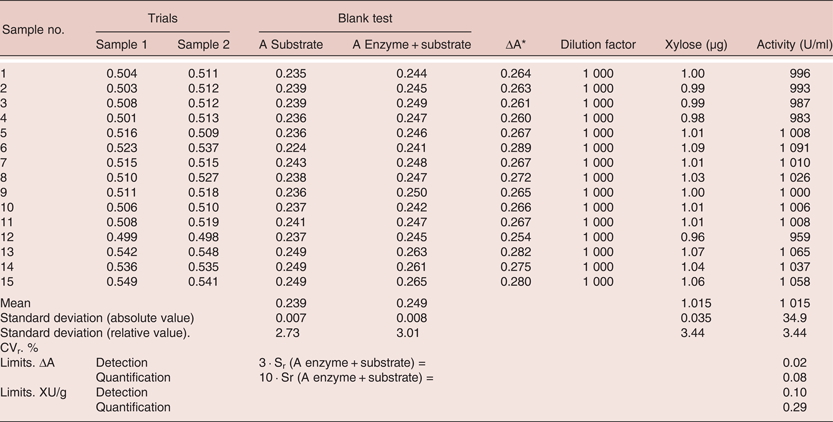
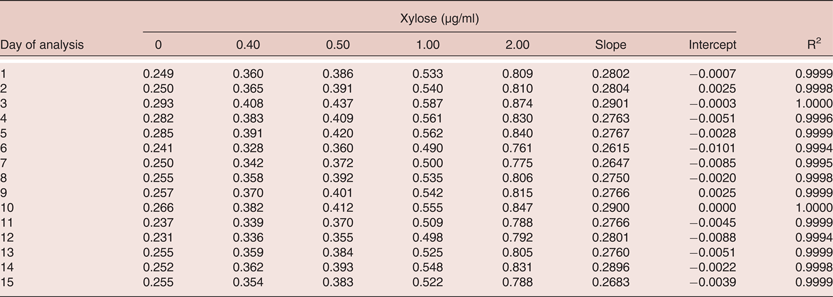
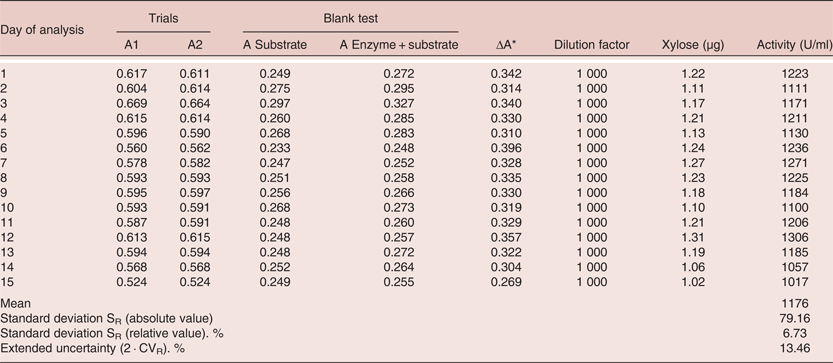
This study initially included creating a calibration curve with xylose to determine its absorbance over a range (results not shown). The calibration curve was utilised to determine the precision of the determination of xylanase activity of Vegpro®. The readings over the range of 0 – 10 µg/ml of xylose yielded linearity with R2 values of 0.9997 and 0.9998 for the tests taken in the respective research laboratories. To study repeatability, fifteen determinations of Vegpro® were completed and are presented in Table 1. The study to examine intra-lab reproducibility involved preparing a calibration curve with xylose 15 times on 15 continuous days. The linearity was determined in each case. The results of the absorbance observed are presented in Table 2. An experiment undertaken to determine intra-laboratory repeatability was similar to that undertaken for repeatability only the repeat testing was carried out on 15 consecutive days (Table 3). The RSD was calculated to be 6.73%.
Matrix 1: Repeatability of xylanase activity in the feed enzyme preparation, Vegpro®

*ΔA corresponds to the difference in absorbance (A) between the mean absorbance values Sample 1 and Sample 2 of two trials and the absorbance value for an enzyme + substrate blank test read at a wavelength of 540 nm. ΔA = ((A1 + A2)/2 – ( A enzyme+substrate blank test)
Matrix 1 (xylanase in Vegpro®): Study of intra-laboratory reproducibility - calibration with xylose solution (absorbance 540nm) on 15 independent days
Matrix 1: Study of intra-laboratory repeatability – xylanase analyses (absorbance 540nm) performed on 15 different days on the feed enzyme premixture preparation, Vegpro®
*ΔA corresponds to the difference in absorbance (A) between the mean absorbance values A1 and A2 of the two trial and the absorbance value for an enzyme + substrate blank test read at a wavelength of 540 nm. ΔA = ((A1 + A2)/2) – ( A enzyme+substrate blank test)
LOD and LOQ
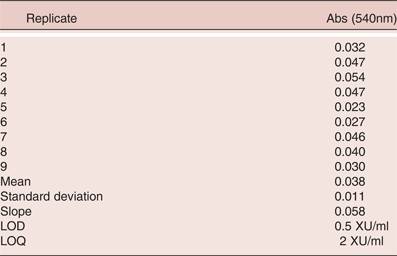
The LOD and LOQ were based on the determinations of the blank sample which contained the enzyme and the substrate which had been denatured. The LOD was calculated using the formula; LOD = 3 · SD of the blank test (enzyme + substrate). The limit of detection was demonstrated to be 0.10 XU/g. The LOQ was calculated using the formula; LOQ = 10 · SD of the blank test (enzyme + substrate). The limit of quantification was found to be 0.29 XU/g. The LOD and LOQ were also calculated independently by Laboratory 2 under different conditions, where nine replicate determinations were run to determine the LOD and LOQ which were calculated to be 0.5 XU/g and 2 XU/g (Table 4).
Matrix 1: (xylanase in Vegpro®): Limit of detection (LOD) and limit of quantification (LOQ) calculation based on nine replicates analyses
Uncertainty
Uncertainty was determined from the calibration ranges under reproducible conditions and based on the standard deviations associated with each of the range endpoints. Uncertainty was defined as twice the ratio of the standard deviation of the average absorbance and expressed as a percentage of the reported value. The uncertainty associated to the results was 20% of the reported value with an extended uncertainty value of ± 13.46% applied to xylanase activity values.
Accuracy
The accuracy of the assay was examined by undertaking six replicate determinations of a known sample with a theoretical activity of 300 XU/g on two separate days. The accuracy is a measure of the closeness of agreement between the theoretic true value and the experimental value. The accuracy was calculated with the formula;
 $$\eqalign{ \% \;\hbox{Recovery} &= [(\hbox{average recorded value} - \hbox{expected value})\cr & \quad /\hbox{average recorded value}]\;100 + 100}$$
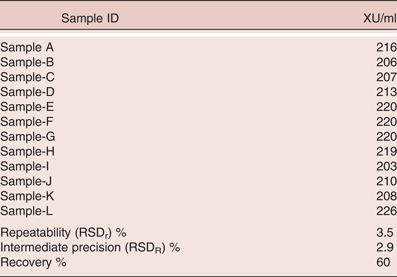
The result was found to be 60%. The SD and %RSD was found to be 7.2 and 2.9% respectively (Table 5).
Matrix 1: Accuracy of analyses determined from 12 Vegpro® samples on two independent days
RSDr. % = Si · 100/x (Si = standard deviation of known samples; x = mean of known samples)
RSDR. % = Sr · 100/X (Sr = standard deviation. calculated from results generated under repeatability conditions
X = mean calculated from results under repeatability conditions
% Recovery = [(average recorded value – expected value)/average recorded value] · 100 + 100
Matrix 2: The determination of xylanase in-feed
The validation study examined the following parameters; a) a study of the range of concentrations covered by the method, b) an estimate of uncertainty; c) verification of the choice of the quantification limit with the calculation of the detection limit, d) a study designed to highlight any possible matrix effects of poultry starter feed.
Concentration range
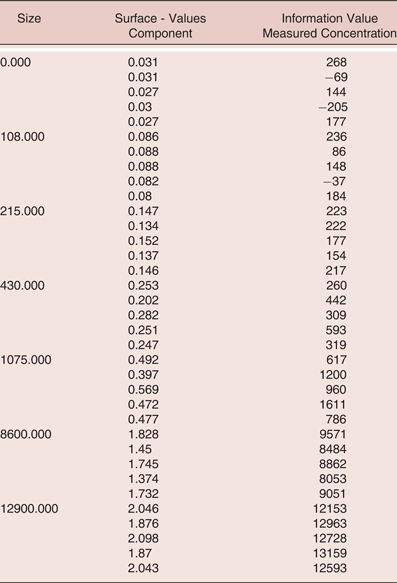
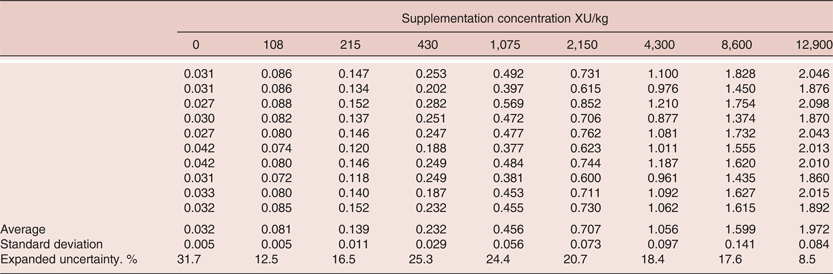
The test feed was supplemented with increasing concentrations of enzyme in the range 0 to 12,900 XU/kg where one xylanase unit (XU) is the amount of enzyme that liberates 1 micromole of xylose per min at pH 5.3 and 50°C. A range of enzyme concentrations were tested five times under identical test conditions over a five month period. To develop a calibration curve nine enzyme concentrations were chosen within the presumed range of the method; supplementation rates and absorbance's at 540nm are given in Table 6. Based on the characterisation of the protocol presented, the method is valid for the range 0 to 12,900 XU/kg. See Figure 1 for calibration graph of the linear model.
Linear model of observed range from feed spiked with known concentrations of xylanase (XU/kg feed)
Matrix 2: Linear activity of xylanase in feed supplemented with Vegpro®
Estimate of Uncertainty
Expanded uncertainty was determined from the calibration ranges under reproducible conditions and based on the standard deviations associated with each of the range endpoints. Expanded uncertainty was calculated as twice the standard deviation of the average absorbance and expressed as a percentage of the reported value. All the values of the calibrations made during the study of the range of application and the matrix effects were compiled (Table 7). For the various range endpoints, there was a variation of uncertainty ranging from 10% to 25% of the reported values. Over the supplementation rate ranging from 100 to 12,900 U/kg, the method provides an expanded estimated calculated uncertainty equal to ±25% of the reported value (at a risk α = 5%).
Matrix 2: Calibration values from range of application and matrix effects, Absorbance measurement at 540nm (average abs. – average abs. trial run)
Sensitivity (LOD and LOQ)
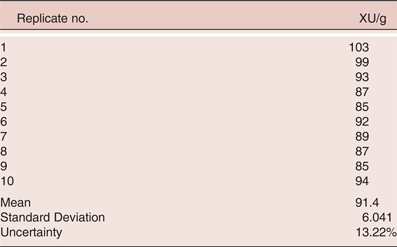
The LOQ was examined in accordance with the French standard Norme NF XPT 90-210 (Association Francaise do Normalisation, 1999). Two conditions are stipulated in this standard in choosing an LOQ: 1) the average value does not differ from the quantification limit chosen, and 2) the quantification limit is not equal to zero. A LOQ of 100 XU/kg which met the demands of the standard was selected and the SD and uncertainty of ten replicate analyses of this concentration point were determined (Table 8). The adequacy test gives an estimated calculated uncertainty associated with this point that is greater than 13%. The limit of quantification can be considered to be 100 XU/kg with an estimated calculated expanded uncertainty equal to ±25%. The limit of detection is therefore 35 XU/kg.
Matrix: Verification of the limit of quantification (LOQ) of xylanase in feedingstuffs
Matrix effect
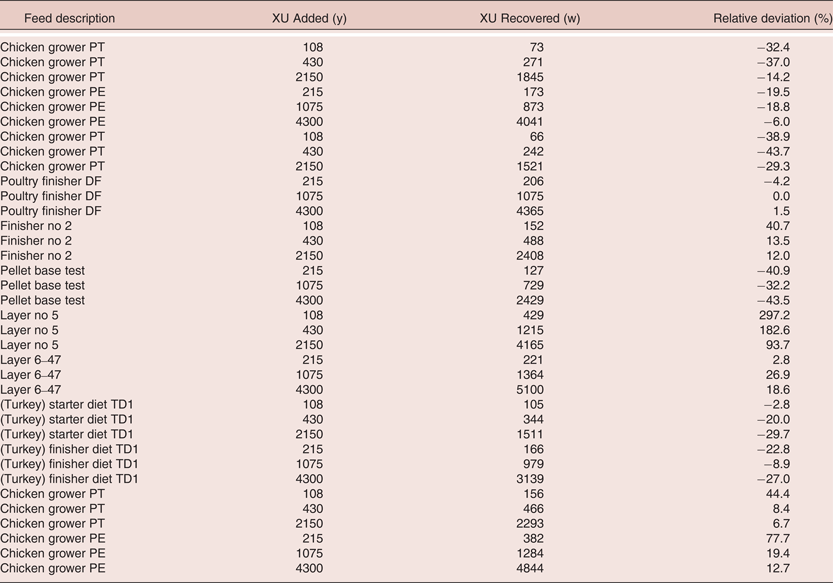
The objective of studying the matrix effect was to determine whether the method was effective in determining xylanase activity in a variety of poultry feeding stuffs. The method was tested using a range of enzyme concentrations in chicken starter feed and that same range of enzyme concentrations was used to test a series of feed matrices. The feed matrices were representative commercial soy diets for different phases of poultry growth. Enzyme activity levels were then calculated empirically by plotting against the theoretical levels. A linear regression was plotted corresponding to the activity levels recovered versus the theoretical levels added (See Table 9 and Figure 2). To evaluate specificity, we verified that the curve of the line did not differ by 1 and that the original y axis did not differ from 0. In conclusion, the specificity study showed that the 12 matrices tested met the requirements regarding the enzyme activity values determined using theoretical levels. No significant matrix effects were present.
Matrix effect of selected commercial poultry feeds on xylanase recovery (XU/kg feed)
Assay 2: Matrix effect of investigated feeds - Verification of the regression model after the specificity study
Conclusions
Xylanases are enzymes that can hydrolyse non-starch polysaccharides and break down arabinoxylans thus increasing the nutrient availability of poultry feeds and significantly improve the digestion and absorption of feed components. As the inclusion of xylanase has become routine in animal feeds, it has become increasingly important to be able to account for the activity of xylanase in animal feed additives and in feed. Hitherto, it had proved difficult to analyse the activity of xylanase in animal feeds. The analytical method provided herein measures the activity of xylanase in terms of in terms of the quantity of reducing sugars released in the presence of xylanase, which react with dinitrosalicylic acid.
The method described here demonstrated that the principle of the method can be applied in two separate assays; namely, 1) for the determination of the activity of xylanase in a poultry feed premixture where it was combined with a high concentration of fungal protease; and 2) the determination of the activity of xylanase in poultry feedingstuffs. Both of the assays were validated separately and independently and covered the assay performance parameters such as linearity, precision, sensitivity, accuracy and matrix effects. The in-feed validation demonstrated that the assay is sensitive and calculation of the LOD and LOQ to be 0.5 XU/g feed and 2 XU/g feed respectively. The tests show that the methodology is fit for purpose and therefore suitable to determine the activity of xylanase in both matrices. Neither the use of crude enzyme extracts from fungal fermentation nor combining a high protease enzyme with the xylanase influenced the assay performance. Therefore, the study meets the objective in providing two validated methods that can be applied for quality control of xylanase in the commercial premixture Vegpro® and post application into compound poultry feed.
Acknowledgements
The authors would like to thank Alltech France for funding this study. The authors wish to acknowledge the work of O. Locqueneux, M.D.L'Hotellier and K. Michel on performing the validation work at the Institute of Environmental Engineering and Biotechnology, Bordeaux, France.
Declaration of interest
The authors are employees of Alltech in various countries, and Vegpro® is a registered enzyme brand belonging to Alltech Inc, USA.