Introduction
Approximately 16% of patients with a diagnosis of schizophrenia exhibit formal thought disorder (FTD) (Andreasen, Reference Andreasen1979), a symptom representing problems of language and communication (American Psychiatric Association, 2013). FTD is, however, a notoriously heterogeneous symptom, where large variations in the efficiency of communicative behaviours through speech are observed (Andreasen, Reference Andreasen1982).
FTD as a linguistic impairment
One account of FTD proposes that it is the result of hyperactivity in the semantic network (Manschreck et al., Reference Manschreck, Maher, Milavetz, Ames, Weisstein and Schneyer1988; Spitzer et al., Reference Spitzer, Braun, Hermle and Maier1993). Automatic semantic priming appears to be stronger in FTD, specifically in the earlier or automatic stages of semantic activation (see Pomarol-Clotet et al., Reference Pomarol-Clotet, Oh, Laws and McKenna2008 for a meta-analysis). Alternatively, FTD may be a result of abnormalities in the building up and use of context (Cohen and Servan-Schreiber, Reference Cohen and Servan-Schreiber1992). Abnormalities in sensitivity to linguistic context have been documented on both behavioural measures (Truscott, Reference Truscott1970; Kuperberg et al., Reference Kuperberg, McGuire and David1998, Reference Kuperberg, McGuire and David2000, Reference Kuperberg, Krecher, Goff, McGuire and David2006a; Dwyer et al., Reference Dwyer, David, McCarthy, McKenna and Peters2014a, Reference Dwyer, Peters, McKenna, David and McCarthy2014b) and in event related potentials (ERP) studies (see Wang et al., Reference Wang, Cheung, Gong and Chan2011 for a meta-analysis). People with schizophrenia do not demonstrate the reduction in the amplitude of the N400 that is reliably observed in healthy controls when a word is preceded by a semantically supportive context (see Kutas and Federmeier, Reference Kutas and Federmeier2011, for a review).
However, these may not be incompatible accounts of FTD. Evidence of a processing bias for semantic associations driving impairments in contextual processing in schizophrenia (both non-FTD and FTD patients) has been found in studies investigating the resolution of lexical ambiguity in congruous, incongruous or biasing contexts (Titone et al., Reference Titone, Levy and Holzman2000; Sitnikova et al., Reference Sitnikova, Salisbury, Kuperberg and Holcomb2002; see Kuperberg et al., Reference Kuperberg, Kreher, Sitnikova, Caplan and Holcomb2007 for a review). These findings suggest an impairment in suppressing contextually inappropriate meanings and a dependence on lexical semantic associations together compromising the building of the whole sentence context.
An integrated theory of language production and comprehension
The relationship between contextual processing impairments during comprehension and the deviant language production seen in FTD remains unclear. Research into FTD has focussed primarily on these as unrelated independent processes. However, there is considerable evidence of the inter-related nature of these acts, including their recruitment of strongly overlapping neural circuits (Scott and Johnsrude, Reference Scott and Johnsrude2003; Wilson et al., Reference Wilson, Saygin, Sereno and Iacoboni2004), engagement of the production system during speech perception (e.g. Scott et al., Reference Scott, McGettigan and Eisner2009; Pulvermüller and Fadiga, Reference Pulvermüller and Fadiga2010; Silbert et al., Reference Silbert, Honey, Simony, Poeppel and Hasson2014), and evidence that prediction during comprehension engages production processes (e.g. Federmeier, Reference Federmeier2007; Martin et al., Reference Martin, Branzi and Bar2018).
Pickering and Garrod (Reference Pickering and Garrod2013) invoke a theory of forward modelling in action and action perception (e.g. Wolpert, Reference Wolpert1997; Davidson and Wolpert, Reference Davidson and Wolpert2005) to explain the relatedness of these processes. In this prediction-based account, the listener uses the same mechanisms used in production to make predictions about the speakers' upcoming utterances. Firstly, the listener exploits contextual information to determine the speaker's intention and then to predict what she would say. The listener imitates the speaker's utterance as it unfolds and then uses the inverse model and context to derive the production command that the listener would use if she were to produce the speaker's utterance. These representations are then exploited to make predictions about upcoming utterances that the speaker will make, and so on. In constructing a representation corresponding to the speaker's utterance, the listener aligns her linguistic representations with the speaker along with a representation corresponding to what she predicts the speaker will say next. Such alignment increases the likelihood that those representations will be used in the listeners' subsequent utterances since it is more efficient to re-employ previously activated elements. If the speaker and the listener are successful, they will produce similar predictions about the speaker's upcoming utterance, leading to well-coordinated communication. Thus, alignment is facilitated by emulation and prediction during comprehension using the production system (Pickering and Garrod, Reference Pickering and Garrod2013). This mirroring is widely observed in dialogue at various levels of structure (see Pickering and Garrod, Reference Pickering and Garrod2013 for an overview).
An imbalance in the mechanisms involved in the building of the whole sentence context would be expected to result in poverty of alignment in patients' output. We carried out a study of alignment in FTD, non-FTD patients' and healthy controls' contributions in dialogue. We hypothesized that the FTD group would produce poor alignment, demonstrating failure to utilise the available linguistic context and update their interpretation of the discussion via the production system.
Theory of mind in schizophrenia
Theory of mind (ToM) is the capacity to attribute and understand others' mental states. Impairment of ToM is a consistent finding within schizophrenia research (see Sprong et al., Reference Sprong, Schothorst, Vos, Hox and van Engeland2007 for a meta-analysis and Brüne, Reference Brüne2005; Harrington et al., Reference Harrington, Siegert and McClure2005 for systematic reviews) at both the level of a ‘state’ and ‘trait’ (see Bora et al., Reference Bora, Yucel and Pantelis2009; Bora and Pantelis, Reference Bora and Pantelis2013 for meta-analyses). Psychotic speech may reflect a specific problem of ToM (Frith, Reference Frith1992; Hardy-Bayle, Reference Hardy-Baylé1994). Impoverished contextual processing could also impair the ability to collate the contextual information necessary to build up an interpretation of the interlocutor's mental state (Schenkel et al., Reference Schenkel, Spaulding and Silverstein2005).
The only study of alignment in schizophrenia to date found evidence of preserved alignment in FTD in the presence of impaired ToM (Stewart et al., Reference Stewart, Corcoran and Drake2008). These authors proposed that alignment facilitates patients' successful conversation, obviating intensive modelling of the interlocutor's mental state. Yet, studies analysing ToM in dialogue have demonstrated preserved ToM abilities in schizophrenia (McCabe et al., Reference McCabe, Leudar and Antaki2004; Stewart et al., Reference Stewart, Corcoran and Drake2009). The inconsistency in findings across ToM studies could be attributed to a difference between explicit reasoning skills and implicit skills required in dialogue (Frith, Reference Frith2004). Explicit reasoning skills as measured by traditional ToM tasks require processing complex sentential structure (e.g. Mary thinks that Billy thinks that…) (De Villars, Reference de Villiers, Astington and Baird2005). Problematic is that explicit reasoning places demands upon a range of executive functions known to be impaired in schizophrenia, e.g. working memory, sustained attention and sequencing (e.g. Docherty and Gordinier, Reference Docherty and Gordinier1999; Docherty, Reference Docherty2005; Lee and Park, Reference Lee and Park2005), which have been found to be strongly associated with FTD (Kerns and Berenbaum, Reference Kerns and Berenbaum2002).
We compared patients' ToM performance on a traditional ToM task and in natural dialogue. We hypothesised that FTD patients would show a relative decrement in ToM in natural dialogue as a result of contextual processing problems. We further hypothesised this would result in a correlation between poverty of alignment and ToM performance.
Methods
Participants
Forty-three patients with a diagnosis of schizophrenia (DSM-IV; American Psychiatric Association, 1994) were recruited from inpatient wards in London and Cambridge. All clinical participants were chronic patients who were stable on typical and atypical antipsychotic medication. Twenty-one healthy controls were recruited from a local Job Centre, and from non-academic posts at University College London. Inclusion criteria for all participants were: age between 18 and 65 years, no self-reported history of brain injury, substance abuse, or neurological illness, and native speaker level of English. Informed consent was obtained from all participants. The study was approved by the relevant clinical research ethical committees (Ref: 06/Q0706/86).
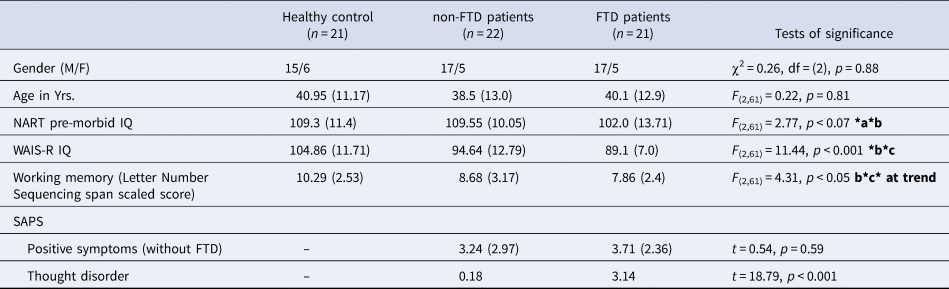
The Scale for Assessment of Positive Symptoms (SAPS; Andreasen, Reference Andreasen1984) was administered to clinical participants. Recordings from SAPS interviews were used to derive a positive FTD score with the version of Andreasen's Thought Language and Communication (TLC) scale in the Comprehensive Assessment of Symptoms and History (CASH; Andreasen et al., Reference Andreasen, Flaum and Arndt1992). Description of tests and the procedure used to calculate FTD scores are in the online supplementary material 1. The two patient groups did not differ on global scores for delusions or hallucinations (see Table 1).
Demographic characteristics of the three groups [means; standard deviations (s.d.s) in parentheses]
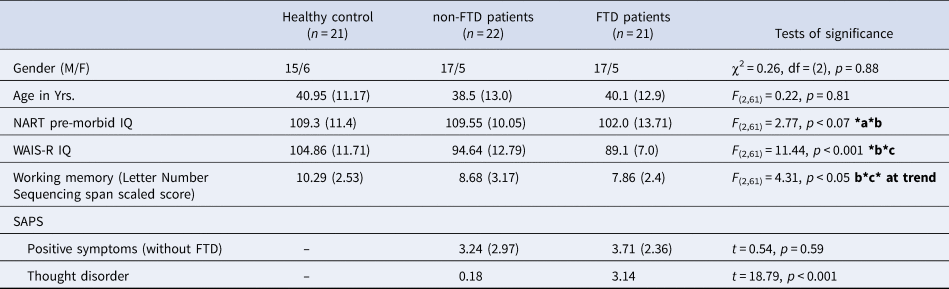
LSD: least significant difference test; a: FTD patients v. non-FTD patients; b: FTD patients v. healthy controls; c: non-FTD patients v. healthy controls; (*p < 0.05).
The three groups differed in terms of current and pre-morbid IQ, and working memory function. The two patient groups only differed on premorbid IQ, and all other differences were between the patients and healthy controls. Description of tests used to calculate the various variables are in the online supplementary material 1. Participants' demographic and clinical characteristics are presented in Table 1.
Materials and procedures
Alignment in dialogue (the maze task)
Garrod and Anderson's (Reference Garrod and Anderson1987) maze game was reproduced with permission [see Garrod and Anderson (Reference Garrod and Anderson1987) for a full description of the task]. An illustration of the maze can be found in the online supplementary material 2. In this study, the experimenter (K.D.) and participant were each seated in front of a laptop displaying a maze configuration. Each player had different starting points and different destinations. The aim of the task was for each player to get to their destination by taking turns to move through the maze one box at a time. Each maze had locked gates, which were controlled by the other player. This required cooperation between the two players. Previous studies have shown that players achieve this by aligning in their descriptions of the mazes (Garrod and Anderson, Reference Garrod and Anderson1987; Garrod and Clark, Reference Garrod and Clark1993; Garrod and Doherty, Reference Garrod and Doherty1994).
Each participant played 3 × 10 min games against the experimenter. Unbeknownst to the participants, the experimenter used a confederate script technique to ensure consistent descriptions of the maze were provided to participants across the three groups. The experimenter provided location descriptions if requested by the participant, or when cooperating with the participant to negotiate unlocking gates. The experimenter requested the participant's location if the participant requested her cooperation, or if the experimenter required assistance because she was otherwise unable to move. The dialogue between the two players was recorded to allow for scoring of alignment.
Syntactic alignment
This syntactic priming task was adapted from Branigan et al. (Reference Branigan, Pickering and Cleland2000) with permission. The task comprised 12 experimental items cards and 36 filler cards. Each card depicted a scene involving a finite set of recurring characters e.g. doctor, cowboy, as agents performing an action towards either an inanimate object or another character (see online supplementary material 3). The naïve participant and the confederate each had two sets of cards; a description set, and a duplicate of their partner's description set. Both the experimenter and the participant took it in turns to describe their pictures, while the other matched the picture that was being described from a further set of cards arranged on the table in an 8 × 6 grid formation. Participants were asked to provide a description of their illustrations using the verb indicated on the bottom of the card.
Each experimental item consisted of a pair of picture cards (the card prime described by the experimenter and the participant's experimental card). Each of the experimental item cards was a ditransitive verb (e.g. The cowboy handing the ballerina a cake) and involved an agent, patient and beneficiary. These cards depicted the ditransitive verbsFootnote 1Footnote † give, hand, offer, sell, show and throw a total of twice. These pictures could be described according to two possible word order rules in English depending on the order of the complements following the verb, e.g. ‘the soldier gave [the ballerinaNP] [a gunNP]’ or ‘the soldier gave [a gunNP] [to the ballerinaPP]’. The filler cards depicted 18 transitive verbs a total of twice each. The target verb was printed on the bottom of each card.
The participants were unaware that the confederate had a script of descriptions for the prime cards. The confederate's prime preceded the participant's prime card for each of the 12 experimental cards. There were two different orders of cards, according to the structure of the complements described by the experimenter (i.e. ‘[the ballerinaNP] [a gunNP]’ or ‘[a gunNP] [to the ballerinaPP]’). These were counterbalanced across participants. While the verbs on the prime cards and the target cards differed, they were always ditransitive verbs. This is because we were interested in the syntactic structure that the participants' would use in their descriptions of target items. We calculated the number of times the participants' description of the ditransitive target consisted of the same syntactic structure (i.e. either NP,NP or NP,PP after the verb) as that used by the experimenter in her immediate preceding turn describing the ditransitive prime.
Theory of mind in dialogue
Participants were interviewed after each of the three maze games to elicit a speech sample of their reflections of their own and the experimenter's thinking during participation in the task. Interviews consisted of questions about their views on both players' performance during the maze game, e.g. ‘Did we make any mistakes?’, ‘Do you think I understood what you were trying to do to?’ To seek participants' full justification for their answers, responses were probed further with scripted WH-questions (who, what, where, why, which) (e.g. ‘What mistakes did we make?’, ‘What was I trying to do?’). All interviews were recorded and later transcribed verbatim for analysis (see online supplementary material 4 for examples illustrating how these were scored).
Theory of mind stories
A set of six stories (Frith and Corcoran, Reference Frith and Corcoran1996) was used to assess ToM ability involving explicit reasoning skills assessed in a traditional ToM task. These stories contained first- and second-order deception questions and the other three contained first- and second-order false belief questions. Stories were read aloud to participants, who were also shown cartoons simultaneously to facilitate comprehension. After each story, participants were asked one memory/reality question (concerning an event in the story) and one question that depended on the ability to infer the mental state of one of the characters. The memory control question is not a measure of ToM, but serves as a control for understanding and memory of the story, from which the participant makes a ToM judgment. Each question type occurred three times across the six stories, making a total of 12 questions across the four types.
Scoring
Alignment in dialogue (maze task)
A full description of the system of measuring alignment is reported elsewhere (Garrod and Doherty, Reference Garrod and Doherty1994) plus a discussion in the online supplementary material 5. In brief, there was a total of six description types: Path, matrix, line, figural, comment, goal, and non-descriptions. Alignment was scored as the degree that the participants' descriptions were influenced by the experimenters' descriptions in the previous exchange N−1 (see Garrod and Clark, Reference Garrod and Clark1993). We calculated the number of participants' descriptions in each dialogue that matched that of the experimenter's preceding description in the same game. This number was then divided by the total number of transitions in the game where the experimenter had provided a preceding description to create an alignment score as a percentage.
Due to the relatively low number of comments, non-description and goal type descriptions, scores for these were collapsed into one category labelled ‘other’. A Kruskal–Wallis test showed no significant difference in the mean number of each description type across the three mazes provided by the experimenter for each group; path [H(2) = 4.29, p = 0.12], line [H(2) = 0.87, p = 0.65], figure [H(2) = 3.86, p = 0.15], matrix [H(2) = 1.04, p = 0.6] and other [H(2) = 0.9, p = 0.64]. A one-way ANOVA revealed there was no significance difference between the groups' mean total recording times (F (2,63) = 3.55, p = 0.13).
Theory of mind in dialogue
Transcripts were analysed for evidence of ToM through patients' demonstration of representation of their own or others mental states either spontaneously or in response to a question (McCabe et al., Reference McCabe, Leudar and Antaki2004). Interviews were coded by two raters, one blind to group membership. Responses from participants that simply provided yes/no answers were not counted as evidence of ToM unless justification was provided. The number of references to own and other's beliefs used by participants was measured according to lexical indices of ToM e.g. ‘think’, ‘believe’, ‘want’, ‘try’, ‘aim’ and ‘realise’ (Stewart et al., Reference Stewart, Corcoran and Drake2009).
Inter-rater reliability between the two scorers on 15 interview scripts showed almost perfect agreement for reference to own beliefs (intra-class correlations (ICC): 0.99) and for reference to others' beliefs (ICC = 0.99).
Analyses
Due to differences between the two patient groups on the NART (pre-morbid IQ), scores for this measure were entered as covariates in all analyses, as a sensitive and conservative strategy. Because a working memory deficit is well established to be a core feature of schizophrenia (see Lee and Park, Reference Lee and Park2005 for a meta-analysis), and is found to be strongly correlated with both language comprehension (Bagner et al., Reference Bagner, Melinder and Barch2003) and language production deficits (Cohen et al., Reference Cohen, Barch, Carter and Servan-Schreiber1999; Docherty et al., Reference Docherty, Rakfeldt, Hawkins, Hoffman, Quinlan and Sledge1996), scaled scores for Letter Number Sequencing span (working memory), arguably the strongest measure of working memory, were also entered on all analyses.
To test for differences on degree of alignment in the maze tasks, a 3 (group: FTD v. non-FTD v. healthy control) × 3 (maze: three levels) ANCOVA was carried out. The dependent variable (DV) was the total score on alignment for each of the three mazes. In the syntactic alignment task, only the first responses that contained target verbs were included. Data were entered into a 3 (group: FTD, non-FTD, HC) × 2 (word order: direct object, indirect object v. indirect object, direct object) ANCOVA, with syntactic alignment scores as the DV. To test for performance on the traditional ToM task, two separate two-way ANCOVAs for deception and false belief mentalising with a group as the between-participant factor and order as the within-participant factor were carried out with scores from the memory question and NART entered as covariates. To test for differences on ToM performance in the interviews, a 3 (group) × 2 (own belief v. experimenter's belief) ANCOVA was carried out. The DV was a total score on references to own and other's beliefs indicating ToM. Individual group differences were investigated using LSD post-hoc tests. To test for the relationship between alignment and ToM, Pearson's correlations were calculated between total alignment scores (separately for the maze and syntax tasks) and ToM scores on own, and others', beliefs, and on ToM stories, within each group separately.
Results
Alignment
Alignment in dialogue (the maze task)
A one-way ANOVA revealed that there was a significant group difference on participants' success on the maze task as measured by the number of successful attempts at reaching their destination (F (2,61) = 4.4, p < 0.05). LSD post hoc analysis showed that there was no difference in success rates between the two patient groups (p = 0.6), but both FTD and non-FTD patients were less successful at task completion than healthy controls (FTD: p < 0.01; non-FTD: p < 0.05). Pearson's correlations showed there was a significant relationship between task success and degree of alignment in the FTD group (r = 0.45, p < 0.05), but not in either the non-FTD group or the healthy controls (r = −0.08, p = 0.73) and (r = −0.35, p = 0.12) respectively.
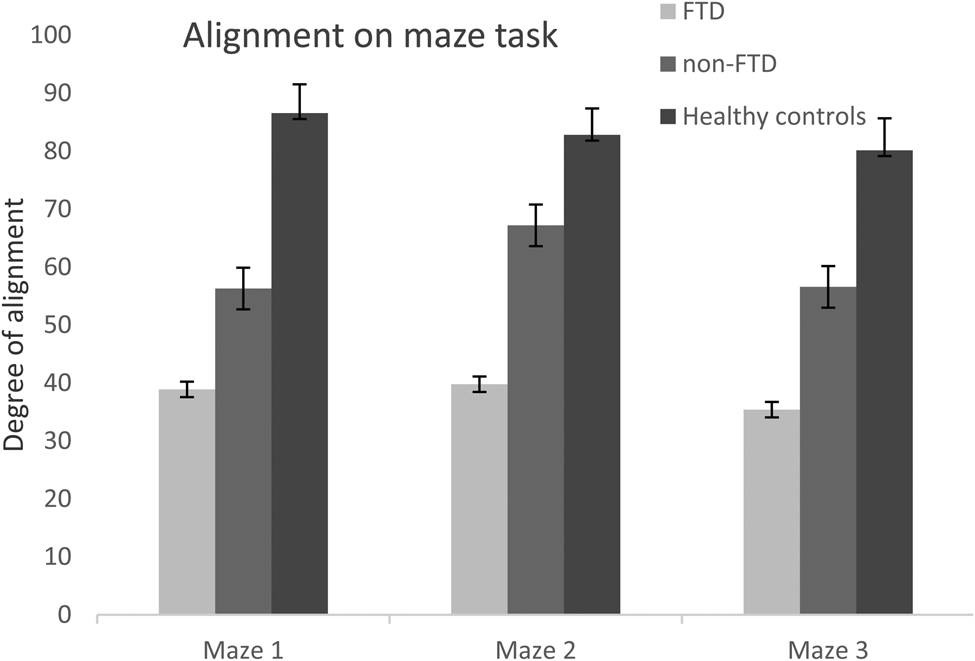
In the alignment analysis, as predicted, the main effect of group (F (2,59) = 19.33, p < 0.001) was found (see Fig. 1). LSD post-hoc analysis revealed significant differences in all comparisons: the FTD group produced less alignment than both the non-FTD group (p < 0.01) and the healthy controls (p < 0.001), while the non-FTD group also produced less alignment than healthy controls (p < 0.01). There was no main effect of a maze (F (2,118) = 0.11, p = 0.90) or interaction between maze and group (F (4,118) = 0.46, p = 0.76). There was no effect of working memory (F (1,59) = 0.88, p = 0.35) or NART pre-morbid IQ (F (1,59) = 0.84, p = 0.36).
Mean percentage scores for each of the three groups in establishing alignment in the dialogue task based on the N−1 scores. Error bars represent standard errors.
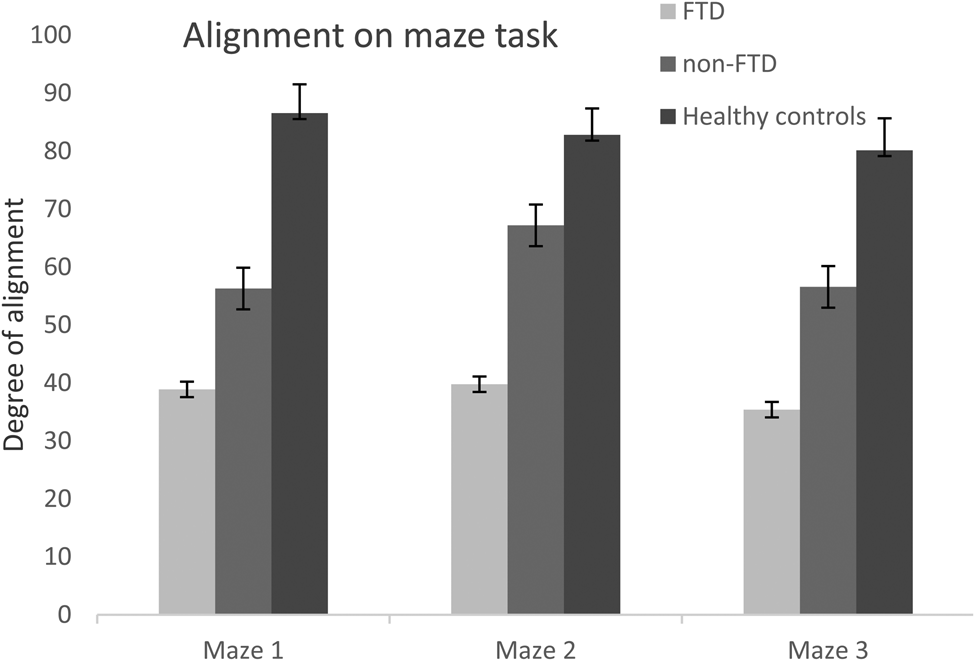
Cohen's d between-participant effect sizes demonstrated that on the degree of alignment, there were medium effect sizes between the FTD and non-FTD group (d = 0.91) and the non-FTD group and healthy controls (d = 1.06), and a very large effect size between the FTD group and healthy controls (d = 2.25).
Syntactic alignment
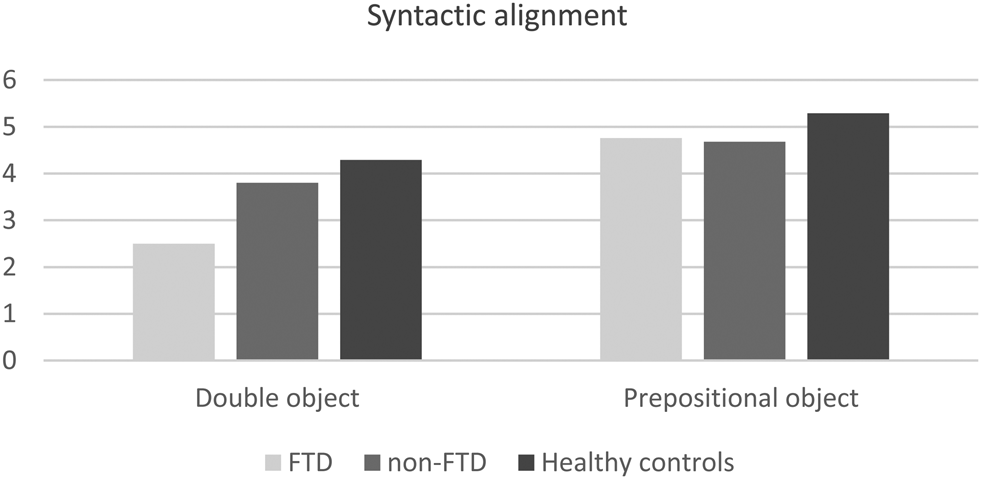
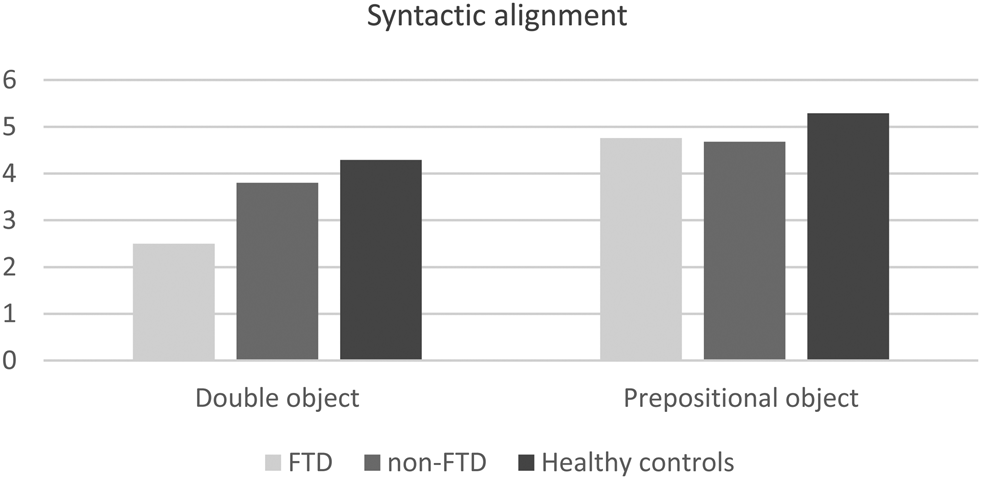
As predicted, the two-way ANCOVA for the syntactic alignment task revealed a main effect of group (F (2,59) = 4.38, p < 0.05) (see Fig. 2). LSD post hoc tests revealed a significant difference between the FTD group and healthy controls (p < 0.01) with the FTD patients showing less alignment. The difference between the FTD group and non-FTD group was not significant (p = 0.1) and there was no significant difference between the non-FTD patients and healthy controls (p < 0.16). There was a trend for an effect of word order (F (1,59) = 3.67, p = 0.06), but no interaction between word order and group (F (2,59) = 0.84, p = 0.44). There was an effect of working memory (F (2,59) = 8.7, p < 0.01), but no effect of NART (F (2,59) = 0.6, p = 0.46).
Total mean scores for each of the three groups on the syntactic alignment task for double object and prepositional object forms.
Theory of mind tasks
Theory of mind in dialogue
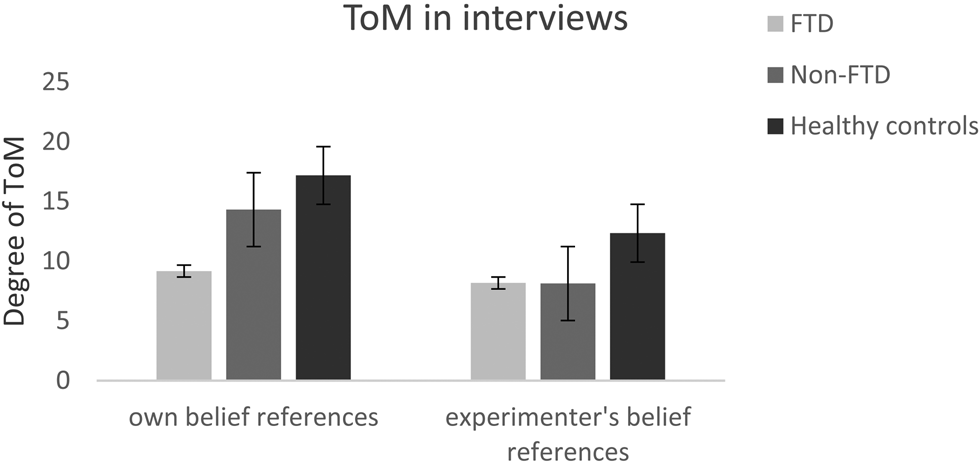
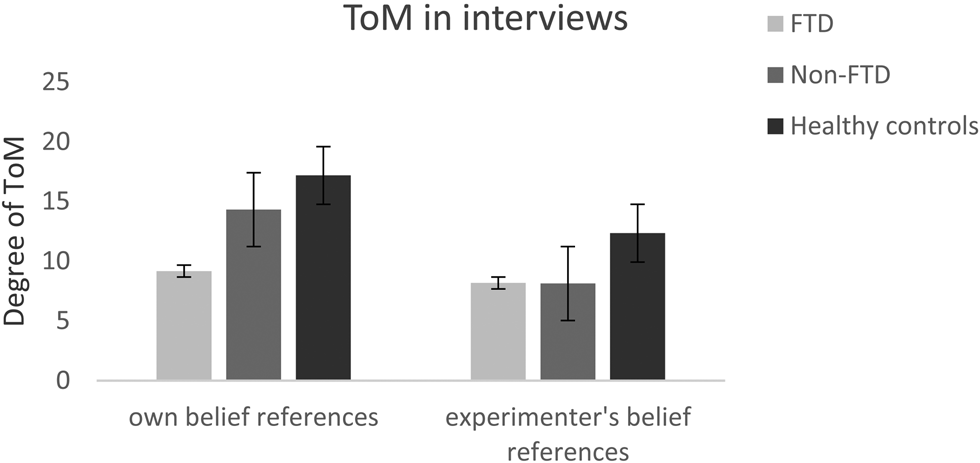
One-way ANOVAs revealed no significant differences between the groups' mean total recording times (F (2,61) = 0.01, p = 0.99) or mean number of utterances (F (2,61) = 0.42, p = 0.66). As predicted, the 2-way ANCOVA revealed a main effect of group (F (2,59) = 4.48, p < 0.05) on overall ToM scores, but there was no effect of own v. experimenter belief reference (F (1,59) = 1.93, p = 0.17) (see Fig. 3). Post-hoc LSD tests showed that the healthy controls produced more belief references than the FTD group (p < 0.01), and, at trend level, than the non-FTD group (p = 0.06). Unexpectedly, there was no significant difference between the two patient groups (p = 0.24). There was no interaction between belief reference and group (F (2,59) = 1.17, p = 0.32). There were no effects of working memory (F (1,59) = 2.34, p = 0.13) or pre-morbid IQ (F (1,59) = 0.24, p = 0.63). Pearson's correlations showed there was no significant relationship between task success and degree of ToM in any of the three groups (FTD: r = 0.01, p = 0.96; non-FTD: r = 0.18, p = 0.42; healthy controls: r = −0.18, p = 0.42).
Ratio scores for the occurrence of own belief and experimenter's belief references made by the three groups in the post maze interview. Error bars represent standard errors.
Theory of mind stories
A one-way ANOVA revealed a group difference in the memory control task (F (2,61) = 4.4, p < 0.01). Tukey's LSD post hoc tests revealed no significant difference between the two patient groups (p = 0.6), who both scored lower than the healthy controls (FTD: p < 0.01; non-FTD group: p = 0.03).
For deception questions, there was a significant main effect of group (F (2,59) = 7.65, p = 0.001) while there was no effect of memory questions (F (1,59) = 0.33, p = 0.57) and no effect of (pre-morbid) IQ (F (1,59) = 0.03, p = 0.86). LSD post hoc analysis revealed that the FTD group produced fewer accurate responses than both the non-FTD group (p < 0.05) and healthy controls (p < 0.001), as did the non-FTD compared to the healthy controls (p < 0.05). There was no effect of order (F (1,59) = 0.13, p = 0.72) and no interaction between order and group (F (2,59) = 1.13, p = 0.33).
In the false belief stories there was again a main effect of group (F (2,59) = 13.02, p < 0.001) and a significant main effect of the memory questions (F (1,59) = 7.16, p = 0.01) but no effect of (pre-morbid) IQ (F (1,59) = 2.34, p = 0.13). LSD post hoc analysis revealed that the FTD group performed worse than both the non-FTD group (p < 0.05) and healthy controls (p < 0.001), as did the non-FTD group compared to the healthy controls (p < 0.01). There was no main effect of order (F (1,59) = 0.04, p = 0.85) or interaction between order and group (F (2,59) = 1.12, p = 0.33).
Relationship between alignment and theory of mind
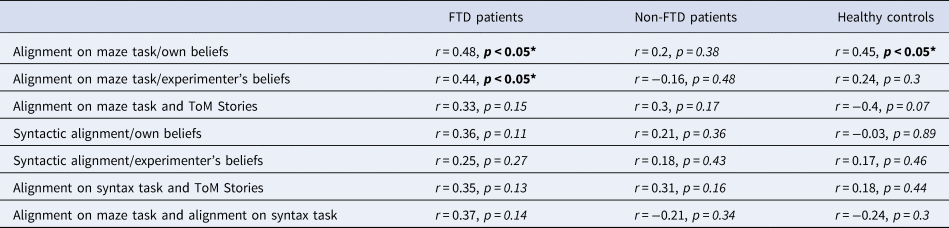
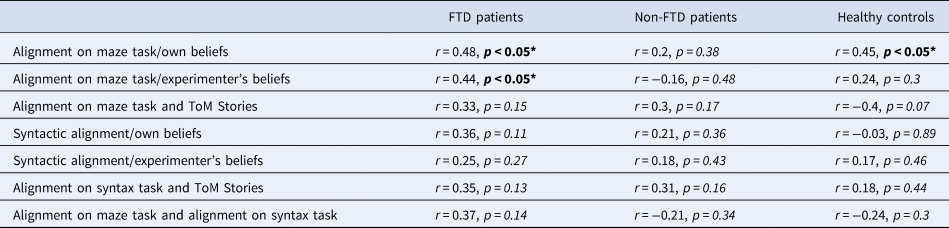
In the FTD group, there were significant relationships between alignment in dialogue and both own beliefs (r = 0.48, p < 0.05) and experimenter's belief (r = 0.44, p < 0.05) utterances on the maze task, and in the healthy control group for alignment and own belief (r = 0.45, p < 0.05). No other significant correlations for total alignment scores (separately for the maze and syntax tasks) and ToM (separately for dialogue or stories) were found. All correlations are shown in Table 2.
Correlations between alignment and theory of mind
Discussion
Alignment
As predicted, we found that FTD patients, compared to both healthy controls and non-FTD patients, displayed significantly less alignment with a conversational partner on a common lexical and semantic system in their dialogic contributions, and lower level syntactic alignment than healthy controls. Differences across groups were independent of pre-morbid IQ and there was no effect of working memory, apart from on the syntactic alignment task. Referential communication impairments are correlated with poor performance on specific neuropsychological measures, including working memory (Docherty and Gordinier, Reference Docherty and Gordinier1999; Doherty, Reference Docherty2005) and thus the distinction here may represent differing working memory demands for the two tasks.
Poverty of alignment observed in both patient groups relative to the healthy control group can be explained as a failure to utilise the available linguistic context and update their own interpretation of the evolving discussion via the production system. This would impoverish the ability to make predictions about upcoming structures, as observed in ERP studies of contextual processing in schizophrenia (Wang et al., Reference Wang, Cheung, Gong and Chan2011). Moreover, the healthy listener's employment of the production system in comprehension suggests a disruption in underlying mechanisms for both input and output processes in FTD.
While the non-FTD patients also showed a decrement in producing a shared semantic and conceptual representation of the maze in comparison to the healthy controls, they did not show reduced syntactic alignment. It thus seems unlikely that poverty in alignment at lower levels failing to percolate up to the situational model can account for the reduced alignment in non-FTD patients in an interactive dialogue.
The non-FTD group's reduced alignment in dialogue relative to healthy controls may reveal subtle weaknesses in the mechanisms underpinning alignment in schizophrenia, which are more prominent in FTD. This would support the idea of a continuum of context processing deficits in schizophrenia (Kuperberg et al., Reference Kuperberg, Kreher and Ditman2010; Tan et al., Reference Tan, Neill and Rossell2015). Problems of priming at low levels of activation in schizophrenia (see Doughty and Done, Reference Doughty and Done2009 for a review), may create a tipping point for the manifestation of clinical FTD in the context of an imbalance between algorithmic and semantic associative streams of processing (Kuperberg et al., Reference Kuperberg, Kreher and Ditman2010).
Poor alignment found here may result from difficulty in creating an efference copy that feeds into the forward production model. This would result in difficulty in generating predictions, as observed in schizophrenia (Wang et al., Reference Wang, Cheung, Gong and Chan2011), and potentially in processing new input as it unfolds (Kuperberg and Jaeger, Reference Kuperberg and Jaeger2016). Alternatively, a problem of monitoring the current utterance and the predicted utterance percept would be consistent with the suggestion that underlying schizophrenia is a failure to monitor one's own representations (Frith, Reference Frith1992), and more specifically, of FTD as a failure in self- or error-monitoring (McGrath et al., Reference McGrath, Scheldt, Hengtsberger and Dark1997; Laws et al., Reference Laws, Kondel and McKenna1999; Kircher and David, Reference Kircher, David, Kircher and David2003).
These findings are also consistent with the proposal of FTD as a breakdown in generative circuitry within a hierarchical generative framework of language processing (Brown and Kuperberg, Reference Brown and Kuperberg2015). These authors argue that a tendency to discount the precision of predictions prior to encountering bottom up information leads to an overweighting of prediction error along with an over-dependence on bottom-up activity, resulting in an over-reliance on semantic associations to establish the global structure. This would result in reduced alignment as patients' activation of a much broader set of semantic neighbours when a new input is encountered.
Theory of mind: main findings
Our second hypothesis was that FTD patients would display reduced implicit ToM in online communication relative to non-FTD patients and healthy controls. Both patient groups demonstrated a decrement in performance on ToM in dialogue relative to healthy controls but the difference between the two patient groups did not reach significance. Neither clinical group demonstrated an absence of ToM reasoning in dialogue but they did demonstrate a relative impairment (see also Langdon et al., Reference Langdon, Michie, Ward, McConaghy, Catts and Coltheart1997; Russell et al., Reference Russell, Reynaud, Herba, Morris and Corcoran2006; Stewart et al., Reference Stewart, Corcoran and Drake2009). In traditional ToM tasks, however, FTD patients showed significantly poorer performance than the other two groups. The main finding here is that, as predicted, FTD patients display both impoverished explicit and implicit ToM performance, while the non-FTD group displayed more impoverished ToM in dialogue only.
Importantly the two tasks test distinct skills. It is plausible that impoverished contextual processing could impact on FTD patients' ToM abilities in dialogue specifically. An inability to collate the contextual information necessary to build up an interpretation of the mental states of others (Schenkel et al., Reference Schenkel, Spaulding and Silverstein2005) may create difficulty in exploiting linguistic context to construct a representation corresponding to what the speaker has said. This in turn may impoverish alignment with the speaker and cause difficulty with tailoring communication appropriately to the listener in dialogue.
Theory of mind and alignment
As predicted, a correlation between alignment and ToM in dialogue was robust in the FTD group, but not in the non-FTD group, and was only evident for own beliefs in the healthy control group. This finding supports the hypothesis that reduced alignment representing problems of contextual processing has implications for mentalising. Failure to align linguistic representations to converge on a common situational model might create a decrement in the contextual scaffolding that facilitates establishing the interlocutor's mental state in dialogue. There was no correlation between ToM as measured by traditional tasks or between syntactic alignment and either measure of ToM, potentially reflecting a distinction of mediated and unmediated alignment.
Mediated accounts conceptualize alignment as a more strategic process, whereby imitation in conversation is deployed to facilitate communicative success. In contrast to syntactic alignment, lexical and semantic alignment observed in the maze task might be supported by additional communicative strategies, i.e. beliefs about the audience. Additionally, the FTD group's performance on ToM in dialogue correlated with alignment in dialogue but not with syntactic alignment. Collectively, this suggests that both measures of performance in dialogue might capture a more conscious element or ‘communicative design’. However, a more mediated role might be expected to be related with working memory abilities (Kaschak and Glenberg, Reference Kaschak and Glenberg2004), widely reported to be impaired in schizophrenia (Lee and Park, Reference Lee and Park2005), yet there was no effect of working memory in either the alignment in dialogue task or in the ToM in dialogue task.
This pattern of processing in alignment and ToM in FTD might indicate a more generalised impairment of contextual processing underlying schizophrenia (Cohen and Servan-Schreiber, Reference Cohen and Servan-Schreiber1992). This relationship between abnormalities of alignment and ToM can also be captured within the hierarchical generative framework (Brown and Kuperberg, Reference Brown and Kuperberg2015). A failure to take the listener's feedback into account may, to a large extent, also be implicated in abnormal monitoring at other levels of the system in FTD (e.g. McGrath, Reference McGrath1991). Impaired monitoring of feedback and detection of miscommunication, could at least contribute to the failure of communication that characterizes thought disorder.
Limitations
The researcher's role meant that the dialogue in the task did not allow entirely natural alignment with the participants. For the purpose of achieving experimental control, it was, however, important to use similar input across the three groups. This study has used a categorical approach, distinguishing between patients with and without FTD, rather than treating FTD as a continuous variable preferred by some researchers. As a strength, we recruited a sufficient number of FTD patients with well-matched non-FTD patients and ensured thorough clinical and cognitive assessment; moreover, only patients with marked or severe FTD were included in the final analysis, which offsets the relatively small sample size. As a consequence, however, it was not possible to match all participants on all estimates of IQ.
Conclusion
This is the first study to investigate contextual processing in FTD in dialogic interactions. The findings (the key tasks show a decrement in performance) show that an impairment in sensitivity to contextual influences may underlie patients' disruption in spontaneous speech, given that mechanisms of alignment in the dialogue are underpinned by the production system (although patient groups performed similarly on syntactic alignment). The non-FTD group's relative impairment supports the continuum view of language functioning in schizophrenia. The association between ToM and alignment performance in FTD may indicate a more generalised deficit in integrating multiple sources of information into a contextual whole or a consequence of failure to build up a representation of the speaker's utterance. This indicates a potential area for future work that may allow the teasing apart of these different possibilities.
Supplementary material
The supplementary material for this article can be found at https://doi.org/10.1017/S0033291719002289
Acknowledgements
We thank Professor Simon Garrod and Professor Martin Pickering for providing permission to recreate the alignment tasks and Professor Rhiannon Corcoran for her permission to use the ToM stories. All authors have declared that there are no conflicts of interest in relation to this study.
Financial support
This work was supported by the British Academy Small Research Grants Fund (Grant number FW: SG-44292) [EP]; and by CIBERSAM, Spain [PMcK].