Obesity is a complex, multifactorial chronic disease that develops from an interaction of genotype and the environment. The prevalence of corpulence and obesity in industrialised nations is increasing, even in children and adolescents. Although the fatal medical diseases affecting the cardiovascular system usually occur in adulthood, the basis thereof was mainly found decades earlier.
Abnormalities of the autonomic nervous system, clinically manifested as a hyperkinetic circulation characterised by elevations in heart rate, blood pressure, levels of norepinephrine in the plasma, and cardiac output, have been repeatedly shown in hypertensive patients.Reference Palatini and Julius1 Beat-to-beat fluctuations in heart rate are mainly determined by the activity of the cardiac sympathetic and parasympathetic systems. Variability in heart rate can be easily and non-invasively assessed, and can provide valuable information to the physician. Reduced variability, reflecting autonomic imbalance, has been shown to be an independent predictor of mortality in various populations, including patients surviving myocardial infarction, patients with cardiac failure, and the elderly.Reference Kristal-Boneh, Raifel, Froom and Ribak2 Several investigators have reported reduced variability in heart rate in obese subjects, and an autonomic disturbance may therefore be involved in the mechanisms promoting hypertension, arrhythmias, and sudden death in this group.Reference Piestrzeniewicz, Luczak and Lelonek3–Reference Gutin, Barbeau and Litaker8 In contrast with these findings, others were unable to confirm a correlation between variability in heart rate and body mass index in a cohort of subjects without cardiac disease.Reference Antelmi, De Paula and Shinzato9 Earlier studies have been performed mainly in middle-aged or elderly persons, or in patients with cardiac disease.Reference Piestrzeniewicz, Luczak and Lelonek3 There are very few studies that have included overweight adolescents, and these studies only considered a small number of individuals.Reference Guizar, Ahuatzin and Amador6, Reference Rabbia, Silke and Conterno7 We were able to study the associations between corpulency, variability in heart rate, and well-being in a large cohort of young men eligible for military service.
We hypothesised an inverse correlation between body mass index and variability in heart rate also in these young men. Further, we assessed systolic and diastolic blood pressure as traditional indicators of cardiovascular risk.
Materials and methods
Subjects
Between April, 2005 and January, 2006, we examined 1000 young men living in the region of a Saxon city, namely Leipzig, who were eligible for military service. In addition to the routine medical examination, we offered a voluntary measurement of variability in heart rate and well-being. A urine drug-screening test (Multiline-6/5-Drug test, Diagnostik-Nord, Schwerin, Germany) was used to identify the drug users.
Questionnaires
A standardised questionnaire enquired about the basic and anamnestic data. The collected data included age, height, weight, use of pharmaceuticals or drugs, duration of sleeping, sporting activities in hours per week, and blood pressure. Body mass index was defined as the body weight divided by the square of the height, values being saved as kilogram per square metre. We used the international classification of adults made by the World Health Organisation (WHO)10 to determine the subjects who were considered underweight, pre-obese, and obese according their body mass index.
Psychological well-being was evaluated by a standardised questionnaire with five items. The WHO-Five Well-being Index was derived from a larger-rating scale developed for a project organised by the WHO on quality of life in patients suffering from diabetes. During the first psychometric evaluation, 10 of the original 28 items were selected due to the homogeneity they had shown across the various European countries participating in this study. As positive psychological well-being has to include positively worded items only, these 10 items were then reduced to 5 items, the WHO-Five, which still covered positive mood, such as good spirits and relaxation, vitality in terms of being active and waking up fresh and rested, and general interests, specifically being interested in things.11 Each of the five items was rated on a six-point Likert scale from zero when not present to five, if constantly present. The theoretical raw score ranged from 0, indicating a very poor state of well-being, to 25, indicating the best state of well-being.11
Variability in heart rate
All tests took place between 8:00 am and 1:00 pm and were carried out by the same investigator under comparable ambient conditions.
The volunteers were asked to sit comfortably on a chair. After relaxation, heart rate was monitored continuously for at least 3 minutes using the ambulatory heart rate monitor Polar® Vantage® with Polar® Advantage® Interface and Precision Performance® software version 2.0 (Polar® Electro, Kempele, Finland). The system has been described in detail elsewhere.Reference Radespiel-Tröger, Rauh, Mahlke, Gottschalk and Mueck-Weymann12
Initially, the raw data were inspected for artefacts by the investigator, and, if possible, these were corrected using a proven tool from the Polar® software. Evaluation included the root mean square of the successive differences, and the ratio of low-to-high frequency derived from the spectral frequency analysis.
It is generally accepted that the root mean square of the successive differences indicates vagal modulation of the heart rate, while the ratio of low-to-high frequency derived from the spectral frequency analysis is thought to reflect sympathovagal balance.
Statistical analysis
Statistical evaluation was performed using the software package SPSS 15.0 for Windows. As most variables did not follow a normal distribution, we presented all data using the median with interquartile range. Associations between the pairs of quantitative variables were evaluated using the scatter plots and Spearman’s correlation coefficients. In addition, Kruskal–Wallis and Mann–Whitney tests were used. We use the term significant throughout our paper to refer to the statistical significance at a level of less than 5%.
Ethics
This study was part of a research project to identify the parameters of somatic and psychomental well-being during the regular health check-ups. The research project was approved by the Ethics Committee for Research Project Analysis at the University Erlangen-Nuremberg (no. 3178/2004). The data presented in this study were collected from a required medical check-up that was used to determine the degree of fitness for military service. Participation in the supplementary measurement of variability in heart rate and well-being was voluntary. Informed consent was obtained before carrying out these tests. The data were collected anonymously in accordance with the legal requirements regarding the data protection and medical confidentiality.
Results
The 214 subjects who used drugs, or who reported the use of any kind of pharmaceuticals, were not included in the statistical evaluation. Therefore, we included a total of 786 men with a mean age of 19.4 years, standard deviation of 1.4, and with a range from 16 to 24 years, after they had given the informed consent.
Body mass index
The median body mass index was 22.2 kilograms per square metre, with a range from 15.8 to 42.4, and an interquartile range from 20.3 to 24.4 kilograms per square metre. The index of 563 persons (71.6%) was in the normal range, specifically from 18.50 kilograms per square metre to 24.99 kilograms per square metre. Of all the subjects, 52 (6.6%) men were underweight, having a body mass index lower than 18.5 kilograms per square metre, 136 (17.3%) were pre-obese, with a body mass index up to 29.9 kilograms per square metre, and 35 (4.5%) were obese, their body mass index being at least 30 kilograms per square metre.
Blood pressure
The median blood pressure was 130/70 millimetres of mercury. Hypertensive values were found in 33.6% of the cohort, systolic blood pressure being measured at least at 140 millimetres of mercury, with a maximum value of 160 millimetres of mercury. A diastolic blood pressure of at least 90 millimetres of mercury was seen in 3.1% of the subjects, the maximum value being 100 millimetres of mercury.
Well-being
The median raw score was 17, with a range from 2 to 25, and an interquartile range from 14 to 19. A raw score below 13 indicates poor well-being, and was observed in 18.3% of the cohort.
Sleep
Of our responders, 110 (14.0%) reported that they suffered from sleeping disorders, with 49 recognising sleep-onset insomnia, 46 sleep-maintenance insomnia, and 15 combined disorders. The median period of sleeping was 7.5 hours per night, with a range from 4 to 12 hours, and an interquartile range from 6.5 to 8.0 hours per night.
Sporting activities
From the cohort, 552 (70.2%) reported the involvement in sporting activities, with a median weekly involvement of 4 hours, the range being from 2 to 25 hours, and the interquartile range from 2 to 6 hours per week.
Considering the whole group, the average weekly sporting activity was 2.5 hours per week, with an interquartile range from 0 to 5 hours per week.
Variability in heart rate
The median heart rate was 76 beats per minute, with an interquartile range from 67 to 86 beats per minute. The median of the root mean square of successive differences was 50.7 milliseconds, with an interquartile range from 33.3 to 73.5 milliseconds.
The median of the ratio of low-to-high frequency that was derived from the spectral frequency analysis was 1.99, with an interquartile range from 1.31 to 3.20.
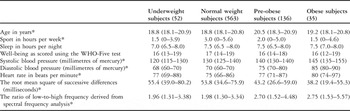
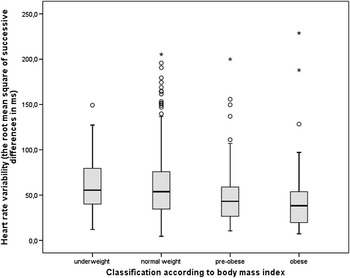
The four groups of underweight, normal weight, pre-obese and obese subjects differed significantly with respect to age, sporting activities, systolic and diastolic blood pressure, heart rate, and variability in heart rate (Table 1; Kruskal–Wallis test). Significant differences were mainly seen between normal and overweight men, including both those pre-obese and obese, as shown by the root mean square of the successive differences (Fig 1).
Median values and 25th and 75th centiles in underweight, normal weight, pre-obese, and obese men.

*Groups differ significantly (Kruskal–Wallis test).
Box plots of the root mean square of successive differences, in milliseconds, in underweight, normal weight, pre-obese, and obese men.

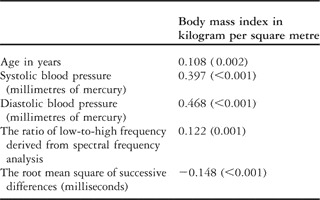
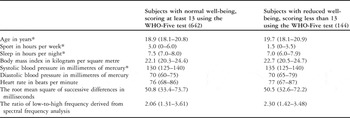
There were multiple correlations of body mass index with age, blood pressure, and variability in heart rate (Table 2). A total of 642 men with normal well-being, scoring at least 13 for the WHO-Five test, and 144 men with reduced well-being, scoring below 13, differed significantly with respect to age, sporting activities, duration of sleep, and systolic blood pressure (Table 3; Mann–Whitney U-test). In young men, well-being was obviously, although not yet, influenced by obesity.
Spearman’s correlation coefficients for the correlations of body mass index.
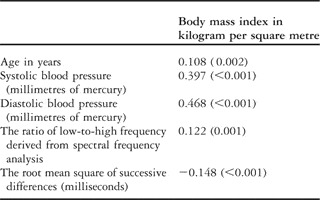
p-values are given in brackets.
Median values and 25th and 75th centiles in men with normal and reduced well-being.
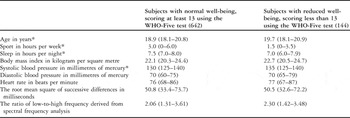
*Groups differ significantly (Mann–Whitney U-test).
A multiple stepwise regression analysis showed that significant factors associated with variability in heart rate were body mass index and sporting activities. Well-being was mainly associated with sporting activities and duration of sleeping.
Discussion
Several investigators have reported reduced variability in heart rate in obese subjects, although others were unable to confirm a correlation between variability in heart rate and body mass index in a cohort of subjects without cardiac disease.Reference Antelmi, De Paula and Shinzato9 We studied a large and very homogeneous group of young men, keeping well-established confounding factors as constant as possible.
With our data, we could confirm an association between body mass index and variability in heart rate in our cohort of young male recruits.
Hypertension and obesity are well-known risk factors for coronary arterial disease in adults. Although the association between obesity and hypertension is firmly established, mechanisms underlying the development of hypertension in overweight persons have not been fully understood.
Adipokines, such as leptin, are hormone-like peptides secreted by adipose tissue. More recently, a possible impact of adipokines on the autonomic nervous system has been hypothesised. The observed relationship between concentrations of leptin and resistin in the blood and the variability in parameters for heart rate may indicate a possible link between adipokines and disturbances of the autonomic nervous system.Reference Piestrzeniewicz, Luczak and Lelonek3 In experimental models, leptin has been shown to stimulate the sympathetic nervous system, thus increasing heart rate and arterial blood pressure.Reference Paolisso, Manzella and Montano4 These results might explain, at least partially, the relationship between obesity, increased concentrations of leptin in the blood, disturbances of the autonomic nervous system, hypertension, and cardiovascular mortality.
It has been well established that hypertension is associated with autonomic dysregulation. Studies investigating variability in heart rate have established that hypertension is characterised by sympathetic overactivity and/or attenuation of parasympathetic modulation of the heart. The new-onset hypertension is characterised by the diminished short-term variability in heart rate, possibly due to an increase in the cardiovascular sympathovagal balance.Reference Pavithran, Nandeesha and Sathiyapriya13, Reference Pavithran, Mithun and Nandeesha14 Those providing these data, however, studied only 36 patients, and did not account for body weight.Reference Pavithran, Nandeesha and Sathiyapriya13, Reference Pavithran, Mithun and Nandeesha14 OthersReference Mussalo, Vanninen and Ikäheimo15 studied the relationship between cardiac autonomic nervous control and the severity of essential hypertension in patients receiving long-term antihypertensive therapy. They found an inverse relationship between variability in heart rate and blood pressure, whereby the severity of chronic essential hypertension seemed to be related to the severity of impairment of cardiac autonomic control.Reference Mussalo, Vanninen and Ikäheimo15
Still other studies have shown that the autonomic disturbances in obese patients improve after loss of weight.Reference Karason, Mølgaard and Wikstrand5, Reference Ashida, Ono and Sugiyama16, Reference Nault, Nadreau and Paquet17 Loss of weight achieved by implementing a low-calorie diet with a constant intake of sodium reduced blood pressure in obese hypertensive patients by improving vagal nervous control and insulin resistance.Reference Nakano, Oshima and Sasaki18 In addition, women with anorexia nervosa are known to have increased variability in heart rate, which reflects vagal hyperactivity.Reference Galetta, Franzoni and Prattichizzo19 This might be a favourable compensatory mechanism, and a protective factor against the risk of arrhythmic events during the phase of starvation.Reference Galetta, Franzoni and Prattichizzo19
Sporting activities seem to exert a positive effect on variability in heart rate, in large part because of the increase in the root mean square of the successive differences, an effect well known from literature.Reference Gutin, Barbeau and Litaker8, Reference Earnest, Lavie and Blair20, Reference Mueck-Weymann, Janshoff and Mueck21 Using our data, we were able to confirm that there were associations between variability in heart rate and body mass index, as well as sporting activities, in young men. There was no association between body mass index and well-being in our group of young men. Reduced sporting activities and duration of sleep, nonetheless, seemed to be associated with decreased well-being.
One main limitation of our study is that we were not able to include women. The results presented, therefore, are valid only for men. Another limitation is the occasion at which the investigation took place. The young men could have been excited during a medical examination determining their degree of fitness for military service. This fact might have caused a systematic bias towards increased sympathetic activation. Another consideration that must be taken into account is that the answers given to questions about well-being depended on the compliance and the truthfulness of the volunteers, as well as on their individual assessments of themselves. Unfortunately, no measurement of distribution of fat could be performed.
It is well known that adolescents with an increased body mass index are at elevated risk for obesity in adulthood.Reference Wang, Chyen and Lee22 In our study, we clearly showed that, in young men, being overweight is also associated with negative effects on the autonomic nervous system, and with an increase in blood pressure even when the well-being is not yet affected. The data are in accordance with the hypothesis that the autonomic dysregulation causes the increased blood pressure. Our study gives additional motivation for early prevention and treatment of corpulency in childhood and adolescence. Population-based efforts combined with the targeted interventions for these high-risk individuals are needed.
Acknowledgements
We thank all the participants for their cooperation. Parts of this paper have been included in the medical thesis of Jana Schönlebe at the Medical Faculty of the University Erlangen-Nuremberg. Parts of this paper have also been presented at the Annual Congress of the German Society for Occupational and Environmental Medicine, held in Aachen from March 11 to 14, 2009.