Introduction
Chickpea (Cicer arietinum L.) is one of the oldest (earlier than 9500 BC) and widely cultivated pulse crops in over 50 countries of the world. Chickpea is a member of the West Asian Neolithic crop assemblage, associated with the origin of agriculture in the Fertile Crescent some 10,000 years ago (Lev-Yadun et al., Reference Lev-Yadun, Gopher and Abbo2000; Zohary and Hopf, Reference Zohary and Hopf2000). It most probably originated in south-eastern Turkey and adjoining Syria. C. bijugum, C. echinospermum, and C. reticulatum, the wild annual species of Cicer, closely related to chickpea are predominantly found in this region. Southwest Asia and the Mediterranean are the two primary centres of origin, and Ethiopia is the secondary centre of diversity (Vavilov, Reference Vavilov1926, Reference Vavilov1951). Wild annual Cicer originated mainly in the Mediterranean regions having a wide ecogeographic range, differing in habitat, topographic and climatic conditions (Abbo et al., Reference Abbo, Berger and Turner2003; Berger et al., Reference Berger, Abbo and Turner2003). The four evolutionary bottlenecks in chickpea reported are (1) scarcity and limited distribution of the wild progenitor, C. reticulatum, (2) founder effect associated with domestication, (3) shift, early in the crop's history, from winter to spring sowing, and the attendant change using rainfall as it occurs to a reliance on residual soil moisture, (4) replacement of locally evolving landraces by the elite cultivars produced by modern plant breeding (Abbo et al., Reference Abbo, Berger and Turner2003).
Chickpea is a self-pollinated crop, with 2n = 2x = 16 chromosomes and a genome size of 740 Mb (Arumuganathan and Earle, Reference Arumuganathan and Earle1991). Two distinct forms of cultivated chickpeas are desi (small seeds, angular shape and coloured seeds with a high percentage of fibre) and kabuli types (large seeds, owl shaped, beige-coloured seeds with a low percentage of fibre). A third type, designated as intermediate or pea-shaped, is characterized by medium to small size and round/pea-shaped seeds. Hair-like structures on its stems, leaves and pods secrete acids that provide the first line of defence against pests, reducing the need for chemical sprays (Yadav et al., Reference Yadav, Redden, Chen and Sharma2007).
Chickpea seeds contain protein, fibre, calcium, potassium, phosphorus, iron, zinc and magnesium along with appreciable quantities of selenium, sodium and copper, which make it one of the nutritionally best composed edible dry legumes, for human consumption (Esha, 2010). Like as most other beans, chickpea is a good source of cholesterol lowering fibre (Pittaway et al., Reference Pittaway, Ahuja, Cehun, Chronopoulos, Robertson, Nestel and Ball2006). In addition to lowering cholesterol, the high fibre content prevents blood sugar levels from rising too rapidly after a meal, making chickpea a good choice for individuals with diabetes, insulin resistance or hypoglycaemia (McIntosh and Miller, Reference McIntosh and Miller2001). Chickpea does not contain any antinutritional factors except the raffinose-type oligosaccharides, which cause flatulence (Williams and Singh, Reference Williams, Singh, Saxena and Singh1987). However, the oligosaccharides can be neutralized by boiling or mere soaking in water (Queiroz et al., Reference Queiroz, de Oliveira and Helbig2002).
Chickpea is the second most important grain legume in Asia after soybean, which contributes 86.73% of global production from 89.89% area. The global area under chickpea is about 11.08 Mha, with a total production of 9.77 Mt and an average productivity of 882 kg/ha (FAO, 2009). India accounts for 67.68% of this area (7.50 Mha), and 66.91% (6.54 Mt) of production followed by Pakistan (with 9.75% of area: 1.08 Mha and 0.741 Mt). Chickpea is also an important crop in Iran (0.56 Mha), Turkey (0.45 Mha), Myanmar (0.20 Mha), Australia (0.36 Mha), Ethiopia (0.23 Mha), Mexico (0.11 Mha), Syria (0.07 Mha), the USA (0.04 Mha), Canada (0.05 Mha), Spain (0.02 Mha) and Eritrea (0.02 Mha) (FAO, 2009).
Chickpea is traditionally grown extensively as a low input crop under receding soil moisture status with minimum management. Despite its high morphological variability, genetic variation is low (Udupa et al., Reference Udupa, Sharma, Sharma and Pai1993), probably a consequence of its monophyletic decadence from its wild progenitor C. reticulatum in the Fertile Crescent (Ladizinsky and Adler, Reference Ladizinsky and Adler1976; Lev-Yadun et al., Reference Lev-Yadun, Gopher and Abbo2000; Abbo et al., Reference Abbo, Berger and Turner2003). The major constraints to chickpea productivity are biotic stresses (like Helicoverpa pod borer and fusarium wilt) and abiotic stresses (like drought, extreme temperatures and salinity), apart from its poor response to better management. The progress achieved through conventional breeding for improved varieties is not in pace with the current requirements, which is evident from the stagnant production of chickpea during the past two decades (Varshney et al., Reference Varshney, Thudi, May and Jackson2010b). With the exception of soybean, to various extents, legume crops, including chickpea, have suffered from the lack of genomic resources for genetic and genomic analysis – they have literally been ‘orphans’ from the genomics revolution (Varshney et al., Reference Varshney, Close, Singh, Hoisington and Cook2009a). Recent years have seen tremendous progress in the development of large-scale genomic resources such as DNA-based molecular markers, comprehensive genetic maps, whole-genome transcription profiling techniques to identify genomic regions and genes underlying plant stress responses (Varshney et al., Reference Varshney, Close, Singh, Hoisington and Cook2009a, Reference Varshney, Thudi, May and Jackson2010b). These genomic tools will be useful to understand and access the diversity conserved in ex situ germplasm collections for chickpea improvement (Glaszmann et al., Reference Glaszmann, Kilian, Upadhyaya and Varshney2010). This article discusses the global status of germplasm collection, development of mini core and reference sets, identification of trait-specific germplasm, advances in the development of genomic resources and the utility of genomic and germplasm resources for chickpea improvement.
Germplasm assembly
The genus Cicer has 43 species (nine annual and 34 perennial), out of which C. arietinum is the only cultivated species. The species C. arietinum has wide variability with thousands of landraces spread over 50 countries and a large number of traditional cultivars, which were grown and maintained by farmers worldwide (Singh et al., Reference Singh, Sharma, Varshney, Sharma and Singh2008b). However, after the introduction of modern, high-yielding, genetically uniform varieties, much of the species diversity has been lost due to replacement of traditional varieties and landraces over wide areas. In addition, change in dietary habits, natural calamities, land and crop conversion (deforestation, developmental activities such as hydroelectric projects, roads and urbanization), introduction of exotic crops, etc. have further aggravated the situation (http://www.primalseeds.org/bioloss.htm; Pusadeea et al., Reference Pusadeea, Jamjoda, Chiangb, Rerkasema and Schaalc2008; Upadhyaya et al., Reference Upadhyaya, Yadav, Dronavalli, Gowda and Singh2010). The vulnerability of genetically uniform modern varieties, which are planted to large areas, to new pests, diseases, climatic conditions and changes in the market needs is widely acknowledged. The diverse landraces, exotics and wild relatives hold a wealth of alleles, which, if included in breeding programmes, can help raise the yield levels and enhance stress resistance level of agronomically superior cultivars. This emphasized the need for preservation of germplasm, which led to assembling and maintaining a very large number of germplasm accessions (over 97,400) by many countries and conserving them in their genebanks (WIEWS-FAO, 2009).
Germplasm repositories
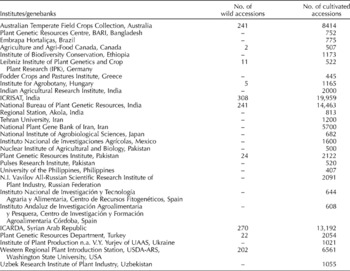
Although germplasm exchange and plant introduction have been in practice sporadically for centuries, purposeful efforts started only in the 1920s, and genebanks have been established in different countries. The major chickpea germplasm repositories (ex situ) in the world are listed in Table 1.
Major genebanks holding chickpea germplasm

The International Crops Research Institute for the Semi-Arid Tropics (ICRISAT) genebank has the largest collection of 20,267 accessions in the genus Cicer from 60 distinct countries across five continents (Asia, Africa, the Americas, Europe and Oceania-pacific) including 308 accessions of 18 (eight annual and ten perennial) wild Cicer species. Of these, 4153 accessions were obtained from 65 collection missions in 14 countries across Asia (eight countries) and Africa (six countries); the remaining 16,114 were donations from 58 countries across five continents. Of the 308 wild accessions, 233 were donations from seven countries (Australia, India, Israel, Lebanon, Syria, the UK and the USA), and the remaining (75) were collected from Afghanistan, Turkey, Syria and Pakistan.
The International Centre for Agricultural Research in the Dry Areas (ICARDA) genebank holds 13,462 accessions from 61 distinct countries across five continents (Asia, Africa, the Americas, Europe and Oceania-pacific) including 270 accessions of 12 (nine annual and three perennial) wild Cicer species. Of these, 3245 accessions were obtained from 160 collection missions in 41 countries, and the remaining were donations from Ethiopia, Israel, Jordan, Lebanon, Syria and Turkey. Of the 270 wild species accessions, 180 were collected from Afghanistan, Armenia, Jordan, Lebanon, Syria, Tajikistan and Turkey.
Characterization and evaluation
The characterization, evaluation and documentation of the germplasm are essential for utilization in crop improvement and for efficient management. Therefore, all the chickpea accessions have been characterized and evaluated at the ICRISAT research farm, Patancheru, India (18°N, 78°E, 545 m.a.s.l.), for seven qualitative and 13 quantitative traits, following the chickpea descriptors (IBPGR, ICRISAT and ICARDA, 1993). A multi-disciplinary approach is followed for characterization and evaluation of chickpea germplasm for biotic and abiotic stresses, agronomic traits and for updating and maintenance of databases. These germplasm accessions contain very useful diversity for crop improvement. Evaluation of wild species had resulted in identification of genes for resistance to botrytis grey mould in C. judaicum and C. pinnatifidum (Singh et al., Reference Singh, Singh and Kapoor1982); to ascochyta blight in C. bijugum, C. pinnatifidum and C. yamashitae (Shah et al., Reference Shah, Hussan, Haq, Atta, Alam and Ali2005); to fusarium wilt in C. bijugum (Infantino et al., Reference Infantino, Porta-Puglia and Singh1996). Two wild species C. echinospermum and C. reticulatum are cross-compatible with the cultivated C. arietinum and are reported to be resistant to several pests (cyst nematodes, leaf minor and bruchids) and diseases (fusarium wilt, ascochyta blight and Phytophthora), apart from tolerance to cold (Dwivedi et al., Reference Dwivedi, Blair, Upadhyaya, Serraj, Balaji, Buhariwalla, Ortiz and Crouch2005).
Geographic patterns of diversity
The primary centre of diversity is the Fertile Crescent (Abbo et al., Reference Abbo, Berger and Turner2003), where the crop was domesticated and later spread to the secondary centres – the northeast Africa, the Mediterranean, Europe and the Indian sub-continent and more recently to Mexico and Chile (van der Maesen, Reference van der Maesen1972). The distribution of landraces and wild relatives of chickpea occurs in three main regions from 8° to 52°N latitude and 8°W to 85°E longitude covering (1) the western Mediterranean, Ethiopia, Crete and Greece, (2) Asia Minor, Iran and Caucasus, (3) Central Asia, Afghanistan and the Himalayan region (van der Maesen, Reference van der Maesen1972). The ICRISAT's chickpea germplasm collection represents this entire area, showing wide range of variation for various morphological and agronomic traits. The level of diversity found among the traits indicate that West Asia region in which southwest Asia, one of the primary centres of diversity, is located was adequately represented by 5,564 (33.1%) accessions in the ICRISAT genebank. This was also demonstrated by the highest diversity for the morphological descriptors and agronomic traits observed in this region. The principal component (PC)-based hierarchical cluster analysis resulted in two clusters. The accessions from Africa, South Asia and Southeast Asia grouped together as cluster-I, and the accessions from rest of the countries (the Americas, Europe, West Asia, the Mediterranean region and East Asia) formed cluster-II (Upadhyaya, Reference Upadhyaya2003). The accessions in cluster-I were predominantly desi type, short statured, with low plant anthocyanin, pink flowers, angular shaped and rough, brown seeds of low seed weight, where most accessions in cluster-II were predominantly of kabuli type with no anthocyanin pigmentation, beige-coloured seeds with smooth seed surface and high 100 seed weight.
Morphological diversity
Large phenotypic diversity exists for morphological, reproductive, yield, nutrient content and biotic/abiotic stress tolerance-related traits in the chickpea germplasm. The variability ranges for some valuable traits are plant pigmentation (green to high pigmented), growth habit (five types), flower colours (seven colours), seed-coat colour (21 colours), plant height (14–105 cm), plant width (13–124 cm), days to flowering (31–107 d), flowering duration (13–75 d), days to maturity (84–169 d), pod number/plant (2–251), seeds/pod (1–3.2), seed weight (4–65 g), seed shape (three types), seed testa texture (three types), seed yield (70–5100 kg/ha) and seed protein (8–30%) (http://www.icrisat.org/what-we-do/crops/ChickPea/Project1/pfirst.asp).
Low use of genebank germplasm collection
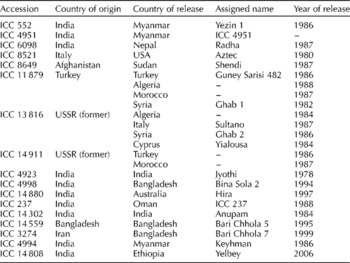
ICRISAT has provided 314,525 chickpea seed samples to recipients in 86 countries from 1974 till Nov, 2010. The evaluation of the chickpea germplasm by national programmes has led to the release of 17 accessions directly as cultivars in 15 countries (Table 2). A small proportion of chickpea germplasm at ICRISAT and other genebanks has been used in crop improvement programmes. For example, in the ICRISAT chickpea breeding programme (1978–2004), only 91 were germplasm accessions among 12,887 (586 unique) parents used in the development of 3548 advanced breeding lines (Upadhyaya et al., Reference Upadhyaya, Gowda, Buhariwalla and Crouch2006a). Two most frequently used cultivars were L 550 and K 850. In India, out of 126 chickpea cultivars released in the past four decades, 41% had Pb 7 as one of the parents; IP 58, F 8, S 26 and Rabat were also the most extensively used parents (Kumar et al., Reference Kumar, Gupta, Singh, Ali, Singh, Kumar and Dhar2004)). Plant breeders frequently use parental lines from their working collections only, as they make reasonable and steady progress in most cases, and broadening the adapted genetic base generally will dilute agronomic performance (Kannenberg and Falk, Reference Kannenberg and Falk1995). Plant breeders consider elite inbred lines as the best genetic resources simply because each line contains a combination of genetic traits that satisfies the marketplace (Troyer, Reference Troyer1990). Yet new germplasm, if used in crop improvement programmes, can (1) raise the genetic ceiling on improvement, (2) decrease vulnerability to biotic and abiotic stresses, (3) add new developmental pathways and ecological adaptations (Kannenberg and Falk, Reference Kannenberg and Falk1995).
Chickpea germplasm lines released as cultivars in different countries

Although plant breeders recognize the limitation of their working collections and the potential value of wild and landrace resources, they are often reluctant to use these resources for the following reasons:
(1) Lack of reliable knowledge about stable donors for specific traits.
(2) Linkage load of many undesirable genes.
(3) Lack of germplasm assessment for economic traits that show high genotype–environment interaction and require expensive, laborious and replicated multi-environment evaluation.
(4) Assumed risks: while dealing with unknown and wild germplasm lines, breeders are apprehensive about the possibility of complete programme failures; timescales may be too long; or the value of the new varieties may never allow costs to be recouped. Additionally, there is the possibility of introducing toxic, allergenic or pharmaceutically active plant products into food products, risks that are virtually absent in crossing elite, widely grown germplasm (Heslop-Harrison, Reference Heslop-Harrison2002).
(5) The need of plant breeders for genetically diverse, trait-specific and agronomically desirable parents is not met by the information available in the genebank databases.
(6) The restricted access due to limited seed availability and regulations governing international exchange.
Advances in development of large-scale genomic resources
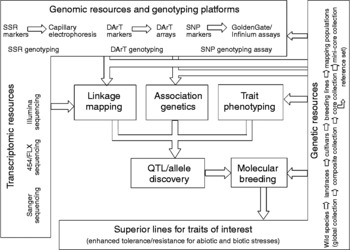
Until recently, a very limited number of genomic resources such as few hundred molecular markers, some fragmentary genetic maps were available in chickpea. In the past 5 years, however, several national and international initiatives have tackled the challenge of dearth of genomic resources for genetics and breeding of chickpea (Varshney et al., Reference Varshney, Thudi, May and Jackson2010b; Fig. 1). As a result, various types of genomic resources such as microsatellite or simple sequence repeat (SSR)/sequence tagged microsatellite sites, expressed sequence tags (ESTs), single nucleotide polymorphism (SNP), cleaved amplified polymorphic sequences (CAPS), conserved intron spanning primers and diversity array technology (DArT) markers have been developed for chickpea.
A holistic approach to harness germplasm diversity through genomic tools. Modern genomics technologies such as NGS and high-throughput genotyping platform together with appropriate germplasm and their precise phenotyping can be used to identify the quantitative trait locus (QTL)/alleles for the trait of interest by using linkage or association mapping approaches. QTLs or desirable alleles, subsequently, can be deployed through molecular breeding approaches such as marker-assisted selection for developing the superior lines for traits of interest to the breeders.

SSR markers
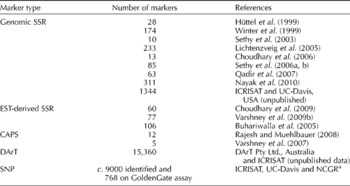
SSR markers are considered the markers of choice for plant genetics and breeding applications (Gupta and Varshney, Reference Gupta and Varshney2000). In case of chickpea, however, only few hundred SSR markers were available until recently (Table 3). It is also important to note that majority of these markers were developed from targeted SSRs for assaying variation in particular repeat motifs. Furthermore, low level of polymorphism especially in the cultivated germplasm of chickpea posed a need for the development of large-scale SSR markers. Hence, in order to increase the molecular marker repertoire and to develop genome-wide SSR markers, ICRISAT in collaboration with the University of Frankfurt, Germany, developed 311 SSR markers from SSR-enriched libraries (Nayak et al., Reference Nayak, Zhu, Varghese, Choi, Datta, Horres, Jüngling, Singh, Kavi Kishor, Kahl, Winter, Cook and Varshney2010) and 1344 SSR markers from bacterial artificial chromosome (BAC)-end sequence mining approaches in collaboration with the University of California, Davis, USA (unpublished data; Table 3). As ESTs from various tissues and developmental stages of chickpea have also been reported (Boominathan et al., Reference Boominathan, Shukla, Kumar, Manna, Negi, Verma and Chattopadhyay2004; Romo et al., Reference Romo, Labrador and Dopico2004; Buhariwalla et al., Reference Buhariwalla, Jayashree, Eshwar and Crouch2005; Coram and Pang, Reference Coram and Pang2005; Choudhary et al., Reference Choudhary, Sethy, Shokeen and Bhatia2009; Varshney et al., Reference Varshney, Hiremath, Lekha, Kashiwagi, Jayasree, Deokar, Vadez, Xiao, Srinivasan, Gaur, Siddique, Town and Hoisington2009b), a few hundred SSR markers have been developed from ESTs (Buhariwalla et al., Reference Buhariwalla, Jayashree, Eshwar and Crouch2005; Choudhary et al., Reference Choudhary, Sethy, Shokeen and Bhatia2009; Varshney et al., Reference Varshney, Hiremath, Lekha, Kashiwagi, Jayasree, Deokar, Vadez, Xiao, Srinivasan, Gaur, Siddique, Town and Hoisington2009b). As a result of the above-mentioned efforts, >2000 SSR markers representing the entire chickpea genome are available at present.
Genomic resources available for chickpea

a ICRISAT, international crops research institute for the sem-arid tropics, Hyderabad, India; UC-Davis, University of California, Davis, USA; NCGR, National Center for Genome Research, New Mexico, USA.
Transcript sequences and SNP markers
Molecular marker technologies, however, are currently undergoing a transition from largely serial technologies based on separating DNA fragments according to their size (SSR, amplified fragment length polymorphism (AFLP)) to highly parallel, hybridization-based technologies that can simultaneously assay hundreds to tens of thousands of variations especially in genes. This transition has already taken place in several major crop species such as rice (Nasu et al., Reference Nasu, Suzuki, Ohta, Hasegawa, Yui, Kitazawa, Monna and Minobe2002), maize (Yan et al., Reference Yan, Shah, Warburton, Buckler, McMullen and Crouch2009), soybean (Wu et al., Reference Wu, Ren, Joshi, Vuong, Xu and Nguyen2010) and common bean (Hyten et al., Reference Hyten, Song, Fickus, Quigley, Lim, Choi, Hwang, Pastor Corrales and Cregan2010). In case of chickpea, only few hundred ESTs and some reports on identification of SNPs were available. Recent years have witnessed significant progress in the development of comprehensive resource of transcripts by using Sanger sequencing as well as by using ‘next generation sequencing’ (NGS) technologies (Varshney et al., Reference Varshney, Nayak, May and Jackson2009c) that are being deployed for understanding genome dynamics as well as for the development of SNP markers.
Sanger sequencing of a number of cDNA libraries constructed from drought- and salinity-challenged tissues has provided about 20,000 ESTs in chickpea (Varshney et al., Reference Varshney, Hiremath, Lekha, Kashiwagi, Jayasree, Deokar, Vadez, Xiao, Srinivasan, Gaur, Siddique, Town and Hoisington2009b). Two NGS technologies, namely Roche 454/FLX and Illumina/Solexa, have also been used to sequence the transcriptomes of reference genotype or parental genotypes of several mapping populations of chickpea to access the gene space and develop functional markers. For instance, c. 500,000 transcript reads have been generated after sequencing the pooled and normalized RNA isolated from >20 tissues from different developmental stages. Combined analysis of Sanger ESTs together with 454/FLX transcript reads provided 103,215 tentative unique sequences in chickpea. In parallel, RNA of four chickpea lines that represent parents of different mapping populations has been sequenced by using Illumina/Solexa sequencing approach that has resulted c. 118 million reads for chickpea. Alignment of these Illumina/Solexa reads of these genotypes with transcriptome assemblies of the respective species has provided a large number (tens of thousands) of SNPs. Selected set of SNPs are being used to develop large-scale SNP genotyping platform in chickpea that will augment recently developed GoldenGate assay platforms for 768 SNPs by the University of California, Davis, USA, the National Centre for Genome Resources (NCGR), USA and the ICRISAT (Varshney et al., Reference Varshney, Glaszmann, Leung and Ribaut2010a).
High-throughput genotyping DArT platform
DArT offers a rapid and DNA sequence-independent shortcut to medium-density genome scans of any plant species. A single DArT assay simultaneously types hundreds to thousands of SNPs and insertion/deletion polymorphisms spread across the genome. Hence, in collaboration with DArT Pty Ltd., Australia, extended DArT arrays with 15,360 features for chickpea have been developed at ICRISAT (Varshney et al., Reference Varshney, Glaszmann, Leung and Ribaut2010a).
Genetic maps
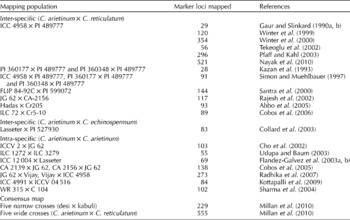
Because of limited amount of genomic resources and a low polymorphism in cultivated germplasm, initial genetic mapping studies were restricted to inter-specific mapping populations. These mapping populations were derived from wide crosses between C. arietinum and C. reticulatum and between C. arietinum and C. echinospermum (Collard et al., Reference Collard, Pang, Ades and Taylor2003). While several research groups used the C. arietinum × C. reticulatum mapping population for developing genetic map by deploying a variety of molecular markers (Table 4), the mapping population based on C. arietinum × C. echinospermum cross has been used occasionally.
Molecular genetic maps developed for chickpea

ICRISAT in collaboration with several partners like the University of California, Davis, USA, and the University of Frankfurt, Germany, has recently developed a comprehensive genetic map of chickpea that comprises >1500 marker loci including 315 SSR and 420 SNP loci. Part of this map has already been published (Nayak et al., Reference Nayak, Zhu, Varghese, Choi, Datta, Horres, Jüngling, Singh, Kavi Kishor, Kahl, Winter, Cook and Varshney2010). Recently, a consensus map with 555 loci has also been developed by Millan et al. (Reference Millan, Winter, Jüngling, Gil, Rubio, Cho, Cobos, Iruela, Rajesh, Tekeoglu, Kahl and Muehlbauer2010) based on five crosses, i.e. FLIP 84-92C(3) × PI 599072, Hadas × Cr205, ICC 4958 × PI 489777, ILC 72 × Cr5-10 and ICCL 81 001 × Cr5-9.
For trait mapping, it is, however, important to develop genetic maps based on intra-specific mapping populations (Fig. 1). In past, several genetic maps were also developed by employing intra-specific (kabuli and desi) crosses, and QTLs/markers associated with different agronomic traits have been identified (Table 4). At ICRISAT also, recently two intra-specific maps have been developed for ICC 4958 × ICC 1882 (253 SSR loci) and ICC 283 × ICC 8261 (191 SSR loci). These maps have been used to identify the hotspot containing QTLs for several drought tolerance-related traits in chickpea genome (unpublished data). Recently, a consensus intra-specific genetic map of chickpea has been constructed by merging linkage maps from ten different populations based on SSR markers as bridging markers (Millan et al., Reference Millan, Winter, Jüngling, Gil, Rubio, Cho, Cobos, Iruela, Rajesh, Tekeoglu, Kahl and Muehlbauer2010).
Assessment of allelic diversity in germplasm collections
Crop breeders are reluctant to select parental lines from thousands of available germplasm lines without knowing their performance especially for quantitative traits, which are highly environment sensitive. Selecting a few lines from these vast pools of germplasm is like searching for a needle in a haystack. Obviously, it is more appropriate and attractive to have a small sample of a few hundred germplasm lines, based on critical evaluation, representing the entire diversity of the species. Genomic tools such as molecular markers developed as mentioned above may be useful to select such a representative set of diversity that can be useful in breeding programme (Glaszmann et al., Reference Glaszmann, Kilian, Upadhyaya and Varshney2010).
Genetic diversity studies
Almost all kind of molecular markers have been used for analysis of genetic diversity in chickpea germplasm. Majority of these studies, however, employed random amplification of polymorphic DNA and AFLP markers. Although a limited number of genotypes were used for diversity analyses in majority of these studies, the main outcome of these studies was availability of a low level of genetic diversity in cultivated germplasm compared with wild species. Some of these studies have been mentioned in supplementary Table S1 (available online only at http://journals.cambridge.org).
Some diversity studies have also provided a general consensus about the members of the first crossability group, which contains C. arietinum along with C. reticulatum (Ahmad, Reference Ahmad1999; Iruela et al., Reference Iruela, Rubio, Cubero, Gil and Milan2002; Rajesh et al., Reference Rajesh, Tullu, Gil, Gupta, Ranjekar and Muehlbauer2002; Sudupak et al., Reference Sudupak, Akkaya and Kence2002, Reference Sudupak, Akkaya and Kence2004; Javadi and Yamaguchi, Reference Javadi and Yamaguchi2004; Nguyen et al., Reference Nguyen, Taylor, Redden and Ford2004), suggested to be the annual progenitor of chickpea (Ladizinsky and Adler, Reference Ladizinsky and Adler1976), and C. echinospermum, suggested to have played a significant role in the evolution of cultivated chickpea (Tayyar and Waines, Reference Tayyar and Waines1996). The second crossability group contained C. bijugum, C. judaicum and C. pinnatifidum (Ahmad, Reference Ahmad1999; Sudupak et al., Reference Sudupak, Akkaya and Kence2002, Reference Sudupak, Akkaya and Kence2004; Sudupak, Reference Sudupak2004; Nguyen et al., Reference Nguyen, Taylor, Redden and Ford2004). The last three species, C. yamashitae, C. chorassanicum and C. cuneatum, were either not included in many studies or differentially positioned with respect to the cultivated germplasm.
Allelic diversity in the global chickpea composite collection
A composite collection of 3000 lines, representing a wide spectrum of genetic diversity captured from the entire collection of chickpea germplasm preserved in the ICRISAT and ICARDA genebanks, was developed by Upadhyaya et al. (Reference Upadhyaya, Furman, Dwivedi, Udupa, Gowda, Baum, Crouch, Buhariwalla and Sube2006a). The composite collection that includes core and mini core collections was genotyped using 48 SSR markers and field evaluated for seven qualitative and 17 quantitative descriptors. A total of 1683 alleles were detected, 935 rare and 748 common alleles. Gene diversity varied from 0.533 to 0.974. Kabuli as a group were genetically more diverse than other seed types. Several group-specific unique alleles were detected: 104 in kabuli, 297 in desi and 69 in wild Cicer; 114 each in West Asia and the Mediterranean; 117 in South and Southeast Asia; ten in African region accessions (Upadhyaya et al., Reference Upadhyaya, Dwivedi, Baum, Varshney, Udupa, Gowda, Hoisington and Sube2008).
Core, mini core and reference sets for enhancing the use of germplasm in breeding
Selecting a representative sample of all the diversity in the large collection would facilitate the enhanced use of germplasm in the breeding programmes. Such samples would be cost effective and easy to maintain by individual breeders. A core collection (Frankel, Reference Frankel, Arber, Limensee, Peacock and Stralinger1984) is a subset, consisting of approximately 10% of total accessions, which captures most of the available diversity in the entire collection (Brown, Reference Brown, Brown, Frankel, Marshall and Williams1989). At ICRISAT, a core collection consisting of 1956 accessions was developed (Upadhyaya et al., Reference Upadhyaya, Bramel and Sube2001). However, the size of core was still large for practical use by breeders to identify trait-specific accessions for use in crop improvement (Glaszmann et al., Reference Glaszmann, Kilian, Upadhyaya and Varshney2010).
To overcome the above-mentioned constraint, Upadhyaya and Oritz (Reference Upadhyaya and Oritz2001) postulated the mini core collection concept, where approximately 10% of core collection (1% of entire collection) is selected without loosing any diversity of the core or entire collection. Following these procedures, a mini core set of 211 accessions in chickpea was developed at ICRISAT (Upadhyaya and Oritz, Reference Upadhyaya and Oritz2001). This mini core collection is an ‘International Public Good’ now, and the ICRISAT has supplied 28 sets of chickpea mini core collection to national partners in several countries. The mini core collection has been thoroughly evaluated at ICRISAT and by national partners in diverse and multiple environments at several locations in Canada, India, Japan, Mexico, Sweden, the USA, and diverse trait-specific germplasm lines have been identified for use in crop improvement. This approach has provided a point of entry to the world chickpea germplasm and as a working collection for scientists to tackle their region-specific problems. The detailed information is available in Upadhyaya et al. (Reference Upadhyaya, Pundir, Dwivedi and Gowda2009).
Furthermore, based on allelic diversity data of global composite collection of chickpea, a ‘reference set’ of most diverse 300 accessions was selected (Upadhyaya et al., Reference Upadhyaya, Dwivedi, Baum, Varshney, Udupa, Gowda, Hoisington and Sube2008). Genotype-based reference set on 48 SSR markers captured 1315 alleles, where the reference set based on seven qualitative traits captured 1237 alleles (Upadhyaya, Reference Upadhyaya, Dwivedi, Baum, Varshney, Udupa, Gowda, Hoisington and Sube2008). Mining allelic variation in the mini core collection and reference set will facilitate identification of diverse germplasm with beneficial traits for enhancing the genetic potential of chickpea globally and broaden the genetic base of cultivars.
Identification of trait-specific germplasm for use in chickpea improvement programme
The use of genetic resources in the breeding programmes has been mainly as sources of resistance to pests and diseases (Knauft and Gorbet, Reference Knauft and Gorbet1989), or as sources of male sterility, short stature or any such character with simple inheritance. In fact, there have been fewer efforts for identifying germplasm lines for increasing yield potential than for pest resistance and nutritional quality (Halward and Wynne, Reference Halward and Wynne1991). Using the core\mini core approach, a number of germplasm lines have been identified at ICRISAT and national programmes. This includes tolerance to abiotic and biotic stresses and to agronomic characters such as early maturity (28 accessions, Upadhyaya et al., Reference Upadhyaya, Salimath, Gowda and Sube2007b); large-seeded kabuli (49 accessions, Gowda et al., Reference Gowda, Upadhyaya, Dronavalli and Sube2010); high yield (39 accessions, Upadhyaya et al., Reference Upadhyaya, Dwivedi, Gowda and Sube2007a); resistance/tolerance to biotic stresses (Pande et al., Reference Pande, Kishore, Upadhyaya and Rao2006) such as ascochyta blight (3), botrytis grey mould (55), wilt (67), dry root rot (5), multiple resistance (31); Helicoverpa resistance-related traits (15 accessions – five each for low leaf feeding score, low larval survival and low larval weight, Upadhyaya et al., Reference Upadhyaya, Yadav, Dronavalli, Gowda and Singh2010); drought avoidance root traits (18 accessions, Kashiwagi et al., Reference Kashiwagi, Krishnamurthy, Upadhyaya, Krishna, Chandra, Vincent and Serraj2005; five accessions, Krishnamurthy et al., Reference Krishnamurthy, Kashiwaji, Upadhyaya and Serraj2003); salinity tolerance (29 accessions, Serraj et al., Reference Serraj, Krishanamurthy and Upadhyaya2004; 16 accessions, Vadez et al., Reference Vadez, Krishnamurthy, Serraj, Gaur, Upadhyaya, Hoisington, Varshney, Turner and Siddique2007); ten accessions high soil plant analysis development meter reading (Kashiwagi et al., Reference Kashiwagi, Upadhyaya and Krishnamurthy2010); water use efficiency (six accessions, and cool canopy temperature, one accession, Kashiwagi et al., Reference Kashiwagi, Krishnamurthy, Singh, Gaur and Upadhyaya2006a, Reference Kashiwagi, Krishnamurthy, Singh, Gaur, Upadhyaya, Panwar, Basu, Ito and Tobitab); high temperature tolerance (ten accessions, Upadhyaya et al., Reference Upadhyaya, Yadav, Dronavalli, Gowda and Singh2010).
Towards genomics-based germplasm research for chickpea improvement
As mentioned above, specialized germplasm collections such as composite collection, core collection, mini core collection and reference sets representing global diversity are available now. In parallel, new genomic resources have been developed that can be used for detection and utilization of allelic diversity. Availability of high-throughput genotyping platform such as GoldenGate or Infinium assay (SNP genotyping), capillary electrophoresis (SSR genotyping) and DArT arrays (DArT genotyping) on appropriate germplasm collections mentioned will facilitate the use of association genetics approach for identification of genes/markers associated with traits of interest to breeders. Advent of NGS technology has also encouraged chickpea community for undertaking genome sequencing effort. For instance, the National Institute of Plant Genome Research (NIPGR), New Delhi (India), is using Roche/454 and Applied Biosystem SOLiD (AB SOLiD) sequencing technologies (http://www.nipgr.res.in/NGCPCG/ngcpcg.html). Once the reference genome of chickpea is available, low-cost and faster re-sequencing technologies such as Illumina/Solexa and AB SOLiD will offer the possibilities to generate the genome sequences for the entire set of reference set or composite collection in short term and for the entire germplasm collection in long term. However, association of genomic sequences/haplotypes with traits of interest to breeders would require multi-location and precise phenotyping data as well as appropriate analytical tools on high-computing bioinformatics platform. Nevertheless, advances in high-throughput phenotyping as well as in bioinformatics platform (e.g. cloud computing) and tools are expected to facilitate initiation of ‘genomics-assisted breeding’ (Varshney et al., Reference Varshney, Graner and Sorrells2005) or ‘Breeding by design’ approaches such as ‘genomic selection’ (Jannink, Reference Jannink2010) in chickpea breeding in coming future.
Acknowledgements
The authors are thankful to the Generation Challenge Programme (GCP) of CGIAR, the National Fund of Indian Council of Agricultural Research (ICAR) and Department of Biotechnology (DBT) of Government of India, for supporting genomics-based germplasm research at ICRISAT.