


Introduction
Hopelessness, a set of negative expectations about oneself and the future, is a correlate of depression in adults (Beck, Wenzel, Riskind, Brown and Steer, Reference Beck, Wenzel, Riskind, Brown and Steer2006 Beck, Steer, Kovacs and Gamion, Reference Beck, Steer, Kovacs and Gamion1985) and adolescents (Shahar, Bareket, Rudd and Joiner, Reference Shahar, Bareket, Rudd and Joiner2006; Asarnow and Bates, Reference Asarnow and Bates1988; Joiner, Rudd, Rouleau and Wagner, Reference Joiner, Rudd, Rouleau and Wagner2000). Studies with adults suggest that hopelessness may be a more powerful predictor of suicidal intent than depression (Beck, Wenzel, Riskind, Brown and Steer, Reference Beck, Wenzel, Riskind, Brown and Steer2006; Beck, Steer, Beck and Newman, Reference Beck, Steer, Beck and Newman1993; Joiner and Rudd, Reference Joiner and Rudd1996; Wen-Hung, Gallo and Eaton, Reference Wen-Hung, Gallo and Eaton2004). Moreover, feelings of hopelessness are positively correlated with suicidal behavior in adults (Smith, Alloy and Abramson, Reference Smith, Alloy and Abramson2006; Beck, Steer, Kovacs and Gamion, Reference Beck, Steer, Kovacs and Gamion1985) and in children and adolescents (Thompson, Mazza, Herting, Randell and Eggert, Reference Thompson, Mazza, Herting, Randell and Eggert2005; Spirito, Williams, Stark and Hart, Reference Spirito, Williams, Stark and Hart1988; Spirito, Brown, Overholser and Fritz, Reference Spirito, Brown, Overholser and Fritz1989; Asarnow and Guthrie, Reference Asarnow and Guthrie1989; Kashani, Reid and Rosenberg, Reference Kashani, Reid and Rosenberg1989). Hopelessness has also been found to be a long-term predictor of completed suicide among adolescents (van Heeringen and Vincke, Reference van Heeringen and Vincke2000). Depressed adult inpatients, high in hopelessness, have poorer responses to pharmacological and cognitive-behavioral treatments (Whisman, Miller, Norman and Keitner, Reference Whisman, Miller, Norman and Keitner1995; Kuyken, Reference Kuyken2004). Similar results have also been found in adolescents (Barbe, Bridge, Birhamer, Kolko and Brent, Reference Barbe, Bridge, Birhamer, Kolko and Brent2004). Hopelessness, then, appears to be a concomitant of major depression, a concomitant and long-term predictor of suicidal ideation and behavior, and a predictor of treatment response. As a consequence, hopelessness has become a focus of treatment and an area of interest in the prevention of suicide.
The developmental psychopathology of hopelessness has received little research attention. It is not clear why some depressed youth also become hopeless (and potentially suicidal) whereas others do not. Several questions remain unanswered: are there identifiable risk factors that make youth more likely to become hopeless? Are there protective factors that reduce or ameliorate this risk? What are the developmental antecedents of or contributors to hopelessness among depressed youth?
Current research suggests four possible areas of vulnerability for hopelessness. First, hopelessness is both a common feature of depression and a hypothesized etiological factor (Abramson, Metalsky and Alloy, Reference Abramson, Metalsky and Alloy1989; Brown and Harris, Reference Brown and Harris1978; Beck, Rush, Shaw and Emery, Reference Beck, Rush, Shaw and Emery1979). Cross-sectional correlations between depression and hopelessness range between .22 to .73 among adults (Beck, Steer and McElroy, Reference Beck, Steer and McElroy1982; Chabon and Robins, Reference Chabon and Robins1986), between .41 and .69 among adolescents (Cole, Reference Cole1989; Brown, Overholser, Spirito and Fritz, Reference Brown, Overholser, Spirito and Fritz1991), and between .22 and .74 among children (Asarnow, Carlson and Guthrie, Reference Asarnow, Carlson and Guthrie1987; Kazdin, French, Unis, Esveldt-Dawson and Sherick, Reference Kazdin, French, Unis, Esveldt-Dawson and Sherick1983). Moreover, studies of depressed adults have found that hopelessness is a strong predictor of later depression (Abramson, Metalsky and Alloy, Reference Abramson, Metalsky and Alloy1989; Hankin, Abramson, Miller and Haeffel, Reference Hankin, Abramson, Miller and Haeffel2004; Beck, Steer, Kovacs and Gamion, Reference Beck, Steer, Kovacs and Gamion1985). Studies have not, however, examined the reverse relationship – whether depression predicts hopelessness. Relations between depression and hopelessness have also been found among adolescents (Gibb et al., Reference Gibb, Alloy, Abramson, Rose, Whitehouse, Donovan, Hogan, Cronholm and Tierney2001; Yorbik, Birmaher, Axelson, Williamson and Ryan, Reference Yorbik, Birmaher, Axelson, Williamson and Ryan2004). In a longitudinal study of 156 undergraduates, Alford and colleagues (Reference Alford, Lester, Patel, Buchanan and Giunta1995) found that hopelessness predicted future depression severity, while the reverse was not demonstrated. Taken together, these studies indicate that depression and hopelessness are highly correlated. To be sure, the correlation between depression and hopelessness varies depending on the type of measure used in assessment. Adolescent self-reported depression severity has a greater association with self-reported hopelessness than clinician assessed depression does. For this reason, we use a clinician–rated depression severity measure (Children's Depression Rating Scale-Revised) for our main analyses, but we also examine the correlation between hopelessness and a self-report measure of depression symptomatology (Reynolds Adolescent Depression).
Second, studies suggest an association may exist between social problem-solving and hopelessness (Speckens and Hawton, Reference Speckens and Hawton2005; Bonner and Rich, Reference Bonner and Rich1988; Dixon, Heppner and Anderson, Reference Dixon, Heppner and Anderson1991). An early study by Schotte and Clum (Reference Schotte and Clum1987) found that hopelessness was correlated with interpersonal problem-solving in adult psychiatric inpatients. In a study of college undergraduates, problem-solving confidence was found to be correlated with hopelessness (Dixon, Heppner and Anderson, Reference Dixon, Heppner and Anderson1991). More recently, D'Zurilla and colleagues (D'Zurilla, Chang, Nottingham and Faccini, Reference D'Zurilla, Chang, Nottingham and Faccini1998) reported that negative problem orientation, positive problem orientation, and avoidant problem-solving style were correlated with hopelessness in college students and adult inpatients. Moreover, they found that rational problem-solving predicted level of hopelessness among suicidal psychiatric inpatients. Studies with adolescents also indicate that relationships may exist between hopelessness and social problem-solving, even after controlling for severity of depression (Asarnow, Calson and Guthrie, Reference Asarnow, Carlson and Guthrie1987; Fremouw, Callahan and Kashden, Reference Fremouw, Callahan and Kashden1993; Rotheram-Borus, Trautman, Dopkins and Shrout, Reference Rotheram-Borus, Trautman, Dopkins and Shrout1990; Spirito, Brown, Overholser and Fritz, Reference Spirito, Brown, Overholser and Fritz1989). Taken together, studies with both adolescents and adults indicate that associations may exist between rational problem-solving, problem-solving motivation, and hopelessness.
Beck and colleagues (Reference Beck, Steer, Kovacs and Gamion1985) view hopelessness as a relatively stable set of expectancies that are activated by environmental stress. With this in mind, the possibility exists that a chaotic, unstable home environment, characterized by high family conflict and poor parental marital adjustment, may create stress for youth, contributing to the development of negative expectancies. Studies have found evidence of relations between hopelessness and perceived familial and social support (Kashani, Canfield, Borduin, Soltys and Reid, Reference Kashani, Canfield, Borduin, Soltys and Reid1994), hopelessness and family disruption, and hopelessness and level of connectedness (Bolland, Lian and Formichella, Reference Bolland, Lian and Formichella2005). Preliminary findings suggest that environmental context (Perez-Smith, Spirito and Boergers, Reference Perez-Smith, Spirito and Boergers2002) and dysfunctional families (Duyan, Reference Duyan2005) may contribute to increased hopelessness among adolescents. It is not clear, however, which specific family characteristics are most strongly associated with the development of hopelessness among youth.
Finally, research indicates that cognitive factors, including negative attributional style, dysfunctional attitudes, and cognitive biases or distortions may predict levels of hopelessness. Dysfunctional attitudes are highly correlated with depressed mood, and some have suggested that dysfunctional attitudes make an independent contribution to level of hopelessness (Abramson, Metalsky and Alloy, Reference Abramson, Metalsky and Alloy1989; Beck, Rush, Shaw and Emery, Reference Beck, Rush, Shaw and Emery1979). Among adult inpatients, negative cognitive bias is associated with severity of hopelessness (Beevers and Miller, Reference Beevers and Miller2004). Similarly, level of cognitive distortion has been found to distinguish patients with high-hopelessness from controls (Whisman, Miller, Norman and Keitner, Reference Whisman, Miller, Norman and Keitner1995). The relationship between hopelessness and perfectionism is not clear. Perfectionism has been shown to be elevated among hopeless adults (Hewitt, Flett and Turnbull-Donovan, Reference Hewitt, Flett and Turnbull-Donovan1992) and adolescents (Hewitt, Newton, Flett and Callander, Reference Hewitt, Newton, Flett and Callander1997; Donaldson, Spirito and Farnett, Reference Donaldson, Spirito and Farnett2000). While social perfectionism does appear to be associated with high levels of hopelessness in adult clinical samples (Hewitt, Norton, Flett, Callander and Cowan, Reference Hewitt, Norton, Flett, Callander and Cowan1998; Hunter and O'Conner, in press), research with clinical patient groups (Hunter and O'Connor, in press) and student populations (O'Conner, O'Conner, Harper, Smallwood and Miles, Reference O'Conner, O'Conner, Harper, Smallwood and Miles2002; Flett, Hewitt, Blankstein and Mosher, Reference Flett, Hewitt, Blankstein and Mosher1991) revealed that other-oriented perfectionism is associated with lower hopelessness and positive future thinking. The relationship between hopelessness and perfectionism is under researched and specific associations are not clearly delineated. Research with college undergraduate students suggests that irrational beliefs may interact with life stress to predict hopelessness, independent of level of depression (Bonner and Rich, Reference Bonner and Rich1991). To our knowledge, no studies have been completed that examine relations between cognitive distortions and level of hopelessness among adolescents.
Results from a recent study examining relations between six self-report measures of cognitive factors associated with depression suggest that depression-related cognitions could be synthesized into three constructs (Ginsburg et al., Reference Ginsburg, Silva, Tonev, Kingery, Reinecke and Curry2006). The factors were descriptively labeled: Cognitive Distortions and Negative Beliefs (Factor 1); Cognitive Avoidance (Factor 2); and Solution-focused Thinking (Factor 3). Factor 1 contained six variables reflecting perfectionistic expectations, an unrealistic need for social approval, specific negative cognitive views of the self and the world, and hopelessness; whereas Factor 2 and Factor 3 were related to social problem-solving. This finding is consistent with previous studies indicating that items from different cognitive questionnaires loaded on a single factor reflecting cognitive distortions (Garber, Weiss and Shanley, Reference Garber, Weiss and Shanley1993; Gotlib, Lewinsohn, Seeley, Rohde and Redner, Reference Gotlib, Lewinsohn, Seeley, Rohde and Redner1993; Joiner and Rudd, Reference Joiner and Rudd1996). Thus, evidence supports the hypothesis that cognitive measures associated with depression may tap overlapping cognitive constructs. This overlap highlights the importance of examining the broad conceptual network of vulnerability factors and exploring associations between them in an integrated manner. Following this logic, in addition to examining contributory variables independently, we grouped variables into a cognitive set, a problem-solving set, and a family environment set. Given the potential significance of the individual's social environment and the ways it may interact with cognitive factors, we included these variables in our analyses to capture social influences.
The goal of this study is to do an exploratory examination of the predictors of hopelessness in a sample of clinically depressed adolescents. Specifically, cognitive and socio-environmental variables are examined as a means of determining variables that may be important in predicting severity of hopelessness among depressed youth. Given the poverty of research in this area and its importance, an introductory investigation of hypothesized correlates of hopelessness in one of the largest samples of depressed adolescents is valuable. Further research will be able to use the findings from this study to guide research on prediction. It was hypothesized that: 1) severity of depression, negative views of self and world, dysfunctional attitudes and attributions, problem-solving orientation, and family environment would be correlated with hopelessness; 2) cognitive and socio-environmental contributors to hopelessness would remain significant after controlling for severity of depression; and 3) these cognitive and socio-environmental variables would distinguish depressed adolescents who are hopeless from those who are not.
Methods
Study participants
Participants were 439 clinically depressed adolescents, enrolled in the Treatment for Adolescents with Depression Study (TADS). Sponsored by NIMH, TADS is a randomized controlled trial comparing the effects of CBT (n = 111), fluoxetine (FLX, n = 109), their combination (COMB, n = 107), and a pill placebo (PBO, n = 112).
Adolescents in the TADS sample were between 12 and 17 years of age (inclusive) with a current primary DSM-IV diagnosis of Major Depressive Disorder (MDD). Fifty-four percent of the participants were girls, 74% were Caucasian, and the mean age was 14.6 (SD = 1.5) years. A score of 45 or greater on the Children's Depression Rating Scale – Revised (CDRS-R, Pozanski and Mokros, Reference Pozanski and Mokros1996) was required for study entry. The CDRS-R total scores at the pretreatment assessment ranged from 45 to 98 (mean 60, SD = 10.4), which is indicative of mild to severe depression. This mean total score translates to a normed T score of 75.5 (6.43), suggesting moderate to severe depression. Details of consent and assent, IRB approval, rationale, methods, design of the study, and other demographic and clinical characteristics of the sample are detailed in previous reports (TADS, 2003, 2005).
Measures
Assessments were conducted prior to randomization to treatment (Baseline). A trained Independent Evaluator (IE) completed clinical assessments. A battery of self-report questionnaires completed by the youth and parent(s) were collected at that time.
Beck Hopelessness Scale (BHS). The BHS (Beck and Steer, Reference Beck and Steer1988) is a self-report measure that assesses negative expectations about the future with 20 true-false statements. Sample items include “My future seems dark to me”, and “Things just don't work out the way I want them to.” The measure yields a total score ranging from 0 to 20, with higher scores indicating greater levels of hopelessness. Although the BHS was originally developed for use with adults, Steer, Kumar and Beck (Reference Steer, Kumar and Beck1993), in a study of 12 to 17-year-olds, concluded that the BHS is appropriate for use with adolescents. An internal consistency of 0.86 was reported with good convergent and discriminant validity (Steer, Kumar and Beck, Reference Steer, Kumar and Beck1993). BHS was used as a continuous variable for the linear regression analysis and was dichotomized for the logistic regression analysis, using a cut-off score of 9, to differentiate hopeless from not hopeless subjects. This cut-off has been used in previous research and has shown clinical utility in differentiating patients at high risk for suicide among adult psychiatric patients (Beck, Brown, Berchick, Stewart and Steer, Reference Beck, Brown, Berchick, Stewart and Steer1990). In support of this, they found that people with a score of 9 or higher were 11 times more likely to die by suicide than those with lower scores. A recent meta-analysis of the performance of the BHS in predicting suicide found similar results, with odds ratios comparable to Beck and colleague's (1990) study (McMillan, Gilbody, Beresford and Neilly, Reference McMillan, Gilbody, Beresford and Neilly2007).
Children's Depression Rating Scale – Revised (CDRS-R, Poznanski and Mokros, 1995). Children's Depression Rating Scale – Revised (CDRS-R, Poznanski and Mokros, 1995). The CDRS-R is a 17-item clinician-rated depression severity measure that was completed by the IE. Scores on the CDRS-R are based on interviews with the adolescent and parent(s) and can range from 17 to 113, with higher scores representing more severe depression. The scale has good internal consistency (coefficient alpha = .85), inter-rater reliability (r = .92), and test-retest reliability (r = .78), and is correlated with a range of validity indicators, including global ratings and diagnoses of depression (Poznanski and Mokros, 1995).
The Reynolds Adolescent Depression Scale (RADS; Reynolds, Reference Reynolds1987) is a 30-item self-report measure of current depressive symptomatology. This measure utilizes a 4-point Likert scale and has excellent internal consistency and good test-retest reliability (Reynolds, Reference Reynolds1987). The total score was used in the present study, and higher scores reflect more severe depression.
The Social Problem-Solving Inventory—Revised (SPSI-R; D'Zurilla, Nezu and Maydeu-Olivares, Reference D'Zurilla, Nezu and Maydeu-Olivares1996) is a 52-item self-report questionnaire, with five subscales that assess functional and dysfunctional cognitive and emotional orientations toward solving life problems. The subscales are labeled Positive Problem Orientation (PPO; 5 items, e.g. “Whenever I have a problem, I believe it can be solved.”), Negative Problem Orientation (NPO; 10 items, e.g. “When my first efforts to solve a problem fail, I get very frustrated.”), Rational Problem Solving (RPS; 20 items; e.g. “When I have a problem to solve, one of the things I do is analyze the situation and try to identify what obstacles are keeping me from getting what I want.”), Impulsivity-Carelessness Style (ICS; 10 items, e.g. “When I am attempting to solve a problem, I act on the first idea that occurs to me.”), and Avoidant Style (AS; 7 items, e.g. “I prefer to avoid thinking about the problems in my life instead of trying to solve them.”). The five subscales have good internal consistency and test-retest reliability (D'Zurilla, Nezu, and Maydeu-Olivares, Reference D'Zurilla, Nezu, Maydeu-Olivares, Chang, D'Zurilla and Sanna2004; Maydeu-Olivares and D'Zurilla, Reference Maydeu-Olivares and D'Zurilla1996). Higher scores on the NPO, ICS, and AS reflect a more maladaptive approach to problem-solving, whereas higher scores on the PPO and RPS indicate more adaptive problem-solving. The SPSI-R was originally developed for use with adults. Sadowski and colleagues (Sadowski, Moore and Kelley, Reference Sadowski, Moore and Kelley1994) explored the psychometric properties of the SPSI-R among adolescents between 13 and 17. Internal consistency estimates were adequate with coefficients between 0.85 and 0.90 for the total score and between 0.62 and 0.88 among the subscales.
The Children's Attributional Style Questionnaire—(CASQ; Seligman et al., Reference Seligman, Peterson, Kaslow, Tanenbaum, Alloy and Abramson1984) is a measure of optimistic and pessimistic explanatory style. The CASQ was adapted for the TADS to include 24 items assessing internal, stable, and global attributions for positive events. In 1998, when TADS was developed, a decision was made to modify the CASQ as a means of reducing participant burden. Each item consists of a hypothetical event for which participants are required to choose the most likely explanation from two alternatives. For example, “You get an A on a test. Your explanation is: a) I am smart, or b) I am good at the subject that the test was in.” The total score used in the current study reflected a composite negative attributional style (i.e. external, unstable, and specific) toward positive events. Although we are unaware of any studies that have utilized only the positive event portion of the CASQ, a recent study with young adults (mean age = 20.6) found that a tendency to assign external, unstable, and specific causes for positive events alone distinguished between those with a depression diagnosis from those with no depression diagnosis (Fresco, Alloy and Reilly-Harrington, Reference Fresco, Alloy and Reilly-Harrington2006). Other studies with adults have found that attributional style for positive events is related to recovery from depression and risk for relapse (Edelman, Ahrens and Haaga, Reference Edelman, Ahrens and Haaga1994; Ilardi, Craighead and Evans, Reference Ilardi, Craighead and Evans1997; Johnson, Crofton and Feinstein, Reference Johnson, Crofton and Feinstein1996). Moreover, attributional style for positive events has shown some predictive specificity in distinguishing depression from anxiety among adults (Heimberg, Vermilyea, Dodge, Becker and Barlow, Reference Heimberg, Vermilyea, Dodge, Becker and Barlow1987, Ahrens and Haaga, Reference Ahrens and Haaga1993). In Seligman and colleagues' (Reference Seligman, Peterson, Kaslow, Tanenbaum, Alloy and Abramson1984) original report of the CASQ in a sample of 8 to 13 year olds, the reliability coefficients for positive events were 0.66 at Time 1 and 0.73 at Time 2, and the validity of the measure was reported as adequate. Other studies using Seligman's CASQ with older adolescents have reported moderate internal consistency reliabilities (Curry and Craighead, Reference Curry and Craighead1990; Gotlib et al., Reference Gotlib, Lewinsohn, Seeley, Rohde and Redner1993). In a study of adolescents, Gladstone and colleagues (Reference Gladstone, Kaslow, Seeley and Lewinsohn1997), for example, reported an internal consistency reliability of 0.45 for positive events. In Gotlib and colleagues' (Reference Gotlib, Lewinsohn, Seeley, Rohde and Redner1993) sample of depressed adolescents between the ages of 14 and 18, one-year test-retest reliabilities were 0.68.
Cognitive Triad Inventory for Children (CTI-C). The CTI-C is a measure of negative views of the self, world, and future. The version of the CTI-C (Kaslow, Stark, Printz, Livingston and Tsai, Reference Kaslow, Stark, Printz, Livingston and Tsai1992), used in the present study, was a 24-item self-report measure that consists of the two subscales (12 items each): view of the self and view of the world (the views of the future subscale was excluded due to overlap in content with the Beck Hopelessness scale). Higher scores indicated more positive views. Sample items include: “I have messed up almost all the best friendships I have ever had”, and “My family doesn't care what happens to me.” The CTI-C was originally developed in a sample of 4th to 7th graders. Kaslow and colleagues (Reference Kaslow, Stark, Printz, Livingston and Tsai1992) reported internal consistency coefficients between 0.69 and 0.85 for each subscale and 0.92 for the total CTI-C. Other studies have successfully utilized the CTI-C with primarily adolescent samples, and there is sufficient evidence of the measures validity with this population (e.g. Jacobs and Joseph, Reference Jacobs and Joseph1997; Greening, Stoppelbein, Dhossche and Martin, Reference Greening, Stoppelbein, Dhossche and Martin2005).
Dysfunctional Attitudes Scale (DAS). The DAS (Weissman and Beck, Reference Weissman and Beck1978) is a 40-item self-report measure of maladaptive contingencies of self-worth. It utilizes a 7-point Likert scale, anchored by the responses “Totally disagree” and “Totally agree.” Sample items include: “It is difficult to be happy unless one is good looking, intelligent, rich and creative”, and “My value as a person depends greatly on what others think of me.” Two scales, labeled “perfectionism” and “need for approval” were used in the present study, and higher scores on each scale represented greater dysfunctional attitudes. These two scales were identified by Imber and colleagues in a study of depressed adults (Imber et al., Reference Imber, Pilkonis, Sotsky, Elkin, Watkins, Collins, Shea, Leber and Glass1990). These same subscales were also recently identified in the TADS adolescent sample (Rogers et al., Reference Rogers, Essex, Park, Klein, Curry and Feeny2006). The DAS was originally developed for adults but has been used widely with adolescent samples (e.g. Martin, Kazarian and Breiter, Reference Martin, Kazarian and Breiter1995; Williams, Connolly and Segal, Reference Williams, Connolly and Segal2001). Internal consistency is good, and stability is excellent over 8 weeks (Marton, Churchard and Kutcher, Reference Marton, Churchard and Kutcher1993; Garber et al., Reference Garber, Weiss and Shanley1993).
Conflict Behavior Questionnaire (CBQ; Robin and Foster, Reference Robin and Foster1989). The CBQ is an objective self-report questionnaire that assesses conflict and negative communication between adolescents and their parents. Adolescents and parents both complete the CBQ. The CBQ yields two scores: 1) perception of the other's conflict behavior, and 2) perception of the dyad's conflict behavior. The parent version of the CBQ contains 75 items rated “True” or “False,” and the adolescent CBQ version contains 73 items. High scores on the CBQ reflect perceptions of conflict in the relationship. The CBQ has internal consistencies of.90 and higher for parent and teen reports on each scale and shows good test-retest reliabilities (ranging from .37 to .85) (Robin and Foster, Reference Robin and Foster1989). For the purposes of this analysis, only scores from the adolescent and the parent of perception of the dyad's conflict behavior are used (Conflict-a; Conflict-p).
Conners-Wells' Adolescent Self-Report Scale (CASS; Conners et al., Reference Conners, Wells, Parker, Sitarenios, Diamond and Powell1997). The CASS is an 87-item measure of psychological distress that is completed by adolescents. The instrument yields scores on nine subscales: Family problems, Emotional problems, Conduct problems, Cognitive problems, Anger problems, Hyperactivity, Attention-Deficit/Hyperactivity Disorder Index, Inattentive symptoms, and DSM-IV Hyperactivity-Impulsive symptoms. The CASS's subscales have internal consistencies ranging from 0.75 to 0.92, and the CASS shows good test-retest reliabilities (ranging from.73 to.89) (Conners et al., Reference Conners, Wells, Parker, Sitarenios, Diamond and Powell1997). For the purposes of this analysis, only the Family Problems subscale was used. This scale consists of 12 items, including statements such as “My parents' discipline is too harsh”, “My parents only take notice of my bad behavior”, and “My parents expect too much from me.” As with all the CASS subscales, the family problems subscale has excellent psychometrics.
Family Assessment Measure-III General Scale (FAM; Skinner, Steinhauer and Santa-Barbara, Reference Skinner, Steinhaur and Santa-Barbara1983). The FAM is a 50-item questionnaire designed to assess overall family functioning. The measure is completed by both the parent (FAM-P) and the adolescent (FAM-A). The FAM has good internal consistency (overall score, α = .93, subscales median α = .73) (Skinner, Steinhauer and Santa-Barbara, Reference Skinner, Steinhaur and Santa-Barbara1983). For each statement, the individual rates how well the statement applies to his/her family on a 4-point scale. Higher scores on this scale indicate less favorable ratings of family functioning. The FAM has seven subscales: Task accomplishment, Role performance, Communication, Affective expression, Involvement, Control, and Values and norms. For the purposes of this analysis, only the overall scores from the adolescent and parent were used.
Statistical analyses
All 439 patients enrolled in TADS were included in this baseline analysis. Given that these analyses were exploratory, non-directional statistical tests were conducted, and the level of significance was set at 0.05.
The following numbers of participants were missing measures at baseline: 12 (2.7%) hopelessness score, 30 (6.8%) SPSI positive problem orientation and SPSI negative problem orientation score, 34 (7.74%) SPSI rational problem solving, and a SPSI impulsivity/carelessness style score, 29 (6.6%) SPSI avoidant style score, 24 (5.5%) CASQ internal attributional style and CASQ stable attributional style score, 23 (5.2%) CASQ global attributional style score, 27 (6.2%) CTI view of self score, 25 (5.7%) CTI view of world score, 20 (4.6%) DAS perfectionism score, 21 (4.8%) DAS need for social approval score, 24 (5.5%) CBQ conflict with mother score, 15 (3.4%) CBQ conflict with adolescent score, 18 (4.1%) CASS family problem score, 36 (8.2%) FAM-a score, and 31 (7.1%) FAM-p score. Missing data was the result of a patient's deviation from protocol and/or the subsequent withdrawal from treatment or assessments. To assess possible bias due to data loss, groups with all data present (n = 347) versus any data missing on the 17 scales above (n = 92) were compared on demographic variables and global depression severity. No significant group differences were detected for age and CDRS-R (t-tests) or for income, sex, and race (chi-square tests). The baseline sample median score was imputed for youth with missing values. Imputing median scores for missing values does not change the results of the study or significant findings of any analyses.
Descriptive statistics. Descriptive statistics for each of the above baseline measures were computed. Pearson correlation coefficients were also calculated between each baseline measure.
Multiple Regression Analysis. Multiple regression was used to determine which variables predicted baseline hopelessness. First, a regression model was developed that included all 18 items. The effect of each variable alone (not controlling for any other variables) and unique effects (controlling both for baseline depression and the other 17 items) for each item were estimated. Second, since several of our measures were correlated with each other, a more parsimonious model was constructed via backward elimination (sequentially eliminating non-significant items, until all retained items were significant at p < .05). Again, semi-partial correlations were estimated for each variable in the final model.
Logistic Regression Analysis. The above approach was again applied to a binary dependent variable, using logistic regression. Although this analysis is less powerful statistically, the binary cut-off has shown clinical utility in differentiating patients at high risk for suicide among adult psychiatric patients (Beck et al., Reference Beck, Brown, Berchick, Stewart and Steer1990), and supplements the prior analyses by describing results in terms that are more clinically useful. The first model included all 18 predictor variables. Odds ratios were estimated for all items, controlling for all other items (unique effect of each predictor). Second, a parsimonious model was achieved based on backward exclusion, and odds ratios for each significant variable were estimated.
Results
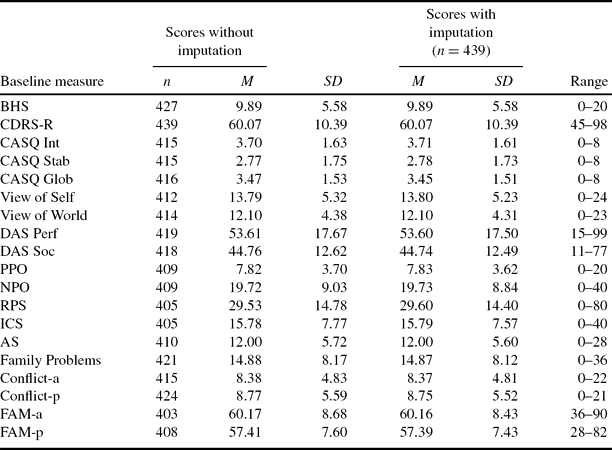
Descriptive statistics are presented in Table 1. As a group, participants demonstrated moderate-to-severe depression (CDRS, M = 60.1, SD = 10.39), and moderate levels of hopelessness (BHS, M = 9.89, SD = 5.58). Without imputation, 56.7% of participants (58.5% with imputation) presented with clinically significant hopelessness, defined as a BHS above 9. Data on measures of family conflict, social problems solving ability, and cognitive style approximated a normal distribution.
Descriptive statistics

BHS = Total Score; CDRS-R = Total Score; CASQ Int = Internal Attributions Scale; CASQ Stab = Stable Attributions Scale; CASQ Glob = Global Attributions Scale; DAS Perf = Perfectionism; DAS Soc = Need for Social Approval; PPO = Positive Problem Orientation; NPO = Negative Problem Orientation; RPS = Rational Problem Solving; ICS = Impulsivity/Carelessness Style; AS = Avoidance Style; Family Problems = CASS family problems scale; Conflict-a = CBQ dyadic conflict (adolescent report); Conflict-p = CBQ dyadic conflict (maternal report); Self = View of Self Scale; CTI-C World = View of World Scale; FAM-a = Overall score (adolescent report); FAM-p = Overall score (parent report)
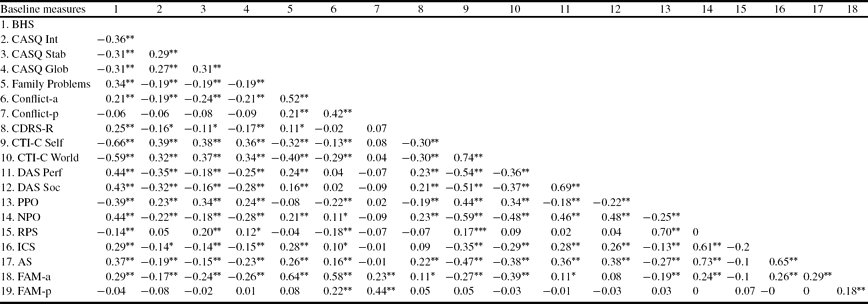
Hopelessness scores ranged from 0 to 20 and were significantly correlated with all predictor variables, with the exception of the parent's report of conflict (r = −.06) and the parent's report of overall family functioning (r = −.04). Hopelessness was only modestly correlated with depression severity (r = .25).
Correlation coefficients were conducted to examine multicollinearity among the predictor variables. As can be seen in Table 2, significant associations were observed between many of the variables. Given the relatively large sample size, however, power for finding statistical significance was great. Despite the high correlations between several variables, statistical tests indicated that multicollinearity was not a significant problem. Variable inflation factors (VIF) were computed for each predictor variable to detect multicollinearity. As a rule of thumb, a VIF > 10 indicates problematic collinearity (Kennedy, Reference Kennedy2003). The maximum VIF among our predictor variables was approximately 3, indicating that collinearity was not a significant issue.
Pearson Product-Moment Correlation Matrix

BHS = Total Score; CASQ Int = Internal Attributions Scale; CASQ Stab = Stable Attributions Scale; CASQ Glob = Global Attributions Scale; Family Problems = CASS family problems scale; Conflict-a = CBQ dyadic conflict (adolescent report); Conflict-p = CBQ dyadic conflict (maternal report); CDRS-R = Total Score; CTI-C Self = View of Self Scale; CTI-C World = View of World Scale; DAS Perf = Perfectionism; DAS Soc = Need for Social Approval; PPO = Positive Problem Orientation; NPO = Negative Problem Orientation; RPS = Rational Problem Solving; ICS = Impulsivity/Carelessness Style; AS = Avoidance Style; FAM-a = Overall score (adolescent report); FAM-p = Overall score (parent report)
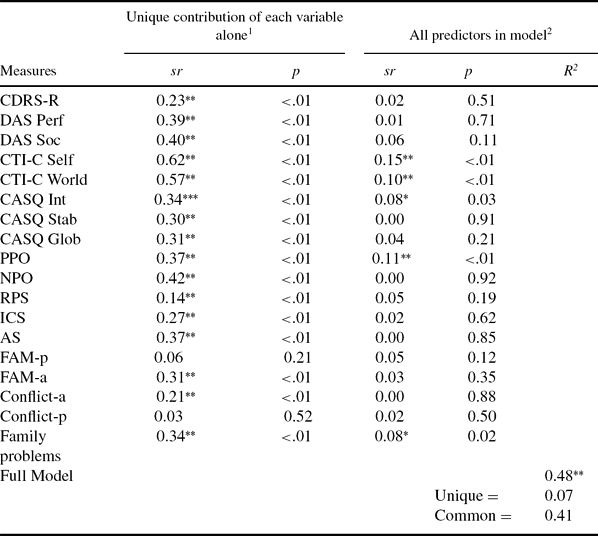
Multiple Regression Analysis. Multiple regression analysis with all 18 regressor variables revealed five significant predictors of hopelessness scores: the view of the self (r = 0.15, p < .001), view of the world (r = 0.10, p < .01), positive problem orientation (r = 0.11, p < .01), internal attributional style (r = 0.08, p < .05), and family problems (r = 0.08, p < .05). Severity of depression did not emerge as a significant predictor of hopelessness (r = 0.02, p = .48). The full model accounts for 48% of the variance in hopelessness. The results of this regression analysis are presented in Table 3.
Multiple regression with all predictors

1 = not controlling for any other variables 2 = controlling for all other variables in model
* = p < .05 ** = p < .01
CDRS-R = Total Score; DAS Perf = Perfectionism; DAS Soc = Need for Social Approval; CTI-C Self = View of Self Scale; CTI-C World = View of World Scale; CASQ Int = Internal Attributions Scale; CASQ Stab = Stable Attributions Scale; CASQ Glob = GlobalAttributions Scale; PPO = Positive Problem Orientation; NPO = Negative Problem Orientation; RPS = Rational Problem Solving; ICS = Impulsivity/Carelessness Style; AS = Avoidance Style; FAM-p = Overall score (parent report); FAM-a = Overall score (adolescent report); Conflict-a = CBQ dyadic conflict (adolescent report); Conflict-m = CBQ dyadic conflict (maternal report); Family Problems = CASS family problems scale
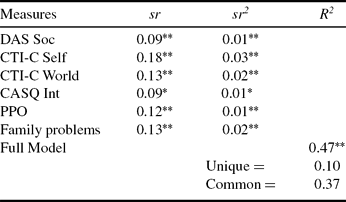
Backwards linear regression was next completed as a means of determining the most parsimonious explanatory model. As a result of the analysis, 6 variables remained significant in the final model: view of self (r = 0.18, p < .001), view of world (r = 0.13, p < .001), internal attributional style (r = 0.09, p < .05) need for social approval (r = .09, p < .01), positive problem orientation (r = 0.12, p < .001), and family problems (r = 0.13, p < .001). This model accounted for 46% of the variance in hopelessness. (See Table 4 for results of the final regression model). As noted previously, because these analyses were exploratory, the significance level of 0.05 was retained. Of note, however, five of the six variables in the final model were significant at a more conservative level of 0.01.
Backwards multiple regression

* = p < .05 ** = p < .01
DAS Soc = Need for Social Approval; CTI-C Self = View of Self Scale; CTI-C World = View of World Scale; CASQ Int = Internal Attributions Scale; PPO = Positive Problem Orientation; Family Problems = CASS family problems scale
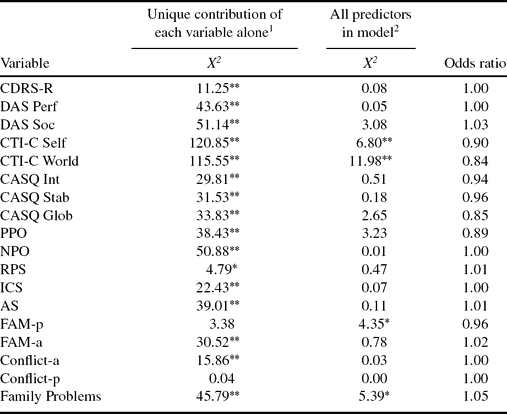
Logistic Regression Analysis. As a means of determining the best model for identifying depressed adolescents who were hopeless from those who were not significantly hopeless, the analysis was repeated using logistic regression. First, a logistic regression analysis was performed with the dichotomized hopelessness outcome variable and all 18 predictors in the model. Depression severity (CDRS-R) distinguished hopeless adolescents from non-hopeless adolescents, X2 = 11.25, p < .001. A test of the full model with all 18 predictors was statistically significant, X2 = 101.57, p < .001. The predictors, as a set, reliably distinguished between depressed adolescents with and without hopelessness. The X2 Wald statistics and odds ratios, for each of the 18 predictors are presented in Table 5.
Logistic regression with all predictors

1 = not controlling for any other variables 2 = controlling for all other variables in model
* = p < .05 ** = p < .01
CDRS-R = Total Score; CTI-C Self = View of Self Scale; CTI-C World = View of World Scale; CASQ Int = Internal Attributions Scale; DAS Soc = Need for Social Approval; PPO = Positive Problem Orientation; NPO = Negative Problem Orientation; RPS = Rational Problem Solving; Family Problems = CASS family problems scale; FAM-a = Overall score (adolescent report); FAM-p = Overall score (parent report)
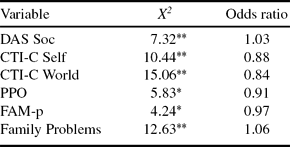
Next, backwards logistic regression was completed as a means of determining the most parsimonious model. According to the Wald criterion, 6 variables remained significant in the final model: view of self (X2 = 120.85, p < .001), view of world (X2 = 22.76, p < .001), need for social approval (X2 = 7.56, p < .01), positive problem orientation (X2 = 5.97, p < .05), family problems (X2 = 10.63, p < .01), and parent report of dyadic relationship (X2 = 4.29, p < .05), and reliably classified depressed youth who are hopeless from those who are not. The odds ratios for these significant predictors represent the likelihood of being hopeless, based on a one unit change in the predictors (view of self = .88; view of world = .84; need for social approval = 1.03; family problems = 1.06; FAM-p = .97; PPO = .91). Results indicate that hopeless adolescents were significantly more likely to have a negative view of themselves, negative view of the world, and low positive problem solving orientation than depressed adolescents who were not hopeless. Hopeless adolescents were also more likely to report family problems and have a negative relationship with their parent (by parent report) than depressed adolescents without clinically significant hopelessness. The X2, Wald statistics, and odds ratios for each predictor in the final model are presented in Table 6.
Backwards logistic regression

* = p < .05 ** = p < .01
CTI-C Self = View of Self Scale; CTI-C World = View of World Scale; DAS Soc = Need for Social Approval; PPO = Positive Problem Orientation; Family Problems = CASS family problems scale; FAM-p = Overall score (parent report)
In sum, although severity of depression was correlated with level of hopelessness among depressed adolescents, the correlation was not large, and depression does not emerge as a significant predictor of hopelessness, after adjusting for other cognitive and familial variables. Significant predictors of hopelessness include a negative view of the self, negative view of the world, negative internal attributions, the adolescent's report of family problems, and low positive problem solving orientation. These variables remain significant after controlling for the variance due to depression and all other included predictor variables. Other cognitive variables (perfectionism, stable and global attributions), social problem-solving factors (negative social problem-solving orientation, impulsiveness/carelessness style, avoidant style, and rational problem-solving), and family environment measures (parent and adolescent reports of conflict and adolescent and parent reports of family functioning) were not significant predictors of hopelessness after accounting for the influence of other variables.
Discussion
The present study sought to examine factors that distinguish depressed youth who become hopeless from those who do not. Although severity of depression was associated with hopelessness, it was not a significant predictor of hopelessness. Cognitive variables, including a negative view of the self, negative view of the world, negative internal attributions, and the need for social approval were positively associated with levels of hopelessness. Moreover, these variables distinguished depressed youth who were highly pessimistic from those who were not. Although rational social problem solving did not emerge as a predictor of hopelessness, positive problem orientation was negatively associated with levels of hopelessness. Finally, adolescent reported family conflict emerged as an environmental contributor that was positively associated with levels of hopelessness. Taken together, these variables accounted for 48% of the variance in hopelessness. Our analyses suggest that hopeless youth can be distinguished from non-hopeless adolescents on the basis of four cognitive predictors. The adolescent's views of the self and the world appear to be especially important contributors to level of hopelessness.
Overall, these findings replicate and extend those of Cannon and colleagues (Reference Cannon, Mulroy, Otto, Rosenbaum, Fava and Nierenberg1999), in that dysfunctional cognitions and impaired problem-solving predicted hopelessness. Interestingly the predictive significance of depression severity was overshadowed by other, more powerful cognitive and social-environmental predictors. Our findings extend the existing literature in highlighting the importance of a negative view of the self, negative view of the world, and dysfunctional attitudes in understanding the development of hopelessness.
Our first hypothesis was that depression severity would be positively associated with hopelessness. Although prior research has suggested that hopelessness has a strong relationship with depression among adolescents (Hammond and Romney, Reference Hammond and Romney1995; Pinto and Whisman, Reference Pinto and Whisman1996; Rotheram-Borus and Trautman, Reference Rotheram-Borus and Trautman1988; Topol and Reznikoff, Reference Topel and Reznikoff1982), the current study found only a modest correlation between the variables. One possible explanation for this result is shared method variance. Self-report measures are often more highly correlated with other self-report measures. The use of self-report measures may, at least in part, account for the high correlations often observed between depression and hopelessness. Only two studies reviewed (Brown, Overholser, Spirito and Fritz, Reference Brown, Overholser, Spirito and Fritz1991; Cole, Reference Cole1989) did not exclusively use self-report measures. In Asarnow et al.'s, (Reference Asarnow, Carlson and Guthrie1987) study, for example, hopelessness and depression measures were derived from the same scale. As a result, the correlation (r = .74) may be spuriously high due to shared-method variance. In contrast, Kazdin and colleagues (Reference Kazdin, French, Unis, Esveldt-Dawson and Sherick1983) report a correlation between clinician assessed depression and self-reported hopelessness of r = .22, similar to the correlation found in the current study. Indeed, the correlation between self-reported hopelessness and self-reported depression (Reynolds Adolescent Depression Scale, RADS) yielded a correlation comparable to previous research (r = .58). It appears, as such, that the lower correlations observed in this study may stem from methodological differences between studies.
Our second hypothesis was that cognitive variables, including a negative view of the self and world, perfectionism, need for social approval, and negative attributional style, would be significantly correlated with level of hopelessness. Our findings suggest that the set of cognitive variables explain the majority of the variance in hopelessness in our sample. These findings are consistent with research indicating that cognitive variables are associated with vulnerability for a range of negative psychological outcomes in children and adolescents (McCauley, Mitchell, Burke and Moss, Reference McCauley, Mitchell, Burke and Moss1988), as well as adults (Ingram, Miranda and Segal, Reference Ingram, Miranda and Segal1998). Our results are consistent with Beck's cognitive theory of depression (Beck, Reference Beck1963, Reference Beck1967). According to this theory, depressed individuals selectively attend to negative aspects of events and their own behaviors, engage in systematic patterns of misinterpretation (i.e. cognitive distortions), and develop pervasive negative views of the self, world, and future (i.e. the negative cognitive triad; Beck et al., Reference Beck, Rush, Shaw and Emery1979). Indeed, in our sample of depressed adolescents, negative views of the self, world, and future appeared to cluster together. Put simply, the more distorted one's thinking, the more likely the person is to project this negative thinking into the future and be more hopeless.
Temporal relations between hopelessness and other cognitive factors, however, are not well understood. Whether this negative cognitive style is a result of hopelessness or whether it predisposes an individual to become hopeless cannot be addressed with the present data. Prospective research is necessary to determine relations between the various cognitive predictors and hopelessness. Longitudinal research will also be important to investigate possible developmental changes in relations between cognitive predictors and hopelessness. Negative views of the self and the world may be important for our understanding of adolescent hopelessness, given the particular importance of peer acceptance and independence during this time. Adolescence is characterized by physical, social, biological, and environmental change. Adolescents may, as a consequence, be more sensitive to factors influencing self-concept and relationships with others than are children or adults.
Although research suggests that perfectionism is highly correlated with depression in adolescents (Einstein, Lovibond and Gaston, Reference Einstein, Lovibond and Gaston2000) and was associated with level of hopelessness in this study (r = .44), it did not uniquely contribute to level of hopelessness in our sample. In our final model, it appeared that other variables better accounted for the variance in hopelessness. Thus, while perfectionism may serve as a vulnerability factor for depression and contribute to an increased risk of recurrent depressive episodes (Blatt and Zuroff, Reference Blatt and Zuroff1992; Dunkley, Sansilow, Grilo and McGlasah, Reference Dunkley, Sansilow, Grilo and McGlasah2006), it does not appear to predict pessimistic views of the future. Indeed, not all factors that predict depression appear to be strong predictors of hopelessness. This finding is consistent with previous research suggesting perfectionism does not have an independent relationship with hopelessness; rather the relationship is mediated by other coping skills (Hunter and O'Conner, in press).
Given the current findings, which suggest that need for social approval is highly associated with hopelessness, building social skills may represent an important target for therapy. Indeed, children high in hopelessness report lower levels of social skills and are rated by parents as lower in their social participation (Kazdin, Rodgers and Colbus, Reference Kazdin, Rodgers and Colbus1986). Hopeless adolescents may behave in ways that elicit social rejection and may engage in fewer activities that might provide opportunity for social approval. In turn, this lack of social approval may increase the likelihood of being hopeless and exacerbate existing pessimism.
While we predicted that negative problem orientation (NPO) would be positively correlated with hopelessness, only positive problem orientation (PPO) was significantly associated with level of hopelessness. The difference between these constructs is subtle. The PPO scale taps a constructive, problem-solving cognitive approach (e.g. optimism, commitment, self-efficacy), whereas the NPO scale assesses inhibitive cognitions (e.g. self-blame, pessimism, anxiety, anger). Our data shows a moderate correlation between NPO and PPO (r = .24) and suggests the scales are indeed tapping separate concepts. Our findings are congruent with prior research indicating that links exist between social problem solving deficits and hopelessness (Bonner and Rich, Reference Bonner and Rich1988; Dixon, Heppner and Anderson, Reference Dixon, Heppner and Anderson1991). Our results support the hypothesis that deficits related to problem orientation, rather than rational problem-solving skills, are most important (Haaga, Fine, Terrill, Stewart and Beck, Reference Haaga, Fine, Terrill, Stewart and Beck1995). In fact, D'Zurilla and colleagues (Reference D'Zurilla, Chang, Nottingham and Faccini1998) found that negative problem orientation was the most highly correlated with hopelessness in a sample of undergraduates, followed by positive problem-orientation. The fact that the current study found positive problem orientation to be the only significant contributor to hopelessness suggests the need for further research delineating the specific nature of problem-solving deficits and hopelessness among adolescents. It may be that in adolescence (our sample, 12 to 17 years old), the constructs tapped by the positive problem orientation scale are more relevant. However, as adolescents become older (D'Zurilla's sample, college undergraduates), negative, inhibiting may thoughts become more salient. In other words, in early adolescence a lack of optimism, commitment, and openness to challenge may contribute to increased hopelessness, whereas during later adolescence the presence of low self-efficacy, as well as the experience of criticism or threat, represents increased vulnerability to hopelessness. In addition, the inconsistency may be the result of the fact that the sample in this study was more severely depressed and hopeless than the population studied by D'Zurilla and colleagues (Reference D'Zurilla, Chang, Nottingham and Faccini1998). Instead of viewing a problem as a challenge or beneficial opportunity, confronting problems directly, being persistent, and having confidence, depressed adolescents with significant levels of hopelessness may doubt their abilities to solve problems and give up without trying. Our results are congruent with prior research in suggesting that hopelessness is not necessarily associated with deficits in rational problem-solving skills. Rather poor social problem-solving may result from the lack of a constructive problem-solving cognitive “set”.
Our results indicate that a problematic or high conflict family environment (as reported by the depressed adolescent) may contribute to hopelessness. Although family conflict variables are only moderately correlated with hopelessness and did not emerge as the best predictors of group classification, associations are significant and warrant attention. In as much as young children are highly dependent on their families, family conflict may exert a greater impact on children and, to a slightly lesser degree, adolescents. In fact, research suggests associations may exist between suicide attempts in youth and their perceptions of low familial support (Asarnow and Carlson, Reference Asarnow and Carlson1988). The results of the current study suggest that family variables may have a significant impact on the adolescent's views of the future. While adolescents' reports of family conflict and overall family functioning were significantly associated with hopelessness, parental reports of conflict with adolescents and parent reports of overall family functioning were not. This raises the question whether the adolescent's negative perceptions of family functioning and conflict reflect an objective assessment of the family environment or stem from the adolescent's negative mood or negative cognitive style. Further research is needed to evaluate the degree to which hopeless adolescents' perceptions of their families are shared by other family members and what the specific role of family conflict is in the development and maintenance of hopelessness.
Results indicated modest correlations, in general, between the variables and hopelessness. Even in the final model, the predictor variables only explained around 50% of the variance of hopelessness. This may be in part due to the issue of method variance described previously; all of the predictor variables were self-report measures, whereas the dependant variable was clinician administered. Another possibility is that there are other domains not assessed in this study, which may be related to hopelessness. The literature suggests a number of additional domains that may be important including neighborhood factors (Perez-Smith, Spirito and Boergers, Reference Perez-Smith, Spirito and Boergers2002), life satisfaction and self-esteem (Chioqueta, Stiles and Tore, Reference Chioqueta, Stiles and Tore2007), and personality features such as high Neuroticism (Chioqueta and Stiles, Reference Chioqueta and Stiles2005).
Traditionally, hopelessness is conceptualized as a concomitant or component of depression. The results of this study suggest that hopelessness may be viewed as a separate construct and can be considered independent of depression. Indeed, we found that depression severity accounted for a relatively small portion of variance in hopelessness and that many predictors remained significant after controlling for depression severity. In sum, hopelessness appears to be a distinct cognitive phenomenon with unique causes and consequences.
Limitations
Confidence in our interpretation of the results obtained is constrained by several factors. First, our sample is composed of a representative group of clinically depressed outpatient adolescents. Studies are needed to clarify whether the findings will generalize to more severely depressed inpatient samples or to youth with other Axis I disorders. Second, as our study used a cross-sectional design, it did not allow for identification of causal links between factors and hopelessness. These variables have been hypothesized to increase the risk for depression and suicide (Abramson et al., Reference Abramson, Metalsky and Alloy1989; Beck et al., Reference Beck, Steer, Beck and Newman1993; Nezu, Reference Nezu1987; Olinger, Kuiper and Shaw, Reference Olinger, Kuiper and Shaw1987). While it is plausible that a negative world and self view, along with maladaptive attitudes, lack of positive problem solving orientation, and a highly stressful family environment may contribute to increased levels of hopelessness among depressed youth, it may also be true that these constructs are consequences of hopelessness or a more general sense of despair. Our results do not allow for conclusions about the causal pathways or developmental course of hopelessness.
Longitudinal and prospective research is needed to determine the extent to which these measures predict subsequent hopelessness, as well as potential age or gender effects. Prospective treatments that target correlates of hopelessness are necessary to determine if the proposed variables have a causal role in the etiology of hopelessness. At the same time, in order to examine the stability of factors associated with hopelessness, it will be important to examine relations among predictors of hopelessness in at risk (non-depressed) youth and adolescents who have remitted from a depressive episode. Such studies are crucial for clarifying developmental processes that lead some depressed adolescents to become hopeless and other adolescents to maintain a positive outlook on the future.
Implications for research, policy, and practice
In developing a fuller understanding of hopelessness, it is important to remember that hopelessness is a dynamic, rather than static, construct. Levels of hopelessness tend to vary over time. Moreover, like depression, hopelessness appears to be multiply determined. Indeed, Young and colleagues (Reference Young, Fogg, Scheftner and Fawcett1996) propose that individuals possess a baseline level of hopelessness when not depressed, an increased level of hopelessness when depressed, and a characteristic rate of increase (hopelessness sensitivity). As a result, scores on objective measures of pessimism, such as the BHS, reflect several factors – baseline hopelessness, incremental increases in hopelessness as a function of depression, hopelessness sensitivity, and life events. Young and colleagues (Reference Young, Fogg, Scheftner and Fawcett1996) propose that individuals will have different levels of hopelessness prior to the onset of a depressive episode and differ in the magnitude of increases in level of hopelessness over time. It follows that for some individuals, hopelessness changes little over the course of a depressive episode; whereas for others, a high level of hopelessness may be unrelated to depression (Beck et al., Reference Beck, Brown, Berchick, Stewart and Steer1990). If baseline hopelessness and hopelessness sensitivity are two distinct and independent components of hopelessness, it is possible that these constructs are predicted by or associated with different factors. The current study did not discriminate between state and trait components of hopelessness. Further research is necessary to specify which predictors are correlated with each component. Results from Young and colleagues (Reference Young, Fogg, Scheftner and Fawcett1996) suggest that suicide and subsequent depression may be more related to the trait level of hopelessness that remains after depression remits. Consequently, it may be important to focus on predictors of trait/baseline hopelessness, rather than all factors associated with total hopelessness scores.
The present findings have implications for the treatment of depressed and suicidal adolescents. Hopelessness has been identified as a robust predictor of suicide among adults and a moderately strong predictor among adolescents. Identifying predictors and correlates of hopelessness may provide clinicians with additional targets for assessing and treating suicidal risk. The findings of this study highlight the need to attend to more than severity of depression in the assessment of risk. Attention to cognitive styles and attributions, problem solving orientation, and the adolescent's view of his or her family may provide clinicians with markers of suicide risk among depressed adolescents. As such, assessment of these variables at the beginning of treatment may be helpful in this regard. Mental health professionals should be vigilant to young people who have strong negative views of themselves and the world, who are overly concerned with gaining approval from others, have poor problem orientation, and report significant family problems. The strong associations observed between hopelessness and cognitive factors, including problem-solving and cognitive distortions, suggests that these may be a useful focus for treatment.
Taken together, our results suggest that hopelessness may be multiply determined from a combination of cognitive and socio-environmental variables. Longitudinal research examining the ways in which cognitive, problem-solving, and family environment factors associated with hopelessness interact over time in contributing to the development of a pessimistic outlook is needed. Given evidence indicating the negative effects of hopelessness, it is critical that research investigate how hopelessness may be prevented, as well as how it can be most effectively treated.
Acknowledgements
TADS is supported by contract N01 MH80008 from the National Institute of Mental Health (NIMH) to Duke University Medical Center (John S. March, Principal Investigator). Portions of this work were presented at the meeting of the Kansas Conference in Clinical Child and Adolescent Psychology, 2006, and the Association for Psychological Science, 2007. Preparation of this manuscript was supported by NIMH fellowship F31 MH075308 to Rachel H. Jacobs. The Treatment for Adolescents with Depression Study (TADS) is coordinated by the Department of Psychiatry and Behavioral Sciences and the Duke Clinical Research Institute at Duke University Medical Center in collaboration with the National Institute of Mental Health (NIMH), Rockville, Maryland. The Coordinating Center principal collaborators are John March, Susan Silva, Stephen Petrycki, John Curry, Karen Wells, John Fairbank, Barbara Burns, Marisa Domino, and Steven McNulty. The NIMH principal collaborators are Benedetto Vitiello and Joanne Severe. Principal Investigators and Co-investigators from the clinical sites are as follows: Carolinas Medical Center: Charles Casat, Jeanette Kolker, Karyn Riedal, Marguerita Goldman; Case Western Reserve University: Norah Feeny, Robert Findling, Sheridan Stull, Felipe Amunategui; Children's Hospital of Philadelphia: Elizabeth Weller, Michele Robins, Ronald Weller, Naushad Jessani; Columbia University: Bruce Waslick, Michael Sweeney, Rachel Kandel, Dena Schoenholz; Johns Hopkins University: John Walkup, Golda Ginsburg, Elizabeth Kastelic, Hyung Koo; University of Nebraska: Christopher Kratochvil, Diane May, Randy LaGrone, Martin Harrington; New York University: Anne Marie Albano, Glenn Hirsch, Tracey Knibbs, Emlyn Capili; University of Chicago/Northwestern University: Mark Reinecke, Bennett Leventhal, Catherine Nageotte, Gregory Rogers; Cincinnati Children's Hospital Medical Center: Sanjeev Pathak, Jennifer Wells, Sarah Arszman, Arman Danielyan; University of Oregon: Anne Simons, Paul Rohde, James Grimm, Lananh Nguyen; University of Texas Southwestern: Graham Emslie, Beth Kennard, Carroll Hughes, Maryse Ruberu; Wayne State University: David Rosenberg, Nili Benazon, Michael Butkus, Marla Bartoi. Greg Clarke (Kaiser Permanente) and David Brent (University of Pittsburgh) are consultants; James Rochon (Duke University Medical Center) is statistical consultant.



Comments
No Comments have been published for this article.