Introduction
Is it possible for bilinguals to read words or utterances in one of their languages without any interference from their other language? It was once thought by some researchers that bilinguals can completely filter out the non-target language through language-selective access (Rodriguez-Fornells, Rotte, Heinze, Nösset & Münte, 2002) or by accessing language-specific lexicons (Gerard & Scarborough, Reference Gerard and Scarborough1989; Scarborough, Gerard & Cortese, Reference Scarborough, Gerard and Cortese1984). In contrast, other authors (e.g., Dijkstra & van Heuven, Reference Dijkstra and van Heuven2002) have proposed that some interference cannot be avoided because words in the bilingual mental lexicon are accessed in a language non-selective manner. In this view, bilinguals activate word candidates in both their languages while reading, and these representations compete for selection. At present, the majority of available studies supports the notion that the non-target language cannot be ‘switched off’ and remains active in the background (for reviews, see Dijkstra & van Heuven, Reference Dijkstra and van Heuven2002; van Heuven & Dijkstra, Reference Van Heuven and Dijkstra2010). Much of the available evidence comes from behavioural studies on words with different levels of form and meaning overlap across languages, such as cognates and interlingual homographs.
Cognates are words with similar orthographic forms and meanings across languages. There is a spectrum of items ranging from identical cognates with shared orthographic forms across languages, via non-identical cognates with similar orthographic forms, to words with little or no cross-linguistic overlap. Examples of cognates between English and Dutch include hotel (Dutch: hotel), tent (tent), silver (zilver), ocean (oceaan), and olive (olijf). In contrast, interlingual homographs are words with identical orthographic forms but different meanings across languages. Examples between Dutch and English are kind (Dutch meaning: child), glad (Dutch meaning: slippery), and brand (Dutch meaning: fire).
Bilinguals often recognise and produce cognates more quickly than matched control words. This cognate facilitation effect has been observed in many experimental circumstances in visual word recognition (e.g., Cristoffanini, Kirsner & Milech, Reference Cristoffanini, Kirsner and Milech1986; De Groot & Nas, Reference De Groot and Nas1991; Dijkstra, Grainger & van Heuven, Reference Dijkstra, Grainger and van Heuven1999; Peeters, Dijkstra & Grainger, Reference Peeters, Dijkstra and Grainger2013; Voga & Grainger, Reference Voga and Grainger2007), auditory word recognition (Marian & Spivey, Reference Marian and Spivey2003) and word production (Costa, Caramazza & Sebastian-Galles, Reference Costa, Caramazza and Sebastian-Galles2000; Kroll & Stewart, Reference Kroll and Stewart1994). The effect has been found in first language (Van Hell & Dijkstra, Reference Van Hell and Dijkstra2002), second language (Lemhöfer & Dijkstra, Reference Lemhöfer and Dijkstra2004), and third language processing (Lemhöfer, Dijkstra & Michel, Reference Lemhöfer, Dijkstra and Michel2004), but it is typically the strongest in non-native languages.
In contrast, in lexical decision tasks interlingual homographs are recognized as fast as or more slowly than control words. One experimental factor that determines whether null-effects or inhibition effects arise for interlingual homographs is stimulus list composition (see Dijkstra, Reference Dijkstra, Kroll and De Groot2005). In pure stimulus lists that contain only L2 words, null-effects have been reported, whereas in mixed lists, containing both L2 and L1 words, homograph inhibition effects appear when the L1 words require a ‘no’ response. For instance, when Dijkstra, Van Jaarsveld and Ten Brinke (Reference Dijkstra, Van Jaarsveld and Ten Brinke1998) presented Dutch–English bilinguals with interlingual homographs in an English lexical decision task with only English words in the stimulus list, their RTs were not different from those to matched English control words (Experiment 1). However, after half of the pseudowords in the list were replaced by Dutch words, requiring a ‘no’ response, slower RTs were obtained for interlingual homographs than for English control words (Experiment 2).
Computational models of bilingual word recognition, like the BIA+ model (Dijkstra & van Heuven, Reference Dijkstra and van Heuven2002) and the Multilink model (Dijkstra & Rekké, Reference Dijkstra and Rekké2010; Dijkstra et al., Reference Dijkstra, Wahl, Buytenhuijs, Van Halem, Al-jibouri, De Korte and Rekké2019) have proposed two mechanisms to explain the observed differences in result patterns across item types (cognates vs interlingual homographs) and stimulus lists (pure vs mixed). The mechanisms relate to cross-linguistic overlap and to response competition in pure and mixed stimulus lists. The over-arching goal of the present paper was to test these proposed mechanisms for several item types in pure and mixed language conditions by manipulating stimulus list composition. Next, we will discuss each mechanism in more detail.
Cross-linguistic overlap in orthography and semantics
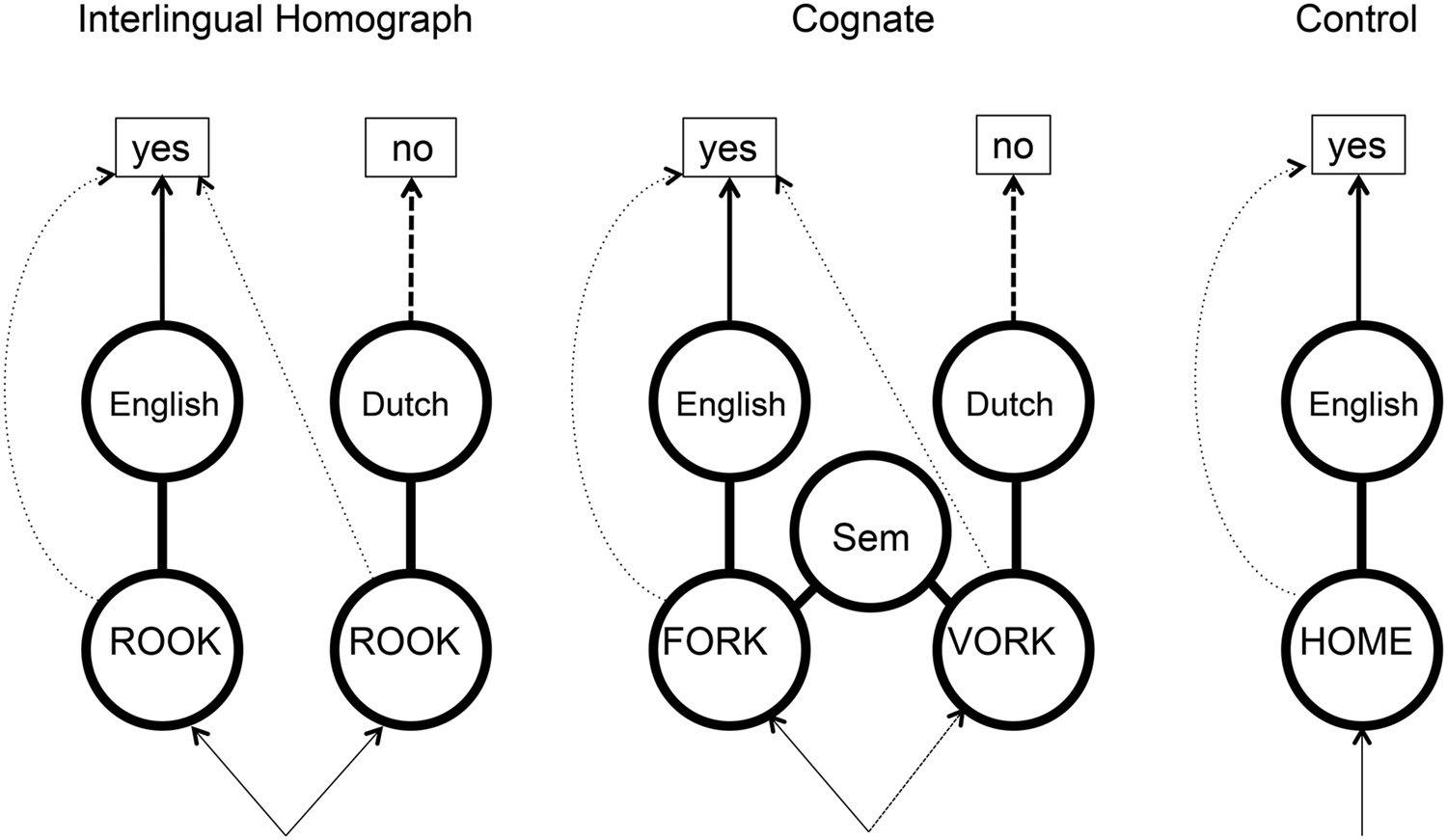
Both BIA+ and Multilink assume that bilingual readers, presented with a visual letter string, activate stored orthographic representations of words to the extent that they overlap with the input. They do this irrespective of the language to which they belong (language nonselective access). Furthermore, in the framework of the BIA+ and Multilink models, the processing of interlingual homographs, cognates, and control (one-language) words differs due to the special representational characteristics of the first two item types (see Figure 1; also see Dijkstra, Reference Dijkstra, Kroll and De Groot2005). Due to cross-linguistic orthographic overlap, readings of cognates and interlingual homographs in multiple languages are co-activated during processing. At the same time, their processing is different, because there is cross-linguistic overlap in meaning for cognates (e.g., film having the same meaning in Dutch and English), but not for interlingual homographs (Dutch room referring to ‘cream’).
Stimulus-response bindings in an English lexical decision task performed by Dutch-English bilinguals, extending Dijkstra (Reference Dijkstra, Kroll and De Groot2005). Word and language membership representations are simplified. Identical and non-identical cognates have similar representations (Peeters et al., Reference Peeters, Dijkstra and Grainger2013). In an English (pure) stimulus list, Dutch word representations are only weakly linked to the “no” response. The short-cut from word representations to the ‘yes’ response allows responses based on activated word orthography, even without a language membership check. In a Dutch-English (mixed) list, the presence of purely Dutch words leads to a stronger 'no' binding. Responses here should be based exclusively on language membership. Effects of lateral inhibition and global lexical activation are not represented.

These representational similarities and differences between item types have their consequences for processing in pure and mixed lists. In a pure list, the semantic convergence of cognate representations leads to facilitation relative to control words. Because there are no words in the stimulus list belonging to a language other than the target language, any lexical activation can be considered as evidence favoring a word response. However, no semantic convergence exists for interlingual homographs, explaining the absence of facilitation effects for this item type in a pure list. What happens in mixed lists will be considered next.
Response competition in mixed vs pure stimulus lists
The BIA+ and Multilink models argue that, in order to account for the effects of stimulus list composition on cognate and interlingual homograph processing, the involvement of a task/decision system must be presumed. When bilinguals perform a task like lexical decision, they make use of a task schema that specifies the order of events, actions, and decisions leading up to a correct performance. Task schemas allow bilinguals to select the appropriate response to an input word for a given task and context. The setting of parameters in these task schemas is sensitive to several factors, one of which is stimulus list composition.
In a language-specific lexical decision task with a pure list condition, only items of the target language are explicitly bound to the ‘yes’ response (see Figure 1); non-target language items are absent or infrequent and not relevant for responding. Said differently, participants in an English lexical decision task may pose the question ‘Is this item an English word or not?’ without considering that the input might be an item from Dutch. In contrast, when the list is mixed (i.e., contains words of two languages), the frequently occurring items of the non-target language must be explicitly considered and coupled to the ‘no’ response (Dijkstra, Reference Dijkstra, Kroll and De Groot2005; Van Heuven, Schriefers, Dijkstra & Hagoort, Reference Van Heuven, Schriefers, Dijkstra and Hagoort2008). For instance, in an English lexical decision task with mixed English and Dutch words, participants may encounter Dutch words so frequently that they need to exclude the possibility that the input is a Dutch word on every trial.
In sum, in an English (L2) lexical decision task involving a list mixing English and Dutch words, (a) words from both languages are activated, and (b) words from the L2 (English) are bound (linked up) to the ‘yes’ response, but words from L1 (Dutch) to the ‘no’ response (Dijkstra, Reference Dijkstra, Kroll and De Groot2005). Therefore, a change from a pure to a mixed list increases response competition and the associated interference effects. Especially L2 items will be affected, because their representations are generally weaker than those of L1 items. In the case of interlingual homographs, their representations in both L1 and L2 are activated. Because in the mixed list these are linked to ‘no’ and ‘yes’ responses, respectively, this causes response competition and slows down the ‘yes’ decision for the L2 reading of the homograph relative to a matched control word. This account is in line with data patterns that have been observed for interlingual homographs in previous studies. In what follows, we formulate four model hypotheses related to stimulus list composition and cross-linguistic overlap, to be empirically tested in the present study.
First, to test if the response competition account holds for cognates in general (both non-identical and identical cognates), we investigated if cognates are affected by stimulus list composition in ways similar to interlingual homographs. If this is the case, response competition should arise for cognates in an English lexical decision task when Dutch words are included that require a ‘no’ response. Preliminary findings suggest that increased response competition should result in a reduction of the cognate facilitation effect under mixed vs pure conditions (Poort & Rodd, Reference Poort and Rodd2017) and it could possibly even induce a cognate inhibition effect. We tested this prediction on cognate processing for unbalanced adult Dutch–English bilinguals in English (L2) lexical decision by presenting them with a pure stimulus list including English words only and a matched mixed stimulus list with both Dutch and English words (see Brenders, Van Hell & Dijkstra, Reference Brenders, van Hell and Dijkstra2011, for a similar study with children). In particular, we kept all properties of the lists the same (e.g., randomization, list length, test items) and just replaced half of the nonwords by words from the non-target language (Dutch). Thus, potential confounding effects of fatigue, learning, and additional words or word types were explicitly excluded.
Second, we tested the hypothesis that incorporating Dutch words in the stimulus list has a more detrimental effect on the cognate facilitation effect for identical cognates than for non-identical cognates in an English lexical decision task. Identical cognates (e.g., Dutch–English film) and non-identical cognates (e.g., Dutch tomaat and English tomato) might be affected differently by a change in stimulus list composition, because identical cognates are ambiguous with respect to their language membership. Instead, because non-identical cognates unambiguously belong to only one language, they might be less affected by the presence of Dutch words in the stimulus list.
Third, we included non-identical cognates with more and less orthographic cross-linguistic similarity in both the pure and mixed stimulus lists. This allowed us to assess how effects of response competition are modulated by fine-grained differences in cross-linguistic overlap. In a language-specific L2 lexical decision experiment by Dijkstra, Miwa, Brummelhuis, Sappelli and Baayen (Reference Dijkstra, Miwa, Brummelhuis, Sappelli and Baayen2010), the cognate facilitation effect was modulated by the degree of cross-linguistic orthographic overlap in the cognates. RTs for L2 cognates decreased gradually with increasing orthographic overlap. Remarkably, a sudden drop in RTs was found for identical cognates, suggesting that identical cognates are processed differently from non-identical cognates and controls. However, this finding was not obtained in another English lexical decision study: Van Assche, Drieghe, Duyck, Welvaert and Hartsuiker (Reference Van Assche, Drieghe, Duyck, Welvaert and Hartsuiker2011) found a linear trend in RTs as the degree of cross-linguistic orthographic similarity increased, without a discontinuity for identical cognates. In all, it remains unclear how cognate effects depend on the presence of complete or partial form overlap across languages in different list contexts.
Finally, to evaluate whether the response competition account holds for different item types we directly compared the effects of stimulus list composition for interlingual homographs and identical cognates. Because both of these two item types share complete orthographic overlap between languages, they allow for an evaluation of the effects of convergent vs divergent semantics on response competition. It is predicted that semantic overlap in cognates will result in an increase of facilitation effects in a pure list condition, but a decrease of inhibition in a mixed list condition, relative to interlingual homographs. In other words, the convergent semantics in (identical) cognates should decrease the negative effects of response competition relative to interlingual homographs.
The current study
We tested our hypotheses in two English lexical decision tasks involving the same group of proficient, unbalanced Dutch–English bilinguals. Across the two tasks, we manipulated stimulus list composition to induce response competition in a way similar to the study by Dijkstra et al. (Reference Dijkstra, Van Jaarsveld and Ten Brinke1998). The first English lexical decision task was performed on a list composed of cognates, interlingual homographs, English control words, and pseudowords. In the second task, half of the pseudowords were replaced by Dutch words. We used a relatively small proportion of pseudowords (40% of trials instead of the standard 50% in Task 1, 20% in Task 2), because we wished to induce a ‘yes’ bias in the experiment by reducing the pseudoword proportion. A reduced proportion of ‘no’ responses should increase the competition effects for interlingual homographs. To keep the participants alert under these circumstances and the experimental design compatible with an fMRI study that used the same materials and procedure (Peeters, Vanlangendonck, Rueschemeyer & Dijkstra, Reference Peeters, Vanlangendonck, Rueschemeyer and Dijkstra2019; also see Vanlangendonck, Reference Vanlangendonck2012), we included trials in which no stimulus appeared in each task.
English lexical decision without and with pure Dutch words
Method
Participants
Forty Dutch–English bilinguals participated in the study, which consisted of two lexical decision tasks (excluding or including Dutch words) performed across two different experimental sessions. Data from seven participants were excluded from the analyses because in comparison to others they had exceptionally high overall error rates (above 15%). The remaining 33 participants consisted of 5 men and 28 women with a mean age of 21.9 years (SD = 2.26). All participants were right-handed and had normal or corrected-to-normal vision. They gave written informed consent before the start of the experimental session and received 10 euros or course credit for participating.
Participants’ language background and English proficiency were assessed by means of a self-rating questionnaire. All participants were native speakers of Dutch who on average came into contact with English at the age of 11.0 (SD = 1.5). They rated their English reading experience as 5.5 (SD = 1.1) on a scale from 1 (very little experience) to 7 (very much experience).
Stimulus materials
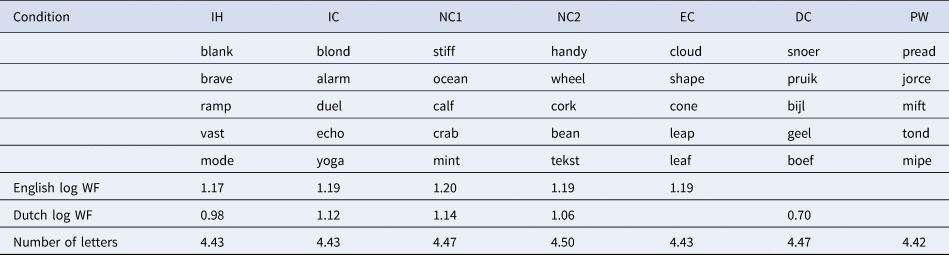
The total stimulus set consisted of 300 English words, 30 Dutch words, and 90 pseudowords. All words were nouns and adjectives made up of one or two syllables and four to six letters. The English words consisted of 60 identical cognates, 120 non-identical cognates, 60 false friends, and 60 English control words (see Table 1 for examples). The Levenshtein distance (LD) was used to quantify the degree of cross-linguistic orthographic overlap between the non-identical cognates and their Dutch translation equivalents. The Levenshtein distance refers to the number of characters that have to be replaced, added, or deleted to transform one string of characters into another string. The cognates had a Levenshtein distance of 0 for Identical Cognates (IC), and 1 or 2 for Non-identical Cognates (NC1 and NC 2, respectively). The false friends had a Levenshtein distance of at least three to their Dutch translation equivalents.
Examples of stimuli in all conditions used in the two lexical decision tasks, with average English word form frequency per million and number of letters. Note: IH = Interlingual Homograph; IC = Identical Cognate; NC1 = Nonidentical Cognate with Levenshtein Distance 1; NC2 = Nonidentical Cognate with Levenshtein Distance 2; EC = English Control; DC = Dutch Control; PW = Pseudoword.

The English words were matched item-by-item across conditions based on their length and English word form frequency, as available from the SUBTLEX-US database (Brysbaert & New, Reference Brysbaert and New2009). Table 1 contains examples of the frequency-matched stimuli used in the two tasks (English frequency in occurrences per million, opm). T-tests revealed no differences in length or frequency across any pairs of conditions. The Dutch words were low-frequency words with a Dutch word form frequency between 2 and 10 occurrences per million, as available from the SUBTLEX-NL database (Keuleers, Brysbaert & New, Reference Keuleers, Brysbaert and New2010). They did not include any cognates or interlingual homographs. Pseudowords were created by replacing one letter in existing English words. The pseudowords and Dutch words were matched item-by-item with the English words for length. For the full set of stimulus materials, see Appendix 1.
The 300 English words were allocated to two lists. Items of each stimulus category were separately matched across the two lists for English word form frequency and word length. For instance, identical cognates were divided into two matched groups before allocation to each list. Half of the participants were presented with the first list in the first task, the other half saw it in the second task. Thus, no items were repeated across tasks. In the first task, 60 pseudowords were added to the English words. In the second task, 30 pseudowords and 30 Dutch words were included in addition to the English words. As a result, the stimulus lists for each lexical decision task consisted of 210 stimuli, 150 of which were existing English words. To keep the participants alert in conditions with a lower proportion of pseudowords (e.g., task 2), we added 30 trials to each task in which no letter string appeared. Each stimulus was presented once to each participant over the course of the two tasks. The stimuli were pseudorandomised to create a different list for each participant. Each pseudorandomised list contained no more than four English words in a row and stimuli were never succeeded by an item from the same condition.
Procedure
Participants received written instructions before the start of the experiments. They were asked to indicate as quickly as possible whether a presented letter string was an existing English word or not by pressing the appropriate button on a button-box. YES-responses were given with the right index finger, NO-responses were given with the left index finger. Participants were informed of the presence of words existing in both Dutch and English in the stimulus list. The same instructions were used for both tasks.
Participants completed a series of 14 practice trials before the start of each task. The practice trials contained the same proportion of stimuli from each condition as the actual experiment. The experiments were run using Presentation software. Participants were seated in a normally lit room at approximately 60 cm from the computer screen. Stimuli were presented in white 20-point Arial font on a black screen. Each trial began with a variable jitter of 0, 500, 1000, or 1500 ms. Next, a fixation cross was presented in the centre of the screen for 400 ms. The fixation cross was immediately followed by the presentation of the stimulus in the centre of the screen. The stimulus remained visible until the participant pressed a button or until the maximum response time of 2000 ms was reached. Between trials a blank screen appeared for 2000 ms. In total, each task took no more than 25 minutes.
Each participant completed both tasks. The two tasks were scheduled on different days, between 1 and 14 days apart. The order of the tasks was kept constant to ensure that the presence of Dutch words would not affect participants’ expectations during the second session. After the first experiment, participants filled out a written questionnaire assessing their language background and English proficiency. Apart from this, experimental procedures were identical during both sessions.
Results
Responses to 15 items that elicited at least 40% errors over the two tasks were removed. The removed items consisted of 2 English control items (gown, moan), 7 interlingual homographs (arts, bout, gist, rake, stem, stout, vast), 3 non-identical cognates with LD = 1 (beak, plight, wasp), and 3 non-identical cognates with LD = 2 (grin, heap, wart). The removal of these data points did not create any significant differences in the matching between conditions. In addition, all responses that were faster than 300 ms or slower than 1500 ms were discarded. After removal of these responses and errors, mean RT for pseudowords was 737 ms (accuracy: 95.8%) in Task 1 and 748 ms (94.9%) in Task 2. Mean RT to Dutch words in Task 2, also requiring a ‘no’ response, was 732 ms (94.4%).
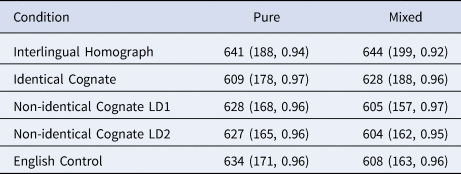
The dataset of correct word responses in all conditions together amounted to 8,890 points. Mean RTs with standard deviations and proportion correct for each condition are given in Table 2.
Mean reaction times with standard deviations and proportion correct for interlingual homographs, cognates, and control words in pure and mixed task situations.

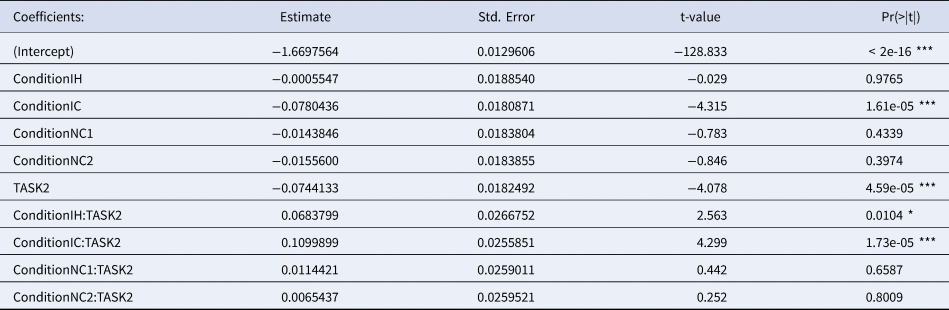
To analyze the RT patterns in the various conditions, we performed regression analyses on the correct responses only. Because inspection of the data revealed the typical skewedness of RT distributions, we performed the analyses on an inverse transform of the RT (namely, -1000/RT), which successfully reduced non-normality. Our first regression analysis had Condition and Task (pure vs mixed) as fixed factors and used the English Control condition as a reference. Due to the nesting of participants and items with respect to task situation (pure vs mixed), these could not be used as random factors.
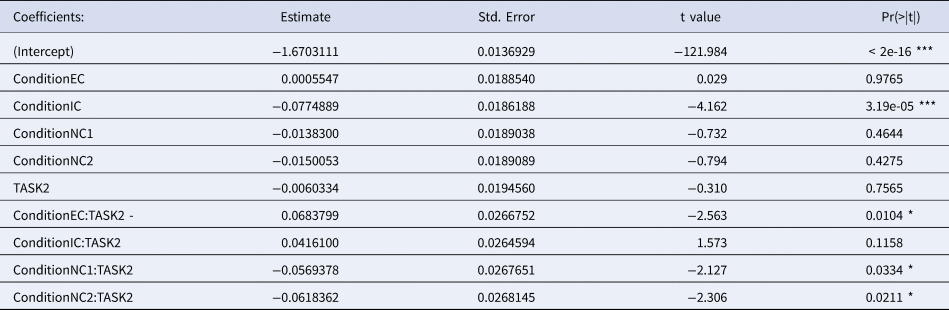
In correspondence with the data in Table 2, Table 3 shows a number of important results. First, relative to English Controls, Identical Cognates show a significant facilitation effect in the pure task condition. There is a strong significant interaction of Identical Cognates with Task, reflecting the transition to an inhibition effect in the mixed task condition. Second, Interlingual Homographs show an interaction effect with Task, reflecting that they are processed slower than the English Controls in the mixed condition, but not in the pure condition. The Task effect indicates that, in contrast, English Controls are processed faster in the mixed task. Third, there were no significant effects of Non-Identical Cognates relative to English Controls.
Regression analysis with Condition and Task as fixed factors and English control as reference condition.

Signif. codes: 0 ‘***’ 0.001 ‘**’ 0.01 ‘*’ 0.05 ‘.’ 0.1 ‘ ’ 1
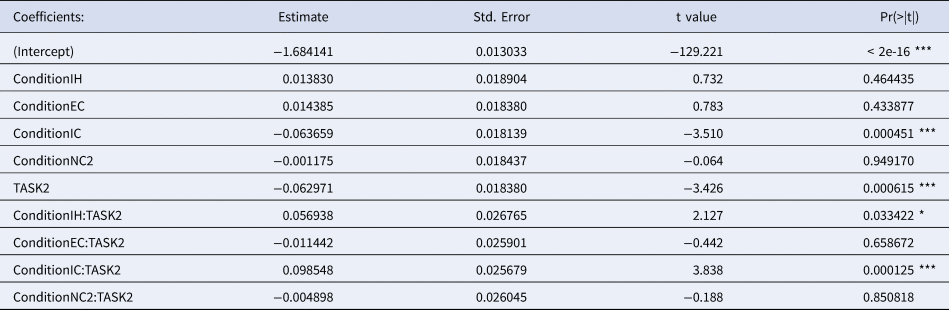
When we releveled, taking Interlingual Homographs as a reference condition, the results in Table 4 were obtained. As additional information, they indicate that under mixed conditions, Interlingual Homographs were processed slower than Identical Cognates in the pure task and slower than all other conditions in the mixed task.
Regression analysis with Condition and Task as fixed factors and Interlingual Homographs as reference condition.

Signif. codes: 0 ‘***’ 0.001 ‘**’ 0.01 ‘*’ 0.05 ‘.’ 0.1 ‘ ’ 1
We relevelled once more, taking non-identical cognates with Levenshtein distance 1 (NC1) as a reference condition, in order to test differences between non-identical cognates and the other conditions. This led to the results in Table 5.
Regression analysis with Condition and Task as fixed factors and Non-identical Cognates with Levenshtein distance 1 (NC1) as reference condition.

Signif. codes: 0 ‘***’ 0.001 ‘**’ 0.01 ‘*’ 0.05 ‘.’ 0.1 ‘ ’ 1
New information provided by the relevelling indicates that Non-Identical Cognates with Levenshtein Distance 1 did not differ from Non-Identical Cognates with Levenshtein Distance 2 in either task. However, the NC1 condition was slower than the Identical Cognate condition in the pure task condition, and faster than it in the mixed task condition. The NC1 condition was also faster than the Interlingual Homographs in the mixed Task 2 (see Table 2 for the corresponding RTs).
Finally, we performed a logistic mixed effect error analysis on the correct and incorrect responses to assess the differences between conditions in terms of accuracy (given in Table 2). No significant differences arose relative to the English Control condition.
Discussion
In the present study, we tested the representational accounts of cognates and interlingual homographs put forward by the BIA+ and Multilink models by examining the effects of stimulus list composition on the processing of cognates and interlingual homographs.. First, a ‘pure’ task variant of a language-specific English (L2) lexical decision task was performed by Dutch–English bilinguals, providing a largely monolingual English (L2) stimulus context. Apart from identical cognates and interlingual homographs, no items had a reading in the participants’ L1, Dutch. Next, in a second ‘mixed’ task situation, words from Dutch, requiring a ‘no’ response, were included in the stimulus list. In the following sections, we consider the obtained results in terms of the four model hypotheses about stimulus list composition and cross-linguistic overlap formulated in the Introduction.
(1) Change from pure to mixed list increases response competition
We predicted that a change from a stimulus list consisting of one language (pure) to a list consisting of two languages (mixed), would lead to increased response competition. As a consequence, an increased inhibition effect was expected for interlingual homographs and a reduced facilitation effect for cognates. Both predictions were borne out. Non-significant RT differences between homographs and matched controls turned into inhibition effects when a pure list was changed into a mixed list. For identical cognates (having a complete orthographic overlap across languages), the change in RT pattern was substantial: Relative to matched English control words, a cognate facilitation effect of 25 ms in the pure list turned into an inhibition effect of 20 ms in the mixed list. This finding confirms the suggestion, based on a null result, that the cognate effect might change when including words from the non-target language in the stimulus list of an L2 lexical decision task (Poort & Rodd, Reference Poort and Rodd2017).
Given the robustness of cognate effects in many studies, it is remarkable that we did not observe any significant RT differences between non-identical cognates and English control words. This was the case in both the pure and mixed stimulus list conditions. Possibly, the setting of response deadlines were optimized for the strongest conditions in the task, e.g., those involving identical cognates and/or interlingual homographs, thus reducing effects for non-identical cognates.
Another option, suggested by a Reviewer, is that the English control words were affected not only by general list difficulty, but also by specific list effects. In our experimental design, we chose not to repeat words by selecting two groups of matched control words and counter-balancing them across the two presentation blocks (as we did for the test words). As an alternative, the same words could have been presented twice in the different lists. Future research should further investigate this alternative explanation.
(2) Identical cognates have a special status
Assuming that identical cognates have a special status in the mental lexicon, we predicted that they would be processed faster than non-identical cognates in pure list conditions, due to their cross-linguistic form identity and meaning overlap. However, they would be processed slower in mixed list conditions due to increased response conflict. Both results were indeed obtained.
The results deviate from those by Van Assche et al. (Reference Van Assche, Drieghe, Duyck, Welvaert and Hartsuiker2011), who found linear effects of orthographic overlap for identical and non-identical cognates in a sentence study involving eye-tracking. Instead, they do agree with the results from two other studies. First, using a larger number of items, Dijkstra et al. (Reference Dijkstra, Miwa, Brummelhuis, Sappelli and Baayen2010) observed a non-linear effect of orthographic overlap (identical vs non-identical cognates) in an English lexical decision task with Dutch–English bilinguals. Second, Cop, Dirix, van Assche, Drieghe & Duyck (Reference Cop, Dirix, van Assche, Drieghe and Duyck2017) found that identical cognates, but not non-identical cognates, affected total reading time in an eye-tracking study on natural reading.
Interestingly, the inhibitory effects for identical cognates in mixed list conditions were numerically smaller than those for interlingual homographs (628 ms vs 643 ms). Although not significant (p = .11), this difference suggests that the shared semantics in identical cognates led to some reduction of the other-language interference observed for interlingual homographs that do not share any meaning across language.
(3) Identical cognates show disproportionally large effects
Our third prediction was that identical cognates, due to their form identity across languages, would show a considerable drop (in the pure task situation) or peak (in the mixed task situation) in RTs relative to different types of non-identical cognates. The facilitation and inhibition effects for identical cognates in the two stimulus list conditions were indeed disproportionally large relative to non-identical cognates. Not only were there significant RT differences between identical cognates and non-identical cognates, but non-identical cognates also did not differ amongst themselves or relative to control words.
No significant RT differences were found between the two categories of non-identical cognates that differed in one or two letters from their translation equivalents. Many of these cognates differed with respect to one or two letters in the middle of a word, e.g., baker – bakker, stiff - stijf, thereby rendering the cross-linguistic overlap intuitively obvious. It should be noted, however, that the relatively large standard deviations in the non-identical conditions, in spite of 33 participants, suggest that the effects between items with Levenshtein distance 1 and 2 are relatively small and hard to detect. Other studies suggest that relatively small effects of orthographic overlap can be detected under other experimental circumstances, e.g., with more participants, a different methodology, or different stimulus list composition (see Adelman, Johnson, McCormick, McKague, Kinoshita, Bowers, Perry, Lupker, Forster, Cortese, Scaltritti, Aschenbrenner, Coane, White, Yap, Davis, Kim & Davis, Reference Adelman, Johnson, McCormick, McKague, Kinoshita, Bowers, Perry, Lupker, Forster, Cortese, Scaltritti, Aschenbrenner, Coane, White, Yap, Davis, Kim and Davis2014; Dijkstra et al., Reference Dijkstra, Miwa, Brummelhuis, Sappelli and Baayen2010; Van Assche et al., Reference Van Assche, Drieghe, Duyck, Welvaert and Hartsuiker2011).
(4) Relative to interlingual homographs, identical cognates benefit from shared semantics
Finally, we predicted that, relative to interlingual homographs, responses to identical cognates would be facilitated by their shared semantics, which would reduce response competition effects in both experiments. As a consequence, identical cognates should show larger facilitation effects than interlingual homographs in the first task and smaller inhibition effects in the second. This was indeed the case (see Tables 2 and 4).
Interpretation of the result patterns in BIA+ and Multilink
The results in our two experiments can be theoretically interpreted within the framework of the BIA+ model for bilingual word recognition (Dijkstra & Van Heuven, Reference Dijkstra and van Heuven2002) and the obtained data can even be partially simulated within a recent computational model for bilingual word recognition and word translation called Multilink (Dijkstra et al., Reference Dijkstra, Wahl, Buytenhuijs, Van Halem, Al-jibouri, De Korte and Rekké2019).
According to both models, in a language-specific lexical decision task with a pure list condition, items of the target language are explicitly bound to a ‘yes’ response; non-target language items are infrequent and not relevant for responding. In contrast, when the stimulus list is mixed, the frequently occurring items of the non-target language are coupled to the ‘no’ response (Dijkstra, Reference Dijkstra, Kroll and De Groot2005). Figure 1 above shows the representation of cognates, interlingual homographs, and control words, as well as their response binding in pure and mixed lists. Such response binding would occur whenever lexical representations have a systematic relationship to ‘yes’ or ‘no’ responses. Thus, it should hold for both cognates and interlingual homographs. Our findings for such items were indeed in line with our first hypothesis that a change from a pure to a mixed list increases response competition and associated interference effects.
With respect to identical cognates, the BIA+ model assumes that these have two morphemic and two phonological representations (Peeters et al., Reference Peeters, Dijkstra and Grainger2013) and a largely shared semantic representation. The assumption of two sets of representations for identical cognates is actually implemented in the Multilink model (Dijkstra et al., Reference Dijkstra, Wahl, Buytenhuijs, Van Halem, Al-jibouri, De Korte and Rekké2019). As simulations with Multilink attest, considerable facilitation effects arise for identical cognates in the English lexical decision task when a pure list is administered. This can be ascribed to (a) maximal co-activation of input representations due to orthographic identity in combination with resonance at the convergent semantic representation, and (b) the direct and consistent link between their representation and the ‘yes’ response.
In contrast, in the mixed list situation, whereas the English reading of the identical cognate is linked to the ‘yes’ response, its Dutch reading is linked to the ‘no’ response. Thus, the lexical decision process receives conflicting information: both English and Dutch language membership are affirmed. Solving this response conflict is not easy because making a distinction between the two readings of identical cognates is difficult due to their orthographic identity and large semantic overlap. Thus, what hinders cognate performance in the mixed list is precisely what benefits them in the pure list: their cross-linguistic overlap (see Biloushchenko, Reference Biloushchenko2017, for an extension of this argumentation to trilinguals).
The facilitation effects for identical cognates observed in the pure list and the inhibition effects in the mixed list support this interpretation. This pattern of results for identical cognates further mirrors the findings of a recent fMRI study with the same set of cognates and interlingual homographs that was conducted in parallel with the present study (Peeters et al., Reference Peeters, Vanlangendonck, Rueschemeyer and Dijkstra2019). In that study, identical cognates reliably activated the language control network (Abutalebi & Green, Reference Abutalebi and Green2016) in a mixed list context, but not in a pure task situation. In sum, in line with our second hypothesis, identical cognates have a special status relative to non-identical cognates. In the case of non-identical cognates, one of the two cognate readings is less similar to the input; it is therefore less active and less competitive (see below).
Both the BIA+ model and the Multilink model also predict that, as a consequence of orthographic identity, identical cognates would show disproportionally large effects relative to non-identical cognates. This was exactly what was observed in the present study. As reported above, recent neuroimaging findings (Peeters et al., Reference Peeters, Vanlangendonck, Rueschemeyer and Dijkstra2019) indeed reveal that non-identical cognates do not reliably activate the language control network in a mixed list context, whereas identical cognates do.
Although the response bindings for identical cognates and interlingual homographs operate in the same way, reaction times for the cognates were predicted to be faster than for the homographs relative to a one-language control condition. This was expected because the cognate readings share (part of) their meaning, but the homograph readings do not. As we explained, identical cognates did indeed benefit from such shared semantics in our study, both in a pure list and a mixed list condition.
Furthermore, in simulations of Task 1 with the Multilink model, Dijkstra et al. (Reference Dijkstra, Wahl, Buytenhuijs, Van Halem, Al-jibouri, De Korte and Rekké2019) show that the above theoretical account results in very good fits for the various types of cognate and English control items (the model's performance on interlingual homographs is currently being investigated). Simulations with a lexicon including 204 out of the 231 items of the present study led to a considerable Pearson r correlation between simulated and empirical latencies of 0.687.
Finally, we argue that our results are not in line with an account proposing that the entire L1 is inhibited in mixed list conditions. If this were the case, the observed inhibition effects for cognates and interlingual homographs should not have arisen. In fact, what we see in the mixed data are clear effects of Dutch (L1) on the task-relevant language English (L2). Therefore, we argue that the inhibition effects in the mixed condition arise because both languages are considered at a response level, as Dutch items stimulate the Dutch language node linked to the ‘no’ response.
Conclusion
We tested BIA+ and Multilink's accounts of how stimulus list composition and response competition affect the processing of cognates and interlingual homographs in bilingual visual word recognition. Changing a pure stimulus list into a mixed list turned facilitation effects for cognates into inhibition effects, and increased inhibition effects for interlingual homographs. Identical cognates were processed differently from two types of non-identical cognates. Their cross-linguistic form identity and meaning overlap gave them a disproportionally large benefit relative to non-identical cognates in pure list conditions, but they also suffered more in mixed list conditions due to increased response conflict. Finally, the identical cognates did benefit from their shared semantics relative to interlingual homographs without meaning overlap, reducing response competition effects in both pure and mixed stimulus lists. The contrastive effects of cross-linguistic form overlap and response competition are accounted for in the BIA+ and Multilink frameworks in terms of a word identification system and a task/decision system.
Supplementary Material
For supplementary material accompanying this paper, visit http://dx.doi.org/10.1017/S1366728919000531
Acknowledgments
We would like to thank the Technical Staff of the Donders Institute at DCCN and DCC for their assistance. The study was first presented by the last author at the International Science of Aphasia Conference XII (2011) in Barcelona, Spain.
Appendix 1
For all stimulus materials used in Experiments 1 and 2, see Supplementary Materials.