


Introduction
The idea of a universal basic income (UBI) – an unconditional cash transfer to all individuals – has a long intellectual lineage, with early conceptual roots in Thomas More’s 1516 book Utopia (Reference More2003) and advocates across the political spectrum, from Milton Friedman (Reference Friedman1962) to John Kenneth Galbraith (Reference Galbraith1969). In recent years, UBI has gained renewed prominence among policymakers and public figures in the Global North as a potential response to automation, precarious labor markets and rising inequality (Lowrey, Reference Lowrey2018). However, empirical research on public support for UBI remains limited, especially outside advanced industrialised countries.
This exploratory study places the focus on Latin America, a region characterised by persistent inequality, widespread labor informality and twenty years of experience with targeted cash transfer programmes. These features make Latin America a particularly interesting context to examine the political viability of UBI. On the one hand, high levels of social needs and existing familiarity with transfers might promote support for universal programmes. On the other hand, deeply entrenched targeting practices may have the reverse effect.
Using nationally representative surveys conducted in each of seven Latin American democracies – Argentina, Chile, Colombia, Costa Rica, Guatemala, Mexico and Peru – in 2022, we explore the scope and determinants of public support for universal income transfers. The surveys were done in the wake of the COVID-19 pandemic, which was a moment of unprecedented state intervention through emergency cash transfers, especially for informal workers (Blofield et al., Reference Blofield, Pribble and Giambruno2023).
We address three core questions. First, how widespread is public support for potential universal cash transfers in Latin America, and what factors explain that support? Second, how do the drivers of support for universal cash transfers differ from those underpinning more traditional targeted cash transfers? And third, do recipients of targeted transfers exhibit greater support for universal transfers, consistent with theories of programmatic feedback?
Our findings challenge prevailing assumptions about the political momentum behind universal transfers. Support for UBI-like policies is remarkably low despite increased vulnerability and exposure to state assistance during the pandemic. Support also lacks strong ties to household wealth, ideology or prior benefit receipt. In contrast, targeted transfers for the extreme poor receive widespread support. These patterns suggest that targeted programmes in the region are not serving as stepping stones toward broader universality but may instead reinforce preference for narrowly targeted welfare interventions.
This manuscript first reviews the existing literature on support for redistribution, UBI and targeted transfer programmes (section Support for redistribution and cash transfers). It then describes the original dataset it draws on to test hypotheses of support for universal and targeted transfers using binary logit regressions and outlines the variables to be analysed (section Data and research design). This is followed by a presentation of the results of the statistical analyses (section Individual-level support). The manuscript concludes by discussing the significance of these results for the study of social policy in developing countries and proposing avenues for future research (section Summary and conclusions).
Support for redistribution and cash transfers
Economic self-interest is a core assumption of research on attitudes toward social policy and redistribution (Meltzer & Richard, Reference Meltzer and Richard1981; Huber & Stephens, Reference Huber and Stephens2001). As individuals earn more, their need for government assistance declines while their expected tax burden increases. These effects are reinforced by education and economic security. In advanced post-industrial democracies, attitudes toward redistribution reflect both self-interest and values, like ideology and perceptions of deservingness (Margalit, Reference Margalit2013; Rueda & Stegmueller, Reference Rueda and Stegmueller2019). Women are also consistently found to be more supportive of welfare policies than men (Inglehart & Norris, Reference Inglehart and Norris2003; Iversen & Rosenbluth, Reference Iversen and Rosenbluth2011).
The evidence on support for redistribution from Latin America is mixed. Some studies find the expected negative correlation with income (Gaviria, Reference Gaviria2007; Morgan & Kelly, Reference Morgan and Kelly2017; Haggard et al., Reference Haggard, Kaufman and Long2013), while others report an unclear (Kaufman, Reference Kaufman2009; Dion & Birchfield, Reference Dion and Birchfield2010; Borges, Reference Borges2022) or inconsistent relationship (Blofield & Luna, Reference Blofield, Luna and Blofield2011). Beyond income, Kaufman (Reference Kaufman2009) finds that Latin America’s poor are not more likely to support taxation or perceive income distribution as unfair. Holland (Reference Holland2018) attributes this ambiguity to the region’s truncated welfare regimes in which employment-based social insurance programmes exclude informal workers. Similarly, Berens (Reference Berens2015) finds that income effects matter only for formal-sector workers. Finally, the effect of gender remains inconclusive (Gaviria, Reference Gaviria2007; Morgan & Kelly, Reference Morgan and Kelly2017; Holland, Reference Holland2018; Borges, Reference Borges2022; Berens & Deeg, Reference Berens and Deeg2024).
Public attitudes toward UBI
Most research specifically on UBI has focused on normative arguments (Van Parijs & Vanderborght, Reference Van Parijs and Vanderborght2017 for Brazil, see: Suplicy, Reference Suplicy2004) or on questions of feasibility and cost (Ortiz et al., Reference Ortiz, Behrendt, Acuña-Ulate and Nguyen2018). Cross-national empirical research explores the political economy of support for UBI and has largely focused on post-industrial democracies (Laenen, Reference Laenen2023, p. 29).
The one-time inclusion of a UBI support item in the 2016 European Social Survey (ESS) enabled cross-national analyses. Overall, 52.1 per cent of Europeans supported UBI, with support ranging from 33.7 per cent in Norway to 80.6 per cent in Lithuania (Vlandas, Reference Vlandas2019, p. 4). Support was lower in countries with more comprehensive welfare policies and higher in those with greater unemployment, poverty and inequality (Lee, Reference Lee2018; Roosma & van Oorschott, Reference Roosma and van Oorschot2020; Shin, Kemppainen & Kuitto, Reference Shin, Kemppainen and Kuitto2021; Laenen, Reference Laenen2023, pp. 55–56), a pattern that Parolin and Siöland (Reference Parolin and Siöland2020, p. 16) labeled the ‘demand-capacity paradox’. In short, satisfaction with existing welfare policy may reduce openness to radical reform (Roosma & van Oorschot, Reference Roosma and van Oorschot2020; Laenen & Gugushvili, Reference Laenen and Gugushvili2023).
Consistent with economic self-interest, UBI support tends to be lower among high-income individuals (Vlandas, Reference Vlandas2019, Reference Vlandas2021; Roosma & van Oorschott, Reference Roosma and van Oorschot2020). However, patterns among lower-income respondents are less consistent (Shin et al., Reference Shin, Kemppainen and Kuitto2021; Weisstanner, Reference Weisstanner2022). Support is higher among younger, left-leaning and precariously employed individuals (Vlandas, Reference Vlandas2019, Reference Vlandas2021; Roosma & van Oorschott, Reference Roosma and van Oorschot2020; Shin et al., Reference Shin, Kemppainen and Kuitto2021; Weisstanner, Reference Weisstanner2022). Education effects are also inconsistent (Roosma & van Oorschott, Reference Roosma and van Oorschot2020; Weisstanner, Reference Weisstanner2022), as are gender patterns. While most studies of support for UBI show no difference between men and women (Rincón, Reference Rincón2023), but some find men to be slightly more supportive (Vlandas, Reference Vlandas2019; Weisstanner, Reference Weisstanner2022).
These results, however, merit caution. As Rincón García (Reference Rincón García2026, pp. 62–63) notes, support for UBI does not necessarily reflect a clear preference over other policy options. Comparative research shows that targeted or conditional basic income schemes – especially those for specific groups like parents or the elderly – tend to be more popular than universal, unconditional ones (Laenen, Reference Laenen2023, p. 277). In fact, a fully universal and unconditional UBI is often the least favoured option, even among groups typically seen as likely supporters, such as youth, low-income populations and left-wing voters (Laenen, Reference Laenen2023, p. 280).
UBI’s political prospects are further complicated by evidence showing that features that appeal to one group may alienate others. For example, right-wing Belgians favour excluding those not seeking employment or involved in caregiving (Laenen et al., Reference Laenen, Van Hootegem and Rossetti2023), which can reduce left-wing support. Support also declines when UBI is framed as replacing existing programmes, a core argument of right-wing advocates (Friedman, Reference Friedman1962; Stadelmann-Steffen & Dermont, Reference Stadelmann-Steffen and Dermont2020; Rincón, Reference Rincón2023; Rincón et al., Reference Rincón, Vlandas and Hiilamo2022; Laenen et al., Reference Laenen, Van Hootegem and Rossetti2023).
Support also differs across countries and contexts (Laenen, Reference Laenen2023, p. 148). In Finland, universality boosts support while unconditionality reduces it, while the reverse happens in Spain (Rincón, Reference Rincón2023; Rincón et al., Reference Rincón, Vlandas and Hiilamo2022). Support also spiked during COVID-19 but declined later (Nettle et al., Reference Nettle, Johnson, Johnson and Saxe2021).
Public opinion on cash transfers in Latin America
Unlike Europe, Latin America lacks region-wide surveys on UBI support. A 2013 proxy index using World Values Survey data from eight countries found support ‘not particularly strong’ (Waltenberg, Reference Waltenberg and Lo Vuolo2013, p. 152). In Chile, UBI gained public attention following the 2019-20 Estallido Social (widespread mass protests), which led to a constitutional reform process (Heiss, Reference Heiss2021). The idea was widely debated in 2021-22 across the political spectrum (España et al., Reference España, Godoy and Izquierdo2021; Hardy et al., Reference Hardy, Frigolett and Díaz2022; Kremerman & Sáez, Reference Kremerman and Sáez2021; Troncoso O., Reference Troncoso O.2021; Biehl et al., Reference Biehl, Inostroza, Irarrázaval, Janiak, Larrañaga, Sapelli and Traferrí2022), though the draft constitution ultimately excluded it. Still, the episode underscores how political rupture can open space for universal policy debates.
Research on public opinion toward conditional cash transfers (CCTs) might shed light on which Latin Americans may support UBI. Much of this literature centres on electoral effects, showing that CCT recipients are more likely to back incumbent governments and ruling-party candidates, a pattern consistent with retrospective economic voting (De La O, Reference De La O2013; Zucco, Reference Zucco2013; Layton & Smith, Reference Layton and Smith2015).
Research on Brazil’s Bolsa Família shows broad support: nearly 80 per cent of Brazilians supported expanding or maintaining the programme’s coverage in the 2010s (Layton, Reference Layton and Ames2018). However, over half of non-recipients believed recipients misused stipends, became dependent or had more children, all views linked to support for cuts, especially among older, more educated and male Brazilians (Layton, Reference Layton2020). Even among recipients, those holding these negative views tended to oppose expansion (Layton, Reference Layton2020). Consistent with self-interest models, wealthier, more educated and older respondents tended to favour reducing or eliminating the programme.
Despite being primary recipients, women are no more likely than men to support expanding CCTs. Research by Layton (Reference Layton2020) in Brazil and Berens and Deeg (Reference Berens and Deeg2024) in Mexico challenges expectations based on self-interest and raises questions about CCTs’ gendered political effects.
Prospects and challenges of basic income in Latin America
Some scholars have argued that UBI holds the potential for poor countries to ‘leapfrog’ over traditional contributory social insurance (Rutkowski, Reference Rutkowski2018). This argument is particularly relevant to the poorest Andean and Central American countries, whose truncated contributory welfare systems exclude the 70-80 per cent of the workforce employed in the informal sector. Though simple in theory, enacting UBI presents major challenges. Proponents face a policy design ‘trilemma’ between affordability, adequacy and simplification of welfare policy (Martinelli, Reference Martinelli2020). Naturally, a generous programme with transfers capable of eradicating poverty would be expensive. This can be ameliorated through needs-based targeting, but doing so comes at the cost of complexity that increases administrative costs and increases the likelihood of wrongful exclusion and clientelism. Further, targeted programmes may lack politically crucial middle-class support.
Financing is the largest obstacle facing UBI in Latin America and the Global South more broadly. Based on 2015 data, Ortiz et al. (Reference Ortiz, Behrendt, Acuña-Ulate and Nguyen2018) estimate that a UBI equivalent to national poverty lines would, on average, cost 32.3 per cent of the GDP of Latin America and the Caribbean countries. This amounts to three times the region’s average total social spending (10.9 per cent) and five times its spending on education plus healthcare (6.1 per cent) in 2015 (CEPAL, 2026). Among the countries analysed in our study, costs range from 33.9 per cent of GDP in Guatemala (27.7 per cent) to 16.3 per cent in Mexico (14.1 per cent). Other studies yield comparably expensive estimates. Using 2017 data, Gutiérrez Lara (Reference Gutiérrez Lara2018) estimates that a transfer to every Mexican equivalent to the urban poverty line would cost 19.9 per cent of GDP or 86.6 per cent of the federal budget. Applying this methodology to Argentina, Dinerstein (Reference Dinerstein2020) estimates that a transfer equal to the poverty line covering all 15–64-year-olds would cost 15.5 per cent of GDP.
Thus, any realistic attempt to enact UBI would require major overhauls of existing tax systems and social welfare arrangements. Filgueira and Lo Vuolo (Reference Filgueira and Vuolo2020, p. 71) argue that the region’s tax systems, which are heavily reliant on consumption taxes, leave significant room for increases in personal income and inheritance taxes to fund UBI. Additional funds could be freed up by enacting UBI as a substitute for regressive energy subsidies and consumption tax exemptions, which cost more than several countries’ cash transfers (Levy & Schady, Reference Levy and Schady2013, pp. 209–210). This, however, would transform UBI into a highly contentious policy (Holland & Schneider, Reference Holland and Schneider2017), in sharp contrast to highly popular cash transfers targeted at children, especially needy children (Blofield et al., Reference Blofield, Borges and Martínez Franzoni2026). Further controversy would be sparked by any attempt to fund UBI through reforms to contributory social insurance.
Given its high cost, some have argued for a gradual roll-out of UBI. Gutiérrez Lara (Reference Gutiérrez Lara2018, p. 34) suggests starting with transfers to children and to the elderly and expanding gradually from there. However, a phased-in expansion could stall along the way. Notably, although Brazil made history in 2004 by passing a federal UBI law, that programme was never implemented as focus shifted toward Bolsa Família.
Lo Vuolo (Reference Lo Vuolo and Lo Vuolo2013, p. 263), a leading advocate of UBI in the region, contends that targeted programmes reinforce conditionality and deservingness, undermining the case for universal transfers. The similarities between CCTs and UBI could work against UBI. Politicians in countries with CCTs could argue ‘there already exists something similar’ when rejecting UBI and the difficult decisions it would entail (Filgueira & Lo Vuolo, Reference Filgueira and Vuolo2020, p. 63). Notably, none of the emergency basic income programmes adopted during the COVID-19 pandemic became permanent.
Data and research design
This study is based on original, nationally representative surveys of the populations of Argentina, Chile, Colombia, Costa Rica, Guatemala, Mexico, and Peru conducted in mid-2022. Countries were selected to capture variation in economic development and geography (South, Central, North America) among formally democratic Latin American countries with at least a decade of CCT programmes in operation.Footnote 1 The cases also vary greatly in terms of their social indicators and welfare policy legacies. At the extremes, Chile has one of the most comprehensive and institutionalised social protection systems in the region, while Guatemala has a very fragmented and underdeveloped welfare architecture with much lower coverage rates. As a result, Chile has the region’s highest level of social spending, reaching nearly a quarter of GDP, and the lowest poverty rates, particularly among children. In contrast, Guatemala spends only a third as much relative to GDP as Chile, and more than half of the population lives in poverty, including 60 per cent of minors (Blofield et al., Reference Blofield, Borges and Martínez Franzoni2026, p. 108). Whereas Argentina, Chile and Costa Rica have among the Global South’s most developed social welfare systems, Guatemala’s welfare regime has been described as exclusionary due to its limited coverage and generosity (Filgueira & Filgueira, Reference Filgueira, Filgueira and Huber2002; Martínez Franzoni, Reference Martínez Franzoni2008). Mexico, Colombia and Peru fall between these extremes.
The surveys were conducted via telephone due to pandemic-related constraints on face-to-face interviews. Telephone surveys are a reliable alternative during emergencies (Holt Reference Holt2010; Hoogeveen & Pape, Reference Hoogeveen and Pape2020) and were successfully used by the Latin American Public Opinion Project (LAPOP) during the pandemic (Zechmeister, Reference Zechmeister2020). Fieldwork was led by Blofield and Martínez Franzoni in collaboration with leading polling firms in each country.Footnote 2 The surveys used random stratified sampling with a 95 per cent confidence level and a maximum +/−3 per cent margin of error. Sample sizes ranged from 900 (Chile) to 1,503 (Guatemala), totaling 7,549 respondents across the seven countries. The surveys included thirty-seven predominantly closed-ended questions to ensure consistency. The survey questionnaire is provided in the appendix.
Next, we discuss how the study’s dependent variables were generated.
Dimensions of support for universal cash transfers
Universal cash transfers have two main features: they are not restricted to those who pass a means test (e.g. the extremely poor) or limited to particular population categories (e.g. children, the unemployed), and benefits are unconditional as they constitute rights (Van Parijs & Vanderborght, Reference Van Parijs and Vanderborght2017, p. 8).
The surveys asked respondents to what extent they agreed that ‘transfers should be a right’ (on a five-point scale) and ‘who should receive transfers’ (with four options ranging from ‘only people in extreme poverty’ to ‘all people’). Regrettably, the surveys did not ask whether transfers should be conditional.
Dependent variables
Support for Universal Transfers: as a proxy for UBI support, a measure of support for the right to universal transfers is calculated. A binary variable is coded ‘1’ only when a respondent both ‘agrees’ or ‘strongly agrees’ that transfers should be a right AND also states that those transfers should cover ‘all people’ in the country. All other cases are coded ‘0’.
Support for Means-Targeted Transfers: as an alternative, the analysis also explores the determinants of support for means-tested transfers for those in extreme poverty measured as agreement that transfers should be a right BUT limited to those in extreme poverty (coded as ‘agree’ or ‘strongly agree’ on both). By presenting respondents with alternatives, our measures improve on studies that only ask about UBI in isolation from other policies. This allows us to identify whether respondents truly prefer universal over targeted transfers.
The empirical section consists of two parts. First, we estimate the individual-level determinants using binary logit regressions with robust standard errors and country fixed effects to account for unexplained cross-country variation, including national social policy legacies.
A second, exploratory section examines the macro-level determinants of average national-level support, including the demand-capacity paradox – the tendency for UBI support to be higher in less developed, more unequal and poverty-ridden contexts (Lee, Reference Lee2018; Parolin & Siöland, Reference Parolin and Siöland2020, p. 16; Laenen, Reference Laenen2023, pp. 55–56). Given the small number of countries surveyed, the analysis relies on binary scatterplots rather than multilevel models.
Explanatory variables and expected outcomes
The explanatory variables capture the role of socio-economic status, receipt of targeted government assistance, gender and household composition and ideology.
Socio-economic Status: As an individual’s economic situation improves, the likelihood that they will need (and therefore support) government assistance decreases. Socioeconomic status includes wealth, education and income security. Wealth is measured in quintiles (with the top quintile serving as reference) using LAPOP’s index of household assets and services (see: Córdova, Reference Córdova2009). Education is categorical from no formal education to university education. Income security is captured by binary variables measuring whether the respondent receives employment or pension income and has access to social security benefits (a proxy for formal-sector employment).Footnote 3
Policy Legacies: All of the countries studied have transfers targeting children and older adults. To assess whether targeted transfers constitute stepping stones to universal transfers, the models incorporate binary variables for whether someone in the household received cash or in-kind transfers in the past two years. About a third of respondents received each type. While such exposure may increase support for universal transfers, loss aversion may instead reduce it if recipients fear that broader coverage would reduce current benefits (Laenen, Reference Laenen2023, p. 130). This occurred in Mexico under Andrés López Obrador (2018–2024) (Jaramillo-Molina, Reference Jaramillo-Molina2023).
Gender and Household Composition: Gender is measured as a binary variable. While women are typically more supportive of redistribution than men (Inglehart & Norris, 2003; Iversen & Rosenbluth, Reference Iversen and Rosenbluth2011), this pattern does not extend to support for UBI in Europe (Laenen, Reference Laenen2023, p. 298) or CCTs in Latin America (Layton, Reference Layton2020; Berens & Deeg, Reference Berens and Deeg2024). Household composition captures the presence of minors or people over 65 in a household. Age is measured as a continuous variable capped at 80.
Ideology: Although UBI is often presented as a left-wing policy, it has features attractive to right-wing voters (Friedman, Reference Friedman1962; Laenen, Reference Laenen2023, p. 88). Whether to include measures of ideology in the study of social policy remains debated. Some view it as a product of economic preferences (see: Rueda & Stegmueller, Reference Rueda and Stegmueller2019, p. 68), while others argue it exerts an independent effect (see: Margalit, Reference Margalit2013). Most cross-national studies of UBI include ideology and related values such as egalitarianism. Given this debate, models are estimated with and without measures of ideology.
Ideology is captured using four variables: vote choice in the most recent presidential election (coded as left or centre/right); views on inequality (‘the rich have too much, and the poor have too little’); support for taxing the rich to fund social programmes; and whether respondents prioritise social programmes over the police.
Controls include urban residence, minority status (not white or mestizo) and Evangelical Christian identification.
National-level Variables: include social spending (as per cent of GDP), poverty and extreme poverty rates, income inequality (Gini coefficient) and GDP per capita. Data come from CEPAL (2026) except GDP, published by the World Bank (2025). Additionally, we examine CCT coverage and generosity using CEPAL (2025).
Individual-level support
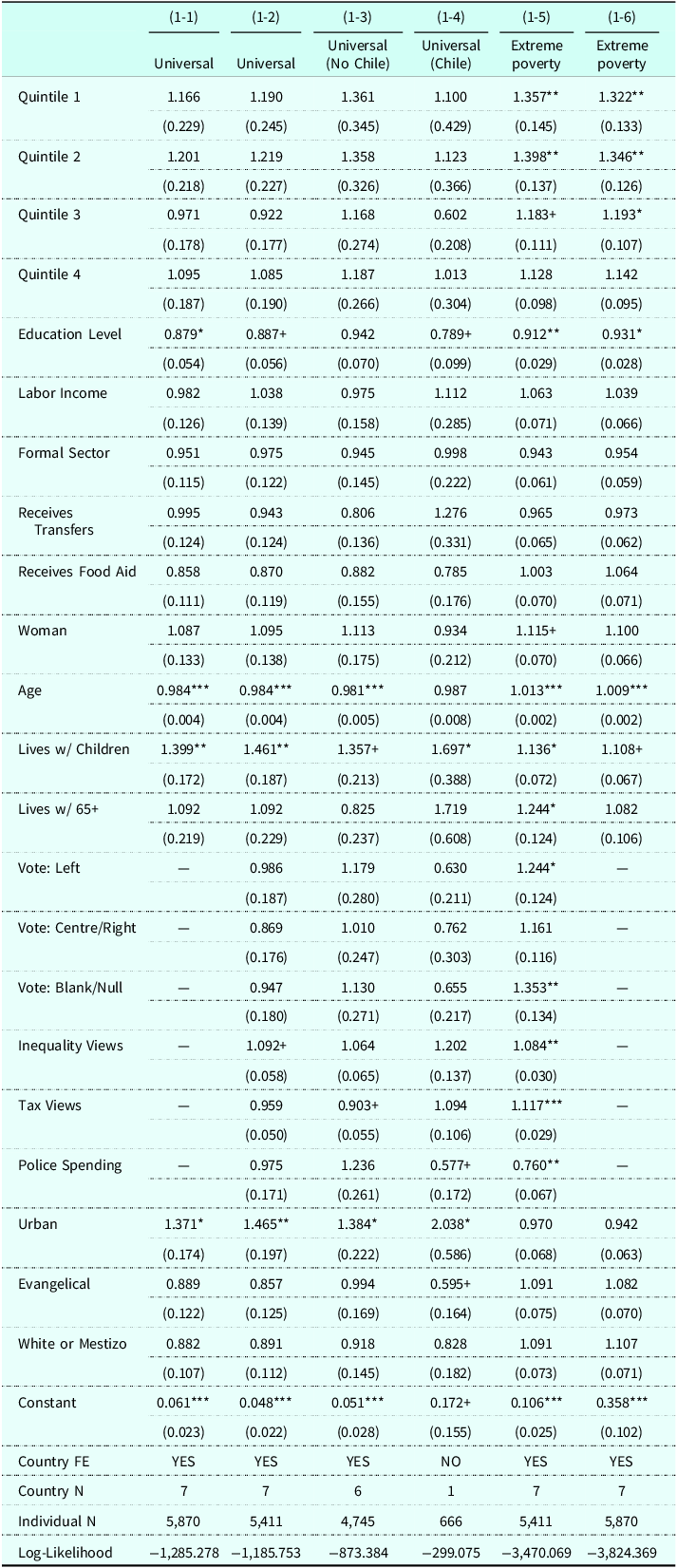
This section first presents logit estimates of support for universal cash transfers, operationalised as endorsing both the right to transfers and universal coverage, followed by equivalent models for transfers targeted at those in extreme poverty (see Table 1).
Determinants of support for a right to universal transfers and targeted transfers

Table 1. Long description
Table presenting the results of logistic regressions. The first four models present the determinants of individual-level support for a right to universal transfers. The final two models present the determinants of individual-level support for a right to transfers to those in extreme poverty.
Coefficients presented as log odds. Standard errors are in parentheses. Coefficients for country fixed effects are omitted for brevity. The top quintile serves as the reference category for household wealth variables. ***P < .001, **P < .01, *P < .05, +p<0.10.
Support for universal transfers
Support for a right to transfers is quite high: more than two-thirds (68.6 per cent) of respondents either agree (60.5 per cent) or strongly agree (8.2 per cent). There is, however, substantial cross-national variation, ranging from 80.7 per cent in Guatemala to 46.6 per cent in Argentina.
While sizable majorities, except in Argentina, support a right to transfers, they overwhelmingly support targeting. In a major blow to the prospects of universal transfers in the region, only 8.4 per cent of respondents support universal coverage. The overwhelming majority (86.4 per cent) believe that only the poor should receive transfers, and most of them (76 per cent) would restrict them to those in extreme poverty.
Chile is an outlier: 23.7 per cent would back universal transfers and only 36.6 per cent would limit transfers to those in extreme poverty. As noted earlier, this may reflect the heated debate over UBI and welfare expansion following the 2019–2020 mass protests, which, however, the survey does not directly address. The Estallido capped more than a decade of popular mobilisation starting in 2011 that re-politicised inequality after years of cross-party neoliberal consensus (Roberts, Reference Roberts2016). By 2022, debates over universal social policy had been prominent in Chile, likely making Chileans more open to universal transfers.
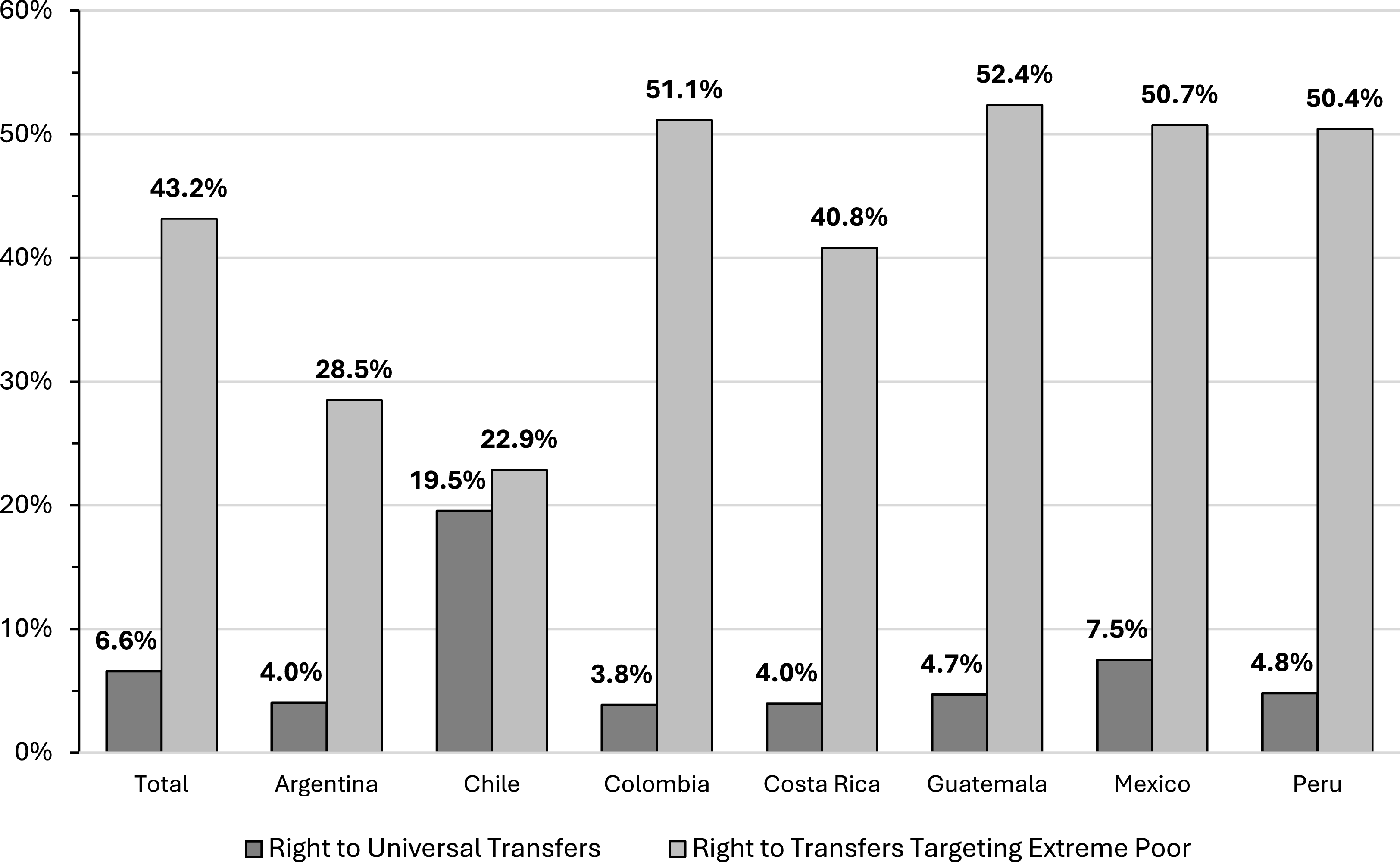
Only 6.6 per cent of respondents support both a right to transfers and universal coverage. Chile again stands out (19.5 per cent), while support elsewhere ranges from 4 per cent in Argentina, Costa Rica and Colombia to 7.5 per cent in Mexico (see Figure 1). As in Chile, Mexico´s relatively high support may reflect recent reforms under López Obrador, including universal basic pensions and expanded targeted unconditional transfers (Borges, Reference Borges2025).
Dependent variables.

Figure 1. Long description
Bar charts of the two dependent variables: average national support for a right to universal transfers and average national support for a right to transfers targeting those living in extreme poverty. The chart is organized in pairs comparing support for universal and targeted transfers.
The low level of support for a right to universal transfers is striking. Latin American views on poverty and responsibility to ameliorate it have more closely resembled those of continental Europeans than those of residents of the United States (Lindert et al., Reference Lindert, Skoufias and Shapiro2006, p. 10). From 2008–2023, 60 per cent of Latin Americans surveyed by the Latin American Public Opinion Project strongly agreed (6 or 7 on a 7-point scale) that the government should ‘implement strong policies to reduce income inequality’.Footnote 4 Further, seven in ten respondents in our surveys ‘strongly support’ (5 on a 5-point scale) transfers to children (70.4 per cent) and the elderly (72.0 per cent), with smaller but sizable shares strongly backing transfers to the unemployed (60.5 per cent) and even immigrants (38.7 per cent) (Blofield et al., Reference Blofield, Borges and Martínez Franzoni2026, 106). Thus, it is not that Latin Americans reject social policy or are skeptical of the government’s ability to redistribute – they specifically reject universal transfers.
Given Chile’s seeming exceptionalism, regression models are estimated with (1–1 and 1–2) and without Chile (1–3) and Chile is analysed separately (1–4).
Explaining support for universal transfers
Support for a right to universal transfers is not only low but appears unrelated to socio-economic status, prior benefits receipt or ideology.Footnote 5 Instead, it is higher among younger people and people living with children. The main determinants thus reflect household composition. Further, urban residents are also substantially more likely to support such transfers.
Model 1-1 excludes ideological variables and is in line with the most consistent findings in European UBI research, showing that younger Latin Americans are much more likely to support universal transfers. Based on this model, it is estimated that a one-standard-deviation increase in age (15.5 years) reduces the likelihood of supporting universal transfers by 1.1–1.9 percentage points. A typical 18-year-old is about 38 per cent more likely to support the policy than a comparable respondent with a sample-mean age of 41 (10.0 per cent versus 7.3 per cent). Among typical 80-year-olds, support drops to only about 4.1 per cent. This finding is robust to including ideology, excluding any country and restricting the sample by gender.Footnote 6
Additionally, living with children further increases the likelihood of supporting universal transfers by about a third (35.3 per cent), raising support among a typical respondent from 5.4 to 7.3 per cent. This finding is also robust across model specifications and samples.Footnote 7
Regarding socio-economic status, only education appears to influence support for universal transfers. Education, however, is only marginally significant (0.10 level) in models accounting for ideology and when the sample is restricted to men.Footnote 8 Further, education is not significant when Chile is excluded (1–3) or when the sample is limited to women.Footnote 9
Finally, urban residents are 1.9 pp (32 per cent) more likely to support universal transfers (7.2 per cent versus 5.3 per cent), a result robust to the exclusion of any of the countries, but not significant when the sample is restricted to men.Footnote 10
Model 1-2 adds ideological variables. However, only one – attitude toward inequality – approximates marginal statistical significance. Including these variables, as noted, also renders education no longer significant at the standard level. Results for age, living with children and urban residency remain largely unchanged.
Given Chile’s higher support for universal transfers, models 1-3 and 1-4 exclude Chile and analyse it separately, revealing distinct drivers, especially regarding household composition. Notably, excluding Chileans significantly weakens the positive impact of living with children. Although still positively signed, the coefficient becomes only marginally significant. In contrast, among Chileans, living with children not only retains a positive and significant impact, but it has a substantially larger effect. Among otherwise typical Chileans, living with children raises support from 9.7 per cent to 15.4 per cent, indicating that Chile drives much of this relationship in the full sample. Living with children increases the likelihood of supporting universal transfers by 59.1 per cent among Chileans, compared to 43.0% among the full sample.
Surprisingly and contrary to prior models and European evidence, younger Chileans are no more likely to support universal transfers than their older counterparts.
Beyond household composition, results are not that different: socio-economic status and ideology show no clear effects. Among Chileans, higher education and support for reallocating social spending to public security are associated with lower support for universal transfers, although these relationships are only marginally significant. Excluding Chileans, support for taxing the rich appears negatively correlated with support for universal transfers, but this effect is also marginally significant. Other socio-economic and ideology variables show no effect, and, as in the full models, prior receipt of cash transfers or food aid remains unrelated to support for universal transfers.
Regarding the control variables, the impact of urban residence is substantially larger among Chileans than among the full sample. The typical urban Chilean is almost twice as likely to support universal transfers as a rural one (14.7 per cent versus 7.9 per cent), possibly reflecting the urban nature of the Estallido Social protests.
In sum, support for universal transfers among residents of the seven Latin American countries analysed is limited and largely unrelated to socio-economic status or ideology. Further, the drivers of support differed significantly in Chile. We now turn to support for means-based transfers.
Support for a right to transfers for individuals in extreme poverty
The plurality of respondents (43.2 per cent) supports a right to transfers limited to those in extreme poverty (see Figure 1). And, unlike support for universal transfers, support for targeted transfers is greatly influenced by socioeconomic status and ideology,
Model 1-5 shows that support for a right to transfers limited to those in extreme poverty follows economic self-interest. People in the bottom two quintiles are more likely to support this policy than those in the top quintile, while those with more education are less likely to support it. Both findings are robust to the exclusion of any of the countries studied.Footnote 11 Beginning with wealth, a typical person in the first (second) quintile is expected to be 7.2 pp (7.9 pp) more likely to support these transfers than one in the top quintile. This amounts to a 15.8 per cent (17.4 per cent) increase. People with a college education are 4.3 pp less likely to support such transfers than those with secondary education.
Ideology is also a major determinant: moving from neutral positions to strongly agreeing that inequality is too high and that the rich should be taxed more increases support by 3.7 pp and 5.0 pp, respectively. Similarly, prioritising police over social spending decreases support by 6.4 pp. These findings are robust to the exclusion of any of the countries.Footnote 12 Having voted for the left-wing candidate in the previous election has a smaller and less robust effect.
Taken together, the most ideologically inclined respondents are nearly twice as likely to support a right to transfers for those in extreme poverty (54.3 per cent) than the least ideologically inclined (29.2 per cent). This effect exceeds that of socio-economic status: a bottom quintile respondent with only primary education is about a third more likely to support the policy than a top-quintile, university-educated respondent (41.9 per cent versus 55.5 per cent).
As with universal transfers, prior receipt of cash- or food assistance does not influence support for narrowly targeted transfers.
Regarding household composition, living with children increases support for transfers for those in extreme poverty. This finding, however, is not robust to excluding specific countries.Footnote 13 In contrast to universal transfers, younger respondents are less likely to support targeted transfers: a typical 18-year-old is 6.8 pp less likely to support the policy than a comparable 41-year-old. The typical 80-year-old is 10.9 pp more likely to support it than a comparable 41-year-old. This finding is robust to the exclusion of any of the countries. Women also appear more likely than men to support the policy, though this is only marginally significant.
Explaining cross-national variation
The demand-capacity paradox (Parolin & Siöland, Reference Parolin and Siöland2020), the finding that UBI support is lower in countries with more comprehensive welfare policies and higher in those with greater unemployment, poverty and inequality, is perhaps the most notable macro-level finding of European public opinion research on UBI. Through binary scatterplots, this section briefly assesses whether that pattern is present among the Latin American countries surveyed.
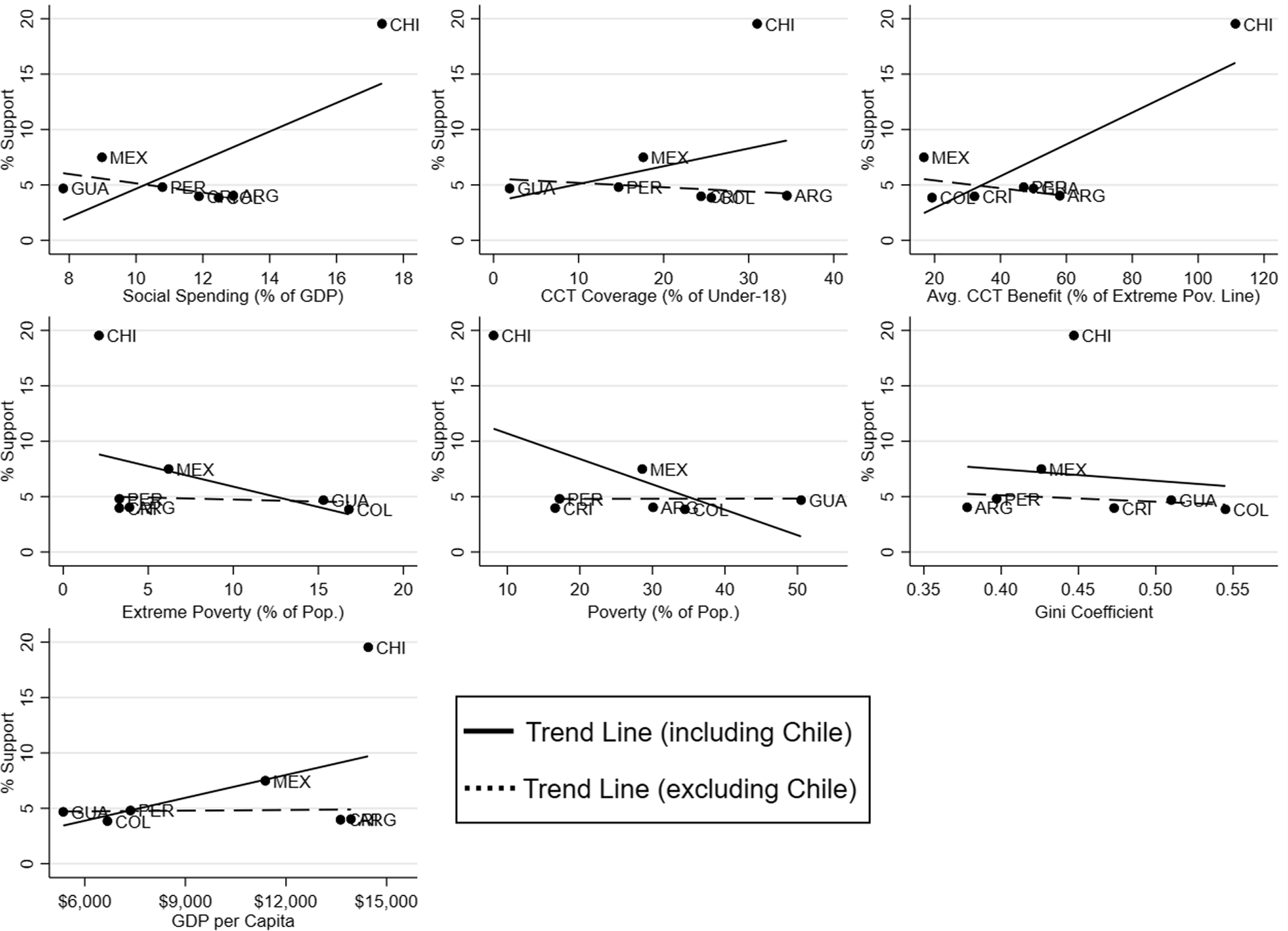
At first glance, the demand-capacity paradox does hold support in Latin America: support for universal transfers is higher in countries with greater social spending (as a share of GDP), more generous CCTs, higher GDP per capita and lower where poverty and extreme poverty are higher (see Figure 2, solid lines).
National-level correlates of average support for a right to universal transfers (including/excluding Chile).

Figure 2. Long description
Scatterplots of the correlations between average support for a right to universal transfers and social spending, CCT coverage, average CCT benefit, extreme poverty rate, moderate poverty rate, Gini coefficient, and GDP per capita.
These findings, however, are largely driven by Chile, where support for universal transfers is almost four times higher than in the other six countries. Excluding Chile reveals some support for the demand-capacity paradox (see Figure 2, dashed lines). Among the remaining six countries, support is higher where social spending and CCT coverage and generosity are lower. However, support for universal transfers also tends to be higher where inequality is greatest and shows no clear relation with poverty or GDP per capita.
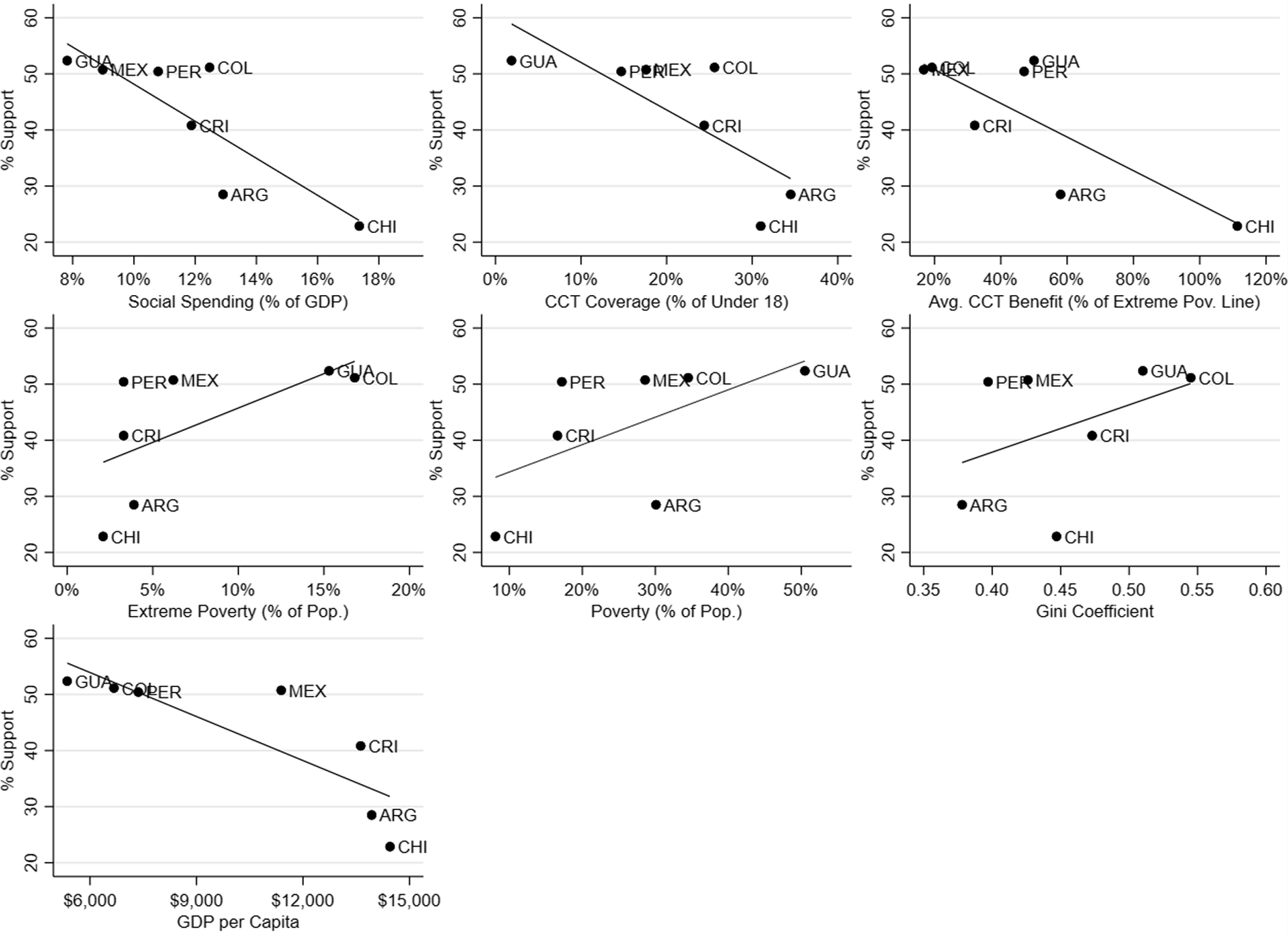
We also assess whether the demand-capacity paradox applies to support for the right to targeted transfers (see Figure 3). Overall, the evidence for this relationship is stronger for targeted than for universal transfers. Support is higher in countries with lower social spending, cash transfer coverage and generosity, and GDP per capita. Support is also higher where poverty, extreme poverty and income inequality are higher.
National-level correlates of average support for a right to transfers targeting extreme poor.

Figure 3. Long description
Scatterplots of the correlations between average support for a right to transfers targeting those living in extreme poverty and social spending, CCT coverage, average CCT benefit, extreme poverty rate, moderate poverty rate, Gini coefficient, and GDP per capita.
Discussion
The findings confirm that support for universal transfers remains limited across the region, especially when compared to more targeted transfer schemes. Importantly, and contrary to expectations about programmatic feedback, current transfer recipients are no more likely to support a right to universal transfers. This may reflect the strong path dependency of Latin America’s social programmes, where benefits have long been associated with targeting rather than universality.
Other factors, such as living with children and urban residence, are positively associated with support for the right to a universal transfer. However, the overall lack of consistent support across socio-economic and ideological lines leaves UBI without a clearly defined constituency or base of political support.
The notable variation in support across countries – particularly Chile’s significantly higher levels of support for a right to universal transfers – highlights the importance of country- and context-specific political and institutional factors. Still, the consistency of the broader patterns points to shared regional dynamics in how access to social programmes is understood and politically supported, especially in welfare arrangements historically rooted in segmented access to social benefits.
In contrast, support for the right to means-tested transfers is not only more widespread but also clearly influenced by both socio-economic status and ideology. Poorer respondents and those with lower levels of education are significantly more likely to endorse targeted transfers, in line with mainstream political economy theories of self-interest. With regard to ideology, support for a right to targeted transfers is higher among those who voted for left-wing candidates, perceive inequality as too high, support taxing the rich to fund social programmes and oppose funding the police over social programmes.
At the macro level, national-level correlates of support for a right to universal and targeted transfers offer evidence that the demand-capacity paradox present in support for UBI among European countries is also present in Latin America. When the outlier Chile is excluded, bivariate correlations show that support for a right to universal transfers is higher in Latin American countries with lower social spending and CCT coverage and benefit levels. Similar, if stronger, patterns are present among the national-level correlates of support for a right to transfers targeting those in extreme poverty. Support for such a policy is higher in countries with lower social spending, CCT coverage and benefit levels and GDP per capita. Further, support is higher where poverty (extreme and moderate) and inequality are higher. Together, these correlations point to the demand-capacity paradox being a phenomenon that extends beyond Europe to middle-income countries.
Summary and conclusions
This exploratory study provides one of the first cross-national analyses of public attitudes toward universal cash transfers in Latin America. Using original survey data from seven countries, we find limited public support for a right to universal transfers, even after COVID-19 significantly expanded coverage through state deployment of emergency assistance. Support for a right to universal transfers is confined to a small minority and does not align with economic self-interest or ideological predictors. In contrast, support for highly targeted transfers is widespread and follows expected patterns linked to wealth, education, ideology and concern about inequality.
Importantly, we find no evidence that receiving or having received targeted transfers increases support for universal ones. Indeed, recipients are no more likely to endorse a right to universal benefits, suggesting that targeted programmes may entrench rather than broaden targeting preferences.
Chile stands out for its much higher support for universal transfers, underlining how exceptional political circumstances, such as mass mobilisation or constitutional reform processes, may open space for more expansive social policies. Elsewhere, path dependency and constrained welfare architectures continue to shape public expectations over state assistance.
These findings suggest that in Latin America, political and social support for universal income programmes remains tenuous. Far from laying the groundwork for UBI, targeted programmes may be reinforcing welfare arrangements centred on means-testing and conditionality. Future research should further investigate the drivers of these public attitudes, including elite and institutional ones, and assess whether alternative framings can meaningfully alter the conditions to expand support for broader social rights in the region. UBI advocates should further study the Chilean case for lessons on how inequality can be politicised in ways that increase public support for universal policies.
Supplementary material
The supplementary material for this article can be found at https://doi.org/10.1017/S0047279426101718.
Funding statement
Surveys used for this study were primarily conducted with research funding from Deutsche Forschungsgemeinschaft (DFG), the German Foundation for Scientific Research allocated to Merike Blofield and Juliana Martínez (project number 468209777).
Competing interests
The authors declare none.


 Open access

