Introduction
The ‘krill surplus’ hypothesis was first proposed by Sladen (Reference Sladen1964) and expanded upon by Laws (Reference Laws1977, Reference Laws1985) to explain increases in Antarctica penguin populations in the 1960s as a result of historic depletion of baleen whales and fur seals in the Southern Ocean. The severe depletion or near extinction of numerous krill-eating species such as the southern right whale (Eubalaena australis Gray), blue whale (Balaenoptera musculus (L.)), humpback whale (Megaptera novaeangliae (Borowski)), and southern fur seal (Arctocephalus gazella (Peters)) in particular left tons of unconsumed krill (Euphausia spp.) for penguins to exploit (Laws Reference Laws1977). Chinstrap (Pygoscelis antarctica Forster) and Adélie penguins (Pygoscelis adeliae (Hombron & Jacquinot)) in particular seem to have benefited the most from this surplus with populations increasing in the Antarctic Peninsula through the 1970s. By the late 1970s and 1980s, however, a decline in Adélie penguins was observed while chinstrap penguins continued to increase. This discrepancy was attributed to a decline in sea ice in the Antarctic Peninsula that impacted the Adélie penguin more so than the chinstrap (Fraser et al. Reference Fraser, Trivelpiece, Ainley and Trivelpiece1992).
Since the mid-1980s, however, climate warming, a continued decline in sea ice and therefore krill productivity, and a drop in ocean productivity in the western Antarctic Peninsula have severely impacted populations of chinstrap and Adélie penguins (Atkinson et al. Reference Atkinson, Siegel, Pakhomov and Rothery2004, Montes-Hugo et al. Reference Montes-Hugo, Doney, Ducklow, Fraser, Martinson, Stammerjohn and Schofield2009, Trivelpiece et al. Reference Trivelpiece, Hinke, Miller, Reiss, Trivelpiece and Watters2011). Thus, any krill surplus that may have existed from a decline in baleen whales and fur seals was no longer evident. Emslie & Patterson (Reference Emslie and Patterson2007) provided the first direct evidence in support of the krill surplus hypothesis with stable isotope analysis (δ13C and δ15N) of Adélie penguin eggshell from active and abandoned colonies, the latter record extending to over 38 000 years before present (bp). They documented an abrupt shift in penguin diet within the past 200–300 years to lower trophic prey, or a krill-based diet, in correlation with the removal of baleen whales and krill-consuming seals in the Southern Ocean. Additional evidence for this dietary shift also has been documented by Huang et al. (Reference Huang, Sun and Wang2010) in δ15N in modern to 8000 year old Adélie penguin bone and feather from Vestfold Hills, Antarctica.
One other penguin species also depends on krill for part or most of its diet, the gentoo penguin (Pygoscelis papua Forster), and thus, should also exhibit a dietary shift associated with the krill surplus. This species has been increasing in the Antarctic Peninsula, and expanding farther to the south, since the 1980s despite a decline in krill throughout this region (Smith et al. Reference Smith, Domack, Emslie, Fraser, Ainley, Baker, Kennett, Leventer, Stammerjohn, Mosley-Thompson and Vernet1999, Zhu et al. Reference Zhu, Sun, Yin, Xie and Liu2005, Ducklow et al. Reference Ducklow2007). Gentoo penguins also feed relatively more on fish than Adélie and chinstrap penguins and this, among other reasons, may explain why a decline in sea ice and krill has not impacted this species as much as the other two (Trivelpiece et al. Reference Trivelpiece, Trivelpiece and Volkman1987, Reference Trivelpiece, Hinke, Miller, Reiss, Trivelpiece and Watters2011). Unfortunately, the past record for gentoo penguin in Antarctica is more limited than that for the Adélie penguin and only a few ancient deposits have been located and sampled.
Emslie et al. (Reference Emslie, Ritchie and Lambert2003) reported excavations of abandoned gentoo penguin colonies at King George Island, Antarctic Peninsula. Although the material recovered was relatively young in age, dating to the late Holocene or 500–600 bp after correcting and calibrating for the marine carbon reservoir effect, it was still older than when the purported ‘krill surplus’ began at about 150–200 years ago. A recent paper by Emslie et al. (Reference Emslie, Baumann and van Tuinen2011) reported excavations of gentoo penguin colonies at Byers Peninsula, Livingston Island. This record also is relatively young, dating to the past 1000 years, with ancient DNA extracted from penguin eggshell membranes to verify the identification of the penguin species. Finally, one other gentoo penguin deposit reported herein was excavated in 2011 at an active colony on Ardley Island, King George Island, where penguin occupation has existed for at least the past 2400 years (Wang et al. Reference Wang, Want, Wang and Sun2007). Our excavations produced additional penguin tissues that predate the krill surplus. Here, we present stable isotope analysis of ancient and modern gentoo penguin eggshell membrane from all three of these localities to determine if this species also underwent an historic dietary shift in accordance with the krill surplus hypothesis. We focused our analyses on egg membrane (the inner lining of the eggshell) because it has preserved better than other tissues in the ancient gentoo penguin deposits that we investigated.
Methods
Study sites and sample collection
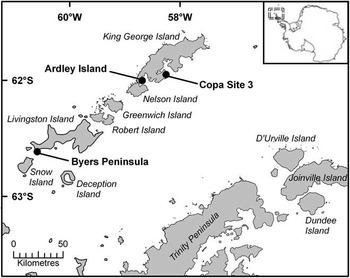
Eggshell membrane was recovered during excavations of abandoned gentoo penguin colonies at two locations in the Antarctic Peninsula: Copa Site 3 at King George Island (Emslie et al. Reference Emslie, Ritchie and Lambert2003) and from Mound 3 at Devils Point, Byers Peninsula, Livingston Island (Fig. 1; Emslie et al. Reference Emslie, Baumann and van Tuinen2011). The egg membrane samples from Copa Site 3 were recovered from levels 2 (n = 5) and 3 (n = 5); those from Byers Mound 3 were recovered from levels 2, 4, 5, 7, and 8 (n = 6 samples per level). Identification of gentoo penguin tissue from these sites was confirmed with ancient DNA analyses. Modern eggshell membrane samples were collected near active gentoo penguin colonies at Byers Peninsula (n = 22) and Admiralty Bay, King George Island (n = 20), in 2008/09 and at Ardley Island (n = 20) in 2010/11. These samples were collected by gathering recently hatched eggs in and near the colonies or recently depredated eggs near skua (Stercorarius spp.) nests near the colonies.
Map of the Antarctic Peninsula (inset) with details of boxed area showing the location of sampling sites on Livingston, Ardley, and King George islands.

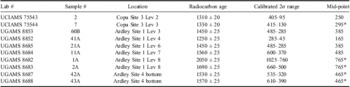
We also sampled modern and older sediment at four locations (Sites 1–4) within an active gentoo penguin colony on the east end of Ardley Island, King George Island, in January 2011 (Fig. 1; Table I). These areas were excavated in 5–10 cm levels to the bottom of ornithogenic deposits to a depth of 60 cm below surface at each site using methodology similar to excavations at Copa and Byers. All excavated sediment were screen-washed and sorted using the methods of Emslie et al. (Reference Emslie, Ritchie and Lambert2003, Reference Emslie, Baumann and van Tuinen2011). Two of these locations, Sites 1 and 4 (62°13′00.6′′S, 58°55′13.0′′W and 62°12′43.7′′S, 58°55′06.6′′W, respectively) produced enough egg membrane for use in stable isotope analyses here. At Site 1, egg membrane was recovered and analyzed from levels 3 (n = 10), 4 (n = 11), 6 (n = 10), 7 (n = 10), and 8 (n = 10), including samples that were split in half and used for radiocarbon dating (Table I). Site 4 was a 60 cm deep deposit below an active penguin mound. The bottom 5 cm of this deposit was sampled to recover ten egg membrane samples used here.
Radiocarbon dates with calibrated 2σ ranges on gentoo penguin egg membrane from Copa Site 3 and Ardley Island Sites 1 and 4, Antarctic Peninsula. All dates were completed at the University of California-Irvine AMS Facility and the University of Georgia Accelerator Mass Spectrometry facility and are catalogued with UCIAMS and UGAMS numbers, respectively. The conventional radiocarbon ages were calibrated using the Calib 6.0 program and a ΔR = 700±50 years to produce 2σ ranges in calendar years bp. The mid-point of these ranges was used to assign ages to associated membranes by level; an asterisk (*) indicates mid-points calculated using the minimum and maximum of multiple dates from the same stratigraphic level.

Sample preparation and stable isotope analysis
All egg membranes recovered from excavated deposits were rinsed with distilled water and if necessary cleaned with a small brush to remove any adhering dirt and other matter. Egg membranes from modern egg samples were extracted from the inner shell surface, cleaned with a small brush and rinsed in distilled water to remove any organic material adhering to the membrane. Approximately 0.5 mg of clean, dry egg membrane was loaded into tin cups, flash-combusted (Thermo-Finnigan and Costech ECS4010 elemental analyzers) and analysed for δ13C and δ15N through Con-Flo III devices interfaced with Thermo Finnigan Delta Plus XL and Delta V Plus continuous-flow stable isotope ratio mass spectrometers. Raw δ values were normalized using IAEA NO-3, IAEA CH-6, USGS-40, USGS-41 and internal standards. Precision was better than ± 0.2 ‰ for both carbon and nitrogen isotope values. Stable isotope abundances are expressed in δ notation in per mil (‰), according to the following equation:
 $$ {\rm{\rdelta }}X \,{\rm{ = }}\,{\rm{[(}}{{R}_{sample}}\:{\rm{/}}\:{{R}_{standard}}{\rm{)\, {\hbox-}\, 1]}}\,{\rm{\cdot }}\,{\rm{1000}} \eqno\rm$$
Where X is 13C or 15N and R is the corresponding ratio 13C /12C or 15N /14N. The R standard values relative to the Vienna PeeDee Belemnite (VPDB) standard for 13C and atmospheric N2 (AIR) standard for 15N.
Radiocarbon dating
Radiocarbon dates were obtained from penguin egg membrane, eggshell, feather, or bone at all sites investigated here. Most dates have been published elsewhere for Copa Site 3 (Emslie et al. Reference Emslie, Ritchie and Lambert2003) and for the abandoned mounds at Byers Peninsula (Emslie et al. Reference Emslie, Baumann and van Tuinen2011). Here, two additional dates were completed on egg membrane from Copa Site 3. Radiocarbon analyses were also conducted on eight egg membrane samples from excavated sediment at Ardley Island Sites 1 and 4 (Table I). All membrane samples were split in half so that one-half could be used for stable isotope analysis and the other half for radiocarbon analysis. This method provides an absolute date for stable isotope results reported here.
All dates were corrected and calibrated for the marine-carbon reservoir effect using Calib 4.2 to 6.0.2 version software (Stuiver & Reimer Reference Stuiver and Reimer1993; http://calib.qub.ac.uk/calib) and a ΔR = 700±50 bp to obtain a 2σ calibrated range in calendar years bp. The minimum and maximum ages of these ranges were rounded to the nearest five years. Egg membranes used for stable isotope but not radiocarbon analysis were assigned ages in accordance with dated membranes and other tissues from the same stratigraphic level. To simplify analysis and data plots, the date corresponding to the mid-point of each 2σ calibrated range was used as an estimated age for those samples associated with that date. When multiple dates were available from the same stratigraphic level, the minimum and maximum of all calibrated ranges collectively was used to calculate the mid-point. For example, three calibrated ranges for one date from level 7 Byers Mound 3 were 455–225, 210–200, and 160–150 bp with the minimum and maximum range as 455–150 yielding a midpoint of approximately 305 bp.
Statistical analysis
Dietary shifts were first assessed by comparing modern and ancient eggshell membrane δ13C and δ15N values across and within each site. As the mid-point date of all calibrated ranges predated the purported initiation of the krill surplus in Antarctica, all ancient samples from each locality were used to calculate mean isotope values for those localities for comparison to means from modern egg membrane samples. A two-way ANOVA with Tukey-Kramer multiple comparison tests was then used to assess differences in mean δ13C and δ15N values with age (ancient versus modern) and locality (Copa, Byers, and Ardley) as independent variables. Significance was assumed at P < 0.05.
In addition, we used a two-source Bayesian mixing model (Parnell et al. Reference Parnell, Inger, Bearhop and Jackson2010) in the R environment (R Development Core Team 2007) to quantify shifts between fish and krill consumption between modern and ancient time periods across and within each site. We used published stable isotope values (δ13C, δ15N) of Antarctic krill (Euphausia superba Dana) and a common prey fish species (Lepidonotothen squamifrons (Günther)) collected from the northern Antarctic Peninsula and South Shetland Islands from 2005/06 to 2008/09 as our two prey sources (Polito et al. Reference Polito, Lynch, Naveen and Emslie2011). For this model we incorporated gentoo penguin egg membrane discrimination factors (δ13C: 2.8±0.5; δ15N: 4.4±0.5; Polito et al. Reference Polito, Fisher, Tobias and Emslie2009, M. Polito, unpublished data) and ran 1 million iterations, thinned by 15, with an initial discard of the first 40 000 resulting in 64 000 posterior draws. While this mixing model approach may be informative for examining diet shifts over time, it does not account for variation in krill and fish stable isotope values between modern and ancient time periods. As in other studies, detailed historical stable isotope data from krill and fish prey species, that are currently unavailable, are required to conclusively validate comparisons between modern and ancient times (Bond & Jones Reference Bond and Jones2009).
Results
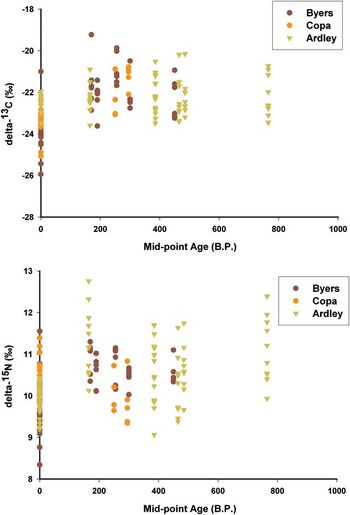
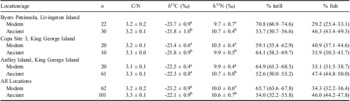
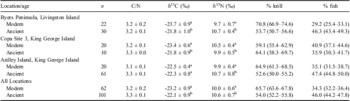
Mid-points of calibrated radiocarbon dates from dates reported here (Table I) and in Emslie et al. (Reference Emslie, Ritchie and Lambert2003, Reference Emslie, Baumann and van Tuinen2011) indicate that all egg membrane samples from ancient deposits are at least 165 years old or older. δ13C and δ15N values of these ancient membranes were plotted with modern egg membranes collected at the same localities (Fig. 2). After averaging all ancient sample δ13C and δ15N results regardless of age (Table II) and comparing these means to those of the modern egg membranes, we found a significant decline in mean values of both δ13C (-1.1‰; F 1, 162 = 68.90, P < 0.0001) and δ15N values (-0.6‰; F 1, 162 = 14.35, P < 0.0002). Similarly, mixing model results suggest an overall 11.7% increase in the proportion of krill in modern gentoo penguin diets across all sites, relative to ancient samples (Table II). While there were no differences in egg membrane δ13C and δ15N values across sites independent of age (F 2, 162 < 2.54, P > 0.0820), a significant interaction occurred between time period and site for both δ13C and δ15N (F 2, 162 > 12.58, P < 0.0001). This interaction occurred because Copa had a 0.6‰ increase in δ15N from ancient to modern, opposite of Ardley and Byers Peninsula which exhibited a 0.8–1.0‰ decrease. In addition, Ardley showed only a slight decrease of 0.2‰ in δ13C from ancient to modern in contrast to a more significant decrease of 1.9‰ at Byers Peninsula and 1.6‰ at Copa (Table II). Our isotopic mixing model suggests a 12.3% and 17.1% increase in the proportion of krill in modern gentoo penguin diets at Byers Peninsula and Ardley Island, respectively, relative to ancient samples (Table II). In contrast, there was a 5% decrease in the proportion of krill in modern gentoo penguin diets at Copa relative to ancient samples, though 95% confidence intervals overlapped between these two time periods.
Gentoo penguin δ13C (top) and δ15N (bottom) values of ancient and modern egg membrane from three sites in the Antarctic Peninsula: Byers Peninsula, Livingston Island, Mound 3 (diamonds), Copa Site 3, King George Island (squares), and Ardley Island Sites 1 and 4 (triangles). Plotted ages are mid-points of calibrated 2σ ranges in calendar years BP from dates obtained on samples from each stratigraphic level.

Mean ± SD of eggshell membrane δ13C and δ15N values and the estimated percent krill (Euphausia superba) and fish (Lepidonotothen squamifrons) in the diets of ancient and modern gentoo penguins from Copa Site 3 and Ardley Sites 1 and 4, King George Island, and Devils Point, Byers Peninsula, Livingston Island. The C:N ratio also is given for each sample group. Diet estimates are provided with 95% confidence intervals (in parentheses) and were calculated using a two-source Bayesian mixing model (Parnell et al. Reference Parnell, Inger, Bearhop and Jackson2010). Modern samples were collected at Byers Peninsula and King George Island in 2008/09, and at Ardley Island in 2010/11. Superscript letters for ancient versus modern stable isotope values within each locality indicate significant differences if letters differ (Tukey Kramer post-hoc tests, P < 0.05).
Discussion
The significant decrease in both δ15N and δ13C values in ancient to modern egg membrane at Ardley Island and Byers Peninsula implies that a dietary shift occurred in gentoo penguins in accordance with the krill surplus hypothesis. However, shifts in gentoo penguin stable isotope values (all < 2‰) were not as large as those found in Adélie penguins over the same time periods (∼4–6‰ decrease in δ15N and ∼8–10‰ decrease in δ13C; Emslie & Patterson Reference Emslie and Patterson2007). Furthermore, our isotopic mixing model suggests a maximal 17.1% increase in the proportion of krill in modern relative to ancient diets. These small shifts in gentoo penguin diets during the krill surplus may be indicative of their generally higher propensity to consume fish relative to other Pygoscelis penguin prey species. For example, the diets of breeding Adélie and chinstrap penguins in the South Shetland Islands are dominated by krill and often contain little fish (Trivelpiece et al. Reference Trivelpiece, Trivelpiece and Volkman1987). In contrast, breeding gentoo penguins can feed from up to 21 to 37% on fish with males relying on this prey source more than females (Miller et al. Reference Miller, Kappes, Trivelpiece and Trivelpiece2010). Outside of the breeding season, non-krill prey such as fish and squid can comprise up to 58% of gentoo penguin diets (Jablonksi Reference Jablonski1985, Williams Reference Williams1995, Polito et al. Reference Polito, Lynch, Naveen and Emslie2011).
Because gentoo penguins feed relatively more on fish than the other pygoscelid penguins, it can be expected that their δ15N values will be higher and more variable between years and colonies. For example, our results suggest that modern diets of gentoo penguins at each of our three sites differed to varying degrees. This variation is also apparent in a recent study of modern Adélie and gentoo penguin eggshell isotopes from numerous colonies throughout the Antarctic Peninsula as well as the South Orkney and South Shetland Islands (Polito et al. Reference Polito, Lynch, Naveen and Emslie2011). These authors found mean δ15N values to be up to 0.8‰ higher in gentoo penguins compared to Adélie penguins at the same location; δ13C values also were from 0.3 to 1.0‰ higher in gentoo penguins at these sites. The more eclectic diet in gentoo penguins has probably characterized this species in the past as well as today as suggested by the variation in δ15N that we observed among the three sites and time periods, with one site (Copa Site 3) even showing a slight increase in δ15N values in modern samples (Table II, Fig. 2).
Lorenzini et al. (Reference Lorenzini, Olmastroni, Pezzo, Salvatore and Baroni2009) suggest that high nitrogen values in ornithogenic sediment due to ammonia volatilization (Mizutani & Wada Reference Mizutani and Wada1988) would explain high δ15N values in ancient eggshell reported by Emslie & Patterson (Reference Emslie and Patterson2007). However, the high values related to bacterially mediated volatilization occur only in the soil and in plants growing in that soil that utilize ammonia as their nitrogen source. Detrital remains that are allochthonous to the soil, including penguin bone, feather, and eggshell are not influenced by this process. This absence of an effect on eggshell is further evinced by the relatively low δ15N values 10–16‰ in penguin samples reported by Emslie & Patterson (Reference Emslie and Patterson2007) versus the very high values (31–35‰) in soil and cyanobacteria reported by Mizutani & Wada (Reference Mizutani and Wada1988). In addition, δ15N values on modern versus ancient gentoo penguin egg membranes reported here display opposite trends, i.e. decreases at two sites and an increase at one (Copa Site 3). Such trends would not occur if volatilization was impacting these remains. Thus, volatilization does not appear to influence ancient penguin remains in ornithogenic sediment and the argument presented by Lorenzini et al. (Reference Lorenzini, Olmastroni, Pezzo, Salvatore and Baroni2009) is not valid.
Anthropogenic carbon may also influence δ13C values in marine and terrestrial ecosystems via the Suess effect (McNeil et al. Reference McNeil, Matear and Tilbrook2001). These authors calculated a decrease in δ13C of -0.005±0.003‰ per year, or a negligible amount of -0.1‰ every 20 years. We believe the Suess effect has had only a slight influence on our results for penguin egg membranes because old carbon is consistently upwelling in the Antarctic Peninsula, especially in areas near many penguin colonies. Moreover, the gentoo penguin is known to forage primarily inshore (Trivelpiece et al. Reference Trivelpiece, Bengtson, Trivelpiece and Volkman1986, Reference Trivelpiece, Trivelpiece and Volkman1987), where upwelling would be most intense, though this behaviour can vary throughout their range (Lescroël & Bost Reference Lescroël and Bost2005). However, Hilton et al. (Reference Hilton, Thompson, Sagar, Cuthbert, Cherel and Bury2006) attributed a historic to modern decrease in δ13C in rockhopper penguin (Eudyptes chrysocome) feathers to changes in ocean productivity, even after correcting for a Suess effect of 0.34–0.75‰ in δ13C between 1840 and 2000. The Suess effect corrections of Hilton et al. (2006) are for the sub-Antarctic and thus may be too high for the Antarctic. However, even an effect of half the magnitude they apply (∼0.4‰) could account for a portion of the declines in δ13C in penguin egg membranes observed here and might act to bias mixing model estimates of penguin diet.
Our data indicate that gentoo penguins responded only slightly to the krill surplus, with variable responses depending on colony location. This response is not surprising given the large variation in dietary signals present in modern gentoo penguins at numerous locations throughout the Antarctic Peninsula (Polito et al. Reference Polito, Lynch, Naveen and Emslie2011). Additional ancient sites are needed from other regions of the Antarctic and sub-Antarctic to fully assess dietary shifts in this species with the krill surplus hypothesis.
Acknowledgements
This research was funded by NSF Grant ANT 0739575. We thank Antonio Quesada and the Spanish Polar Program for their support of field work at Byers Peninsula and the Liguang Sun, members of CHINARE 27 at Great Wall Station, and the Chinese Institute of Polar Environment for their support of field work at Ardley Island. Raytheon Polar Services provided additional logistical support in Antarctica. We also thank Xiaodong Liu, Zhouqing Xie, and Chelsea McDougall for assistance in the field. Two anonymous reviewers provided many useful comments that helped improve this manuscript. This article was published thanks to financial support from the Ministerio de Ciencia e Innovación (Spain) with grant CTM2011-12973-E.