1. Introduction
Government sponsored central banks outside of England have a much shorter history than commercial banks and finance in general (Goodhart, Reference Goodhart1988; Smith, Reference Smith1990). While central banks are seen as integral to the regulation of monetary and banking systems today, there are several historical examples of banking systems that have been able to self-regulate in the absence of a central bank. Typically, this would be achieved by forming a club or within a club-like setting where rules were set co-operatively and limited membership was achieved by erecting some sort of barrier.
The theory of club goods provides an alternative to government provision of public goods (Buchanan, Reference Buchanan1965; McNutt, 1999; Sandler and Tschirhart, Reference Sandler and Tschirhart1997), one such good being law and order. By achieving exclusion through the club, incentives are created for the public good to be provided privately. By analogy, the same argument can be applied to the setting of rules and their enforcement within banking. In the absence of a central bank to provide regulation and enforcement of rules, club like institutions arose locally to provide the setting in which the business of banking and credit could take place.
In this paper, I present the case of the 19th century Chettiar banking system in South-east Asia. Dubbed ‘indigenous bankers’, Chettiar bankers functioned in an environment free from any government intervention or regulation of their banking. I argue that their self-regulatory mechanisms should be seen as an instance of a successful voluntary club-like institution. With such mechanisms in place, Chettiar bankers were able to provide certain key services such as information sharing, clearinghouse mechanisms and inter-bank lending. Beyond these key club goods, matters of branching decisions, reserve ratio requirements or even risk-taking were left up to the discretion of individual bankers.
The ability of voluntary co-operation and clubs to regulate and provide sufficient rules in banking have been documented in Dowd (Reference Dowd1992), White (Reference White1984, Reference White1989), Selgin (Reference Selgin1988), Selgin and White (Reference Selgin and White1987) and Dowd (Reference Dowd1989, Reference Dowd, Capie and Wood1991, Reference Dowd1994), Timberlake (Reference Timberlake1984), Briones and Rockoff (Reference Briones and Rockoff2005), Calomiris and Kahn (Reference Calomiris and Kahn1996). Timberlake (Reference Timberlake1984) presents historical evidence of the private clearinghouse arrangements amongst 19th century New York banks that worked well and provided self-regulatory functions. Calomiris and Kahn (Reference Calomiris and Kahn1996) present similar evidence on the workings of the voluntary Suffolk banking system.
The Chettiar case is distinct in that the self-regulating mechanisms were limited to banking activities. Unlike other cases considered in the literature, the money supply was not regulated by the Chettiars. While the Chettiar bankers kept fractional reserves and were able to affect the money supply to a certain extent, they never printed bank notes. Nonetheless, they do present a case of a voluntary club like setting providing key regulatory functions, distinct from a central bank.
2. Chettiars and their banking system
The Chettiars, native to the South Indian state of Tamil Nadu, started out as salt traders and money lenders in the 17th century and evolved into a full-fledged banking system by the 19th century (Chandrashekhar, Reference Chandavarkar1980; Krishnan, Reference Krishnan1959; Menon, Reference Menon1985). At its peak, their banking system extended from South India to Burma, Malaya, Ceylon (now Sri Lanka) and parts of China. It resulted from the exploitation of new business opportunities created by the British conquest of these countries in the early 19th century. It lasted until around 1930, which is when many migrated back to India and into formal joint stock banking while others disinvested from banking and finance altogether.
This decline was not due to inherent instability within the banking system. Rather it was a combination of various external factors such as the Great Depression, increasingly hostile business environments in other countries as well as the opening up of more lucrative investment opportunities in India in the formal sector (Mahadevan, Reference Mahadevan1978b; Menon, Reference Menon1985; Mukherjee, Reference Mukherjee2011; Weerasooria, Reference Weerasooria1973). They were an important source of credit in the countries where they did business and are widely acknowledged as having been instrumental to the economic development of various industries (Baker, Reference Baker1984; Curtin, Reference Curtin1984; Mahadevan, Reference Mahadevan1978a, Reference Mahadevan1978b; Tun Wai, Reference Tun Wai1953; Weerasooria, Reference Weerasooria1973).
Keynes (Reference Keynes1913: 195) divided financial markets in India into four categories: ‘(i) The Presidency Banks, (ii) The European Exchange Banks, (iii) The Indian Joint Stock Banks, and (iv) the Shroffs, Marwaris, and other private bankers and money lenders’. The Chettiar bankers, similar to the Shroffs and Marwaris, belong in the fourth and final category, that of private bankers. Alternatively known as ‘indigenous’ bankers, their growth and functioning took place outside of the formal government-backed banking sphere. Jain (Reference Jain1929: 1) describes indigenous bankers as ‘not required to register themselves as such under any law of the realm’. He writes of the distinction between the formal European banks and the informal indigenous bankers as (Jain, Reference Jain1929: 25):
Each system had a distinct and separate existence, because each had its own particular function. The indigenous banker concerned himself with the granting of credit to the agriculturists and the artisans and the financing of the internal trade of the country, while the early European banks confined their activities almost entirely to the three Presidency capitals, providing remittance and deposit facilities, chiefly made use of by Europeans, and financing the external trade.
This distinct segregation of the two spheres of banking into formal and informal had much to do with informal bankers such as the Chettiars being able to harness local knowledge and built-up relationships with clientele in villages and towns over many years. The importance of personal relationships as a way to reduce inherent asymmetric information in credit transactions continues to be one of the main reasons why banks exist and survive even today despite the proliferation of direct financial markets (Boot, Reference Boot2000). In a speech delivered to the Royal Society of Arts, London in 1927, then Late Controller of Currency and Financial Secretary to the Government of India, M.M.S Gubbay was skeptical of the success of a formal Central Bank in India as formal banks faced a distinct disadvantage outside of big cities precisely because of the ubiquity of informal bankers such as the Chettiars.Footnote 1
The Chettiar bankers thus catered to a niche market of local businessmen and agricultural labor whose credit needs were not met by government banks in India and abroad. They competed with other ‘private’ or informal bankers such as the Multani and Marwari bankers, local Burmese and Chinese moneylenders and with each other within this loan market (BBEC, 1930; Krishnan, Reference Krishnan1959; Tun Wai, Reference Tun Wai1953). For attracting deposits, they also competed with government banks in addition to any other bankers offering deposit services (BBEC, 1930; MPBEC, 1930).
As the Madras Provincial Banking Enquiry Committee (MPBEC, 1930) reports,
These proposals were in general agreed to and a press communiqué was issued on 12th June 1929 stating that the objects of the enquiry were the investigation of existing conditions of banking and the consideration of what steps, if any, are feasible and desirable under the following headings:-
a) The regulation of banking with a view to protecting the interests of the public;
b) The development of banking in the sense of the expansion of both indigenous and joint-stock banking with reference to the needs of agriculture, commerce and industry.
. . .The indigenous bankers in this Presidency must include the banking communities of Marwaris, Multanis, Nattukottai Chettiyars and Kallidaikuruchi Brahmans. They grant loans primarily on personal credit generally at higher rates of interest than large joint-stock banks and at the same time take larger risks relying more on personal knowledge of their clients and their clients’ business than on pledged securities for trade loans. They deal in hundisFootnote 2 to a very large extent and finance a great deal of the internal movement of goods. (MPBEC, 1930: 2, emphasis mine)
Though they were sporadically impacted by legislation pertaining to business practices in general (Krishnan, Reference Krishnan1959; Weerasooria, Reference Weerasooria1973), the government did not exercise any significant regulatory control until after 1930.Footnote 3
While it is tempting to draw parallels with the Medici in Renaissance Italy (De roover, Reference De Roover1963; Goldthwaite, Reference Goldthwaite1987; Padgett, Reference Padgett2001), it's important to note that the social structure of the Chettiars as a caste was much more complex than just a family network. The word caste is typically used interchangeably for two very distinct social institutions: ‘Varna’ and ‘Jati’. The concept of Varna refers to the four sections of society: Brahmins (priests), Kshatriya (warriors), Vaisya (merchants) and Shudra (artisans and laborers) and is loosely translatable into the various classes of society. Jati on the other hand refers to groups of people that all practice the same commercial occupation and marry within the group (endogamy) and is much more akin to the concept of a commercial guild (Beteille, Reference Beteille1996). The Chettiars belong in the second group of a jati.
Jati as a social institution is much more economically relevant to the understanding of Indian society than Varna which is the prevalent ‘book view’ (Beteille, Reference Beteille1996; Srinivas, Reference Srinivas1962; Thapar, Reference Thapar2003).Footnote 4 The origins of the jati are not fully established but several scholars link the genesis of the jati to ancient commercial guilds that existed in India in the first millennium A.D. (Roy, Reference Roy2010; Thapar, Reference Thapar2003, Reference Thapar2004; Thaplyal, Reference Thaplyal1996).Footnote 5 These commercial guilds or ‘srenis’ closely resembled their European counterparts where membership could be bought and rules were set and enforced by the group. The significant difference between a jati and a sreni is that membership in the former came to be restricted by birth as well as members would only marry within the group or practice endogamy.
Economic historian Roy (Reference Roy2010) puts forth the term ‘endogamous guild’ for jati or caste where professional and economic came to be so closely tied with personal and social choices. He surmises that the transformation of the sreni into jati is more prevalent for groups of merchants and skilled artisans because they had more capital to protect and restrict access to. On the other hand, professions such as laborers and peasants did not typically form into endogamous guilds for they did not possess much capital, rather they used looser forms of collective organizations where personal ties were not that strong.
Rudner (Reference Rudner1994) provides an understanding of the Chettiar caste social structure as being formed of concentric circles around each individual, where the bigger the circle, the greater the social distance and hence lower the trust level with that person. The tightest circle was formed by each individual's immediate nuclear family, the next circle by the joint family and in-laws. The next circle of trust would be relatives and cousins while the next would be acquaintances within the same village without any relation. The penultimate circle would be members of the same temple clan (Chettiars had nine temple clans within the caste) and furthest social circle would be members of other temple clans with the caste. Hence, any Chettiar could place another Chettiar in a certain category of trustworthiness depending on the social distance between them.
The Chettiar banking system on the other hand was formed by an interdependent network of hundreds of banks, all run by members of the Chettiar caste. Family firms (these could be based around the nuclear family or joint family) would accept deposits, issue bills of exchange and grant loans, rendering them separate banks. The main proprietor (who was also the male head of household) would live in his homeland village in South India, while hired agents from within the caste or extended family would carry out day-to-day operations of the business in India or abroad.
The phenomenon of business ties being embedded within the context of strong social bonds allowed for the frequent sharing of information, tacit knowledge and transfer of reputational capital. Morrison and Wilhelm (Reference Morrison and Wilhelm2004) distinguish between financial capital on the one hand and reputational and informational capital on the other. Financial capital is easily accounted for as well as transferred across firms and generations. Reputational and informational capital is not easily transferrable, since they are not easy to codify or monetize. Though such capital is crucial for the smooth working of business, they find that the right incentives must be present for senior members to mentor and pass it on to junior members. Chettiar business organization that was based on caste ties did create the right incentives for such inter-generational transfer of knowledge as well as reputational capital, not just financial capital as is discussed below.
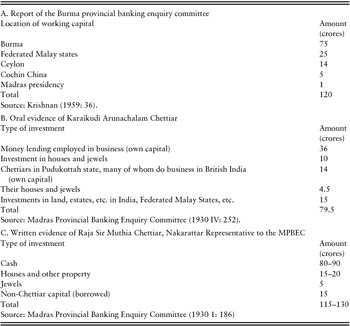
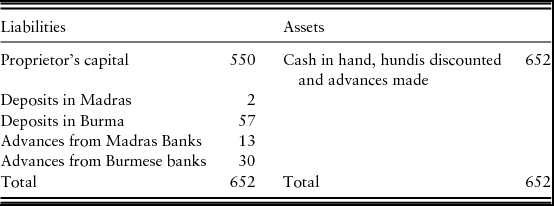
Estimates of their working capital in 1930 range from 795 million rupees to 1,200 million rupees, which translates to 3.71 billion and 5.6 billion in 2008 dollars respectively.Footnote 6 The standard definition of working capital as current assets minus current liabilities does not seem to be applicable to the three estimates, which seem to be providing a measure of the value of assets more broadly, not equity, in Table 1 below. Conventional balance sheets are available only in the case of Burma and are dealt with later in this section. There were 243 firms or bankers doing business locally in South India in 1930 (Rudner, Reference Rudner1994: 72), while 1,650 firms were operating in Burma in 1929 (Mahadevan, Reference Mahadevan1978b). There were 700 firms operating in Ceylon in 1916 (Rudner, Reference Rudner1994: 76). This picture is consistent with a regional break-up of ‘working capital’ provided below in Table 1, which shows that Chettiar business was least prominent in India and most prominent in Burma. A consolidated balance sheet for the Chettiar system in Burma in 1929 is presented in Table 2.Footnote 7
Break up of three estimates of working capital in 1930 (1 crore = 10 million)

Consolidated balance sheet, 1929 (in millions of rupees)
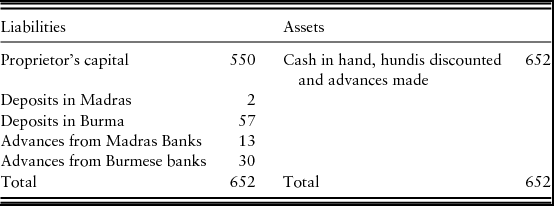
Source: Rudner (Reference Rudner1994: 84).
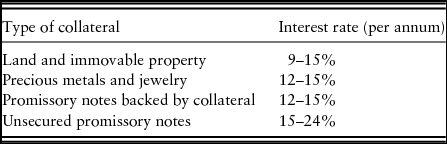
Chettiar banks took deposits and made loans. All deposits, including the checkable ones, paid interest, pointing to the keeping of fractional reserves (BBEC, 1930; Nair, Reference Nair2013). Chettiar bankers made a clear distinction in their account books of deposits (time and on demand) received from fellow caste members and those received from outsiders. The interest rates paid on the two were also different. Interest paid on Chettiar time deposits was lower than non-Chettiar time deposits, allowing them cheaper access to stable capital from within the caste. Loans of various kinds, on the other hand were granted against promissory notes and other kinds of collateral such as land or jewelry. The interest rate varied depending on the banker's knowledge of the borrower and quality of collateral offered. Chettiar bankers competed with each other and other bankers in the loan market. Thus, there was no one standardized loan rate that was used by all banks. It depended on local knowledge, trust, bank's location and strength of collateral offered. The variability in interest rates according to the nature of collateral offered is apparent from Table 3 below, taken from the Burmese government report and represent Chettiar loan rates in 1929 in Burma.
Chettiar lending rates, Burma 1929
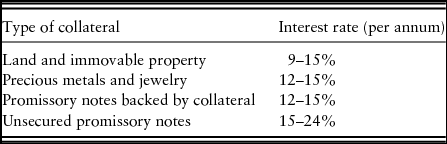
Source: BBEC (1930) cited in Chakravarti (Reference Chakravarti1971: 65).
Deposits were the basis for the drawing of ‘hundis’, instruments resembling bills of exchange. Clients had to maintain a deposit account with the banker, in order to be able to draw a hundi. Checkable deposits could be drawn on by ‘at sight’ or ‘darshan’ hundis, resembling demand drafts or banker's drafts. They also offered ‘trade hundis’ resembling true bills of exchange, enabling merchants to pay for produce in a distant town by drawing a ‘hundi’ that would be discounted and cashed by the local Chettiar banker who in turn would have the bill rediscounted by a bank where the merchant maintained an account. Tun Wai (Reference Tun Wai1953) estimates that over 75% of Chettiar bills were in fact ‘trade hundis’ or genuine bills of exchange.
The Chettiar banking system started to decline post-1930, a year that is taken by several authors to have been the turning point (Chakravarti, Reference Chakravarti1971; Mahadevan, Reference Mahadevan1978a, Reference Mahadevan1978b; Menon, Reference Menon1985; Turnell, Reference Turnell2009). The biggest economic factor that contributed to the decline was the Great Depression of 1930. The depression caused a sharp decline in prices of agricultural commodities, which led to large-scale defaults on agricultural loans and foreclosures. As a result, the Chettiars came to acquire large amounts of agricultural land, an illiquid asset.Footnote 8 This along with rising nationalist movements in Burma, Malaya and Ceylon led governments to pass legislation that effectively nationalized the ownership of land acquired by the Chettiars (Adas, Reference Adas1971: 194; Mahadevan, Reference Mahadevan1978a; Weerasooria, Reference Weerasooria1973) and led to mass exodus back to India.Footnote 9
Chettiars returning to India found themselves amidst a rapidly changing socio-political and business environment. Several ‘indigenous’ business elite were leaving the informal sphere to set up businesses and industries in the ‘formal’ business sector that was regulated by the government (Ito, Reference Ito1966; Lamb, Reference Lamb1955; Roy, Reference Roy2010). Mukherjee (Reference Mukherjee2011) traces the effect of better technology and communication networks that allowed for prominent Chettiar bankers to not rely on caste banking as much and allowed them to set up joint stock banks. This movement into the formal sector of the economy coincided with indigenous elite becoming increasingly involved with local political parties and the rising nationalist political agenda. Hence, the Chettiar banking system changed dramatically and went into decline post-1930.
3. Bankers’ clubs in theory
Clubs allow for the possibility of public goods to be provided privately, given that the right incentives exist (Buchanan, Reference Buchanan1965, McNutt, 1999; Sandler and Tschirhart, Reference Sandler and Tschirhart1997). The Chettiar bankers fit well into the category of a club precisely because of their caste ties for rules of the caste mirror closely the conditions that exist within a club. For one, they have an explicit rule that allows for membership that is achieved only by birth. Exclusion is thus achieved by only allowing membership to those born into the group. The caste is also voluntary in the sense that though one cannot switch castes, there is freedom to exit the caste at all times. Rules are enforced through the self-enforcing mechanism of endogamy (Nair, Reference Nair2011) or denying marriage rites to those who disagree with temple council judgments in case of conflicts (both personal and economic).
There is wide ranging support for the idea that voluntary club like institutions such as the Chettiar banking system can and have provided self-regulation in the past (Dowd, Reference Dowd1992, Reference Dowd1994; Goodhart, Reference Goodhart1987, Reference Goodhart1988; Gorton and Mullineaux, Reference Gorton and Mullineaux1987, Timberlake, Reference Timberlake1984, White, Reference White1984). The theoretical literature, however, remains divided on the desirability of clubs versus government sponsored central banks to provide commercial banks with all required rules, especially those related to the lender of last resort function and monetary regulation.
Gorton and Mullineux (Reference Gorton and Mullineaux1987) and Mullineaux (Reference Mullineaux1987) argue for a ‘spontaneous evolution of central banking’ theory and make the case that clearinghouses that evolved in free banking situations came close to resembling central banking regulation. These ‘commercial-bank clearinghouses (CBCHs)’ extensively regulated member banks and can thus be seen as an ‘endogenous “regulatory” response to the problems associated with the asymmetric distribution of information in the banking industry’ (Gorton and Mullineaux, Reference Gorton and Mullineaux1987: 458). They see the Suffolk banking system as an example of a hierarchical institution to support their argument, as opposed to typical market institutions that are usually non-hierarchical.
Goodhart (Reference Goodhart1987, Reference Goodhart1988) sees a critical role for a government sponsored central bank for two reasons: asymmetric information and the for-profit nature of any voluntary co-operative arrangement. He sees a problem with the asymmetric information between banks and their liability holders on one side and the fact that banks provide fixed nominal value loans to borrowers on the other. The quality of assets is privately known to banks and is not easily ascertainable by liability holders. In case of a run on a poorly performing bank, even sound banks may be unable to persuade their lenders that there is no reason to worry, who nonetheless may demand redemption due to poor information about the true quality of the bank's assets. An outside impartial bank that provides a lender of last resort function is needed to pre-emptively increase faith in the system and hence stave off a system wide collapse resulting from panic runs on potentially sounds banks.
Secondly, he sees the for-profit nature of voluntary regulatory clubs (Reference Goodhart1988: 38–39) or ‘central commercial banks’ as problematic for they will suffer from being seen as competitors by their member banks. Member banks may not have confidence and may not want to keep deposits at the central commercial bank, for fear of helping out a competitor. Hence, Goodhart (Reference Goodhart1988) sees the need for an outside non-competitive, non-profit entity such as a government central bank to provide a lender of last resort function. To him, wherever central commercial banks or voluntary arrangements have worked well historically, it has been more a result of luck and the personalities of the people involved rather than inherent institutional characteristics. He writes (Reference Goodhart1988: 44): ‘Whether commercial banks, acting collusively, but without guidance from a Central Bank, could perform quasi- Central Bank functions depends on their number, the nature of the relationships between them, and the accidents of personality and leadership’.
The claim that such voluntary arrangements would amount to collusion deserves further attention. Not all voluntary arrangements are collusive and the incentives at work within a club and a collusive cartel are distinctly different. While it benefits any cartel member to cheat on the collusively agreed upon price by exiting and lowering his own, a club member who cheats or exits the club mainly stands to lose by doing so as he will not be able to harness the benefits of membership any more. It is for this reason that cartels are notoriously unstable with the ever-present risk of members undercutting one another and cheating on the agreed upon price. Clubs on the other hand tend to be stable as long as leadership can be held accountable and members can vote with their feet by being allowed to exit and join a competing club. This issue of collusion is dealt with in some more detail below while discussing Chettiar bankers’ communal interest rate setting practices.
White (Reference White1999), on the other hand, sees central banks as unnecessary and distinguishes between central banking functions and the actual institution of a modern day central bank. He identifies five typical functions that one thinks as definitive to central banking: banker's bank, lender of last resort, regulating commercial banks, monopoly of note issue and conducting monetary policy. To White (Reference White1999: 71–79), the first three functions can be performed by voluntary Clearinghouse Associations (CHAs) or clubs and there is ample historical evidence of them doing so. The last two functions, he argues, only need to be undertaken when there is government involvement already.
Dowd (Reference Dowd1994), too, is optimistic about the ability of clubs to offer the optimal amount of required governance to member banks and does not see a large role for a government sponsored central bank. He develops the concept of a ‘bankers’ club’, a voluntary association among member banks that would regulate and provide clearinghouse services. He differentiates between this concept and the services of a government central bank in an economy.
Dowd (Reference Dowd1994) lists three possible benefits to such an association: the benefits of reducing monitoring and transactions costs, benefits of help against bank contagion and the benefits of external reserves. The club would most likely be in the form of a clearinghouse, where member banks would pay a fee and partake of the services and regulatory structure. Such self-regulation would only pertain to key features such as organizing clearing of notes and checks against counterfeiting (Dowd, Reference Dowd1994). A central bank, in contrast, is not a voluntary institution but an imposed one and has historically regulated banks in a more extensive way.
Briones and Rockoff (Reference Briones and Rockoff2005) survey the literature on free banking to see if there is agreement within it on what limits if any should be imposed on self-regulated banking and conclude that even there it is not unanimously accepted that the lender of last resort function be done away with. They write (Reference Briones and Rockoff2005: 28) ‘Perhaps the question on which scholars disagree the most is whether a lightly regulated banking system can dispense with a lender of last resort. While some students of lightly regulated banking argue that a central bank is unnecessary; others maintain that the potential for a banking panic exists in any fractional reserve system, so that some institutional arrangement is needed to deal with the problem. . . The jury is still out’.
The Chettiar bankers did not issue their own bank notes, though they did affect the money supply marginally through the issuing of checking accounts that paid interest, thus pointing to the keeping of fractional reserves (Nair, Reference Nair2013). Hence, their case does not offer much insight into the question of the stability of monetary self-regulation. Much of the free banking literature focuses on the question of the stability or instability of free note issue in a competitive banking system. Nonetheless, it does offer a case of banking self-regulation, the specific mechanisms of which are outlined below. Moreover, it does provide support for the idea that voluntary club goods are capable of providing self-regulation in banking.
4. Mechanisms of self-regulation
This section provides a description of the self-regulation mechanisms used by the Chettiar banking system as they relate to the working of a club. The three main mechanisms that aided the functioning of the banking system were the use of parent bankers as clearinghouses, inter-bank lending and frequent information exchange. Beyond that, other banking decisions related to matters such as account keeping, risk-taking or adequate reserves were always left up to the judgment of the proprietors or their hired agents.
Parent bankers as clearinghouses
The natural elite or ‘parent’ bankers among the Chettiars served as clearinghouses for the smaller firms. The main differentiating factor between these ‘parent’ or ‘adathi’ bankers and ‘non-adathi’ bankers was the size and scope of their business. ‘Adathi’ bankers owned an extensive network of banking branches, and comprised 5–10% of the caste population (Rudner, Reference Rudner1994: 123). This widespread network of banking branches allowed smaller Chettiar firms to transmit funds over wider distances.Footnote 10 Every small or mid-sized Chettiar firm would maintain an account with an adathi banker and this in turn led them to function as clearinghouses for the banking system in a defacto way. It allowed for the efficient clearing of debits and credits among dispersed Chettiar bankers.
Adathi bankers also had a larger say in the monthly setting of interest rates, (Rudner, Reference Rudner1994: 124) discussed in further detail below. This helped regulate as well as standardize interest rate levels across business locations. Hundis issued by adathi bankers had a greater value than those issued by non-adathi banks and were often kept uncashed by caste members as security for a time when liquidity was required. Further, British banks would lend to some adathis from a pre-approved list, who in turn would further lend out the funds at a higher rate to fellow bankers and thereby earn an interest rate differential.
This higher status was not granted on the basis of a one-time agreement among members, but evolved over time. It was the result of greater respect and trust given to those bankers who had done very well in business, and thus represents an organically evolved institution resulting from repeated interaction among caste members. One could argue that this amounts to a centralized institution wielding power over smaller member banks, similar to the relationship between a modern central bank and commercial banks, seemingly providing support to the argument made by Gorton and Mullineaux (Reference Gorton and Mullineaux1987) regarding the spontaneous evolution of central banking.
There is one crucial difference however; the higher status or authority could be lost just as it was gained. The higher status of authority brought responsibility with it and the parent bankers were subject to the same rules and norms of social and economic conduct as everyone else in the caste. This points to the institutional constraints in a club, where even in the presence of hierarchy, leaders are held accountable by the same rules that members are subject to.
One finds proof of this whereby the adathi bankers were subject to the same rules and procedures in the event of disputes among members of the community.Footnote 11 One example of this mechanism at work is given by Rudner (Reference Rudner1994: 212) documenting a dispute regarding payment of a tribute to the village temple by a wealthy banker. Like all disputes (commercial or non-commercial) among community members, the temple council was called to judge upon the dispute. The temple ruled against the wealthy member and took away certain marriage rights from the member and his family for continuing to refuse to pay the tribute associated with that temple. This was the standard punishment meted out to all non-abiding members, wealthy or otherwise. The adathi banker ended up paying his overdue tribute to the temple along with interest for the years lost, since the social cost of losing certain marriage rights was too high.
Inter-bank lending
Although the Chettiar system never evolved formal lender of last resort function usually carried out by a central bank, they did have an inter-bank lending mechanism that any Chettiar banker could call on in a time of need. This functioned as an informal agreement among all bankers to lend to one another on terms that were easier than borrowing from outside the community, thus playing the role of a de facto inter-bank lending mechanism. Among other things, this mechanism involved the pre-setting of the interest rate at which they would lend to one another on short notice, dealt with in further detail below. Shenoy (Reference Shenoy1941: 127) states it explicitly when he writes, ‘the system of inter-Chetty lending was the chief support of the successful working of Chettiar banking. When in need of liquid funds they freely lent among themselves, at the usual inter-Chetty rate (6% or under) or the rate charged by the bank, whichever was higher’.
Chandrasekhar (Reference Chandrasekhar1980: 26) refers to the ‘freedom of funds, which was allowed all agents and employees’ within the community, Turnell (Reference Turnell2009: 27) refers to it as the ‘inter-Chettiar deposit system’ while Chakravarti (Reference Chakravarti1971: 60) writes of the easy loans amongst the Chettiars as a system of ‘self-help’. Evers and Pavadarayan (Reference Evers, Pavadarayan, Sandhu and Mani2006: 856) document this practice amongst the Chettiars living and working in Singapore as ‘they frequently borrow from each other in times of need’. The report of the Burma Banking Enquiry Committee (BBEC, 1930: 229) documents in some detail the various ways in which a Chettiar bank in need of cash may plausibly meet those needs, borrowing from other Chettiar banks being the chief among them.
These interest rates were set communally in common houses or temple, in every Chettiar place of business in India and abroad. The focal point of the monthly meeting was the setting of the checking deposit rate or ‘nadappu’ rate. This was the rate that Chettiars paid each other on short-term loans or checking deposits that could be withdrawn at any time (the inter-bank rate). The BBEC Report (1930: 225) describes this process of setting the inter-bank or ‘nadappu’ interest rates in Burma's capital Rangoon.
‘[The nadappu rate] is fixed in the evening of the 16th of every Tamil month at a meeting held at 9 p.m. in the Nakarattar temple at Rangoon, and it holds good for all the current Nakarattar month including the sixteen days already passed. . . . The meeting discusses the general financial situation, and fixes the current [nadappu] rate for the current month with this, taking into account the current pitch and tendency of the thavanai rate, the rates current amongst the Marwaris, Multanis, and Gujeratis [other informal banking groups] and the rates for advances by the joint-stock banks to Nakarattars. As every firm has both income and expenses determined largely by this rate, great care is taken to fix the rate according to the needs of the situation. . .’ (Emphasis added)
Interest rate setting only pertained to the inter-Chettiar deposit rates. Loan rates or the rate that a Chettiar would charge a typical non-Chettiar client for a loan were not communally set in any way. They were left up to the discretion of each firm and its proprietor. Neither were deposit rates that the Chettiars paid to non-Chettiars for their deposits set in this communal manner. Those Chettiars that did offer deposit services to non-Chettiars added a mark-up to the pre-set short term or long-term rates (‘nadappu’ or ‘thavanai’) and paid out that rate on non-Chettiar deposits (Chakravarti, Reference Chakravarti1971; Turnell, Reference Turnell2009). Thus, the Chettiars coordinated interest rates so that they could borrow from one another at a cheaper rate than borrowing from non-Chettiars. Yet they competed with one another in attracting non-Chettiar clients on deposits and loans since there was no standardization on the level of the mark up that was paid or charged to outsiders.
The inter-bank lending mechanism however, was not automatically guaranteed and was rooted in cautious judging of the particular situation at hand by the lender, since it was their private money and capital at risk. Members of the community, then, had the incentive to reduce asymmetric information amongst them by providing for the smooth exchange of information. This exchange would take place at the weekly and monthly meetings for the setting of interest rates as well as by maintaining blacklists of risky debtors that were circulated throughout the community of bankers. This process is dealt with in more detail in the next sub-section.
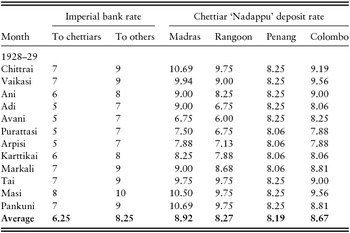
This brings us to whether the practice of interest rate setting amounted to collusive behavior. First, as noted above, the Chettiars were not communally setting loan rates that they were charging their clients. They were only communally setting the inter-bank Chettiar deposit rates (short- and long-term). Hence, this does not amount to a case of price setting behavior, rather a voluntary system of providing access to cheaper capital within the group. A look at the actual ‘nadappu’ rates that Chettiars paid each other on short-term deposits reveals a consistently higher level than the lending rate of the Imperial Bank presented in Table 4 below. The Imperial Bank (present in India (Madras) and Burma (Rangoon)) would lend to a few pre-approved Chettiars at a lower rate and charge a different higher rate for lending to others.
Chettiar ‘Nadappu’ rate and imperial bank lending rates

Source: Rudner (Reference Rudner1994: 242).
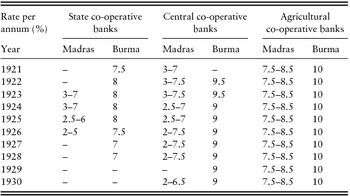
This points towards a market mechanism at play or the need for setting their own rate high enough so that members from within the community (Chettiar bankers and possibly even non-banking caste members) would find the return attractive enough to deposit money within the caste banking system rather than earning a higher return outside. This also implies that their inter-bank rate is substantially above the Imperial Bank deposit rate, or the rate that would be earned by putting money under deposit with the Imperial Bank. If they were engaging in collusive behavior, there would be no need to set the inter-bank deposit rate high enough to spontaneously attract deposits from each other since that would be part of the explicit agreement of the cartel. A look at deposit rates of certain co-operative banks operating at the time and in the same regions seems to corroborate this argument, shown in Table 5 below.Footnote 12
Annual borrowing rates of state, central and agricultural co-operative banks

Source: Banking and Monetary Statistics of India, Reserve Bank of India, (1954: 725–728).
The deposit rates for the various Co-operative banks in Madras stay below or around the ‘nadappu’ deposit rate presented in Table 4 below, though they seem to be a bit higher in the case of Burma. This however, is explained by the fact that the lending rates of higher level banks were often reported as the borrowing rates of the lower level banks (see footnote 11), which is in fact the case with the Burmese banks’ rates (Banking and Monetary Statistics of India, 1954: 725–728, Lending Rate Tables of Co-operative Banks). The fact that the Chettiars set their inter-bank deposit rates close to and in most cases higher than the deposit rates available at other banks in the same region shows that they were not engaged in collusion.
Thus, even though they were engaged in communally setting their inter-bank lending rate, they still seem to take into account the market determined opportunity cost of capital. Tun Wai (Reference Tun Wai1956) goes as far as to use the Chettiar current rates as a proxy for commercial bank rates at the time in Burma. In his study, on interest rates in underdeveloped countries in the early 20th century, he writes (Tun Wai, Reference Tun Wai1956: 271)
Prewar data on interbank call loan rates in Burma are not available, but Chettiar interest rate statistics throw light on the subject. The Chettiar call deposit rate or current rate was fixed for only one month at a time after account was taken of all the other indigenous rates in the market and, more important still, the rate for joint stock bank advances to the Chettiars. Therefore, it can be concluded that changes in Chettiar current rates were representative of changes in Rangoon market rates as a whole. (Emphasis added)
Information exchange
Inter-bank lending leads to monitoring of member banks in a private insurance scheme. This is because the costs of having to bail out a bank are completely internalized and hence monitoring becomes important. This monitoring has been documented in the case of private bank insurance in Germany (Beck, Reference Beck2002). The Chettiars too closely monitored each other as a result of their inter-bank lending. In a situation that involves a group of people co-insuring one another, problems related to moral hazard could arise. These problems are pronounced in the case of a central bank acting as lender of last resort, which necessarily entails the socialization of costs and privatization of benefits. However, it could possibly exist even in the case of voluntary insurance contracts, though the underlying institutional constraints create incentives that minimize it.
Dowd (Reference Dowd1994) discusses this issue with respect to voluntary bankers’ clubs. In a bankers’ club, there is private ownership of the banks and rule-setting authority ultimately rests with the member banks themselves. Hence, the problem of socialized loss is not as pronounced as it would be if there were no private property rights. Yet, even so, the problem of moral hazard still could arise to a certain extent in the case of easy inter-bank lending. If member banks agree to lend on easier terms to one another in times of need or in a crisis, it can possibly create an incentive for individual banks to indulge in excessive risk taking. Dowd (Reference Dowd1994: 294) postulates that such excessive risk taking could be discouraged or minimized by effective monitoring of member banks or even by stipulating certain rules pertaining to deposit ratios and capital requirements.
As documented above, the Chettiars had a functioning inter-bank lending mechanism. If a trusted Chettiar was in sudden need of liquidity, he could count on his fellows to lend to him easily and at a lower rate than he could secure from outside (Rudner, Reference Rudner1994: 124). This easy lending however was always under scrutiny by fellow members, thus effectively minimizing excessive risk taking and doing away with the problem of moral hazard that arises in the case of privatized gains and socialized losses. The reason for this was that while gains were privatized, losses were also privatized thus creating a strong incentive to effectively monitor other members’ borrowing behavior.
An important way in which behavior was kept in check manifested itself indirectly, through norms giving importance to honesty and one's reputation for trustworthiness within the community. There are several references to the importance given to honesty and one's trustworthiness. Rudner (Reference Rudner1994: 110) writes ‘whatever its tangible investments, a Nakarattar family firm's greatest intangible asset was its reputation. Without a reputation for trustworthiness (nanayam), no family could attract deposits or reassure clients of honesty (or, at least, predictability) and flexibility in the extension of credit’. Masters (Reference Masters1957) in her study of the Chettiars in Burma, cited in Chandrasekhar (Reference Chandrasekhar1980: 26) writes of this importance given to honesty, that the ‘first thing demanded of a Chettiar was honesty. . .for not only does a reputation of honesty enhance the Chettiar prestige with their customers, but the freedom with funds which was allowed all agents and employees required trustworthiness’. Shenoy provides a similar picture regarding the importance of honesty amongst the Chettiars in his study of banking in Ceylon when he writes (Reference Shenoy1941: 127) ‘A Chettiar valued his reputation among his brother Chettiars very dearly. And they looked upon too frequent, or too large, loans from the banks on the part of any among them with disfavor’.
As a result, the reputation of fellow Chettiars was under consistent scrutiny and formed an important part of the information exchange that took place at collective events at common houses or temples. Rudner (Reference Rudner1994: 125) describes this activity:
As clearinghouses for information about each other and about business opportunities generally, these collective events effected investment decisions, including decisions about the optimum allocation of investment funds and the amount of credit to extend to a fellow Nakarattar. In other words, vitutis provided Nakarattars with access to information about each other's business.Footnote 13 They provided opportunities to scout out investment opportunities and arrange for loans by fellow Nakarattars looking for investments. At the same time, the information they provided served as checks against incautious business behaviour and unreasonable requests for credit. (Emphasis mine)
Evers and Pavadarayan (Reference Evers, Pavadarayan, Sandhu and Mani2006) also document the frequent exchange of information that would take place among the Chettiars living and working in Singapore as an efficient way to keep tabs on one another and defaulting clients. They write (Reference Evers, Pavadarayan, Sandhu and Mani2006: 855) of ‘frequent meetings in the temple grounds enable the Chettiars to exchange news concerning personal family situations and keep up with the latest information regarding business conditions in the different centers. Clients who defaulted on payment of loans had a hard time trying to hide anywhere in South-east Asia!’
These meetings however never went past such information exchange to include increasing amounts of governance of other aspects of their banking business. By the time that their banking system began to decline, these gatherings were used by those interested in setting up modern-style banks for their own purposes of lobbying the government and local authorities (Mahadevan, Reference Mahadevan1978b: 348).
5. Conclusion
This paper provides a description and analysis of the self-regulatory mechanisms of a private banking system in 19th-century India. The term ‘indigenous banking’ was used historically to distinguish such private bankers from formal banks (government owned or joint-stock) that each served different purposes and catered to different clientele in the Indian economy. The Chettiar banking system was but one of many such private banking systems that operated independently of government regulation and became an important source of credit for several industries in India and South-East Asia.
The Chettiar banking system was made up of members of a common caste, a social institution that provided self-enforcement mechanisms that were crucial for the functioning of their banking business. Caste or more specifically the jati, which is relevant in this case, was shown to be economically significant by limiting membership through birth as well as the practice of members only marrying within the group (endogamy). Thus, it helped create club like conditions within which rules could be provided and enforced. The Chettiar caste is but one of many trading and merchant groups that relied on this unique social institution and further research on other castes’ (jatis) impact on economic organization is bound to be fruitful.
Specifically, the Chettiar banking system engaged in providing clearinghouse functions, easy access to capital through inter-bank lending as well as frequent information exchange that was only available to members of the group. In addition, they also aided in the inter-generational transfer of tacit capital and hands-on practice through apprenticeships and mentoring as well as allowing junior members to harness the benefit of built up local knowledge, reputations and client relationships.
To be sure, much debate remains concerning the extent to which governments should regulate the banking system. However, it is now widely acknowledged that voluntary CHAs and clubs are capable of providing some amount of self-regulation in the absence of a central bank. The Chettiar experience provides additional support for this view. Further, it also points to the economic robustness of clubs that can be seen to flourish in varied institutional settings, either within the presence of existing government regulation or outside of it.