Constructions are complex assemblies of form–meaning pairings consisting of a fixed, schematic sequence of elements governed by lexical and semantic rules. They are schematic and symbolic in nature and are abstracted from the input through two general cognitive processes: similarity reasoning (e.g., identifying a concrete feature that all exemplars have and finding a relational structure across the exemplars) and analogical reasoning (e.g., finding an underlying structure that all exemplars follow; Gentner & Markman, Reference Gentner and Markman1997). These cognitive processes are believed to promote pattern detection and abstraction, which can be facilitated through exposure to low-variability input, which is input with little lexical diversity or low type frequency (Bybee, Reference Bybee2006; Ellis, Reference Ellis2006; Goldberg, Reference Goldberg2006, Reference Goldberg2009; Tomasello, Reference Tomasello2003). Low-variability input is believed to facilitate initial pattern detection and abstraction by inducing learners to extract the underlying similarity in the argument relationships across exemplars of the same construction, rather than treat each exemplar as a unique construction (Brooks, Tomasello, Dodson, & Lewis, Reference Brooks, Tomasello, Dodson and Lewis1999; Kidd, Lieven, & Tomasello, Reference Kidd, Lieven and Tomasello2006; Matthews, Lieven, Theakston, & Tomasello, Reference Matthews, Lieven, Theakston and Tomasello2005).
Researchers have suggested that low-variability input may be particularly useful for detecting structural patterns when it has a skewed distribution (Boyd & Goldberg, Reference Boyd and Goldberg2011; Casenhiser & Goldberg, Reference Casenhiser and Goldberg2005; Goldberg & Casenhiser, Reference Goldberg, Casenhiser, Robinson and Ellis2008; Goldberg, Casenhiser, & Sethuraman, 2004; Goldberg, Casenhiser, & White, Reference Goldberg, Casenhiser and White2007; Year & Gordon, Reference Year and Gordon2009). A skewed distribution includes constructions created from a limited number of lexical items, but one lexical item occurs across exemplars with high token frequency. For example, low-variability input might consist of 20 double-object dative constructions created using five lexical verbs (give, hand, pass, throw, and make). If it had a skewed distribution, one lexical verb, most likely give, would occur with high token frequency, such as in eight exemplars, with the remaining lexical verbs each occurring with equally low token frequency, that is, three exemplars each. Having one lexical item with high token frequency may help learners extract the underlying structure of those exemplars, thereby facilitating pattern detection. For example, when abstracting a double-object dative construction, a learner needs to correctly assign argument roles to the agent, patient, and recipient by using syntactic cues such as word order or morphology and semantic cues such as animacy or plausibility. When low-variability input provides exemplars in which give occurs with high token frequency, learners may find it easier to detect the underlying structure based on the grammatical and semantic features of that specific verb and its role in the construction, which they can then extrapolate to other verbs through analogical reasoning.
In contrast to low-variability input with a skewed distribution, low-variability input with a balanced distribution provides exemplars in which key lexical items occur with equally low token frequency. For example, 12 exemplars of the English plural might be created from three nouns (apple, pear, and carrot) with each noun occurring four times each. In other words, the key lexical items used to create the constructions occur with equally low token frequency. A balanced distribution may help learners detect recurrent morphemes, such as the plural –s affix (i.e., she bought two pears; those pears taste good; I ate all the carrots; and these carrots fell out of the bag). Attribute similarity is revealed by the reoccurrence of the same concrete element, that is, a morpheme, which is used to identify the relationship with the other constituents (those, all, or these) and to facilitate extrapolation through similarity reasoning.
Based on the arguments above, linguistic constructions such as the plural in English, which displays morphological properties, may be more easily abstracted from balanced input, while constructions associated with syntactic properties, such as the double-object dative construction in English, may be more easily abstracted from skewed input. Empirical support for the interaction between the distribution of low-variability input and the properties of the target construction was reported by Krajewski, Siebenborn, and Lieven (Reference Krajewski, Siebenborn and Lieven2011), who found that skewed input positively facilitated categorizations over syntactic constructions, while balanced or flat input promoted the abstraction of morphological constructions.
Comparative studies of low-variability input that targeted syntactic structures such as the English ditransitive construction (McDonough & Nekrasova-Becker, Reference McDonough and Nekrasova-Becker2014; Year & Gordon, Reference Year and Gordon2009), the Samoan ergative construction (Nakamura, Reference Nakamura2012), and the transitive construction in Esperanto (McDonough & Trofimovich, Reference McDonough and Trofimovich2013) with English second language (L2) speakers found either no significant differences in the effectiveness of skewed and balanced input (Nakamura, Reference Nakamura2012; Year & Gordon, Reference Year and Gordon2009) or a facilitating effect for balanced input (McDonough & Nekrasova-Becker, Reference McDonough and Nekrasova-Becker2014; McDonough & Trofimovich, Reference McDonough and Trofimovich2013). The findings, conflicting with the previous English first language (L1) research, were attributed to external factors such as learning environment (formal classroom settings) and the participants’ previous exposure to the construction, or to internal factors such as adults’ tendency to rely on explicit learning (Nakamura, Reference Nakamura2012). Additional factors that may help account for the divergent findings include the semantic properties of the lexical item selected as the high token frequency exemplar in skewed input (Year & Gordon, Reference Year and Gordon2009), the number of constructions targeted in the experimental materials (Nakamura, Reference Nakamura2012), the compatibility between the construction learning and the test items (McDonough & Nekrasova-Becker, Reference McDonough and Nekrasova-Becker2014), and the nature of the construction learning task (McDonough & Trofimovich, Reference McDonough and Trofimovich2013). Taken together, the divergent findings of these studies with L2 English speakers indicate that a combination of factors may contribute to their ability to detect novel patterns through low-variability input.
Besides the distribution of low-variability input (skewed vs. balanced) and the nature of the pattern (syntactically or morphologically marked), a speaker's previously known languages may also impact novel pattern detection. Because a construction's compositionality is language dependent, speakers may be affected by how events are encoded in their previously known languages when detecting patterns in a new language. To illustrate, for the transitive construction targeted here, the agent–patient relationship can be marked through word order, such as subject–verb–object (SVO) in English, or by means of case marking, as in Icelandic (Sinnemäki, Reference Sinnemäki2014). There is variation within case-marking languages, with nonrestrictive languages, like Icelandic, consistently marking all direct objects, and restrictive case-marking languages marking the direct objects differentially, based on the pragmatic or semantic properties of the arguments. Within the restrictive languages, case marking may be triggered by degrees of prominence in terms of animacy, definiteness/specificity, or both animacy and definiteness/specificity (Sinnemäki, Reference Sinnemäki2014). Animacy indicates whether a noun is animate or inanimate (e.g., horse vs. car) and places the noun on an animacy scale (e.g., girl is higher on the animacy scale than cat). Definiteness/specificity provides information on whether the noun is definite/specific or not (e.g., the dog vs. a dog).
When learning a transitive construction in a new language, a speaker of a nonrestrictive language may be able to identify accusative markings across transitive exemplars in a restrictive language, but may face difficulty finding the relational structure between the arguments unless the factors governing it, such as animacy or definiteness, are also detected. Likewise, a speaker of an animacy language may be affected in his or her ability to detect the relational structure governing transitivity in a language that marks definiteness. However, by making use of only a few items, low-variability input may make it cognitively easier to detect the semantic and grammatical properties of each argument and draw a relational structure across exemplars. Skewed input might facilitate pattern detection based on a single prototypical lexical item (e.g., one noun repeatedly acting as patient in a transitive construction) whose semantic and pragmatic properties may then be easier to generalize across other nouns with the same function; but balanced input might facilitate detection of a recurrent morpheme (e.g., an accusative affix), allowing learners to draw a relational structure based on the absence or presence of this grammatical feature.
Focusing exclusively on the linguistic features of the input (balanced vs. skewed), the target pattern (morphological vs. syntactic) and the speaker's previously known languages (restrictive or nonrestrictive) may not capture the holistic nature of information processing, which often includes a nonlinguistic component in the form of visual information (Paivio, Reference Paivio1991). In order to complement the ease of processing achieved through low-variability linguistic input, the visual input needs to display properties that will also ensure fast decoding. Two properties of visual input that seem to affect processing are prototypicality and chromatic information. A prototypical visual would depict only generic attributes of a particular thing or animal, leaving out redundant details, such as in simple line drawings of things or animals as opposed to realistic representations such as photographs, or complex, detailed drawings. Because prototypical visuals resemble prototypes stored in memory, they may be easier to process semantically, as suggested by Travers' (Reference Travers1964) claim that efficient transmission of information through visual media takes place only when the visual message is nonredundant (i.e., lacks realistic detail). This is because having to switch between auditory and visual channels requires time and has a negative effect on learning due to cognitive overload. Based on this hypothesis, it may be argued that learning tasks that employ prototypical visuals to transmit new information may result in better recall of that information. This idea was suggested by Goldberg et al. (Reference Goldberg, Casenhiser and White2007), who proposed that visual information that provides more prototypical scenes of appearance (i.e., those that do not encode a particular manner) may be more useful for pattern detection.
In terms of the chromatic features of visual input, when compared to black-and-white visuals, color visuals have been found to positively influence recall, recognition memory, and semantic processing. Evidence for the facilitating effect of colored visuals on information processing comes from studies comparing the effect of black-and-white versus color images on attentive behavior, recall, and recognition memory (Cano, Class, & Polich, Reference Cano, Class and Polich2009; Shaari, Reference Shaari1998; Wichmann, Sharpe, & Gegenfurtner, Reference Wichmann, Sharpe and Gegenfurtner2002). Although it may be argued that the positive effect of color observed in these studies is due to object familiarity (the world is colored), studies in which unrealistic colors were used, such as in coloring line drawings of natural or artificial objects (Dwyer, Reference Dwyer1971; Hocking & Price, Reference Hocking and Price2008; Zannino et al., Reference Zannino, Perri, Salamone, Lorenzo, Caltagirone and Carlesimo2010) revealed that memory is not positively affected by resemblance to the real world, but rather by prototypicality in terms of both color and shape.
The aforementioned studies analyzed the effect of colored prototypical visuals on learning in the general cognitive domain. With regard to the effect of visuals on language learning, it has been studied with regard to vocabulary acquisition only, and the visuals used were not prototypical. This line of research has already confirmed that more L2 words are recalled when learners are presented with black-and-white visual stimuli (Deno, Reference Deno1968; Webber, Reference Webber1978) and that black-and-white pictures of objects are better primes than colored representations (Altarriba & Knickerbocker, Reference Altarriba, Knickerbocker, Trofimovich and McDonough2011), but there is not much evidence for the influence of colored prototypical visuals on the acquisition of L2 structures.
In addition, because both studies on the effect of images on general cognitive processes (recognition memory, semantic processing, and recall) and studies on the effect of visuals on vocabulary learning found different results for colored versus black-and-white images, it is important to further explore whether colored and black-and-white images differentially impact on the acquisition of morphosyntax. Because the role played by prototypical colored visuals in information processing has been explored only in reference to concrete objects presented in isolation, an interesting question is whether prototypicality influences information processing when concrete objects are depicted in a relationship. If prototypicality facilitates the processing of individual objects, then it may also facilitate faster processing of the relationship between objects. For example, the prototypical rendition of the words boy (+animate, +instigator, +/− affected) and ball (−animate, −instigator, +/− affected) might facilitate processing of the grammatical roles these nouns play. Because boy hits ball and ball hits boy are both plausible scenarios, quick decoding/recognition of the nouns when rendered visually as prototypical may allow for more attentional resources to be devoted to processing syntactic and morphological cues, such as word order or morphological markings, which would help to further decode the relationship between the two arguments. In other words, using colored, nonredundant visuals may induce quick and efficient processing of the concrete attributes of the arguments, which may in turn induce faster processing of their structural relationship by allowing cognitive resources to be more efficiently spent on decoding grammatical features that reveal relational structures.
To summarize, novel pattern detection may be facilitated by the distributional characteristics of low-variability input, by the linguistic properties of a learner's previously known languages, and by simple, prototypical visual images. In addition, because black-and-white nonredundant visuals are prototypical in terms of shape only, their processing may be different than that of nonredundant color visuals, so they may have a different effect on the learning new linguistic structures than colored visuals do. This study considers the potential impact of a speaker's previously known languages (animacy vs. definiteness case marking) and visual information (color or black and white) on the effectiveness of balanced and skewed input for the detection of the transitive construction in Esperanto. The construction presents novelty not in terms of meaning, but in terms of form–meaning mapping because transitivity exists in the speakers’ L1s. With regard to form–meaning mapping, the transitive construction in Esperanto has flexible word order, which makes the accusative marking –n the most valid and reliable grammatical cue for encoding meaning.
As detailed above, due to the importance of morphology in the Esperanto transitive construction, low-variability input with a balanced distribution may be more beneficial for pattern detection. However, the occurrence of accusative case marking in the participants’ previously known languages may override any advantages of balanced input. Furthermore, visual images may also impact the effectiveness of low-variability input, with simple color images potentially facilitative of pattern detection regardless of the input distribution. Therefore, the purpose of the study was to explore the impact of both L1 background and visual information on the effectiveness of balanced and skewed input at promoting pattern detection of the Esperanto transitive construction.
METHOD
Participants
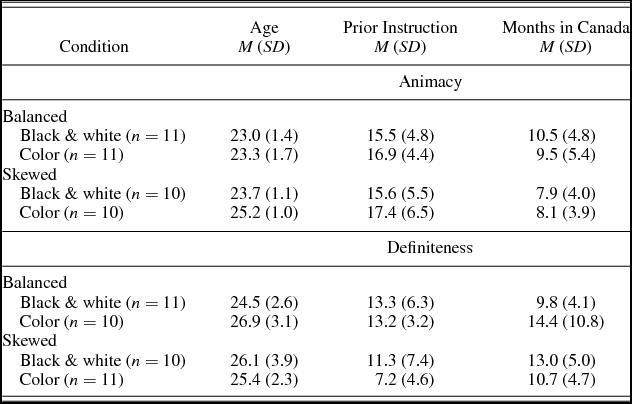
The participants were 84 English L2 students (17 women, 67 men) enrolled in degree programs at an English-medium university in Montreal, Canada. The participants spoke L1s with restrictive case marking largely driven by either animacy or definiteness (Sinnemäki, Reference Sinnemäki2014). The animacy group (n = 42) included L1 speakers of French, Gujarati, Hindi, Punjabi, Spanish, and Telugu, while the definiteness group (n = 42) included L1 speakers of Arabic, Farsi, and Tamil. Participants were randomly assigned to receive either balanced or skewed input, with either black-and-white or color visuals, which resulted in the eight conditions shown in Table 1. Across the eight conditions, the participants had similar ages (M = 24.7, SD = 2.6), years of prior English instruction (M = 13.8, SD = 6.1), and months of residence in Canada (M = 10.0, SD = 6.0).
Background information across the eight conditions

Target construction
The target construction was the Esperanto transitive, characterized by morphological features and flexible word order, the most common being SVO and object–verb–subject (OVS; Cox, Reference Cox2011; Harlow, Reference Harlow1995). All singular Esperanto nouns end with the vowel o, and when nouns function as an object, they receive the –n suffix, regardless of their animacy or definiteness features. For example, the word goat (kapro) appears without an affix when it functions as the subject, but it receives the –n suffix when it functions as the object (kapron). Because word order is variable, the sentence horse chases goat can be expressed as either cevalo pelas kapron (SVO) or kapron pelas cevalo (OVS). Although morphological affixes have occurred in the constructions previously tested in low-variability input research (e.g., –o with verbs in the appearance construction and –e with nouns in the Samoan ergative construction), the meaning of those constructions could be detected through reliance on word order only. In contrast, the accusative marking is a key grammatical cue for assigning correct argument roles in the Esperanto transitive construction due to its flexible word order and its high productivity, that is, not being limited to a small set of lexical verbs.
Design
A factorial design was used to compare the effectiveness of low-variability input and visual images at promoting detection of the Esperanto transitive construction by speakers from different case-marking L1 groups. Detection of the Esperanto transitive construction, the dependent variable, was operationalized as the accuracy with which the participants could identify the meaning of previously unheard transitive sentences through a forced-choice picture identification task. For each Esperanto transitive the participants heard, they had to select which of two pictures correctly depicted its meaning. The independent variables were the distribution of low-variability input (skewed vs. balanced), visual images (color vs. black and white), and L1 groups (animacy vs. definiteness). For the input variable, both the balanced and the skewed distributions were created from low-variability input consisting of six nouns and two verbs that were used to make 30 sentences. However, whereas balanced distribution presented each noun in object position with equally low token frequency (5 times each), the skewed distribution presented one prototypical noun with high token frequency (15 times). The noun chosen to appear with high token frequency was pilko (tennis ball). Its selection was motivated by its semantic properties (−volitional, −instigator, + affected), which could be interpreted as representative of a prototypical object, that is, a noun that occurs more often in object than in subject position (Næss, Reference Næss2007).
For the previously known languages variable, all the participants were from L1 groups that have restrictive case marking on direct objects in transitive constructions. However, the definiteness languages mark direct objects with accusative case based on a hierarchy of prominence for definiteness (pronoun > proper noun > definite > indefinite specific > nonspecific; Aissen, Reference Aissen2003). Accusative case marking is used primarily when the object is definite (e.g., the ball) but not when it is indefinite (e.g., a ball). Furthermore, within the class of nonspecifics, the object is case marked if it is animate (e.g., the subject is a ball, the object is a boy). In contrast, the animacy languages mark direct objects based on degrees of prominence in an animacy hierarchy (human > animate > inanimate). Direct objects are marked primarily when they are animate, that is, both the boy and a boy, but within the category of inanimate nouns, case marking is possible only if the object is definite (Aissen, Reference Aissen2003). Put simply, the definiteness languages encode accusative case first based on definiteness with animacy as a secondary consideration, while animacy languages encode accusative case first based on animacy with definiteness as a secondary consideration. With regard to word order, the participants’ L1s allowed for some variation in word order, but the most commonly used word orders were SOV (Farsi, Gujarati, Hindi, Punjabi, and Telugu) and SVO (French and Spanish). Some Esperanto words were cognates in some of the participants’ L1s (e.g., French tigre or Spanish tigro), but these were the same words that were cognates with English (tiger), which was the shared L2 for all participants.
Finally, for the visual information variable, all images were characterized by prototypicality through nonredundant, simple drawings in which the characters expressed through nouns (agent and patient) and their environments were drawn without extra details and without variation from one drawing to the other. With regard to the actions performed by the nouns, prototypicality was achieved by rendering these actions in the same manner throughout the visuals. They differed in terms of chromatic properties as either being color or black and white. The color of each noun was determined through a Google images search with the most frequent color depicted in the illustrations.
Materials
The construction learning task was designed to encourage detection of the syntactic (e.g., variable word order) and morphological (e.g., accusative suffix) features necessary for decoding the Esperanto transitive construction. It began with a vocabulary activity to introduce and practice the two verbs (pelas/chase and batas/hit) and six nouns (pilko/tennis ball, tauxro/bull, kapro/goat, cevalo/horse, kato/cat, and makropo/kangaroo) that occurred in the construction learning sentences. A total of 30 Esperanto transitive sentences were created, using both SVO and OVS word orders (see Appendix A for the construction learning items). For each sentence, participants had a set of two pictures, and their task was to select the picture that correctly depicted the meaning expressed through the aural sentence. The content of the distractor pictures was manipulated to draw their attention to different elements in the Esperanto transitive sentences. For the first four items, the distracter pictures shared no lexical similarity with the target pictures so that participants could rely on lexical knowledge to identify the correct picture. For the next three sets (six items each), choice was based on the meaning of the subject, of the direct object, and of the verb, respectively. The last eight items had fully reversible pictures (cat chases goat; goat chases cat), so that morphology served as a key grammatical cue for understanding sentence meaning.
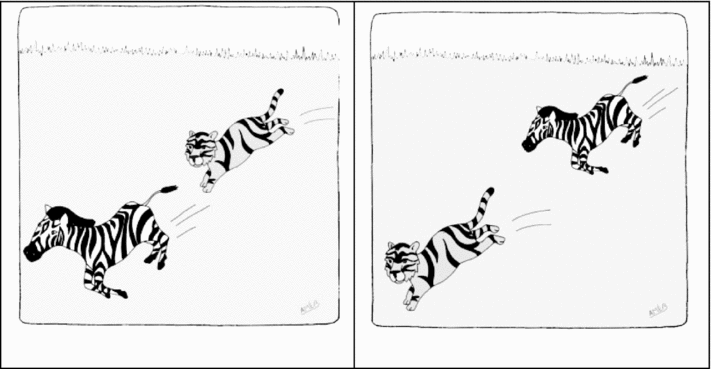
In order to determine whether the participants could generalize to novel lexical items, the construction learning phase was immediately followed by a test phase, which began with an activity to introduce and practice six new nouns: zebro/zebra, bubalo/buffalo, automobilo/car, tigro/tiger, leporo/rabbit, and pordego/gate. The 30 test items (see Appendix B) represented both word orders (15 SVO, 15 OVS) using the new nouns and the same verbs presented during the learning phase (batas and pelas). The participants selected the picture that corresponded to the sentence they heard. For example, the two pictures for the sentence zebro pelas tigron (zebra chases tiger) depicted reversible events, as shown in Figure 1. Reliability statistics were calculated for the 15 SVO and the 15 OVS test items separately, and Cronbach α values were 0.91 and 0.95, respectively.
Example pictures for test item.
Each aural sentence, recorded by a native Spanish speaker, was presented twice, with a 5000 ms pause between the repetitions and a 10,000 ms pause between sentences. The pictures showed the actions performed by the verbs (chase or hit) in the same manner. The position of the characters was slightly diagonal to ensure clear visibility and to avoid reliance on linear reading (left–right, right–left). The orientation of the action was back/front or front/back, with the character representing the object being always in the front. For example, the correct image for the sentence horse kicking gate had the gate in the foreground and the horse in the background. The visuals were either color or black and white.
Procedure
The research activities were administered during a 40-min data collection session facilitated by the first researcher. Prior to carrying out the construction learning activities, the participants first completed vocabulary activities to hear and practice the target nouns and verbs (10 min). Prior to starting the construction learning task (10 min), participants were told to pay attention to the noun endings. Each construction learning sentence was presented aurally two times, and participants circled the corresponding picture on their answer sheets. There was a brief pause between items in each distracter set when participants were reminded to listen carefully to the sentences and to pay attention to the noun endings. Prior to starting the testing phase, the participants heard and practiced the new nouns (10 min), followed by the test sentences (10 min).
Analysis
The test items were scored by giving one point to each correct picture identification and zero points to each incorrect picture selection, followed by the calculation of d′ values. Based on signal detection theory (Macmillan & Creelman, Reference Macmillan and Creelman2005), d′ is a measure of sensitivity that takes into account participants’ correct discrimination of a pattern (i.e., ideally, a high “hit” rate with minimal “misses”) and their bias to report false positives (i.e., ideally, a low “false alarm” rate, coupled with a high rate of “correct rejections”). Because the agent in transitive constructions is expressed as the first noun phrase (NP) in the participants’ L1s and L2 (English), the expected response bias was to interpret the first NP as the subject regardless of morphology. If the participants successfully detected the Esperanto transitive construction, however, they would correctly interpret the first NP in SVO sentences as the subject (i.e., high hits) and correctly reject the first NP as the subject in the OVS sentences (i.e., high correct rejections). Therefore, correct responses for SVO items were coded as hits, while incorrect responses for SVO items were coded as misses. For the OVS items, correct responses were classified as correct rejections (i.e., rejecting the first NP as subject), while incorrect responses were treated as false alarms (i.e., selecting the first NP as subject). For each participant, the resulting d′ sensitivity values were computed as the difference between the proportions of hit (H) and false alarm (FA) responses, expressed as z scores (d′ = z[H] – z[FA]). High positive d′ values indicated the ability to rely on inflected morphology to interpret transitive constructions, while values at or near 0 indicated that sentence interpretation was driven largely by a familiar word order cue. High negative values reflected low accuracy on both SVO and OVS items. The alpha value was set at 0.05.
RESULTS
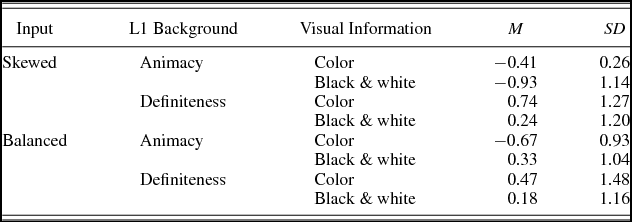
The purpose of the study was to find out whether there was an effect of L1 background (animacy languages vs. definiteness languages) and visual information (color vs. black and white) on the effectiveness of low-variability input (balanced vs. skewed) at promoting pattern detection of the transitive construction in Esperanto. Table 2 summarizes the mean d′ values as a function of L1 group, input, and visual information.
Mean d′ values by L1, input, and images
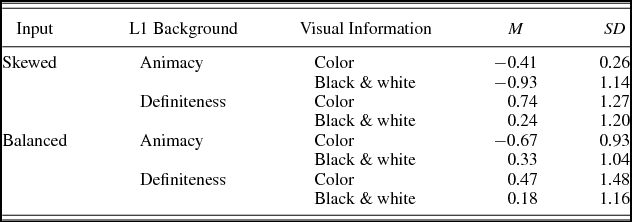
The mean scores were analysed using an analysis of variance (ANOVA) with three variables: input (skewed vs. balanced), L1 background (animacy vs. definiteness), and visual information (color vs. black and white), which revealed a significant main effect for L1 group, F (1, 80) = 11.23, p = .001, partial η2 = 0.123. There was no main effect for input, F (1, 80) = 0.415, p = .521, partial η2 = 0.005, or for visuals, F (1, 76) = 0.098, p = .755, partial η2 = 0.001, and no interaction between L1 and input F (1, 80) = 1.90, p = .172, partial η2 = 0.023. The input by images interaction approached significance, F (1, 76) = 3.156, p = .080, partial η2 = 0.40. The post hoc comparison for L1 background indicated that the definiteness group (0.40) scored significantly higher than the animacy group (–0.42). A one-sampled t test for each group indicated that whereas the definiteness group scored significantly above chance, t (41) = 2.11, p = .041, the animacy group performed significantly below chance, t (41) = 2.64, p = .012.
DISCUSSION
The purpose of this study was to explore the impact of L1 background and visual information on the effectiveness of low-variability input, and the findings revealed a main effect for L1 background. More precisely, the definiteness group did significantly better than the animacy group even though both L1 groups and Esperanto have accusative case marking in transitive constructions. Whereas Esperanto is a nonrestrictive language (all direct objects are marked) with flexible word order, both L1 groups are restrictive, with case selectively marked based on either definiteness or animacy, and relatively fixed word order. An interesting question, then, is why restrictive case marking based on definiteness facilitated detection of the Esperanto transitive construction, while restrictive case marking based on animacy did not.
The divergent findings for the definiteness and animacy L1 groups may be explained with reference to the extended argument dependency model (Bornkessel & Schlesewsky, Reference Bornkessel and Schlesewsky2006), which suggests a positive relationship between L1-specific form–meaning mappings and linguistic processing. The model proposes three processing phases in which different aspects of a structure are computed. In Phase 1, morphology-driven word category information is processed based on stored templates (i.e. noun and verb) without relational information. For example, in the sentence goat chases cat, the words goat and cat are identified as nouns, while the word chases is identified as a verb. In Phase 2a, information needed to assign argument roles is activated. This information is subject to cross-linguistic variation and may contain aspects such as morphology, word order, and the arguments’ animacy, definiteness, and specificity. For instance, for the nouns illustrated above, the properties activated are (+animate, +instigator) for goat and (+animate, +affected) for cat. Features of verb phrases, such as tense, aspect, voice, and agreement, are also activated. In Phase 2b, the information activated in Phase 2a is further computed, such as by classifying animacy or specificity in a prominence hierarchy and computing argument–verb agreement in order to assign argument roles. For the example, in goat chases cat, the accusative marking is absent, and both nouns are animate and therefore potential agents. In this case, argument roles might be assigned based on word order. However, if in some languages morphological markings are absent and goat is higher on the animacy scale than cat, then the role of goat as agent based on its position in the sentence would further be enforced. In Phase 3, generalized mapping occurs, which repairs and finalizes argument role assignment by computing information from prosody, frequency, plausibility, and world knowledge. For example, for a sentence such as cat chases tiger, although cat may be assigned the role of agent and instigator in Phase 2b based on word order, real-world knowledge activated in Phase 3 may conflict with that initial role assignment.
As detailed above, assigning argument roles entails several steps, starting from the activation of templates for word categories, continuing with the activation and computation of the information necessary for assigning argument roles, and ending with the reanalysis and potential repair of the relations between arguments and between arguments and the verb. Because these phases are interdependent, the information that is activated in previous stages of processing needs to be stored in the short-term memory until generalized mapping takes place in Phase 3. When more cues need to be stored in short-term memory, there is potentially greater demand on processing. The discrepancy between the animacy and the definiteness groups in this study could be thus interpreted in terms of processing overload. More specifically, based on their L1-specific encoding of transitivity, definiteness language speakers attended only to details related to word-level information because both animate and inanimate nouns are marked for accusative when they are definite. In contrast, the animacy language speakers needed to attend to both word-level information, such as the presence or absence of markings, and to the semantic properties of the nouns (i.e., animate/inanimate). In their L1s, inanimate nouns in object position are marked when the agent is lower on the animacy scale than the patient. Because the Esperanto transitives in this study featured animate and inanimate nouns in both agent and patient position with all objects marked regardless of their animacy information, the animacy language speakers may have been unable to find the argument relationship specific to Esperanto because they were attending to too many conflicting cues.
Similar to previous comparative studies with L2 English speakers (e.g., Nakamura, Reference Nakamura2012; Year & Gordon, Reference Year and Gordon2009), the current study also revealed no advantages for input distribution. We speculated that balanced input might be more effective for the Esperanto transitive construction because argument roles are rendered by means of morphology, and elements of morphology may be easier to detect with balanced input (Krajewski et al., Reference Krajewski, Siebenborn and Lieven2011). However, the findings indicated no such advantage, which diverges from McDonough and Trofimovich's (Reference McDonough and Trofimovich2013) finding for the greater effectiveness of balanced input. However, balanced input was only effective in their study when paired with deductive, as opposed to inductive, instructions. The current study provided inductive instructions in which the participants were told to pay attention to the noun endings, but they were not told about Esperanto word order or the specific suffix used with objects. Another difference between the two studies concerns the learning task. Whereas the test items in McDonough and Trofimovich required that the participants circle a picture of the noun that functioned as an object in each sentence, the test items used here required that they choose between two pictures that depicted the meaning of the entire construction. In sum, detecting a novel pattern may be influenced by all the factors mentioned above, along with the optimal combination of learning task and instructions.
We also speculated that skewed input may promote analogical reasoning, while balanced input may trigger similarity reasoning. However, abstracting a syntactic construction requires finding a relational structure between the two arguments of the verb, that is, assigning argument roles, and generalizing it across the exemplars, which can be done through both types of reasoning. Within the skewed input group, the relational structure may have been detected through generalizations based on the high-frequency noun, pilko (ball) in the object position (pilko-n), while within the balanced group, the relation may have been triggered by the correspondence between the morpheme –n = affected and its equal occurrence with all the object nouns. Therefore, although by attending to balanced input a listener may be able to easily detect the morpheme –n, he or she would still have to find the relational structure between the two arguments, on the one hand, and between the arguments and the verb, on the other hand, in order to abstract the linguistic category. Because detecting a relational structure across the elements in the input is part of both analogical and similarity reasoning, both balanced and skewed input may be useful for pattern detection for this particular construction.
With regard to the effect of visuals on input type, there was no main effect for visual information, but there was a trend for an interaction between input and visual images, with the combination of balanced input and black-and-white images associated with pattern detection. Previous studies have shown that black-and-white nonredundant visuals and colored nonredundant visuals may be processed differently. More precisely, colored images, unlike black-and-white images, were observed to activate the bilateral occipital regions and the right anterior fusiform, associated with visual and semantic processing (Hocking & Price, Reference Hocking and Price2008). Black-and-white representations of objects may, therefore, not activate the semantic properties associated with those objects. At the same time, by encouraging learners to focus on the grammatical properties of the arguments (i.e., the presence or the absence of the accusative marker), balanced input may in turn not allow for categorizations of linguistic structures based on the semantic properties of the arguments the way skewed input does, as explained above. Thus, the interaction between the black-and-white visuals and the balanced input may be interpreted as affinity of processing by a shift of focus from the semantic properties of the components to their concrete form. These assumptions need to be further tested, however, because the ways in which different types of information are decoded by the human brain are not entirely known.
Our interpretation of the findings emphasizes the key role played by the morphological suffix –n in decoding the Esperanto transitive construction. However, the participants may have also drawn upon other semantic features of the test items, such as the specific verb, animacy, or plausibility, when extracting the transitive construction. In terms of the attributes of the target verbs, hit (batas) entails greater affectedness of the patient than does the verb chase (pelas). Furthermore, the two verbs have agents and patients that differ in terms of animacy. Chase requires an animate agent but allows either animate or inanimate patients, such as boy chases dog or boy chases ball. In contrast, hit can occur with any combination of animate or inanimate agents and patients: ball hits fence, rock hits man, woman hits desk, or girl hits boy. The test items’ plausibility in terms of real-world knowledge could influence sentence interpretation, such as the greater probability associated with tiger chases zebra as opposed to zebra chases tiger.
To explore the possibility that these features helped account for the participants’ test performance, we ran a post hoc item analysis with three predictor variables: verb (chase, hit), animacy features of the agent and patient (+/+, +/−, −/+, −/−), and plausibility. To assess plausibility, two graduate students in applied linguistics independently judged whether the images depicted equally plausible events (such as gate hits car and car hits gate) or whether one image was more plausible (tiger chases rabbit) than the other (rabbit chases tiger). Their agreement was 93% (28/30), and the 2 disagreements were assessed by a third rater and included in the analysis. Their judgments were classified as three possible outcomes: the distracter was more plausible, the target was more plausible, or both pictures were equally plausible. A linear regression indicated that neither verb (Β = 0.246, p = .33), nor animacy (Β = 0.352, p > .20), nor plausibility (Β = 0.272, p > .20) were significant predictors of test item performance, and the overall model fit was R 2 = .181. In sum, the participants did not seem to be influenced either by animacy or by plausibility in detecting the Esperanto transitive pattern. However, the findings of the post hoc analysis should be interpreted cautiously because the current study was not designed to manipulate these variables or assess their individual or combined impact on test performance.
Future studies to further clarify the contribution of low-variability input, visual information, and learners’ previously known languages are needed to gain a more nuanced understanding of novel pattern detection. Due to the small number of participants per condition in the current study, replication studies are needed to confirm the findings. In addition, studies that clarify the contribution of visual information to pattern detection should provide visual images in the form of unfilled, color line drawings. Although the visuals in the current study were drawn with minimum details, the characters were represented with backgrounds representing grass and the sky, which may have interfered with processing when the participants were simultaneously decoding the images and the linguistic input. Images without background coloring may facilitate more efficient processing of the visual input, allowing for more memory space to be used for linguistic processing.
Another issue that warrants further investigation concerns novelty and the selection of a prototypical lexical item as the high token frequency exemplar in skewed input conditions. In the current study, the novelty of the Esperanto transitive construction concerned the assignment of argument roles. In some studies, novelty is operationalized as acquisition of a construction completely absent in a speaker's previously known language (such as the appearance construction in Goldberg's studies), but in other studies novelty is operationalized as acquisition of a construction whose linguistic realization is novel, as is the case with the Esperanto transitive construction. In the latter case, the selection of a prototypical exemplar as the high token frequency element for skewed input should highlight the novel component. In the current study, the skewed element pilko was selected on the basis of its prototypical semantic properties (−volitional, −instigator, +affected), but it may not have been most useful for helping the participants detect the relational structure between the arguments. Because the grammatical realization of relational structure through nonrestrictive morphological marking is the novel aspect of Esperanto for the participants in this study, skewed input may have been more effective if the high token frequency element highlighted the grammatical relationship between argument roles, as opposed to the semantic properties of a single lexical item.
To conclude, the low-variability input studies involving L2 English speakers to date indicate that pattern detection may be affected by the combination of input and other factors, such as the explicitness of the learning task (deductive instruction/balanced: McDonough & Trofimovich, Reference McDonough and Trofimovich2013), environment (classroom setting/balanced: McDonough & Nekrasova-Becker, Reference McDonough and Nekrasova-Becker2014; Year & Gordon, Reference Year and Gordon2009), adults tendency to rely on explicit learning (Nakamura, Reference Nakamura2012). The current study suggests that a speaker's L1-specific form–meaning mappings may also play a role in whether speakers’ differentially benefit from balanced or skewed input. Future research on the role of low-variability input in pattern detection should take into account that the specifics of an L1 structure may also map onto the target L2 structure, impacting the ability to detect new patterns. In addition, prototypicality needs to be defined in terms of a construction's abstract meaning only when dealing with novelty in terms of both form and meaning, such as the construction meaning appearance invented by Goldberg et al. (Reference Goldberg, Casenhiser and White2007). When a construction represents novelty largely in terms of form, learners may activate known patterns associated with that of the previously known meaning and fail to notice all the grammatical aspects of the new form. Consequently, research that investigates both learning situations can provide a more robust understanding of the role of low-variability input in novel pattern detection.
APPENDIX A Construction learning items
APPENDIX B Test sentences
ACKNOWLEDGMENTS
This article reports on the findings of the first author's MA thesis (Fulga, Reference Fulga2013). The study was funded by the Canada Research Chairs program and the Social Sciences and Humanities Research Council of Canada. We thank the members of the MA thesis committee (Sara Kennedy and Pavel Trofimovich) and the artists who provided the illustrations (Amelie Bissonette and Boryana Sezanova).