

The employment rate of young adults with disabilities aged 16 to 24 has hovered at approximately half that of similarly aged young adults without disabilities for the last three years (Office of Disability Employment Policy, 2014). In addition, while the 2011 national hourly wage was $23.19, high school graduates with disabilities only earned $10.61 per hour (Bureau of Labor Statistics, 2011; Newman et al., Reference Newman, Wagner, Knokey, Marder, Nagle, Shaver and Schwarting2011). Rehabilitation research has long focused on employment outcomes and what leads to successful employment. There has also been much attention on what personal factors lead to young adults with disabilities becoming employed. However, little attention has been paid to the young adults with disabilities who obtain but do not retain employment.
Employment Outcomes
The poor post-school outcomes for young adults with disabilities have been well researched. It has been found that academic preparation to enter the job market for young adults with disabilities is inadequate (Benz & Halpern, Reference Benz and Halpern1993; Wagner & Blackorby, Reference Wagner and Blackorby1996; Wittenburg & Loprest, Reference Wittenburg and Loprest2007), young adults with disabilities face uneven transition planning during high school (Mason, Field, & Sawilowsky, Reference Mason, Field and Sawilowsky2004), and they often do not have enough opportunities for participation in career and vocational education curriculums, both of which may have a positive impact on post-school outcomes for young adults with disabilities (Benz & Halpern, Reference Benz and Halpern1993; Brewer et al., Reference Brewer, Karpur, Sukeyong, Erickson, Unger and Malzer2011; Wagner & Blackorby, Reference Wagner and Blackorby1996; Wittenburg & Loprest, Reference Wittenburg and Loprest2007). In addition, young adults with disabilities encounter a lack of opportunities to participate in transition programmes outside of school that provide assistance in securing and maintaining employment after graduation or school completion (Certo, Luecking, Brown, Courey, & Belanger, Reference Certo, Luecking, Brown, Courey and Belanger2008; Certo et al., Reference Certo, Mautz, Pumpian, Sax, Smalley, Wade and Batterman2003; Certo & Pumpian, Reference Certo and Pumpian1997; Gerry & Certo, Reference Gerry and Certo1992).
Employment outcomes for these young adults are affected by disability, demographic and school-related factors (Entwisle, Alexander, & Olson, Reference Entwisle, Alexander and Olson2000; Fabian, Reference Fabian2007; Gardecki, Reference Gardecki2001; Gold, Fabian, & Luecking, Reference Gold, Fabian and Luecking2013; Hasnain & Balcazar, Reference Hasnain and Balcazar2009; Wagner, Newman, Cameto, Garza, & Levine, Reference Wagner, Newman, Cameto, Garza and Levine2005). While considerable attention has been focused on the personal, behavioural and environmental factors that can predict successful employment (e.g. Colley & Jamison, Reference Colley and Jamison1998; Lindstrom & Benz, Reference Lindstrom and Benz2002; Wagner & Blackorby, Reference Wagner and Blackorby1996; Wittenburg & Loprest, Reference Wittenburg and Loprest2007 among many others), there has been relatively little attention to those young adults with disabilities who do not successfully retain employment.
Becoming Employed
Much of the existing rehabilitation and special education literature works to identify which factors contribute to young adults with disabilities obtaining paid employment. Several studies have demonstrated that being either Asian or White and male has a positive impact on post-school employment (Blackorby & Wagner, Reference Blackorby and Wagner1996; Entwisle et al., Reference Entwisle, Alexander and Olson2000; Fabian, Reference Fabian2007; Hasnain & Balcazar, Reference Hasnain and Balcazar2009; Wagner et al., Reference Wagner, Newman, Cameto, Garza and Levine2005). Additionally, prior work experience (Colley & Jamison, Reference Colley and Jamison1998; Fabian, Reference Fabian2007; Test, Fowler, White, Richter, & Walker, Reference Test, Fowler, White, Richter and Walker2009; Wagner et al., Reference Wagner, Newman, Cameto, Garza and Levine2005), participating in vocational education (Brewer et al., Reference Brewer, Karpur, Sukeyong, Erickson, Unger and Malzer2011; Karpur, Clark, Caproni, & Sterner, Reference Karpur, Clark, Caproni and Sterner2005), and having a career goal (Benz, Lindstrom, & Yovanoff, Reference Benz, Lindstrom and Yovanoff2000) all have a significant impact on employment. Other factors that affect post-school employment include: age (Fabian, Reference Fabian2007; Wagner et al., Reference Wagner, Newman, Cameto, Garza and Levine2005), gender (Dong, MacDonald-Wilson, & Fabian, Reference Dong, MacDonald-Wilson and Fabian2010; Gardecki, Reference Gardecki2001; Rojewski, Lee, & Gregg, Reference Rojewski, Lee and Gregg2013), stability of home environment (Gardecki, Reference Gardecki2001), receiving Supplemental Security Income (SSI) (Burke-Miller, Razzano, Grey, Blyler, & Cook, Reference Burke-Miller, Razzano, Grey, Blyler and Cook2012; Fabian, Reference Fabian2007), staying in high school (Gardecki, Reference Gardecki2001; Wagner & Newman, Reference Wagner and Newman2012), and having an employed sibling (Gardecki, Reference Gardecki2001).
Other studies have identified what factors or characteristics of young adults might be associated with a lack of employment success. For example, students with certain disabilities (emotional/behavioural disabilities, intellectual disabilities and multiple disabilities) are less likely to secure a job (Fabian, Reference Fabian2007; Wagner et al., Reference Wagner, Newman, Cameto, Garza and Levine2005), as are Hispanic females (Fabian, Reference Fabian2007). African-American young adults who live in high poverty neighbourhoods and have long commutes to work are also less likely to have a job prior to completing high school (Fabian, Reference Fabian2007; Gardecki, Reference Gardecki2001; Hasnain & Balcazar, Reference Hasnain and Balcazar2009).
Early Termination
While a majority of the research on employment for young adults with disabilities has focused on factors related to getting a job, very few have focused on job retention. Research has shown that having previous work experience significantly predicts job retention (Brewer et al., Reference Brewer, Karpur, Sukeyong, Erickson, Unger and Malzer2011; Colley & Jamison, Reference Colley and Jamison1998; Fabian, Lent, & Willis, Reference Fabian, Lent and Willis1998; Karpur et al., Reference Karpur, Clark, Caproni and Sterner2005), as does level of education, income, health and perceptions of disability (Colley & Jamison, Reference Colley and Jamison1998; Fabian et al., Reference Fabian, Lent and Willis1998; Hasnain & Balcazar, Reference Hasnain and Balcazar2009).
However, factors that impact early work termination often continue to be neglected in the literature. One study on employment for young adults with disabilities found that 46% of students with severe emotional disorders were fired from work during their senior year of high school (Benz & Halpern, Reference Benz and Halpern1993). Another study found that employed adolescents with emotional or behavioural disturbances had different views of their performance at work, rating themselves differently than their employers. The authors described this as a contributing factor for the early termination from work for these young adults (Carter & Wehby, Reference Carter and Wehby2003).
However, there are a number of internship placement programmes and career development programmes that assist young adults with disabilities in the transition from high school to work. For example, the Marriott funded Bridges… From School to Work programme (Bridges programme), has been successfully placing young adults in transition from high school into paid employment since 1989 (Marriott Foundation, 2012b). This study utilises data from this transition programme.
While there has been a considerable amount of research on the factors related to the employment of young adults with disabilities, very little research has been conducted on those young adults who obtain but do not retain employment. The purpose of this study is to explore what factors contribute to early termination of internships in a school to work transition programme for young adults with disabilities. To that end, the research questions for this study are as follows:
1. What reasons do young adults with disabilities participating in a national multi-site vocational intervention programme give for early termination from the programme?
2. What personal and programmatic variables (race, gender, per capita income, prior work experience, previous vocational education, job benefits, and whether or not the individual is a Supplemental Security Income (SSI) recipient or is utilising their Ticket to Work (TTW)) contribute to early termination from a job placement programme for young adults with disabilities?
Methods
Participants and Setting
Bridges…From School to Work (Bridges) is a transition programme for young adults with disabilities that was developed by the Marriott Foundation in 1989 (Mariott Foundation, 2008). The programme assists students with disabilities transitioning out of high school in finding and retaining competitive employment. The programme places over 1,000 young adults with disabilities into paid employment each year (Marriott Foundation, 2012b) and serves students at eight urban sites: Atlanta, Chicago, Dallas, Los Angeles, Philadelphia, San Francisco, Oakland and Washington, DC.
Bridges works to satisfy both the student and the employer by ensuring that the needs of both are met. Students are placed in positions where their strengths match with the job description, so that their functional limitations do not greatly affect their job performance. Students may be placed in any number of work settings, as there are no set positions in which students must be employed. The Bridges programme has been successful in student placement, and employers often use the Bridges programme to hire multiple students with disabilities (Marriott Foundation, 2012b).
To enter the programme, students in their last year of high school are referred through their high school, their family, or are self-referred. These students, aged 17–22, are assisted in three steps. First, students receive career counselling and job placement services, which places them in a paid work experience. Throughout this work experience, participants receive support from Bridges staff (step two). The third step of the programme is the follow-up, which tracks the students after they exit the programme (Fabian, Reference Fabian2007). The programme aims for students to both be employed competitively prior to high school exit, and to sustain this employment after graduation. The Bridges programme has specific programme implementation guidelines, training and monitoring of staff, to ensure that the intervention is standardised. It is funded through the Marriott Foundation, but also through private businesses and state and federal contracts and grants (Marriott Foundation, 2012a) and has been used in a number of studies about young adults with disabilities in transition (i.e. Garcia-Iriarte, Balcazar, & Taylor-Ritzler, Reference Garcia-Iriarte, Balcazar and Taylor-Ritzler2007; Luecking & Fabian, Reference Luecking and Fabian2000).
Programme participants were students with disabilities aged 17–22 enrolled in the Bridges… From School to Work programme who lived in or near Atlanta, Chicago, Dallas, Los Angeles, Philadelphia, San Francisco or Washington DC. Students at the Oakland site were omitted, as there were not enough participants for analysis. Referral to the programme was done through local schools, other community agencies, families, or self-referral. To participate, students were required to provide documentation of their disability from a doctor, state vocational rehabilitation provider, or their high school.
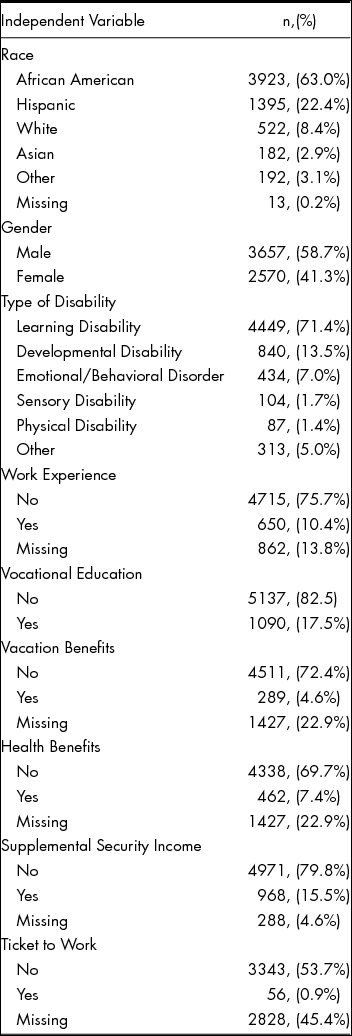
Self-report data from 6,227 young adults who entered the Bridges programme between March 2004 and October 2010 was used for this study. Over half of the sample was male (58.7%). A majority of the participants were African American (63.1%), and the sample predominately consisted of young adults with learning disabilities (71.4%). Nearly 25% of the participants lived in the Los Angeles area. These demographic characteristics are presented in more depth in Table 1.
Participant characteristics (N = 6227)

For this study, young adults were considered to terminate early if they obtained a job but left the programme prior to achieving any of the programme benchmarks. Programme benchmarks were: ‘12 months of continuous employment, assuming specific additional job responsibility, commencement of post-secondary education or training, completion of vocationally related certification or training, moving into and sustaining an independent living situation, [and/or] moving from seasonal to permanent employment’ (Mariott Foundation, 2008). In this study, 21.1% of the participants terminated early, 16.3% for negative reasons and 4.8% positive.
Data Collection and Procedure
Bridges staff collects data from students throughout the programme. All data are self-report and identical information is collected at each Bridges site and staff are instructed on how and when to collect data from the student (Mariott Foundation, 2008). As participants enter the programme, enrolment forms are completed, while other forms are updated regularly (pre-employment forms, placement forms and employment logs). This occurs throughout the job support process. After successful completion of the programme, follow-up data are collected from the student at three and 12 months (Mariott Foundation, 2008). After Bridges staff at each of the eight sites input the data, data from all sites are then combined into a single dataset at the Foundation's headquarters. In order to ensure consistency and reliability among both programme sites and staff at each site, headquarters staff check the data for consistency. Data from young adults who participated in the Bridges programme between March 2004 and October 2010 were utilised to ensure that the data was recent and to ensure enough time for programme completion for each participant. As the data were collected by the Bridges programme and was part of an existing transition programme, this study qualified for an Exempt IRB review at the University of Maryland.
Data Analysis
As the participants in this study were placed at eight different sites with different staff, different local economies and different environments, a multilevel model that could control for these differences was necessary. It is inappropriate to use regression on multilevel data, as it has been shown to violate the assumption of uncorrelated errors, an essential assumption of regression (Luke, Reference Luke2004). Additionally, using logistic regression instead of multilevel modeling when working with nested data has been found to lead to an increased likelihood of Type-I errors (Austin, Tu, & Alter, Reference Austin, Tu and Alter2003). Therefore, data in this study were analysed using Hierarchical Linear Modeling (HLM), a statistical analysis tool for nested data (Raudenbush, Bryk, Cheong, & Congdon, Reference Raudenbush, Bryk, Cheong and Congdon2001). Data in this study were nested at the programme site level, while the analysis of the variables occurred at the individual level. A two-level model (individual and site) allowed the researcher to control for the effect of programme site when analysing the independent variables.
The dependent variable included in this study was early termination, with the independent variables on level one of the model being: race, gender, type of disability, socioeconomic status, previous work experience, vocational education, whether or not the young adult was receiving vacation and health benefits at work, and whether or not the young adult was receiving supplemental security income and utilising the ticket to work. At level two, the independent variable was the site at which the young adult was receiving services.
The percentages of the sample representing each independent variable are shown in Table 1.
Results
Relationships Between Variables
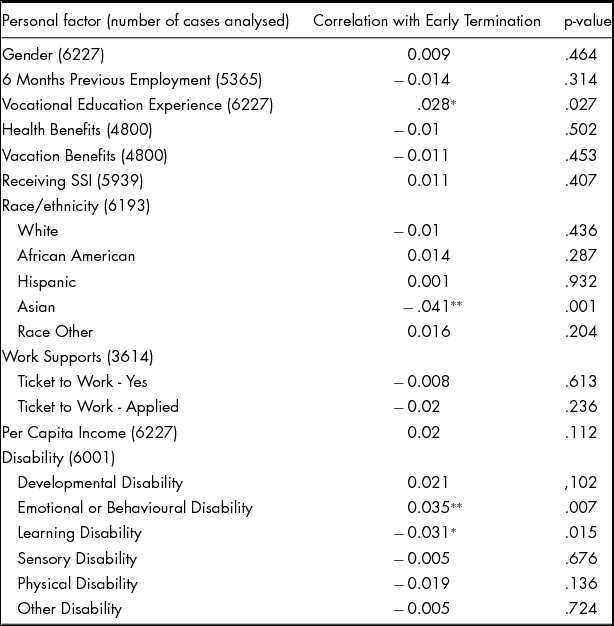
In order to explore the relationship between each independent variable and the dependent variable prior to conducting the logistic regression and subsequent Hierarchical Linear Modelling analysis, bivariate correlations were run. This analysis resulted in four significant correlations. Previous vocational education was significantly positively correlated with early termination, at the 0.05 level. Additionally, there was a negative correlation between having a learning disability and early termination (also significant at the 0.05 level). Individuals with emotional or behavioural disabilities were more likely to terminate early, and Asian-American young adults with disabilities were less likely to terminate work early, both significant at the 0.01 level. These correlations are shown in Table 2.
Factors correlated with Early Termination
*. Correlation is significant at the 0.05 level (2-tailed).
**. Correlation is significant at the 0.01 level (2-tailed).
Reasons for Early Termination
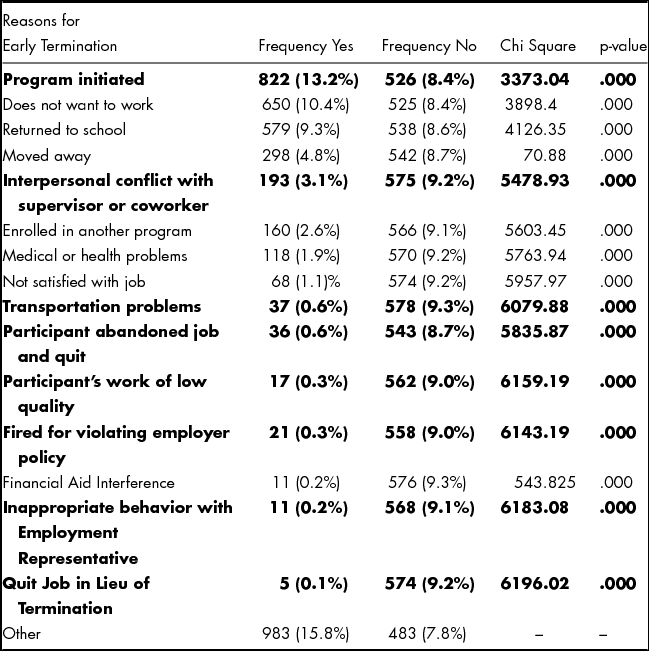
In order to identify what reasons young adults with disabilities participating in a national multi-site vocational intervention programme gave for early termination a frequency analysis was run. The reasons for early termination and their frequencies are included in Table 3 with negative reasons for early termination bolded. These responses were self-report and came from a fixed item list with an option to specify an ‘other’ response. Reasons for early termination response options were as follows: ‘program initiated; does not want to work; returned to school; moved away; interpersonal conflict with supervisor or coworker; enrolled in another program; medical or health problems; not satisfied with job; transportation problems; participant abandoned job and quit; participant's work of low quality; fired for violating employer policy; financial aid interference; inappropriate behaviour with employment representative; quit job in lieu of termination; and other’. These responses were classified into positive and negative reasons for early termination with the help of another researcher who had previously worked with the data and was experienced in transition research. Positive and neutral reasons for early termination were considered to not indicate a problem with the young adults in the workplace, and negative reasons indicated potential problems with the young adults’ performance, the position in which the young adults was placed, and/or problems within the transition programme.
Reasons for Early Termination
Bolded reasons for early termination indicate negative reasons for termination
There were two positive reasons for early termination: returned to school and enrolled in another programme. Additionally, the three most commonly cited neutral reasons for early termination were: does not want to work, moved away and medical or health problems. The most common negative reasons for early termination were: programe initiated, interpersonal conflict with supervisor or coworker and transportation problems.
Predictors of Early Termination
To determine which personal and programmatic variables (race, gender, type of disability, per capita income, prior work experience, previous vocational education, job benefits and whether or not the individual is an SSI recipient or is utilizing their TTW) contributed to terminating early (for negative reasons) from a job placement programme for young adults with disabilities, a stepwise logistic regression was run, followed by HLM analyses.
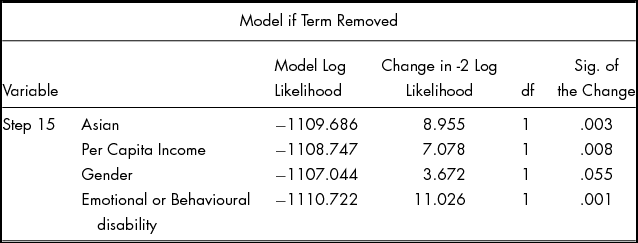
A backwards step logistic regression was utilised to determine which variables belonged in the HLM analysis, allowing for a more parsimonious model to be developed prior to running the HLM. There were 18 variables entered into the regression equation: African-American, Hispanic, Asian, Other Race, Not using Ticket to Work, Applied for Ticket to Work, Per Capita Income – centered and reduced to thousands, Male, Six Months Previous Employment, Previous Vocational Education, Receiving Health Benefits, Receiving Holiday Benefits, Receiving Supplemental Security Income, Developmental Disability, Emotional or Behavioural Disability, Sensory Disability, Physical Disability and Other Disability. The model was complete at step 15, which indicated that whether or not the individual was Asian, their per capita income, whether or not they were male, and whether or not they had an emotional or behavioural disturbance all significantly impacted early termination. Step 15 of the backwards step logistic regression is included in Table 4.
Unique contribution of ethnicity, per capita income, gender and disability type on work termination
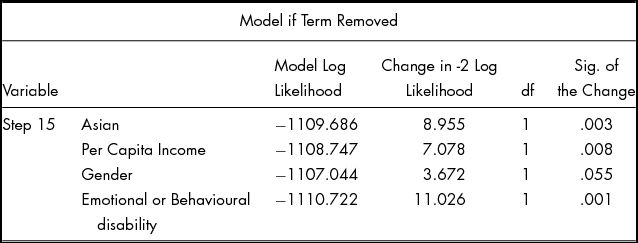
Therefore, the variables Asian, Per Capita Income, Gender and Emotional or Behavioural Disability were included in the subsequent HLM.
In order to determine whether or not there was variance between sites, which would then identify the need to analyse the data hierarchically, the fully unconditional model was run. Following the fully unconditional model being satisfied, the prediction model was run. The prediction model included all of the variables previously found to be significant in the logistic regression, but was a way to control for the variance between the different sites.
The HLM analysis was approached initially by conducting the fully-unconditional model.Footnote 1
This model includes no level-1 or level-2 predictors, which allows for a determination of whether hierarchical analysis is necessary. This resulted in a Tau value of 0.53669, which was used to determine the intraclass correlation (the percent of variance between sites). The intraclass correlation resulted in a value of 0.01605, demonstrating the need to run the HLM (Raudenbush et al., Reference Raudenbush, Bryk, Cheong and Congdon2001).
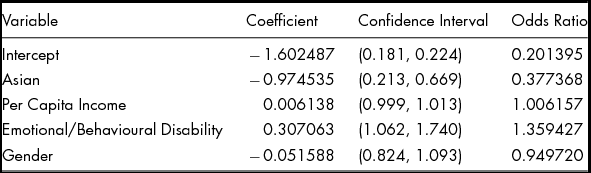
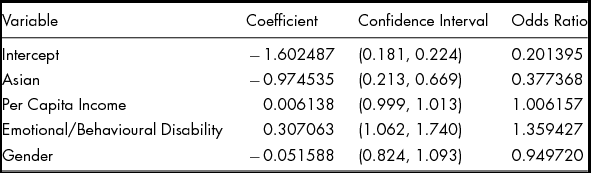
The prediction model was used to determine the impact of the variables in the analysis (Asian, Per Capita Income, Emotional or Behavioural Disability and Gender), while ensuring that the differences in these variables were not due to site level differences. Each independent variable was added to the model un-centred, as the author was not interested in the interactions between the independent variables. Missing data was managed using listwise deletion, however, in total, the analysis included all 6,227 participants. This prediction model ultimately resulted in one significant variable, thereby demonstrating that young adults with disabilities who are Asian are 63% less likely to terminate work early than White individuals with disabilities when taking into account the differences at the site level. The results of the prediction model are in Table 5.
Hierarchical Linear Modeling Prediction Model of personal factors that predict early termination from work
Discussion
These results provide insight into an area of transition that has often been overlooked in previous research. Identifying factors that are related to a young adults with a disability obtaining but not retaining a job can provide insight into how best to support these young adults. Knowing what commonly cited reasons young adults provided for terminating early from this transition programme (programme initiated termination, termination due to interpersonal conflict with a supervisor or coworker and transportation problems) can provide insight into where to provide additional services to help these young adults succeed.
The HLM analysis, which removed the impact of site level variance on the dependent variable, found that race had a significant impact on early termination. Race's impact on work has been confirmed by a number of studies (e.g. Blackorby & Wagner, Reference Blackorby and Wagner1996; Entwisle et al., Reference Entwisle, Alexander and Olson2000; Fabian, Reference Fabian2007; Gardecki, Reference Gardecki2001), all of which found a relationship between race and job placement. Similarly, the results of this study found that Asian students with disabilities were 63% less likely to terminate early from work than White individuals with disabilities.
Implications
The most common reason for early termination was ‘programme-initiated’ which may indicate a need for programme procedures to be altered. Transition programmes may assist young adults in transition by altering their programme requirements to alleviate the difficulties young adults with disabilities may face in remaining in an internship programme. As young adults in transition are young, in this case between 17 and 22 years old, they may benefit from being allowed a larger number of mistakes before being terminated from the programme.
It is also important to recognise how interpersonal conflicts with coworkers or supervisors affected transition. Understanding that interpersonal conflicts can lead to early termination can help transition programmes alleviate these difficulties for the students. Staff in transition programmes can mediate problems between employers or coworkers and the young adults in transition. Programmes may also need to provide mediation training for the staff at transition programmes, to better prepare them for providing this mediation. In addition, students may benefit from receiving social skills training during job preparation in the transition programme.
Finally, knowing that young adults with disabilities in transition are encountering transportation problems that can lead to early termination, changes should be made. These changes could include transition programmes providing transportation stipends to help young adults get to work, particularly in the beginning of the programme. For example, as students begin the programme, financial assistance for transportation may be provided so that students have the opportunity to become situated in their positions with less concern over transportation problems. This could also allow young adults to begin to save money for transportation costs in the future. In addition, if transportation is an anticipated problem for the young adults, placing these students in employment that is in closer proximity to their school or home could minimise the potential for transportation to become an issue. These transportation problems should be addressed, as previous research has shown that longer commutes can influence whether or not a young adults with a disability obtains employment (Fabian, Reference Fabian2007).
While the only personal factor found to be significantly impacted by early termination was race, it is important to recognise that although Asian-American young adults were less likely to terminate early, and that other minority young adults in the study did not have significant early termination results, readers not interpret this as an example of the ‘model minority’ stereotype (Lee, Reference Lee1996). It is important to continue to recognise the impact of structural barriers that exist for minority young adults (e.g. D’Amico, Reference D’Amico1984), and ensure that these structural barriers are not overlooked.
Limitations
This study has several limitations. First, the participants in this dataset are disproportionately minority young adults and young adults with learning disabilities, which limits the generalisability of the results. In addition, young adults in the Bridges programme may not be representative of all young adults with disabilities, as the young adults are in their final years of high school and were either self-referred to the programme, or were referred by others. This indicates that these young adults may be more persistent, or have better access to transition services than other young adults with disabilities. Additionally, this study identified the impact of personal factors on early termination, therefore leaving out many of the other potential reasons for early termination. Including data on workplace supports (e.g. whether supports were provided, what supports were provided) in the analysis could have provided more robust results. This is especially important as young adults with disabilities transitioning through the Bridges programme are given workplace supports, and these supports vary depending on the participant (Garcia-Iriarte et al., Reference Garcia-Iriarte, Balcazar and Taylor-Ritzler2007).
There are also limitations with regards to the data in the study. The data are self-reported, which introduces a potential for response bias with students reporting more socially desirable reasons for termination. Additionally, as many individuals enter the data, there are concerns of consistency in the data. Unfortunately, the format of the instrument used allowed for multiple reasons for early termination to be reported for a single participant, making it more difficult to parse out the particular effect of a certain reason for termination. Finally, the use of stepwise regression prior to the HLM may have led to a higher chance of a Type-I error in the study.
Conclusion
Despite its limitations, this study makes an important contribution to the existing transition literature. Focusing on early termination can help better serve at-risk young adults with disabilities who may fall through the cracks during transition. Although early termination has previously been neglected in transition research, it is essential that researchers begin to consider how it effects successful transition for young adults with disabilities.
Acknowledgments
Dr Pebdani's work on this article was partially funded by the US Department of Education, NIDRR post-doctoral Advanced Rehabilitation Research Training grant number H133P080008.
I would like to thank Dr Ellen Fabian for her assistance with this journal article. I would also like to thank the Marriott Foundation for People with Disabilities and the Bridges From School to Work programme for collecting the data and allowing me to utilise it for this study.