Posttraumatic stress disorder (PTSD) is a debilitating disorder manifesting in a prolonged maladaptive response to traumatic events. While several psychotherapies and pharmacotherapies have been developed for PTSD, research has consistently shown that more than one-third of patients never fully remit, even if treated (Difede et al., Reference Difede, Olden and Cukor2014). A multidimensional meta-analysis of psychotherapies for PTSD has found only short-term improvements in about 50% of patients following treatment, with most patients continuing to show substantial residual symptoms post-treatment (Bradley et al., Reference Bradley, Greene, Russ, Dutra and Westen2005). A critical lack of advancement was noted also for pharmacotherapy, with only 20–30% of patients achieving complete remission (Krystal et al., Reference Krystal, Davisd, Neylanf, Raskindj, Schnurrl, Steinh, Vessicchiob, Shinerl, Gleasona and Huangn2017). Thus, an acute need to identify new targets for therapeutic interventions arise, hoping that these might serve as the basis for developing alternative or augmenting treatments for PTSD (Difede et al., Reference Difede, Olden and Cukor2014). Threat-related attentional biases, defined as the heightened tendency to allocate attentional resources to threatening stimuli in the environment (Bar-Haim et al., Reference Bar-Haim, Lamy, Pergamin, Bakermans-Kranenburg and van Ijzendoorn2007), have been proposed as one such potential target in PTSD (Armstrong and Olatunji, Reference Armstrong and Olatunji2012). Indeed, cognitive models for PTSD have implicated several faulty cognitive processes in the disorder (Buckley et al., Reference Buckley, Blanchard and Neill2000; Brewin and Holmes, Reference Brewin and Holmes2003), including biased attentional processes of trauma-related information (Chemtob et al., Reference Chemtob, Roitblat, Hamada, Carlson and Twentyman1988; Foa et al., Reference Foa, Steketee and Rothbaum1989; Litz and Keane, Reference Litz and Keane1989; Ehlers and Clark, Reference Ehlers and Clark2000; Aupperle et al., Reference Aupperle, Melrose, Stein and Paulus2012).
To date, research examining threat-related attentional biases in PTSD has relied mostly on reaction time (RT)-based tasks and measures (In-Albon and Schneider, Reference In-Albon, Schneider, Hadwin and Field2010), in which attention bias to threat is inferred from facilitated or interfered performance (i.e. changes in RT) due to the presence of threatening stimuli. For example, in the emotional Stroop task (Williams et al., Reference Williams, Mathews and MacLeod1996), threatening and non-threatening words are paired along with a color (the word or its background), and participants are asked to name that color while ignoring its semantic meaning. Threat-related attention bias is inferred when participants are slower in naming the color of threatening words compared with non-threatening words. In the dot-probe task (MacLeod et al., Reference MacLeod, Mathews and Tata1986), threatening stimuli, usually words or facial expressions, are presented simultaneously alongside neutral stimuli, and their removal is followed by a small probe appearing at the location just occupied by one of these stimuli. Participants must determine as fast as possible between two variants of the probe (e.g. ‘E’ or ‘F’) which appear with equal probability at the location previously occupied by the threat or neutral stimuli. Threat-related attention bias is revealed when participants are faster to respond to probes replacing threat rather than neutral stimuli. Several advantages of these tasks have contributed to their wide dissemination and extensive usage over the years. They require simple hardware (usually a laptop or a desktop computer) and software, making them cost-effective and accessible for researchers, and easily understood and operated by participants. These advantages are further heightened when considering treatment protocols designed to modify attention biases (i.e. attention bias modification (ABM) procedures), as these can be easily delivered to a wide range of patients. In addition, as ABM procedures can be also delivered remotely, via web-based protocols, they minimize the need for in-person contact, thus enabling treating potential patients that have no access to other forms of mental health services (Bar-Haim, Reference Bar-Haim2010).
While advancing our knowledge in the field, extant studies using RT-based tasks have yielded mixed results in PTSD. For the emotional Stroop task, some studies have shown biased attention towards threat (McNally et al., Reference McNally, Kaspi, Riemann and Zeitlin1990; Foa et al., Reference Foa, Feske, Murdock, Kozak and Mccarthy1991; Cassiday et al., Reference Cassiday, McNally and Zeitlin1992; Kaspi et al., Reference Kaspi, McNally and Amir1995; Harvey et al., Reference Harvey, Bryant and Rapee1996; Beck et al., Reference Beck, Freeman, Shipherd, Hamblen and Lackner2001; Ashley et al., Reference Ashley, Honzel, Larsen, Justus and Swick2013; Martinson et al., Reference Martinson, Sigmon, Craner, Rothstein and McGillicuddy2013), while others revealed attention bias away from threat or lack of differences between trauma-exposed healthy participants (TEHC) and patients with PTSD (McNally et al., Reference McNally, Amir and Lipke1996; Freeman and Beck, Reference Freeman and Beck2000; Shin et al., Reference Shin, Whalen, Pitman, Bush, Macklin, Lasko, Orr, McInerney and Rauch2001; Bremner et al., Reference Bremner, Vermetten, Vythilingam, Afzal, Schmahl, Elzinga and Charney2004; Constans et al., Reference Constans, McCloskey, Vasterling, Brailey and Mathews2004; Devineni et al., Reference Devineni, Blanchard, Hickling and Buckley2004; Reid et al., Reference Reid, McMillan and Harrison2011). One meta-analysis concluded that the Stroop effect in PTSD is extremely weak or subtle, if exists at all (Kimble et al., Reference Kimble, Frueh and Marks2009), while a second more recent one concluded that while PTSD patients do differ from healthy controls on the task, they do not differ from TEHC participants (Cisler et al., Reference Cisler, Wolitzky-Taylor, Adams, Babson, Badour and Willems2011). Similar equivocal conclusions also emerge for the dot-probe task, with some evidence suggesting biased attention toward threat (Dalgleish et al., Reference Dalgleish, Moradi, Taghavi, Neshat-Doost and Yule2001; Bardeen and Orcutt, Reference Bardeen and Orcutt2011; Fani et al., Reference Fani, Tone, Phifer, Norrholm, Bradley, Ressler, Kamkwalala and Jovanovic2012b), some suggesting an association between PTSD and bias away from threat (Bar-Haim et al., Reference Bar-Haim, Holoshitz, Eldar, Frenkel, Muller, Charney, Pine, Fox and Wald2010; Fani et al., Reference Fani, Bradley-Davino, Ressler and McClure-Tone2011; Sipos et al., Reference Sipos, Bar-Haim, Abend, Adler and Bliese2014), some finding no attention bias in PTSD (Fani et al., Reference Fani, Jovanovic, Ely, Bradley, Gutman, Tone and Ressler2012a; Schoorl et al., Reference Schoorl, Putman and van Der Does2013; Iacoviello et al., Reference Iacoviello, Wu, Abend, Murrough, Feder, Fruchter, Levinstein, Wald, Bailey, Pine, Neumeister, Bar-Haim and Charney2014), and some implicating an enhanced tendency for attention to fluctuate between threat vigilance and threat avoidance (Iacoviello et al., Reference Iacoviello, Wu, Abend, Murrough, Feder, Fruchter, Levinstein, Wald, Bailey, Pine, Neumeister, Bar-Haim and Charney2014; Naim et al., Reference Naim, Abend, Wald, Eldar, Levi, Fruchter, Ginat, Halpern, Sipos, Adler, Bliese, Quartana, Pine and Bar-Haim2015). Thus, while theoretical thinking and laboratory research assert that threat-related attentional biases are important in PTSD, these mixed findings have slowed progress in converting the understandings of attention biases into novel intervention targets for PTSD.
Below we argue that several inherent weaknesses of RT-based tasks and measures might contribute to this state of affairs, and offer eye-tracking as an alternative strategy for assessing attention processes, potentially offering more precise targets for intervention. We then discuss the results of a systematic review of the literature on threat-related attentional biases in PTSD using eye-tracking methodology, and offer suggestions for best practices and next steps for researchers in the field.
The first disadvantage of RT-based tasks is their limited ability to capture the complexity of attention processes and to easily distinguish between the different aspects of attention (Weierich et al., Reference Weierich, Treat and Hollingworth2008; Felmingham et al., Reference Felmingham, Rennie, Manor and Bryant2011; Armstrong et al., Reference Armstrong, Bilsky, Zhao and Olatunji2013), such as facilitated threat detection, difficulty disengaging attention from threat, and attentional threat avoidance (Weierich et al., Reference Weierich, Treat and Hollingworth2008; Cisler and Koster, Reference Cisler and Koster2010). Facilitated threat detection, or threat vigilance, is defined as the ease or speed in which threat is detected, as attention is preferentially drawn to threatening stimuli in the environment. Difficulty disengaging attention from threat refers to the degree to which attention is held by a threatening stimulus, once detected, due to difficulty in diverting attention away from it. Finally, attentional threat avoidance is the tendency to preferentially allocate attention away from threatening stimuli, as if to intentionally avoid threatening information altogether (Cisler and Koster, Reference Cisler and Koster2010). While seemingly different, these aspects of attention are not mutually exclusive, and might operate at different stages of information processing (Weierich et al., Reference Weierich, Treat and Hollingworth2008). For example, individuals with PTSD may display facilitated threat detection at early stages of visual processing, followed by difficulty disengaging attention once threat has been detected, and finally, exhibit avoidance at later, more strategic stages of processing (Mogg et al., Reference Mogg, Bradley, De Bono and Painter1997; Cisler and Koster, Reference Cisler and Koster2010). However, as RT-based measures of attention are derived from keypresses occurring at the end of the information processing course they inevitably involve an inherent temporal distance between the behavioral output (i.e. key presses) and the examined attentional components taking place earlier in the process. Thus, attentional processes are only measured indirectly, inferred from facilitated or interfered performance measured at the end of the process (Kimble et al., Reference Kimble, Fleming, Bandy, Kim and Zambetti2010; Lee and Lee, Reference Lee and Lee2012; Thomas et al., Reference Thomas, Goegan, Newman, Arndt and Sears2013), providing no information about the course of attention deployment before or after the moment of measurement (Hermans et al., Reference Hermans, Vansteenwegen and Eelen1999; Bar-Haim et al., Reference Bar-Haim, Lamy, Pergamin, Bakermans-Kranenburg and van Ijzendoorn2007; Bar-Haim, Reference Bar-Haim2010; In-Albon and Schneider, Reference In-Albon, Schneider, Hadwin and Field2010; Yiend, Reference Yiend2010; Felmingham et al., Reference Felmingham, Rennie, Manor and Bryant2011; Armstrong and Olatunji, Reference Armstrong and Olatunji2012; Shechner et al., Reference Shechner, Jarcho, Britton, Leibenluft, Pine and Nelson2013; Thomas et al., Reference Thomas, Goegan, Newman, Arndt and Sears2013; Lazarov et al., Reference Lazarov, Abend and Bar-Haim2016; Price et al., Reference Price, Greven, Siegle, Koster and De Raedt2016; Lazarov et al., Reference Lazarov, Pine and Bar-Haim2017b). In addition, due to their ‘snapshot’ nature, RT-based tasks are limited in their ability to differentiate the different aspects of attention, especially within single trials, and to accurately describe the dynamic and ongoing process of attention as it unfolds and changes over time (Lee and Lee, Reference Lee and Lee2012; Thomas et al., Reference Thomas, Goegan, Newman, Arndt and Sears2013). Indeed, it has been suggested that the Stroop effect may index difficulty in threat-disengagement, or even avoidance of processing aversive information, rather than vigilance or attention toward threat (De Ruiter and Brosschot, Reference De Ruiter and Brosschot1994; Fox, Reference Fox1994; Reference Fox and Yiend2004; Hermans et al., Reference Hermans, Vansteenwegen and Eelen1999; Tolin et al., Reference Tolin, Lohr, Lee and Sawchuk1999; Mogg and Bradley, Reference Mogg, Bradley and Yiend2004; In-Albon and Schneider, Reference In-Albon, Schneider, Hadwin and Field2010; Thomas et al., Reference Thomas, Goegan, Newman, Arndt and Sears2013), with similar claims raised also for the dot-probe task (Fox et al., Reference Fox, Russo, Bowles and Dutton2001; Bar-Haim et al., Reference Bar-Haim, Lamy, Pergamin, Bakermans-Kranenburg and van Ijzendoorn2007; Weierich et al., Reference Weierich, Treat and Hollingworth2008; Felmingham et al., Reference Felmingham, Rennie, Manor and Bryant2011). Consequently, it remains less clear which attentional mechanisms are driving observed results on these tasks, which is crucial in providing valuable insights into the maintenance of symptoms and in clarifying novel specific targets for therapeutic intervention (Armstrong et al., Reference Armstrong, Bilsky, Zhao and Olatunji2013).
Two additional disadvantages of RT-based tasks further highlight the need to find new and improved paradigms capable of assessing, and subsequently modifying threat-related attentional biases. First, RT-based tasks suffer from poor psychometric properties including low internal consistency and test-retest reliability, as well as poor convergent and ecological validity (In-Albon and Schneider, Reference In-Albon, Schneider, Hadwin and Field2010; Rodebaugh et al., Reference Rodebaugh, Scullin, Langer, Dixon, Huppert, Bernstein, Zvielli and Lenze2016). Low test-retest reliability and minimal convergent validity were found for the Stroop (Eide et al., Reference Eide, Kemp, Silberstein, Nathan and Stough2002; Strauss et al., Reference Strauss, Allen, Jorgensen and Cramer2005) and for the dot-probe tasks (Schmukle, Reference Schmukle2005; Staugaard, Reference Staugaard2009; Waechter et al., Reference Waechter, Nelson, Wright, Hyatt and Oakman2014; Waechter and Stolz, Reference Waechter and Stolz2015). Importantly, the observed low reliability of RT-based tasks is an inevitable consequence of deriving attention bias scores from differences in the RTs of two highly correlated conditions (e.g. response time to probes that replace threat and neutral stimuli in the dot-probe task). Subtracting highly-correlated components inescapably leads to a low-reliability composite, even when each separate component, in itself, demonstrates high reliability (Sipos et al., Reference Sipos, Bar-Haim, Abend, Adler and Bliese2014; McNally, Reference McNally2018). Indeed, while RT components of the dot-probe task are usually found to be highly reliable (Waechter et al., Reference Waechter, Nelson, Wright, Hyatt and Oakman2014) they are also highly correlated (Sipos et al., Reference Sipos, Bar-Haim, Abend, Adler and Bliese2014), rendering it extremely difficult for the RT-based attentional indices to achieve even modest reliability (McNally, Reference McNally2018). Second, as RT-based tasks rely on keypresses as indices of attention, they give rise to potential confounding elements related to the execution of the motor responses (i.e. key-presses), possibly obscuring the interpretation of obtained results (In-Albon and Schneider, Reference In-Albon, Schneider, Hadwin and Field2010; Kimble et al., Reference Kimble, Fleming, Bandy, Kim and Zambetti2010; Armstrong and Olatunji, Reference Armstrong and Olatunji2012; Thomas et al., Reference Thomas, Goegan, Newman, Arndt and Sears2013; Price et al., Reference Price, Greven, Siegle, Koster and De Raedt2016).
An alternative approach for assessing attentional biases, eye-tracking methodology, has emerged in attention research to overcome the above-mentioned shortcomings of RT-based tasks. Eye-tracking is a non-invasive method that continuously samples gaze data at different rates (ranging from 60 to 2000 Hz). Using eye-tracking measures to indicate attentional processes is based on the assumption that the individual's overt eye movements and direction of gaze highly correspond with the visual attention allocation deployed over time (Just and Carpenter, Reference Just and Carpenter1976; Wright and Ward, Reference Wright and Ward2008; In-Albon and Schneider, Reference In-Albon, Schneider, Hadwin and Field2010). While deployment of visual attention allocation can also occur via covert attention, with no overt gaze shifting, in naturalistic viewing overt eye-movements are considered to be a primary source for attention selection, to follow closely covert attention and to be directed by it, and are regarded as a necessary mediator for the effects of covert attention (Kowler et al., Reference Kowler, Anderson, Dosher and Blaser1995; Hayhoe and Ballard, Reference Hayhoe and Ballard2005; Armstrong and Olatunji, Reference Armstrong and Olatunji2012). Furthermore, research has shown that the eye movement system plays a vital role in covert attention, with common mechanisms underlying both overt and covert attention orienting (Smith et al., Reference Smith, Rorden and Jackson2004). Finally, the relation between covert attention and overt eye movements is considered much closer than the one between covert attention and manual responses, such as those used in RT-based tasks (Armstrong and Olatunji, Reference Armstrong and Olatunji2012).
In eye-tracking research, all facets of eye-data (e.g. saccades, fixations, and pupillometry) are recorded, analyzed, and later interpreted to characterize attentional patterns. F ixations, defined as the time periods between eye-movements when the eye stops at a certain position and visual information is encoded, reflects maintenance of gaze on an object of interest. Saccades, defined as fast movements of the eye, are considered manifestations of changing the focus of attention. Scan-path usually refers to the resulting series of saccades reflecting stimulus scanning (Duchowski, Reference Duchowski2007), and is typically measured in terms of saccade/fixation count, saccade duration or overall scan-path length (Stewart, Reference Stewart2012; Kimble et al., Reference Kimble, Boxwala, Bean, Maletsky, Halper, Spollen and Fleming2014). Pupillometry, the measurement of pupil size and reactivity, allows continuous measurements of involuntary physiological reactions and autonomic activity (i.e. arousal) that is intimately related to emotional states (Cascardi et al., Reference Cascardi, Armstrong, Chung and Pare2015). These various measures are then used to describe differences in gaze-related behavior reflecting different attentional processes and biases.
Free-viewing, one of the most widely used eye-tracking paradigms in visual attention research, can help illustrate this process. In free-viewing tasks, participants are requested to freely view arrays of stimuli without any specific requirements or demands. Attentional measures and processes are then deduced from the recorded eye-data (see Fig. 1 for a schematic timeline of stimulus presentation and the inferred attentional measures). Facilitated/biased threat detection can be determined by examining the location and the latency of initial eye movements occurring immediately after stimulus onset, namely, first fixations. A greater proportion of first fixations on threat compared with neutral stimuli, or shorter latencies to first fixate on threat compared with neutral stimuli, are considered evidence of facilitated threat detection (Felmingham et al., Reference Felmingham, Rennie, Manor and Bryant2011; Armstrong et al., Reference Armstrong, Bilsky, Zhao and Olatunji2013). Likewise, while less common, scan-path variables are sometimes used to reflect hypervigilance behavior occurring when scanning different stimuli, which might enhance threat detection (Stewart, Reference Stewart2012; Kimble et al., Reference Kimble, Boxwala, Bean, Maletsky, Halper, Spollen and Fleming2014). These include saccades/fixations count, saccade duration/length or number of revisits to predefined areas of the displayed stimulus, usually measured throughout stimuli presentation duration. Pupillometry measures can be also used to examine hypervigilance (Cascardi et al., Reference Cascardi, Armstrong, Chung and Pare2015). Difficulty disengaging attention from threat is usually indicated by measuring fixation duration (i.e. dwell time). When computed for initial fixations, increased dwell time on threat compared with neutral stimuli signals difficulty in initial attention disengagement. When accumulating the durations of all fixations made on threat compared with neutral stimuli during stimulus presentation (i.e. total dwell time), increased dwell time usually reflects sustained attention or maintenance of attention on threat (Armstrong and Olatunji, Reference Armstrong and Olatunji2012; Armstrong et al., Reference Armstrong, Bilsky, Zhao and Olatunji2013). Alternatively, though less common, total fixation count may be also used to indicate sustained attention, although total fixation count and dwell time are usually highly correlated (Waechter et al., Reference Waechter, Nelson, Wright, Hyatt and Oakman2014). Importantly, sustained attention on threat usually refers to threats that have already been detected and are known to exist in the environment (i.e. an initial fixation on threat has already occurred; Armstrong et al., Reference Armstrong, Bilsky, Zhao and Olatunji2013), and as such provide vital information that is not accessible by RT-based tasks. Lastly, total dwell time can also be computed separately for consecutive time intervals to reflect changes in attention deployment over time (i.e. time course analysis). Reduction in total dwell time on threatening stimuli across time intervals is used to indicate attentional threat avoidance. For example, for a presentation duration of 6 s (second), dwell time can be computed separately for three 2-s intervals, with a reduction in total dwell time on threat across intervals indicating avoidance. A second less common measure of attentional avoidance is the location or dwell time of second fixations that follow an initial fixation on threat (Kimble et al., Reference Kimble, Fleming, Bandy, Kim and Zambetti2010; Felmingham et al., Reference Felmingham, Rennie, Manor and Bryant2011).
Schematic timeline of stimulus presentation and the inferred attentional measures.

Another example of a widely-used eye-tracking-based paradigm in attentional research is that of visual search (Armstrong and Olatunji, Reference Armstrong and Olatunji2012). In this paradigm, eye-movements are recorded while participants are engaged in an active search for a target embedded among an array of distractors. Facilitated/biased threat detection is usually examined in trials in which the target is a threatening stimulus with non-threatening stimuli used as distractors. Latency to fixating on the threat target (Miltner et al., Reference Miltner, Krieschel, Hecht, Trippe and Weiss2004; Rinck et al., Reference Rinck, Reinecke, Ellwart, Heuer and Becker2005; Huijding et al., Reference Huijding, Mayer, Koster and Muris2011), as well as number of fixations ‘needed’ to detect it (Ohman et al., Reference Ohman, Flykt and Esteves2001), can be used to reflect facilitated threat detection. Conversely, difficulty disengaging attention from threat is usually examined using a neutral target situated within an array of threatening stimuli or an array of neutral stimuli with one threat stimulus (Armstrong and Olatunji, Reference Armstrong and Olatunji2012). Attention bias is reflected by the detrimental effects of threat distractors on eye-movement in searching for the neutral target (Rinck et al., Reference Rinck, Reinecke, Ellwart, Heuer and Becker2005; Gerdes et al., Reference Gerdes, Alpers and Pauli2008; Derakshan and Koster, Reference Derakshan and Koster2010). However, as we will shortly describe, no eye-tracking attentional study to date has used the visual search paradigm in patients with PTSD.
Importantly, the extracted eye-tracking-based indices of attention described above can be then used to reflect different aspects of PTSD phenomenology. For example, facilitated threat detection and hypervigilant scanning of stimuli could be used to reflect hypervigilance (Kimble et al., Reference Kimble, Fleming, Bandy, Kim and Zambetti2010), a widely-reported symptom of PTSD defined as ‘a state of heightened alertness or watchfulness’ (American Psychiatric Association, 2013). Sustained attention could be related to the ruminative quality of PTSD, shown to predict and maintain PTSD (Michael et al., Reference Michael, Halligan, Clark and Ehlers2007), and to the ‘persistent negative emotional state’ symptom recently introduced in the fifth edition of the Diagnostic and Statistical Manual of Mental Disorders (DSM-5; American Psychiatric Association, 2013). Finally, indices of attentional avoidance could be used to reflect symptoms of Cluster C, namely, persistent avoidance of stimuli associated with the traumatic event.
Several significant features of eye-tracking methodology make it less inherently constrained by the limitations of RT-based tasks and hence potentially better suited for assessing attentional processes and biases (In-Albon and Schneider, Reference In-Albon, Schneider, Hadwin and Field2010; Armstrong and Olatunji, Reference Armstrong and Olatunji2012). First, eye tracking provides a more direct measure of attention. Eye movements are recorded continuously over time, allowing for an improved delineation of the time course and the different components of the attentional processes (Armstrong and Olatunji, Reference Armstrong and Olatunji2012; Lazarov et al., Reference Lazarov, Abend and Bar-Haim2016). Second, continuous recording can increase the efficacy of research as some attentional components can be assessed within a single trial (e.g. enhanced threat detection, sustained attention and later threat avoidance) while also providing different parameters for each element (e.g. first fixation latency and location as measures of threat vigilance), thus reducing the need for multiple repetitive trials/conditions to examine single attentional components (Armstrong and Olatunji, Reference Armstrong and Olatunji2012). Third, eye-tracking can eliminate confounding elements due to motor responses, as none are required, especially in free-viewing paradigms (Kimble et al., Reference Kimble, Fleming, Bandy, Kim and Zambetti2010; Armstrong and Olatunji, Reference Armstrong and Olatunji2012). Fourth, eye-tracking psychometrics, including test-retest reliability and internal consistency are more established (In-Albon and Schneider, Reference In-Albon, Schneider, Hadwin and Field2010; Skinner et al., Reference Skinner, Hubscher, Moseley, Lee, Wand, Traeger, Gustin and McAuley2017), albeit, recent research has indicated that high reliability is more characteristic of eye-tracking indices computed over long presentation duration (i.e. sustained attention measures) and less for early stage-indices of attentional biases such as first fixation measures reflecting threat vigilance (Waechter et al., Reference Waechter, Nelson, Wright, Hyatt and Oakman2014; Lazarov et al., Reference Lazarov, Abend and Bar-Haim2016; Skinner et al., Reference Skinner, Hubscher, Moseley, Lee, Wand, Traeger, Gustin and McAuley2017; Wermes et al., Reference Wermes, Lincoln and Helbig-Lang2017; Lazarov et al., Reference Lazarov, Ben-Zion, Shamai, Pine and Bar-Haim2018). High ecological validity is also achieved as people typically look at the stimuli they attend to, especially in free-viewing tasks in which no specific requirements exist (Kimble et al., Reference Kimble, Fleming, Bandy, Kim and Zambetti2010; Lazarov et al., Reference Lazarov, Abend and Bar-Haim2016). Finally, eye-tracking-based procedures designed to modify threat-related attentional biases have been found to be perceived as more pleasant and acceptable by participants, resulting in lower dropped-out rates during training (Lazarov et al., Reference Lazarov, Pine and Bar-Haim2017b).
Despite these advantages, eye-tracking methodology also has some limitations that need to be acknowledged (In-Albon and Schneider, Reference In-Albon, Schneider, Hadwin and Field2010; Armstrong and Olatunji, Reference Armstrong and Olatunji2012). First, as mentioned earlier, eye-tracking cannot track covert movement of visual attention, which can be dissociated from direction of gaze. Put differently, attention can shift covertly even when gaze is fixed at a certain location (Posner, Reference Posner1980; Egeth and Yantis, Reference Egeth and Yantis1997). This has been specifically emphasized regarding sustained attention, which might occur covertly prior to overt first fixations (Armstrong and Olatunji, Reference Armstrong and Olatunji2012). Second, eye-tracking technology is still relatively expansive, less accessible, and cannot be readily used remotely. Finally, while the psychometric properties of eye-tracking are more established compared with RT-based tasks, psychometric research of eye-tracking methodology in attentional research is still in its early stages, and as such necessitates additional research, using different paradigms and different populations, to reach a more definitive conclusion (In-Albon and Schneider, Reference In-Albon, Schneider, Hadwin and Field2010; Skinner et al., Reference Skinner, Hubscher, Moseley, Lee, Wand, Traeger, Gustin and McAuley2017). Still, research explicitly examining the psychometric properties of RT- and eye-tracking-based attentional tasks and indices has clearly demonstrated the superiority of the latter (Waechter et al., Reference Waechter, Nelson, Wright, Hyatt and Oakman2014; Price et al., Reference Price, Kuckertz, Siegle, Ladouceur, Silk, Ryan, Dahl and Amir2015; Skinner et al., Reference Skinner, Hubscher, Moseley, Lee, Wand, Traeger, Gustin and McAuley2017). In sum, while eye-tracking does entail some limitations, we believe that the advantages of using eye-tracking methodology in attentional research outweigh its shortcomings, a premise that motivated the current review.
Here, we systematically reviewed all experimental studies of threat-related attentional biases in PTSD that used eye-tracking methodology. Our goal was to determine whether individuals with high levels of PTSD symptoms (i.e. sub-clinical and clinically diagnosed PTSD patients) demonstrate increased threat-related attentional biases compared with individuals low in PTSD symptoms (trauma-exposed as well as non-TEHC) to clarify mixed results of extant RT-based paradigms. Threat-related attention biases included: (a) facilitated threat detection, including hypervigilance; (b) difficulty disengaging attention from threat (initial disengagement) and sustained attention; and (c) attentional avoidance of threat. We also documented the effects of comparison group (i.e. subclinical v. diagnosed PTSD group and trauma exposed v. non-trauma-exposed healthy controls) and stimuli used to elicit attentional processes (i.e. stimuli type, valence, and threat-specificity).
Method
The systematic review protocol was registered in Prospero before undertaking the review (Lazarov et al., Reference Lazarov, Neria, Edmondson, Falzon and Tamman2017a), and this report conforms to PRISMA guidelines (Moher et al., Reference Moher, Liberati, Tetzlaff, Altman and Group2009).
Search strategy
Studies were selected following a systematic search for publications between 1980, when PTSD was first introduced in the DSM (American Psychiatric Association, 2013) and December 2017 in PsycINFO, MEDLINE and the National Center for PTSD Research's Published International Literature on Traumatic Stress (PILOTS) database. All relevant subject headings and free-text terms were used to represent PTSD and eye tracking in search strategies (see Supplemental material for copies of all search strategies). Additional records were identified by employing the Similar Articles feature in PubMed, and the Cited Reference Search in ISI Web of Science. Reference sections of review articles, book chapters and studies selected for inclusion were searched for further studies. Ongoing studies were also sought through Clinicaltrials.gov.
Search selection process
Titles and abstracts were independently screened by two reviewers (LF and AT) using the inclusion and exclusion criteria outlined below. Discrepancies were resolved by discussion between the two reviewers. Full articles were then independently screened by two reviewers (AL and AT). Inter-rater reliability was calculated, and where disagreements occurred, a consensus meeting was held to decide on study inclusion. Study selection process and reasons for exclusions are described in Fig. 2.
PRISMA flowchart of paper selection.

Study inclusion criteria were: (1) used eye-tracking methodology; (2) investigated post-traumatic symptoms using an accepted measure of PTSD or Acute Stress Disorder (ASD) or clinician diagnosis; (3) compared performance of at least two groups that differed on PTSD symptoms or diagnosis; (4) assessed attention to different emotional (i.e. negative, threatening, positive) and/or neutral stimuli – as standalone stimuli or in comparison with each other; and (5) the primary outcome measure was an attentional measure operationally defined using eye-data. Studies were excluded on the following grounds: (1) review article, case study, or book chapter; (2) clinically-relevant symptoms of PTSD were not used in defining study groups; (3) the PTSD group was not specifically identified; (4) lack of a non-PTSD control group; (5) the index trauma was a psychotic episode or participants had comorbid traumatic brain injury (TBI); (6) studies were not designed to examine threat-related attentional biases in PTSD; and (7) attention was not assessed using eye-tracking methodology.
Data extraction and assessment of study quality
Data extraction and quality assessment were undertaken by two reviewers (AT and AL) and checked by a third (BSJ) for errors. Study characteristics extracted from reviewed studies included: (1) clinical status of the PTSD group (clinical v. subclinical) and PTSD/ASD measures used to define PTSD; (2) comparison group (trauma-exposed healthy controls v. healthy controls); (3) trauma type ; (4) stimulus type used (faces, pictures, words), pictures refers to images of scenes or objects; (5) threat stimulus specificity (trauma-related, general negative/threat); (6) stimulus valence; (7) stimuli array size; (8) presentation duration; and (7) type of attentional variable examined.
Quality assessment was conducted independently by two reviewers (AL and AT) following a method recently employed in a systematic review of attention to threat in generalized anxiety disorder (GAD) involving similar experimental designs (Goodwin et al., Reference Goodwin, Yiend and Hirsch2017). Accordingly, the following six quality domains were addressed based on the Q-Coh I and II (Jarde et al., Reference Jarde, Losilla, Vives and Rodrigo2013) and the Effective Public Health Practice Project Quality Assessment Tool (Thomas et al., Reference Thomas, Ciliska, Dobbins and Micucci2004): selection bias, information bias, performance bias, attrition bias, representativeness, and statistical analysis. Selection bias examined the inclusion criteria used, accounting for the confounding factors. Information bias measured whether studies used validated and reliable methods of assessment. Assessing information bias was done for the assessment of participants at recruitment (i.e. the measures that were used to assess PTSD symptomology and create the experimental groups) and for outcome measurement (i.e. the quality and characteristics of the eye-tracking apparatus used to record eye-data). Performance bias assessed whether the experimental procedure used in the study to examine attentional processes was appropriate. Finally, attrition bias assessed whether studies reported or accounted for dropouts/data loss. In representativeness, we considered whether the sample was selected from a group that is indeed representative of the population aimed by the study, and in the statistical analysis, we determined whether the statistics and conclusions were appropriate and checked whether null results were reported as well. As was done in by Goodwin et al. (Reference Goodwin, Yiend and Hirsch2017), we emphasized the attention devoted to the study's design to control for relevant confounding variables in deciding studies’ quality. Age as a confounding variable was considered key in quality assessment as research has clearly shown age-related changes in attention processes using RT-based tasks (Mather and Carstensen, Reference Mather and Carstensen2005; Spaniol et al., Reference Spaniol, Voss and Grady2008) and eye-tracking methodology (Knight et al., Reference Knight, Seymour, Gaunt, Baker, Nesmith and Mather2007; Nikitin and Freund, Reference Nikitin and Freund2011; Isaacowitz and Choi, Reference Isaacowitz and Choi2012). We also emphasized the clinical status of the PTSD group and sample size in deciding the study's quality. Finally, we considered the control group/s used (i.e. trauma-exposed, non-trauma-exposed) and the threat-specificity and emotion-valence of the stimuli employed in the study.
Results
Search results
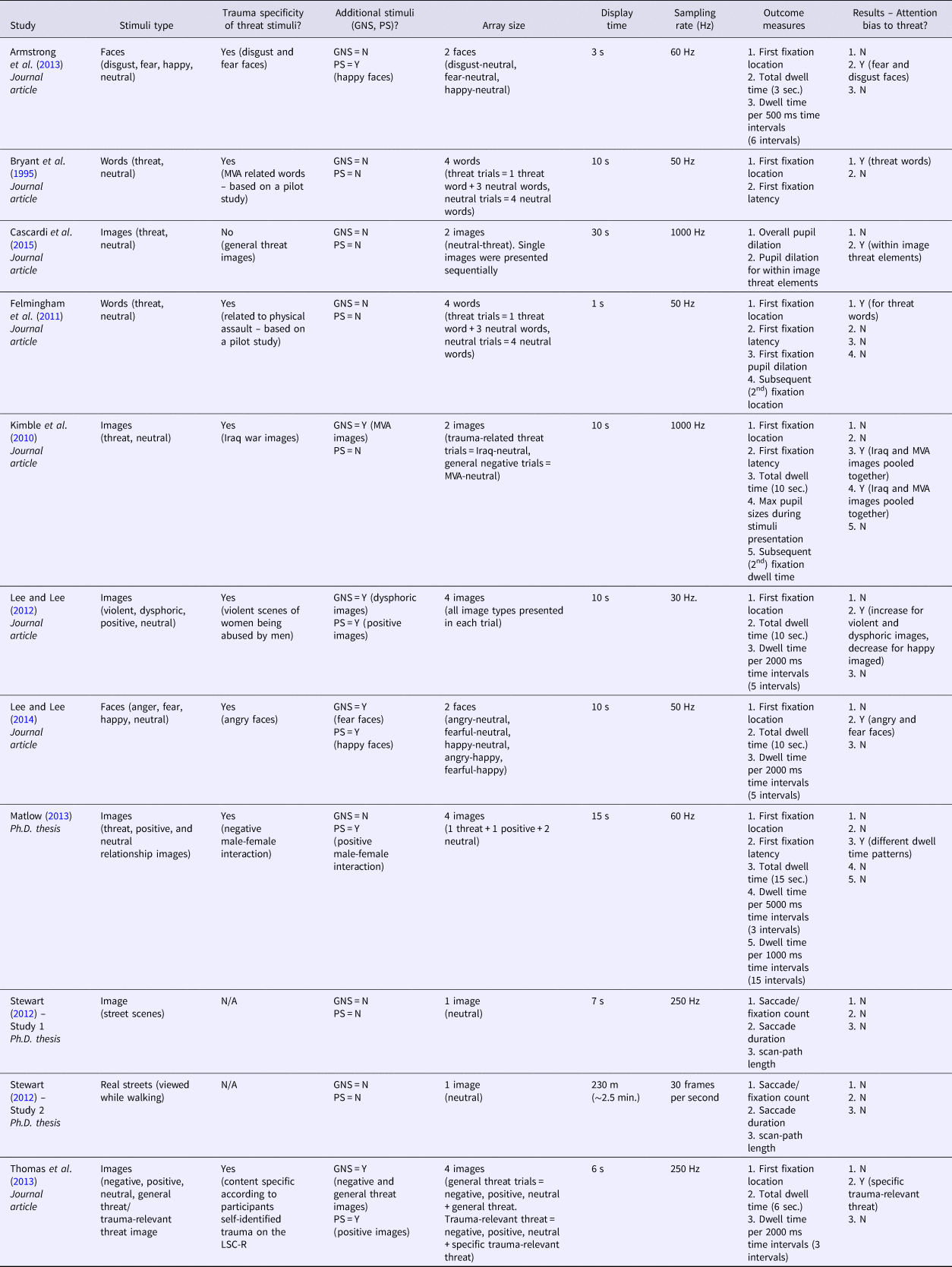
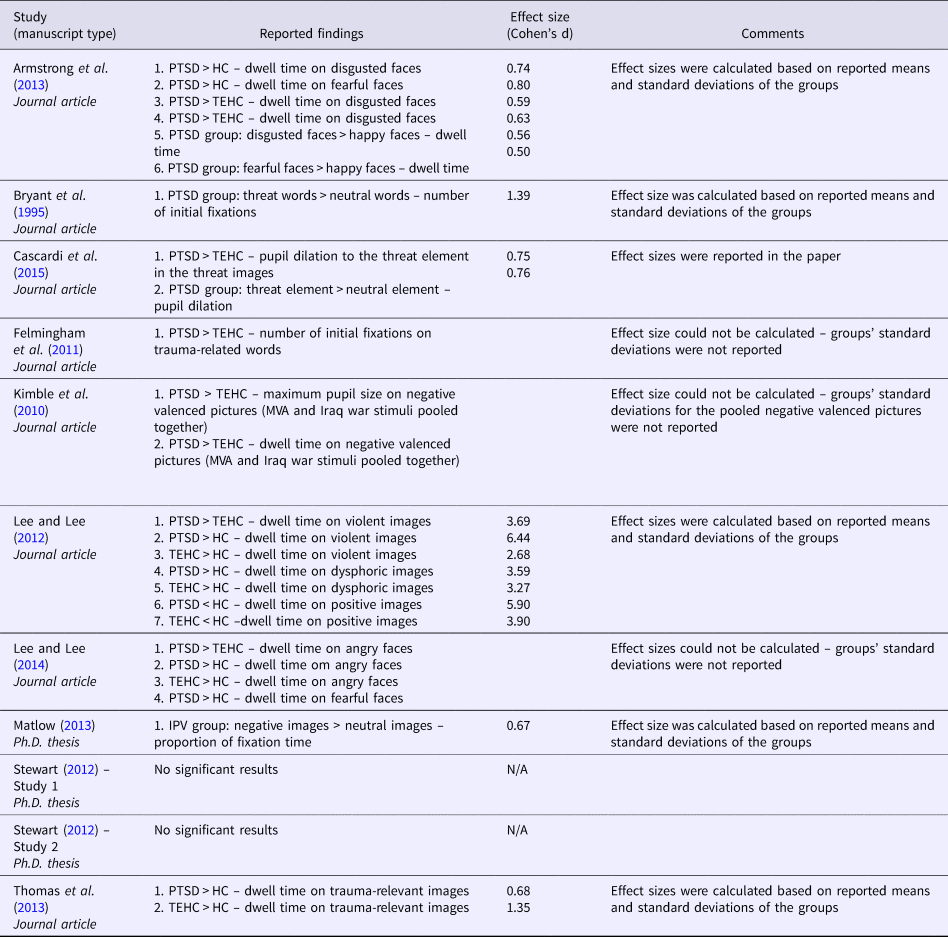
Our initial search yielded 3475 potential records after removing one duplication (see Fig. 2 for the PRISMA flowchart of paper selection). Records were then screened using titles and abstracts and those deemed irrelevant (e.g. not examining PTSD, not using eye-tracking methodology) were excluded (n = 3446), resulting in 29 records that underwent full-text assessment. Records were then removed per inclusion/exclusion criteria (for specific reasons see Fig. 2). After full-text review, eight journal articles (Bryant et al., Reference Bryant, Harvey, Gordon and Barry1995; Kimble et al., Reference Kimble, Fleming, Bandy, Kim and Zambetti2010; Felmingham et al., Reference Felmingham, Rennie, Manor and Bryant2011; Lee and Lee, Reference Lee and Lee2012, Reference Lee and Lee2014, Armstrong et al., Reference Armstrong, Bilsky, Zhao and Olatunji2013; Thomas et al., Reference Thomas, Goegan, Newman, Arndt and Sears2013; Cascardi et al., Reference Cascardi, Armstrong, Chung and Pare2015) and two doctorate dissertations (Stewart, Reference Stewart2012; Matlow, Reference Matlow2013), with one dissertation reporting two separate studies (Stewart, Reference Stewart2012), for a total of 11 studies, were included in the final review. Specific studies descriptions are presented in Table 1, their relevant results are summarized in Table 2, and effect sizes of significant findings are reported in Table 3.
Systematic review summary of study characteristics

PTSD, posttraumatic stress disorder; M:F, Male:Female; TEHC, trauma-exposed healthy control; HC, healthy control; MINI, Mini International Neuropsychiatric Interview; PCL-C, PTSD checklist-civilian version; GAD, generalized anxiety disorder; PD, panic disorder; MDD, major depressive disorder; DSM, Diagnostic and Statistical Manual of Mental Disorders; IES, Impact of Event Scale; STAI, State-Trait Anxiety Inventory; MVA, motor vehicle accident; CAPS, Clinician Administered PTSD Scale; TSQ, Trauma Screening Questionnaire; THS, Trauma History Screen; SCID, structured clinical interview for DSM Disorders; IES, Impact of event scale; AUDIT, Alcohol use disorders inventory; BDI, Beck depression inventory; CES, Combat Exposure Scale; PSS, PTSD Symptom Scale; PDS, Post-traumatic Diagnostic Scale; CTS-R or CTS-2, Revised Conflict Tactic Scale; THQ, Trauma History Questionnaire; BAI, Beck Anxiety Inventory; DES, Dissociative Experiences Scale; DRRI, Deployment Risk and Resilience Inventory; LSC-R, Life Stressor Checklist-Revised.
Systematic review summary of study findings

GNS, general negative stimuli; PS, positive stimuli; Y, yes; N, no; s, seconds; MVA, motor vehicle accident; min., minutes; LSC-R, Life Stressor Checklist-Revised.
Systematic review summary of effect sizes for reported significant findings

PTSD, posttraumatic stress disorder; HC, healthy control; TEHC, trauma-exposed healthy control; MVA, motor vehicle accident.
Participant characteristics
See Table 1 for a full description of participant characteristics. The reviewed studies included a total n = 195 participants with PTSD (M age = 30.7), n = 141 trauma-exposed healthy controls (TEHC; M age = 29.5), and n = 120 healthy controls (HC; M age = 24.1) with no trauma exposure. One study reported only the overall mean age of the sample (Cascardi et al., Reference Cascardi, Armstrong, Chung and Pare2015). Group size ranged n = 9–52 in the PTSD group, n = 10–24 in the TEHC group, and n = 10–33 in the HC group. The PTSD group comprised 31.3% male participants, ranging from 0% to 100%, the TEHC group 8%, ranging from 0% to 100%, and the HC group 31%, ranging from 0% to 90%. Two studies only reported the gender distribution of their entire sample (Kimble et al., Reference Kimble, Fleming, Bandy, Kim and Zambetti2010; Thomas et al., Reference Thomas, Goegan, Newman, Arndt and Sears2013). Four studies provided information about ethnicity (Kimble et al., Reference Kimble, Fleming, Bandy, Kim and Zambetti2010; Armstrong et al., Reference Armstrong, Bilsky, Zhao and Olatunji2013; Matlow, Reference Matlow2013; Cascardi et al., Reference Cascardi, Armstrong, Chung and Pare2015), with only two providing within-group distributions (Armstrong et al., Reference Armstrong, Bilsky, Zhao and Olatunji2013; Matlow, Reference Matlow2013).
Participants with a clinical diagnosis of PTSD were examined in seven studies (Bryant et al., Reference Bryant, Harvey, Gordon and Barry1995; Felmingham et al., Reference Felmingham, Rennie, Manor and Bryant2011; Stewart, Reference Stewart2012; Armstrong et al., Reference Armstrong, Bilsky, Zhao and Olatunji2013; Thomas et al., Reference Thomas, Goegan, Newman, Arndt and Sears2013; Cascardi et al., Reference Cascardi, Armstrong, Chung and Pare2015), with four using a clinical interview such as the Structured Clinical Interview for DSM (SCID; Spitzer et al., Reference Spitzer, Williams, Gibbons and First1996), the Mini-International Neuropsychiatric Interview (MINI; Sheehan et al., Reference Sheehan, Lecrubier, Sheehan, Amorim, Janavs, Weiller, Hergueta, Baker and Dunbar1998), and the Clinician-Administered PTSD Scale (CAPS; Blake et al., Reference Blake, Weathers, Nagy, Kaloupek, Gusman, Charney and Keane1995) in determining PTSD diagnosis, while the other three relying only on self-reported measures. Thomas et al. (Reference Thomas, Goegan, Newman, Arndt and Sears2013) used the 17-item PTSD Checklist-Civilian (PCL-C; Weathers et al., Reference Weathers, Litz, Huska and Keane1991) to allocate trauma-exposed participants to the PTSD group contingent on: (a) a PCL-C total score ⩾44, and (b) a score of at least 3 (‘moderately so’) on one intrusion symptom, three avoidance symptoms, and two arousal symptoms, as required per DSM-IV (American Psychiatric Association, 2000). Trauma-exposed participants who met only partial criteria were assigned to the TEHC group. In Stewart (Reference Stewart2012; Study 1 and 2) group allocation was dependent upon whether participants reported sufficient PTSD symptoms at the required level in each symptom cluster (i.e. ‘2–4 times a week/half the time’) to meet PTSD diagnostic criteria using the Posttraumatic Stress Diagnostic Scale (PDS; Foa et al., Reference Foa, Cashman, Jaycox and Perry1997). The remaining four studies examined participants with high levels of PTSD symptoms (i.e. analogue sample) as their study group of interest. Kimble et al. (Reference Kimble, Fleming, Bandy, Kim and Zambetti2010) used a median split of the CAPS, indicating an approximate index of PTSD severity, to create PTSD-High and PTSD-Low groups. Lee and Lee (Reference Lee and Lee2012, Reference Lee and Lee2014) used the PDS to create study groups, with those scoring above 15 forming the PTSD group, and those scoring below forming the trauma-control group. Finally, Matlow (Reference Matlow2013) also used the PDS to assess women exposed to interpersonal violence (IPV) compared with non-exposed women. A score above 11 was used as an exclusion criterion for the non-exposed group.
Trauma type varied across studies with nine targeting a homogeneous sample of participants, including survivors of a motor vehicle accident (MVA), army veterans, survivors of dating violence (DV), victims of IPV, and survivors of non-sexual physical assault. The remaining two studies examined heterogeneous groups. Thomas et al. (Reference Thomas, Goegan, Newman, Arndt and Sears2013) screened 1086 undergraduate students using the Life Stressor Checklist-Revised (LSC-R; Wolfe et al., Reference Wolfe, Kimerling, Brown, Chrestman, Levin and Stamm1996) while Cascardi et al. (Reference Cascardi, Armstrong, Chung and Pare2015) screened potential participants using the Trauma Screen Questionnaire (TSQ; Brewin et al., Reference Brewin, Rose, Andrews, Green, Tata, McEvedy, Turner and Foa2002). In both studies, those that endorsed trauma exposure and were likely to meet criteria for PTSD were invited for an additional clinical assessment.
Comorbidity was reported in three studies, with an additional study assessing but not reporting the results in the paper. Of the remaining seven studies, five used self-report measures of anxiety and depression, such as the Beck Depression Inventory-I or II (BDI; Beck et al., Reference Beck, Ward, Mendelson, Mock and Erbaugh1961, Beck et al., Reference Beck, Steer and Garbin1988) and the State-Trait Anxiety Inventory (Spielberger et al., Reference Spielberger, Gorsuch, Lushene, Vagg and Jacobs1983). Finally, Stewart (Reference Stewart2012, Study 1 and 2) did not report any additional measures.
Studies also diverged in the control group compared with the PTSD group. Two studies used only healthy participants with no prior trauma exposure (Bryant et al., Reference Bryant, Harvey, Gordon and Barry1995; Matlow, Reference Matlow2013), five used only TEHCs (Kimble et al., Reference Kimble, Fleming, Bandy, Kim and Zambetti2010; Felmingham et al., Reference Felmingham, Rennie, Manor and Bryant2011; Stewart, Reference Stewart2012; Cascardi et al., Reference Cascardi, Armstrong, Chung and Pare2015), and four used both HC and TEHC participants (Lee and Lee, Reference Lee and Lee2012, Reference Lee and Lee2014; Armstrong et al., Reference Armstrong, Bilsky, Zhao and Olatunji2013).
Study characteristics
See Table 2 for a full description of study characteristics. Two studies used words as stimuli, while the remaining nine used image-based stimuli (i.e. pictures/faces) such as faces (n = 2) or images/pictures (n = 7), with three of those using International Affective Picture System (IAPS; Lang et al., Reference Lang, Bradley and Cuthbert2008) images. Array size and presentation time also varied across studies. Five studies used a 4-stimuli array size, four used pairs of stimuli, and two studies used a single stimulus. Presentation time ranged from 1 to 30 s.
The trauma-specific material was used as threat stimuli in eight of the reviewed studies. Bryant et al. (Reference Bryant, Harvey, Gordon and Barry1995) used words relating to MVA (e.g. blood, ambulance) in examining MVA survivors and Felmingham et al. (Reference Felmingham, Rennie, Manor and Bryant2011) used words relating to physical assault (e.g. blood, attack, agony, terror and dead) when examining survivors of non-sexual physical assault. Kimble et al. (Reference Kimble, Fleming, Bandy, Kim and Zambetti2010) used Iraq war slides for Iraq war veterans, Lee and Lee (Reference Lee and Lee2012, Reference Lee and Lee2014) used violent IAPS images and angry faces for DV survivors, Matlow (Reference Matlow2013) showed images depicting negative interaction for IPV-exposed women, and Armstrong et al. (Reference Armstrong, Bilsky, Zhao and Olatunji2013) used fearful and disgusted expressions for war veterans, as these emotions reflect the primary peritraumatic emotions in combat-related PTSD (i.e. fear and horror). The only study to present exclusively general threat stimuli (i.e. not trauma-specific) was that of Cascardi et al. (Reference Cascardi, Armstrong, Chung and Pare2015) that used general fear-provoking IAPS images, possibly due to the heterogeneous sample used in this study. Conversely, Thomas et al. (Reference Thomas, Goegan, Newman, Arndt and Sears2013), also examining a heterogeneous sample, opted to utilize trauma-relevant threat images specifically matched to each participant's self-identified trauma event on the LSC-R (Wolfe et al., Reference Wolfe, Kimerling, Brown, Chrestman, Levin and Stamm1996). Finally, two studies used a single neutral stimulus (Stewart, Reference Stewart2012, Study 1 and 2), as these studies were designed to examine hypervigilance/scanning behavior of neutral scenes occurring prior to threat detection.
Four studies also incorporated general threat/negative stimuli in addition to trauma-specific stimuli to explore the level of threat specificity needed to elicit threat-related attention biases, which might reflect the generalization of these biases. Kimble et al. (Reference Kimble, Fleming, Bandy, Kim and Zambetti2010) used MVA pictures for Iraq war images, Thomas et al. (Reference Thomas, Goegan, Newman, Arndt and Sears2013) used general negative and general threat images in addition to the specific personal identified trauma images, Lee and Lee (Reference Lee and Lee2012) used dysphoric images in addition to the violent ones for DV victims, and Lee and Lee (Reference Lee and Lee2014) included fearful faces in addition to the angry faces, as only angry faces were considered trauma-relevant stimuli for DV survivors. Five studies included also positive-valence stimuli aiming to examine the emotionality hypothesis, namely, determine whether attention bias is manifested exclusively for threatening/negative information, or whether it may also be manifested when different valenced information is presented, such as positive stimuli.
Quality of studies
The quality assessment found most studies to be of acceptable quality (n = 8), with one rated as having good quality (Armstrong et al., Reference Armstrong, Bilsky, Zhao and Olatunji2013) and two considered as having low quality (Kimble et al., Reference Kimble, Fleming, Bandy, Kim and Zambetti2010; Matlow, Reference Matlow2013). The ‘good quality’ study was rated as such due to two primary considerations. First, it employed a clinical PTSD sample, using both a PTSD-specific measure (i.e. CAPS, PCL) and a general clinical interview to support the PTSD diagnosis (i.e. MINI, SCID), and it assessed co-morbid conditions (representativeness). Second, this study controlled for age as a possible confound, as well as for other elements such as gender and ethnicity (selection bias). While two additional studies (Bryant et al., Reference Bryant, Harvey, Gordon and Barry1995; Felmingham et al., Reference Felmingham, Rennie, Manor and Bryant2011) also met these two primary considerations, their small sample size reduced their quality from ‘good’ to ‘acceptable’ (statistical analysis criterion). Studies that did not support PTSD clinical status by an additional general clinical interview (Cascardi et al., Reference Cascardi, Armstrong, Chung and Pare2015), that employed only self-report measures to deduce a clinical PTSD diagnosis (Stewart, Reference Stewart2012; Thomas et al., Reference Thomas, Goegan, Newman, Arndt and Sears2013), or that included sub-clinical analogue samples (Lee and Lee, Reference Lee and Lee2012, Reference Lee and Lee2014) were considered of acceptable quality, unless other indications hindered this rating. Accordingly, two studies were considered of low quality. While having several strong features, such as the diagnostic tools used in the procedure, the study of Kimble et al. (Reference Kimble, Fleming, Bandy, Kim and Zambetti2010) did not control for age or report statistics regarding age differences between groups. In addition, no information was provided regarding within group gender distribution. Finally, the study recruited a small number of participants per group. Matlow (Reference Matlow2013) received a low-quality rating due to an absence of a matched control group of women without IPV exposure on gender, age and ethnicity (see Table 1). Most importantly, analyses were performed separately for each sample, not enabling direct group comparisons, deterring the ability to draw definite conclusions from obtained results (statistical analysis).
Overall findings – Is there threat-related attentional bias in PTSD?
Facilitated threat detection and hypervigilance
Facilitated threat detection was examined in eight studies, all using first fixation location as their primary measure (Bryant et al., Reference Bryant, Harvey, Gordon and Barry1995; Kimble et al., Reference Kimble, Fleming, Bandy, Kim and Zambetti2010; Felmingham et al., Reference Felmingham, Rennie, Manor and Bryant2011; Lee and Lee, Reference Lee and Lee2012, Reference Lee and Lee2014, Armstrong et al., Reference Armstrong, Bilsky, Zhao and Olatunji2013; Matlow, Reference Matlow2013; Thomas et al., Reference Thomas, Goegan, Newman, Arndt and Sears2013). Only two found evidence for facilitated threat detection using this measure. Bryant et al. (Reference Bryant, Harvey, Gordon and Barry1995) presented participants one threat or one neutral word alongside three filler words and found that MVA survivors with PTSD initially fixated more on threat words than on neutral words. In contrast, HCs displayed a similar number of initial fixations on both word types. Using a similar design, Felmingham et al. (Reference Felmingham, Rennie, Manor and Bryant2011) found comparable results showing that PTSD patients made more initial fixations on trauma words compared with TEHC participants, with no difference between groups on initial fixations on neutral words. Interestingly, these two studies were also the only studies to use words as stimuli. Latency to first fixation as indicating vigilance was examined in four of the above-cited studies (Bryant et al., Reference Bryant, Harvey, Gordon and Barry1995; Kimble et al., Reference Kimble, Fleming, Bandy, Kim and Zambetti2010; Felmingham et al., Reference Felmingham, Rennie, Manor and Bryant2011; Matlow, Reference Matlow2013), but none found evidence for group differences on this measure.
Hypervigilance was examined in five studies, with three using pupillometry-based measures (Kimble et al., Reference Kimble, Fleming, Bandy, Kim and Zambetti2010; Felmingham et al., Reference Felmingham, Rennie, Manor and Bryant2011; Cascardi et al., Reference Cascardi, Armstrong, Chung and Pare2015) and two using scan-path indices (Stewart, Reference Stewart2012, Study 1, Study 2). Unlike first fixation measures, pupillometry-based measures utilized across studies were highly heterogeneous. Kimble et al. (Reference Kimble, Fleming, Bandy, Kim and Zambetti2010) used maximum pupil size detected during the entire 10-s stimuli presentation period as reflecting hypervigilance. Results indicated that veterans with high PTSD symptoms demonstrated a larger maximum pupil size to negatively valence pictures (Iraq and MVA pictures pooled together) compared with TEHC participants, with no specificity effect for the combat-related pictures. Felmingham et al. (Reference Felmingham, Rennie, Manor and Bryant2011) examined changes in mean pupil dilation from baseline to initial fixations on threat and neutral words, with baseline mean pupil area computed for a 1-s time interval that preceded stimulus onset. Results indicated only a main effect of group, with the PTSD group displaying increased pupil dilation overall to both threat and neutral words compared with TEHC participants. No evidence emerged for an increase in pupil dilation to traumatic compared with neutral words in the PTSD group. Finally, Cascardi et al. (Reference Cascardi, Armstrong, Chung and Pare2015) examined pupillometry while PTSD and TEHC participants scanned pairs of neutral and threatening images presented for 30 s. Pupil dilation was computed using a ratio-based measure by dividing the pupil area registered when fixating on threat-evoking elements within the image (i.e. areas of interest, AOIs) by the pupil area registered during the entire 30-s viewing period of each image. This ratio-based measure was computed separately for threat and neutral images. Results indicated no group differences in pupil dilation for neutral and threatening images as a whole. However, compared with TEHC participants, PTSD patients showed significantly larger pupil dilation to the threat element within the threat images, with no group difference in pupil dilation for similarly shaped elements within the neutral ones. Within-group analyses showed that patients with PTSD had significantly larger pupil dilation to the threat element than to the neutral element, whereas those without PTSD did not. In sum, pupillometry-based evidence for hypervigilance in PTSD is ambiguous, with one study finding no group differences in overall pupil dilation to threat and neutral stimuli (Cascardi et al., Reference Cascardi, Armstrong, Chung and Pare2015), another reporting larger pupil area to both trauma and neutral initial fixations in PTSD (Felmingham et al., Reference Felmingham, Rennie, Manor and Bryant2011), and a third demonstrating group differences in maximum pupil size to negatively valenced stimuli compared with neutral stimuli in general, not unique to trauma-related stimuli (Kimble et al., Reference Kimble, Fleming, Bandy, Kim and Zambetti2010).
The two studies using scan-path measures to assess hypervigilance do not clarify this ambiguity (Stewart, Reference Stewart2012, Study 1, Study 2). In Study 1, war veterans with PTSD and TEHC veterans freely viewed street scenes presented one at a time for 7 s each, with attention indices computed for the entire presentation time. Results indicated that while subjective threat ratings of these scenes were higher in the PTSD group compared with the TEHC group, PTSD patients did not differ from controls in the number of saccades/fixations made per trial, in saccade duration or in scan-path length. Study 2 utilized a more naturalistic task analogous to the task used in Study 1, with participants wearing a portable eye-tracking device while walking along unknown pre-chosen streets in London. Attention indices were computed for the entire walking route of 230 m, lasting approximately 2.5 minutes. Results revealed a group difference in saccade/fixation count, but in the opposite direction to what was hypothesized. Veterans with PTSD made significantly less frequent saccades than did TEHC veterans. Groups also did not differ on the duration of saccades or on scan-path length. Overall, these two scan-path studies do not lend support for a hypervigilance bias in PTSD patients when viewing neutral images that are subjectively perceived as more threatening. Taken together, the evidence for facilitated threat detection and hypervigilance in PTSD is relatively weak, with most studies failing to find evidence supporting these biases.
Sustained attention and difficulty in initial disengagement from threat
None of the reviewed studies examined difficulties in initial disengagement from threat (i.e. dwell time of the first fixation). Sustained attention (i.e. maintenance of attention), as indicated by total dwell time, was examined in six studies (Kimble et al., Reference Kimble, Fleming, Bandy, Kim and Zambetti2010; Lee and Lee, Reference Lee and Lee2012, Reference Lee and Lee2014, Armstrong et al., Reference Armstrong, Bilsky, Zhao and Olatunji2013; Matlow, Reference Matlow2013; Thomas et al., Reference Thomas, Goegan, Newman, Arndt and Sears2013), with all finding supporting evidence. Kimble et al. (Reference Kimble, Fleming, Bandy, Kim and Zambetti2010) presented participants with slides containing either a trauma-relevant threat picture (i.e. Iraq war slides), or a general threatening negative-valenced picture (MVA pictures), paired with a neutral picture for 10 s. Results showed that veterans with high PTSD scores dwelled longer on threatening pictures compared with those with low-PTSD scores. However, this finding was not further qualified by type of threat stimulus (i.e. Iraq and MVA images pooled together). In Lee and Lee (Reference Lee and Lee2012), HC participants and DV survivors, categorized as high or low on PTSD symptomology, viewed slides with four images per slide (violent, dysphoric, positive, and neutral) for 10 s. Violent images were considered trauma-relevant, dysphoric images were used to indicate a general ‘negative effect,’ and positive stimuli were included to examine the emotionality hypothesis. Results showed that for violent images high-PTSD participants dwelled significantly longer compared with the two control groups, with Low-PTSD participants dwelling longer than HCs but only at trend level. The high and low PTSD groups also dwelled significantly longer on dysphoric stimuli and significantly shorter on positive stimuli compared with the HC group. In a subsequent study, similar participant groups were shown an emotional face (angry, fearful or happy) paired with a neutral face, as well as pairs of negative (angry or fearful) and happy faces for 10 s (Lee and Lee, Reference Lee and Lee2014). Angry faces served as trauma-related stimuli, fearful faces were included to examine the generalizability of biases to general threat/negative stimuli, and happy faces were once again used to examine the emotionality hypothesis. Results showed that the high-PTSD group dwelled significantly longer on angry faces compared with the two control groups, with the low-PTSD group dwelling longer compared with the HC group. For fearful faces, the high-PTSD group showed significantly longer dwell time compared with the HC group, but not compared with the low-PTSD group. No group differences were found for happy faces. Armstrong et al. (Reference Armstrong, Bilsky, Zhao and Olatunji2013) showed veterans with PTSD, trauma-exposed non-PTSD veterans and HC participants pairs of faces containing one emotional (fearful, disgusted, or happy) and one neutral face for 3 s. Fearful and disgusted faces were considered trauma-relevant and happy faces were included to examine the emotionality hypothesis. Veterans with PTSD dwelled significantly longer on disgusted and fearful expressions compared with non-veteran HCs, and dwelled marginally longer compared with veterans without PTSD. The three groups did not differ on dwell time on happy faces. Finally, the two control groups did not differ in dwell time on any of the emotional expressions. Additional analyses within the PTSD group showed that participants dwelled longer on both the disgusted and the fearful expression relative to the happy expression. Thomas et al. (Reference Thomas, Goegan, Newman, Arndt and Sears2013) examined attention bias toward general and trauma-relevant threat stimuli in individuals with clinical PTSD, TEHCs, and HCs. Participants viewed sets of four images containing one negative, one positive, one neutral, and either a general negative threat image or a trauma-relevant threat image, for 6 s. Analyzing trials containing the general threat image revealed no group differences in dwell time on any of the different images. For trauma-relevant threat trials, a significant difference in dwell time emerged between the PTSD and TEHC groups compared with the HC group, with no differences between the two trauma-exposed groups. No differences were found for positive or general negative stimuli. Finally, Matlow (Reference Matlow2013) presented participants with sets of four images containing one negative, one positive, and two neutral relationship images for 15 s. This task was delivered once to a sample of IPV-exposed participants and once to a sample of HC participants with no history of IPV. Analyses were performed separately for each sample. For IPV-exposed participants, the proportion of fixation time was significantly greater for negative images compared with the neutral images. Conversely, for non-IPV exposed participants no such difference was found.
Taken together, the evidence supports an attentional bias in PTSD manifesting in sustained attention on threat stimuli, especially when comparing PTSD participants with HC participants using trauma-relevant stimuli. All five studies using these groups found evidence for increased dwell time on trauma-related threat stimuli, including violent images and angry faces for DV survivors, fear and disgust faces for army veterans, specific trauma-related images for a heterogeneous sample, and negative relationship images for IPV-exposed participants. When using more general negative stimuli, not specifically related to trauma, results were somewhat less consistent, with two studies finding evidence for a similar bias, while one did not. Finally, the emotionality hypothesis received no support.
When comparing PTSD with TEHC participants, a similar pattern of results emerged, with four out of five studies showing performance differences in dwell time on threat. Three studies found group differences for specific trauma-related stimuli only (Lee and Lee, Reference Lee and Lee2012, Reference Lee and Lee2014; Armstrong et al., Reference Armstrong, Bilsky, Zhao and Olatunji2013), one study only for general threat stimuli pooled together with trauma-relevant stimuli (Kimble et al., Reference Kimble, Fleming, Bandy, Kim and Zambetti2010), with one study failing to find evidence with either (Thomas et al., Reference Thomas, Goegan, Newman, Arndt and Sears2013). Again, all studies incorporating positive stimuli showed no group differences.
Four studies also compared TEHC and HC participants, aiming to elucidate the effect of mere trauma exposure on attention. For trauma-specific stimuli, three studies found evidence for group differences in total dwell time on threat (Lee and Lee, Reference Lee and Lee2012, Reference Lee and Lee2014, Thomas et al., Reference Thomas, Goegan, Newman, Arndt and Sears2013), with one failing to do so (Armstrong et al., Reference Armstrong, Bilsky, Zhao and Olatunji2013). Conversely, when using general threat/negative stimuli, only one study showed group differences in dwell time on threat (Lee and Lee, Reference Lee and Lee2012) while the other studies did not. Finally, there were no group differences in dwell time on positive stimuli in any of these studies.
Attentional threat avoidance
Attentional threat avoidance was examined by seven studies, with five using a time course analysis in which dwell time was computed per time interval to examine reduction in dwell time across intervals (Lee and Lee, Reference Lee and Lee2012, Reference Lee and Lee2014, Armstrong et al., Reference Armstrong, Bilsky, Zhao and Olatunji2013; Matlow, Reference Matlow2013; Thomas et al., Reference Thomas, Goegan, Newman, Arndt and Sears2013), and two examining second fixation measures (Kimble et al., Reference Kimble, Fleming, Bandy, Kim and Zambetti2010; Felmingham et al., Reference Felmingham, Rennie, Manor and Bryant2011). None of these seven studies found evidence for attentional avoidance.
Armstrong et al. (Reference Armstrong, Bilsky, Zhao and Olatunji2013) divided a total presentation time of three seconds to six 500 ms (milliseconds) intervals. No evidence was found for time-interval effects, suggesting that the observed group differences in dwell time on threat stimuli (disgust and fearful faces) were relatively sustained over the 3-s trials. Lee and Lee (Reference Lee and Lee2012, Reference Lee and Lee2014) divided a 10-s presentation time into five 2-s time intervals in both their studies. In Lee and Lee (Reference Lee and Lee2012) results indicated that increased dwell time on violent images in the high-PTSD group was relatively maintained throughout the 10-s trials (or the five 2-s intervals). In Lee and Lee (Reference Lee and Lee2014), similar results emerged with significant group differences in dwell time on angry and fearful faces maintained across time intervals. Thomas et al. (Reference Thomas, Goegan, Newman, Arndt and Sears2013) divided an overall presentation time of six seconds to three 2-s time intervals. While no significant group-by-image type-by-time interval emerged for general threat trials, a significant interaction was found for trauma-relevant threat trials. However, further analyses of these trials revealed that the PTSD group dwelled longer on threat, compared with the HC group, during the 0–2 and 4–6 s time intervals, with no difference in the 2–4 interval, indicating increased dwell time also in the latest stage of stimulus presentation. Thus, no evidence emerged for avoidance at this juncture, which is hypothesized under the vigilance-avoidance hypothesis (Cisler and Koster, Reference Cisler and Koster2010). Finally, Matlow (Reference Matlow2013) conducted two separate time-course analyses by dividing his 15-s time interval to three 5-s intervals (Analysis 1) and 15 1-s intervals (Analysis 2). However, the two analyses revealed similar patterns of attention allocation across time intervals in IPV-exposed and non-IPV-exposed participants.
Two studies explored avoidance using characteristics of the fixation made following an initial fixation on threat, that is, the second fixation. Kimble et al. (Reference Kimble, Fleming, Bandy, Kim and Zambetti2010) inspected whether veterans higher in PTSD symptoms would dwell less on threat stimuli after spending more time when initially fixating on it. No evidence was found supporting avoidance of traumatic visual stimuli. Felmingham et al. (Reference Felmingham, Rennie, Manor and Bryant2011), examining the location of subsequent fixations following a first threat fixation, hypothesized that the PTSD group would make fewer subsequent fixations on threat words following an initial traumatic fixation, compared with the TEHC group. Results indicated no significant group differences on this measure.
Discussion
The current systematic review examined the eye-tracking-based-empirical evidence for threat-related attention biases in PTSD. It included 11 studies (n = 456) employing group-comparison designs examining basic attentional processes. Evidence for facilitated threat detection using first fixation location was found only in two studies using words as stimuli, with no studies demonstrating such evidence using latency to first fixations. None of the reviewed studies found evidence for attentional threat avoidance, whether using time course analysis or second fixation variables. Finally, evidence for increased total dwell time on threat, reflecting sustained attention, was found in all studies examining this process. Importantly, this consistency in findings, or lack of, across studies is striking in comparison with the RT-based research of attentional biases in PTSD, which have yielded mixed results.
Facilitated threat detection and hypervigilance
The lack of evidence for enhanced threat detection in PTSD using image-based stimuli is in line with previous image-based eye-tracking studies in other anxiety disorders, such as social anxiety disorder (Lazarov et al., Reference Lazarov, Abend and Bar-Haim2016) and GAD (Macatee et al., Reference Macatee, Albanese, Schmidt and Cougle2017). It is further consistent with image-based dot-probe studies that found no evidence for threat-related attention bias in PTSD (Fani et al., Reference Fani, Bradley-Davino, Ressler and McClure-Tone2011; Fani et al., Reference Fani, Jovanovic, Ely, Bradley, Gutman, Tone and Ressler2012a; Schoorl et al., Reference Schoorl, Putman and van Der Does2013). Interestingly, the only two eye-tracking studies that did find evidence for enhanced threat detection using first fixation location were also the only ones to use trauma-relevant words as stimuli (Bryant et al., Reference Bryant, Harvey, Gordon and Barry1995; Felmingham et al., Reference Felmingham, Rennie, Manor and Bryant2011). This positive finding is in line with a recent meta-analysis of the emotional Stroop task in PTSD, a task inherently using words as stimuli, which found performance differences between PTSD patients and healthy control participants (Cisler et al., Reference Cisler, Wolitzky-Taylor, Adams, Babson, Badour and Willems2011). In addition, some word-based dot-probe studies have also found evidence for enhanced threat detection in PTSD (Bryant and Harvey, Reference Bryant and Harvey1997; Dalgleish et al., Reference Dalgleish, Moradi, Taghavi, Neshat-Doost and Yule2001). Still, other word-based RT studies using dot-probe (Iacoviello et al., Reference Iacoviello, Wu, Abend, Murrough, Feder, Fruchter, Levinstein, Wald, Bailey, Pine, Neumeister, Bar-Haim and Charney2014), Stroop (for another meta-analysis, see Kimble et al., Reference Kimble, Frueh and Marks2009), or visual search tasks (Pineles et al. Reference Pineles, Shipherd, Welch and Yovel2007; Pineles et al. Reference Pineles, Shipherd, Mostoufi, Abramovitz and Yovel2009) failed to find evidence for enhanced threat detection.
The fact that eye-tracking studies using words as stimuli produced results reflecting enhanced threat detection, whereas image-based studies did not, might be related to the complexity of the stimuli used. As words are considered easier to process they enable rapid appraisal of stimulus content in parafoveal vision, allowing the manifestation of enhanced threat detection (Armstrong et al., Reference Armstrong, Bilsky, Zhao and Olatunji2013). However, studies using facial expressions, whose effective value can be easily and rapidly processed even under subprime viewing conditions (Armony et al., Reference Armony, Corbo, Clement and Brunet2005), have not yielded significant results, undermining this proposition. Armstrong et al. (Reference Armstrong, Bilsky, Zhao and Olatunji2013) further suggested that faces lack the specificity needed to activate the trauma memory from parafoveal vision, and hence cannot elicit enhanced threat detection in PTSD. A second possible explanation is that the greater visual saliency and complexity of images increase the likelihood of automatic attention capture regardless of the threatening nature of the image, thus obstructing the ability to detect potential existing differences in threat detection (Thomas et al., Reference Thomas, Goegan, Newman, Arndt and Sears2013). In a related vein, as lexical stimuli are considered to produce lesser levels of arousal relative to image-based stimuli (Felmingham et al., Reference Felmingham, Bryant and Gordon2003), it is possible that only lexical stimuli enable the manifestation of biased threat detection, while the higher arousal produced by image-based stimuli hinders the detection or manifestation of this bias. Thus, and although examined only by two studies with relatively small sample sizes, it seems that for detecting biased threat detection word-based stimuli might be preferable.
Alternatively, the observed lack of evidence for enhanced threat detection in eye-tracking studies using image-based stimuli might be related to the nature of the task used to assess attention, namely, the free-viewing paradigm, which was the only one employed in the reviewed studies. As in free-viewing, there are no specific demands from participants in wake of an explicit task, it might be less suited for detecting attentional aspects that are better manifested in the context of task performance. Put differently, if enhanced threat detection is a phenomenon mainly occurring in the context of task performance then free-viewing tasks are less able to detect it. This possibility is line with studies using rapid serial visual presentation (RSVP) paradigms (Most et al., Reference Most, Chun, Widders and Zald2005), in which participants are instructed to detect a target image presented within a series of rapidly presented visual stimuli. Importantly, emotional threatening stimuli are presented as part of the stimuli series, preceding the target stimulus by different time intervals. Target awareness (i.e. failing to detect target appearance) is then used to reflect attentional capture by the preceding threatening distractor (Olatunji et al., Reference Olatunji, Armstrong, McHugo and Zald2013). Indeed, studies using RSVP tasks have found evidence for attentional capture by threatening distractors in both analogue/experimentally induced trauma samples (Verwoerd et al., Reference Verwoerd, Wessel, de Jong and Nieuwenhuis2009; Verwoerd et al., Reference Verwoerd, Wessel and de Jong2010) and clinical populations (Olatunji et al., Reference Olatunji, Armstrong, McHugo and Zald2013). Thus, future research should try and combine task requirements with an assessment of eye-movements when exploring enhanced threat detection in PTSD.
Hypervigilance studies were relatively heterogeneous in measures used and thus were more difficult to interpret, with three using differently-computed pupillometry indices (Kimble et al., Reference Kimble, Fleming, Bandy, Kim and Zambetti2010; Felmingham et al., Reference Felmingham, Rennie, Manor and Bryant2011; Cascardi et al., Reference Cascardi, Armstrong, Chung and Pare2015) and two using saccade-based scan-path indices (Stewart, Reference Stewart2012). Pupillometry indices were further different with regard to the timing of measured pupil responses, with some using pupil dilation during first fixations (Felmingham et al., Reference Felmingham, Rennie, Manor and Bryant2011) while others examined pupil dilation throughout presentation duration (Kimble et al., Reference Kimble, Fleming, Bandy, Kim and Zambetti2010; Cascardi et al., Reference Cascardi, Armstrong, Chung and Pare2015). Moreover, comparing pupil diameter response with different stimuli within single trials should be interpreted with caution as the pupil diameter response is delayed by approximately 2 s following stimuli onset (Bradley et al., Reference Bradley, Miccoli, Escrig and Lang2008). Considering additional relevant studies and measures may prove useful in attempting to resolve this ambiguity and reach clearer conclusions. One such study, exploring the causal impact of hypervigilance on gaze behavior, was conducted by Kimble et al. (Reference Kimble, Boxwala, Bean, Maletsky, Halper, Spollen and Fleming2014). In this study, 71 non-selected participants were randomly allocated to one of three conditions, namely, hypervigilant, pleasant, or control condition. Participants were then asked to view a series of single neutral scenes presented sequentially, each for 10 s. Scenes were neutral, yet relevant to PTSD, depicting potentially threatening cues (e.g. an empty street). Hypervigilance was experimentally manipulated by telling participants in the hypervigilance condition that they need to find a threat embedded within each scene to avoid an aversive consequence. Participants in the pleasant condition were instructed to search for a pleasant target and told that a loud noise would be heard if they fail, and control participants were asked to view each image freely and to ignore the loud white noise in the background. Results indicated that hypervigilant participants performed more fixations/saccades compared with the other groups, with fixations covering a greater percentage of the presented scene. Hypervigilant participants also displayed a larger pupil size relative to controls. The authors concluded that these results provide some support for the role of hypervigilance in increased visual scanning and arousal, occurring before the actual threat is detected (Kimble et al., Reference Kimble, Boxwala, Bean, Maletsky, Halper, Spollen and Fleming2014).
Psychophysiological responses, reflecting increased sympathetic arousal, can be also used to indicate hypervigilance, since increased sympathetic activity has been associated with threat-related attention bias (Lang et al., Reference Lang, Bradley, Fitzsimmons, Cuthbert, Scott, Moulder and Nangia1998; Kimble et al., Reference Kimble, Fleming, Bandy, Kim and Zambetti2010; Fani et al., Reference Fani, Bradley-Davino, Ressler and McClure-Tone2011; Felmingham et al., Reference Felmingham, Rennie, Manor and Bryant2011). Psychophysiology was used in two of the reviewed studies, both of which primarily examined enhanced threat detection using first fixations (Bryant et al., Reference Bryant, Harvey, Gordon and Barry1995; Felmingham et al., Reference Felmingham, Rennie, Manor and Bryant2011). Results indicated higher skin conductance response (SCR) during all first fixations, regardless of stimulus type (i.e. threat and neutral words), when comparing PTSD patients with HC participants (Bryant et al., Reference Bryant, Harvey, Gordon and Barry1995). Comparing PTSD patients with TEHC participants revealed a more specific effect, indicating group differences on first fixation SCR for threat words but not for neutral words (Felmingham et al., Reference Felmingham, Rennie, Manor and Bryant2011). These additional studies do lend some support for the hypervigilance hypothesis in PTSD, but further eye-tracking research is clearly needed to better elucidate this process.
Attentional threat avoidance
The present review did not find evidence for attentional avoidance examined through second fixation measures or time-course analysis, using a variety of stimuli (i.e. words, facial, and image-based), array sizes, presentation times, or group types (i.e. clinical and sub-clinical PTSD v. TEHC, HC or both). Importantly, while the different studies employing time-course analysis used the different timing of measures taken (i.e. different overall presentation times divided differently to sub-intervals) none of them found evidence for attentional avoidance. Two studies demonstrated a tendency for threat avoidance in intermediate time-intervals, but not in early or later stages of stimulus presentation, suggesting a pattern of attentional fluctuations (Matlow, Reference Matlow2013; Thomas et al., Reference Thomas, Goegan, Newman, Arndt and Sears2013). This proposition is in line with some RT-based studies demonstrating increased attention bias variability, defined as the enhanced tendency for attention fluctuating between threat vigilance and threat avoidance, among PTSD patients (Naim et al., Reference Naim, Abend, Wald, Eldar, Levi, Fruchter, Ginat, Halpern, Sipos, Adler, Bliese, Quartana, Pine and Bar-Haim2015). However, variability-based indices have been recently questioned in their current form due to the inability of these indices to de-couple measurement error from bias variability, leading to the emergence of group differences even when no actual bias exists (Kruijt et al., Reference Kruijt, Field and Fox2016).
Other studies have suggested attentional avoidance as a possible risk factor for PTSD, reflecting vulnerability for developing the disorder following exposure to traumatic events. Indeed, previous studies utilizing dot-probe paradigms among war-zone civilians and pre-deployed military personnel have shown attentional avoidance to be a possible risk factor for PTSD (Wald et al., Reference Wald, Shechner, Bitton, Holoshitz, Charney, Muller, Fox, Pine and Bar-Haim2011; Wald et al., Reference Wald, Degnan, Gorodetsky, Charney, Fox, Fruchter, Goldman, Lubin, Pine and Bar-Haim2013). Furthermore, attention training toward threat delivered prior to combat deployment was found to mitigate risk for PTSD following combat exposure (Wald et al., Reference Wald, Fruchter, Ginat, Stolin, Dagan, Bliese, Quartana, Sipos, Pine and Bar-Haim2016). Only one eye-tracking study to date has followed a similar rationale in examining attentional processes in PTSD (Beevers et al., Reference Beevers, Lee, Wells, Ellis and Telch2011). In this study, eye data of 139 soldiers were assessed before deployment to Iraq with PTSD symptoms being reported periodically by soldiers once deployed. During the assessment, participants freely viewed 2-by-2 matrices depicting one fearful, one sad, one happy and one neutral face for 30 s. Fearful faces were considered PTSD-related stimuli while sad faces were considered depression-relevant. Results indicated that PTSD symptoms were predicted by shorter mean fixation time for fearful faces. The authors concluded that such an eye-gaze measure may serve as a potential vulnerability marker for PTSD. Taken together, findings suggest that attentional avoidance of threat may better reflect a risk factor for PTSD rather than a PTSD characteristic. Future eye-tracking research could use longitudinal designs to assess change in gaze allocation among at-risk populations prior to- and following trauma exposure.
Sustained attention on threat
The most consistent finding pertains to sustained attention on threat, once detected, in PTSD. Results were consistently demonstrated across studies regardless of stimulus type, array size, presentation time, and PTSD group status, with medium-to-large effect sizes emerging for between-group differences across studies. Findings were most robust when PTSD subjects were compared with HC participants, with all studies using this comparison finding significant results. Comparing PTSD with TEHC participants still yielded consistent results with only one study failing to find group differences. This conclusion is in accordance with visual search studies (Pineles et al., Reference Pineles, Shipherd, Welch and Yovel2007; Pineles et al., Reference Pineles, Shipherd, Mostoufi, Abramovitz and Yovel2009) as well as with dot-probe tasks using an extended presentation times (Bardeen and Orcutt, Reference Bardeen and Orcutt2011), both suggesting PTSD to be better related to difficulty disengaging threat than to facilitate threat detection. Eye-tracking studies in other psychopathologies have also shown increased dwell time on threat in anxious and depressed populations (Sanchez et al., Reference Sanchez, Vazquez, Marker, LeMoult and Joormann2013; Lazarov et al., Reference Lazarov, Abend and Bar-Haim2016).
Several explanations were proposed for sustained attention on threat in PTSD. First, increased dwell time on threat might be related to the ruminative quality of PTSD (Kimble et al., Reference Kimble, Fleming, Bandy, Kim and Zambetti2010; Lee and Lee, Reference Lee and Lee2012). Accumulative evidence has shown rumination to play a significant role in predicting and maintaining PTSD symptoms, and their severity, as well as in treatment efficacy (Michael et al., Reference Michael, Halligan, Clark and Ehlers2007; Ehring et al., Reference Ehring, Frank and Ehlers2008; Echiverri et al., Reference Echiverri, Jaeger, Chen, Moore and Zoellner2011). Specifically, it has been suggested that repetitive and perseverative thinking about trauma-related issues, such as its causes, consequences, and implications, is significantly associated with PTSD (Michael et al., Reference Michael, Halligan, Clark and Ehlers2007; Ehring et al., Reference Ehring, Frank and Ehlers2008). Thus, one could conceptualize increased dwell time on threat stimuli as reflecting an attentional component of trauma-related rumination. A second possible explanation relates increased dwell time on threat to the acute emotional reaction induced by threat stimuli serving as trauma-reminders (Lee and Lee, Reference Lee and Lee2014), which may lead to increased attention allocation to threat by activating brain regions involved in fear processing such as the amygdala (Sergerie et al., Reference Sergerie, Chochol and Armony2008; Hayes et al., Reference Hayes, Vanelzakker and Shin2012) and/or by altering activity of brain structures involved in attentional control (Fani et al., Reference Fani, Jovanovic, Ely, Bradley, Gutman, Tone and Ressler2012a; Hayes et al., Reference Hayes, Vanelzakker and Shin2012). Third, sustained attention in PTSD might be also related to the nature of threats encountered in this disorder compared with other disorders in which attentional avoidance is mainly observed (Mulkens et al., Reference Mulkens, deJong and Merckelbach1996; Tolin et al., Reference Tolin, Lohr, Lee and Sawchuk1999). Specifically, threats represent more urgency and danger for individuals with PTSD, necessitating hyper-monitoring of these threats to prevent harm, and resulting in sustained attention (Armstrong and Olatunji, Reference Armstrong and Olatunji2012). Finally, sustained attention on threat in PTSD might be related to diminished attention control, defined as the capacity to execute voluntary and effortful goal-directed attention deployment (i.e. top-down) while ignoring conflicting attentional demands (i.e. Bottom-up; Derryberry and Rothbart, Reference Derryberry and Rothbart1997, Sarapas et al., Reference Sarapas, Weinberg, Langenecker and Shankman2017). Importantly, research has shown attention control to moderate the association between posttraumatic symptoms and attention bias. Specifically, among participants with relatively higher levels of PTSD symptoms, attention control was found to be positively related to the ability to disengage and shift attention at will away from threat stimuli (Bardeen and Orcutt, Reference Bardeen and Orcutt2011; Bardeen et al., Reference Bardeen, Tull, Daniel, Evenden and Stevens2016).
Generalizability, emotionality, and the role of trauma-exposure – preliminary conclusions
While most studies examined threat-related attention biases using specific trauma-relevant stimuli, four studies (Kimble et al., Reference Kimble, Fleming, Bandy, Kim and Zambetti2010; Lee and Lee, Reference Lee and Lee2012, Reference Lee and Lee2014, Thomas et al., Reference Thomas, Goegan, Newman, Arndt and Sears2013) also addressed the possible generalization of attentional bias beyond trauma-specific cues by including also more general negative/threat stimuli, such as MVA stimuli for veterans, dysphoric images and fearful faces for DV survivors, and non-personalized general threat and negative stimuli. As evidence for enhanced threat detection and attentional avoidance was not found in any of these studies, for either type of stimuli, we will focus our discussion on sustained attention. When comparing PTSD with HC participants, two studies found evidence for increased dwell time beyond trauma-specific (Lee and Lee, Reference Lee and Lee2012, Reference Lee and Lee2014) while one did not (Thomas et al., Reference Thomas, Goegan, Newman, Arndt and Sears2013). When comparing PTSD with TEHC participants, generalizability effects were found in only one study (Kimble et al., Reference Kimble, Fleming, Bandy, Kim and Zambetti2010) with three finding no effect of general threat stimuli (Lee and Lee, Reference Lee and Lee2012, Reference Lee and Lee2014, Thomas et al., Reference Thomas, Goegan, Newman, Arndt and Sears2013). While research examining the generalization of attentional bias is relatively scarce, preliminary evidence implies that generalization might be more evident when comparing PTSD with healthy participants than to trauma-exposed individuals. This tentative conclusion is in line with the meta-analysis of Cisler et al. (Reference Cisler, Wolitzky-Taylor, Adams, Babson, Badour and Willems2011) examining the Stroop task in PTSD. Comparing PTSD patients with HC participants revealed a significant Stroop interference effect for PTSD-relevant and general threatening words. However, comparing the PTSD and TEHC groups showed an interference effect only for PTSD-relevant words. Still, additional eye-tracking research incorporating trauma-specific and more general threatening/negative stimuli is clearly needed to further clarify generalizability of threat-related attention bias in PTSD. Relatedly, future eye-tracking research should better define trauma-specificity, especially when using facial stimuli. For example, while Armstrong et al. (Reference Armstrong, Bilsky, Zhao and Olatunji2013) defined fearful faces as trauma-relevant for veterans, Lee and Lee (Reference Lee and Lee2014) considered fear faces as reflecting the general threat for DV survivors.
In contrast to the generalizability hypothesis, which received some preliminary support, the emotionality hypothesis, namely, the effects of emotional stimuli in general on attention, was not supported by any of the studies addressing this possibility. All studies examining attention to positive-valence stimuli found no evidence for biased attention on any of the examined attentional processes in PTSD (i.e. enhanced detection, sustained attention and avoidance).
The effects of mere trauma exposure on attentional processes can be inferred by exploring the differences between TEHC and HC participants. Studying trauma exposure is imperative, especially since research has shown subthreshold PTSD to be related to significant psychological and functional impairment (Mylle and Maes, Reference Mylle and Maes2004) compared with healthy individuals with no posttraumatic symptoms (Jakupcak et al., Reference Jakupcak, Conybeare, Phelps, Hunt, Holmes, Felker, Klevens and McFall2007). Again, we will focus our discussion on sustained attention as none of the studies that included both TEHC and HC groups have found group differences in enhanced threat detection or attentional avoidance. As described earlier, three out of four studies comparing these groups found evidence for group differences when using specific trauma-relevant stimuli, and only one when using more general threat/negative stimuli.
Taken together, while considering the findings regarding generalizability and the role of trauma-exposure, results suggest that trauma exposure may be sufficient to bias attention toward trauma-relevant stimuli only, while PTSD symptomology on a clinical level is ‘required’ or ‘needed’ for broadening this bias to further include general threat/negative stimuli. Put differently, trauma exposure produces sustained attention on specific threat-related stimuli, while PTSD extends this impairment to include other less relevant threatening and negative stimuli. This proposition is in line with fear-conditioning studies (a research analog for trauma-exposure; Shvil et al., Reference Shvil, Rusch, Sullivan and Neria2013) demonstrating that learned fear associations may be sufficient to capture and hold attention even if one tries to resist (Mulckhuyse et al., Reference Mulckhuyse, Crombez and Van der Stigchel2013). It also echoes the clinical phenomenology of PTSD implicating fear overgeneralization for a broad range of circumstances in various degrees of separation from the original traumatic event (Kaczkurkin et al., Reference Kaczkurkin, Burton, Chazin, Manbeck, Espensen-Sturges, Cooper, Sponheim and Lissek2017). Thus, future research should incorporate both trauma-exposed and non-trauma-exposed control participants to clarify the specific effects of mere trauma exposure and clinical PTSD. In a related vein, future research could also examine the association between attention bias indices and a continuous measure of PTSD symptomology as the categorical distinction between PTSD and TEHC may not necessarily reflect a corresponding categorical difference on attention measures. Including participants on a wide range of PTSD symptomology will further elucidate the relationship between PTSD symptomology and attentional processes.
Recommendations for future research
Several features related to study and participant characteristics need to be addressed in future studies. First, array size across studies ranged from one to a maximum of four stimuli presented at once, with usually only one of an emotional, and thus predictive, valence. The generalizability and ecological validity of such small set sizes in eye-tracking research have been called into question, emphasizing the need for using more complex visual displays presenting various competing threatening and non-threatening stimuli at once, thereby increasing resemblance to real-world situations (Ferrari et al., Reference Ferrari, Mobius, van Opdorp, Becker and Rinck2016; Lazarov et al., Reference Lazarov, Abend and Bar-Haim2016; Price et al., Reference Price, Greven, Siegle, Koster and De Raedt2016). Second, mean age of participants across studies was relatively low. However, age is an important variable to consider when examining attentional processes, as research using both RT-based tasks (Spaniol et al., Reference Spaniol, Voss and Grady2008) and eye-tracking methodology (Mather and Carstensen, Reference Mather and Carstensen2005; Isaacowitz, Reference Isaacowitz2012) has found evidence for sustained attention away from threatening stimuli and toward positive ones in older adults. Some have also linked this attentional pattern to clinical findings of lower reported PTSD symptoms among older veterans (Konnert and Wong, Reference Konnert and Wong2015). It is, therefore, possible to assume that age-related shift in attention away from negative and toward positive stimuli might increase resilience to trauma in older adults, as research has also shown lower risk for adverse outcomes following trauma exposure among older adults (Acierno et al., Reference Acierno, Ruggiero, Kilpatrick, Resnick and Galea2006). Thus, future research should aim to recruit also elderly PTSD patients to further elucidate the associations between age, attention, and PTSD. Third, while seven studies reported using a clinical sample of PTSD patients, only four used a clinical interview to support PTSD diagnosis. As significant psychological and functional impairment differences have been noted between clinical PTSD and subclinical analogue samples (Breslau et al., Reference Breslau, Lucia and Davis2004), more research employing rigorous clinical assessment is needed. Finally, the sample size was relatively small in most studies hampering study quality and raising doubts about some of the reported null results, which might have been due to lack of statistical power to detect existing group differences. Notably, none of the reviewed studies conducted an informed power analysis to determine the sample size that would be powered to detect also more subtle group differences. Studies with greater statistical power and larger sample sizes would yield stronger, more reliable conclusions.
While solid psychometric properties are essential for increasing confidence in research methodology and theory, none of the reviewed studies examined the psychometric properties of the tasks/measures used to examine attention biases, which are essential for increasing confidence in research methodology and theory. Importantly, eye-tracking studies in other fields have shown good internal consistency and test-retest reliability for total dwell time indices, but not for first fixation measures (Waechter et al., Reference Waechter, Nelson, Wright, Hyatt and Oakman2014; Lazarov et al., Reference Lazarov, Abend and Bar-Haim2016; Skinner et al., Reference Skinner, Hubscher, Moseley, Lee, Wand, Traeger, Gustin and McAuley2017; Lazarov et al., Reference Lazarov, Ben-Zion, Shamai, Pine and Bar-Haim2018), which correspond nicely with the findings of the current review implicating sustained attention in PTSD. However, as reliability estimates are specific to the sample examined and for the outcome measures used (Skinner et al., Reference Skinner, Hubscher, Moseley, Lee, Wand, Traeger, Gustin and McAuley2017), it is essential that attentional research in PTSD acknowledge this issue and examine the psychometrics of tasks and measures used in research.
Lack of heterogeneity in experimental paradigms across studies also necessitates further research as all reviewed studies employed the free-viewing paradigm. As mentioned earlier, while being highly beneficial in attentional research (Armstrong and Olatunji, Reference Armstrong and Olatunji2012), the free-viewing paradigm only measures spontaneous viewing behavior as participants are not required or directed to look towards or away from specific threat/neutral stimuli. Neither attentional engagement nor attentional disengagement is necessary to complete the task at hand. Thus, free-viewing tasks do not examine participants’ ability to actively regulate their attention in light of explicit task-demands to redirect attention away from or toward the threatening stimulus. Indeed, eye-tracking research focusing on attentional biases in other anxiety disorders have used additional paradigms and tasks such as visual search tasks (Rinck et al., Reference Rinck, Reinecke, Ellwart, Heuer and Becker2005; Huijding et al., Reference Huijding, Mayer, Koster and Muris2011), the remote distracter paradigm (Richards et al., Reference Richards, Benson and Hadwin2012) and anti-saccade tasks (Reinholdt-Dunne et al., Reference Reinholdt-Dunne, Mogg, Benson, Bradley, Hardin, Liversedge, Pine and Ernsts2012; Chen et al., Reference Chen, Clarke, Watson, MacLeod and Guastella2014) to explore different threat-related attentional processes. Using additional paradigms could increase convergent validly of findings, enhance our understanding of different attentional processes and biases in PTSD, and enable the exploration of attentional features less easily tapped by free-viewing paradigms. In a related vein, future research could also examine the specificity of extant results to PTSD by using the same tasks in other psychopathologies. For example, increased dwell time on threat stimuli, reflecting sustained attention, has been demonstrated also in social anxiety disorder (Schofield et al., Reference Schofield, Johnson, Inhoff and Coles2012; Lazarov et al., Reference Lazarov, Abend and Bar-Haim2016).
Finally, the results of the present review implicate most clearly sustained attention on threat in PTSD as reflected in total dwell time. Notably, our analyses further showed medium-to-large effect sizes for group differences on this measure across studies. Moreover, previous research in the field has shown that this eye-tracking-based measure is also more reliable compared with first fixation measures (Waechter et al., Reference Waechter, Nelson, Wright, Hyatt and Oakman2014; Lazarov et al., Reference Lazarov, Abend and Bar-Haim2016; Skinner et al., Reference Skinner, Hubscher, Moseley, Lee, Wand, Traeger, Gustin and McAuley2017). Hence, we believe that future research in PTSD should focus on this aberration, aiming to better understand the specific conditions giving rise this phenomenon.
Limitations
The current review has several limitations. First, we excluded correlational studies, which may have contributed to the body of knowledge of attentional biases in PTSD. However, this decision was made intentionally to increase the precision of our research question, namely, whether individuals with high PTSD symptomology differ from controls on threat-related attentional processes and biases. Second, we could not examine the association between the different attentional processes and specific PTSD symptom clusters, as most studies did not provide sub-scale scores of PTSD measures. Future research should test the associations of different potential threat-related attention biases to individual PTSD symptom clusters (Blake et al., Reference Blake, Weathers, Nagy, Kaloupek, Gusman, Charney and Keane1995; American Psychiatric Association, 2013), such as estimating the association between attentional avoidance and Cluster C (i.e. avoidance) and enhanced threat detection and/or sustained attention on threat and scores on Cluster E (i.e. arousal). Finally, since the utilization of eye tracking research is relatively new, this review comprises only 11 studies. Although data from 195 subjects with PTSD, 141 trauma-exposed controls, and 120 non-trauma exposed controls were included in this review, for a total of 456 subjects, more eye-tracking research is still needed to further deepen our understanding of attentional biases in PTSD. In a related vein, heterogeneity in study design across the reviewed studies precluded the option of statistically examining our hypotheses using meta-analytic procedures. However, a coherent result pattern across studies did emerge, highlighting sustained attention on threat as a promising target for exploration in future research. Thus, we believe the current review could serve as a preliminary road-map for clinicians and researches aiming at exploring attentional processes in PTSD thus guiding future research in the field.
Conclusions
This review is the first to systematically analyze existing eye-tracking-based evidence for threat-related attentional biases in individuals with high PTSD symptoms compared with TEHC and HC participants. Evidence for enhanced threat detection, including the related processes of hypervigilance, was relatively weak and was found in only two studies using words as stimuli. Attentional avoidance received no empirical support. Conversely, evidence consistently implicated sustained attention on threatening stimuli in PTSD, which was found regardless of stimulus type, array size, presentation time, clinical status, or comparison group. Thus, increased dwell time on threat stimuli in PTSD could serve as a potential target for future intervention and as an important stepping stone in developing novel gaze-contingent therapeutic procedures for PTSD. Extant research in other psychopathologies characterized by sustained attention on threat has shown the potential of gaze-contingent procedures in modifying attentional processes and reducing sustained attention on threat (Ferrari et al., Reference Ferrari, Mobius, van Opdorp, Becker and Rinck2016; Price et al., Reference Price, Greven, Siegle, Koster and De Raedt2016), leading to a corresponding reduction in anxiety symptoms (Lazarov et al., Reference Lazarov, Pine and Bar-Haim2017b).
Supplementary material
The supplementary material for this article can be found at https://doi.org/10.1017/S0033291718002313
Acknowledgements
This work was supported by the National Institutes of Mental Health - Institutional stipend grant T32 (Amit Lazarov, grant number MH020004, and Benjamin Suarez-Jimenez, grant number MH015144), National Institutes of Health grant U24AG052175 and contract S15-0142 from the Value Institute of New York-Presbyterian Hospital (Louise Falzon), Stand for the Troops Foundation and the New York State Psychiatric Institute (Neria). These funding agencies had no role in the study design; in the collection, analysis and interpretation of the data; in the writing of the manuscript; or in the decision to submit the article for publication.
Conflict of interest
None.
Ethical standards
The authors assert that all procedures contributing to this work comply with the ethical standards of the relevant national and institutional committees on human experimentation and with the Helsinki Declaration of 1975, as revised in 2008.