


1. Introduction
This article presents a first description of contact-influenced aspects of the speech of the Finnish migrant and heritage speakers in Misiones, Argentina. Colonia Finlandesa, a Finnish migrant colony, was established in the region in the early 1900s, and spoken material from the last remaining migrants and their descendants in the 1970s has recently been discovered. This material is used to study the language of the migrants to document the use and developments in heritage varieties of Finnish in contact with Spanish.
So far, the study of Finnish varieties outside of Finland has focused on the most popular destinations for Finnish migration, such as Sweden, the United States, and Canada (Virtaranta et al. Reference Virtaranta, Jönsson-Korhola, Martin and Kainulainen1993, Jönsson-Korhola & Lindgren Reference Jönsson-Korhola and Lindgren2003, Halmari Reference Halmari2005), and data from contact situations between Finnish and Spanish are limited, with the focus on contemporary migration within Europe (e.g. Tervala-Pirskainen Reference Tervala-Pirskainen2003). Similarly, in the Latin American context, and more specifically in the River Plate region, there are only sporadic studies on Nordic languages (see e.g. Flodell Reference Flodell, Sture Ureland and Iain1996, Reference Flodell2012 for Swedish; and Heegård Petersen & Kühl Reference Heegård Petersen and Karoline2017 and Kühl & Heegård Petersen Reference Kühl and Heegård Petersen2018 for Danish). These studies report on a high degree of bilingualism and an accelerated linguistic shift in the third generation on the community level. They also describe some syntactic influences on the linguistic level but, more characteristically, highlight lexical loans from Spanish and a high degree of individual and inter-speaker variation as typical of the moribund heritage languages of communities facing language shift at the community level.
Based on interview material collected in the community in 1972, I analyze Spanish matter and pattern replication (Sakel Reference Sakel, Yaron and Jeanette2007) and instances of codeswitching in Finnish in Misiones. I assess the contact outcomes at the linguistic level in the light of the generational information and the social history of the community. In addition to the description of contact outcomes, I describe strategies of translation and word searches to reach an understanding of the speakers’ awareness about language mixing. Based on these two areas of analysis, the general aim is to shed light on linguistic outcomes as a result of language shift happening over a few generations in the Finnish enclave community in contact with Spanish.
The paper is structured as follows. Section 2 discusses replication of linguistic matter and pattern from one language to another and the interconnections between borrowing and codeswitching in heritage language settings. Sections 3 and 4 provide background information on the community, the speakers, and the data processing procedures of the study. Section 5 describes the pattern and matter replication, codeswitching phenomena, and the awareness of language use, as seen in translations of and comments on the contact-influenced phenomena. Concluding remarks are presented in Section 6.
2. Borrowing and codeswitching in heritage language settings
Multilingualism, for individuals and on a community level, is a prerequisite for mixing linguistic items from different languages or varieties, as speakers need to be able to access several repertoires in order to create mixed codes. Borrowings are usually integrated into the recipient linguistic system, thus extending the vocabulary with new items, while codeswitching occurs between overt, unintegrated elements from different language varieties, often with stylistic and symbolic functions, for instance expressing humor and emphasis, or a new, bilingual identity. Borrowing and codeswitching (or their outcomes) are often the normal multilingual practices of a community that highlight specific identity or communicative purposes and need not be signs of language attrition (Auer Reference Auer1984). Nevertheless, the study of loans and codeswitches in heritage languages has often focused on trying to identify the degree of contact influence from the language of the dominant society, either in an attempt to describe the geographical and social variation of a language in new environments, or, by extension, as the sign of the level of acquisition or language attrition. The degree and type of borrowings and codeswitches have been connected to intergenerational differences and the question whether mixers are fluent speakers or not. For instance, the codeswitches of highly proficient bilinguals have been shown to be more complex and intra-sentential, and they are more consistent, while the switching of less proficient bilinguals is often limited to less tightly integrated constituents and shows less voluntary control (Poplack Reference Poplack1980, Lipski Reference Lipski2014).
If speakers access their first language (L1) less often after prolonged and intense contact with their second language (L2), the contact situation can be interpreted as a trigger for language attrition (e.g. Silva-Corvalán Reference Silva-Corvalán, Seliger and Vago1991, Schmid & de Bot Reference Schmid, de Bot, Alan and Catherine2008). It is important to distinguish the mechanisms that trigger attrition for different speakers, ranging from multilingual usage and contact to lack of usage (see Putnam, Kupisch & Pascual y Cabo Reference Putnam, Kupisch, Pascual y Cabo, David, Fatih, Jason and Ludovica2018:262). For migrant and heritage speakers who have acquired the language as a L1 in a (relatively) monolingual context, for example, in the country of origin, borrowing and codeswitching can be signs of possible loss of a previously acquired lexical or grammatical feature. For later generations, contact influences can better be described as outcomes of different acquisition or development patterns of the heritage language’s linguistic system, resulting from limited exposure and use of the heritage language.
Borrowing and codeswitching can be understood as two sides of the same mixing process from different perspectives (see Matras Reference Matras2009:106). On the language system level, loans into one language start off as synchronic codemixes that become established as part of the system in a diachronic perspective. In order to distinguish between different patterns of mixing in Finnish spoken in Misiones, I first approach the contact influences from the perspective of contact-induced change in the language system level in examining matter and pattern replication, and then take a closer look at matter replication in borrowings and how they differ from codeswitches.
2.1 Matter and pattern
In language contact situations, the model language provides the model for transfer, and the replica language makes use of that model (following Heine & Kuteva Reference Heine and Tania2005:2). In the case of Finnish in Misiones, I will focus on the Spanish influences in the Finnish of the heritage speakers. The linguistic material that is transferred from one language to another can be of various kinds, for instance, lexical, semantic, and structural replication. A general division into matter and pattern can be used to examine replication processes (Matras Reference Matras, Heiko and Bernd2011:281). Matter replication implies the direct copying of word forms with their attached meanings from the model language to the recipient language, while pattern replication maps the structures and functions of the model to the recipient language using word forms from the recipient language. Pattern is often referred to as calque or loan translation. Matter is in general more contextually stable or permanent and seen as belonging to a certain language (Matras Reference Matras, Heiko and Bernd2011:290). These kinds of structural changes and contact processes are motivated and constrained by social factors that influence the outcomes of language contact situations. The diffusion of linguistic practices, processes, and items depends on social interaction within and across speech communities and at the individual level, as well as additional situational factors, such as listener expectations and the appropriate language choice for a given communicative situation (see Matras Reference Matras2009).
2.2 Borrowing and codeswitching
In this article, I adapt Poplack’s (Reference Poplack2018:157) criteria for distinguishing between borrowing (or matter loans) and codeswitching. Multi-word units are here taken as uncontroversial codeswitches to another language. They can include both content and function words, which are not integrated syntactically and morphologically into the recipient language’s system. Their frequency is rare, and they have a restricted diffusion in the community. Single-word units are more challenging to categorize. They can be borrowings that occur frequently, i.e. items that are (becoming) established loanwords, or borrowings that occur rarely, basically only once in the speech of an individual, called nonce borrowings in Poplack’s terms. Both frequent and nonce borrowings are typically syntactically and morphologically integrated nouns, while codeswitches remain unintegrated and can also include function words. Similarly, regarding Finnish in migrant settings, Hirvonen & Lauttamus (Reference Hirvonen and Timo2000:52) stress the importance of morphological assimilation as the determining factor between loans and codeswitches, while Halmari (Reference Halmari1997:48–49) considers the importance of phonological assimilation. However, phonological integration has been shown to be problematic for distinguishing between the two types (e.g. Poplack Reference Poplack2012:647), as both borrowings and codeswitches show variable degrees of phonological integration. Knowledge of the model language and the item’s frequency and diffusion across the speech community can be further used as extralinguistic factors to distinguish between frequent and nonce borrowings and codeswitching items (Poplack Reference Poplack2012:644–645; Reference Poplack2018:157). Loanwords are frequent and diffused across the community and speakers do not need to know the model language to use them, while nonce borrowings resemble codeswitches in that they are rare and idiosyncratic, and in order to use them, speakers need to have knowledge of the model language.
3. History of the Finnish community in Misiones
Finnish immigration to Argentina began at the beginning of the 20th century as a nationalist utopian project to avoid Russian repression in the Grand Duchy of Finland. It was part of a larger number of migration projects to Latin America in the beginning of the 20th century (Aronen & Pakkasvirta Reference Aronen and Jussi1998:27–40). However, the project eventually became more of an aspiration towards economic enrichment and a return to nature (Lähteenmäki & Kero Reference Lähteenmäki and Kero1989:111). At the turn of the 20th century, Argentina recruited European settlers to the sparsely populated region of Misiones, a subtropical province in North-Eastern Argentina. After World War I, many settlers from Central and Eastern Europe came to the region. Nordic immigration can be seen as belonging to this migratory wave numerically dominated by Germans, Poles, and Ukrainians (e.g. Flodell Reference Flodell2012, Putnam & Lipski Reference Putnam and Lipski2016). News of the Argentinian migration policies also reached Finnish and other Nordic circles through Argentine migration agents representing their country in Sweden. After an initial exploration trip to Patagonia, the Finnish project leaders chose Misiones as the destination, where the first group of settlers consisting of 165 people established Colonia Finlandesa in 1906 on land given by the Argentine government (Lähteenmäki & Kero Reference Lähteenmäki and Kero1989:140–141).
Members of the first group of settlers were mainly single men in their 20s and 30s, while almost all the women were married (Lähteenmäki & Kero Reference Lähteenmäki and Kero1989:146–148). Only ten percent had Finnish as their mother tongue, while for the vast majority it was Swedish (a minority language in Finland). In the following decades, more Finnish migrants joined the community, some after having spent some time in Brazil or elsewhere in Argentina, while many of the original settlers returned to Finland. In the 1920s, new migrants from Kitee in eastern Finland and a group from a northern region, Torne River Valley, arrived in the colony. In the following decades, the colony gained some new members, and in the 1930s, around 500 people belonged to the Finnish community in the areas in and around the original Colonia Finlandesa. In the 1950s, the colony dispersed to other parts of Argentina, in a movement of internal migration towards the cities. Yet, visitors documented about 150 inhabitants still living in the colony of which 100 spoke Finnish. From the 1960s onwards, the process of language shift accelerated, and intergenerational transmission seems to have largely ceased. Pärssinen (Reference Pärssinen1974) calculates that a little more than ten Finnish families still lived in Colonia Finlandesa in the early 1970s.
Based on the external history and comments extracted from the interview data, it can be concluded that sociolinguistic factors did not support the long-term maintenance of Finnish in the region. Finnish was lost in the community as a result of demographic changes related to the small number of members of the colony, return migration to Finland, the bilingualism of the founding group, and marriages with people who did not speak Finnish. There was an initial period when the colony had a separate identity, supporting the maintenance of Finnish as a home language and a close community. However, alongside the use of the dominant language Spanish in other settings, the Argentinian language policies supported assimilation into the Spanish-speaking society. Combined with the low number of Finns and the consequent lack of contacts with other speakers of Finnish, these developments led to a near complete loss of the language. Today, some individual speakers and heritage community members who have some knowledge of Finnish can be found, but the original community has dissolved. The materials investigated in this study, which were collected in 1972, are undoubtedly from a community that was facing language shift on the community level.
4. Materials and methods
The linguistic material analyzed in this study consists of interviews conducted in and around Colonia Finlandesa in 1972. Finnish immigrants and their descendants, who were still in the area some forty years after the heyday of the colony, were interviewed by the historian Olavi Lähteenmäki (see Lähteenmäki & Kero Reference Lähteenmäki and Kero1989). The data consist of approximately 140,000 tokens with a total time of 20 hours and 15 minutes for the interviews in Finnish. Thirty-seven speakers participate, of whom 32 are identified with personal information. Twenty-three persons interviewed speak Finnish. Of the other identified participants who are family members of the Finns, eight speak Spanish and one speaks German. Some Swedish insertions are also used. Of the 32 participants, there is enough background information to place ten in the first generation, 13 in the second generation, and three in the third generation. Here, the first generation consists of people born in Finland, while the second and third generations are their children and grandchildren born in Argentina. The average age of the interviewees is around 60 years, although some children also participate in the recordings speaking mostly in Spanish. In the examples, an informant code identifies the speakers by indicating the generation (e.g. 1G = first generation), gender (M = male, F = female) and age at the time of the interview. All the non-Finnish items, patterns, and comments related to the use of Spanish as well as information on the linguistic history of the speakers were extracted from this material.
The material contains speech representing colloquial Finnish in the community at the time of the interviews. It should be kept in mind that the material is restricted to a specific communicative situation, the interview by a native Finland Finnish speaker who is an outsider to the community. Originally, the interviews were conducted in Finnish by a Finnish researcher for a historical study, which means that the sample does not represent the colloquial, probably multilingual, language use of the community. The interviewer mentions on several occasions, especially with more disfluent speakers, that he understands Spanish and that the interviewee could also switch to Spanish. However, only one of the interviews in the collection is conducted in Spanish because the second-generation speaker cannot speak Finnish. The overall impression of the interviews is their relative fluency, dialectal variation, and low number of grammatical ‘errors’. This last observation is in line with recent results of studies on moribund heritage language communities, where aged speakers’ bilingual grammars do not show signs of incomplete acquisition or structural simplification but instead exhibit restructuring (for an overview, see Putnam et al. Reference Putnam, Kupisch, Pascual y Cabo, David, Fatih, Jason and Ludovica2018:270). It thus seems probable that the Finnish community’s use of Finnish was on a sufficient level to secure intergenerational transmission until the 1950s. Overall, although limited in length and not designed for a linguistic study, the material is valuable for its oral character and the carefully documented demographic material, which includes the settlers’ age, generation, and profession. The recordings and other materials are archived at the Migration Institute (Turku, Finland) and the archives of the University of Turku. It is one of the few oral samples that are available from this community.
The community interviewed is relatively close knit, as many of the interviewed speakers are members of the same family, representing different generations, and many of the first-generation migrants had married other Finns. In general, the discussion revolves around the history of the colony and the personal migration histories of the first-generation migrants, including their journey to and life in Latin America. The topics of the second-generation interviews deal with professional activities, their connections to the colony, and Finnish language and traditions.
The interviews have been transcribed here following standard Finnish orthography. This transcription allows for a phonemic representation of most of the Finnish dialectal forms as well as Spanish items. Hesitations, self-interruptions, and minimal responses have been transcribed orthographically and pauses and overlapping turns have been marked using a defined set of forms (following Val.Es.Co. 2013).
5. Contact influence in Finnish in Misiones
In total, 812 occurrences of items from other languages than Finnish (excluding historical established loanwords) have been identified in the material. Typically, as in (1), the single Spanish lexical item sakra ‘lot’ from Sp. chacra occurs morphologically integrated in the Finnish sentence of a second-generation speaker.Footnote 1

In (2), there is no overt marking of morphological integration of the Spanish item vieha ‘mother’ from colloquial Sp. vieja.

These kinds of single items are matter replication from Spanish and can be analyzed either as cases of borrowing (as for example 1) or nonce borrowing, in (2), depending on the defining factors regarding their distribution across the community and frequency of use explained in Section 2.2 above. Of the non-Finnish items less than one percent come from languages other than Spanish, for instance Swedish, as in norska ‘Norwegian’.
In addition to this kind of matter replication, there are Finnish lexical items and constructions that differ clearly from Finland Finnish. In these cases, the semantics and/or use of the item often reflect the dominant language of the speaker and follow Spanish patterns, even if the form of the lexical item is Finnish, as in (3), where siskot ‘sisters’ is used instead of sisarukset ‘brothers and sisters’.

This example, produced by a third-generation speaker, points towards problems of using a Finnish word and a possible transfer from the dominant L1 Spanish item hermanos ‘brothers’ or ‘brothers and sisters’ that is modified in the ad hoc solution of using the feminine word of siskot to mean both genders also in Finnish.
In the following, I will first present and discuss pattern replication from Spanish, showing structural and semantic transfer to Finnish, followed by matter replication in borrowings, i.e. established loanwords and nonce borrowings, and in codeswitches. The final part describes the ways speakers initiate and mark mixing items from Spanish to the Finnish discourse.
5.1 Pattern replication
There is only a limited amount of pattern replication in the material, mostly in the interviews of second-generation speakers, although examples can also be found in the speech of the first-generation. Pattern replication can be direct copying of the semantics and patterns or partial, i.e. modifying the original pattern. Many examples of pattern replication are connected to general expressions, such as telling one’s age. However, these are not very commonly used in the communicative situations of close networks as people know one another’s ages already. This pattern replication shows clear structural transfer from Spanish, the dominant language in the community and at the individual level, especially for second and third generation speakers. As the speakers are not always able to use Finnish patterns in the interview setting directed towards a listener who is a Finland Finnish speaker, this can be interpreted as a sign of language attrition probably due to limited exposure and use of Finnish.
In (4), a pattern replication from Spanish possessive construction tenía cinco años ‘I was five years old’ (had.1sg five years) replicates the possessive semantics of Spanish tener ‘to have’ in the Finnish possessive construction with an adessive case, literally translated to English as ‘I had five years’. Using a possessive construction for the expression of age is ungrammatical in other varieties of Finnish.

In (5), the same speaker calques the Spanish expression llevar X tiempo ‘be older/ahead’ (lit.: ‘take, lead X time’) in line 2, to which the interviewer (I) asks a confirming question in line 3 to make sure he has understood correctly.

Concerning expressions of time, monta aikaa instead of pitkän aikaa ‘for a long time’ is used, as in (6).

It seems that the expression monta aikaa combines or mixes Finnish expressions monta kertaa ‘many times’ and pitkän aikaa ‘for a long time’. Spanish mainly uses varias/muchas veces ‘several times’ for the first and mucho tiempo ‘much time’ for the second. This points towards partial influence from Spanish, instead of a direct pattern loan.
Occasionally, Spanish semantics are also transferred to Finnish lexical matter, as in kissa ‘jack’ < Sp. gato ‘cat’ and ‘jack’, whereas in Finland Finnish it is kissa ‘cat’ and tunkki ‘jack’. Similarly, tuntea Suomi ‘to know Finland’ follows its Spanish semantics to ‘know a place’, while in Finnish the object is more limited, generally to ‘know a person’.
5.2 Spanish matter
The great majority of Spanish matter items are nouns (121/156), but also other word types occur sporadically. These include verbs (8 items), adjectives (8), and numerals (15). Adverbs (7), such as pookko ‘a little’ < Sp. poco and tampoko ‘neither’ < Sp. tampoco, and conjunctions (2), such as entonses ‘then’ < Sp. entonces and bueno ‘well’ that organize discourse, also appear. Distinguishing between borrowings, nonce borrowings, and codeswitches is here based on the single vs. multiword division, the morphosyntactic integration, the frequency of occurrence, and the distribution across different speakers.
5.2.1. Established loanwords from Spanish
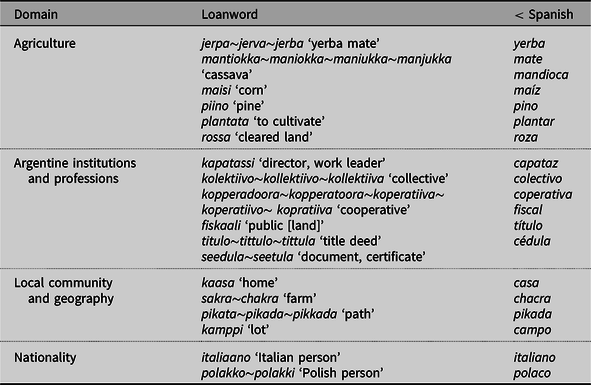
Established loanwords in the data are identified by morphological integration, the number of occurrences in the speech of individuals and across the community, as well as the lack of direct translation into Finnish (Halmari Reference Halmari1997; Hirvonen & Lauttamus Reference Hirvonen and Timo2000:52; Poplack Reference Poplack2018). These are generally related to local contexts, such as agriculture and Argentine institutions (proper names such as first names are also taken into account if they are contrasted with Finnish names by the speakers). Some examples are given in Table 1.
Established loanwords from Spanish.

For most of these words, translation equivalents were not available in Finnish contexts, which lends additional motivation to their incorporation into Finnish (for a similar discussion, see Halmari Reference Halmari1997:49). Although there are repeated occurrences, the forms are subject to individual differences. The community’s members represented several different Finnish dialectal backgrounds, and the material shows no clear evidence of levelling between them in the community. Some general tendencies can still be observed. These include, for example, the reinterpretation of the Spanish tonic vowel as a long vowel, as in kaasa < Sp. casa /ʼkasa/ as well as the doubling of the consonant /k/ at the syllable border between the penultimate and ultimate syllable mantiokka ‘cassava’ or polakko ∼ polakki ‘Polish person’.
Most loanwords belong to domains that were typical of the new local contexts and are also conditioned by frequency of occurrence, as in North American Finnish (see Virtaranta Reference Virtaranta1993:74). In Argentina, the local flora and fauna as well as institutions and professions related to agriculture and local institutions are the most common areas where loanwords appear. In studies on the lexicon of North American Finnish (Virtaranta Reference Virtaranta1993), loanwords can be grouped into different domains that tell us about the typical jobs of migrants and the material and cultural differences between their country of origin and the new societies. These include, for example, mining, mills, food items, clothing, medical terms, technical terms, buildings and construction work, associations and unions, professions, as well as flora and fauna not typical of Finland. Of these, the last four areas are also typical of Argentinian Spanish loans in Finnish spoken in Misiones. However, in comparison to these English-origin loanwords and their domains, the Argentinian Spanish loanwords are from strikingly restricted areas. The small size of the community and its local nature are probable explanations for this.
The use of kaasa ‘house, home’ is interesting, as it is not tied to the new environments as such. Naturally, Finnish talo ‘house’ or koti ‘home’ were available in the migrants’ repertoire, but it seems that the symbolic value of the new house and home attracted the use of the Spanish item for this purpose. In North American Finnish, haussi ‘house’ is also documented as an established loanword (Virtaranta Reference Virtaranta1992).
Months and dates can be expressed in Spanish, as in oktopra ‘October’ < Sp. octubre. Also combined forms, such as fevreerokuu ‘February’ < Sp. febrero ‘February’+ kuu ‘month’, occur, but these seem ad hoc solutions to retrieval problems and a translation to Finnish generally follows. Some numerical expressions, such as kilometro seero < Sp. kilómetro cero ‘0 km’ and kilometro veinttidoos < Sp. kilómetro veintidós ‘22 km’, also occur in Spanish, but they function as place names and thus should be rather classified as proper names that are seen as neutral with respect to borrowing and codeswitching.
The data for Misiones Finnish are restricted as to family relations, but the closest relations isä ‘father’, äiti ‘mother’, veli ‘brother’, sisko ‘sister’, poika ‘son’, and tyttö ‘daughter’ are quite consistently expressed in Finnish. Occasional alterations have to do with partial pattern replication, as in example (3) above, where siskot ‘sisters’ is used instead of sisarukset ‘brothers and sisters’.
5.2.2. Formal integration and adaptation of borrowings
As for morphological integration, borrowings occur in the Finnish frame, similar to North American Finnish (Hirvonen & Lauttamus Reference Hirvonen and Timo2000:52), and are generally phonologically adapted, also like the Finnish–English contact in a migrant setting (Halmari Reference Halmari1997:48–49). Nouns generally receive morphological case marking, like genitive -n in (7), and genitive and locative marking (-lla) in (8).


Finnish morphemes are directly added to Spanish items with a final vowel. If the inserted Spanish word has a final consonant and it does not fall within the Finnish types, a vowel is added, most typically -i, as in susessionin ‘succession-i-gen’ <Sp. sucesión. This is common with English borrowings into North American Finnish as well (Martin Reference Martin1993:99–100).
Integrated verbs are conjugated in the Finnish paradigm, such as plantata ‘to plant’ in (9) and the infinitive luchata ‘to fight’ in (10).


Other verbs in the sample are intentata ‘intend’, kasata ‘marry’, parata ‘stand up’, provechata ‘take advantage’, solisteerata ‘solicit’, and visitata ‘visit’.
Some mixed compounds are also found, such as legaalipaperit ‘legal papers’, katoliikkiuskonto ‘Catholic religion’, and fevreerokuu ‘month of February’. In these the head is generally in Finnish.
5.3 Codeswitching to Spanish for discourse functions
Codeswitching can be observed in multi-word units that occur syntactically or morphologically unintegrated into Finnish. It is not frequent and occurs in the speech of a limited number of speakers in the sample. It is characteristic of codeswitching to have discourse functions, such as quotations, evaluations, and emphatic uses, as in (11). Codeswitching is associated with more informal interactions between the interviewer (I) and the interviewee (A) and may include laughter and jokes, as also seen in the example.

When answering to the interviewer’s question, the first-generation speaker confirms that she did not marry again after her husband passed away, and jokingly explains that there were several suitors that she turned away. Here she switches to Spanish no pasa in the quotation of her answer in line 7 and makes a wordplay with the Swedish passa inte in line 8, which is formally similar to the Spanish expression, as (some of) the suitors were Swedes. Later, the speaker switches to Spanish in the expression yo no sirvo más ‘I am of no use anymore’ in line 20 with an evaluation of her suitability as a partner. This comment could have been partly directed to the imaginary suitors that were not speakers of Finnish. The multiple languages present in the migrant community, including Swedish and Spanish in addition to Finnish, also become evident in this example.
In (12), the Spanish approximative más o menos ‘more or less’ is used to give an evaluation of the speaker’s skills in Finnish at the clause periphery.

This is the only occurrence of the construction in our data, and we have coded it as a codeswitch and not a nonce borrowing, because of its location and the evaluative function.
5.4 Consciousness about mixing
There seems to be a tendency towards avoiding mixing codes in the interview data, and most speakers target a rather monolingual conversation in Finnish in this specific communicative setting. Only a few speakers have difficulties in starting to respond to the interviewer’s questions in Finnish, as shown by repeated initiations of the turns in Spanish in the beginning of the interviews. However, the language choice is typically retracted by switching to Finnish, as in (13).

In other cases, Spanish items are occasionally repeated and translated into Finnish. In the following, I will discuss examples of repairs and the ways word searches are flagged in interaction in the interviews.Footnote 3
5.4.1. Translations of Spanish items
Beyond the established loanwords that have achieved some kind of stability across different speakers (presented in Section 5.2.1 above), Spanish lexical items appearing in Finnish frames can be followed by translations into Finnish or other metalinguistic comments by the speakers themselves, as in (14), or by other participants in the conversation, as in (16). As the interview setting was clearly directed towards the use of Finnish, and most of the interviewees consistently rejected the interviewer’s invitations towards switching the language to Spanish and did not show signs of identifying him as a Spanish speaker, we can treat these items as multilingual repetitions for clarification (Gumperz Reference Gumperz1982:78; Auer Reference Auer1984:88). Indeed, translating, clarifying, or emphasizing are often mentioned as functions of codeswitched reiterations in the literature (see Harjunpää & Mäkilähde Reference Harjunpää and Aleksi2016 for an overview). Aside from one exception, in the interview data, translation only happens from Spanish into Finnish.
In (14) the speaker first uses Spanish kanseri ‘cancer’ < Sp. cáncer and repairs it with syöpä.

The short pauses after vatsa ‘stomach’ might indicate that the speaker was trying to retrieve cáncer de estómago or vatsasyöpä ‘stomach cancer’ but resorted to a locative expression ‘cancer in the stomach’ with a Spanish loanword kanseri as the first solution before accessing syöpä. The speaker is a very fluent speaker of Finnish and in general uses only a limited number of borrowings and codeswitches in her speech in the recorded interview. In (15) there is a similar case with the mixed compound puolidoktor with puoli- ‘half’ in Finnish and the head doctor ‘doctor’ in Spanish, and the Spanish word is repaired with a translation after a pause.

Repair by another participant in the interaction is shown in (16).

Speaker A uses first a phonologically adapted loan panateero ‘baker’ (< Sp. panadero) in line 1 and is corrected by her husband B, who offers the Finnish equivalent of leipuri in line 4. A continues repeating leipuri and agrees to the use of the word in line 5. In the extract, the interviewer (I) agrees and expresses that both forms are fine for comprehension (lines 6–7), which does not affect the negotiation of the correct form between A and B. These kinds of repairs by translation occur especially in the speech of first-generation speakers. Their wider lexical repertoire probably explains the difference to later generations.
Occasionally, Spanish items are commented on, and their use is marked before they are uttered, as in (17).

Here the speaker first gives an explanation that ‘it was called posisioon’ (from Sp. posición) in the community or in Spanish in general, and then translates it into Finnish lupa ‘permit’.
5.4.2. Flagging a missing word
Occasionally, speakers resort to questions to find the correct form in Finnish, as in (18).

In (18), the first-generation speaker offers the translation himself after a short pause. Here the question miksi ne sanotaan suomeksi? ‘What are they called in Finnish?’ is interesting, as the pronoun ne ‘they’ is in the nominative form instead of the partitive niitä that would be expected in Finland Finnish with sanotaan. Miksi can mean both ‘what.tra’ and ‘why’ in Finnish, and the formal overlap of the item could be reflecting a partial replication of the pattern as in Sp. ¿Cómo los llaman? ‘What [lit.: how] are they called?’. Compare the question to (19), where kuinka ‘how’ is used. Furthermore, questions may occur in combination with other cues of hesitation (h), such as lengthening and filled pauses, as in (19).

Here, the first-generation speaker also uses an untypical formulation in Standard Finnish for asking ‘How do you say’, a calque of Sp. ¿Cómo se dice? These kinds of unspecified interrogatives or general word search markers, such as Mitä se on? ‘What is it?’ or the ones used in previous examples are a common means to flag the problem of word search in L2 speech, as they are very open in their reference (Kurhila Reference Kurhila2006:100).
As shown in the previous examples, for first-generation speakers it is common to offer either a direct translation or explanations and descriptions in Finnish. In the interview data, second-generation speakers prefer to resort to translations by the Finnish-speaking interviewer or make use of Spanish items. In (20), the second-generation speaker does not know the expression höyrylaiva ‘steamship’ and is expecting a translation to Spanish en vapor from the interviewer.

Comments with sanoa ‘say’ can be used to highlight word searches without directly formulated questions, as in (21).

Here, the speaker is responding to the interviewer’s question about whether he knows other Finns who would be traveling workers (i.e. without a farm or steady lodging). The speaker’s hesitation is signaled by sanotan < sanotaan ‘let’s say’ and a pause before oma talo ‘own house’.
In (22), the speaker searches for the word lanko ‘brother-in-law’, a non-immediate family relation, and offers the Spanish translation cuñado and continues with sanotaan ‘it is said’.

The speaker is a second-generation speaker, which might suggest that he is not aware of the term because of his age and the Argentine setting. However, because of the limitations in the sample, it is difficult to say if other speakers in the community would have known and used the Finnish term. In North American Finnish, Finnish words are used for close relations, while more distant relations are expressed with English loans, such as krämppa ∼ ramppa ‘grandpa’, niis(s)i ‘niece’, etc. (Virtaranta Reference Martin1993:80). Similar data beyond the close family terms (see Section 5.2.1 above) are not available for Finnish in Misiones, but occasionally circumlocutions are used to express more distant relations, i.e. ‘the daughters of my mother’s brother for cousins’, as in (6).
5.5 Generational differences and consciousness about mixing in Misiones Finnish
The results of the analysis of contact phenomena investigated here show that the Spanish influence in Finnish spoken in Misiones in the 1970s is mainly lexical, i.e. matter replication, although some pattern replication could also be identified. This strongly suggests that the remaining inhabitants of Colonia Finlandesa in the 1970s had spent their childhood in families and a community where the everyday language was Finnish. This provided them with enough input to master Finnish at a high level.
Although more detailed variationist studies fall beyond the scope of this paper, some general observations on the speech documented in the interviews can be made along the following lines: first-generation Finnish shows contact influences that are limited to lexical loans and occasional codeswitching, while second generation speakers seem to have shifted mostly to Spanish in their daily communication and thus show a clearer preference for Spanish, with more pattern loans and an accent that sounds different from standard varieties spoken in Finland. However, individual variation is notable. Starting from the third generation, the material shows evidence of an almost complete shift towards Spanish. The contact influences in the first-generation are well in line with results from the North American contact setting with English when it comes to loanwords and occasional codeswitches (see Hirvonen & Lauttamus Reference Hirvonen and Timo2000). In contrast to the North American setting, at least some first-generation speakers in Colonia Finlandesa also use codeswitching for discourse functions, pointing towards the fact that local Spanish is one of the main languages in their daily interactions. The second generation in Colonia Finlandesa shows more traits that reflect the situation of the third generation in the North American setting, indicating a different process of acquisition caused by declining use of Finnish in the community.
With regard to metalinguistic knowledge about mixing in the interview setting, first generation speakers tend to translate the occasional Spanish items to Finland Finnish and offer further explanations in Finnish. Later generations rely more on Spanish translations and the help of the interviewer in their word searches for Finnish items. In her study of Finnish in North America, Halmari (Reference Halmari2005) has shown that these kinds of translations and marking of non-Finnish items can be analyzed from the perspectives of consciousness about languages as separate entities and as signs of retrievability or accessibility of a lexical item. That is, if speakers are trying to retrieve a word and first resort to an item that is more accessible to them. As in the cases presented here, Halmari’s participants’ bilingual consciousness was shown by metalinguistic discussions and conscious repair phenomena, such as translations or questions, when either an English word is inserted into an otherwise Finnish discourse, or when the speaker accidentally produces an ungrammatical Finnish form.
6. Concluding remarks
This study examined Spanish contact influences in Finnish heritage speakers based on historical interview data. The results pattern well with what is known about lexical borrowing in heritage settings where its function is to fill in gaps in the speakers’ language production (e.g. Lauttamus Reference Lauttamus1992; Halmari Reference Halmari1997, Reference Halmari2005; Hirvonen & Lauttamus Reference Hirvonen and Timo2000 for North American Finnish). Spanish items can be unmodified multi-word codeswitches, for instance using the Spanish items whose form and function do not differ from Spanish, or they can be modified morphologically and syntactically and occur in the Finnish frame as established loanwords and ad hoc borrowings. Borrowing from Spanish can also be seen as a communication strategy in interaction when speakers do not know or cannot access a word in Finnish. Resorting to Spanish can be interpreted as a sign of difficulty in maintaining a Finnish conversation for less fluent speakers or at the start of an interview. In addition, fluent speakers of Finnish use codeswitching into Spanish mainly for discourse and emphatic purposes.
In general, this study demonstrates how historical material can be used to document lost or moribund heritage varieties and to shed light on the language practices of migrant varieties in Misiones in particular. With a high degree of bilingualism and an accelerated linguistic shift in the third generation on the community level that could be concluded from the historical material, the Finnish case in Misiones reflects similar situations of other Nordic languages in Argentina (Flodell Reference Flodell, Sture Ureland and Iain1996, Reference Flodell2012; Kühl & Heegård Petersen Reference Kühl and Heegård Petersen2018). In comparison to previous studies on Finnish migrant varieties in North America, it becomes evident that the loss of Finnish as a community language was a rapid process that happened nearly within two generations and shows a shift from dialectal varieties of Finnish to regional Argentinian Spanish, probably mainly caused by the small size of the community. As in other communities, lexical influence from Spanish is prominent, and the effects of language shift can be seen in the pattern transfer in the speech of speakers who are more dominant in Spanish. This study adds to these in examining the strategies and level of metalinguistic awareness in the heritage community, showing a clear avoidance towards mixing. Beyond established lexical loans, both fluent and less fluent speakers avoid mixing and comment on it by using translations and word searches. The interview format and the presence of the Finland Finnish interviewer, who was an outsider to the community, probably had an effect. This, however, shows that the speakers have a high consciousness of languages as separate entities, even if their possibilities of using Finnish outside the immediate home circle were already scarce.
Acknowledgements
I would like to thank the Migration Institute of Finland for their support during the collection of the archival material used in this study, as well as the NJL reviewers and the guest editors of this special issue for their helpful comments.