1. INTRODUCTION
The scope of examining the linguistic landscape (LL) as a sub-field within sociolinguistics is expanding dramatically as scholars use the marking of the public space by different languages to analyse the linguistic ecology of multilingual communities across the world (see, for example, Shohamy and Gorter, Reference Shohamy and Gorter2009). This project focuses on the manner in which France's regional heritage languages (RHL), and specifically Breton and Corsican, are present within the LL in their respective regions. Undertaking research into France's LL is fruitful and rewarding, although not without its surprises. One of the principal reasons for the potential offered by examining the marking of the public space in France is the long-standing, well documented and widely known commitment of the State to language management in order to direct language practices across the country. Spolsky (2004: 63) refers to France as ‘the paradigmatic case for strong ideology and management’ and it is against the backcloth of clear language management in favour of the national standard language, French, that investigations into the LL are projected. The language ideology that cherishes French above all other languages spoken across the country pre-dates the Revolution; Kings, Emperors and Presidents have remained committed to assuring the hegemony of French, from as far back as François I in the early sixteenth century to as recently as President Nicolas Sarkozy, who took his entire cabinet of ministers to Corsica in October 2007 for a symbolic meeting outside Paris, where he famously vouched support for the Corsican language on the understanding that such support would come at no cost to the prestigious standard language.
In the twentieth century, France engaged in language management strategies designed to govern the use of language in and beyond the public space. The context for all LL research in France is the legislation, above all from the second half of the century, to define and guide language practices. The two landmark pieces of legislation are the 1975 loi Bas-Lauriol and the 1994 loi Toubon. The loi Bas-Lauriol aimed to regulate language practices to make the use of French in areas such as commerce, advertising and communication obligatory. The loi Toubon was glossed as an updating of the loi Bas-Lauriol and sought, according to Adamson (Reference Adamson2007: 27) to provide ‘better protection for the language [French] in numerous fields of public life, and in advertising [. . .].’ The reach of this law extended into areas of life as diverse as education, research, the media, advertising and employment. The loi Toubon is most often summarised as requiring both top-down and bottom-up management of language practices to be undertaken in French when it is possible so to do. There are some caveats which permit the use of a translation into French alongside another language – usually, in practice, English – but the primacy of French is stressed by this piece of language legislation. Although Adamson (Reference Adamson2007: 28) notes that the total of successful prosecutions for infringement of the loi Toubon is relatively small, the law still stands and regulates the use of different languages in the public space as well as in documentation.
This project constitutes an empirical study of the LL of two areas of France with a view to comparing evaluating and comparing the relative presence (or absence) of two of the country's RHL. This article presents a new methodology for analysing signs in the LL which, in the first instance, adapts the most well known approach to surveys of the LL, devised by Backhaus (Reference Backhaus2007: 60–70) and proposes a new categorisation for signs in order to facilitate and encourage comparison with other research. In the light of France's management of languages, this article examines the RHLs in the LL from two different perspectives: first, in monolingual signs, and, second, in multilingual signs. Part of the analysis of these corpora will focus on those responsible for the sign with a view to contrasting the practices of those who manage the public space in two parts of the same country. The selection of Brittany and Corsica for this project is based partly on their geographic opposition within France: Brittany is in France's north-west corner on the Atlantic Ocean whereas Corsica is the country's Mediterranean island territory off the Italian coast. Before presenting the findings from the fieldwork, it is first important to establish a sociolinguistic context for this study.
2. SOCIOLINGUISTIC OVERVIEW
Whilst these two areas share a number of commonalities, they also differ in some important ways. Brittany boasts two RHLs, namely Breton, a Celtic language, and Gallo, a Romance language. The Duchy of Brittany became part of France in 1532, and language practices in both RHLs declined after the Revolution. Breton, spoken by a larger proportion of the population, is identified with western Brittany, and is subdivided into four main dialectal groups. Corsica was purchased by France just before the Revolution and experienced intensive gallicisation from the end of the nineteenth century onwards (see Blackwood, Reference Blackwood2004). In terms of language practices, over the past 250 years, the population's first language has changed from Corsican, an Italo-Romance language, to French, thanks largely to language management strategies, economic incentives and other factors. Both Breton and Corsican are supported by language activists in their respective areas, and although the RHLs remain marginalised, there are opportunities to use them in education, the arts and the media.
There are, however, no monolingual speakers of any of France's RHLs. In terms of numbers of speakers, Judge (Reference Judge2007: 97–87) suggests that research in the 1990s estimated that 240 000 of the 3, 080 648 populationFootnote 2 of Brittany spoke Breton. In other words, just under 8% of the population of the region considers themselves to be speakers of Breton. On Corsica with a population of 278 650, Blackwood (Reference Blackwood2008: 108) calculates that currently there are approximately 156 000 Corsican speakers on the island. Therefore, in terms of comparison, although there are approximately 100 000 more people who identify themselves as Breton speakers than those who are corsophones, the proportion of speakers of the RHL on the island – almost 56% of the population – is eight times greater than the speakers of Breton. One of the key contexts for this project is, consequently, the fact that Corsica is inhabited by a much higher proportion of speakers of Corsican than Brittany is of speakers of Breton. Whilst it could be argued that one in two islanders speaks Corsican, only one in thirteen residents of Brittany speaks Breton. The disparity in the number of speakers is likely to be one factor that would have an impact on language practices in terms of marking the public spaces in both areas.
3. METHODOLOGY
Although the breadth of research into the LL is increasing, very little has been published on the methodologies for undertaking empirical studies into this area. The most notable exception to this is Backhaus’ 2007 examination of the LL of Tokyo. Backhaus exploited the public transport system in Japan's capital by starting his survey areas at the street-level entrances to underground train stations. One of the aims of this article is to suggest a methodology for fieldwork in the LL that can be applied to other case studies in order to facilitate comparative investigations between LLs. In seeking to adapt Backhaus’ methodology (Reference Backhaus2007: 60–70) to more provincial settings, such as Brittany and Corsica, it is important to develop a specific procedure that not only responds to the specificities of the fieldwork in France, but which can also be used in more rural settings than the megalopolis surveyed by Backhaus. Backhaus (Reference Backhaus2007: 65) identifies three concerns for data collection: 1) spatial determination of the survey areas, 2) counting the items and 3) monolingual vs. multilingual signs and these concerns will be discussed in turn.
The first concern for undertaking research into the LL is the selection of survey areas. Unlike some of the major cities whose LL has been investigated (such as Tokyo, Rome, Montréal, Jerusalem; see Backhaus, Reference Backhaus2007: 56 for an index of published analyses), the surveys in Brittany and on Corsica covered towns and villages. Moreover, since Brittany and Corsica are both rural regions, the public space is marked more sparsely by the written word than in the large cities surveyed by others. As such, it was necessary to define a framework that can be used in both rural and urban settings. It is important to explain the choices of centres for the counting of items in the LL, having already established the sociolinguistic contexts for these surveys. Two factors came into play when deciding where exactly to survey the public space in Brittany and on Corsica. First, there is the size of the population in the two regions; thanks to the on-line publications of France's office for national statistics, INSEE, it is possible to ascertain the populations of all towns, cantons and communes in France, although it should be acknowledged that the 2004 census results are not yet available on this scale, so the results for the 1999 census have been used. However, given that the number of citizens in the Breton city of Rennes is marginally smaller than the total population of Corsica, it was clear that a second factor had to be brought into consideration. As such, the significance of given towns in administrative or political terms has also been considered when selecting centres for data collection.
In Brittany, the region's principal city Rennes (population: 212, 494) is the biggest town and also the administrative centre of the region. It is also the centre for the revitalisation of the Breton language (Judge, Reference Judge2007: 118). In comparison, the ‘capital’ of modern-day Corsica is Ajaccio, on the south-west coast of the island, but it is home to 54 697 citizens and therefore significantly smaller than Rennes. However, given its importance to Corsica, it constitutes the main Corsican survey area for this project. Both Brittany and Corsica are considered rural parts of France and, as such, towns are relatively small in comparison with other corners of the Republic. Nevertheless, beyond the main centres of both regions, it is possible to find municipalities of comparable size and significance. In both regions, ten surveys were undertaken in the major towns (Rennes and Ajaccio) with a further ten surveys beyond the ‘capital’.Footnote 3
For this project each survey area constituted 50-metre stretch of the streets selected. The length of the sections was approximate and was measured by pacing out 50 metres along the street, thereby defining the survey area. In one respect, it could be argued that to choose 50 metres of a street is an arbitrary decision, which potentially diminishes the significance of the research. However, in the same way that sociolinguistic surveys use groups of respondents (rather than entire populations) to predict trends in language practices, 50-metre stretches of roads (totalling 20 survey areas in both Brittany and Corsica) can be understood as representative of wider regions. The streets themselves were chosen on the basis of their relationship to the towns or villages in which they were found. In the towns of Rennes and Ajaccio, it was straightforward to identify that which was generally accepted as the main street of the town and, subsequently, to select streets of decreasing importance and size. In the larger villages, it was expected that there might only be one or two main streets suitable for LL research, since, in residential parts of small towns and large villages, the public space is barely marked by the written language, something which makes a survey of such a street less useful and more likely to distort the overall picture. Although the streets as well as the towns and villages selected were chosen specifically using the parameters highlighted above, the decisions as to which part of a given street to chose were arbitrary and made on arrival (yet still prior to any examination, even casual, of the LL). It was essential not to predetermine the findings of the surveys by seeking out areas of towns where there might be more or fewer signs featuring the RHL. A defining characteristic of this methodology is that it focuses in the most objective way on a representative selection of streets in a given city, town or village. Beyond the 50-metre length framework, it was not necessary to define a height limitation; as Backhaus (Reference Backhaus2007: 66) found in Tokyo, relatively few signs appeared much above the ground floor and those that did were designed to be visible (and therefore open to analysis) from street level.
The second concern for the survey work is the counting of signs. In terms of counting items, much time and space has been devoted to discerning what should and should not be counted as a sign for the purposes of these kinds of surveys. Cenoz and Gorter (Reference Cenoz, Gorter and Gorter2006: 70) for their examination of the LL of Ljouwert (in the Netherlands) and Donostia (Spain), adopt a counting system that could be described as narrow, whereby one shop front, for example, constitutes one sign. A different, broader method is proposed by Backhaus (Reference Backhaus2007: 66) who defines a sign as ‘any piece of text within a spatially definable frame’. For this project, it was decided to adapt the practices of Backhaus and define a LL sign as a written text considered as a single item, be that a poster, a menu, a shop sign above a premises, a man-hole cover or a one-word instruction. Signs without text were not counted. The question of non-fixed items has been considered by others and Backhaus excludes from his survey non-fixed items such as newspapers, price tags and leaflets. For this survey, which seeks to be as comprehensive as possible, such signs were included when they were considered to be semi-permanent items in the landscape; although it is expected that newspapers, postcards and leaflets are removed from the landscape, it is also the case that stocks are replenished on a frequent basis. Excluded were items whose presence was fleeting, such as logos on public transport, clothing or tattoos on passers-by or ephemera such as litter and shopping bags.
The final concern is the decision as to whether a sign is multilingual or monolingual. In terms of the principal focus of this investigation, namely the relationships between France's standard language and its RHLs, the differences between French and Breton, Corsican or English are so marked that there were no grey areas in the definition of a sign as multilingual. The signs were all clearly either monolingual or multilingual; in other words, signs that included more than one language were deemed multilingual. The question of international brand names remains a contentious one in empirical surveys of the LL. Edelman (Reference Edelman, Shohamy and Gorter2009: 149) examines brand names in the LL, and proposes two different approaches, which she refers to as Analysis A and Analysis B. In Analysis A, trademarks are excluded from consideration in the LL on the assumption that they cannot be ascribed to a specific language. In Analysis B, trademarks are treated in the same way as other words recorded in the LL and assigned to their language of origin. Given both the focus of this article on RHLs and, at the same time, the paucity of brand names that use either RHL, the attribution of trademarks to a specific language other than Breton or Corsican is not relevant to this present study (although see Tufi and Blackwood, forthcoming, for a proposed evaluation of brand names in the LL).
Included in the survey were acronyms which were categorised according to the criteria above, meaning that the ubiquitous ‘CB’ (for ‘Carte Bleue’, the principal French credit card) was considered to be French. The surveys were carried out in July 2007 (for Brittany) and August 2007 (for Corsica) during business hours (which included weekends). All signs were allocated a reference code which identifies their location and, where necessary, gives a brief description of the item. All multilingual signs were recorded on a digital camera.
4. FIRST OBSERVATIONS
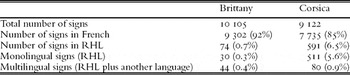
Having established the methodology for this fieldwork and presented a new categorisation of the signs, a quantitative starting point for the analysis of the LL of Brittany and Corsica is set out in Table 1.
Statistical overview of the two surveys

At this stage, not only can it be concluded that the public space is less marked on Corsica than it is in Brittany, but it is also possible to generalise with confidence that French dominates the LL in these regions. It is important to draw attention to the fact that what is not asserted by these first findings is that the presentation of the LL in accordance, to a greater extent, with the State's language management strategies is due to the language laws highlighted above. There is no evidence from these surveys that decisions to use French (or other languages) in the public space in France, is as a direct result of, for example, the loi Toubon. This project goes some way to examining the motivation behind the marking of the LL – that which Spolsky and Cooper (Reference Spolsky and Cooper1991: 82–94) refer to as the three Sign RulesFootnote 4 – but focuses instead on the actual presence and/or absence of languages in the survey areas in order to facilitate some level of decoding of language practices on a wide scale.
The RHLs are not absent from their respective parts of France, nor is their presence uniform, with a greater visibility for Corsican than for Breton. Although Breton boasts more speakers and is generally considered, by the laity as well as by language activists in France, as one of the country's strongest RHL, its presence in the LL is overshadowed by Corsican, which has 100 000 fewer speakers.
4.1. The presence of the regional heritage languages
The relative smallness of the corpus of signs featuring either of the regional heritage languages under examination here constitutes both an advantage and a disadvantage. On the one hand, the fact that monolingual Breton signs, for example, total less than 1% of the total number of items recorded in Brittany expose suggested trends to the accusation that they are based on very little evidence – in other words, this is much ado about nothing in terms of the wider LL. On the other hand, however, the size of this corpus means that more space can be devoted to a close analysis of the nature of the signs that are in the regional heritage languages which, ultimately, is the primary focus of this project.
In this thorough examination of the RHLs, it is helpful and revealing to categorise the signs recorded in Breton and in Corsican in the LL in order to identify trends in the use of the language. Once this categorisation has been outlined, it will be possible to seek to explain the how and why these two languages appear as they do in the public space. To facilitate the evaluation of the signs, it has been beneficial to keep the number of categories of signs as low as is practical. The definition of the categories is, to a certain extent, arbitrary and some categories that apply to the appearance of French, for example, do not apply to the regional heritage languages. In terms of Breton and Corsican, however, there were 9 principal categories of signs, namely 1) business names, 2) business signs (which explain what an enterprise does, such as ‘baker’ or ‘jewellery’), 3) graffiti, 4) information (including advertisements, opening times or details of services of offered), 5) instructions (such as ‘push’ or ‘pull’), 6) labels (on products), 7) legends (including statements such as ‘I support the Diwan’ [Breton-language immersion schools], trades association membership stickers, or slogans in general), 8) street signs (for example street names or directions) and 9) trademarks. Not only is this selection of categories far from exhaustive, it is also potentially controversial. Scholars examining the LL are still moving towards an agreed methodology for examining the definitions of signs; it is hoped, therefore, that this practical application of categories to an empirical study will help to inform the current debate.
5. BRETON
5.1. Breton monolingual signs
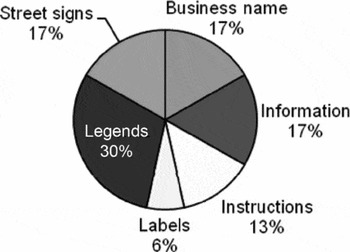
The distribution of monolingual signs in Breton according to the category of signs is set out in Figure 1.
Distribution of monolingual signs in Breton according to category of sign

The division of signs into categories is more useful when considered using the template offered by Ben-Rafael et al. (Reference Ben-Rafael, Shohamy, Hasan Amara, Trumper-Hecht and Gorter2006) that examines the ‘top-down’ and ‘bottom-up’ forces which govern the power relationship in the LL. This project uses the definitions offered by Ben-Rafael et al. (Reference Ben-Rafael, Shohamy, Hasan Amara, Trumper-Hecht and Gorter2006: 14):
The ‘top-down’ LL items included those issued by national and public bureaucracies – public institutions, signs on public sites, public announcement and street names. ‘Bottom-up’ signs, on the other hand, included those which were issued by individual social actors – shop owners and companies – like the names of shops, signs on businesses and personal announcements.
If we re-examine the thirty monolingual Breton signs using this model, 60% are bottom-up signs with the 40% being ‘top-down’. All of the examples of legends, such as a sticker noting that a given shop was staffed by Breton-speakers, can be classified as bottom-up language management, in that they are added by the shop-owner to identify his or her premises with the Breton language and its cause. Those signs that were business names can again be considered as bottom-up language management in favour of the RHL, since the shop-owner elected to give his business a name in Breton, rather than having the choice decided for him by a top-down ruling. The top-down items, slightly in the minority in what has already been acknowledged as a small corpus, include the five street signs in Breton. These are official signs placed by the municipal authorities to identify either a street's name or to give directions. Also deemed top-down items in Breton are the three signs conveying some level of information in Rennes in the underground railway station.
5.2. Multilingual signs featuring Breton
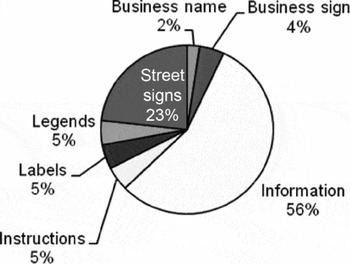
In terms of the forty-three multilingual signs featuring Breton, as shown in Figure 2, the highest proportion of signs were those conveying information, totalling 55%, over half of which were found at the main underground railway station.
Multilingual signs featuring Breton

As far as the multilingual signs are concerned, 63% of the forty-three signs that feature Breton can be considered top-down items. These signs either contained information – given normally at the underground station – or were street names. The remaining 37% of bilingual signs featuring Breton were bottom-up items, including eight signs conveying information, such as details on an exhibition or opening times. In the sense that the multilingual signs featuring Breton and French conform to France's language management strategies highlighted above, it is unsurprising that top-down signage is more consistently multilingual than monolingual. Those top-down signs solely in Breton, especially those found at the underground railway station in Rennes, are matched by a monolingual French sign on an opposite or neighbouring wall, containing exactly the same information but in the national standard language. Although the differences between the two sets of statistics are not vast (28 signs being top-down, 16 bottom-up), it is possible to posit that the presence of Breton in monolingual signs tends to be as a result of bottom-up language management in the public space, whereas multilingual signs are, generally, top-down items. Nevertheless, it is worth recalling that the figures we are discussing are particularly small in comparison with the total number of monolingual signs in French, for example, and the negligible presence of Breton owes a great deal to the language management strategies of the regional transport company.
When examining Breton in the public space, one location in the entire survey stood out for its multilingual LL and that was at the main railway station in Rennes, where the survey area was the connecting hall between the railway platforms and the underground train station. In comparative terms, this was the survey area which included the most Breton, totalling a 22 signs, multilingual and monolingual. This survey area included six monolingual Breton signs and sixteen bilingual French-Breton signs, all of which were official signs erected by the city's regional transport company, STAR. These 22 signs are all categorised as information, detailing, for example, the opening times of the hallway to the underground station, the fact the closed circuit video surveillance is in operation, and the way to the exit. It is worth dwelling on the presence of Breton in this particular railway station and the decisions made to include the RHL in signs erected by the regional transport company. The decision by STAR to feature Breton in their signage exemplifies Sign Rule 3, explained as ‘prefer to write signs in your own language or in a language with which you wish to be identified’ (Spolsky and Cooper, Reference Spolsky and Cooper1991: 84). Since there are no monolingual Breton speakers left, the inclusion of Breton in a modern underground railway network is not an example of a sign-writer seeking to convey information. This is not, it is argued, Sign Rule 2 (Spolsky and Cooper, Reference Spolsky and Cooper1991: 83), namely ‘prefer to write signs in the language or languages that intended readers are assumed to read’. The decision by STAR to provide signage in Breton at its underground station linked directly to the main railway station – which sits on the line between Brest in the far west of Brittany and Paris – indexes a desire to identify socio-culturally with the region's heritage language.
The inclusion of Breton in this particular part of the LL in Brittany is interesting and demands further discussion. Whilst this project has not examined the rationales offered by those who govern the public space, it is clear that the regional transport company wished to identify itself with the RHL. Below, we shall return to the presentation of French and the RHLs in relation to one another, but it is worth drawing attention to the fact that the use of Breton by STAR is not consistent or uniform. Further investigation of Rennes’ comparatively small underground train network revealed that at no other station was Breton present to such an extent as it was here, at the mainline railway station. There was no Breton at all in some of the underground stations, whereas one or two included a handful of instructions, normally providing bilingual signs indicating the exits. Only at the underground station at the main railway station was the use of Breton in conjunction with French widespread and consistent. Given the likelihood that the greatest number of passengers pass through this particular underground station, the presence of bilingual and monolingual signs is symbolic but not a policy that STAR wished to pursue across its transport network.
6. CORSICAN
6.1. Corsican monolingual signs
One reason for the prominence of Corsican in the public space is the use of the Corsican term for the island, ‘Corsica’ (in comparison with the French term ‘Corse’), which is exploited on items as varied as product stands, tourist advertising slogans, merchandising including towels, clothing and badges in window displays, and official slogans. The fact that the English form of the island's name is identical to the Corsican form cannot be ignored, since the international language that is English clearly resonates on the island as elsewhere in France, especially in tourist areas. Not only is ‘Corsica’ the English and the Corsican name for the island, but it is also the standard Tuscan Italian name for the island and, given the proximity of the island to the Italian peninsula and the popularity of the island with holidaying Italians, the international appeal of the word ‘Corsica’ is clearly an advantage to the island's tourist industry. A decision had to be reached as to what language the one-word legend ‘Corsica’ appeared in. Given the fact that ‘Corsica’ appeared in more than one-word slogans and noting that English-speaking visitors to the island are considerably outnumbered by their German and Italian counterparts, it was decided to qualify ‘Corsica’ when it appeared in the LL as Corsican. Further support for this decision is provided by the general understanding on the island that ‘Corsica’ is a Corsican (rather than as an English or Tuscan Italian) word thanks to its presence in Corsican life. The term ‘Corsica’ is used in political life (such as by the grouping of nationalists, Corsica Nazione), in the media (where the evening news bulletin is called Corsica Sera and a news magazine appears monthly, entitled Corsica), and elsewhere, such as in transportation, private business and the arts.
For comparison between the two RHLs in this study, there are over 17 times more monolingual Corsican signs on Corsica than there are Breton signs in Brittany. It is important, therefore, to attempt to analyse the greater prominence of Corsican in its LL by following the same process as that undertaken for Breton. In the categorising of the monolingual Corsican signs, a different pattern emerges on the island to that noted in Brittany.
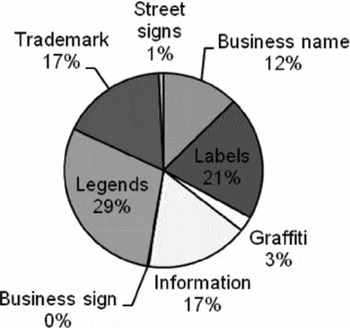
The most frequent appearance of Corsican in the LL on the island is in the form of legends in the regional heritage language, which came to 28% of all the monolingual signs. Not only was the one-word legend ‘Corsica’ recorded in the LL but other examples were found, including a sticker on the window in a barbers’ shop which read Qui si parla corsu, ‘Corsican spoken here’, and an explanation beneath a reprint of a portrait of the eighteenth-century Corsican independence hero, Pasquale Paoli.
The second most widely recorded category of signs was the labelling of products in Corsican, totalling 21% of the monolingual Corsican items. At first glance, this would seem to contradict the strict measures of the loi Toubon, which requires a translation of product information, where possible and feasible, into French. However, the use of the Corsican language on product labels, especially local produce such as olive oil, cured meats, pâté, honey, chestnut-based cakes, biscuits and alcohol is widespread and anchors the product in the island's cultural heritage. This is another exemplification of Spolsky and Cooper's Sign Rule 3 (Reference Spolsky and Cooper1991: 84) where the Corsican-ness of the products is indexed by the use of the Corsican language on the labelling as if to guarantee its authenticity as a product of Corsica. The use of the Corsican language on these labels is not something matched on Brittany and, on the island, it accounts for one in five of the items in Corsican in the LL. In terms of number of items, the third biggest category of monolingual Corsican signs in the LL was trademarks, constituting 17% of the total but not encountered at all in Breton. Two or three private businesses on Corsica elected to use the Corsican language in the trademark for their product, notably the brewery Pietra (whose trademark ‘Pietra – birra corsa’ constitutes one of the most prominent Corsican-language brand names in the island's LL) and the soft-drinks manufacturer Corsica-Cola. Both companies supply umbrellas, ashtrays and other merchandising for the café industry that flourishes across Corsica and the repeated use of the RHL on café terraces significantly boosts the presence of Corsican in the LL.
Monolingual signs featuring Corsican

In examining the monolingual Corsican signs from the perspective of top-down or bottom-up marking of the public space, the statistics provide a dramatic explanation for the appearance of the RHL in the LL. Of the 511 monolingual Corsican signs in the surveys, only 1.4% could be considered as top-down signs. This corpus of seven signs consisted of four street signs, an information panel – highlighted above – commemorating the place where Maistrale died, a commemorative plaque in Propriano, and the business name of a museum in Bonifacio. It is clear, therefore, that the extent of the presence of Corsican in monolingual signs in the LL is assured by bottom-up language management. The RHL owes its position within the public space on the island to the language practices of shop owners, graffiti writers, manufacturers and businesses, rather than to the language management strategies of the Regional Assembly, the Collectivité Territoriale de Corse (the body to whom responsibility for the administration of the island has been devolved) or of the French State.
Multilingual signs featuring Corsican

6.2. Multilingual signs featuring Corsican
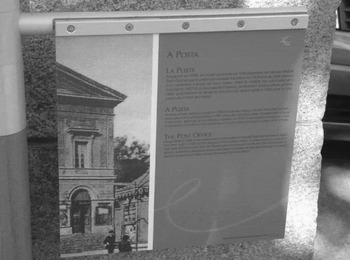
Of the 80 multilingual signs featuring Corsican, only one did not feature French: the business sign of a clothes shop in Ajaccio. This sign was in Portuguese and in Corsican, and appeared above the window of a clothes shop for Brazilian clothes. There was also one multilingual sign featuring Corsican, French and English, which was an official information board outside Ajaccio's post office, explaining the history of the building as a theatre before its conversion and had been erected by the island's Regional Assembly. The short text in French was then printed again below in Corsican and finally, at the bottom of the sign, in poorly translated English. The remaining 78 signs were bilingual French-Corsican signs and it is upon these items that we shall concentrate in this section.
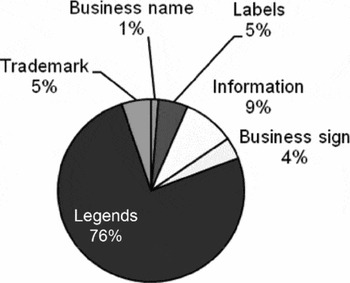
The largest category of this kind of signs belong to the category of legends, totalling 76%. Without exception, all of these signs appeared on postcards, where the picture was explained using the slogan ‘Corse’ and ‘Corsica’, using both the French and the Corsican name for the island. This kind of bilingualism, limited to the presentation of the name of the island in both French and Corsican, is designed for visitors to Corsica, since it can be expected that it is tourists who buy postcards. These items are also designed to be removed from the LL (although, as acknowledged above, on the understanding that they will be replaced) and sent elsewhere. The use of Corsican and French together on postcards, therefore, is created in order to associate the card, the sender or the image represented on the card with the dual identity of Corsica as a French and yet also as a Corsican island. This typifies Sign Rule 3, (Spolsky and Cooper, Reference Spolsky and Cooper1991: 84), namely to identify with, in this case, the languages being used.
The other categories of bilingual French-Corsican signs were dwarfed by the use of both languages in legends. Two categories of signs each make up 5% of the bilingual LL: labels and trademarks. The labels were on products where details were presented both in French and in Corsican. These labels, all of which were for honey in a shop on the rue Napoléon in Ajaccio, featured first French (Miel de Corse) followed beneath by the same information but in a smaller font in Corsican (Mele di Corsica) and then the rest of the label was in French. The trademarks also privileged French, using a Corsican name and then qualifying it in French. By way of example, one sign read ‘Torra – Bière du Maquis’, where the Corsican name indexed the provenance of the beer and associated the product with the island, whereas the French gloss explained what the product actually is, namely a beer identified with the maquis, the collective name for the varieties of wild shrubs that grow across the island.
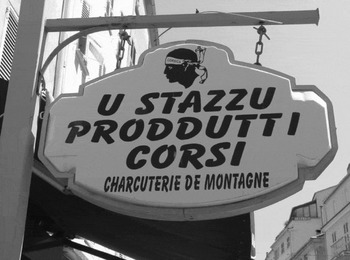
The final two categories barely featured in bilingual signs on the island but it is worth briefly outlining business signs (4%) and business names (1%) which appeared in the surveys in French and Corsican. One of the business signs appeared twice, in Ajaccio on the rue Napoléon which featured more Corsican signs than the majority of other survey areas. A tourist shop, called U Stazzu, on the rue Napoléon, sold Corsican produce and gifts and had a business sign which explained what it sold. In the upper position and in a larger font, the sign read in Corsican ‘Proddutti corsi’ (Corsican produce), below which appeared in French ‘Charcuterie de montagne’ (cooked meats from the island's interior).
The last category of sign was the single example of a business name which appeared in both French and Corsican and was found on rue Paul Colonna d'Istria in Ajaccio, where a nationalist grouping has one of its offices. The name of the business, ‘Corsica Nazione’, appears in Corsican, beneath which appears the legend ‘Comité Anti-Répression’ in the same font, in the same size. Again, the information conveyed by both slogans is not identical but the two languages appear alongside one another in the same sign.
In terms of the differences between top-down and bottom-up management of the public space, the contrast between the two is no less striking than that observed in the monolingual signs. Of the eighty multilingual signs featuring Corsican, only one – the trilingual information panel outside the post office in Ajaccio – can unquestionably be described as a top-down sign. The three nationalist movement posters for the general election are, in one sense, bottom-up since the party is not in a position of authority on the island and, even less so, within greater France. On the other hand, the poster for the official Socialist Party candidate at the Presidential elections could be considered top-down language management of the public space, since the French Socialist Party, although not in power at the time of the elections or the surveys, is a dominant force in the administration of France. That acknowledged, it is unlikely that the bilingual poster was produced at the Socialist Party's Paris headquarters and therefore, it should be considered that there is only one top-down multilingual sign in the LL on Corsica. Let us recall, moreover, that this particular sign was not merely in French and Corsican, like the majority of multilingual signs on the island, but trilingual, including, in addition, English.
Bilingual business sign in Corsica

7. A CODE PREFERENCE FOR BILINGUAL SIGNS?
The final area of comparison between Breton and Corsican in the LL focuses on the presentation of the RHL alongside the standard language, French, in multilingual signs. This has been referred to by Scollon and Scollon (Reference Scollon and Wong Scollon2003: 120ff) as a ‘code preference system’ by which a hierarchy of languages can be identified based on the positioning and styling of the items within a given multilingual sign. It is of interest to this project, and others investigating the LL in places where a language ideology articulated by some form of authority – most often a national government or a local authority such as a town or regional council – is clear and widely publicised. In the case of France and French law, the hegemony of French must be protected. This language policy is not always strictly followed, as has already been demonstrated, but it is expected that official, top-down signs within the LL will respect the spirit and the letter of the law. In the surveys in Brittany, we have identified the underground railway station as the site where most multilingual signs featuring Breton were recorded. In these multilingual signs (produced by STAR, the local regional transport company whose logo appears on ticket machines, maps of the transport network and information panels in this survey site), a set hierarchy was uniformly adopted. The French part of the sign (for example, in one sign at Rennes’ railway station, ‘Sortie’ for exit) appeared above the Breton (‘Er-maez’) and in a larger font. This is the standard presentation of languages in the LL in accordance with France's twentieth-century language management strategies. However, this particular ordering of languages was not only recorded in official – and therefore ‘top-down’ – signs. For example, the business name for a gift shop in Carhaix followed this pattern, yet a jeweller's in the same town used the same order but maintained the same font size for both the French and Breton items.
Multilingual information sign in Corsica

The reverse hierarchy could be found with the instructions on a door putting the Breton ‘sachit’ above the French ‘tirez’ but with both in the same size and the same font. There were also three signs which placed the Breton information – in this case, the business name of a crêperie – in the prime position (in the centre of the sign in a large font) and provided a direct translation in French, using an asterisk to direct the audience, up the side of the sign in a significantly smaller font. The trend that emerged in this code preference hierarchy was that top-down signs in Brittany consistently placed Breton in what Scollon and Scollon (Reference Scollon and Wong Scollon2003: 121) refer to as the lower or secondary position, ensuring that French, the standard language, was presented as the preferred code. Although this model was also adopted on occasion in some bottom-up signs, the reverse – that is the placing of Breton in the upper, preferred position, above French – was not recorded on top-down signs.
On Corsica, given the paucity of top-down multilingual signs, it is unwise to seek to point to any trends in a code preference system, although it is worth recalling that the only top-down multilingual sign on the island was produced by the Collectivité Territoriale de Corse and featured English as well as French and Corsican. French was in the upper position, with the text reproduced below in Corsican and, finally, in English at the bottom. The inclusion of English, albeit in a relegated position in relation to Corsican, is significant in that the sign-makers chose not to produce merely a bilingual sign but one which included the most dominant language in the world, and to place the RHL above that language. Although not as significant, it is interesting to recognise that the title given at the top of this panel read ‘A Posta’, using the Corsican article and name for the building, rather than the French or even the English version.
As for the bottom-up multilingual signs in Corsican, it is difficult to determine with any certainty a pattern for establishing a hierarchy of codes. The majority of the 59 legends, mostly on postcards, gave the French name for the island next to its Corsican name, normally beneath an image. In terms of what Scollon and Scollon (Reference Scollon and Wong Scollon2003: 121) refer to as the ‘text vector’, French is privileged over Corsican by virtue of the fact that, in reading the legend, we start on the left and move to the right. However, given that this case centres on two single words standing next to one another, it seems unwise to give too great a significance to the positioning of either language on a postcard. For the seven signs of information, the three nationalist grouping posters were identical and used only two lines of French at the very top of the frame, one giving the dates of the two rounds of voting and the other identifying the constituency to which the candidates would be attached. The rest of these posters were in Corsican and included the name of the nationalist grouping and the fact that they are nationalist candidates, something not made explicit by the name of their political grouping. Interestingly, in what could be understood as a paratextual detail, the poster featured the two candidates standing next to a bust of Pascal Paoli, the eighteenth-century leader of Corsica during its brief period of independence. The legend beneath the head of Paoli is clearly visible and is also in Corsican, not French, and gives Paoli his Corsicanised Christian name, Pasquale, and his nickname ‘Babbu di a Patria’ – ‘the father of the nation’. The poster for Ségolène Royal's Presidential campaign is first in Corsican with the slogan ‘Scambià avvena’ – ‘Let's change the future’ – followed by the French ‘Un avenir plus juste’. Based on these four posters, there is clearly a value in using Corsican in political signs, but there are not enough examples upon which to generalise about a code preference system for Corsican with any confidence.
8. CONCLUSIONS
This empirical study of the LL in two geographically peripheral regions of France leads us to some interesting conclusions. Based on the surveys in Brittany and on Corsica, French is undoubtedly the dominant language within the LL, appearing on at least nine out of ten signs in Brittany and eight out of ten signs on Corsica. At the same time, the presence of the RHLs is limited, although particularly so in the case of Brittany where monolingual signs in the RHL total less than a tenth of one per cent of the items recorded. This is not the case on Corsica, where the proportion rises to 5.6%. Corsican appears in the public space to a much greater extent than Breton. Part of the explanation for this disparity is the lack of use of Breton by local businesses in the region. Where Corsican breweries, cottage industries and small retailers see a value in using the RHL in the economy of the island, there are few businesses in Brittany that embrace Breton in a public way. Although private enterprise in Brittany appeared happy to use Breton in its signage, as exemplified by the brand new supermarket built by the company SuperU (where Breton is used consistently in the signs in and around their premises in Vern, Val d'Orson), there was no evidence of a company that wishes to trade using a Breton name or even the name for Brittany in the RHL. It is clear from these surveys that there is a lack of identification with the Breton language by businesses in Brittany that is not the case on Corsica.
The top-down support for the RHL is more striking in Brittany than on Corsica. On the Mediterranean island, the presence of the RHL is sustained by bottom-up language practices, where – in the main – small businesses, cafés and family companies use Corsican and mark the public space accordingly. In Brittany, we noted the use of Breton by STAR, the regional transport company at the interchange between Rennes’ national railway station and the underground station. Here, there is clear top-down use of the RHL, although this does not appear to be a consistent policy and at no other underground station was the use of Breton so widespread. Such use of the RHL on Corsica, however, is absent, and the official bodies who manage the public space on the island, based on the statistics of these surveys, do so in French, not Corsican.
Where Corsican and Breton do appear in the LL in their respective regions, it is rarely to the detriment of French. Although there are over five hundred examples of monolingual signs in Corsican, many of them are logos, slogans and trademarks, which – whilst they index a desire to identify with or support the RHL – do not challenge the dominance of French. This submissiveness to French is even more striking when the national standard language appears in the same sign as another language, normally a RHL in the cases highlighted in these surveys. On these signs, it is rare for the information in either Breton or Corsican not to be conveyed also in French. There is no sense that to move easily through the cityscapes of either Brittany or Corsica, one needs any language other than French. Given what Spolsky refers to as ‘strong ideology and management’, highlighted in the introduction to this article, the position of the national standard language is in no sense challenged by the RHLs of the country. Although not the focus for this particular survey, it is also accurate to note that English – the traditional enemy in the eyes of the twentieth-century's guardians of French – is no more prominent in the LL. It might be ventured by some that English, Breton and Corsican are kept in their places directly as a result of language management such as the loi Toubon. Although the motivation for each and every sign-writer behind the inscriptions recorded in these surveys will never been known, it does not appear that there is tension between the inhabitants of the public space in Brittany and on Corsica, wishing to mark the LL in the regional heritage languages, and a zealous State stepping in to ensure the supremacy of French. The LL of Brittany and Corsica appears to reflect the language practices identified by researchers, namely that although Breton and Corsican are not obsolescent, French remains unquestionably the language of France.