Introduction
The Mini-Cog is a new short dementia screening instrument combining two simple cognitive tasks (three-item word recall and clock drawing) with an empirical algorithm for scoring (Borson et al., Reference Borson, Scanlan, Brush, Vitaliano and Dokmak2000). The idea was to enhance the effectiveness of the Clock Drawing Test (CDT) and the Mini-Mental State Examination (MMSE) (Folstein et al., Reference Folstein, Folstein and McHugh1975) by combining both, which was supported by several studies (Borson et al., Reference Borson, Scanlan, Brush, Vitaliano and Dokmak2000; Reference Borson, Scanlan, Watanabe, Tu and Lessig2005; Milian et al., Reference Milian, Leiherr, Straten, Müller, Leyhe and Eschweiler2012). Its administration takes on average 3.2 minutes, making it much less time consuming compared to the MMSE (Tangalos et al., Reference Tangalos1996) and is well accepted by the elderly (Borson et al., Reference Borson, Scanlan, Brush, Vitaliano and Dokmak2000; McCarten et al., Reference McCarten, Anderson, Kuskowski, McPherson and Borson2011), as there are no “shameful” questions to orientation included.
In our previous work, the Mini-Cog was shown to demonstrate superior discriminatory power than both the CDT and the MMSE in a large sample of dementia patients and healthy elderly. Overall, the Mini-Cog showed significantly higher sensitivity (86.8%) than the MMSE (72.6% at a cut-off ≤24, respectively, 79.2% at ≤25) and CDT (78.1%) and did not perform worse than the algorithm MMSE and/or CDT. The specificity of the Mini-Cog (100.0%) was similar to that of the MMSE (100.0% for both cut-offs) and CDT (96.9%) against normal elderlies (Milian et al., Reference Milian, Leiherr, Straten, Müller, Leyhe and Eschweiler2012). Previous studies also report high sensitivities ranging from 76% to 99% and specificities ranging from 89% to 93% for the Mini-Cog (Scanlan and Borson, Reference Scanlan and Borson2001; Borson et al., Reference Borson, Scanlan, Chen and Ganguli2003). A crucial advantage of the Mini-Cog over the CDT and MMSE is that it is less susceptible for age, education, and dementia stage (Borson et al., Reference Borson, Scanlan, Brush, Vitaliano and Dokmak2000; Milian et al., Reference Milian, Leiherr, Straten, Müller, Leyhe and Eschweiler2012).
Of course an appropriate screening tool has not only to be brief, unswayable by factors unrelated to dementia and sensitive, but it also has to show a high specificity (Borson et al., Reference Borson, Scanlan, Brush, Vitaliano and Dokmak2000). A high specificity is given, when as many elderly without dementia as possible are assigned to the group of patients without dementia as well, in other words, when the false positive rate is low. In daily clinical practice, one knows that a large portion of elderly subjects seek help from a general practitioner or a memory clinic due to self-observed or by proxy observed memory complaints. However, the differentiation between dementia and “pseudo-dementia,” i.e. cognitive impairment as a symptom of minor and major depression, which could mimic dementia, remains a challenge in primary care and memory clinics.
The sensitivity of the MMSE for the detection of dementia and its specificity strongly depends on the elected cut-off score. In the majority of studies, the sensitivities reported range from 72.6% up to 91% (Borson et al., Reference Borson, Scanlan, Brush, Vitaliano and Dokmak2000; Kirby et al., Reference Kirby, Denihan, Bruce, Coakley and Lawlor2001; Milian et al., Reference Milian, Leiherr, Straten, Müller, Leyhe and Eschweiler2012). In the work of Kirby et al. (Reference Kirby, Denihan, Bruce, Coakley and Lawlor2001), the specificity of the MMSE in separating dementia from both normal and depressed elderly was 88%. Overall, the MMSE (88%) showed higher specificity than the CDT (77%) against depressed elderly, but the specificities against depressed elderly did not differ from those against normal elderly.
In our previous work, we emphasized the superiority of the Mini-Cog over the CDT and MMSE in the detection of dementia (Milian et al., Reference Milian, Leiherr, Straten, Müller, Leyhe and Eschweiler2012). In this follow-up work, we aimed to compare the specificity of the Mini-Cog, MMSE, and CDT against depressed patients in the extended sample. The second scope of interest was to investigate whether the specificities against depressed elderly differ from the specificities against normal elderlies. A third focus was to analyze the specificities of all three screening instruments in dependence of depression severity. We hypothesized that the Mini-Cog would show a similar or only slightly lower specificity against depressed patients as the CDT and MMSE, but a higher sensitivity. Furthermore, we assumed that all three instruments would show lower specificities against depressed patients compared to the specificities against healthy controls due to cognitive decline in mood disorders. Herein, we present the retrospectively ascertained Mini-Cog specificity compared to that of the MMSE and CDT in a large extended sample of patients with dementia and depression that underwent diagnostics in a German Memory Clinic and a healthy control group.
Methods
Subjects
The data of 644 subjects (375 female, 269 male) with a mean age of 72.0 ± 10.2 years (range: 36.0–93.0 years), who were admitted between 2004 and 2009 to the Memory Clinic of the Department of Psychiatry and Psychotherapy of the University Hospital of Tuebingen, were retrospectively analyzed. All subjects underwent diagnostic work-up for dementia including physical, neurological, and psychiatric examinations. In addition, electroencephalography and computed tomography or magnetic resonance imaging of the brain were performed. Routine laboratory tests included lues serology, analysis of vitamin B12, folic acid, and thyroid-stimulating hormone levels.
In all subjects, neuropsychological testing was performed using the CERAD test battery (Morris et al., Reference Morris1989) including the MMSE (Folstein et al., Reference Folstein, Folstein and McHugh1975) and additionally the CDT (Shulman and Gold, Reference Shulman and Gold1993). The cognitive diagnoses were assigned by two authors S. M. and M. M. based on the above mentioned neuropsychological tests, clinical interviews, and medical history by proxy. Subjects were classified by the medical team as “demented” according to the Diagnostic and Statistical Manual of Mental Disorders, fourth edition (DSM-4) (American Psychiatric Association, 1994), the International Classification of Diseases, Tenth Revision (ICD-10) of Mental and Behavioural Disorders (WHO) (World Health Organization, 1992), and the criteria of the National Institute of Neurological and Communicative Disorders and Stroke and the Alzheimer's Disease and Related Disorders Association (NINCDS-ADRDA) (McKhann et al., Reference McKhann, Drachman, Folstein, Katzman, Price and Stadlan1984). Dementia diagnoses were Alzheimer's disease (AD) in 215 (33.3%) and non-Alzheimer's disease (e.g. vascular dementia, Parkinson's disease dementia, Frontotemporal Lobar Degeneration) in 223 (34.6%) subjects. One hundred forty-two (22.0%) subjects met the criteria for a depressive episode (F 32.0, F 32.1, or F32.2) according to the International Classification of Diseases, Tenth Revision (ICD-10) of Mental and Behavioural Disorders (WHO) (World Health Organization, 1992) and did not fulfill criteria for dementia. The main reason why we included depressed patients, who were younger than 60 years, was that we aimed to obtain sufficient sample sizes when dividing the patients in mild, moderate, and severe depression. Sixty-four subjects (9.9%) were classified as cognitively not impaired, showing neither abnormal values in the CERAD subtests nor impairments concerning daily life activities. Table 1 shows demographic data, mean CDT, and MMSE scores and medication of the patients with depression and dementia, and the healthy subjects.
Demographic data, mean CDT, and MMSE scores (standard deviation in parentheses) and medication of the patients with depression, dementia patients, and healthy subjects

Note: CDT = Clock Drawing Test (max. 6 points, normal range 1–2 points); MMSE = Mini-Mental State Examination (max. 30 points, conventional cut-off score ≤24); SD = standard deviation; – not appropriate; *significant difference to the healthy subjects; apatients with depression received significantly less antihypertensive drugs and anticoagulant medication than the patients having dementia (each p < 0.05), but as frequently as the healthy subjects (each p > 0.05).
All patients and healthy subjects had normal or corrected-to-normal visual acuity and sufficient hearing ability. None of the participants had such a severe physical handicap that influenced the ability to perform the required tasks or suffered from other severe neurological or psychiatric disorders unrelated to their diagnosis.
Instruments
The CDT and MMSE were performed and scored by the two authors S. M. and M. M. Both investigators were blinded to the respective diagnoses at the time they investigated the patients, since diagnostic workup (e.g. physical, neurological, and psychiatric examinations, brain imaging, laboratory tests) had not been completed at the time the testing was performed.
Algorithm Mini-Cog
For the Mini-Cog analysis, the CDT (see below) and the three-item recall from the MMSE of all subjects were taken as a basis for the well-established algorithm from Scanlan and Borson (Reference Scanlan and Borson2001). The optimal algorithm had the following three rules: (i) subjects recalling none of the words were classified as having dementia, (ii) those recalling all three words were classified as without dementia, and (iii) those with intermediate word recall (1–2) were classified based on the CDT (abnormal = having dementia, normal = without dementia). In the present study, we used the three items from the validated German CERAD test-battery, i.e. Zitrone (lemon), Schlüssel (key), and Ball (ball).
CDT
In the original version of the Mini-Cog (Borson et al., Reference Borson1999), the CERAD four-point system for clock scoring was used. For the CDT evaluation in the present work, the instruction and the scoring system of the modified version of Shulman and Gold were applied (Shulman and Gold, Reference Shulman and Gold1993). The participants were asked to draw the numbers in appropriate positions in a predrawn circle. Then, they were asked to place the hands on the clock to indicate “10 past 11 o'clock.” The results were evaluated by scoring from 1 point (= “perfect”) to 6 points (= “not at all representation of a clock”). A score ≥3 was considered as impaired.
Depression inventories
Depression severity was ascertained by using either the Beck Depression Inventory (BDI) (Beck et al., Reference Beck, Ward, Mendelson, Mock and Erbaugh1961) or the Geriatric Depression Scale (GDS) (Sheikh and Yesavage, Reference Sheikh, Yesavage and Brink1986) after neuropsychological testing. Patients who were older than 65 years completed mostly the GDS, patients below 65 filled out the BDI.
Beck Depression Inventory (BDI)
The original BDI (Beck et al., Reference Beck, Ward, Mendelson, Mock and Erbaugh1961) consists of 21 questions about how the subject has been feeling in the last week. Each question has a set of at least four possible answer choices, ranging in intensity. When the test is scored, a value of 0–3 is assigned for each answer and then the total score is compared to a key to determine the depression severity. Ten to 18 points indicate mild depression, 19–29 points indicate moderate depression, and 30–63 points indicate severe depression. Higher total scores indicate more severe depressive symptoms.
Geriatric Depression Scale (GDS)
The GDS was developed as a basic screening measure for depression in older adults by Yesavage et al. (Reference Yesavage1983). The original GDS is a brief, 30-item questionnaire and participants are asked to respond by answering yes or no in accordance with how they felt during the last week. In our memory clinic, we usually use the Short Form GDS consisting of 15 questions that was developed in 1986 (Sheikh and Yesavage, Reference Sheikh, Yesavage and Brink1986). Questions from the Long Form GDS, which had the highest correlation with depressive symptoms in validation studies, were selected for this short version GDS-15. Scores of 5–8 indicate mild depression, 9–11 indicate moderate depression, and 12–15 indicate severe depression.
Data analysis
The SPSS-16 statistical package for Windows® (Munich, Germany) was used for data analysis. Differences in the MMSE and CDT scores between dementia patients, patients with depression, and healthy controls were evaluated with an analysis of covariance (ANCOVA) controlling for age and education. Pairwise comparisons were applied to specify group differences. Differences in age and education between dementia patients, patients with depression, and healthy controls were evaluated with analyses of variance (ANOVA). ANOVAs were also applied for the assessment of group differences for the CDT and MMSE between all three depression severity grades. Afterwards, post hoc tests (Student–Newman–Keuls) were used to specify group differences. Independent Sample t-Tests were chosen to assess group differences for age between the patients completing the BDI and GDS. Differences in the specificities for the Mini-Cog, CDT, and MMSE between the healthy and depressed patients were assessed with χ 2 tests, respectively, Fisher's Exact Tests. χ 2 tests were also applied for the detection of differences between the specificity of the screening tests in the depressed patients. Receiver operating characteristic (ROC) curves were generated in order to determine sensitivities and specificities for the MMSE at a cut-off score ≤24 and ≤25. Sensitivities and specificities of the CDT and Mini-Cog were determined by the proportion of actual correctly identified positives and negatives. The significance level was set at p < 0.05.
Results
Demographic data, MMSE, and CDT scores
One-way analyses of variance for the mean age (p < 0.001) and education (p < 0.01) showed significant group differences. Depressed patients were younger than the other groups and dementia patients showed a lower educational level than the other two groups (p < 0.05). There was also a difference in gender distribution, the dementia group showing a larger amount of female patients (p < 0.01). As expected, the ANCOVA was highly significant for the MMSE and the CDT (each p < 0.001) when controlling for age and education. The following pairwise comparisons for the CDT revealed that patients with depression scored worse than the healthy controls and patients with dementia scored worse than the depressed patients (each contrast p < 0.05). Pairwise comparisons for the MMSE revealed that patients with dementia scored significantly worse than the healthy controls and the depressed patients (each contrast p < 0.001) and patients with depression scored slightly worse than the healthy subjects, however, the difference failed significance level (p = 0.067) (Table 1).
Depression scores
72.5% of the depressed patients were scored by the BDI, 27.5% completed the GDS. Patients who were rated by the GDS were significantly older (mean age 69.7 ± 11.5 years) than patients completing the BDI (mean age 57.8 ± 8.9 years) (p < 0.001). The mean BDI score was 20.6 (±8.9) and the mean GDS-15 score was 8.8 (±3.2). After allocation of each patient to the severity grades: mild depression, moderate depression, and severe depression according to the classification of the BDI, respectively, GDS (see section instruments) we counted for the amount of patients in the respective category. A mild depression occurred in 49.5% of the patients, 29.4% stated moderate depressive symptoms, and 21.1% suffered from severe symptoms.
Sensitivities and specificities of the screening tests – all depressed patients
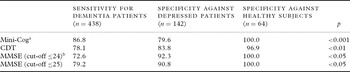
Table 2 shows the sensitivities and specificities for the Mini-Cog, the CDT, and the MMSE at a cut-off score ≤24 and ≤25 against depressed patients and healthy subjects. The Mini-Cog achieved a specificity of 79.6% against depressed elderly and 100.0% against healthy subjects (p < 0.001). Similarly, the specificities against the healthy subjects were significantly higher than the specificities against depressed patients for the CDT (p < 0.01), the MMSE at a cut-off ≤24 (p < 0.05), and the MMSE at a cut-off ≤25 (p < 0.05). However, when comparing the specificity of the Mini-Cog (79.6%) to the specificity of the CDT (83.8%) in the sample of depressed patients, we found no significant differences (p = 0.357), meaning that the Mini-Cog and the CDT demonstrated similar specificities. The specificities of the MMSE at both cut-off scores were significantly higher than that of the Mini-Cog (each p < 0.001) and CDT (each p < 0.05) in the group of patients with depression.
Sensitivities/specificities in percentage for the Mini-Cog, CDT, and MMSE

Note: aMini-Cog algorithm of Scanlan and Borson; CDT = Clock Drawing Test (max. 6 points, normal range 1–2 points); bMMSE = Mini-Mental State Examination (max. 30 points, conventional cut-off score ≤24); healthy subjects = 64; the p-value indicates significant differences between the specificities against depressed patients and healthy subjects.
Sensitivities and specificities of the screening tests – depressed patients ≤60 years and >60 years
Additionally to the previous reports, we conducted also analyses dividing the depressed patients in a “young” (≤60 years) and an “old” (>60 years) cohort, the latter being at higher risk for dementia. Eighty-three of the depressed patients (58.5%) were older than 60 years. The Mini-Cog achieved a specificity of 71.1% against the “old” depressed elderly (i.e. >60 years) and a specificity of 91.5% against the “young” depressed patients (i.e. ≤60 years) (p < 0.01). When comparing the specificity of the Mini-Cog (71.1%) to the specificity of the CDT (74.7%) in the sample of the “old” depressed patients, we found no significant differences (p = 0.600), meaning that the Mini-Cog and the CDT demonstrated similar specificities also in older patients. The specificities of the MMSE in the group of patients >60 years at both cut-off scores (91.2% at ≤24 and 90.4% at ≤25) were significantly higher than that of the Mini-Cog and CDT (each p < 0.05).
Effect of depression severity on MMSE and CDT performance
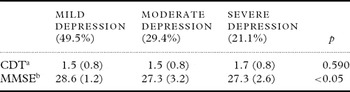
One-way analyses of variance were calculated to determine group differences for the mean CDT and MMSE scores between the three depression severity categories. We found significant differences between the three severity classes for the MMSE (p < 0.05), however, no group differences for the CDT (p = 0.590). Table 3 shows the mean CDT and MMSE scores for the three groups.
Mean CDT and MMSE scores (standard deviation in parentheses) for the three depression severity groups

Note: aCDT = Clock Drawing Test (max. 6 points, normal range 1–2 points);bMMSE = Mini-Mental State Examination (max. 30 points); the p-value indicates significances between the three groups.
Effect of depression severity on the specificities of all three screening tests
Figure 1 shows the specificities of the different screening methods for the respective depression severity groups. Significances are stated with asterisks. The depression severity had no significant effect on the specificities of the Mini-Cog (p = 0.752) and the CDT (p = 0.411). However, the depression severity had a significant effect on the specificity of the MMSE at both cut-off scores (each p < 0.05). Patients suffering from mild depressive symptoms were more often correctly classified as non-impaired compared to patients with a moderate and severe depression.
Relative specificities of the different screening methods for separating dementia from the respective depression severity groups, significant differences in specificity *p < 0.05, **p < 0.01.

Discussion
In our previous work, we emphasized the superior sensitivity of the Mini-Cog for the detection of dementia compared to that of the CDT and the MMSE (Milian et al., Reference Milian, Leiherr, Straten, Müller, Leyhe and Eschweiler2012). We found similarly high specificities (i.e. 96.9% up to 100.0%) for all three screening instruments against healthy controls (N = 64), whereat we argued that a higher cohort size of normal subjects would probably lead to a slightly lower specificity as reported in previous studies (Borson et al., Reference Borson, Scanlan, Chen and Ganguli2003). Since a screening tool has not only to be sensitive but also specific, in the present work we aimed to compare the specificity of the Mini-Cog to that of the CDT and MMSE against depressed elderly. In order to achieve this, we retrospectively analyzed the data of 142 patients with depression, 438 patients with dementia, and 64 healthy controls (N = 644). The differentiation between depression and dementia poses a challenge in daily clinical practice, since a high amount of patients with underlying mood disorder contact general practitioners and memory clinics with the presumptive diagnosis of “Alzheimer's disease.” Neurocognitive deficits, especially reduced attentional function, processing speed, and episodic memory impairment are common in dementia but can also occur in depressed patients (Blazer, Reference Blazer2002; Schatzberg, Reference Schatzberg2002; Shenal et al., Reference Shenal, Harrison and Demaree2003; Harvey et al., Reference Harvey2004; Kampf-Sherf et al., Reference Kampf-Sherf2004; Naismith et al., Reference Naismith, Longley, Scott and Hickie2007).
Depression causes cognitive impairment in all three screening tools
After statistical analyses, we found that all three screening tools, i.e. Mini-Cog, MMSE, and CDT, demonstrated lower specificities against depressed elderly than against healthy controls. The Mini-Cog achieved a specificity of 79.6% against depressed elderly, the CDT a specificity of 83.8%, and the MMSE 92.3% at a cut-off ≤24 and 90.8% at a cut-off ≤25. When taking only the “older” depressed patients into account, the Mini-Cog achieved a specificity of 71.1% against depressed elderly, the CDT a specificity of 74.7%, and the MMSE 91.2% at a cut-off ≤24 and 90.4% at a cut-off ≤25.
These findings are insofar not surprising since the mean CDT score in the group of depressed patients was significantly lower than in the healthy control persons and also the MMSE score was lower in the depressed patients when compared to healthy controls, however, the difference only marginally failed the significance level. Kirby et al. (Reference Kirby, Denihan, Bruce, Coakley and Lawlor2001) reported contradictory results to ours, since they did not find differences in the specificities against depressed patients and healthy controls for both the CDT and MMSE. A possible explanation could be the fact that they had a considerable smaller sample of dementia patients (N = 41) and depressed patients (N = 84). However, we clearly assume in accordance with previous works that late life depression does alter the performance of the CDT (Lee and Lawlor, Reference Lee and Lawlor1995; Gruber et al., Reference Gruber, Varner, Chen and Lesser1997; Woo et al., Reference Woo, Rice, Legendre, Salmon, Jeste and Sewell2004; Colombo et al., Reference Colombo, Vaccaro, Vitali, Malnati and Guaita2009) and MMSE due to the frequently observed but reversible cognitive impairment in depression.
The dilemma of the MMSE
However, comparing the specificity of the MMSE against depressed elderly with that of the Mini-Cog and CDT, we found similar to the results of Kirby et al. (Reference Kirby, Denihan, Bruce, Coakley and Lawlor2001) a significant higher specificity of the MMSE. This might be due to the fact that the MMSE is less sensitive for the detection of cognitive impairment when compared to the Mini-Cog and the CDT. The drawing of a clock requires the access to semantic memory about the clock (Tuokko et al., Reference Tuokko, Hadjistavropoulus, Miller and Beattie1992; Rouleau et al., Reference Rouleau, Salmon and Butters1996; Cacho et al., Reference Cacho2005; Lessig et al., Reference Lessig, Scanlan, Nazemi and Borson2008; Leyhe et al., Reference Leyhe, Saur, Eschweiler and Milian2009) and executive functions (Libon et al., Reference Libon, Swenson, Barnoski and Sands1993; Royall et al., Reference Royall, Cordes and Polk1998; Woo et al., Reference Woo, Rice, Legendre, Salmon, Jeste and Sewell2004). In contrast, the MMSE is less sensitive to the frontal system functioning (van Reekum et al., Reference van Reekum, Simard, Clarke, Conn, Cohen and Wong2000) that is particularly impaired in depression, but rather covers orientation, short-term memory, working memory, and visuoconstructional skills. This leads to the assumption that the MMSE is less impaired in mild dementia than the CDT.
Mini-Cog, MMSE, or CDT for dementia screening?
It is important to note that we found no differences between the specificity of the Mini-Cog and the CDT in the group of depressed patients, but higher sensitivities for the Mini-Cog for the detection of dementia. Therefore, if one had to make a choice between the CDT and Mini-Cog, preference should clearly be given to the Mini-Cog. Although the MMSE demonstrated higher specificity against depressed patients compared to the Mini-Cog, the sensitivity or detection performance of the MMSE (i.e. 72.6% at a cut-off ≤24 and 79.2% at ≤25, respectively) is inferior compared with that of the Mini-Cog (86.8%) and numerous dementia patients would escape dementia detection.
Depression severity does not alter specificity of the Mini-Cog and CDT
A further question of interest was to investigate whether depression severity has an effect on the specificity of the screening tools. To determine depression severity, we used the standard cut-off scores from the manuals for the BDI (Beck et al., Reference Beck, Ward, Mendelson, Mock and Erbaugh1961) and short (15-item) form of the GDS (Sheikh and Yesavage, Reference Sheikh, Yesavage and Brink1986). In contrast to our expectances, the depression severity had no significant effect on the specificities of the Mini-Cog and the CDT, meaning that patients with a mild depression scored similar to the patients with a moderate and severe depression. A one-way ANOVA was additionally calculated to determine group differences for the mean CDT scores between the three depression severity categories with no significant differences. Our results compare favorably with numerous other studies that did not find any relation between depression severity and cognitive function as well (Fossati et al., Reference Fossati, Amar, Raoux, Ergis and Allilaire1999; Kiosses et al., Reference Kiosses, Klimstra, Murphy and Alexopoulos2001; Landrø et al., Reference Landrø, Stiles and Sletvold2001; Rohling et al., Reference Rohling, Green, Allen and Iverson2002; Murphy et al., Reference Murphy, Michael, Robbins and Sahakian2003; Neu et al., Reference Neu, Bajbouj, Schilling, Godemann, Berman and Schlattmann2005). We observed only for the MMSE significant higher specificities with decrease of depressive symptoms. One study also reported correlations between depression severity and the global cognitive performance assessed with the MMSE (Taylor et al., Reference Taylor, Wagner and Steffens2002), meaning that the MMSE is more susceptible for depression severity than the CDT and Mini-Cog.
Limitations of the present study include the retrospective data acquisition, i.e. the CDT was not performed between naming and recalling the three items, however, all data were collected in the same assessment. As expected, in these age groups many subjects including the cognitive healthy subjects took cardiovascular drugs. About 60% of the healthy subjects were taken antihypertensives and 35% were on anticoagulant medication underlining the local prescription habits to elderlies. Patients suffering from depression received significantly less antihypertensive drugs and anticoagulant medication than the patients with dementia, but as frequently as the healthy subjects, supporting the association of cardiovascular disorders and dementia. However, there is no hint in our data for an impact of these drugs on the cognitive performance. Further critical points are the different sample sizes with the relative small control group compared to the depression and dementia groups, however, we assume that the sample size of 142 depressed patients allows for valid conclusions. We included deliberately also younger patients (i.e. <60 years) in our analyses in order to obtain a larger sample size of depressed patients. This is a limitation of the study, however, the fact to consider only depressed patients older than 60 years does not alter our conclusions: although the specificity of the Mini-Cog declines from 79.6% to 71.1%, it performed not worse than the CDT.
Conclusions
The present study was designed to analyze the specificities of the Mini-Cog, CDT, and MMSE against depressive elderly subjects. Due to the frequently observed cognitive decline in depression, we obtained for all three screening tools lower specificities against depressed elderly than against healthy controls. Within mild depressed patients, the MMSE demonstrated significantly higher specificity than the Mini-Cog and the CDT, but in general also the lowest sensitivity for the detection of dementia. Moreover, the MMSE was the only test susceptible for depression severity. Overall, although the MMSE showed higher specificities in mild depression, the weighting between the detection rate and false positive rate in all tests reinforce again the Mini-Cog as a short, valid, and sensitive screening tool.
Conflict of interest
None.
Description of authors’ roles
All authors contributed significantly to the paper. Monika Milian designed the study, undertook the statistical analysis, and wrote the first draft of the paper. Anna-Maria Leiherr collected the data and was responsible for data entry. Monika Milian and Stephan Müller performed the neuropsychological tests in the memory clinic; Gerhard W. Eschweiler, Guido Straten, and Thomas Leyhe were part of the medical expert group for dementia clarification in the memory clinic. All authors gave helpful advices for analysis and interpretation of the data, revised critically the paper, and approved the final paper version.