Introduction
Gymnocarena Hering (Diptera: Tephritidae) as currently recognised includes 16 species in the Nearctic Region, Mexico, and Central America with the centre of diversity in the southern Sierra Madre Occidental and Transverse Volcanic Belt of Mexico. Norrbom (Reference Norrbom1992) revised Gymnocarena and recognised 13 species from the western United States and Mississippi Valley south to southwestern Mexico. Larval host plants and details on biology were reported for only a few species. Sutton et al. (Reference Sutton, Steck and Defoe2002) extended the known range of Gymnocarena in North America eastward to the southern Appalachian Mountains. Norrbom (Reference Norrbom2006) described three additional species from Mexico and Costa Rica, thereby extending the known range for this genus to southern Central America and provided additional larval host information. The concept of the genus Gymnocarena, and its monophyly and assignment in the subfamily Tephritinae, were discussed by Norrbom (Reference Norrbom1992, Reference Norrbom2006).
In this paper we describe three new species of Gymnocarena, including the first species of this genus from the highlands of Guatemala and two species from eastern North America, bringing the total number of species to 19. One of the new species was confused with Gymnocarena mississippiensis Norrbom, therefore we redescribe the latter. Males that may represent additional as yet unnamed species of Gymnocarena are known, including one from Mexico (discussed by Norrbom Reference Norrbom1992) and one recently discovered in the highlands of Guatemala. These have not been described formally because they are not associated with females, which have diagnostic genitalic differences, unlike the males. A revised key to the species of Gymnocarena and additional information on larval hosts and biology also are provided here.
It is our pleasure to dedicate this paper to the coordinators of the Manual of Nearctic Diptera, a seminal contribution to dipterology that has greatly advanced the science well beyond the boundaries of the Nearctic Region. Indeed, the newly published Manual of Central American Diptera is very much an outgrowth of its Nearctic predecessor. Fittingly, the genus Gymnocarena is endemic to the Nearctic Region and Central America, and it already includes a species honouring Manual coordinator J.F. McAlpine.
Materials and methods
Acronyms for museums in which specimens are deposited are as follows:
FSCA – Florida State Collection of Arthropods, Gainesville, Florida, United States of America.
GSNP – Natural History Museum, Great Smoky Mountains National Park (GSMNP), Tennessee, United States of America.
USNM – National Museum of Natural History, Smithsonian Institution, Washington, District of Columbia, United States of America.
UVGC – Colección de Artrópodos, Universidad del Valle de Guatemala, Guatemala.
Measurements
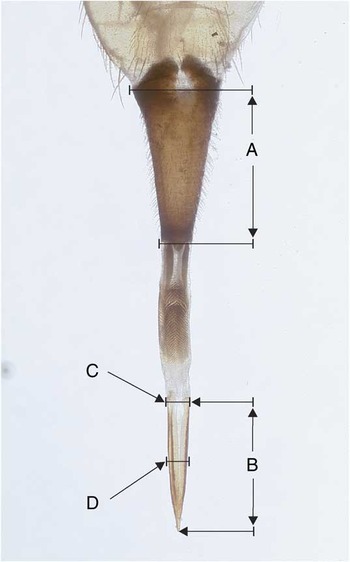
The following measurements (all in mm) were taken: gena height/eye height ratio (each oriented to show maximum height); dorsal mesonotum length; wing length, wing width at widest point; oviscape length (A) (measured ventrally along midline from line between basal corners to tip), and aculeus length (B) and width basally (C) and at mid-length (D) (see Fig. 1). Frequency plotting of these variables suggests that the underlying distributions are generally nonsymmetric and asymmetrically tailed. Measurements for data with n > 2 are given as the total range (minimum–maximum), quartiles Q1, Q2, Q3 (calculated by the ungrouped data method; the central tendency is the median [Q2]), and the interquartile range (IQR) as the measure of dispersion for the quartiles (i.e., minimum, maximum [Q1, Q2, Q3, IQR]).
Oviscape and aculeus of Gymnocarena norrbomi sp. nov. (paratype female, Tennessee) showing measurements (in mm.) of oviscape length (A), aculeus length (B), aculeus basal width (C), and aculeus width at mid-length (D).

Wing description
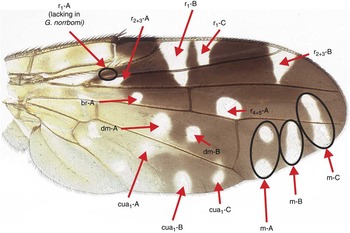
The diagnostic hyaline wing markings for Gymnocarena are labelled in Figure 2. The term “pale” is used to describe areas of the wing that may be hyaline, or have a pattern that is light brown, light grey, or yellowish and often difficult to distinguish from hyaline (Norrbom Reference Norrbom1992). The hyaline marks within pale areas can generally be differentiated by slight differences in colour pattern. In teneral specimens, development of the full colour progresses from veins and adjacent areas into the cell interior, often resulting in light longitudinal stripes or spots that should not be confused with true hyaline or pale markings.
Wing of Gymnocarena norrbomi sp. nov. (paratype male, Tennessee) showing diagnostic hyaline marks and spots.


Gymnocarena defoei Sutton and Steck, sp. nov.
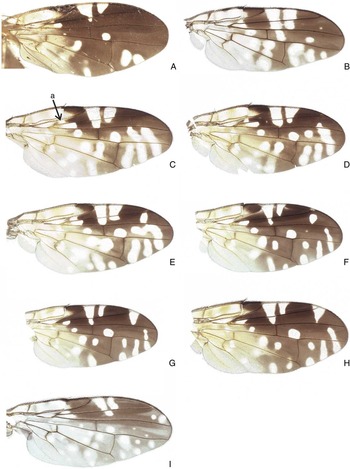
Wings of Gymnocarena. (A), G. defoei, sp. nov. (paratype female, Tennessee); (B), G. monzoni sp. nov. (paratype female, Guatemala); (C–E), G. mississippiensis (males, Kentucky); (F), G. norrbomi sp. nov. (paratype female, Kentucky); (G), G. norrbomi (paratype male, Kentucky); (H), G. norrbomi sp. nov. (paratype female, Tennessee); (I), G. unplaced (male, Guatemala).

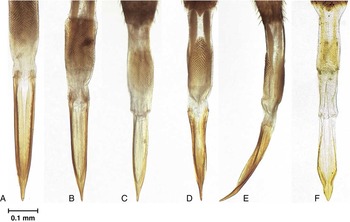
Female terminalia of Gymnocarena (ventral view, except where noted). (A), G. mississippiensis (paratype, Kentucky); (B), G. norrbomi sp. nov. (paratype, Tennessee); (C), G. norrbomi sp. nov. (paratype, Kentucky); (D), G. defoei sp. nov. (paratype, Tennessee); (E), G. defoei, same specimen, lateral view; (F), G. monzoni sp. nov. (paratype, Guatemala).

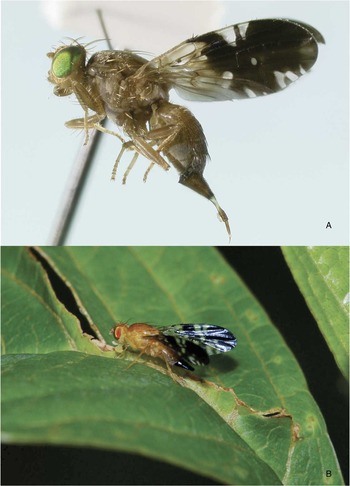
(A), Gymnocarena defoei sp. nov. (holotype female, Tennessee). Habitus lateral; (B), G. monzoni sp. nov., female on host (Guatemala). Photograph by J. Monzón S.

Material examined
Holotype ♀ (FSCA) U.S.A.: Tennessee: Blount County, GSMNP, western Cades Cove, Wildcat Branch, N35.5806°/W83.8371°, 1800′, 6–14 VIII 2002, 6 m Malaise trap, coll. G.J. Steck and B.D. Sutton. Paratype (FSCA) U.S.A.: Tennessee: Blount Co., GSMNP, Cades Cove, Tater Branch, N35.60698°/W83.83017°, 1780′, 19.VIII.2004, coll. B.D. Sutton, on Verbesina virginica L. (Asteraceae) 1 ♀.
Etymology
This species is named in honour of the late Don Defoe, in recognition of his contributions to the knowledge of the biodiversity of GSMNP.
Diagnosis
In wing pattern, G. defoei differs from all other species except G. mississippiensis and Gymnocarena norrbomi by having a generally brown wing pattern with two hyaline wedge-shaped marks in cell r1 adjacent to the pterostigma with the long axis of the more proximal mark more or less in line with crossvein r-m. G. defoei can be distinguished from G. mississippiensis and G. norrbomi by the lack of hyaline markings in the distal 1/3 of cells r2 + 3 and r4 + 5 and the more curved aculeus (in lateral view) in the female.
Description
Colouration: Body yellowish-brown–orange except oviscape dark orange. Setae and setulae yellowish except brownish on abdominal tergites 3–6 and oviscape.
Head: facial carina weak; genal height/eye height ratio 0.19–0.22 (n = 2).
Mesonotum: length 2.50; dorsocentral setae closer to transverse suture than to postsutural supra-alar setae.
Legs: femora slender; not robust like those of Gymnocarena diffusa or Gymnocarena tricolor.
Wing: (Figs. 3A, 5A) length 5.30, width 2.20, wing mostly dark, proximal 1/3 pale yellowish; distal 2/3 mostly dark brown with hyaline markings, especially marginally. Cell c pale. Pterostigma dark brown posteriorly with proximal pale or yellowish wedge extending from cell c. Cell r1: extreme base subhyaline, with small yellowish-brown spot anterior to base of cell r2 + 3, followed by small hyaline to yellowish spot posterior to apex of vein Sc, remainder of cell dark brown with two marginal hyaline wedges: proximal (r1-A of Fig. 2) present as hyaline wedge extending into cell r2 + 3, at most 1/2 distance to vein R4 + 5; wedge apex aligned with or slightly distal to crossvein r-m; distal hyaline wedge (r1-B) more or less aligned between crossveins r-m and dm-cu; extending almost to vein R2 + 3 (holotype) or slightly into cell r2 + 3 (paratype). Cell r2 + 3: extreme base yellowish-brown followed by hyaline spot (r2 + 3-A) posterior to base of pterostigma, remainder of cell dark brown except apices of hyaline wedges of cell r1 extending as spots into cell r2 + 3. Cell br: proximal 1/2 pale transitioning to dark brown distally; one wing of holotype with one small hyaline spot bordering vein M approximately 1/3 of distance between crossveins bm-cu and r-m. Cell r4 + 5: generally dark brown with single hyaline spot (r4 + 5-A) bordering vein M or narrowly separated from it just proximal to crossvein dm-cu, 1/2 to 1/3 height of cell. Cell dm: proximal 1/4 pale, single hyaline spot (dm-A) near middle of cell narrowly separated from vein CuA1, remainder of cell dark brown. Cell m: dark brown with two to three marginal or submarginal hyaline spots; proximal mark (m-A) present as irregular hyaline spot or band, not reaching vein M; medial spot (m-B) not reaching vein M, sometimes joining proximal spot; distal hyaline spot or band (m-C) variably present, not reaching vein M. Cell cua1: proximal 1/2 or more pale, perhaps mottled, proximal third with irregular hyaline spot or pair of spots (cua1-A) in yellow area; dark brown distally with distinct hyaline spot (cua1-B) touching or almost touching wing margin and anteriorly with indistinct spot aligned with it.
Female terminalia: (Fig. 4D, 4E) oviscape (n = 2) length = 0.98, width at base = 0.80, width at tip = 0.30; aculeus (paratype): length 0.86, basal width 0.22, width at mid-length 0.14, slender, broad basally, shallowly concave at 1/3 of the aculeus length, distinctly ventrally curved in lateral view, tip nonserrate, with slight keel-like ridge dorsally, 8th sternites with apices not exposed in dorsal view.
Male: unknown.
Host and distribution
Host unknown. A single adult female was collected on V. virginica (white crownbeard, or common frostweed). Tephritid larvae were collected multiple times from flower heads of V. virginica (Fig. 6C), but rearing of adults was unsuccessful. We do not know if these larvae are of G. defoei or G. norrbomi, which have also been collected in the vicinity.
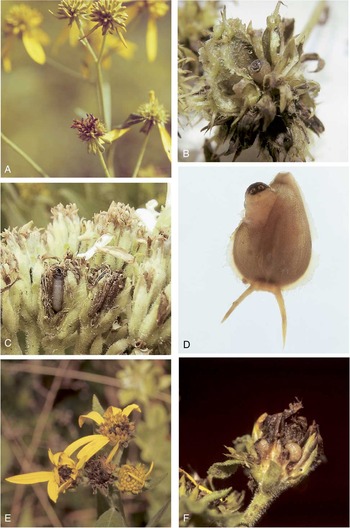
Infested host plants. (A), Characteristic infestation damage from Gymnocarena norrbomi sp. nov. larva in Verbesina alternifolia seed head (lower centre) (Tenneessee); (B), G. norrbomi sp. nov. larvae in flower head of V. alternifolia (Tennessee); (C), Gymnocarena larva in flower head of Verbesina virginica (Tennessee); (D), G. norrbomi sp. nov. larva feeding in seed of V. alternifolia (Tennessee); (E), Characteristic larval damage from Gymnocarena larva in Verbesina helianthoides seed head (Kentucky); (F), Gymnocarena larva in flower head of V. helianthoides (Kentucky). Photographs by G.J. Steck.

Known only from GSMNP (United States of America: Tennessee: Blount County, Cades Cove).
Remarks
The distinctive aculeus with nonparallel concave sides, curved in lateral view, with slender tip having a dorsal keel-like ridge is similar to that of G. macalpinei; the wing patterns are also generally similar.
Gymnocarena mississippiensis Norrbom
Gymnocarena mississippiensis Norrbom, Reference Norrbom1992: 550, (in part: holotype and Kentucky paratype, Figs. 5F, 7C)
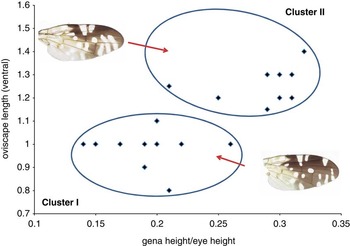
Scatter plot of oviscape length versus gena height/eye height for Gymnocarena females collected or reared from Verbesina helianthoides (Kentucky).

Material examined
Holotype and paratypes examined by Norrbom (see Norrbom Reference Norrbom1992). U.S.A.: Kentucky: Lyon or Trigg County: Land Between the Lakes National Recreation Area, N Golden Pond, vicinity N36.88°/W88.07°, 450–550′, 11–13.vi.2004, Coll. G.J. Steck and B.D. Sutton, larvae ex flower heads Verbesina helianthoides Michx., emerged vi-vii.2005, 7 ♂♂ 4 ♀♀ (FSCA), 1 ♂ (USNM); Lyon County: Land Between the Lakes National Recreation Area, along Silver Trail, vicinity N36.901°/W88.082°, 450–550′, 12.vi.2004, Coll. G.J. Steck and B.D. Sutton, larvae ex flower heads V. helianthoides, emerged v.2005, 1 ♀ (FSCA); 13.vi.2004, Coll. G.J. Steck and B.D. Sutton, swept ex V. helianthoides, 2 ♂♂ (FSCA) 1 ♀ (USNM); Trigg County: Land Between the Lakes National Recreation Area, Forest Road 144, N36.84836°/W88.06740°, 12–13.vi.2004, Coll. G.J. Steck and B.D. Sutton, swept ex V. helianthoides, 3 ♀♀ (FSCA).
Diagnosis
In wing pattern, G. mississippiensis differs from all other species except G. defoei and G. norrbomi by having a generally brown wing pattern with two hyaline wedge-shaped marks in cell r1 adjacent to the pterostigma with the long axis of the more proximal mark more or less in line with crossvein r-m. Gymnocarena mississippiensis can be distinguished from G. defoei in lacking hyaline marks in the apical half of cell r4 + 5 and usually also r2 + 3. It differs from G. norrbomi by the presence of a small hyaline spot in cell r1 posterior to the apical part of cell c. Most specimens of G. mississippiensis also differ from G. norrbomi in lacking a marginal hyaline mark in cell r2 + 3 and the spots in cell m are broader and more diffuse. Females can be reliably distinguished from G. norrbomi by the longer oviscape (1.20–1.40 versus 0.80–1.10), and the gena height/eye height ratio is generally greater in G. mississippiensis (0.21–0.32 versus 0.15–0.26). Occasional males cannot be unambiguously assigned to either G. norrbomi or G. mississippiensis except by the presence or absence of the hyaline spot (r1-A) in cell r1 posterior to the apical part of cell c.
Redescription
Colouration: body yellow to yellowish-brown–orange except oviscape dark orange to red-brown. Setae and setulae yellowish, sometimes brownish on abdominal tergites 3–6 and oviscape.
Head: facial carina weak, narrow dorsally; genal height/eye height ratio: female 0.21–0.32 (0.26, 0.30, 0.31, 0.48) n = 9, male 0.24–0.33 (0.26, 0.29, 0.30, 0.04) n = 12.
Mesonotum: length: female 1.60–2.30 (1.83, 1.95, 2.10, 0.28) n = 9, male 1.60–2.30 (1.80, 1.90, 2.10, 0.30) n = 12; dorsocentral setae anterior to postsutural supra-alar setae up to about halfway between transverse suture and line between supra-alars.
Legs: femora slender; not robust like those of G. diffusa or G. tricolor.
Wing: (Fig. 3C–3E; Norrbom Reference Norrbom1992, fig. 5F) length: female 4.30–5.70 (4.63, 4.80, 5.00, 0.38) n = 9, male 4.10–5.50 (4.50, 4.90, 5.20, 0.70) n = 12; wing mostly dark, proximal 1/3 pale yellowish; distal 2/3 mostly dark brown with hyaline markings. Cell c: pale. Pterostigma: dark brown with proximal hyaline wedge extension from cell c. Cell r1: proximal 1/4 pale transitioning to dark brown distally, with small yellowish-brown spot anterior to base of cell r2 + 3, followed distally by small hyaline to yellowish spot (r1-A of Fig. 2) posterior to apical part of cell c; two distinct marginal hyaline wedges, proximal hyaline wedge (r1-B) extending into cell r2 + 3, sometimes reaching crossvein r-m, wedge apex directed towards r-m; smaller distal hyaline wedge (r1-C) extending at least to vein R2 + 3, usually continuing into cell r2 + 3. Cell r2 + 3: mostly dark brown with hyaline spot (r2 + 3-A) near proximal end contiguous with spot r1-A; extension of spot r1-B in line with crossvein r-m and usually with subapical hyaline spot touching vein R4 + 5 and frequently connected to distal mark in cell m (m-C). Cell br: proximal 1/2–2/3 pale, or somewhat mottled, transitioning to dark brown distally with single hyaline spot (br-A) bordering vein M approximately 1/2 distance between the crossveins bm-cu and r-m. Cell r4 + 5: mostly dark brown with distinct hyaline spot (r4 + 5-A) at or just proximal to dm-cu; one to two hyaline spots distally often as extensions of hyaline marks in cell m. Cell dm: proximal 1/3 pale or mottled, transitioning to dark brown distally with two distinct hyaline spots; proximal spot (dm-A) near middle of cell overlapping pale and dark areas, sometimes contiguous with spot (cua1-A) in cell cua1; distal hyaline spot (dm-B) aligned with crossvein r-m. Cell m: dark brown with three elongate hyaline bands or sets of spots extending from posterior wing margin towards or beyond vein M into cells r4 + 5 and r2 + 3; proximal hyaline spot (m-A) usually elongate, sometimes coalesced with medial spot (m-B); medial hyaline spot (m-B) sometimes continuous into cell r4 + 5, or coalesced with distal hyaline spot (m-C); distal hyaline spot (m-C) continuous as band into at least cell r4 + 5. Cell cua1: mottled, with proximal 1/2 pale transitioning to dark brown, hyaline spot (cua1-A) aligned with medial spot in cell dm (dm-A), and two to three distal marginal or submarginal hyaline spots including elongate, sometimes indistinct, irregular hyaline spot (cua1-B) and smaller variably present more distal hyaline spot (cua1-C).
Female terminalia: (Fig. 4A; Norrbom Reference Norrbom1992, fig. 4C), oviscape length (ventral) (n = 9) 1.20–1.40 (1.20, 1.23, 1.30, 0.10); aculeus (n = 4) length 1.08–1.25 (1.08, 1.08, 1.25, 0.17), width at mid-length 0.17–0.19 (0.17, 0.18, 0.19, 0.02), basal width 0.18–0.23 (0.18, 0.19, 0.23, 0.05) (see also Norrbom (Reference Norrbom1992)).
Male terminalia: distiphallus with spines on apical lobe of the glans consistent with other Gymnocarena species.
Biology
Univoltine. In Kentucky, adults were collected on and 3rd instar larvae collected from V. helianthoides (Fig. 6E, 6F) during the 3rd week of June; larvae of G. norrbomi and G. mississippiensis were abundant in flower heads of the host, with 1–10 larvae per flower head and nearly 100% infestation. Pupariation occurred shortly after collection of larvae, and adults emerged during the late spring or early summer of the following year.
Host and distribution
Reared from flower heads of V. helianthoides (gravelweed, Ozark wingstem, early wingstem). Verbesina helianthoides is characteristic of dry oak woodlands or woodland-plains mosaics and is unusual among the Verbesina L. of eastern North America in that flowering occurs during early summer rather than late summer and/or fall.
It is not known if other Verbesina species are also larval hosts, perhaps secondary, for G. mississippiensis. Searches in western Kentucky for G. mississippiensis and G. norrbomi in Verbesina alternifolia (L.) Britton ex Kearney and V. virginica during August–September failed to locate larvae or adults.
Known from United States of America: Mississippi, Kentucky.
Remarks
The original concept of G. mississippiensis (Norrbom Reference Norrbom1992) was based upon a small series of adults from the Oxford, Mississippi, area (holotype and two paratypes) and a single individual (paratype) from western Kentucky. Norrbom noted parenthetically that the two Mississippi paratypes had a slightly different wing pattern. An additional specimen from Oklahoma was reported by Norrbom (Reference Norrbom2006). In 2002, Steck and Sutton collected a series of Gymnocarena in the southern Appalachian Mountains of eastern Tennessee, GSMNP. Sutton et al. (Reference Sutton, Steck and Defoe2002) reported that series as G. mississippiensis, which was also referred to by Norrbom (Reference Norrbom2006). However, discrepancies in wing pattern and aculeus length between these specimens and the holotype raised the question whether all were conspecific. More recently, additional specimens were obtained (a total of 26 adults including those reared from larvae) from GSMNP, with all but one having wing patterns consistent with the two Mississippi paratypes.
To clarify the taxonomic identity of these GSMNP specimens, Steck and Sutton re-collected G. mississippiensis at the paratype locality in western Kentucky during 2004. Adults with wing patterns and aculeus morphology consistent with the holotype and Kentucky paratype were swept from V. helianthoides and a considerable number of Gymnocarena larvae were collected from flower heads of the same plant. These were all thought to be G. mississippiensis; however, adults (n = 50) eventually reared from these larvae were found to exhibit a mixture of wing patterns including that seen in the Mississippi paratypes as well as that of the holotype and Kentucky paratype.
A scatter plot of oviscape length versus gena height/eye height ratio for adult Kentucky females (n = 22) (Fig. 7) exhibited a clearly bimodal distribution with two disjoint clusters. The clusters segregated on oviscape length, with some overlap in the gena height/eye height ratio but with distinctly separated central tendencies in that variable. Each cluster was associated with a distinct wing pattern.
In cluster I (n = 13 ), the oviscape length was 0.80–1.10 (1.00, 1.00, 1.00, 0) and the gena height/eye height ratio 0.14–0.26 (0.15, 0.19, 0.20, 0.05). The wing pattern associated with cluster I has a well-defined hyaline wedge (r2 + 3-B of Fig. 2) at the apex of, and extending slightly proximally into cell r1; if not a wedge (one specimen) then a hyaline spot just below the apex of cell r1 not more or less continuous with spot m-C and a small mark along the wing margin near the r1 apex. In contrast, specimens in cluster II (n = 9) have an oviscape length of 1.15–1.40 (1.20, 1.23, 1.30, 0.10) and gena height/eye height ratio of 0.21–0.32 (0.26, 0.30, 0.31, 0.05). The wing pattern associated with cluster II lacks a distinct hyaline wedge forming spot r2 + 3-B; if there are hyaline marks in the distal 1/3–1/2 of r2 + 3 then they are generally more or less continuous with spot m-C and there is at most a small mark at the apex of cell r1. In addition, when further studied by Norrbom, all were observed to have a small hyaline spot (r1-A) in cell r1 posterior to the apical part of cell c that is not present in the wing patterns associated with cluster I.
The cluster I wing pattern is consistent with the Mississippi paratypes (1 ♂ [CNC]: U.S.A.: Mississippi: Lafayette Co., v-vi.1960, F.M. Hull; 1 ♀ [USNM] Mississippi: Oxford, vi.1943 [Norrbom Reference Norrbom1992]), the single female from Oklahoma (1 ♀ [FSCA] U.S.A.: Oklahoma: Latimer Co., v.1989, K. Stephan [Norrbom Reference Norrbom2006]), and all specimens from eastern Tennessee (see G. norrbomi sp. nov. below). The cluster II wing pattern is consistent with the holotype female from Mississippi (Holotype ♀ [AMNH], United States of America: Mississippi: Lafayette Co., Oxford, vi.1943 [Norrbom Reference Norrbom1992]) (oviscape length = 1.46 mm, gena height/eye height ratio not given) and the Kentucky paratype (1 ♀ [FSCA], Kentucky: Lyon Co.: Golden Pond. 25.v-25.vi. 1964, M. Tidwell [Norrbom Reference Norrbom1992]) (oviscape length = 1.5 mm, gena height/eye height ratio = 0.21). We thus conclude that the G. mississippiensis type series includes two species: flies with the cluster I wing pattern representing an unnamed species here described as G. norrbomi sp. n., and those with the cluster II pattern are true G. mississippiensis.
Gymnocarena monzoni Sutton, Steck, and Norrbom, sp. nov.
Material examined
Holotype ♀ (FSCA), Guatemala: Dept. Zacapa: Sierra de las Minas, nr. San Lorenzo, old quarry, N15.08121°/W89.68275°, 1794 m, 3–4 X 2008, coll. G.J. Steck, B.D. Sutton, and J. Monzón S., swept ex Viguiera cordata (Hook. and Arn.) D'Arcy (Asteraceae). Paratypes (FSCA, USNM, UVGC): same data as holotype, 9 ♂♂, 3 ♀♀; same site, N15.08109°/W89.68288°, 1794 m, 18.xi.2007, coll. B.D. Sutton, G.J. Steck, A.L. Norrbom, and J. Monzón S., reared ex flower heads of Hymenostephium cordatum ( = V. cordata) (07G36), 3 ♂♂, 3 ♀♀; Dept. Zacapa, Sierra de las Minas, Santa Cruz – San Lorenzo Rd., “cow pasture”, N15.07382°/W89.68455°, 1599 m, 18.xi.2007, Coll. B.D. Sutton, G.J. Steck, A.L. Norrbom, and J. Monzón S., 1 ♂.
Etymology
This species is named in honour of José Monzón Sierra, collector of the first specimen.
Diagnosis
Gymnocarena monzoni can be differentiated from all other species except G. macalpinei Norrbom and G. talamancensis Norrbom by a predominantly brown wing pattern with two hyaline wedges (r1-B and r1-C of Fig. 2) in cell r1 just distal to the pterostigma with the more proximal mark distal to crossvein r-m. Gymnocarena monzoni can be differentiated from G. macalpinei and G. talamancensis by the lack of hyaline wedges in the distal 1/3 of r2 + 3 and the shape of the aculeus, particularly the broad blunt apex in G. monzoni versus the more slender and sharp apex in the other two species.
Description
Colouration: body yellow-brown to orange except for oviscape entirely dark brown to blackish (Fig. 5B), in one specimen the basal 2/3 dark orange. Setae and setulae orange to orange-brown, except brown on abdominal tergites 3–6 and oviscape.
Head: facial carina very weak, small, narrow dorsally; genal height/eye height ratio: females 0.14–0.18 (0.17, 0.17, 0.17, 0) n = 8, males 0.14–0.22 (0.15, 0.17, 0.18, 0.03) n = 18.
Mesonotum: length: females 1.80–1.90 (1.80, 1.80, 1.90, 0.10) n = 8, males 1.60–1.90 (1.70, 1.80, 1.80, 0.10) n = 17; dorsocentral setae anterior to postsutural supra-alar setae, usually about halfway between transverse suture and line between supra-alars, sometimes closer to transverse suture or supra-alars.
Legs: femora slender; not robust like those of G. diffusa or G. tricolor.
Wing: (Fig. 3B) length: females 4.70–5.10 (4.70, 4.80, 5.00, 0.30) n = 8, males 4.20–5.10 (4.60, 4.70, 4.80, 0.20) n = 18; wing mostly dark, proximal 2/5 pale, greyish or subhyaline; distal 3/5 mostly dark brown with hyaline markings. Cell c: hyaline, base pale brownish, at mid-length small brown spot along costa frequently with faint infuscation directed posteriorly. Pterostigma: dark brown with small proximal hyaline wedge extension from cell c. Cell r1: proximal 1/4 pale with small brownish spot anterior to base of r2 + 3 followed distally by small hyaline spot (r1-A of Fig. 2) posterior to apical portion of vein Sc, then by dark brown area with two large hyaline spots apicad of pterostigma continuing into r2 + 3, proximal spot (r1-A) part of continuous hyaline band extending to vein M, with apex aligned with crossvein dm-cu, and distal spot (r1-B) extending to or almost to vein R4 + 5. Cell r2 + 3: extreme base yellowish-brown followed distally by hyaline spot (r2 + 3-A), with remainder of cell dark brown with two large hyaline marks (r2 + 3-A and r2 + 3-B) aligned with spots r1-A and r1-B, respectively. Cell br: proximal 1/2 pale transitioning to dark brown distally, with one large hyaline spot (br-A) approximately 1/2 distance between crossveins bm-cu and r-m. Cell r4 + 5: generally dark brown with two hyaline spots, proximal hyaline spot (r4 + 5-A) part of continuous hyaline band from costa to crossvein dm-cu, and distal spot approximately 1/2 distance from crossvein dm-cu to wing apex and in line with medial spot in cell m (m-B). Cell dm: two large hyaline spots (dm-A and dm-B) covering approximately 4/5 of cell separated by variably narrow brown band. Cell m: dark brown with two to three marginal or submarginal hyaline spots variably coalesced, proximal spot (m-A) irregular or continuous band from vein M to wing margin, medial spot (m-B) irregular band not reaching vein M, frequently coalesced with proximal spot (m-A), and distal spot (m-C) smaller and marginal, not reaching vein M. Cell cua1: with extension of pattern in cell dm with two large hyaline spots (cua1-A and cua1-B) covering approximately 4/5 of cell and separated by variably narrow brown band.
Female terminalia (Fig. 4F): oviscape dark brown to black, length (ventral) (n = 7) 0.90–1.10 (0.98, 1.00, 1.06, 0.08); aculeus length (n = 2) 0.84, 0.79, basal width (n = 3) 0.14, 0.15, 0.17, width at mid-length (n = 3) 0.19; broadest in apical half, tip bluntly rounded, 8th sternites with apices exposed in dorsal view.
Male terminalia: distiphallus with spines on apical lobe of the glans consistent with other Gymnocarena species.
Biology
Virtually all adults collected were found on the host during early October, with a single adult collected in the area by sweeping during mid-November; 3rd instar larvae were found in flower heads of the host during mid-November and emerged in June or July of the following year under laboratory conditions suggesting that this species is univoltine.
Although adults of both sexes were observed repeatedly on the host, details of mating and oviposition remain unknown.
Host and distribution
Reared from flower heads of V. cordata.
Known only from the type locality in Sierra de las Minas, Guatemala, Zacapa.
Gymnocarena norrbomi Steck and Sutton, sp. nov.
Gymnocarena mississippiensis Norrbom, Reference Norrbom1992: 550 (in part: Mississippi paratypes).
Material examined
Holotype ♀ (FSCA) U.S.A.: Tennessee: Blount County, GSMNP, Cades Cove, Abrams Creek springs, N35.5930°/W83.8425°, 1720′, 13 VII 2003, coll. G.J. Steck and B.D. Sutton. Paratypes (FSCA, USNM, GSNP) U.S.A.: Kentucky: Lyon or Trigg County: Land Between the Lakes National Recreation Area, vicinity N36.88°/W88.07°, 450–550′, 11–13.vi.2004, coll. G.J. Steck and B.D. Sutton, larvae ex flower heads V. helianthoides, emerged vi-vii.2005, 7 ♂♂ 15 ♀♀; Lyon County: Land Between the Lakes National Recreation Area, along Silver Trail, vicinity N36.901°/W88.082°, 450–550′, 12.vi.2004, G.J. Steck and B.D. Sutton, larvae ex flower heads V. helianthoides, emerged v.2005, 7 ♂♂; Mississippi: Lafayette County, Oxford, vi.1943, 1 ♀ (USNM) (paratype for G. mississippiensis [Norrbom Reference Norrbom1992]); Oklahoma: Latimer County, v.1989, K. Stephan, 1 ♀ [FSCA] [reported as G. mississippiensis (Norrbom Reference Norrbom2006]); Tennessee: Blount County: GSMNP, Cades Cove, nr. Abrams Creek, vicinity N35.5924°/W83.8435°, ∼1700′, 8–10.vi.2004, coll. G.J. Steck and B.D. Sutton, 6 m Malaise trap, 2 ♂♂ 1 ♀; 1–3.vi.2003, coll. G.J. Steck and B.D. Sutton, 6 m Malaise trap, 1 ♂; 7–9.vii.2003, coll. G.J. Steck and B.D. Sutton, 6 m Malaise trap, 1 ♂; 21–28.v.2003, coll. G.J. Steck and B.D. Sutton, 6 m Malaise trap, 1 unknown sex; vicinity N35.58127°/W83.83682°, 1800′, 1–5.vi.2003, coll. G.J. Steck and B.D. Sutton, 6 m Malaise trap, 1 ♂; nr. Abrams Creek Springs, N35.59266°/W83.84289°, 1720′, 13.vii.2003, coll. G.J. Steck and B.D. Sutton, reared ex V. alternifolia flower heads, emerged by 6.iv.2004, 1 ♂; 6–14.vii.2002, coll. G.J. Steck and B.D. Sutton, 6 m Malaise trap, 2 ♀♀; 13.vii.2003, coll. G.J. Steck and B.D. Sutton, 6 m Malaise trap, 1 ♂; 13.vii.2003, coll. G.J. Steck and B.D. Sutton, larva ex flower head V. alternifolia, emerged 6.iv.2004, 1 ♂; 2.vii.2003, coll. G.J. Steck and B.D. Sutton, 6 m Malaise trap, 1 ♀; 23–30.vii.2003, coll. G.J. Steck, B.D. Sutton, and A. Nichter, 6 m Malaise trap, 1 ♂ 1 ♀; 6–14.vii.2002, coll. G.J. Steck and B.D. Sutton, 6 m Malaise trap, 1 ♀; 13.vii.2004, coll. G.J. Steck and B.D. Sutton, larvae ex flower heads V. alternifolia, emerged by 6.iv.2005, 1 ♀; N35.5930°/W83.8425°, 1720′, 14.vii.2004, coll. G.J. Steck and B.D. Sutton, 1 ♀; N35.59301°/W83.8425°, 1720′, 24.vii.2003, coll. G.J. Steck and B.D. Sutton, 6 m Malaise trap, 1 ♂; 8.vii.2003, coll. G.J. Steck and B.D. Sutton, 6 m Malaise trap, 1 ♂; nr. Wildcat Branch, N35.58063°/W83.83705°, 1800′, 8.vi.2003, coll. G.J. Steck, B.D. Sutton, and A. Nichter, 6 m Malaise trap, 1 ♀; 28.v- 4.vi.2004, coll. G.J. Steck and B.D. Sutton, 6 m Malaise trap, 1 ♂; 12–18.vi.2003, coll. G.J. Steck and B.D. Sutton, 6 m Malaise trap, 1 ♂ 1 ♀; N35.58127°/W83.83682°, 1800′, 1–5.vi.2003, coll. G.J. Steck and B.D. Sutton, 6 m Malaise trap, 1 ♀; path to cemetery, N35.59628°/W83.84158°, 19.viii.2004, coll. B.D. Sutton, swept from flower heads V. alternifolia, 1 ♂; nr. Mill Creek, N35.5829°/W83.8359°, 1800′, 13–17.v.2002, coll. G.J. Steck and B.D. Sutton, 6 m Malaise trap, 1 ♂.
Etymology
This species is named in honour of Allen Norrbom, in recognition of his considerable contributions to the taxonomy and knowledge of Gymnocarena.
Diagnosis
Gymnocarena norrbomi runs to G. mississippiensis in the key of Norrbom (Reference Norrbom1992); it can be distinguished from that species by the lack of a small hyaline spot in cell r1 posterior to the apical part of cell c (Figs. 2, 3F–3H), and by the presence of a marginal or submarginal hyaline mark (r2 + 3-A of Fig. 2) in cell r2 + 3 touching or aligned with the apex of vein R1. This mark is usually wedge-shaped and broadly touching the costa, but occasionally it is reduced to a tiny spot at the apex of vein R1 and a nonmarginal subapical spot; females can be reliably distinguished by the shorter oviscape (0.80–1.10 versus 1.20–1.40) and aculeus (0.74–0.89 versus 1.18–1.25); the gena/eye height ratio is generally smaller in norrbomi (0.10–0.26 versus 0.21–0.33).
Description
Colouration: body yellow to yellowish-brown to orange throughout except oviscape orange to red-brown. Setae and setulae yellowish, brownish on abdominal tergites 3–6 and oviscape.
Head: facial carina weak to very weak, narrow dorsally, mostly less well developed than in G. mississippiensis; genal height/eye height ratio: females (Kentucky) (n = 13) 0.15–0.26 (0.15, 0.19, 0.20, 0.05), (Tennessee) (n = 11) 0.16–0.22(0.17, 0.18, 0.19, 0.02); males (Kentucky) (n = 13) 0.10–0.19 (0.15, 0.18, 0.18, 0.03), (Tennessee) (n = 12) 0.15–0.22 (0.18, 0.19, 0.20, 0.02).
Mesonotum: length: females (Kentucky) 1.40–2.00 (1.60, 1.80, 1.88, 0.28) n = 13, (Tennessee) 1.70–2.70 (2.20, 2.30, 2.53, 0.33) n = 11; males (Kentucky) 1.40–2.10 (1.70, 1.80, 1.90, 0.20) n = 14, (Tennessee) 1.60–2.60 (1.95, 2.20, 2.45, 0.50) n = 14; dorsocentral setae aligned with or very slightly anterior to line between postsutural supra-alar setae.
Legs: femora slender; not robust like those of G. diffusa or G. tricolor.
Wing: (Fig. 3F–3H) wing mostly dark, proximal 1/3–1/2 pale yellowish, distal 2/3–1/2 mostly dark brown with hyaline markings, length: females (Kentucky) 3.70–4.90 (4.15, 4.45, 4.68, 0.53) n = 13, (Tennessee) 4.50–6.00 (5.05, 5.40, 5.90, 0.85) n = 10; males (Kentucky) 3.70–4.90 (4.20, 4.40, 4.50, 0.30) n = 15, (Tennessee) 4.10–6.00 (4.60, 5.20, 5.55, 0.95) n = 14. Cell c: pale, narrow infuscation along vein Sc. Pterostigma: dark brown with proximal hyaline extension from cell c. Cell r1: proximal 1/4 pale transitioning to dark brown distally, with two distinct hyaline wedges and third mark distally, proximal hyaline wedge (r1-A of Fig. 2) extending into cell r2 + 3 and sometimes reaching crossvein r-m, wedge apex directed towards r-m; smaller distal hyaline wedge (r1-B) extending to vein R2 + 3 and sometimes into cell r2 + 3. Cell r2 + 3: mostly dark brown with hyaline spot (r2 + 3-A) near proximal end, hyaline extension of spot r1-B medially and in line with crossvein r-m, and distal marginal hyaline wedge (r2 + 3-B) usually extending into extreme apex of cell r1 and posteriorly to or almost to vein R4 + 5, this mark sometimes divided into submarginal spot and tiny spot on apex of vein R2 + 3. Cell br: proximal 1/2–2/3 pale or somewhat mottled, transitioning to dark brown distally with single hyaline spot (br-A) bordering M approximately 1/2 distance between crossveins bm-cu and r-m. Cell r4 + 5: mostly dark brown with hyaline spot (r4 + 5-A) near crossvein dm-cu and one to two distal hyaline spots aligned with hyaline marks in cell m. Cell dm: proximal 1/3 pale, often mottled, transitioning to dark brown distally with two hyaline spots, proximal spot (dm-A) near middle of cell (sometimes coalesced into proximal pale area of dm and/or extending diffusely into cua1) and distal hyaline spot (dm-B). Cell m: dark brown with three hyaline bands or sets of spots extending from posterior wing margin anteriorly to or beyond vein M into cell r4 + 5, proximal broken hyaline band or pair of spots (m-A) usually not reaching vein M, medial spot (m-B) extending to or almost to vein M, sometimes coalesced with spot m-C or diffusely with proximal spot (m-A), and distal hyaline band (m-C) extending from wing margin to or almost to vein R4 + 5 (rarely broken in cell r4 + 5). Cell cua1: mottled, with proximal 1/2 pale transitioning to dark brown, with hyaline spot (cua1-A) sometimes contiguous with spot dm-A, and one to two distal marginal hyaline spots, more proximal spot (cua1-B) sometimes indistinct, and distal spot (cua1-C) variably present.
Female terminalia: (Fig. 4B, 4C) oviscape: length (ventral) (Kentucky) 0.80–1.10 (1.00, 1.00, 1.00, 0) n = 13, (Tennessee) 1.00–1.20 (1.05, 1.10, 1.10, 0.05) n = 10; aculeus length (Kentucky) 0.74–0.89 (0.76, 0.83, 0.84, 0.08) n = 5, (Tennessee) 0.96–1.01 (0.96, 0.96, 0.96, 0) n = 4, basal width (Kentucky) 0.14–0.18 (0.14, 0.16, 0.17, 0.03) n = 5, (Tennessee) 0.17–0.19 (0.17, 0.17, 0.18, 0.01) n = 5, width at mid-length (Kentucky) 0.13–0.17 (0.13, 0.15, 0.16, 0.03) n = 5, (Tennessee) 0.14–0.17 (0.15, 0.17, 0.17, 0) n = 5, almost parallel sided, very slightly tapered from base, tip nonserrate, similar to that of G. mississippiensis but distinctly shorter and more sharply pointed.
Male terminalia: distiphallus with spines on apical lobe of the glans consistent with other Gymnocarena species (see Norrbom Reference Norrbom1992).
Biology
Univoltine, with adults present from late spring to late summer. Details of mating and oviposition remain unknown. The larvae are seed feeders (Fig. 6D). In GSMNP, low levels of infestation were observed in V. alternifolia. Infested flower heads were characterised by dead brown florets extruded by the feeding larvae (Fig. 6A). An estimated 1% of heads were infested with one to three larvae per head (Fig. 6B). Third instar larvae were present by mid-August in Tennessee. In Kentucky, 3rd instar larvae of G. norrbomi and G. mississippiensis were present in flower heads of V. helianthoides, usually many larvae per head, by the 3rd week of June, with nearly 100% infestation. Larvae leave the flower/seed head to pupariate in the ground then emerge the following spring or early summer.
Hosts and distribution
Reared from flower heads of V. alternifolia (wingstem) in Tennessee and from flower heads of V. helianthoides in Kentucky. Gymnocarena larvae were collected multiple times from flower heads of V. virginica in Tennessee (Fig. 6C), but rearing of adults was unsuccessful. We do not know if these are larvae of G. norrbomi or G. defoei, both of which were collected in the vicinity.
Known from United States of America: Kentucky, Mississippi, Oklahoma, Tennessee.
Remarks
The Mississippi male paratype (CNC) of G. mississippiensis is presumed to be G. norrbomi based on the original description (Norrbom Reference Norrbom1992), but it was not re-examined and therefore was not included in the type series.
In western Kentucky, G. mississippiensis and G. norrbomi were reared from flower heads of V. helianthoides; however, due to pooling of plant samples containing larvae from different nearby habitats for rearing it is not known if they are in direct competition or spatially segregated. Only G. mississippiensis adults were collected by sweeping the larval host in mid-June suggesting that G. norrbomi may have oviposited at an earlier stage of flower development than the former. We speculate that the differences in aculeus morphology may be associated with oviposition into flower heads of different developmental stages with the shorter, finer-tipped aculeus of G. norrbomi associated with oviposition between bud scales prior to opening of the head.
Adults of G. norrbomi collected or reared from V. alternifolia at a somewhat higher elevation in Tennessee (∼500 m versus 200 m), tended to be larger, more brightly coloured, and exhibited less variation in wing pattern than those from western Kentucky. The aculeus lengths in the two populations did not overlap (0.74–0.89 for Kentucky females [Fig. 4C] versus 0.96–1.01 for those from Tennessee [Fig. 4B]).
The distribution of gena height/eye height ratios is more or less symmetric and nontailed in the Tennessee series in comparison to the strongly tailed distributions of the Kentucky specimens, and there is lower overall wing pattern variation in Tennessee specimens. Low level introgression between the two species in Kentucky may be responsible for the small numbers of more or less intermediate individuals, but this remains to be investigated.
Acknowledgements
We thank the U. S. National Park Service, GSMNP, biological staff at Twin Creeks for facilitating our work in the park. Special thanks go to Keith Langdon, Inventory and Monitoring Coordinator for GSMNP, the late Don Defoe, Adriean Mayer, Becky Nichols, and Paul Super. Specimens were collected under NPS permit GRSM-00-103. Janet Rock (GSMNP) kindly identified or confirmed identifications of host plants. We also thank Ms. Jeanie Hilton (formerly of Discover Life in America [DLIA]) and others at DLIA for providing accommodations to support the fieldwork for the “Tephritidae of GSMNP” project as part of the All Taxon Biological Inventory of GSMNP. Funding for research in GSMNP was provided by DLIA. We thank Judy Hallisey (formerly Environmental Stewardship Department Manager, Land Between the Lakes, U.S. Forest Service) for facilitating our collecting at Land Between the Lakes National Recreation Area, Kentucky. We also thank the Comisión Nacional de Áreas Protegidas (CONAP) for permits for Guatemala, the Fundación Defensores de la Naturaleza Guatemala for permission to collect in the Sierra de las Minas Biosphere Reserve, the personnel of the San Lorenzo Marble Quarry, with special thanks to Señor Perdomo, for permitting access to the property, the Laboratorio de Entomología Sistemática and Colección de Artrópodos of the Universidad del Valle de Guatemala (UVG) for support, and José Monzón Sierra (UVG) for his invaluable assistance without which our fieldwork in his country would have been far more difficult. Our very special thanks goes to our good friend and colleague Jack Schuster (UVG) for his dedication and contributions to our understanding of the biodiversity and biogeography of Guatemala and for his enabling of our work in that country. We are indebted to Harold Robinson of the Smithsonian Institution, Washington, District of Columbia, for his identification of Asteraceae from Guatemala. We thank Bill Grogan (FSCA), Wayne Mathis (Smithsonian Institution), Norm Woodley and A. Konstantinov (Systematic Entomology Laboratory, USDA, ARS), and two anonymous reviewers for their comments on the manuscript. This is contribution number 1194 of the Bureau of Entomology, Nematology, and Plant Pathology, Division of Plant Industry, Florida Department of Agriculture and Consumer Services, Gainesville, Florida, United States of America.