


1. Introduction
1.1 The phenomenon
Over the last two decades, agreement has played a central role in shaping a variety of generative frameworks. While canonical agreement patterns usually receive the greatest amount of attention, a full model of agreement must also be able to account for various non-canonical patterns observed in natural language. This paper focuses on one area where subject agreement (informally referred to in much of the subsequent discussion as subject–verb agreement) does not always seem to follow the canonical pattern: the agreement observed when the subject is a quantified noun phrase (QNP) consisting of, at least, a quantifier and a noun. Cross-linguistically, no less than four agreement patterns are attested in such cases:Footnote 2
(i) Agreement with Q (henceforth ‘Q-agr’)
(ii) Agreement with N (henceforth ‘N-agr’)
(iii) ‘Semantic agreement’, i.e., agreement that matches the subject's interpretation rather than its morphosyntactic features
(iv) Default agreement (typically 3rd person singular, masculine or neuter)
From a simple descriptive point of view, it is clear that there is a great amount of variability involved in QNP agreement. First, not all languages allow all four options (in fact, none of the languages discussed in this paper displays all four); and second, even if a language displays two or more of the above options, they are usually not in free variation. This paper focuses mostly on Modern Hebrew, in which both Q-agr and N-agr are widely attested, but neither is always possible, as illustrated below:
(1) 30 axuz-im me-ha-maskoret holxim/?holexet le-sxar dira.
30 percent-m.p of-def-salary.f.s goes.m.p/goes.f.s to-rent
‘30% of the salary goes to (paying the) rent.’ (Q-agr/?N-agr)
(2) maxacit me-ha-tošavim ovdim/*ovedet be-xakla‘ut.
half.f.s of-def-residents.m.p work.m.p/work.f.s in-agriculture
‘Half of the residents work in agriculture.’ (N-agr/*Q-agr)
A less common pattern in Hebrew is ‘semantic agreement’. As opposed to N-agr and Q-agr, in which the agreement trigger can be identified with the lexical or morphological features of the noun or the quantifier, the agreement features in semantic agreement do not seem to match the features of any of the available heads (see e.g. Corbett Reference Corbett2006). This agreement pattern is clearly distinguishable from N-agr and Q-agr only when the semantically-motivated feature values are not marked on the noun or the quantifier; this is illustrated in the plural agreement in (3):
(3) ?xelek me-ha-kita higi‘u be-ixur.
part.m.s of-def-class.f.s arrived.p late
‘Some of the (students in the) class arrived late.’
The phenomenon of semantic agreement raises important questions regarding the autonomy of syntax as it is reflected in agreement operations, not only in the context of QNPs but also in other domains (see e.g. Pollard & Sag Reference Pollard and Sag1994 and Wechsler Reference Wechsler2009). While the focus of this paper is mostly on N-agr and Q-agr, the proposed analysis has the implication that at least in some instances of ‘semantic’ agreement, semantics does not in fact interfere directly with the agreement operation.
Finally, default agreement, which is not attested in Hebrew with QNP subjects, is in fact quite common cross-linguistically with such subjects. Interestingly, none of the languages discussed in this paper allows an alternation between Q-agr and default agreement. Due to the small number of languages surveyed, it is left as an open question whether this is merely a coincidence, or the result of a systematic principle that rules out default agreement with QNPs in languages that allow Q-agr.
In what follows, the following notation is used:
• ‘NP’: the maximal (extended) projection of the noun. The discussion will mostly abstract away from the issue of functional projections in the noun phrase, and hence ‘NP’ here might in fact stand for a DP.
• ‘QP’: the maximal projection of the quantifier.
• The entire quantified nominal will be referred to informally as ‘QNP’. Depending on its exact internal structure, this might actually be NP, DP or QP.
1.2 The theoretical problem
The existence of multiple agreement patterns raises several theoretical problems, both at the level of syntax and at the level of the interfaces between syntax and morphology and semantics. The first of these problems has to do with locality. An assumption shared by both the Minimalist framework and Head-driven Phrase Structure Grammar (HPSG) is that agreement is subject to strict locality constraints. Specifically, in the framework of Chomsky (Reference Chomsky, Martin, Michaels and Uriagereka2000, Reference Chomsky and Kenstowicz2001), it is assumed that a head such as T, the functional head typically associated with subject agreement, can only agree with the closest matching goal. In the HPSG framework, agreement is assumed to always be with the head of the relevant phrase. Focusing on the alternation between N-agr and Q-agr, the existence of these two agreement patterns with QNP subjects seems to pose a problem for locality:
(i) If QP is structurally higher than NP, then N-agr seems to violate these locality conditions.
(ii) If NP is structurally higher than QP, then Q-agr seems to violate these locality conditions.
Put differently, under both Minimalist and HPSG assumptions, agreement is seen as a deterministic process that allows no optionality given the hierarchical structure and presence of features. Therefore, free alternation between two well-formed agreement patterns is not predicted to be possible, unless each agreement pattern follows from a different underlying structure – a possibility to be argued against in Section 3 below.
Our main focus is on QNPs for which the vast majority of previous work has argued that Q occupies a higher position than NP. Specifically, in Hebrew, partitives and construct state QNPs, which are described in Section 2.1 below. Hence, our goal is to account for N-agr in the following schematic structure:Footnote 3
(4)

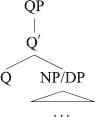
In what follows, we focus mostly on providing an analysis that is compatible with Minimalist assumptions. Given the Minimalist model of agreement and no further assumptions, the prediction, which is clearly false, is that only Q-agr should be possible in configurations like (4) if Q carries ϕ-features.
A second, related, problem has to do with the relation of agreement with case. A well-established generalization is that in nominative-accusative languages, if T agrees with a single XP, it is with a nominative one (see e.g. Bobaljik Reference Bobaljik and Harbour2008). The standard Minimalist model of case and agreement derives this generalization by viewing nominative as a ‘side effect’ of agreement with finite T. In many languages, however, QNPs that trigger N-agr involve an NP (or DP) which seems to be genitive or oblique, where it is the entire QNP which is nominative. N-agr therefore seems to involve agreement with a non-nominative XP. The question, then, is what makes this (apparent) violation of the case-agreement generalization possible in this environment.
The issues raised above revolve around the undergeneration of mainstream agreement models, for which the existence of certain agreement patterns is unexpected. The opposite problem should also be noted: given the fact that multiple agreement patterns are often observed, the simplest theory would be one which predicts free variation between all four patterns. In reality, however, it seems that not all options are available in a given language, and even the agreement options allowed by a language are not always possible for every given QNP in that language. The question is thus what restricts the choice of agreement pattern. I will argue that this has to do not only with syntax but also with semantics and morphology. While the main focus of this paper is on addressing the syntactic undergeneration problem, the proposed analysis also aims to provide an insight into the overgeneration problem.
1.3 Outline of this paper
The structure of this paper is as follows. In Section 2 I summarize the basic data regarding the various agreement patterns in Hebrew, followed by a brief overview of QNP agreement patterns found in other languages. In Section 3 I argue against an analysis based on structural ambiguity. Section 4 discusses previous analyses that can be characterized as percolation-based approaches to N-agr, followed by a brief overview of the distinction between index and concord features. This forms the basis for my analysis of the syntax of QNP agreement and its interfaces with semantics and morphology, which is developed in Section 5. Finally, Section 6 discusses some formal consequences of the proposed analysis to the general architecture of Minimalist feature theory.
2. QNP agreement: Empirical generalizations
Our main focus, in this section and throughout the paper, is on data from Modern Hebrew, a language that displays systematic alternations between N-agr and Q-agr. Section 2.1 presents the basic facts of QNP agreement in Hebrew. Data from other languages is discussed in Section 2.2 to illustrate some important aspects of the cross-linguistic diversity in this domain.
2.1 QNP agreement in Hebrew: An overview
2.1.1 QNP types in Hebrew
In Modern Hebrew, it is possible to distinguish three major syntactic types of QNPs:
• Construct states headed by the quantifier, illustrated in (5a) below. A construct state is usually characterized as a prepositionless genitival construction in which the lexical head, which is often phonologically reduced, is immediately followed by an obligatory genitive NP/DP. (For a more detailed discussion of the properties of the construct state see e.g. Ritter Reference Ritter1991; Siloni Reference Siloni1997, Reference Siloni, Pica and Rooryck2001; Borer Reference Borer, Johnson and Roberts1999).
• Partitives using the preposition me-, as in (5b).
• Simple quantifier–noun constructions, as in (5c).Footnote 4
- (5)
(a) kol/maxacit ha-anašim
all/half def-people
‘all/half the people’
(b) kama/harbe me-ha-anašim
some/many of-def-people
‘some/many of the people’
(c) kama/harbe anašim
some/many people
‘some/many people’
Of these, the Q-agr/N-agr alternation occurs with the first two types: construct states (which often receive a partitive interpretation when headed by a quantifier) and partitives with me-; the third type of QNP never triggers Q-agr.
Before illustrating this, it should be noted that the data regarding QNP agreement in Hebrew shows a very high degree of variability in at least two dimensions: first, QNPs that look quite similar, syntactically and semantically, may sometimes trigger different agreement patterns; and second, different native speakers often have strikingly different judgments, and many speakers often report a difficulty in judging the acceptability of sentences with QNP subjects. At the descriptive level, it should be kept in mind that some of the examples annotated in this paper with the acceptability judgment ‘?’ are judged as acceptable by some (but not all) speakers, while other examples annotated in this way are more or less consistently judged as marginally acceptable. A proper classification of these judgments would be necessary for a full analysis of the factors favoring one agreement pattern over another; in this paper, however, we focus mostly on the theoretical questions raised by the mere existence of both patterns and their proper syntactic representation.
As mentioned above, partitive QNPs often allow both N-agr and Q-agr. The following example illustrates a partitive with the quantifier xelek ‘part, some’:
(6) xelek gadol me-ha-oxlosiya eyna megiva/eyno
part.m.s large.m.s of-def-population.f.s neg.f.s react.f.s/neg.m.s
megiv tov le statinim.
react.m.s well to statins
‘A large part of the population doesn't react well to statins.’ (N-agr/Q-agr)
Similarly, construct state QNPs may trigger either N-agr or Q-agr, as illustrated in (7):
(7) maxacit ha-cava niš‘ar ne‘eman/niš‘ara
half.f.s def-army.m.s remained.m.s loyal.m.s/remained.f.s
ne‘emana la-melex.
loyal.f.s to.def-king
‘Half of the army remained loyal to the king.’ (N-agr/Q-agr)
At this point, the question is to what extent the choice of agreement type is free for partitive and construct state QNPs. Below I discuss two factors that seem to have a systematic effect on the available agreement patterns.
2.1.2 The effect of quantifier morphology
While the examples in (6)–(7) above illustrate what looks like free alternation, in many other cases the N-agr/Q-agr alternation is not free. First, there are construct state and partitive QNPs for which only the N-agr pattern is possible:
(8) harbe me-ha-tošavim ha-mekoriyim azvu/*azav.
many of-def-inhabitant.p def-original.p left.p/left.s
‘Many of the original inhabitants have left.’ (N-agr/*Q-agr)
A natural hypothesis that might arise from example (8) is that the unavailability of Q-agr is due to the quantifier's morphology. Unlike many other Hebrew quantifiers, which have clear gender and number morphology, the quantifier harbe ‘many, much’ does not fit into any known morphological template; and as it cannot take its own adjectival modifiers, it looks like there is no way to determine whether this quantifier has any agreement features of its own, which might justify classifying it as lacking agreement features altogether.Footnote 5 Therefore, it might seem somewhat trivial that N-agr is the only available option with this quantifier.
It should, however, be noted that Q-agr is not always possible even for quantifiers that do have their own (non-default) gender and number features. Consider (9), for instance, in which only N-agr is possible:
(9) marbit ha-našim mevinot/*mevina et ze.
most.f.s def-women.f.p understand.f.p/understand.f.s OM this
‘Most women understand this.’ (N-agr/*Q-agr)
This is despite the fact that the quantifier marbit ‘most, majority’ carries the feminine singular suffix -it. That marbit has gender and number features is also evident from the fact that this quantifier does sometimes trigger Q-agr:Footnote 6
(10) marbit ha-kurs yukdaš/tukdaš
most.f.s def-course.m.s devoted.fut.m.s/devoted.fut.f.s
le-nos‘im mitkadmim.
to-topics advanced
‘Most of the course will be devoted to advanced topics.’ (N-agr/Q-agr)
Contrast (9) with (11), containing the quantifier asirit ‘tenth’, which bears the same feminine singular morphology as marbit; in this case, Q-agr is (at least for some speakers) possible:
(11) asirit me-ha-tošavim tomxim/?tomexet ba-haca‘a.
tenth.f.s of-def-residents.m.p support.m.p/support.f.s in.def-proposal
‘A tenth of the residents support the proposal.’ (N-agr/?Q-agr)
We should therefore reject a simple morphological generalization as the basis of the Hebrew agreement facts. This contrasts with the conclusions of Wechsler & Zlatić (Reference Wechsler and Zlatić2003), who argue that morphological properties of the quantifier are the main factor in determining QNP agreement in Serbo-Croatian.
Nevertheless, it would be wrong to dismiss the role of morphology here altogether. Even though the above discussion shows that bearing morphological gender and number is not a sufficient condition for making Q-agr possible, it does seem to be correct that this is a necessary condition – which might be almost trivially true on the basis of the definition of agreement. In fact, all quantifiers that may give rise to Q-agr are, to a certain extent, noun-like in their morphology. Furthermore, these quantifiers also allow numeral or adjectival modification, as shown in examples (1) and (6), respectively. Therefore, the fact that Q-agr is possible with such quantifiers is not surprising. What is in need of an explanation is the fact that having a noun-like quantifier is not a sufficient condition for allowing Q-agr, and the fact that Q-agr, where possible, does not block the availability of N-agr. Stipulating that Q-agr occurs if and only if the quantifier is used as a noun would simply beg the question of what it is that makes a quantifier behave as a noun, if this is not a fixed lexical property of certain quantifiers.
2.1.3 The effect of noun type
Another factor that seems to show a correlation with the choice of agreement pattern is the choice of noun. Even when the morphology of the quantifier should make Q-agr a possibility, many speakers often tend to have a strong preference for N-agr with plural count nouns. This contrasts with the judgments on collective singular nouns like oxlosiya ‘population’, cibur ‘public’, etc., with which speakers often accept both patterns, sometimes even with a preference for Q-agr. Thus, the judgments in example (12) contrast with those in (13):
(12) xelek me-ha-našim maskimot/??maskim im ze.
part.m.s of-def-women.f.p agree.f.p/agree.m.s with this
‘Part of (the) women agree with this.’ (N-agr/??Q-agr)
(13) xelek me-ha-oxlosiya maskima/maskim im ze.
part.m.s of-def-population.f.s agree.f.s/agree.m.s with this
‘Part of the population agrees with this.’ (N-agr/Q-agr)
Similarly, with construct state QNPs, the acceptability of Q-agr often improves when a plural noun, as in (14), is replaced by a collective singular, as in (15):
(14) rov ha-talmidim lomdim/*lomed la-bxina.
most.m.s def-student.m.p study.m.p/study.m.s to.def-exam
‘Most of the students study for the exam.’ (N-agr/*Q-agr)
(15) rov ha-kita lomedet/?lomed la-bxina.
most.m.s def-class.f.s study.f.s/study.m.s to.def-exam
‘Most of the class studies for the exam.’ (N-agr/?Q-agr)
Judgments in this area are often not clear-cut; nevertheless, it seems that there is a non-accidental effect of noun type. We return to this issue in Section 5.2.
2.1.4 Intermediate conclusions
Overall, the major conclusion so far is that both N-agr and Q-agr in Hebrew are productive patterns that are partially constrained by both morphological and semantic factors. The empirical data presented so far has several important outcomes:
(i) The agreement alternation between N-agr and Q-agr is found with both partitives and construct state QNPs, and hence any analysis of this phenomenon must be flexible enough to be applicable to both QNP types that display alternations. At the same time, the two construction types allowing an alternation seem to share the structural property of having the NP embedded under a projection of the quantifier – a generalization which seems to hold for other languages as well. We return to this issue in Section 3.
(ii) The alternation cannot be reduced to a semantic distinction between partitive and non-partitive QNPs (Selkirk Reference Selkirk, Culicover, Wasow and Akmajian1977). In fact, it could be claimed that the entire N-agr/Q-agr alternation in Hebrew is productive only with QNPs that receive a partitive interpretation. This rules out one possible semantically-motivated line of explanation of the phenomenon.
(iii) While quantifier morphology plays a role in constraining the alternation, there is no ‘if and only if’ relation between morphology and agreement pattern.
Our goal is to show how the syntactic encoding of features and agreement makes possible both agreement patterns, and how this syntactic mechanism interacts with other modules of the grammar to give rise to the observed patterns.
2.2 QNP agreement in other languages
Alterations in QNP agreement are witnessed in many languages and are not unique to Hebrew. Nevertheless, a survey of the agreement patterns in several languages reveals some interesting differences. Summarized below are some of the QNP agreement data that has been reported in the literature. While this sample of languages is far too small to draw any reliable cross-linguistic generalizations, it nevertheless makes some patterns stand out that are probably not accidental, and these will later be used in motivating various aspects of the analysis.
2.2.1 Standard Arabic
Given the well-known similarity between construct states in Hebrew and those in Arabic, it is somewhat surprising that construct state QNPs in these two languages differ in their possible agreement patterns. According to LeTourneau (Reference LeTourneau and Mushira1995), construct state QNPs headed by a quantifier alternate in Standard Arabic between N-agr and default agreement (3rd person singular masculine). This is illustrated in the following examples:Footnote 7
- (16)
(a) yaḥduθu baʕ&dotu;-u ʔal-qalaaqil-i.
occur.3m.s.impf some-nom def-disturbances.f-gen
‘Some disturbances occur.’
(b) kaan-at kull-u muḥaadaθ-at-i-n tabtad-iiʔ-u
was-3f.s all-nom conversation-f-gen-indef begin-3f.s-impf
‘Every conversation used to begin …’
(Standard Arabic; from LeTourneau Reference LeTourneau and Mushira1995: 30)
Unlike Hebrew, in which nouns are not morphologically marked for case, case morphology in Standard Arabic clearly identifies the quantifier as nominative, while the noun is genitive. Taken as is, this would support the view that N-agr is agreement with a non-nominative NP/DP which is embedded under QP; this, of course, poses a challenge to the established view regarding locality of agreement and its relation to case, as discussed in Section 1.2 above.
2.2.2 Russian
A similar pattern is found in Russian. As discussed in Pesetsky (Reference Pesetsky1982), Franks (Reference Franks1994), Bošković (Reference Bošković and Boeckx2006) and Pereltsvaig (Reference Pereltsvaig2006), numerals and quantifiers in Russian that assign genitive to the noun lead to an alternation between two agreement patterns: N-agr and default agreement. This is illustrated in the following example, from Franks (Reference Franks1994):
- (17)
(a) Pjat′ krasivyx devušek prišli.
five beautiful.gen.p girls.gen.p arrived.p
‘Five beautiful girls arrived.’
(b) Prišlo pjat′ krasivyx devušek.
arrived.n.s five beautiful.gen.p girls.gen.p
‘Five beautiful girls arrived.’
(Russian; from Franks Reference Franks1994: 613)
The option of Q-agr in Russian is not discussed in the works cited above. It should be noted, however, that Q-agr is in fact possible in Russian with quantifiers that are more ‘nominal’, giving rise to patterns similar to those discussed above for Hebrew; see e.g. Pereltsvaig (Reference Pereltsvaig2007).
2.2.3 Serbo-Croatian
Other Slavic languages display somewhat different patterns of agreement. In Serbo-Croatian, as discussed in Franks (Reference Franks1994) and Wechsler & Zlatić (Reference Wechsler and Zlatić2003), the agreement pattern triggered by a QNP is directly related to the quantifier's morpho-lexical category. Wechsler & Zlatić (Reference Wechsler and Zlatić2003) classify Serbo-Croatian quantifiers into three types:
(i) Adjectival quantifiers, which agree with the noun in gender and number, and which do not assign genitive. With these, only N-agr is attested.
(ii) Nominal quantifiers, which have their own gender and number, and which assign genitive. These quantifiers trigger Q-agr.
(iii) Uninflecting quantifiers, which assign genitive to the noun. According to prescriptive rules, these can only trigger default agreement, while for a minority of speakers, this optionally alternates with N-agr, as in Russian.
Thus, the Serbo-Croatian facts seem to strongly suggest a generalization based on the quantifier's lexical category and/or morphological feature composition. The problem with adopting this kind of generalization cross-linguistically, however, is the existence of agreement alternations in languages such as Hebrew, Arabic and Russian, where a given quantifier can give rise to more than one pattern.
2.2.4 Basque
Finally, we note that Basque, like Russian and Standard Arabic, shows an alternation between N-agr and default agreement. As reported in Etxeberria & Etxepare (Reference Etxeberria, Etxepare, Abner and Bishop2008, Reference Etxeberria, Etxepare, Etxeberria, Etxepare and Uribe-Etxebarria2012), Basque QNPs with ‘vague’ weak quantifiers trigger optional number agreement:
(18) Bezero asko etortzen da/dira halako egunetan.
customer many come.hab is/are such days.in
‘Many customers come on such days.’
(Basque; from Etxeberria & Etxepare Reference Etxeberria, Etxepare, Etxeberria, Etxepare and Uribe-Etxebarria2012: 150)
There are, however, several important differences between the Basque pattern and the languages discussed above. First, unlike in Hebrew, Arabic, Russian and Serbo-Croatian, the alternation in Basque seems to be highly dependent on semantic properties of the quantifier, as well as on factors like distributivity/collectivity of the predicate (Etxeberria & Etxepare Reference Etxeberria, Etxepare, Abner and Bishop2008, Reference Etxeberria, Etxepare, Etxeberria, Etxepare and Uribe-Etxebarria2012). While I later argue that the choice of agreement pattern has an effect on interpretation in Hebrew too, in none of the languages surveyed so far does the semantic pattern seem to be as clear and robust as in Basque. Second, it should be noted that it is somewhat questionable whether the optional ‘N-agr’ in Basque examples like (18) is really agreement with the NP, as the noun is morphologically singular. It might be therefore that what Basque displays is an alternation between semantic agreement and default agreement; if so, the Basque alternation seems to be quite different from that found in Semitic and Slavic languages.
2.2.5 Some generalizations
Despite the small number of languages surveyed above, which nevertheless show some non-trivial cross-linguistic differences, some important observations can be made:
• In languages that have overt case morphology, alternations between N-agr and other agreement patterns are found with QNPs where the noun is non-nominative.
• The availability of Q-agr correlates with the quantifier's being somewhat ‘nominal’ in its morphology. Nevertheless, having nominal morphology and ϕ-features on the quantifier is only a necessary condition, not a sufficient one, for Q-agr.
• In none of the languages surveyed above is there an alternation between Q-agr and default agreement; where Q-agr is allowed, default agreement is not possible.
• Semantic correlates of the choice of agreement pattern vary significantly from language to language: while in Basque the alternation is clearly semantically conditioned, semantic constraints (if any) in other languages are much subtler.
The question is, thus, to what extent a uniform analysis can be given for QNP agreement in all these languages. In what follows, I propose an analysis mainly for the Hebrew facts, but I believe that much of the data from other languages can also be accommodated under the same general framework. The issue of cross-linguistic variation is further discussed in Section 5.3.
3. Against structural ambiguity
Given the availability of multiple agreement patterns with QNPs, an obvious question is whether the underlying syntactic structure in these cases is uniform. Specifically, one approach that immediately comes to mind would be to postulate that alternating QNPs can have two different syntactic structures, where each structure leads to a different agreement pattern. Alternatively, it might be possible to argue for two distinct positions within the clause for the QNP as a whole. From the point of view of agreement, any approach along these lines would basically mean that QNPs pose no real problem to deterministic, structure-based theories of agreement. The problem would thus be shifted from the domain of features and agreement to that of abstract configurational syntax, where it would be necessary to justify the existence of two abstract structures and to show how both structures are interpreted compositionally.
Such approaches have indeed been proposed for Russian, where the alternation is between N-agr and default agreement. In Section 3.1 I discuss the analyses proposed by Pesetsky (Reference Pesetsky1982) and Franks (Reference Franks1994), and argue that there are good reasons to reject this kind of analysis for Hebrew. Then, in Section 3.2 I provide general reasons for rejecting analyses of the Hebrew facts based on structural ambiguity.
3.1 Structural ambiguity: Previous analyses
One of the most influential analyses of QNP agreement is the one proposed in Pesetsky (Reference Pesetsky1982) for Russian, which was later modified and extended by Franks (Reference Franks1994) to other Slavic languages. These authors argue that in Russian there is a categorial difference (NP/DP versus QP) between agreeing and non-agreeing QNPs, respectively. Furthermore, they argue that agreeing and non-agreeing QNPs occupy two different subject positions – one giving rise to agreement with the noun, and one giving rise to default agreement.
There are, however, several reasons why this kind of analysis cannot work for Hebrew.Footnote 8 At an empirical level, in Hebrew there is no evidence for a categorial difference or for a positional difference between QNPs that trigger N-agr and those that trigger Q-agr. The various tests given by Pesetsky and Franks, which nicely show that agreeing and non-agreeing QNPs in Russian behave differently in a variety of ways, fail to show any similar distinctions in Hebrew. For instance, Franks shows that non-agreeing QNPs in Russian fail to bind anaphors:
- (19)
(a) Pjat′ ženščin smotreli/smotrelo na Ivana.
five women looked.p/looked.n.s at Ivan
‘Five women looked at Ivan.’
(b) Pjat′ ženščin smotreli/*smotrelo na sebja.
five women looked.p/looked.n.s at themselves
‘Five women looked at themselves.’
(Russian; from Franks Reference Franks1994: 659)
Hebrew alternating QNPs (both partitives and construct states) show no such restriction – an anaphor can be bound by the QNP regardless of whether it triggers Q-agr or N-agr (as long as the features of the anaphor match those of the verb):Footnote 9
- (20)
(a) maxacit (me-)ha-cava hegena al acma.
half.f.s of-def-army.m.s defended.f.s on self.f.s
‘Half (of) the army defended itself.’
(b) maxacit (me-)ha-cava hegen al acmo.
half.f.s of-def-army.m.s defended.m.s on self.m.s
‘Half (of) the army defended itself.’
At a deeper level, it is not clear whether there is any reason to try and extend the analyses of Pesetsky and Franks to Hebrew, given that these analyses were meant to account for the option of default agreement, whereas in Hebrew the alternation is between two ‘real’ agreement patterns. Nevertheless, it is still worth considering the possibility that the Hebrew alternation might be the result of some other ambiguity in the internal structure of the Hebrew QNP. We now turn to argue against this possibility.
3.2 Hebrew noun phrase structure
If we tried to account for the Hebrew N-agr/Q-agr alternations in terms of QNP-internal structural ambiguity, this would require an analysis in which there are two possible structures for QNPs: one in which Q c-commands NP, leading to Q-agr, and one in which Q does not c-command the noun's maximal extended projection (for instance, if QP occupies a specifier position within the noun's extended projection), leading to N-agr. Abstracting away from irrelevant details of the internal structure of the noun's extended projection, the following two structures might be taken as representative of the kind of structural ambiguity needed for this kind of approach (where FP stands for some functional projection):Footnote 10
(21)
(22)
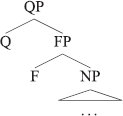
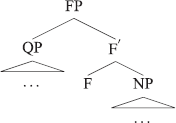
Despite a great deal of disagreement in the literature regarding the exact details, there seems to be an overwhelming consensus that the structure in (21) is a better representation of the position of the quantifier than (22). Since the middle of the 1980s, many studies of the syntax of Semitic noun phrases have proposed that quantifiers are structurally higher than NP. Among these are Ritter (Reference Ritter1991), which proposed that Hebrew quantifiers are heads of the functional projection NumP which dominates NP; Shlonsky (Reference Shlonsky1991), which argued that Hebrew and Arabic quantifiers are heads of QP dominating NP; Benmamoun (Reference Benmamoun1999), according to which quantifiers in Arabic are generated as heads of QP, with a genitive DP specifier, where head movement subsequently raises Q into a higher head position; and more recently, Shlonsky (Reference Shlonsky2004), which states that universal and partitive quantifiers in Semitic languages should be analyzed as heads of high functional projections (above DP).
Much of this is due to the fact that many QNPs in Semitic have the form of a construct state. Despite the lack of consensus regarding the exact structure of construct state nominals, it is widely assumed that the first element in a construct is a head, followed by an embedded genitive DP (see e.g. Ritter Reference Ritter1991; Siloni Reference Siloni1997, Reference Siloni, Pica and Rooryck2001; Borer Reference Borer, Johnson and Roberts1999). For non-QNP constructs, semantic interpretation shows this in an extremely transparent manner, as the second element in a construct is either an argument or a possessor of the first element, which is the lexical head of the entire phrase:
- (23)
(a) hacagat ha-uvdot
presentation def-facts
‘the presentation of the facts’
(b) horey ha-yeled
parents def-boy
‘the boy's parents’
In the case of QNP constructs, while the semantic relation between the Q and the noun that follows it is quite different from the relation in nominal constructs like (23) above, the syntactic properties seem to be essentially the same. For instance, neither can be preceded by the definite article:
- (24)
(a) (*ha-)marbit ha-talmidim
def-majority def-students
‘the majority of the students’
(b) (*ha-)horey ha-yeled
def-parents def-boy
‘the boy's parents’
Similarly, neither allows a modifier to come between the first element and the second: modification of the first element of a construct state can only be achieved by placing the modifier after the second element:
- (25)
(a) maxacit (*ha-rišona) ha-kurs (ha-rišona)
half def-first def-course def-first
‘the (first) half of the course’
(b) horey (*ha-ge‘im) ha-yeled (ha-ge‘im)
Parents def-proud def-boy def-proud
‘the boy's (proud) parents’
In light of these similarities, the null hypothesis is that construct state QNPs have a structure that parallels that of nominal constructs; hence, at least in the case of construct state QNPs, the quantifier is structurally higher than the NP/DP that follows it.
In view of the large number of analyses that take Q to occupy a higher position than N, it is striking that no major works have argued that quantifiers may be lower than NP/DP; and, more importantly, none have argued for a systematic structural ambiguity in Semitic QNPs. The idea that Hebrew quantifiers are not uniform in their syntactic position has been discussed in Danon (Reference Danon and Wyner1998, in press), where it is claimed that quantifiers in construct state QNPs are heads that occupy a higher position than the maximal projection of the noun, whereas quantifiers in simple non-construct state QNPs are specifiers.Footnote 11 But even according to this proposal, there should be no ambiguity – every surface type of QNP corresponds to just one underlying structure. For the class of QNPs that allow both N-agr and Q-agr – namely, construct state and partitive QNPs – this analysis attributes only a structure where Q is higher than NP. Overall, from the perspective of previous works on Semitic QNPs, any proposal for an ambiguity in QNPs would have to be supported by providing new empirical evidence that has not been noticed before.
The discussion in this section has focused so far mostly on construct state QNPs, as this type of QNP has received much more attention in the literature on Hebrew QNPs than partitives have. But strong evidence against structural ambiguity for construct state QNPs is also indirect evidence against adopting the structural ambiguity hypothesis for partitives. As shown in Section 2.1 above, the N-agr/Q-agr alternation is a cross-construction phenomenon, which occurs both with me-partitives and with construct states headed by a quantifier. In fact, it seems that the alternation between N-agr and Q-agr is totally insensitive to the distinction between these two types of QNP. This means that if we pursued an analysis of the agreement alternation in terms of structural ambiguity, this analysis would have to be general enough to apply to both types of QNPs, and still account for the fact that in all other respects, QNPs triggering N-agr behave just like those triggering Q-agr, showing no difference in word order, phonological phrasing, extraction possibilities, etc. In this respect, the theoretical price for adopting an ambiguity analysis seems to be particularly high.
We conclude that unless strong evidence to the contrary can be found, lack of structural ambiguity in alternating QNPs is the null hypothesis. The alternative, which will be pursued here, is a feature-theoretic analysis in which the two agreement patterns (and hopefully also the subtle semantic effects associated with them) follow from a single hierarchical structure, with a different distribution of features associated with each of the agreement patterns.
4. Towards an analysis
4.1 N-agr as successive agreement: Previous proposals
In the previous sections we have seen that, given the existing evidence that Q occupies a higher head position than N, represented schematically as in (4), the possibility of N-agr raises the following questions:
Locality: How can T agree with the lower NP, ‘skipping over’ the higher QP?
Case: How can T agree with an NP that is not nominative?
I start by briefly noting a family of analyses not based on structural ambiguity that have been proposed in some previous works on other languages; while none of these analyses can account for the Hebrew data under the formulations proposed so far, certain insights from these analyses are in fact present in the proposal that I eventually argue for.
If N-agr is indeed found in cases where NP is non-nominative and is embedded under QP, one way to overcome the locality and case problem is to assume that what looks like direct agreement between T and NP is in fact the result of two successive local agreement operations. This approach is explicitly proposed in LeTourneau (Reference LeTourneau and Mushira1995). LeTourneau argues that in Standard Arabic, there is optional agreement – which he analyzes as feature sharing – between Q and NP/DP in a construct state QNP. When this agreement takes place, subsequent agreement between T and the entire QNP (headed by Q) gives the impression of agreement between T and N. Alternatively, as the Q–NP agreement step is claimed to be optional, lack of agreement leads to Q bearing default features, with which T subsequently agrees. In both cases, T in this analysis agrees with the entire QNP, hence avoiding both the locality problem and the case problem raised by N-agr. Somewhat similar ‘percolation’-based analyses of Russian QNP agreement can be found in Franks (Reference Franks1994) and Bošković (Reference Bošković and Boeckx2006). The latter work, for instance, proposes an analysis in which N-agr is in fact agreement with the QP, whose features happen to match those of the N.Footnote 12 Following the hypothesis that agreement and case are tightly related, Bošković claims that when there is no agreement (default agreement) this follows from lack of a case feature on QP.
While this line of analysis nicely overcomes the theoretical problems discussed so far, trying to apply it to Hebrew, we encounter two new problems. First, as in the case of the structural ambiguity approach of Pesetsky (Reference Pesetsky1982) and Franks (Reference Franks1994), the fact that no default agreement is possible in Hebrew undermines the whole goal of these analyses: as the ‘failure to agree’ option is not attested in Hebrew, one of the two patterns which these approaches try to account for is not relevant to an analysis of this language.
The other side of this coin poses an additional problem with trying to adapt this kind of analysis for Hebrew: the existence of the Q-agr pattern, which is apparently the one which requires no special explanation, means that in Hebrew, Q and N may have different features. This means that an analysis of N-agr based on forming a simple two-step agreement ‘chain’ does not seem to straightforwardly work for Hebrew, as it seems that the ‘percolation’ step should be blocked if Q has its own lexically-specified features.
In order to make a successive-Agree analysis of this kind work for Hebrew, what is needed is a way to let the features of NP be copied to QP while co-existing with Q's lexically-specified features. In other words, what we need is for QP to have two separate feature sets.
While, to the best of my knowledge, the possibility of a single syntactic head carrying two sets of ϕ-features has not been proposed in the Minimalist literature, this idea is in fact quite familiar in the HPSG literature.Footnote 13, Footnote 14 In next section, I briefly summarize the main points of this proposal, which will be relevant for the analysis of QNP agreement proposed in Section 5.
4.2 index and concord features
Perhaps the most direct piece of evidence in favor of the hypothesis that NPs carry not one, but two, sets of agreement features comes from the phenomenon of split (mixed/hybrid) agreement found with some nouns in languages such as Serbo-Croatian. Wechsler & Zlatić (Reference Wechsler and Zlatić2000, Reference Wechsler and Zlatić2003) discuss examples like the following, with the aggregate noun deca ‘children’, which is morphologically feminine singular but semantically plural:
(26) Ta dobra deca su došla.
that.f.s good.f.s children.f.s aux.3p come.pprt.n.p
‘Those good children came.’ (Wechsler & Zlatić Reference Wechsler and Zlatić2000: 816)
The agreement in this sentence raises the question what is the gender/number of the noun deca: on the one hand, based on the agreement on the demonstrative and on the adjective, we may want to claim that this noun is feminine singular; but on the other hand, based on the agreement on the auxiliary and on the participle, we may claim that it is neuter plural. Similar examples can be found in other languages. In Biblical Hebrew, for instance, the noun ʕam ‘people’ triggers singular agreement on demonstratives and adjectives, but may simultaneously trigger plural pronominal agreement:
(27) … hineni maʔaxil-am ʔet ha-ʕam ha-ze laʕana…
aux.1s feed-them.m.p om def-people def-this.m.s wormwood
‘… I will feed this people wormwood…’
Following earlier proposals by Pollard & Sag (Reference Pollard and Sag1994) and Kathol (Reference Kathol, Levine and Green1999), Wechsler & Zlatić (Reference Wechsler and Zlatić2000, Reference Wechsler and Zlatić2003) propose that the solution is that an NP carries not one, but two sets of syntactic agreement features, referred to as index and concord features:
• Index features constrain the NP's referential index, and are relevant to pronoun binding and subject–predicate agreement.
• Concord features are more closely related to the noun's morphology, and are relevant to NP-internal concord.
According to Wechsler & Zlatić (Reference Wechsler and Zlatić2000, Reference Wechsler and Zlatić2003), several constraints typically apply to index and concord features:
• index-concord: index and concord features match each other.
• index-semantics: index features match the noun's semantics.
• concord-declension: concord features match the noun's morphology.
In the typical case, all three constraints apply, giving rise to ‘consistent’ NPs for which there is no direct evidence for the existence of two distinct sets of features. But for ‘exceptional’ nouns, not all of these constraints apply, and this gives rise to various kinds of mismatches. Hence, for instance, Wechsler & Zlatić (Reference Wechsler and Zlatić2000, Reference Wechsler and Zlatić2003) propose that the split agreement case illustrated in (26) above involves an index-concord mismatch. In this case, concord features are reflected in NP-internal agreement and in the noun's morphology; as in other cases of index-concord mismatches, evidence for the value of the NP's index features comes only from the agreement that it triggers.
In addition to accounting for the behavior of such ‘hybrid’ nouns, the index-concord hypothesis has been used in analyses of NP-internal coordination (King & Dalrymple Reference King and Dalrymple2004), numeral–noun constructions (Mittendorf & Sadler Reference Mittendorf, Sadler, Butt and King2005), polite pronouns (Wechsler Reference Wechsler2011), and other phenomena. Below I show how this hypothesis can be applied for the analysis of QNP agreement.
5. An index-concord analysis of QNPs
5.1 Overview of the analysis
The main difficulty demonstrated in Section 4.1 above with applying a feature percolation analysis of N-agr to the Hebrew facts is that the percolating features had to somehow co-exist with the lexical-morphological features of the quantifier. The index-concord hypothesis provides an immediate solution to this problem. In fact, Wechsler & Zlatić (Reference Wechsler and Zlatić2003) (henceforth WZ) discuss the QNP agreement facts in Serbo-Croatian in the context of this hypothesis and propose an analysis which, with slight modifications, forms the basis for the analysis of the Hebrew data to be proposed below. However, as the agreement data in Hebrew differs from the Serbo-Croatian data in being sensitive to more factors and in allowing a greater degree of variation, our goal in this section is not only to show how WZ's index-concord distinction makes it possible to formally encode feature ‘percolation’ (and hence, N-agr) in a way that is compatible with the Hebrew facts, but also to extend WZ's analysis to account for a richer set of constraints than what was covered in WZ's original analysis.
The main points of the analysis to be discussed can be summarized as follows:
• Subject–verb agreement (in Hebrew) is always index agreement with the QNP. Thus, even ‘N-agr’ involves no direct agreement relation between T and N/NP.Footnote 15
• Following WZ, the QNP's index features (which are the same as those of its head, the Q) do not always match the Q's concord features. Specifically, N-agr (as well as ‘semantic’ agreement) is the result of such a mismatch.
• Different agreement patterns follow from different mechanisms for assigning values to the QNP's index features. While the grammar itself has no preference for one mechanism over another, the resulting structures differ in their feature composition in a way that might be relevant at the interface with semantics.
While the basic mechanism of this analysis is based on WZ's analysis of Serbo-Croatian, it differs from it in two crucial respects. At an empirical level, I focus on the analysis of Hebrew alternating quantifiers, which contrasts with the more rigid Serbo-Croatian pattern where certain quantifiers trigger Q-agr and others trigger default agreement. At a theoretical level, I propose a derivational analysis based on the Minimalist operation Agree, which I claim allows for the elimination of certain stipulations that are needed in WZ's HPSG analysis of N-agr in non-standard Serbo-Croatian.
Let us assume that a quantifier's concord features, if any exist (i.e., if the quantifier has any morphologically-supported gender and number), are fixed in the lexicon. Unlike (the vast majority of) nouns, whose index features always match their concord features, I propose that this is optional for quantifiers. Thus, one possibility is for a Q's index features to also be determined pre-syntactically, in the lexicon, as matching its concord features. Consider a structure like the following:
(28)
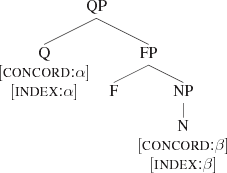
The derivation in this case would thus proceed as follows:
(i) Q enters the derivation with lexically-specified index features which match its concord features.
(ii) The QNP gets the index features from its head, Q.
(iii) T agrees with QNP, giving rise to T carrying the same features as those specified in the lexicon for the Q.
Thus, this derivation results in the Q-agr pattern. Obviously, there is no locality or case problem: what the T agrees with is the entire (nominative) QNP's index features.
An alternative derivation, however, is the one in which Q's index features are not specified in the lexicon. I propose that this possibility is one of the things that characterize quantifiers, perhaps in virtue of their non-referential semantics.Footnote 16 In this case, these features would have to be valued via agreement. Thus, prior to any Agree operation we would have the following structure, where ‘[index:??]’ stands for unvalued index features:
(29)
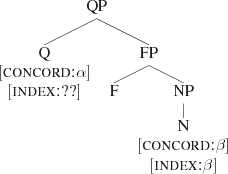
The derivation in this case would proceed as follows:
(i) Q enters the derivation with unvalued index features.
(ii) The index features of the Q probe for the INDEX features of NP (=‘percolation’).
Following this Agree operation, Q's INDEX features might not match its concord features.Footnote 17
(iii) The QNP gets the INDEX features from its head, the Q.
(iv) T agrees with QNP.
Thus, the result is what we have been referring to as N-agr. However, the impression of agreement with the more deeply embedded, non-nominative NP is just apparent. Because of the two-step ‘percolation’ process, there is no locality or case problem with this derivation, as T agrees once again with the index features of the entire (nominative) QNP.
We thus have a relatively straightforward analysis, in which the only factor distinguishing between the N-agr and Q-agr patterns is the source of Q's index features, which are valued either in the lexicon (i.e., pre-syntactically) or in the syntax, via agreement. Unlike the analysis of Wechsler & Zlatić (Reference Wechsler and Zlatić2000, Reference Wechsler and Zlatić2003), in which identity between index and concord (and hence, Q-agr) is the default option, in the derivational analysis proposed above there is no default. Empirically, this seems to be supported by the fact that there is no general preference for either N-agr or Q-agr in Hebrew.
Beyond the fact that the proposed analysis requires little more than the index/concord dichotomy, which is independently motivated by the existence of mixed/split agreement constructions, it has a number of other desirable properties. First, it allows us to maintain a uniform analysis for subject–verb agreement itself, even for QNPs: under this analysis, it is always index agreement with the entire nominative QNP, and never with any of its (non-nominative) sub-constituents.
Second, the proposed analysis provides an elegant solution to one of the puzzles of QNP agreement alternations, namely, its partial dependence on the syntactic type of QNP being used. As noted in Section 2.1, agreement alternations are found in Hebrew in two distinct types of QNPs, partitive and construct state, but not in ‘simple’ QNPs of the quantifier–noun type, which allow only N-agr:Footnote 18
(30) hamon be‘ayot niš‘aru/*niš‘ar lelo pitaron.
very.much.m.s problems.f.p remain.p/remain.m.s without solution
‘A lot of problems remain without a solution.’
The fact that Q-agr is possible for partitive and construct state QNPs follows from our analysis under the plausible assumption that in both of these structures QP dominates NP; the fact that the internal structure of Q's complement is different in each of these QNP types is irrelevant for Q-agr. As to N-agr, both structures make it possible for Q with unvalued index features to probe for NP's features, since in both of these, NP is the closest XP bearing index features which is c-commanded by Q. In contrast, the fact that simple Q–N constructions like (30) above do not allow Q-agr follows from the hypothesis that in such constructions, the quantifier is a specifier and not the head of the QNP, as argued in Danon (Reference Danon and Wyner1998, in press). Schematically, (30) would have a structure like the following, where FP stands for any functional projection(s) that might be present above NP (e.g. DP and/or NumP):
(31)
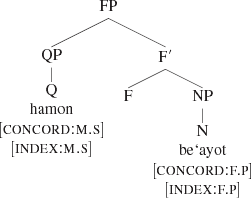
Assuming that the features of NP are shared by its maximal extended projection FP (see e.g. Danon Reference Danon2011), N-agr with such QNPs is the result of an Agree operation between T and FP; unlike in the alternating QNP types, the features of QP are irrelevant since they are not accessible to T. Overall, the ‘unselective’ Agree model, which requires only local c-command, combined with independently motivated assumptions regarding the position of the quantifier, leads to an analysis that does not require any stipulation about the specific QNP types in which both Q-agr and N-agr are possible.
Finally, because of the ways in which index and concord features are related to semantics, morphology and to each other, the proposed analysis provides a framework for analyzing the effect of interfaces with semantics, morphology and the lexicon on QNP agreement. The issue of the interfaces with other modules of the grammar is crucial at this point: the analysis proposed so far successfully solves the undergeneration problem with which we started, but at the price of what looks like a serious overgeneration; if nothing else is added, the analysis wrongly predicts every partitive or construct state QNP to allow free alternation between N-agr and Q-agr. We thus need to supplement the analysis with additional factors that would constrain the choice of agreement pattern. According to WZ's analysis, morphology is the central factor constraining the alternation in Serbo-Croatian. The role of morphology in Hebrew has already been discussed in Section 2.1.2, where it was shown that having nominal morphology is a necessary but not sufficient condition for licensing Q-agr. In next section I argue that constraints on interpretation also play a major role in determining Hebrew QNP agreement.
5.2 index features and the syntax–semantics interface
So far, little has been said about the function of index features, beyond their role in QNP agreement. Following standard assumptions in the HPSG literature, I assume that index features are not mere symbols, but constraints on a noun phrase's referential index. Furthermore, following standard assumptions in the Minimalist literature, I assume that features valued in the lexicon should be interpretable, as opposed to those that are valued via agreement. Therefore, the choice of whether or not a QNP's index is valued independently of the NP's index should have some effect on interpretation. Specifically, we should expect the alternation between the case in which Q and NP share index features (leading to N-agr) and the case in which each has its own features (leading to Q-agr) to correlate with some observable semantic alternation in the QNP's referentiality.
Two types of cases seem to support this prediction: QNPs headed by quantifiers that alternate between what may be described as referential and quantificational interpretations, and QNPs in which the semantics and/or number of the noun correlates with the choice of agreement pattern, as described in Section 2.1.3 above. We start with the former kind of correlation between agreement and interpretation, in which the quantifier itself is ambiguous. This is illustrated in (32)–(33):
(32) zug studentim ba-texniyon gidlu samim
pair/couple.m.s students.m.p in.def-Technion grew.p drugs
še-yiv'u me-xul.
that-imported from-abroad
‘A pair of students in the Technion grew drugs they imported from abroad.’ (N-agr)
(33) zug studentim šaket mexapes dira.
pair/couple.m.s students.m.p quiet.m.s seeks.m.s flat
‘A quiet student couple is seeking a flat.’ (Q-agr)
The subject in these examples contains the word zug ‘couple, pair’, which in terms of its lexical category is somehow borderline between being a quantifier and being a noun. For most speakers there is a semantic contrast associated with the agreement contrast in (32)–(33): while the dominant reading for (32) (with N-agr) is the one in which zug receives a quantificational reading (roughly equivalent to that of the numeral ‘2’), sentence (33) (with Q-agr) allows only an interpretation in which the subject is taken as a single entity (i.e., a couple).Footnote 19 The index agreement analysis proposed in the previous section provides a simple explanation of these facts. In (32), N-agr entails that the QNP shares its index with the NP, and hence zug receives the non-referential, quantificational, reading (‘2’). In this case there is no syntactically-encoded index corresponding to a couple of students.Footnote 20 In contrast, in (33), there is a unique index associated with zug, giving rise to the ‘identifiable couple’ reading.Footnote 21
This kind of data brings forth the question, which often arises in discussions of QNP agreement (see e.g. Franks Reference Franks1994) of what characterizes the category of quantifiers, which often show properties that could justify classifying them as nouns. Even though the proposed analysis of (32)–(33) corresponds to the intuition that zug is ‘more nominal’ in (33), it captures this idea without referring directly to lexical categories, thus allowing us to avoid the problematic assumption that lexical categories are defined semantically. What the current discussion suggests is that the noun/quantifier distinction hinges, at least in part, on the nature of an element's index features: while both nouns and quantifiers may bear index (as well as concord) features, a quantifier's index is more likely not to be valued in the lexicon, with consequences at the syntax–semantics interface.
The same reasoning could also account for the loss of agreement with certain nouns like min ‘kind, sort’ when used non-referentially in constructions like the following:Footnote 22
(34) hayta li min txuša mešuna.
was.f.s to.me kind.m.s feeling.f.s strange.f.s
‘I had a kind of strange feeling.’
While the noun phrase in (34) has the form of a construct state headed by the masculine noun min, verbal agreement in this case is with the feminine txuša, which under standard assumptions about the structure of construct state nominals is the lexical head of an embedded DP. Applying the same analysis as for QNPs, this could be explained as being the result of min lacking in this case independent index features and sharing the same index as the referential noun that follows it. Thus, while normally nouns would enter the derivation with index features valued to match their concord features, certain nouns used modificationally may enter the derivation with unvalued index, which would then be valued via agreement with a structurally lower noun phrase. The generalization that seems to emerge is that a referential head enters the derivation with its own valued index features, while a non-referential head (whether quantificational or not) may carry index features that are valued via agreement.
Another class of cases which seems to support the semantic predictions of the index agreement analysis involves contrasts between QNPs with singular nouns and those with plurals. Consider the following pair of examples, in which N-agr is judged as marginal with the singular count noun in (35), as opposed to the plural in (36):
(35) xeci me-ha-mexonit nirtav/??nirteva.
half.m.s of-def-car.f.s got.wet.m.s/got.wet.f.s
‘Half of the car got wet.’ (Q-agr/??N-agr)
(36) xeci me-ha-anašim *nirtav/nirtevu.
half.m.s of-def-people.m.p got.wet.m.s/got.wet.p
‘Half of the people got wet.’ (*Q-agr/N-agr)
This contrast in acceptability correlates with a semantic contrast: the salient reading of the fully grammatical Q-agr option in (35) is that in which it refers to some identifiable half of the car (the left half, the front half, etc.). In contrast, the salient reading of (36) with N-agr is the ‘true’ quantificational one (‘the number of people who got wet is half the total number of people’). Under the proposed analysis, distinct and interpretable index features are found on the Q only in the case of Q-agr, which in this example is only where the ‘identifiable half’ interpretation is observed. The grammaticality of Q-agr in (35) is therefore expected given the QNP's interpretation. Furthermore, the fact that N-agr is marginal in (35) is therefore not accidental: for N-agr to be grammatical, it must be possible to quantify over the singular count noun – an interpretation that might require some sort of type shifting or ‘grinding’, which is not required in the fully grammatical plural quantification in (36). Finally, Q-agr in (36) would require the unlikely interpretation of the subject as some identifiable half that has its own referential index.Footnote 23
More generally, this line of analysis might also account for the data discussed in Section 2.1.3 above, such as the contrast between (12) and (13), where a QNP with the plural noun našim ‘women’ favors N-agr, in contrast to the singular collective noun oxlosiya ‘population’ which is acceptable also with Q-agr; under the proposed analysis, Q-agr favors the ‘identifiable part’ interpretation, which is much more natural with a collective singular like the English population than with a plural like women, where the part would have to be ‘packaged’ for Q-agr to be meaningful. However, as type shifting operations of this kind are grammatically available, the proposed analysis also predicts the fact that the choice between N-agr and Q-agr is often merely a weak preference, not a categorial difference in grammaticality.
It is beyond the scope of the current paper to fully develop this semantic analysis, but I believe that an analysis along these lines could go a long way towards accounting for some of the subtle semantic consequences of the N-agr/Q-agr alternation. Overall, the data above shows that the choice between a lexically valued index and syntactically valued one is not semantically vacuous. Hence, in contrast with the discussion of QNP agreement in Wechsler & Zlatić (Reference Wechsler and Zlatić2003), which attributes the choice of agreement pattern only to lexical-morphological factors (perhaps due to the nature of the alternation in Serbo-Croatian, which is indeed mostly fixed on a lexical basis), the Hebrew data shows that the alternation is also dependent on requirements of the syntax–semantics interface.Footnote 24
5.3 Cross-linguistic variation
While the discussion so far has centered around analyzing the Hebrew data, one cannot ignore the fact that the availability of the four different agreement patterns (Q-agr, N-agr, semantic agreement and default agreement) varies significantly from language to language. We are now at a position to assess how much of this variability can be predicted.
The first factor that could affect the availability of the different agreement patterns is the internal structure of QNPs. Q-agr, in my analysis, depends on having the Q in a position where it c-commands NP. Therefore, in a language where quantifiers consistently occupy a specifier position within the noun's extended projection, Q-agr is predicted not to be available. Under the assumption that Universal Grammar allows more than one possible structure for QNPs (as evidenced even from looking at just one language, Hebrew, which has three different QNP types as discussed above), we predict this factor to affect at least the availability of the Q-agr pattern. For a discussion of cross-linguistic variation in the position of numerals, which can probably be extended to cover variability in the position of other quantifiers, see Danon (in press).
The second factor, which in the analysis of Wechsler & Zlatić (Reference Wechsler and Zlatić2003) is taken to be the central one, is the morphological declinability of the quantifier. As concord features are tightly related to morphology, a language where quantifiers have no morphologically-triggered features is predicted not to allow Q-agr. Beyond being a cross-linguistic parameter, this also serves as an important language-internal factor (which is in essence how it is presented by WZ). Thus, for instance, this straightforwardly explains why Russian allows Q-agr with those quantifiers that are morphologically more ‘nominal’ (Pereltsvaig Reference Pereltsvaig2007).
As for default agreement, the question is whether this should be analyzed as actual agreement between T and a QNP whose index carries default values (e.g. neuter singular in a language like Serbo-Croatian), or as default specification of values on T which results from a failure to agree with a QNP that lacks index features.Footnote 25 Both of these approaches have been proposed in the literature on Slavic languages: the former, by Franks (Reference Franks1994), and the latter, by Wechsler & Zlatić (Reference Wechsler and Zlatić2003). As it turns out, both of these approaches seem to be compatible with the Minimalist analysis proposed in this paper. Modeling the first of these two approaches is straightforward and requires no special assumptions: if certain quantifiers are lexically specified as carrying default index values (e.g. if certain Serbo-Croatian Qs have a neuter singular index), then the derivation of default agreement is reduced to a special kind of Q-agr; this predicts that there should be no QNPs that alternate between default agreement and ‘regular’ Q-agr – a prediction that seems, at least for the languages surveyed, to be correct.
The second approach to default agreement, as failure to agree due to a Q's lack of index features, is slightly less trivial to incorporate into the current analysis. If Q lacks index features, it might seem that when T probes for such features it would simply find those of NP, giving rise to N-agr rather than to default agreement. This analysis can be ‘rescued’, however, by noting that default agreement systematically involves a genitive-marked noun. Under Minimalist assumptions, once an NP's case feature has been valued, the NP is no longer active as a goal for agreement. As a result, if NP has received genitive case, T is not expected to enter an Agree relation with it even if Q lacks index features. In conclusion, the proposed analysis seems capable of deriving default agreement under either of the two approaches cited above. I therefore leave the choice between these two analyses as an open question.
Finally, the possibility of accounting for the presence or absence of semantic agreement is much less clear. In the current model, semantic agreement could be analyzed as a semantically-based specification of index features of the QNP. In this respect, it is not really the agreement that is semantic, but the pre-agreement feature specification of the subject – a hypothesis that has the desirable consequence that agreement itself (at least in the case of QNPs) is always syntactic. Availability of ‘semantic agreement’ would then depend on the extent to which the language allows semantic factors to determine INDEX features. This is a poorly understood issue, which comes up also in the context of accounting for the availability of ‘semantic agreement’ with collective nouns (committee, family, etc.), pluralia tantum noun (scissors, etc.), and more.
The above is just an overview of how the proposed analysis could deal with some of the cross-linguistic variation in the area of QNP agreement. Putting aside Basque, we may now summarize the properties of the languages surveyed in Section 2.2 as follows (where the exact meaning of ‘default index’ depends on the choice between the two analyses discussed above):
• Standard Arabic: Q enters the derivation either with unvalued index, giving rise to N-agr, or with default index, giving rise to default agreement.
• Russian: For ‘non-nominal’ Q, the options are just like for Standard Arabic; for ‘nominal’ Q, the options are the same as for Hebrew, i.e., entering the derivation either with unvalued index or with index valued to match concord.
• Serbo-Croatian: Some quantifiers must enter the derivation with index matching concord, giving rise to Q-agr, and some must enter the derivation with default index, giving rise to default agreement.
We thus see that cross-linguistic variation among these languages is reduced under this analysis mostly to the lexicon, where different quantifiers allow different lexical specifications of their index features. The model proposed in this paper therefore provides the means to deal with much of the variation in QNP agreement in a principled manner, without having to stipulate syntactic agreement rules on a language-by-language basis.
6. QNP agreement and Minimalist feature theory
As the discussion above should make clear, the analysis of QNP agreement proposed in this paper is in many ways an elaboration on the work of Wechsler & Zlatić (Reference Wechsler and Zlatić2000, Reference Wechsler and Zlatić2003). One important theoretical difference is, however, that in contrast to the works of WZ, which have been formulated within the non-derivational, constraint based, HPSG framework, the current analysis is formulated within the Minimalist framework. One advantage of an analysis based on the Minimalist operation of Agree is that it makes it possible to derive N-agr with no need to stipulate a special (and optional) rule of Q–NP agreement: the only thing that is stipulated in the current analysis is that the index features of Q are optionally not specified in the lexicon, thus making use of the general Minimalist notion of unvalued features, and as the discussion in Section 5.2 tried to show, even this ‘stipulation’ might be derived from deeper principles.Footnote 26 In contrast, the analysis of Wechsler & Zlatić Reference Wechsler and Zlatić2003 encodes the ‘percolation’ step required for N-agr as part of the lexical sign for quantifiers triggering this agreement pattern. While the HPSG framework limits the possibilities of what kinds of agreement relations can be encoded in this way, it is still not clear whether this (restricted) stipulation can be eliminated from WZ's analysis.
While the Minimalist analysis offers the advantage of reducing stipulation and constructions-specific principles to a minimum, care must be taken to ensure that all other aspects of the analysis are indeed compatible with the mechanics of Minimalist feature theory. Specifically, two issues that need to be addressed for the proposed analysis to be applicable are the formal characteristics of features, and the notion of feature deletion.
6.1 Complexity in the feature system
As the index-concord analysis of QNP agreement alternations places most of the burden on the feature content of Q and N, it is important to verify that the expressive power of Minimalist feature theory is sufficient for encoding this analysis. Specifically, for the analysis of N-agr in terms of index agreement between Q and NP, we want to be able to say things like:
Informal statement: In a QNP where the noun is plural, the quantifier may carry an index plural feature simultaneously with a concord singular feature.Footnote 27
This means that the grammatical formalism must allow for two separate number features on the same head. This raises certain technical problems, where the kind of solution depends in many ways on what is meant by the term ‘feature’. Below I discuss several ways of dealing with this, and argue that these technical issues highlight an area of Minimalist syntax which is in need of a more sophisticated formalism than what is usually implicitly assumed.
The simplest notion of feature that can be represented formally is a privative (monovalent) feature, i.e., an atomic symbol which is either present or absent. Clearly, in a model where a syntactic node carries a set of privative features, allowing plural and singular to co-exist on the same node would lead to meaningless or contradictory representations if nothing distinguishes the two features from each other.Footnote 28 If a system of privative features is enriched with a feature geometry, as, for instance, in Harley & Ritter (Reference Harley and Ritter2002) or Béjar (Reference Béjar2003, Reference Béjar and Harbour2008), the index/concord distinction could be encoded as two distinct branches of the geometry, hence allowing two distinct number (and gender) features to co-occur on the same element. Note, however, that having two number branches/sub-trees and two gender branches, in addition to the branches already assumed in such geometries for other reasons, would raise some non-trivial questions regarding the overall organization of a feature geometry. Further complications might arise from the need to ensure that in any given agreement relation, only one of the two ‘parallel’ branches is visible as an agreement target. I leave it as an open question whether such a complex geometry can be empirically and theoretically justified.
Another formal view of features is as functions from (atomic) attributes to values. Under this view, there is no way to have a number feature with two simultaneous values. One technical way to avoid this problem would be to use two different attribute names for the two number features. Thus, something like [numberI plural] and [numberC singular], using two different feature labels, would not be a contradictory representation (see e.g. Pereltsvaig Reference Pereltsvaig2006). The problem with this approach, however, is that, if nothing else is added, it would lead to a grammar that does not explicitly express the fact that both of these are number features, instead leaving this fact as an implicit ‘understood’ property of the formulation of the analysis. The only way to make such an approach fully explicit would be to augment it with a module (outside of narrow syntax) to express relationships and dependencies between different features. This might perhaps be done along the lines of the ‘Feature Co-occurrence Restrictions’ of the GPSG framework of Gazdar et al. (Reference Gazdar, Klein, Pullum and Sag1985); or, simply, by explicitly specifying as part of the grammar all the possible values of each feature, hence grouping together the two number features by virtue of having the property of allowing the same possible values (which would mean that this approach is not compatible with a grammar based on binary features, where all features can have the values ‘ + ’ or ‘–’).Footnote 29
A third way to express the index/concord distinction would be to enrich the attribute–value model of features to use complex features, as in the HPSG and Lexical-Functional Grammar (LFG) formalisms, by not limiting values to being atomic symbols but allowing values that are themselves sets of attribute–value pairs. Such a formal model of features would make forming an explicit and coherent representation of multiple agreement features quite straightforward, as there is no incompatibility or contradiction between [index [number plural]] and [concord [number singular]]; in this representation, the fact that both of these are number features is stated explicitly. We should note, on the other hand, that even under this approach, the amount of complexity in the feature system that is required in this case is quite minimal. Specifically, the problem of QNP agreement does not seem to require unlimited recursion in the feature system, of the type used in HPSG and LFG, but only a fixed amount of structure. Thus, what is proposed here does not entail turning Minimalism into something like a derivational version of HPSG, but merely adopting one specific formal detail that is used in the latter framework into the former. It should also be noted that this kind of structure within the feature system is, in fact, already implicit in most Minimalist analyses that involve rules that refer specifically to the cluster of ϕ-features, as opposed to all other features; the degree of complexity that is argued for here would also allow for this kind of ‘clustering’ of features to be formally and explicitly expressed with no need for any additional machinery.
The conclusion from the above discussion is that expressing an index-concord analysis of QNP agreement in a fully explicit manner requires something beyond a simple view of features as unstructured sets of symbols – a feature geometry, a grammar which is augmented by some additional system that would state relationships between features that have distinct labels in their syntactic representation, or a system of complex features. As all of these options have indeed been explored and shown to be useful under various formalisms, I do not think that this conclusion points to a weakness of the proposed analysis of QNPs, but rather that the analysis points to an area where Minimalist feature theory is still in need of more careful elaboration. As the discussion above shows, however, there might be some problems with an implementation of the proposed analysis using one of the first two options – a feature geometry or a set of superficially distinct feature labels. An analysis in terms of complex features (each with a set of sub-features), on the other hand, seems to raise no major issues, and this is in fact the approach that was assumed (implicitly) in Section 5 above. Adopting this approach would of course require modification to the exact formulation of Minimalist operations such as Agree, in order to allow a Probe to ‘look inside’ a node in order to find a Goal which is not a top-level feature. I leave the task of providing a formal definition of such a revised Agree model for future research.
6.2 The mechanism of agreement
Another issue that should be considered in order to make the proposed analysis work has to do with the mechanism of feature valuation. According to Chomsky (Reference Chomsky, Martin, Michaels and Uriagereka2000, Reference Chomsky and Kenstowicz2001), following successful Agree, the features of the probe are deleted and are no longer available for further operations. This, however, poses a problem for the proposed analysis of N-agr. Assume that N-agr is the result of index agreement between Q and NP:
(i) Q enters the derivation with unvalued index features.
(ii) Q's index features are valued by Agree with NP's index features.
(iii) T's (index) features are valued by Agree with the QNP's index features.
The problem with this derivation is that if Q's features are deleted after the second step, as expected under Chomsky's formulation of the Agree operation, they should not be available as goals for T's features in step (iii). More generally, deletion following Agree seems not to be compatible with any kind of bottom–up feature percolation analysis.
However, there is an alternative view of the operation Agree, under which this problem does not arise. According to Frampton & Gutmann (Reference Frampton, Gutmann and Boeckx2006) and Pesetsky & Torrego (Reference Pesetsky, Torrego, Karimi, Samiian and Wilkins2007), Agree is a feature sharing operation rather than feature copying, and, what is crucial to the current discussion, these authors argue that features are not deleted following Agree, but remain present on all nodes on which the features are shared, with various interface conditions determining where each feature is to be interpreted.
Under this formulation of Agree, the proposed analysis of N-agr is straightforward:
(i) Q enters the derivation with unvalued index features.
(ii) Q and NP agree (share index features)
(iii) T and QNP agree (share index features)
Thus, using feature sharing, the apparent non-local agreement between T and N can be accounted for as a sequence of two local agreement (feature sharing) operations that leads to a three-element index chain (T, QNP, NP), thus providing a formal account in current Minimalist terms of the intuition that N-agr involves some sort of upwards feature percolation. We hence conclude that the patterns of QNP agreement provide additional evidence in favor of the feature sharing model of Agree as opposed to the copy-and-delete model.
7. Conclusion
This paper has argued that the facts of Hebrew QNP agreement, which seem at first to pose a real problem to the hypothesis that agreement is subject to constraints on locality and case, can in fact be shown to be compatible with these constraints if one adopts some sort of upwards feature percolation analysis of N-agr. This, in turn, was shown to require the use of two distinct sets of agreement features which co-exist on the same node. Thus, if, as I have claimed, there is no structural ambiguity in alternating QNPs, analyzing N-agr requires the theoretical framework to allow a certain amount of complexity in its feature system – either by using complex features, where sets of features can be ‘embedded’ as values of other features or as dependents in a feature geometry, or by augmenting ‘narrow syntax’ with an ‘external’ system specifying constraints on what values each feature can take. While this analysis does incur a certain theoretical ‘price’ in terms of the complexity of features, this allows us to maintain other central hypotheses about agreement for which otherwise the data under consideration might seem to pose a counterexample.
A second general theoretical conclusion has to do with the model of agreement and feature valuation. I have shown that for the proposed analysis to work, an index feature on a QNP must not be deleted after it has been valued by agreement with the lower nominal. This, in turn, supports the recently proposed feature sharing formulations of Agree, which make it possible to implement the analysis of N-agr without running into the problems that arise if this analysis is implemented using Chomsky's (Reference Chomsky, Martin, Michaels and Uriagereka2000, Reference Chomsky and Kenstowicz2001) model of Agree as copying and deletion.
Even though the motivation for the proposed analysis was based purely on syntactic considerations, it naturally leads to interesting questions regarding feature interpretability. Assuming a distinction between index and concord features, the question that arises under a modular model of grammar is where each of these features is interpreted. The natural hypothesis, which mirrors the role of these features in the HPSG framework, is that index features are interpretable at the syntax–semantics interface, while concord features can only be interpretable at the syntax–morphology interface. This implies that either ‘interpretability’ cannot be defined as only ‘LF interpretability’ or that all concord features – and not only Case (which has not been discussed in this paper, but is classified as a concord feature in the HPSG literature) – are uninterpretable. Either way, the distinction between the two types of features might lead to a more structured account of the ways in which features are mapped from syntax to other modules, with each of the two feature clusters acting in a uniform manner.


