THE SCTS LIBRARY SERVICES
The Scottish Courts and Tribunals Service (SCTS) library team manage physical and digital resources across all the SCTS sites in Scotland. The team deliver services dealing with legal research, enquiries and resource training to both judiciary and court staff.
FOUNDATION
While the Supreme Courts of ScotlandFootnote 1 have been formally in existence since 1534 when the College of Justice was created by James VFootnote 2, the history of the libraries of court is much shorter.
Although materials were held in courtrooms, offices, departments, corridors and cupboards throughout the Court of Session building in Edinburgh and the High Court of Justiciary buildings in Edinburgh, Glasgow and Aberdeen, there was no official library service in existence throughout the history of the courts.
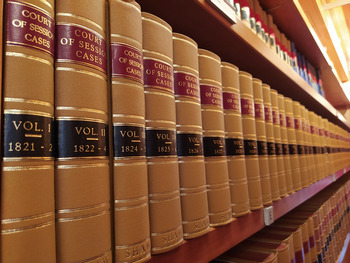
Library shelves with the volumes of the Court of Session Cases.

In the Supreme Courts, where books were kept in a very haphazard manner in over 40 different locations throughout the building, Senators used the Advocates Library and the other membership law libraries in Edinburgh, Glasgow and Aberdeen of which they may have been members. Sheriffs used whichever local membership law library they had available locally throughout the country. Both Senators and Sheriffs often built their own personal collections of law texts, to ensure they had access to suitable materials.
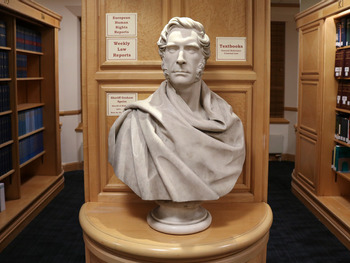
Sheriff Courts Library bust.

In 1984, a request was made for support to assess the materials on the Parliament House site, and the Departmental Librarian of the Lord Chancellor's Department visited to review the existing resourcesFootnote 3. His recommendation was for the creation of a library for the Supreme Courts, staffed by a librarian. The intent was for this librarian to take control of the management of library resources in the Supreme Courts building, and eventually to expand this service to cover all of the court estate.
A temporary assistant librarian was appointed in 1985 to undertake preparatory work for creating a library service, and they too issued a recommendations report, in this case also stating the need for an assistant for the librarian.Footnote 4 At some point, historic items were gathered together from across the courts and formed the basis of the materials held as ‘Special Collections’.
After this, lack of suitable space for a library in the Parliament House building held up development work until an extension of the Supreme Courts into the Cowgate area was built in 1991. In the meantime, the first librarian, Mrs C Harbour, began work in the late 1980s and early 1990s on pulling together materials and creating a catalogue of holdings throughout the Supreme Courts building at Parliament House.Footnote 5, Footnote 6 With some foresight, she began a catalogue immediately in a computerised format, rather than attempt to bring order to the chaos with card files. By 1992 the new Offices of Court building was up and running, and it was formally opened in 1993. Mrs Harbour was replaced as Supreme Courts Librarian in 1993 by M Elizabeth Strachan.
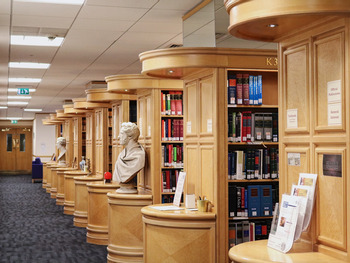
Sheriff Courts Library corridor.

The library space in the new Cowgate extension was not entirely suitable for the library's needs, having replaced in the plans what had been proposed as an office space, and therefore having many awkward layout and lighting issues. A proposed redevelopment of the Exchequer building in the early 2000s provided an opportunity for Ms Strachan to work with the architects to develop a more suitable library space, and the Supreme Courts Library moved into its new purpose-built home in the Exchequer Building in 2003, remaining there ever since. Shortly after, another member of library staff was added to support the librarian, giving a staff complement of two.
RECENT DEVELOPMENTS
Following the retirement in 2014 of Ms Strachan and the subsequent retirement of her assistant Magnus Patterson, the library team was refreshed in 2015 by the arrival of Jennifer Findlay as Supreme Courts Librarian, and Kelly Batzaka as Supreme Courts Assistant Librarian. A systemic review of all practices and procedures in place in the Supreme Courts Library led to a range of redevelopments and expansion of the existing service, and in 2016 it was proposed that the sheriff courts should also be able to benefit from the existence of a similar centralised library service. In late 2016, the business case to create a Sheriff Courts Library Service was approved, and preparation work for the new service began. From late 2016, Jennifer Findlay took on the new role of Library Services Manager for SCTS, with Kayleigh McGarry filling the role of Supreme Courts Librarian.
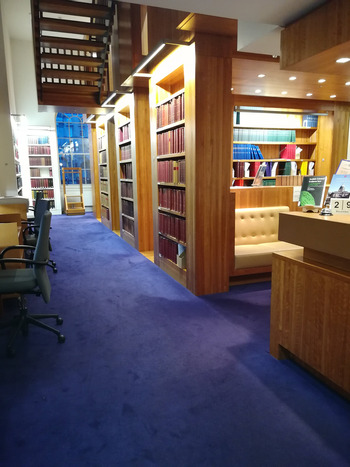
Supreme Courts Library ground floor.

In April 2017, the Sheriff Courts Library Service officially came into being, and was staffed by SarahLouise McDonald as Sheriff Courts Librarian, and Julie McGregor as Sheriff Courts Assistant Librarian. Edinburgh Sheriff Court was chosen to be the main library for the service, and the base for the library team. This new library service began a period of massive change in the sheriff courts, so as to be able to understand what the users needed, the new library staff had to visit and assess each sheriff court site in the country. As there had previously been no centralised control of library purchases in the sheriff courts, these visits could be unpredictable, but one theme was constant throughout: the question “what will we do with these old books?”. With no centralised purchase control, there had also been no centralised authority for disposals, so the team were confronted everywhere by substantial backlogs of outdated materials. The older the building, the more the build-up of random materials that needed dealt with! The Sheriff Courts library team quickly learned how to triage unknown legal book collections, various types of historic materials and assist local staff to manage the library stock on each site.
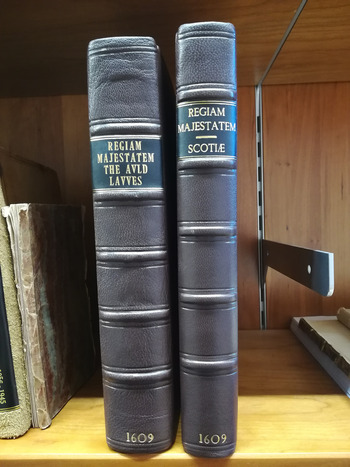
A highlight of the site visits was identifying various items which were added to the ‘Special Collections’ holdings. This included a Latin and Scots copy of the 1609 imprint of the Regiam Majestatem, vellum deeds, old evidence tags, wartime communications of the Offices of Court, and a Hebrew text from the 1540s. These were added to a newly created ‘Special Collections’ area in the Supreme Courts Library, able to be secured against potential environmental threats.
The Regiam Majestatem.

Getting to grips with what was being purchased in the sheriff courts was also a massive task, and it took until October 2017 before preparatory work meant budget control was able to be handed over to the Sheriff Courts library team. The team then had to work with numerous suppliers to create a centralised stock control approach, where the library team were responsible for all aspects of subscriptions management. Some suppliers were more capable of making this change than others, and much staff time was spent in the first year of the service trying to wrestle accurate data out of suppliers, which was matched with on-site data from visits and information supplied by local staff for verification.
The Sheriff Courts library service was finally in a position to fully launch to users in April 2018. This followed many presentations, site visits and one-to-one conversations with staff and Sheriffs. Sheriff Courts library staff had also attended law school introductory evening classes and intensively shadowed and worked with Supreme Courts Library colleagues. This meant that the Sheriff Courts library team were able to start offering the planned legal research and support service to the judiciary and court staff. This service was immediately very popular with the judiciary as it allowed them to focus their pressured and limited time on their core work, knowing that their complex and time-consuming questions could be answered efficiently by trained and experienced legal library staff. Court staff also found the service to be beneficial in supporting them with finding answers to tricky questions that had previously relied on internal knowledge transfer.
CURRENT POSITION
From January 2022 new job titles were introduced to better reflect developing responsibilities, and the relaunch of the department under its new official Library Services title. The Sheriff Courts Library Service is now staffed by Luca Fois as Sheriff Courts Library Service Manager and Fiona Mossman as Sheriff Courts Research Librarian, who together provide a high level of service to sheriff courts users. Kelly Batzaka now leads as the Supreme Courts Library Service Manager, assisted by Sarah Ragg as Supreme Courts Research Librarian, who has experience in both branches of the service. During Ms Batzaka's 2020-21 period of maternity leave Sarah took over as Librarian, and Fiona Mossman joined the team at that point as Assistant Librarian in the Supreme Courts. Fiona took over the Research Librarian role in the Sheriff Courts after her predecessor, Margaret Stephen's, departure. Oversight is provided by Jennifer Findlay, Head of Library and Archive Services. Both teams continue to provide research support, physical and digital stock management, and tailored training to users across Scotland. User feedback is very positive on both branches of the service, with judiciary and court staff appreciating the additional support that Library Services provide for many elements of their work, and how rapidly and comprehensively requests are dealt with. Some of our most memorable recent enquiries include searching on “the admissibility of the sniff” from a cadaver dog in a murder case, whether a company could have feelings, and the history of oaths and affirmations.
THE FUTURE
The remit of the library service in the courts has been significantly expanded since 2015, when the Supreme Courts Library supported only the staff and judiciary of the Supreme Courts. Now, all physical and digital legal resources in SCTS sites are managed by Library Services staff. The two branches of the service together support the judiciary and staff of the Supreme Courts, the Sheriff Courts, the Sheriff Appeal Court (and its associated specialist All Scotland Personal Injury Court), the Scottish Land Court, the Office of the Public Guardian, and specialist bodies such as the Scottish Sentencing Council and the Scottish Civil Justice Council, covering circa fifty sites across Scotland. Incoming Tribunals and the amalgamation of the Scottish Land Court and the Scottish Land Tribunal are expected to happen over the next few years, while specialist courts are proposed to potentially be created in this period too. Together, these varied departments form a current user base of circa 2,000, supported by the staff of four librarians and one service manager, and this user base is likely to increase as proposed changes and integrations progress.
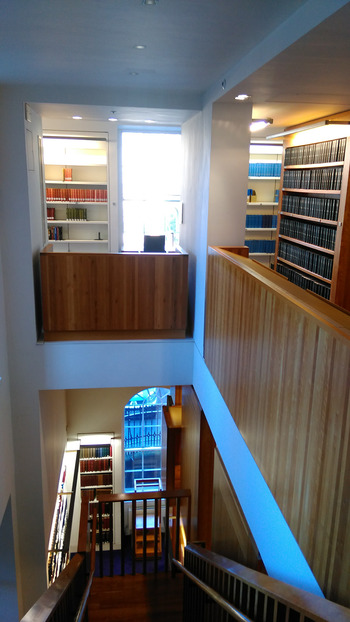
Supreme Courts Library, top and mezzanine floors.

Of course, the pandemic has had a huge effect on the operation of the Library Services department since March 2020. Due to their employment in the justice sector, all court staff, including the Library Services team, were classed as key workers, which meant that with a break of only a few weeks during the early stages of the lockdown, Library Services staff have continued to have a regular presence on site throughout. This has proved invaluable due to the fact that, although suppliers paused delivery during the most restricted periods of lockdown, when these deliveries restarted the massive processing and distribution backlog meant on-site time was primarily spent dealing with accurately managing and distributing these resources. Access to physical materials has continued to be essential to the delivery of the service, as many core Scottish legal materials are either unavailable digitally, or not part of the resources which SCTS has access to. Despite the pandemic, the courts have remained open in some form throughout, with core courts in each region dealing with emergency business during the initial stages of the crisis. For Library Services this has meant still dealing with the various unexpected issues multiple library sites can face such as floods and pests and the resulting aftermath in courts across Scotland, entirely remotely.
The demand for research support from Library Services increased significantly throughout Covid, as the courts were very successful in innovating the use of digital technologies to ensure the continuation of justice throughout the pandemic while remaining compliant with the operational legal framework. Ensuring this compliance required some double and triple checking by multiple teams in different departments to ensure that what was desired to happen was actually legally possible. Identifying the parameters of jury numbers, selection, use and management was a core piece of work during this time. The introduction of virtual court hearings and remote jury centres meant that more resources were being submitted and accessed digitally by the judiciary and court staff, and support for accessing some of these online materials was required from Library Services.
Library Services were also asked to assist with projects that would normally have taken place in person such as the annual Doors Open Days event, when court buildings open their doors to the public to give people the chance to peek inside some of the city's rarely accessed buildings, explore their history and take part in activities. In September 2020, Library Services created online quizzes, mysteries and games, building on this in 2021 with materials such as build-your-own-mace, an investigation into the life of a person named in a historic evidence tag, legal myths, weird laws and building history factsheets, and various recorded talks by academics, library staff and the Lord President. Archival research into the history of various court buildings or court cases also now regularly feature in the enquiry work of Library Services.
Senator Bear.

Clearly, Covid has had a major impact on the type and variety of work Library Services staff are now asked to undertake. Despite the demands of the pandemic meaning planned service developments had to be put on hold, the department is now gearing up to restart these projects. Future plans include a specific Library Services web space to allow users easier access to Library Services resources, a potential oral history project in collaboration with other legal bodies, building closer ties with external specialists such as archivists and academic researchers, and working more closely with other internal teams to identify where the skills of the library team could support both the organisation's objectives, while enabling best management of SCTS's physical and digital resources.